ENG
 Japanese
 French
 German
 Korean

Global Citrus Bioflavonoids Market Size, Share and Forecast 2034
The Global Citrus Bioflavonoids Market was valued at USD 1.45 Billion in 2025 and is projected to reach USD 2.85 Billion by 2034, growing at a CAGR of 7.80% during 2026-2034.
Global Citrus Bioflavonoids Market Overview
The Global Citrus Bioflavonoids Market was valued at USD 1.45 Billion in 2025 and is projected to reach USD 2.85 Billion by 2034, growing at a CAGR of 7.80% during 2026-2034.
The Global Citrus Bioflavonoids Market covers the extraction, purification, standardisation and supply of flavonoid compounds recovered from citrus fruit peel, pulp, seeds and processing by-products. The main compounds are hesperidin, diosmin, naringin, eriocitrin, rutin, nobiletin, tangeretin and narirutin. Hesperidin is extracted from sweet orange and other citrus peel, while diosmin is commonly produced from hesperidin through further processing. These ingredients are sold as powders, granules and liquid extracts, and as finished tablets, capsules and gummies, and they are used in dietary supplements, pharmaceuticals, functional foods and beverages, cosmetics and personal care, and animal feed.
The Global Citrus Bioflavonoids Market was valued at USD 1.45 Billion in 2025 and is projected to reach USD 2.85 Billion by 2034, growing at a CAGR of 7.80% during 2026-2034. In volume terms, the market is estimated at XX Kilotons in 2025 and is expected to reach XX Kilotons by 2034. Growth is supported by rising preventive health spending, the use of citrus flavonoids in vascular, metabolic and skin health products, the recovery of value from citrus peel that would otherwise be discarded, and steady progress in extraction, purification and bioavailability technologies.
The value chain starts with citrus cultivation and harvesting, followed by juice and fruit processing, which generates peel and other by-products. Peel is dried and prepared, and flavonoids are then extracted, separated, purified and concentrated using solvent, enzyme-assisted, ultrasound-assisted, microwave-assisted or supercritical fluid methods. Producers standardise the extracts to defined compound concentrations, formulate them into powders, granules, liquids, tablets, capsules or gummies, and supply them through business-to-business and retail channels. Raw material seasonality, extraction yield, purity specifications, bioavailability and regulatory compliance remain the main considerations for market participants.
The Stellar Market Research (SMR) report provides a comprehensive assessment of the Global Citrus Bioflavonoids Market, covering market size, historical performance, growth forecasts, flavonoid types, sources, forms, production processes, applications, sales channels and regional opportunities from 2020 to 2034. It also examines industry developments, raw material supply, production costs, government regulations and the competitive landscape. With detailed profiles of 22 key industry participants, SWOT analysis, PESTLE analysis and Porter’s Five Forces analysis, the report helps clients understand market dynamics, evaluate competitors, identify emerging opportunities and make informed business, investment and market-entry decisions.
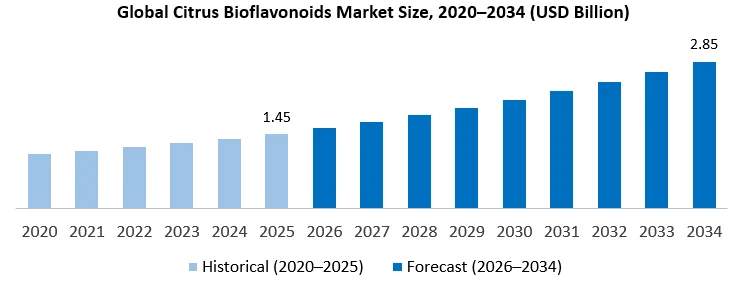
The Global Citrus Bioflavonoids Market grew from USD 1.06 Billion in 2020 to USD 1.45 Billion in 2025 as supplement demand grew and processors put more citrus peel by-products to use. The market is projected to reach USD 2.85 Billion by 2034, a CAGR of 7.80% during 2026-2034. Annual revenue additions widen through the forecast period as branded, high-purity and finished-form products take a larger share of sales.
|
Parameter |
Value |
|
Market Size (2025) |
USD 1.45 Billion |
|
Market Size (2034) |
USD 2.85 Billion |
|
CAGR (2026-2034) |
7.80% |
|
Historical Period |
2020 to 2025 |
|
Forecast Period |
2026 to 2034 |
Global Citrus Bioflavonoids Market Key Highlights
|
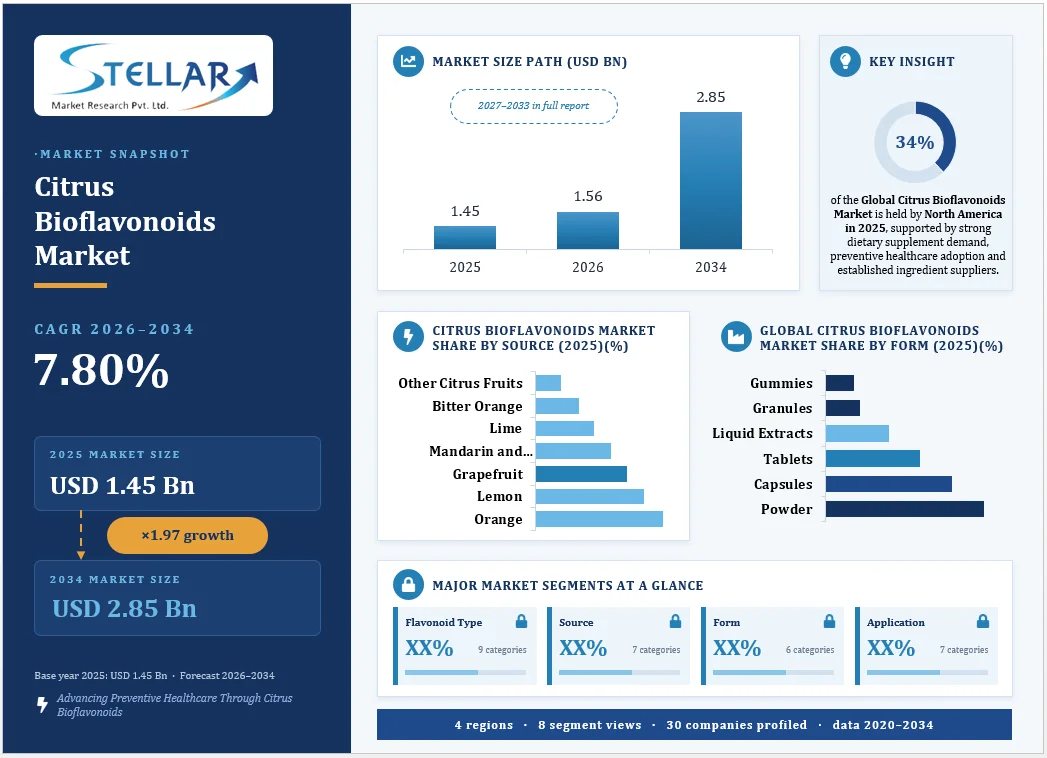
The snapshot summarizes the Global Citrus Bioflavonoids Market at a glance. North America leads the regional ranking with a 34% share in 2025, and hesperidin, orange and dietary supplements are the leading flavonoid type, source and application segments. The market is projected to rise from USD 1.45 Billion in 2025 to USD 2.85 Billion in 2034, a CAGR of 7.80% during 2026-2034.
To get more Insights: Request Free Sample Report
Global Citrus Bioflavonoids Market Dynamics:
Rising Preventive Health Demand to Drive Global Citrus Bioflavonoids Market Growth
Consumers are turning to plant-based ingredients that support vascular, metabolic, immune and skin health, and citrus flavonoids such as hesperidin, diosmin, naringin and eriocitrin fit this demand. Hesperidin and diosmin are used in venous health products, including the micronised purified flavonoid fraction used in medicines for venous disease, while hesperidin and eriocitrin blends are now sold for metabolic and cardiovascular support. Brands also value the link to a familiar fruit, which makes the ingredient easy to explain on a label.
Supplement makers are extending citrus flavonoids into capsules, tablets, gummies, powders and ready-to-drink formats, and finished products can be positioned for healthy ageing, sports nutrition and beauty from within. Growth in these categories depends on clinical evidence, the label claims allowed by each regulator and the ingredient’s taste, since many citrus flavonoids are bitter.
Citrus Peel Valorisation and Circular Economy Practices to Create Opportunities in the Global Citrus Bioflavonoids Market
Juice and fruit processing leaves large volumes of peel, pulp and seeds, and these by-products hold much of the flavonoid content of a fruit. Recovering flavonoids from this material gives processors an added revenue stream and reduces disposal costs. Hesperidin is traditionally recovered by alkaline extraction of peel, which yields a flavonoid complex of 60-70% purity that is refined further through repeated crystallisation.
Recovery economics depend on peel availability near processing plants, solvent and energy use, and effluent treatment. Producers are testing enzyme-assisted, ultrasound-assisted, microwave-assisted and supercritical fluid methods that cut solvent use and shorten processing time, and these methods are expected to gain share as green extraction expectations rise.
Product Innovation and Bioavailability Improvements to Support Global Citrus Bioflavonoids Market Expansion
Standard hesperidin dissolves poorly in water, which limits its use in beverages and its absorption, so suppliers are investing in soluble and better-absorbed forms. Prinova’s CITRAPEAK is a 100% soluble form of hesperidin bonded to tapioca starch, and the company reports that it is more bioavailable than standard hesperidin. At Vitafoods Europe in May 2026, HTBA introduced Leanara, a blend of citrus bioflavonoids and active vitamin B12 aimed at people using GLP-1 therapies.
Branded, clinically studied ingredients help suppliers move from commodity extracts to higher-value products. Ingredients by Nature’s Eriomin, a patented citrus bioflavonoid complex, was featured in three new GLP-1 support supplements from Force Factor in May 2026, which shows how supplement brands are building condition-specific products around citrus flavonoids.
Expanding Applications in Functional Foods, Beverages, Cosmetics and Animal Nutrition to Support Global Citrus Bioflavonoids Market Growth
Beyond supplements, citrus flavonoids are used as natural antioxidants in functional foods and beverages, as active ingredients in skin care, and in animal nutrition. In February 2026, True Citrus launched True Lemon Wellness, a line of zero-sugar functional powdered drink mixes, and its Defend variant includes hesperidin from citrus peels, which shows how beverage brands are adding citrus flavonoids to everyday products.
Ingredients by Nature’s president said in a June 2026 interview that animal nutrition has grown into a substantial part of the company’s sales, reflecting demand from pet food and feed makers for natural antioxidants.
Raw Material Seasonality, Price Volatility and Regulatory Variation to Influence Global Citrus Bioflavonoids Market Commercialization
Citrus bioflavonoid supply depends on fruit harvests, which are seasonal and exposed to weather, disease and climate risks in producing regions. A poor harvest raises peel prices and can delay extraction schedules, and producers that rely on a single origin are more exposed than those with diversified sourcing. Asia Pacific, particularly China, is a major production base for extracts, so trade policy and logistics also affect supply to North America and Europe.
Regulation differs by application and country. The same compound can be sold as a dietary supplement ingredient, a food ingredient, a cosmetic ingredient or a pharmaceutical active, and each route has its own purity, labelling, claim and quality requirements. Adulteration, inconsistent compound content and contamination remain quality concerns, so buyers increasingly ask for standardised extracts, testing data and traceability from suppliers.
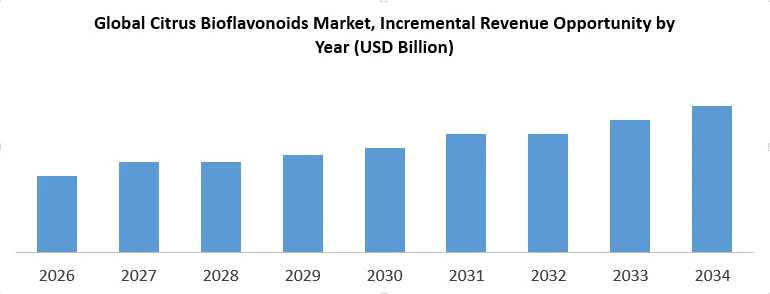
Incremental revenue in the Global Citrus Bioflavonoids Market rises from USD 0.11 Billion in 2026 to USD 0.21 Billion in 2034. Over 2026-2034 the market adds USD 1.40 Billion, taking it from USD 1.45 Billion to USD 2.85 Billion. Annual revenue additions widen over the forecast period, as high-purity, branded and finished-form products take a larger share of sales.
Global Citrus Bioflavonoids Market, Flavonoid Compound Comparison
Citrus flavonoids differ in the fruit they come from, the way they are produced and the applications they serve. The comparison below summarizes four of the leading compounds and shows where each fits in the market.
|
Flavonoid |
Main Source |
Production Route |
Key Applications |
Market Position |
|
Hesperidin |
Sweet orange and other citrus peel |
Direct extraction from peel |
Supplements, vascular health, beverages and cosmetics |
Largest compound segment |
|
Diosmin |
Derived from hesperidin |
Conversion of hesperidin |
Venous health medicines and supplements |
Established in pharmaceuticals |
|
Naringin |
Grapefruit, pomelo and bitter orange |
Extraction from peel and fruit |
Metabolic support, antioxidants and flavour |
Specialised segment |
|
Eriocitrin |
Lemon fruit and peel |
Extraction from lemon material |
Metabolic and cardiovascular supplements |
Emerging, premium positioning |
SMR Analyst Insight: Value Migration Toward Standardised and Branded Ingredients in the Global Citrus Bioflavonoids Market
SMR views the market as moving through three steps. The first is secure raw material access, which needs reliable peel supply and diversified sourcing. The second is process and quality control, which covers extraction yield, purity, standardisation and traceability. The third is differentiation, which comes from branded, clinically supported and better-absorbed ingredients. Companies that perform well on all three are expected to capture the largest share of revenue growth through 2034, and the report tracks each profiled company against these steps.
Global Citrus Bioflavonoids Market Segment Analysis
The Global Citrus Bioflavonoids Market is segmented by flavonoid type, nature, source, form, production process, application, sales channel and region. Each segment reflects different raw material supply, processing routes, purity needs and end-user demand.
Global Citrus Bioflavonoids Market, By Flavonoid Type
Based on flavonoid type, the market is segmented into hesperidin, diosmin, naringin, eriocitrin, rutin, nobiletin, tangeretin, narirutin and other citrus flavonoids.
Hesperidin is the leading flavonoid type with a 38% share in 2025. It is recovered in large quantity from orange peel, has a long record of use in vascular health and antioxidant products, and is the starting material for diosmin. Eriocitrin and the polymethoxylated flavones nobiletin and tangeretin are expected to grow faster from a smaller base as research on metabolic and healthy ageing benefits progresses.
Global Citrus Bioflavonoids Market, By Nature
Based on nature, the market is segmented into conventional and organic.
Conventional is the leading segment with a 74% share in 2025, supported by lower cost and wide availability of conventionally grown citrus peel. Organic is expected to grow faster as brands seek organic-certified supplements, foods and cosmetics, although limited organic peel supply and higher prices restrain volumes.
Global Citrus Bioflavonoids Market, By Source
Based on source, the market is segmented into orange, lemon, lime, grapefruit, mandarin and tangerine, bitter orange, and other citrus fruits.
Orange is the leading source with a 46% share in 2025, as it is the most widely processed citrus fruit and leaves large volumes of peel for extraction. Lemon, lime and grapefruit supply compounds such as eriocitrin and naringin, while mandarin, tangerine and bitter orange peel are sourced for specialised extracts.
Global Citrus Bioflavonoids Market, By Form
Based on form, the market is segmented into powder, granules, liquid extracts, tablets, capsules and gummies.
Powder is the leading form with a 33% share in 2025, as it is the standard form for bulk ingredient supply and for blending into supplements, foods and beverages. Gummies are expected to be the fastest-growing form during 2026-2034 as consumers move toward easy-to-take formats, although sugar content and flavour masking need careful formulation.
Global Citrus Bioflavonoids Market, By Production Process
Based on production process, the market is segmented into solvent extraction, enzyme-assisted extraction, ultrasound-assisted extraction, microwave-assisted extraction, supercritical fluid extraction and other extraction processes.
Solvent extraction is the leading process with a 54% share in 2025 because it is established, scalable and suited to large peel volumes. Enzyme-assisted, ultrasound-assisted and microwave-assisted methods are gaining ground as producers seek higher yields, lower solvent use and shorter processing time, and supercritical fluid extraction serves high-purity grades.
Global Citrus Bioflavonoids Market, By Application
Based on application, the market is segmented into dietary supplements, pharmaceuticals, functional foods, functional beverages, cosmetics and personal care, animal feed and other applications.
Dietary supplements is the leading application with a 47% share in 2025, supported by consumer interest in vascular, metabolic and immune health and by delivery through capsules, tablets and gummies. Pharmaceuticals use diosmin and hesperidin in venous health products, while cosmetics and personal care is expected to grow quickly as brands add citrus antioxidants to skin care.
Global Citrus Bioflavonoids Market, By Sales Channel
Based on sales channel, the market is segmented into business-to-business and business-to-consumer, and the business-to-consumer channel covers online stores and e-commerce platforms, modern trade and supermarkets, pharmacies and medical stores, specialty and health stores, and other retail channels.
Business-to-business is the leading channel with a 62% share in 2025, as most citrus bioflavonoids are sold as ingredients to supplement, pharmaceutical, food and cosmetic manufacturers under supply contracts. Online stores and e-commerce platforms are expected to be the fastest-growing retail route for finished products.
Global Citrus Bioflavonoids Market Regional Insights:
The Global Citrus Bioflavonoids Market is segmented into North America, Europe, Asia Pacific, Latin America and Middle East & Africa. North America holds the largest regional share at 34% in 2025, driven by high supplement consumption in the United States and Canada and by suppliers such as Ingredients by Nature, NOW Foods, Solgar and Natural Factors. Europe is shaped by demand for vascular health products and by strict quality and labelling rules, and it is home to participants such as Merck KGaA, Grupo Ferrer, Destilaciones Bordas Chinchurreta and DSM-Firmenich.
Asia Pacific is expected to be the fastest-growing region during 2026-2034, supported by large citrus processing capacity and extract production in China, growing supplement markets in India, Japan and South Korea, and suppliers such as Hunan Sunfull Bio-tech, Yaan Times Biotech and Nacalai Tesque. Latin America benefits from large citrus crops in Brazil and Argentina that supply peel to processors, and the Middle East & Africa region is supported by supplement demand in Saudi Arabia, the United Arab Emirates and South Africa and by citrus production in Egypt and South Africa.
Global Citrus Bioflavonoids Market Competitive Landscape
The Global Citrus Bioflavonoids Market is moderately fragmented, with citrus extract manufacturers, branded ingredient suppliers, supplement companies, chemical and life science suppliers, pharmaceutical groups and Asian extract producers competing across purity grades and applications. Ingredients by Nature LLC, NOW Foods, Solgar Inc., Natural Factors Inc., Merck KGaA, DSM-Firmenich, Grupo Ferrer Internacional S.A., Hunan Sunfull Bio-tech Co., Ltd., Yaan Times Biotech Co., Ltd., Nans Products and Nacalai Tesque, Inc. are among the key companies shaping the competitive landscape. North American companies lead in branded, clinically studied ingredients and finished supplements, European companies are strong in pharmaceutical-grade and specialty ingredients, and Asia Pacific producers hold cost and scale advantages in extraction. Competition primarily depends on raw material access, extraction and purification capability, product purity and standardisation, clinical evidence, certifications and distribution reach.
Product launches, branded ingredient partnerships, capacity expansion and research collaborations are becoming important strategies for strengthening competitive positioning in the Global Citrus Bioflavonoids Market. Recent developments include the use of Ingredients by Nature’s Eriomin in three Force Factor GLP-1 support supplements in May 2026, HTBA’s launch of Leanara at Vitafoods Europe in May 2026, and Prinova’s showcase of its soluble hesperidin ingredient CITRAPEAK at the same event. Companies are also investing in enzyme-assisted and green extraction, bioavailability technology, traceability and clinical studies. As consumers look for condition-specific products, strategic partnerships with supplement, food and pharmaceutical manufacturers, organic and high-purity product lines and long-term supply agreements are expected to play an important role through 2034.
Global Citrus Bioflavonoids Market Recent Developments:
|
Date |
Development |
|
February 18, 2026 |
True Citrus launched True Lemon Wellness, a line of zero-sugar functional powdered drink mixes for appetite control, immune health and sustained energy; the Defend variant includes hesperidin from citrus peels. |
|
April 17, 2026 |
Prinova announced that it would highlight CITRAPEAK, its 100% soluble hesperidin ingredient for pre-workout products, among its concepts at Vitafoods Europe in Barcelona on May 5-7. |
|
May 4, 2026 |
Ingredients by Nature announced that its patented citrus bioflavonoid complex, Eriomin, is featured in three new GLP-1 support supplements from Force Factor sold at food, drug and mass retailers. |
|
May 5, 2026 |
HTBA (HealthTech BioActives) presented Leanara at Vitafoods Europe 2026, an ingredient that combines citrus bioflavonoids with active vitamin B12 to support muscle mass and energy in GLP-1 users. |
Global Citrus Bioflavonoids Market – Industry Analysis
The report presents a comprehensive analysis of the Global Citrus Bioflavonoids Market, covering stakeholders across citrus growing and processing, flavonoid extraction, ingredient manufacturing, formulation and finished-product supply. It evaluates the historical and current market scenario, industry developments, market size, production volume and the growth outlook through 2034.
The report assesses growth drivers, restraints, opportunities and challenges, and examines macroeconomic conditions, citrus harvest and commodity price movements, production costs and pricing, extraction technology, product quality and standardisation, trade flows, and the regulatory frameworks that apply to supplements, foods, cosmetics and pharmaceuticals.
It also reviews the competitive positioning of leading ingredient manufacturers, supplement brands, chemical and life science suppliers and regional extract producers. Company analysis covers financial position, product portfolio, manufacturing and extraction capability, strategic partnerships and recent developments.
PORTER’s Five Forces and PESTLE analyses are used to assess the competitive environment and the influence of macroeconomic, regulatory, technological and environmental factors, and company profiles include SWOT analysis. Regional assessments and country-level forecasts identify emerging opportunities and investment hotspots for ingredient manufacturers, supplement brands, pharmaceutical companies, investors and policy makers.
Global Citrus Bioflavonoids Market Scope: Inquire before buying
|
Global Citrus Bioflavonoids Market |
|||
|
Report Coverage |
Details |
||
|
Base Year: |
2025 |
Forecast Period: |
2026-2034 |
|
Historical Data: |
2020 to 2025 |
Market Size in 2025: |
USD 1.45 Billion |
|
Forecast Period 2026 to 2034 CAGR: |
7.80% |
Market Size in 2034: |
USD 2.85 Billion |
|
Segments Covered: |
By Flavonoid Type |
Hesperidin Diosmin Naringin Eriocitrin Rutin Nobiletin Tangeretin Narirutin Other Citrus Flavonoids |
|
|
By Nature |
Conventional |
||
|
By Source |
Orange Lemon Grapefruit Mandarin and Tangerine Bitter Orange Other Citrus Fruits |
||
|
By Form |
Powder Granules Liquid Extracts Tablets Capsules Gummies |
||
|
By Production Process |
Solvent Extraction Enzyme-Assisted Extraction Ultrasound-Assisted Extraction Microwave-Assisted Extraction Supercritical Fluid Extraction Other Extraction Processes |
||
|
By Application |
Dietary Supplements Pharmaceuticals Functional Foods Functional Beverages Cosmetics and Personal Care Animal Feed Other Applications |
||
|
By Sales Channel |
Business-to-Business (B2B) Business-to-Consumer (B2C): Online Stores and E-Commerce Platforms, Modern Trade and Supermarkets, Pharmacies and Medical Stores, Specialty and Health Stores, Other Retail Channels |
||
|
By Region |
North America Europe Asia Pacific Latin America Middle East and Africa |
||
Global Citrus Bioflavonoids Market – Key Players
- Ingredients by Nature LLC (United States)
- NOW Foods (United States)
- Solgar Inc. (United States)
- Freeda Vitamins Inc. (United States)
- Country Life LLC (United States)
- MORRE-TEC Industries (United States)
- Santa Cruz Biotechnology, Inc. (United States)
- Natural Factors Inc. (Canada)
- Organika Health Products Inc. (Canada)
- Cayman Chemical Company (United States)
- Merck KGaA (Germany)
- Destilaciones Bordas Chinchurreta S.A. (Spain)
- Grupo Ferrer Internacional S.A. (Spain)
- DSM-Firmenich (Netherlands/Switzerland)
- Hunan Sunfull Bio-tech Co., Ltd. (China)
- Yaan Times Biotech Co., Ltd. (China)
- Hunan Yuantong Pharmaceutical Co., Ltd. (China)
- Nacalai Tesque, Inc. (Japan)
- Yakult Honsha Co., Ltd. (Japan)
- J&K Scientific Ltd. (China)
- Nans Products (China)
- BOC Sciences (China)
- HealthTech BioActives (HTBA) (Spain)
- Euromed S.A. (Spain)
- International Flavors & Fragrances Inc. (IFF) (United States)
- Huisong Pharmaceuticals (China)
- Benepure Pharmaceutical Co., Ltd. (China)
- Nagase Viita Co., Ltd. (Japan)
- Prinova Group LLC (United States)
- Vivion Inc. (United States)
Frequently Asked Questions
Ans: The Global Citrus Bioflavonoids Market is growing at a CAGR of 7.80% during forecasting period 2026-2034.
Ans: Global Citrus Bioflavonoids Market report helps with the PESTEL, PORTER and SWOT analysis, Recommendations for Investors & Leaders, and market estimation of the forecast period.
Ans: The important key players in the Global Citrus Bioflavonoids Market are – Ingredients by Nature LLC, NOW Foods, Solgar Inc., Freeda Vitamins Inc., Country Life LLC, Natural Factors Inc., Organika Health Products Inc., Merck KGaA, DSM-Firmenich, Grupo Ferrer Internacional S.A., Destilaciones Bordas Chinchurreta S.A., Hunan Sunfull Bio-tech Co., Ltd., Yaan Times Biotech Co., Ltd., Hunan Yuantong Pharmaceutical Co., Ltd., Nacalai Tesque, Inc., Nans Products and BOC Sciences.
Ans: The Global Citrus Bioflavonoids Market is studied from 2020 to 2034.
Ans: Citrus bioflavonoids are plant compounds such as hesperidin, diosmin, naringin and eriocitrin found in the peel, pulp and seeds of oranges, lemons, limes, grapefruits and mandarins. They are used in dietary supplements, pharmaceuticals, functional foods and beverages, cosmetics and animal feed.
1. Executive Summary and Industry Overview
1.1 Global market size by value (USD Billion), 2025–2034
1.2 Historical market development, consumption patterns and industry evolution
1.3 Global citrus bioflavonoids industry ecosystem and stakeholder overview
1.4 Major producing countries, leading suppliers and regional leadership
1.5 Key market trends, developments and strategic growth opportunities
1.6 CAGR analysis and future market growth outlook, 2025–2034
2. Market Dynamics and Growth Drivers
2.1 Global citrus bioflavonoids market trends and emerging developments
2.2 Market dynamics influencing industry growth and commercial expansion
2.2.1 Market Drivers
2.2.2 Market Restraints
2.2.3 Market Opportunities
2.2.4 Market Challenges
2.3 Porter’s Five Forces Analysis
2.4 PESTLE Analysis
3. Macroeconomic Factors Analysis
3.1 Global GDP growth trends and consumer spending patterns
3.2 Inflation rates and their impact on ingredient manufacturing costs
3.3 Disposable income trends influencing nutritional supplement consumption
3.4 Foreign exchange fluctuations affecting international ingredient trade
3.5 Global agricultural output and citrus commodity price movements
3.6 Interest rates, investment conditions and industrial financing availability
4. Industry Ecosystem Analysis Overview
4.1 Global citrus bioflavonoids industry ecosystem and stakeholder mapping
4.2 Citrus growers, fruit processors and agricultural raw material suppliers
4.3 Citrus extraction companies and bioflavonoid ingredient manufacturers
4.4 Contract manufacturers, formulation specialists and processing technology providers
4.5 Ingredient distributors, wholesalers and finished-product manufacturers
4.6 Regulatory authorities, research institutions and industry associations
5. Value Chain Analysis Overview
5.1 Citrus cultivation, harvesting and agricultural raw material procurement
5.2 Citrus fruit processing and by-product generation for extraction
5.3 Peel preparation, drying and preliminary material processing operations
5.4 Flavonoid extraction, separation, purification and concentration processes
5.5 Ingredient standardisation, formulation, packaging and quality testing
5.6 Distribution, commercialisation and downstream application integration activities
6. Citrus Raw Material Availability and Supply Analysis
6.1 Global citrus fruit production and regional availability trends
6.2 Orange peel availability and citrus processing by-product generation
6.3 Lemon, lime and grapefruit raw material supply analysis
6.4 Mandarin, tangerine and bitter orange sourcing opportunities
6.5 Seasonal harvesting patterns and raw material procurement cycles
6.6 Agricultural disruptions, climate risks and supply availability constraints
7. Citrus Bioflavonoids Production and Capacity Analysis
7.1 Global citrus bioflavonoids production volume and historical trends
7.2 Installed manufacturing capacity across major ingredient producing countries
7.3 Regional distribution of extraction and processing facilities
7.4 Actual production versus installed capacity and utilisation rates
7.5 Existing, planned and under-construction manufacturing facility expansions
7.6 Production constraints, facility upgrades and capacity optimisation initiatives
8. Production Cost and Pricing Benchmarking Analysis
8.1 Citrus bioflavonoid ingredient production cost structure analysis
8.2 Citrus peel procurement and agricultural raw material cost contributions
8.3 Extraction solvents, enzymes and processing chemical cost analysis
8.4 Energy, labour, utilities and manufacturing overhead cost impacts
8.5 Price benchmarking across flavonoid compounds and commercial grades
8.6 Profitability, pricing fluctuations and ingredient cost competitiveness analysis
9. Extraction Technology and Manufacturing Innovation Analysis
9.1 Conventional solvent extraction technologies and industrial applications
9.2 Enzyme-assisted extraction methods and process efficiency improvements
9.3 Ultrasound-assisted and microwave-assisted extraction technology developments
9.4 Supercritical fluid extraction and emerging separation technologies
9.5 Purification, concentration and standardisation technology advancements
9.6 Green extraction methods, solvent recovery and process optimisation
10. Product Quality, Standardisation and Formulation Analysis
10.1 Citrus bioflavonoid purity levels and commercial quality specifications
10.2 Standardised extracts and compound concentration requirements across applications
10.3 Bioavailability enhancement and formulation compatibility considerations
10.4 Product stability, shelf life and storage condition requirements
10.5 Contaminant testing, adulteration detection and ingredient traceability
10.6 Certifications, quality assurance and manufacturing compliance requirements
11. Application and End-Use Demand Analysis
11.1 Dietary supplement applications across major consumer health categories
11.2 Pharmaceutical applications and specialised formulation requirements
11.3 Functional food applications across bakery, snacks and nutrition products
11.4 Functional beverage applications across juices and wellness drinks
11.5 Cosmetics and personal care ingredient formulation applications
11.6 Animal feed applications and specialised nutritional ingredient requirements
12. Distribution Channel and Commercial Access Analysis
12.1 Business-to-business ingredient distribution and procurement models
12.2 Business-to-consumer finished-product sales and retail distribution channels
12.3 Direct ingredient sales and manufacturer-to-manufacturer supply relationships
12.4 Online marketplaces, e-commerce platforms and digital sales channels
12.5 Pharmacies, specialty stores and modern retail distribution networks
12.6 Distributor partnerships, channel margins and customer acquisition strategies
13. Trade, Import-Export and International Supply Analysis
13.1 Global citrus bioflavonoid ingredient trade flows and patterns
13.2 Major exporting countries and international supplier positioning
13.3 Major importing countries and regional procurement dependencies
13.4 Cross-border trade of citrus extracts and finished ingredients
13.5 Import tariffs, customs regulations and international trade restrictions
13.6 Trade balance developments and international supply chain risks
14. Government Policy and Regulatory Framework Analysis
14.1 Food ingredient regulations and permitted application requirements
14.2 Dietary supplement regulations and pharmaceutical ingredient compliance standards
14.3 Organic certification requirements and natural ingredient labelling regulations
14.4 Food safety standards and manufacturing quality certification requirements
14.5 Import-export regulations and international ingredient registration procedures
14.6 Environmental regulations governing citrus waste and extraction operations
15. Research and Development and Scientific Innovation Analysis
15.1 Research trends across citrus-derived flavonoid compounds and applications
15.2 Clinical research activities and scientific validation developments
15.3 New compound discovery and bioactive ingredient development initiatives
15.4 Formulation research for improved stability and bioavailability
15.5 University-industry collaborations and research commercialisation initiatives
15.6 Patent activity, intellectual property and technology development trends
16. Sustainability and Circular Economy Analysis
16.1 Citrus processing by-product utilisation and waste valorisation opportunities
16.2 Citrus peel recovery and sustainable raw material sourcing practices
16.3 Energy-efficient extraction and environmentally responsible manufacturing operations
16.4 Water consumption, wastewater treatment and resource conservation initiatives
16.5 Sustainable packaging and circular ingredient production practices
16.6 ESG commitments, environmental compliance and sustainability reporting developments
17. Manufacturing Infrastructure and Facility Development Analysis
17.1 Citrus bioflavonoid extraction facility infrastructure and plant development
17.2 Greenfield manufacturing projects and new facility establishment
17.3 Brownfield expansion and existing production facility modernisation
17.4 Extraction equipment, purification systems and processing infrastructure
17.5 Quality laboratories, testing facilities and certification infrastructure
17.6 Manufacturing location advantages and industrial cluster development
18. Supply Chain and Procurement Risk Analysis
18.1 Citrus fruit sourcing strategies and supplier diversification initiatives
18.2 Seasonal raw material shortages and procurement continuity challenges
18.3 Extraction chemical availability and industrial equipment sourcing risks
18.4 Transportation, warehousing and temperature-controlled storage requirements
18.5 Supplier concentration and international sourcing dependency assessment
18.6 Supply chain resilience and business continuity planning strategies
19. Investment and Growth Opportunities Analysis
19.1 Global capital investment trends in citrus ingredient manufacturing
19.2 Investment opportunities in extraction technologies and processing facilities
19.3 High-purity flavonoid production and specialised ingredient opportunities
19.4 Organic ingredient manufacturing and premium product development opportunities
19.5 Regional investment hotspots and emerging production destinations
19.6 Strategic acquisitions, partnerships and capacity expansion opportunities
20. Market Risk Assessment Analysis
20.1 Citrus crop failures and agricultural raw material supply risks
20.2 Ingredient price volatility and manufacturing cost escalation pressures
20.3 Regulatory changes and product approval uncertainty risks
20.4 Quality inconsistencies, contamination and product standardisation challenges
20.5 Competitive pricing pressure and alternative ingredient substitution risks
20.6 Investment execution, technology adoption and commercialisation risks
21. Industry Expansion and Business Development Strategies
21.1 Geographic expansion strategies of leading ingredient manufacturers
21.2 Product portfolio diversification across citrus flavonoid compounds
21.3 Strategic partnerships with food, pharmaceutical and supplement manufacturers
21.4 Development of organic and high-purity ingredient product lines
21.5 Expansion into emerging applications and specialised consumer categories
21.6 International distribution partnerships and market entry strategies
22. Citrus Bioflavonoids Market: Market Size and Forecast by Segmentation (Value USD Billion), 2025–2034
22.1 Global Citrus Bioflavonoids Market Size and Forecast, By Flavonoid Type
22.1.1 Hesperidin
22.1.2 Diosmin
22.1.3 Naringin
22.1.4 Eriocitrin
22.1.5 Rutin
22.1.6 Nobiletin
22.1.7 Tangeretin
22.1.8 Narirutin
22.1.9 Other Citrus Flavonoids
22.2 Global Citrus Bioflavonoids Market Size and Forecast, By Nature
22.2.1 Conventional
22.2.2 Organic
22.3 Global Citrus Bioflavonoids Market Size and Forecast, By Source
22.3.1 Orange
22.3.2 Lemon
22.3.3 Lime
22.3.4 Grapefruit
22.3.5 Mandarin and Tangerine
22.3.6 Bitter Orange
22.3.7 Other Citrus Fruits
22.4 Global Citrus Bioflavonoids Market Size and Forecast, By Form
22.4.1 Powder
22.4.2 Granules
22.4.3 Liquid Extracts
22.4.4 Tablets
22.4.5 Capsules
22.4.6 Gummies
22.5 Global Citrus Bioflavonoids Market Size and Forecast, By Production Process
22.5.1 Solvent Extraction
22.5.2 Enzyme-Assisted Extraction
22.5.3 Ultrasound-Assisted Extraction
22.5.4 Microwave-Assisted Extraction
22.5.5 Supercritical Fluid Extraction
22.5.6 Other Extraction Processes
22.6 Global Citrus Bioflavonoids Market Size and Forecast, By Application
22.6.1 Dietary Supplements
22.6.2 Pharmaceuticals
22.6.3 Functional Foods
22.6.4 Functional Beverages
22.6.5 Cosmetics and Personal Care
22.6.6 Animal Feed
22.6.7 Other Applications
22.7 Global Citrus Bioflavonoids Market Size and Forecast, By Sales Channel
22.7.1 Business-to-Business (B2B)
22.7.2 Business-to-Consumer (B2C)
22.7.2.1 Online Stores and E-Commerce Platforms
22.7.2.2 Modern Trade and Supermarkets
22.7.2.3 Pharmacies and Medical Stores
22.7.2.4 Specialty and Health Stores
22.7.2.5 Other Retail Channels
22.8 Global Citrus Bioflavonoids Market Size and Forecast, By Region
22.8.1 North America
22.8.1.1 United States
22.8.1.2 Canada
22.8.1.3 Mexico
22.8.1.4 Rest of North America
22.8.2 Europe
22.8.2.1 Germany
22.8.2.2 United Kingdom
22.8.2.3 France
22.8.2.4 Italy
22.8.2.5 Spain
22.8.2.6 Netherlands
22.8.2.7 Switzerland
22.8.2.8 Poland
22.8.2.9 Rest of Europe
22.8.3 Asia Pacific
22.8.3.1 China
22.8.3.2 India
22.8.3.3 Japan
22.8.3.4 South Korea
22.8.3.5 Australia
22.8.3.6 Indonesia
22.8.3.7 Thailand
22.8.3.8 Malaysia
22.8.3.9 Vietnam
22.8.3.10 Rest of Asia Pacific
22.8.4 Latin America
22.8.4.1 Brazil
22.8.4.2 Argentina
22.8.4.3 Chile
22.8.4.4 Colombia
22.8.4.5 Rest of Latin America
22.8.5 Middle East and Africa
22.8.5.1 Saudi Arabia
22.8.5.2 United Arab Emirates
22.8.5.3 South Africa
22.8.5.4 Egypt
22.8.5.5 Türkiye
22.8.5.6 Rest of Middle East and Africa
23. Competitive Landscape
23.1 SMR Competition Matrix
23.2 Competitive Positioning of Leading Key Players [Revenue and Market Share (%)]
23.3 Key Players Benchmarking
23.3.1 Company Name
23.3.2 Headquarters
23.3.3 Product Portfolio
23.3.4 Manufacturing Capabilities
23.3.5 Extraction Technology and R&D Capabilities
23.3.6 Distribution Network and Customer Base
23.3.7 Total Company Revenue (2025)
23.3.8 Citrus Bioflavonoids Market Revenue (2025)
23.3.9 Certifications and Quality Standards
23.3.10 Geographic Presence
23.4 Market Structure
23.4.1 Market Leaders
23.4.2 Market Followers
23.4.3 Emerging Players
23.5 Growth Rate / Y-o-Y (%) of Companies
23.6 Profit Margin (%) of Companies
23.7 R&D Investments (%) of Companies
23.8 Revenue Vs Net Earnings – Financial Health Benchmarking (2025)
23.9 Revenue Performance and Financial Analysis (2025)
23.10 Mergers and Acquisitions Details
23.11 Recent Key Developments
24. Competitive Landscape Overview and Industry Structure (2025)
24.1 Global citrus bioflavonoids competitive ecosystem and industry structure
24.2 Market concentration among leading ingredient manufacturers and suppliers
24.3 Competitive intensity across extraction and ingredient manufacturing companies
24.4 Regional competitive positioning of major industry participants
24.5 Positioning of specialised ingredient suppliers versus finished-product manufacturers
24.6 Emerging competitors and changes in industry competitive dynamics
25. Market Share and Competitive Positioning Analysis (2025)
25.1 Global market share of leading citrus bioflavonoid manufacturers
25.2 Company-wise revenue contribution from citrus bioflavonoid products
25.3 Regional market share and competitive positioning of manufacturers
25.4 Competitive positioning across major flavonoid compound categories
25.5 Comparative positioning by manufacturing scale and product portfolio
25.6 Emerging players and changes in competitive market positioning
26. Revenue Performance and Financial Analysis (2025)
26.1 Comparative revenue performance of major ingredient manufacturing companies
26.2 Citrus bioflavonoid business contribution to total company revenue
26.3 Operating profitability and margin comparison across leading manufacturers
26.4 Raw material and manufacturing cost impacts on financial performance
26.5 Capital expenditure and investment trends among industry participants
26.6 Financial resilience and business diversification across ingredient markets
27. Manufacturing Capacity and Operational Benchmarking (2025)
27.1 Installed citrus bioflavonoid manufacturing capacity of leading companies
27.2 Actual production output versus installed manufacturing capacity
27.3 Capacity utilisation benchmarking across major ingredient manufacturers
27.4 Comparison of extraction technologies and processing capabilities
27.5 Operational scale and geographic distribution of manufacturing facilities
27.6 Benchmarking production growth, plant expansion and operational performance
28. Strategic Alliances and Collaboration Analysis (2025)
28.1 Strategic partnerships among global citrus bioflavonoid manufacturers
28.2 Joint ventures for extraction facilities and ingredient manufacturing expansion
28.3 Research collaborations for compound development and formulation innovation
28.4 Raw material supply agreements and strategic sourcing partnerships
28.5 Collaborations with pharmaceutical, food and supplement manufacturers
28.6 Mergers, acquisitions and strategic consolidation across ingredient markets
Section D: Company Profiles
29. Company Profiles: Key Players
Detailed Profile considering the parameters:
29.1 Overview
29.2 Business Portfolio
29.3 Financial Overview
29.4 Citrus Bioflavonoids Product Portfolio
29.5 SWOT Analysis
29.6 Strategic Analysis
29.7 Recent Developments
29.1 North America
29.1.1 Ingredients by Nature LLC (United States)
29.1.2 NOW Foods (United States)
29.1.3 Solgar Inc. (United States)
29.1.4 Freeda Vitamins Inc. (United States)
29.1.5 Country Life LLC (United States)
29.1.6 MORRE-TEC Industries (United States)
29.1.7 Santa Cruz Biotechnology, Inc. (United States)
29.1.8 Natural Factors Inc. (Canada)
29.1.9 Organika Health Products Inc. (Canada)
29.1.10 Cayman Chemical Company (United States)
29.2 Europe
29.2.1 Merck KGaA (Germany)
29.2.2 Destilaciones Bordas Chinchurreta S.A. (Spain)
29.2.3 Grupo Ferrer Internacional S.A. (Spain)
29.2.4 DSM-Firmenich (Netherlands/Switzerland)
29.3 Asia Pacific
29.3.1 Hunan Sunfull Bio-tech Co., Ltd. (China)
29.3.2 Yaan Times Biotech Co., Ltd. (China)
29.3.3 Hunan Yuantong Pharmaceutical Co., Ltd. (China)
29.3.4 Nacalai Tesque, Inc. (Japan)
29.3.5 Yakult Honsha Co., Ltd. (Japan)
29.3.6 J&K Scientific Ltd. (China)
29.3.7 Nans Products (China)
29.3.8 BOC Sciences (China)
29.4 Other Global Participants
29.4.1 Other Regional Citrus Extract Manufacturers
29.4.2 Specialised Citrus Ingredient Suppliers
29.4.3 Emerging Bioflavonoid Extraction Companies
30. Key Findings
31. Strategic Moves and Industry Outlook
32. Research Methodology