ENG
ENG Japanese
  French
  German
  Korean
Frozen Seafood Market Analysis: Growth Potential, Competitive Landscape, and Strategic Outlook (2026-2032)
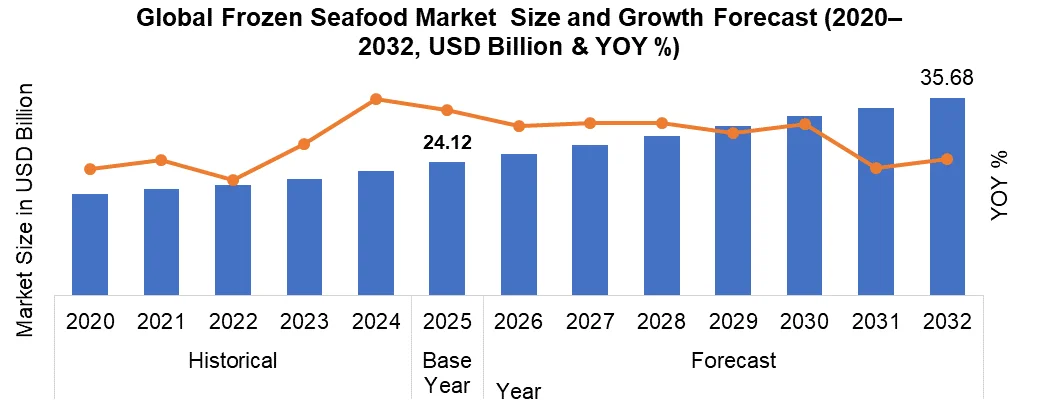
The global frozen seafood market was valued at USD 24.12 billion in 2025 and is expected to reach USD 35.68 billion by 2032, growing at a CAGR of 5.75% during the forecast period.
Global Frozen Seafood Market Overview
The global frozen seafood market is undergoing a structural transformation, driven by advancements in cold-chain logistics, rapid innovation in freezing technologies, and increasing consumer preference for convenient, high-protein food options. As urban lifestyles accelerate, frozen seafood is emerging as a dependable solution for delivering restaurant-quality meals with minimal preparation time.
To get more Insights: Request Free Sample Report
Rising health consciousness is further positioning seafood as a preferred lean protein alternative to red meat, particularly across salmon, shrimp, tuna, and white fish categories. At the same time, sustainability considerations, including traceability, eco-certifications, and responsible sourcing, are becoming critical purchase drivers, reshaping competitive dynamics across global markets.
Major companies such as High Liner Foods, Trident Seafoods, Thai Union Group, and Mowi ASA are expanding value-added portfolios, strengthening cold-chain capabilities, and investing in sustainable sourcing practices to capture long-term growth opportunities.
Global Frozen Seafood Market Growth Potential
Market growth is primarily driven by:
Convenience Foods Boom Accelerates Growth of the Global Frozen Seafood Market
The global frozen seafood market is experiencing strong growth due to rising demand for ready-to-cook and ready-to-eat seafood products. Urban consumers are increasingly adopting products such as pre-marinated fish, frozen shrimp skewers, battered fillets, and seafood meal kits that reduce preparation time while maintaining quality.
In 2025, nearly 34% of retail frozen seafood sales were driven by convenience-focused products, while over 60% of households in North America and Western Europe consumed ready-cooked seafood at least once per month. Southeast Asia is emerging as a high-growth region, expanding at 7–8% annually, supported by urbanization and rising disposable incomes.
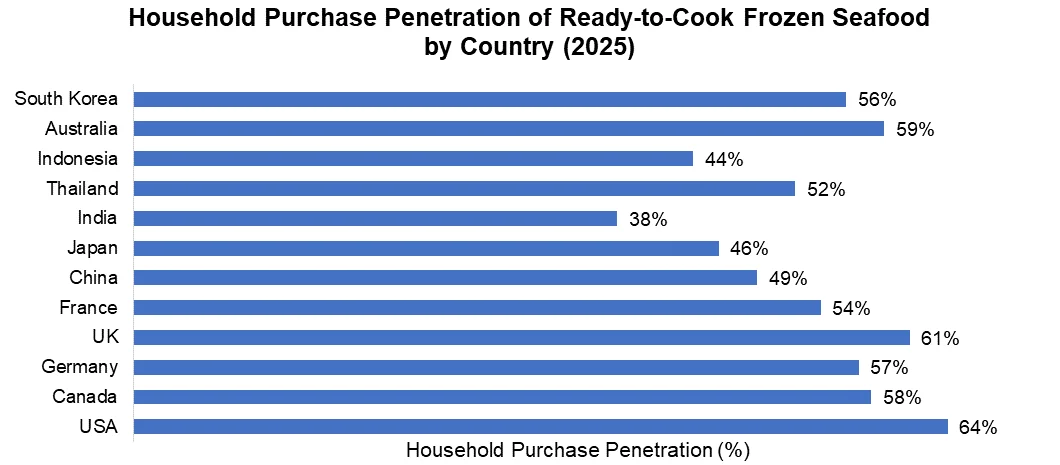
The graph highlights rising household adoption of ready-to-cook frozen seafood, reflecting a key market driver. Urban demand for convenient, high-quality, and time-saving protein options. Strong penetration in North America, Europe, and Southeast Asia fuels growth, innovation, and e-commerce expansion.
|
Global Frozen Seafood Market |
|||
|
Report Coverage |
Details |
||
|
Base Year: |
2025 |
Forecast Period: |
2026-2032 |
|
Historical Data: |
2019 to 2024 |
Market Size in 2025: |
USD 24.12 Billion |
|
Forecast Period 2025 to 2032 CAGR: |
5.75% |
Market Size in 2032: |
USD 35.68 Billion |
|
Global Frozen Seafood Market Segment Analysis |
By Nature |
Organic Conventional |
|
|
By Form |
Raw Processed |
||
|
By Product Type |
Fish Molluscs Crustaceans Others |
||
|
By Distribution Channel |
Hypermarkets & Supermarkets Convenience Stores Traditional Grocery Stores Specialist Food Stores Wholesale Stores E-commerce / Online Stores |
||
|
By End Use |
Food Processing Industry Food Service Industry Retail / Household |
||
Impact of 2025 U.S. Tariffs on Frozen Seafood Imports, Pricing, and Supply Chain Strategies
The imposition of tariffs on frozen seafood imports in key markets such as the United States has significantly reshaped global trade flows, pricing strategies, and sourcing decisions. Exporters are facing margin pressure, leading to diversification of export markets and supply chain optimization.
Companies are increasingly adopting vertical integration strategies to mitigate tariff exposure, improve cost efficiency, and ensure supply chain resilience. This highlights the growing importance of geopolitical risk management in the seafood industry.
India’s Frozen Seafood Exports Surge: Opportunities in U.S., China & Global Markets Despite Falling Prices.
India’s frozen seafood export sector is demonstrating strong volume growth despite declining global prices. Export volumes reached 1.78 million tonnes in 2023–24, reflecting a significant increase from previous years, while export revenues declined to USD 7.38 billion due to falling shrimp prices, which account for nearly 66% of total export value.
The United States and China together account for over 50% of export revenues, making them critical demand centers
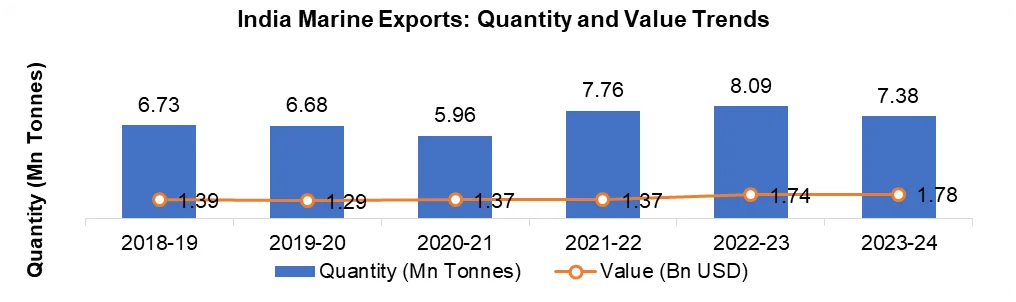
Rising exports and global demand are driving steady growth in India’s frozen seafood market. Companies enhance competitiveness and long-term profitability by focusing on value-added products, expanding offerings, strengthening cold chains, and entering new markets.
Global Frozen Seafood Market Segment Analysis:
Processed Seafood Segment Leads with Convenience and Extended Shelf Life
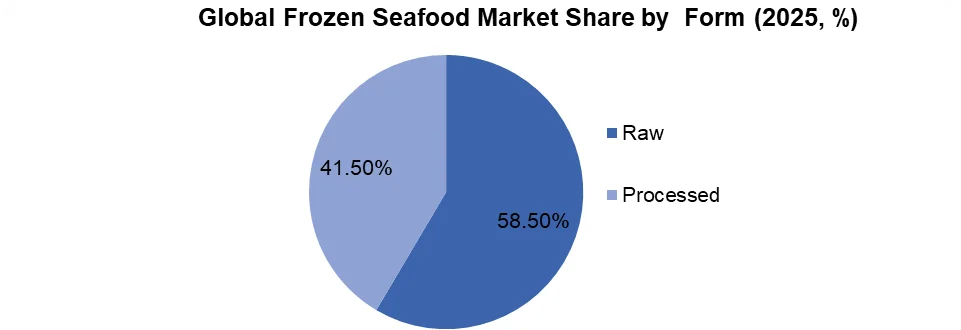
The processed seafood segment dominates the market, accounting for 41.5% share in 2025, driven by strong demand for convenience, extended shelf life, and ready-to-eat formats.
Processed seafood including filleted, marinated, breaded, and pre-cooked products enables product differentiation, branding, and premium pricing, making it the most strategically important segment.
Global Frozen Seafood Market Regional Analysis:
The frozen seafood market shows strong global variation, anchored by Asia Pacific’s dominance with China, India, Japan, Vietnam, and Thailand driving demand through aquaculture growth, rising exports, and urban consumption trends. China leads in regional supply and household adoption, while India’s exports, especially shrimp, continue to expand into key markets.
North America also has a significant share, primarily due to strong demand for convenience and sustainable frozen seafood among consumers and sturdy improvements in retail and foodservice channels in both the U.S. and Canada.
Europe boasts a thriving market for premium frozen fish and shellfish, with Germany, France, and the UK leading the consumption rate. Emerging demand in the Middle East is influenced by urbanization and growth in hospitality.
Leading companies in the frozen seafood market are increasing strategic investments from 2023 to 2025 across R&D, cold-chain infrastructure, packaging innovation, mergers, and local manufacturing. Firms such as Beaver Street Fisheries, High Liner Foods, Premium Seafood, The Sirena Group, and M&J Seafood are strengthening supply chains and expanding value-added product portfolios to meet rising demand for ready-to-cook frozen seafood. These investments enhance cost efficiency, product quality, and long-term global competitiveness.
Major Frozen Seafood Companies
- Mitsubishi Corporation
- Trident Seafoods
- Marine Harvest ASA (Mowi)
- Maruha Nichiro Corporation
- Charoen Pokphand Foods
- SalMar ASA
- Austevoll Seafood ASA
- Norway Royal Salmon
- Coast Seafood
- Fortune Fish & Gourmet
- High Liner Foods
- Birds Eye (Nomad Foods)
- Aqua Star
- Ocean Beauty Seafoods
- Thai Union Group
- Pacific Andes Group
- Dongwon Industries
- Leroy Seafood Group
- Nippon Suisan Kaisha (Nissui)
- Pescanova Group.
Large multinational players dominate high-risk installations due to their global service footprint, certification depth, and brand trust, while regional manufacturers compete in price-sensitive segments.
Frequently Asked Questions
Key players include Beaver Street Fisheries, High Liner Foods, Premium Seafood, The Sirena Group, and M&J Seafood, known for strong investments in innovation and supply chain efficiency.
Advanced cold-chain logistics and packaging help maintain product freshness, extend shelf life, reduce food waste, and support long-distance seafood exports.
They enable companies to expand geographically, strengthen distribution networks, lower costs, and accelerate new product development
Value-added products, sustainable sourcing, gourmet flavors, meal kits, and digital grocery sales are key trends shaping the global frozen seafood market.
1. Global Frozen Seafood Market: Executive Summary
1.1. Executive Summary
1.1.1. Market Size (2025) & Forecast (2026-2032)
1.1.2. Market Size (by Value in USD Billion & Volume in KT) - By Segments, Regions, and Country
2. Global Frozen Seafood Market: Competitive Landscape
2.1. MMR Competition Matrix
2.2. Competitive Positioning of Key Players
2.3. Key Players Benchmarking
2.3.1. Company Name
2.3.2. Headquarter
2.3.3. Product Segment
2.3.4. End User Segment
2.3.5. Total Company Revenue (2025)
2.3.6. Market Share (%)
2.3.7. Profit Margin (%)
2.3.8. Growth Rate (%)
2.3.9. Integration Capabilities
2.3.10. Geographical Presence
2.4. Market Structure
2.4.1. Market Leaders
2.4.2. Market Followers
2.4.3. Emerging Players
2.5. Mergers and Acquisitions Details
3. Global Frozen Seafood Market: Dynamics
3.1. Global Frozen Seafood Market Trends
3.2. Global Frozen Seafood Market Dynamics
3.2.1. Drivers
3.2.2. Restraints
3.2.3. Opportunities
3.2.4. Challenges
3.3. PORTER’s Five Forces Analysis
3.4. PESTLE Analysis
3.5. Key Opinion Leader Analysis for the Global Frozen Seafood Market
3.6. Analysis of Government Schemes and Support for the Industry
4. Global Frozen Seafood Market: Global Market Size and Forecast by Segmentation (by Value in USD Billion & Volume in KT) (2025-2032)
4.1. Global Frozen Seafood Market Size and Forecast, By Product Type (2025-2032)
4.1.1. Fish
4.1.2. Molluscs
4.1.3. Crustaceans
4.1.4. Others
4.2. Global Frozen Seafood Market Size and Forecast, By Nature (2025-2032)
4.2.1. Organic
4.2.2. Conventional
4.3. Global Frozen Seafood Market Size and Forecast, By Form (2025-2032)
4.3.1. Raw
4.3.2. Processed
4.4. Global Frozen Seafood Market Size and Forecast, By Distribution Channel (2025-2032)
4.4.1. Hypermarkets & Supermarkets
4.4.2. Convenience Stores
4.4.3. Traditional Grocery Stores
4.4.4. Specialist Food Stores
4.4.5. Wholesale Stores
4.4.6. E-commerce / Online Stores
4.5. Global Frozen Seafood Market Size and Forecast, By End User (2025-2032)
4.5.1. Food Processing Industry
4.5.2. Food Service Industry
4.5.3. Retail / Household
4.6. Global Frozen Seafood Market Size and Forecast, By Region (2025-2032)
4.6.1. North America
4.6.2. Europe
4.6.3. Asia Pacific
4.6.4. Middle East and Africa
4.6.5. South America
5. North America Global Frozen Seafood Market Size and Forecast by Segmentation (by Value in USD Billion & Volume in KT) (2025-2032)
5.1. Global Frozen Seafood Market Size and Forecast, By Product Type (2025-2032)
5.1.1. Fish
5.1.2. Molluscs
5.1.3. Crustaceans
5.1.4. Others
5.2. Global Frozen Seafood Market Size and Forecast, By Nature (2025-2032)
5.2.1. Organic
5.2.2. Conventional
5.3. Global Frozen Seafood Market Size and Forecast, By Form (2025-2032)
5.3.1. Raw
5.3.2. Processed
5.4. Global Frozen Seafood Market Size and Forecast, By Distribution Channel (2025-2032)
5.4.1. Hypermarkets & Supermarkets
5.4.2. Convenience Stores
5.4.3. Traditional Grocery Stores
5.4.4. Specialist Food Stores
5.4.5. Wholesale Stores
5.4.6. E-commerce / Online Stores
5.5. Global Frozen Seafood Market Size and Forecast, By End User (2025-2032)
5.5.1. Food Processing Industry
5.5.2. Food Service Industry
5.5.3. Retail / Household
5.6. North America Global Frozen Seafood Market Size and Forecast, by Country (2025-2032) (by Value in USD Billion & Volume in KT)
5.6.1. United States
5.6.1.1. United States Global Frozen Seafood Market Size and Forecast, By Product Type (2025-2032)
5.6.1.2. United States Global Frozen Seafood Market Size and Forecast, By Form (2025-2032)
5.6.1.3. United States Global Frozen Seafood Market Size and Forecast, By Nature (2025-2032)
5.6.1.4. United States Global Frozen Seafood Market Size and Forecast, By Distribution Channel (2025-2032)
5.6.1.5. United States Global Frozen Seafood Market Size and Forecast, By End User (2025-2032)
5.6.2. Canada
5.6.2.1. Canada Global Frozen Seafood Market Size and Forecast, By Product Type (2025-2032)
5.6.2.2. Canada Global Frozen Seafood Market Size and Forecast, By Nature (2025-2032)
5.6.2.3. Canada Global Frozen Seafood Market Size and Forecast, By Form (2025-2032)
5.6.2.4. Canada Global Frozen Seafood Market Size and Forecast, By Distribution Channel (2025-2032)
5.6.2.5. Canada Global Frozen Seafood Market Size and Forecast, By End User (2025-2032)
5.6.3. Mexico
5.6.3.1. Mexico Global Frozen Seafood Market Size and Forecast, By Product Type (2025-2032)
5.6.3.2. Mexico Global Frozen Seafood Market Size and Forecast, By Nature (2025-2032)
5.6.3.3. Mexico Global Frozen Seafood Market Size and Forecast, By Form (2025-2032)
5.6.3.4. Mexico Global Frozen Seafood Market Size and Forecast, By Distribution Channel (2025-2032)
5.6.3.5. Mexico Global Frozen Seafood Market Size and Forecast, By End User (2025-2032)
6. Europe Global Frozen Seafood Market Size and Forecast by Segmentation (by Value in USD Billion & Volume in KT) (2025-2032)
6.1. Europe Global Frozen Seafood Market Size and Forecast, By Product Type (2025-2032)
6.2. Europe Global Frozen Seafood Market Size and Forecast, By Nature (2025-2032)
6.3. Europe Global Frozen Seafood Market Size and Forecast, By Form (2025-2032)
6.4. Europe Global Frozen Seafood Market Size and Forecast, By End User (2025-2032)
6.5. Europe Global Frozen Seafood Market Size and Forecast, By Country (2025-2032)
6.5.1. United Kingdom
6.5.2. France
6.5.3. Germany
6.5.4. Italy
6.5.5. Spain
6.5.6. Sweden
6.5.7. Russia
6.5.8. Rest of Europe
7. Asia Pacific Global Frozen Seafood Market Size and Forecast by Segmentation (by Value in USD Billion & Volume in KT) (2025-2032)
7.1. Asia Pacific Global Frozen Seafood Market Size and Forecast, By Product Type (2025-2032)
7.2. Europe Global Frozen Seafood Market Size and Forecast, By Nature (2025-2032)
7.3. Europe Global Frozen Seafood Market Size and Forecast, By Form (2025-2032)
7.4. Asia Pacific Global Frozen Seafood Market Size and Forecast, By Distribution Channel (2025-2032)
7.5. Asia Pacific Global Frozen Seafood Market Size and Forecast, By End User (2025-2032)
7.6. Asia Pacific Global Frozen Seafood Market Size and Forecast, By Country (2025-2032)
7.6.1. China
7.6.2. S Korea
7.6.3. Japan
7.6.4. India
7.6.5. Australia
7.6.6. Indonesia
7.6.7. Malaysia
7.6.8. Philippines
7.6.9. Thailand
7.6.10. Vietnam
7.6.11. Rest of Asia Pacific
8. Middle East and Africa Global Frozen Seafood Market Size and Forecast by Segmentation (by Value in USD Billion & Volume in KT) (2025-2032)
8.1. Middle East and Africa Global Frozen Seafood Market Size and Forecast, By Product Type (2025-2032)
8.2. Europe Global Frozen Seafood Market Size and Forecast, By Nature (2025-2032)
8.3. Europe Global Frozen Seafood Market Size and Forecast, By Form (2025-2032)
8.4. Middle East and Africa Global Frozen Seafood Market Size and Forecast, By Distribution Channel (2025-2032)
8.5. Middle East and Africa Global Frozen Seafood Market Size and Forecast, By End User (2025-2032)
8.6. Middle East and Africa Global Frozen Seafood Market Size and Forecast, By Country (2025-2032)
8.6.1. South Africa
8.6.2. GCC
8.6.3. Nigeria
8.6.4. Rest of ME&A
9. South America Global Frozen Seafood Market Size and Forecast by Segmentation (by Value in USD Billion & Volume in KT) (2025-2032)
9.1. South America Global Frozen Seafood Market Size and Forecast, By Product Type (2025-2032)
9.2. Europe Global Frozen Seafood Market Size and Forecast, By Nature (2025-2032)
9.3. Europe Global Frozen Seafood Market Size and Forecast, By Form (2025-2032)
9.4. South America Global Frozen Seafood Market Size and Forecast, By Distribution Channel (2025-2032)
9.5. South America Global Frozen Seafood Market Size and Forecast, By End User (2025-2032)
9.6. South America Global Frozen Seafood Market Size and Forecast, By Country (2025-2032)
9.6.1. Brazil
9.6.2. Argentina
9.6.3. Colombia
9.6.4. Chile
9.6.5. Rest of South America
10. Market Supply Chain Analysis (2025)
10.1 Production & Capacity
10.2 Import & Export Trends
10.3 Supply & Demand Gap
10.4 Distribution & Logistics
10.5 Cold Storage Infrastructure Availability
10.6 Transportation Cost & Fuel Price Impact
10.7 Quality Control & Food Safety Compliance
10.8 Traceability & Digital Supply Chain Adoption
10.9 Impact of Climate Change on Seafood Supply
10.10 Role of Aquaculture vs. Wild Catch
10.11 Supplier Concentration & Risk Assessment
10.12 Inventory Management & Stock Optimization
10.13 Packaging Materials Supply & Cost Trends
10.14 Trade Policies, Tariffs & Regulatory Barriers
11. Consumer Behavior & Demand Drivers (2025)
11.1 Demand for Ready-to-Cook vs. Ready-to-Eat Products
11.2 Sustainability & Ethical Sourcing Awareness
11.3 Influence of E-commerce & Online Grocery Shopping
11.4 Urbanization & Changing Household Structures
11.5 Premiumization & Gourmet Seafood Demand
11.6 Portion Size & Packaging Format Preferences
11.7 Impact of Inflation on Seafood Purchasing Decisions
11.8 Consumer Trust in Certifications & Labels
11.9 Regional Taste & Flavor Preferences
11.10 Influence of Social Media & Food Trends
12. Company Profile: Key Players
12.1. Mitsubishi Corporation.
12.1.1 Company Overview
12.1.2 Business Portfolio
12.1.3 Financial Overview
12.1.4 SWOT Analysis
12.1.5 Strategic Analysis
12.2. Trident Seafoods
12.3. Marine Harvest ASA (Mowi)
12.4. Maruha Nichiro Corporation
12.5. Charoen Pokphand Foods
12.6. SalMar ASA
12.7. Austevoll Seafood ASA
12.8. Norway Royal Salmon
12.9. Coast Seafood
12.10. Fortune Fish & Gourmet
12.11. High Liner Foods
12.12. Birds Eye (Nomad Foods)
12.13. Aqua Star
12.14. Ocean Beauty Seafoods
12.15. Thai Union Group
12.16. Pacific Andes Group
12.17. Dongwon Industries
12.18. Leroy Seafood Group
12.19. Nippon Suisan Kaisha (Nissui)
12.20. Pescanova Group.
12.21. Others
13. Strategic Outlook & Recommendations (2025)
13.1 Emerging Technologies & Innovation Roadmap
13.2 Investment Hotspots & High-Growth Segments
13.3 Risk Assessment & Market Entry Strategies
13.4 Long-Term Industry Opportunities
14. Key Findings
15. Global Frozen Seafood Market – Research Methodology