ENG
ENG Japanese
  French
  German
  Korean
Smart Transportation in Logistics Market: AI-driven smart transportation systems, IoT-enabled connected fleets, and predictive logistics optimization outlook 2026-2032
Smart Transportation in Logistics Market was valued at USD 118.8 billion in 2025 and is projected to reach USD 275.2 billion by 2032, growing at a 12.5% CAGR. Market growth is driven by rising investments from smart cities, fleet owners, Third-Party Logistics (3PLs), ports, transit agencies, and retailers in freight visibility, fleet telematics, smart mobility solutions, among others.
Smart Transportation in Logistics Market Overview:
The Smart Transportation in Logistics Market is rapidly evolving from standalone transport tools to integrated digital operating platforms. Earlier, companies used separate systems for traffic signals, GPS tracking, warehouse scanning, toll collection, and passenger information.
At present, many consumers are more inclined towards connected platforms that offers combine traffic management, fleet dispatch, freight visibility, smart public transport, warehouse execution, smart ports, and multimodal transport digitization. This shift is gaining pace as modern transportation needs real-time coordination. Logistics providers use freight visibility platforms to reduce manual check calls, track shipments, and manage delays faster.
Fleet operators rely on telematics to monitor driver behaviour, control fuel costs, and improve route performance. Port authorities use digital data exchange to speed up clearance and reduce operational friction, while public transit agencies adopt passenger information systems and operations software to improve service reliability. As demand increases, the market is opening strong revenue opportunities for the key players operating across software, hardware, connectivity, system integration, and managed services of smart transportation technologies.
More reliable and efficient transport visibility, and safety now acts as a growth driver for smart transportation in logistics market.
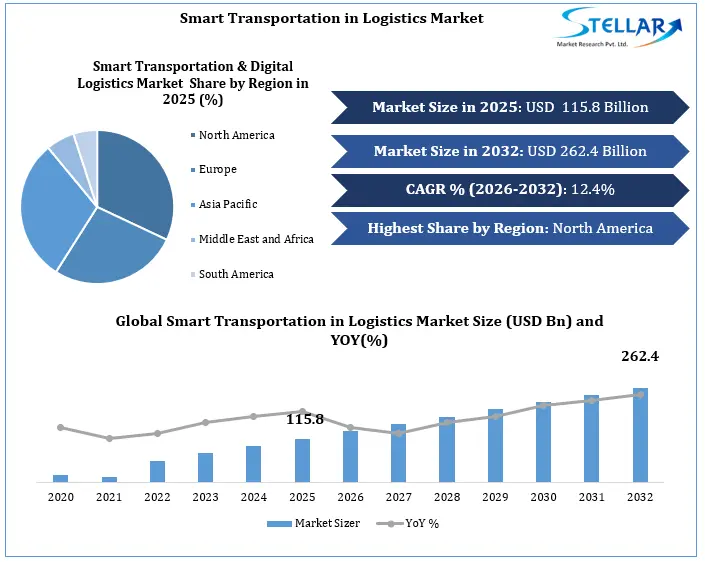
To get more Insights: Request Free Sample Report
Smart Transportation in Logistics Market Definition
Smart Transportation in Digital Logistics means using fleet telematics, GPS tracking, IoT Smart Transportation in Digital Logistics refers to the use of GPS tracking, fleet telematics, IoT sensors, route optimization, traffic data, AI, and real-time analytics to improve the movement of goods, vehicles, and logistics assets. It helps companies to track shipments, cut delays, save fuel, improve delivery accuracy and manage transport operations more efficiently.
Smart Transportation in Logistics Market Growth Drivers
Rising Demand for Connected Freight, Fleet, Port, and Urban Mobility Systems
Rising urban freight and last-mile delivery demand is a key growth driver for the Smart Transportation in Logistics Market. Higher parcel volumes, limited curbside space, traffic congestion, and time-sensitive deliveries are pushing logistics providers to invest in route optimization, dispatch management, last-mile delivery platforms, smart parking, and urban mobility management systems.
Fleet telematics and real-time logistics visibility are also accelerating market adoption. Fleet owners use telematics, driver analytics, fuel monitoring, asset tracking, and freight visibility platforms to reduce idle time, improve compliance, control fuel costs, and provide accurate delivery updates to shippers and customers.
As per the Indian Band Equity Foundation (IBEF), India’s logistics and transportation sector is strongly linked to the Smart Transportation in Logistics Market because its growth depends on digital freight visibility, route optimization, fleet telematics, warehouse-linked logistics software, smart ports, and paperless documentation. The trucking sector remains highly fragmented, with 70% of truck owners operating fewer than five trucks, creating demand for digital freight platforms, GPS tracking, fleet management, and transport management systems.
India’s road network expanded from 62.15 lakh km in FY21 to 63.73 lakh km by January 2023, supporting wider adoption of smart transportation tools. Rail freight loaded 758.20 MT during April–September 2023, while investment in the Dedicated Freight Corridor worth US$ 36.04 billion, supports rail freight digitization and multimodal logistics visibility.
Ports also create strong logistics demand, with India’s 7,500 km coastline, 12 major ports, and 200 minor/intermediate ports, while major ports handled 795 MT of cargo in 2022–23, up 10.4%.
The warehousing market is projected to reach US$ 34.50 billion, by 2027, growing at 15.64% CAGR, increasing demand for WMS, yard management, RFID, IoT tracking, and warehouse-transport integration.
Government programs such as PM GatiShakti, National Logistics Policy, Make in India, and ULIP are pushing logistics toward paperless processing, real-time shipment tracking, digital documentation, AI, IoT, big data, and end-to-end supply chain connectivity.
Smart public transport digitization is increasing spending on intelligent transportation systems. Transit agencies are adopting passenger information systems, fare collection platforms, fleet control software, operations planning tools, and multimodal mobility platforms to improve service reliability, reduce manual work, and enhance the commuter experience.
Smart ports, digital freight corridors, and multimodal logistics integration are also creating strong demand for digital freight platforms. Port authorities, rail freight operators, airport cargo users, customs agencies, and corridor managers are investing in cargo visibility, digital documentation, data exchange, and intermodal tracking to reduce delays and improve supply chain transparency.
Smart Transportation in Logistics Market Opportunities
AI-based route and network optimization offers one of the strongest opportunities in the Smart Transportation in Logistics Market. AI helps improve lane planning, fleet scheduling, delivery sequencing, congestion avoidance, and energy-aware routing. This shift moves the market beyond basic GPS tracking toward intelligent transport decision-making.
Supply chain control towers and predictive logistics are becoming high-value growth areas. Modern control towers help companies predict exceptions, detect inventory risks, coordinate suppliers, track carrier performance, and automate response workflows. This trend is increasing demand for analytics, integration, cloud software, and managed services.
Digital customs, e-documents, and blockchain logistics workflows are opening new revenue opportunities in cross-border trade. Electronic bills of lading, digital freight information, customs data exchange, and secure documentation platforms reduce paperwork, speed up clearance, and improve compliance.
Electric fleet and smart depot management platforms are also emerging as important opportunities. As fleet operators electrify their vehicles, they need software for charger scheduling, route-energy matching, depot load planning, battery monitoring, and vehicle availability management.
Smart Transportation in Logistics Market Trends
The Smart Transportation in Logistics Market is shifting from visibility-based tools to predictive and automated platforms. Buyers no longer want dashboards that only show shipment status. They now expect logistics control towers to combine freight data, inventory data, carrier performance, ETA prediction, and exception workflows.
Smart ports and digital freight corridors are becoming core infrastructure programs. Port and corridor operators now view digital platforms as essential operating systems that support cargo flow, customs coordination, intermodal tracking, and supply chain resilience.
Fleet telematics platforms are also evolving into broader operating layers. Vendors now combine routing, vehicle diagnostics, driver behaviour, fuel or battery performance, ELD compliance, safety monitoring, and maintenance alerts in one connected platform.
Public transport ITS is converging with smart mobility platforms. Transit agencies are linking passenger information, fare collection, bus operations, traffic signal priority, journey planning, and open data to build more connected urban mobility networks.
Overall, the market is moving toward integrated platforms that improve visibility, automation, sustainability, and operational efficiency across the full transport value chain.
Smart Transportation in Logistics Market Segmentation:
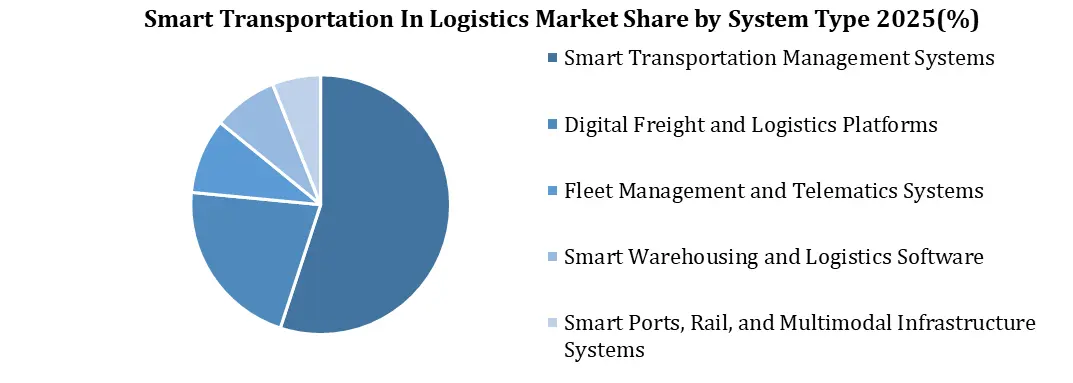
Smart Transportation in Logistics Market By System Type
Digital Freight and Logistics Platforms hold the highest share at 31%. This segment leads because TMS, freight visibility platforms, digital freight platforms, e-documents, control towers, and customs-linked workflows support high-frequency logistics execution across shippers, 3PLs, freight forwarders, carriers, ports, and customs-linked users.
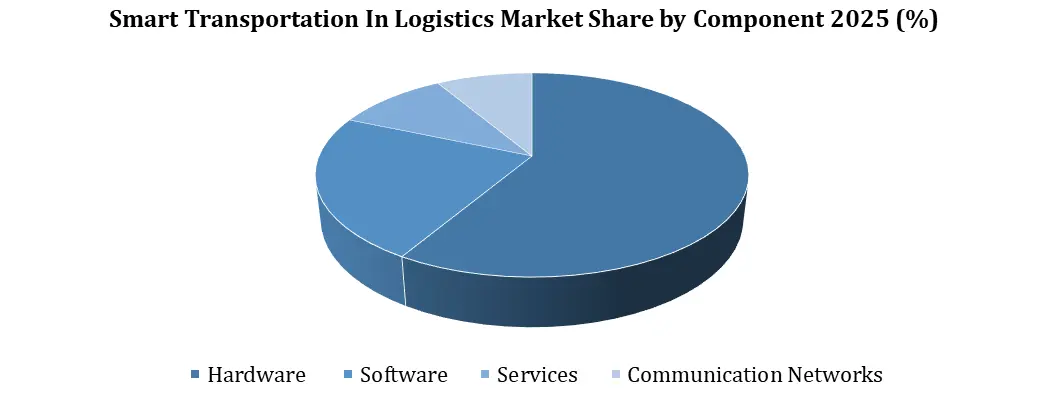
Smart Transportation in Logistics Market by Component
Software holds the highest share at 40%. This segment leads because cloud-based transport management systems, freight visibility tools, route optimization software, smart mobility platforms, warehouse-linked logistics systems, control towers, and AI logistics analytics form the core recurring revenue base of the market.
Smart Transportation in Logistics Market by Application
Freight Visibility and Transport Management holds the highest share at 30%. This segment leads because it sits at the core of daily freight execution, covering shipment planning, carrier selection, transport management systems, freight visibility platforms, ETA tracking, exception handling, customer updates, freight documentation, and carrier performance monitoring. Logistics companies, shippers, and 3PLs prioritize this application because manual shipment tracking cannot support high-volume, multi-carrier, cross-border, and time-sensitive logistics operations.
Smart Transportation in Logistics Market by End User
Logistics Service Providers and 3PLs hold the highest share at 25%. This group leads because 3PLs, freight forwarders, brokers, and contract logistics providers manage large freight volumes across shippers, carriers, warehouses, ports, customs points, and final delivery networks. They invest heavily in TMS, freight visibility platforms, digital freight tools, control towers, e-documentation, routing systems, and customer portals to improve shipment control, reduce manual coordination, manage exceptions faster, and protect service-level commitments.
Smart Transportation in Logistics Market Competitive Analysis 2025
The Smart Transportation in Logistics Market is becoming highly competitive as technology providers expand into connected transport, smart mobility, freight visibility, and logistics platforms. The market is led by two major supplier groups: smart transportation infrastructure providers in logistics solution providers.
Smart transportation infrastructure companies such as Siemens Mobility, Kapsch TrafficCom, Cubic, Thales, Indra, TransCore, SWARCO, Yunex Traffic, Kapsch TrafficCom, Hitachi Rail, Alstom, NEC, Mitsubishi Electric, Huawei, TomTom, Verra Mobility, Miovision, PTV Group, and Aimsun focus on traffic management, tolling, smart roads, rail digitization, public transit systems, passenger information, mobility analytics, and connected transport infrastructure. These players win through large public-sector projects, complex system integration, and strong ties with city authorities and transport agencies.
Digital logistics solution providers such as SAP, Oracle, IBM, Microsoft, Trimble, Descartes, Manhattan Associates, Blue Yonder, Körber, Kinaxis, project44, FourKites, Transporeon, Uber Freight, C.H. Robinson, Geotab, Samsara, Motive, and Verizon Connect compete in fleet telematics, freight visibility, transportation management systems, supply chain control towers, AI logistics analytics, route planning, driver safety, and managed transportation services.
Today, buyers no longer want standalone tools. They prefer connected platforms that improve real-time visibility, reduce delays, automate workflows, and link transport, logistics, fleet, and supply chain operations in one system. As a result, the market is shifting toward platform-based competition, where companies with strong analytics, automation, cybersecurity, multimodal connectivity, and seamless integration will gain the strongest market position.
Smart Transportation in Logistics Market Recent Developments
The Smart Transportation in Logistics market is seeing strong activity as major technology providers expand into AI-enabled transport, connected fleet systems, smart ports, freight visibility, logistics platforms.
- March 2026, Huawei strengthened its smart transportation portfolio by launching five intelligent transportation solution. For instance, Transportation Operations Coordination Center (TOCC) Solution, Transportation Operations Coordination Center (TOCC) Solution, and Chain-of-thought (CoT) technology among others. These solutions cover road operations, rail communication networks, customs big-data risk control, smart port scheduling, and intelligent horizontal transportation. The launch shows how the market is moving toward integrated platforms that connect road, rail, customs, port, and logistics operations through AI, 5G, cloud, sensing, and digital infrastructure.
- January 2025, the European Commission moved electronic Freight Transport Information, or eFTI, closer to operational use. This initiative supports certified freight data platforms, digital document workflows, API-based logistics data exchange, and compliance-ready transport systems. It also creates opportunities for platform vendors and service providers preparing for wider adoption into 2026.
These developments show that the market is moving beyond simple tracking and standalone software. Companies are building connected platforms that bring together freight execution, fleet safety, smart infrastructure, customs workflows, smart ports, and multimodal logistics. The market is becoming more AI-driven, more integrated, and more focused on real-time decision-making.
Smart Transportation in Logistics Market Regional Analysis
The Smart Transportation in Logistics Market shows strong regional variation based on digital infrastructure maturity, logistics demand, and government investment in intelligent transport systems. North America leads the market, driven by advanced adoption of AI-based logistics platforms, strong presence of major players, high investment in autonomous and connected vehicle technologies, and widespread use of cloud-based supply chain systems across the US and Canada.
Europe follows closely, supported by strict sustainability regulations, strong focus on green logistics, and rapid deployment of smart mobility solutions in countries like Germany, the UK, France, and the Nordics, especially in rail freight digitization and multimodal transport integration.
The Asia Pacific region is the fastest-growing market, fuelled by rapid e-commerce expansion, large-scale logistics modernization, and strong government initiatives in China, India, Japan, and South Korea for smart cities, digital freight corridors, and 5G-enabled transport systems. Middle East & Africa is gradually expanding with investments in smart ports, logistics hubs, and infrastructure modernization, particularly in the UAE and Saudi Arabia. South America is also growing steadily, led by Brazil and Chile, focusing on improving freight efficiency and transport adoption.
|
Smart Transportation in Logistics Market |
|||
|
Report Coverage |
Details |
||
|
Base Year: |
2025 |
Forecast Period: |
2026-2032 |
|
Historical Data: |
2020 to 2025 |
Market Size in 2025: |
USD 115.8 Bn. |
|
Forecast Period 2026 to 2032 CAGR: |
12.4% |
Market Size in 2032: |
USD 262.4 Bn. |
|
Segments
|
By System Type |
|
|
|
By Component
|
|
||
|
By Application |
|
||
|
By End User |
|
||
Key Players Profiles Covered in the Report
- Siemens Mobility
- Hitachi Rail
- IBM
- Huawei
- DHL Group
- UPS
- FedEx
- Maersk
- DB Schenker
- Kuehne + Nagel
- DSV A/S
- C.H. Robinson
- XPO Logistics
- GEODIS
- Uber Technologies
- SAP SE
- Oracle Corporation
- Others
Frequently Asked Questions
AI is used for route optimization, traffic prediction, demand forecasting, automated dispatching, and identifying inefficiencies in fleet operations to improve delivery accuracy and cost control.
Cloud platforms enable centralized data access, real-time collaboration between stakeholders, scalable logistics applications, and integration of multiple transport and warehouse systems.
Smart warehousing uses automation, robotics, and IoT systems to manage inventory, reduce manual errors, speed up order fulfilment, and improve supply chain responsiveness.
Digital logistics helps reduce emissions by optimizing routes, improving load efficiency, reducing empty trips, and enabling better monitoring of fuel and energy usage across fleets.
1. Market: Introduction
2.1. Smart Transportation in Logistics Market Size and Forecast (USD Billion)
2.2 Market Definition
2.3 Market Segmentation
2.4 Research Timelines
2.5 Assumptions
2.6 Limitation
3.1 Data Mining
3.2 Secondary Research
3.3 Primary Research
3.4 Subject Matter Expert Advice
3.5 Quality Check
3.6 Final Review
3.7 Data Triangulation
3.8 Top-Down Approach
3.9 Bottom-Up Approach
3.10 Research Flow
3.10 Data Sources
4. 1 Smart Transportation in Logistics Market Overview
4.2 Competitive Analysis: Funnel Diagram (Tier 1, Tier 2, Tier 3)
4.3 Smart Transportation in Logistics Market Absolute Market Opportunity
4.4 Smart Transportation in Logistics Market Attractiveness Analysis, By Region
4.5 Smart Transportation in Logistics Market Attractiveness Analysis, By System Type
4.6 Smart Transportation in Logistics Market Attractiveness Analysis, By Component
4.7 Smart Transportation in Logistics Market Attractiveness Analysis, By Application
4.8 Smart Transportation in Logistics Market Attractiveness Analysis, By End User
4.10 Future Market Opportunities
5.1 Smart Transportation in Logistics Market Evolution
5.2 Smart Transportation in Digital Logistics Adoption Analysis
5.3 Market Trends
5.4 Market Dynamics
5.4.1 Market Drivers
5.4.2 Market Restraints
5.4.3 Market Trends
5.4.4 Market Opportunity
5.5 Porter’s Five Forces Analysis
5.5.1 Threat of New Entrants
5.5.2 Bargaining Power of Suppliers
5.5.3 Bargaining Power of Buyers
5.5.4 Threat of Substitute Products
5.5.5 Competitive Rivalry of Existing Competitors
5.6 PESTEL Analysis
5.7 Value Chain Analysis
5.8 System Configuration and Installation Analysis
5.9 Pricing Analysis
5.10 Analysis Opportunity Outlook & Adoption Analysis
5.10 Geopolitical Impact Assessment
5.12 Regulatory Framework and Policy Impact Assessment
5.13 Technology Landscape
10.1 North America Smart Transportation in Digital Logistics Market
10.2 Europe Smart Transportation in Digital Logistics Market
10.3 Asia Pacific Smart Transportation in Digital Logistics Market
10.4 South America Smart Transportation in Digital Logistics Market
10.5 Middle East and Africa Smart Transportation in Digital Logistics Market
13. Merger & Acquisition
1. Siemens Mobility
2. Hitachi Rail
3. IBM
4. Huawei
5. DHL Group
6. UPS
7. FedEx
8. Maersk
9. DB Schenker
10. Kuehne + Nagel
11. DSV A/S
12. C.H. Robinson
13. XPO Logistics
14. GEODIS
15. Uber Technologies
16. SAP SE
17. Oracle Corporation
18. Others
15. Risk Assessment and Scenario Analysis
16. Strategic Opportunity
17. Investments & Funding Analysis
18. Strategic Roadmap
19. Analyst Recommendations