ENG
ENG Japanese
  French
  German
  Korean
Intelligent Transportation System Market: Global Industry Size, Smart Mobility Trends, AI Traffic Management Analysis, V2X Infrastructure Outlook, and Forecast 2026–2032
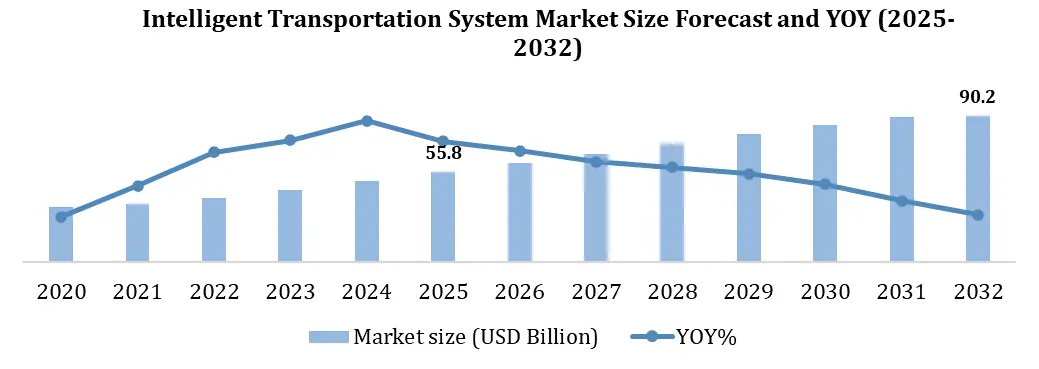
The Intelligent Transportation System Market is estimated at USD 55.8 billion in 2025 and is projected to reach USD 93.4 billion by 2032, growing at a 7.6% CAGR. Demand is primarily driven by transport agencies that use real-time control, tolling, enforcement, transit digitisation, and connected infrastructure to manage congestion, safety, and network reliability.
Intelligent Transportation System Market Overview
From standalone hardware solutions for traffic control, ITS has transformed into a comprehensive mobility infrastructure. Agencies increasingly seek integrated system solutions that include live data-gathering capabilities, incident management, signal optimisation, pricing, transport operations, passenger communication, and cross-agency coordination. In that case, software, communications, data analysis, and managed services take precedence over mere roadside installations.
Market growth is driven by public agencies operating in highly congested urban environments of high congestion, safety goals, the need for tolling upgrades, and obsolete traffic infrastructure tend to be the largest ITS users. Large metros are implementing new traffic operation centers and adaptive signals, highway departments are upgrading toll collection, enforcement, weather reaction, and connected corridor programs, transit agencies are deploying AVLs, dispatch systems, and real-time traveller information due to reliability requirements.
To get more Insights: Request Free Sample Report
Global Intelligent Transportation System Market Dynamics
The Global Intelligent Transportation System Market is growing as cities, highway operators, toll agencies, and transit providers shift from reactive traffic control to real-time, data-driven mobility management. ITS helps monitor road conditions, reduce congestion, detect incidents, improve signal timing, support electronic tolling, and strengthen public transport reliability.
Demand is driven by the need for safer roads, faster incident response, smoother tolling, better passenger information, and stronger control of congested corridors. As agencies move from one-time hardware installations to continuous digital upgrades, vendors offering scalable software, reliable equipment, integration, analytics, and managed services are well positioned to benefit.
Global Intelligent Transportation System Market Growth Drivers
- Urban congestion: Cities are adopting adaptive signals, sensors, cameras, and control centers to manage peak-hour traffic in real time.
- Road safety: Agencies are investing in incident detection, speed control, red-light enforcement, and pedestrian safety systems to reduce accidents.
- Electronic tolling: RFID, ANPR, free-flow tolling, and road pricing models are replacing manual toll collection.
- Public transport digitization: Transit operators are using AVL, dispatch software, passenger information systems, and integrated platforms to improve reliability.
Global Intelligent Transportation System Market Restraints
- High deployment cost: Cameras, sensors, gantries, control centers, V2X units, and communication networks require heavy upfront investment.
- Legacy systems: Old signal controllers, disconnected databases, and fragmented assets make integration slower and more expensive.
- Cybersecurity risks: ITS platforms handle traffic, tolling, enforcement, and passenger data, increasing security and privacy concerns.
- Slow procurement: Multiple agencies often share project responsibility, which can delay approvals and vendor payments.
Global Intelligent Transportation System Market Opportunities
- AI traffic analytics: AI can turn live traffic feeds into faster incident alerts, signal decisions, congestion forecasts, and enforcement support.
- V2X infrastructure: Connected corridors create demand for roadside units, cloud platforms, cybersecurity, and control-system integration.
- Smart transit platforms: Agencies need real-time vehicle tracking, dispatch control, passenger updates, and service recovery tools.
- Next-generation tolling: Distance-based charging and free-flow tolling open new revenue opportunities for tolling technology providers.
Global Intelligent Transportation System Market Challenges
- ITS projects often face long timelines, integration issues, interoperability gaps, and coordination problems across transport, police, tolling, and transit agencies.
- Cybersecurity, data governance, public resistance to enforcement, maintenance costs, uneven city readiness, and vendor lock-in can slow adoption.
Global Intelligent Transportation System Market Trends
- AI is entering live traffic rooms for incident detection, signal support, and network monitoring.
- Connected corridors are gaining policy support as V2X becomes part of road safety and smart mobility plans.
- Tolling systems are transitioning toward free-flow operations using ANPR, RFID, account-based systems, and back-office platforms.
- Transit ITS is becoming platform-led, combining operations control, passenger information, ticketing links, and analytics.
Global Intelligent Transportation System Market Segmentation Analysis
Global Intelligent Transportation System Market by System Type:
Advanced Traffic Management Systems (ATMS) dominated the Global Intelligent Transportation System Market with 34% share in 2025 and accounted for the largest market share due to increasing deployment of adaptive traffic signal control, integrated traffic command centers, AI-enabled congestion monitoring, incident detection platforms, and smart corridor management systems across major metropolitan regions. Governments and highway authorities across North America, Europe, China, and India significantly increased investments in real-time traffic optimization infrastructure to reduce urban congestion, improve emergency response efficiency, and strengthen road safety management. The growing adoption of smart intersections, intelligent surveillance cameras, variable message signboards, and predictive traffic analytics further accelerated demand for ATMS solutions. In addition, rising smart city investments and increasing pressure on transportation agencies to modernize aging road infrastructure continued to support large-scale deployment of traffic management systems.

Global Intelligent Transportation System Market by Component
Hardware leads with 39% share in 2025 because ITS deployment still depends on cameras, sensors, signal controllers, gantries, VMS, roadside units, and enforcement devices. Software grows through analytics, traffic platforms, tolling back offices, transit control, and AI-based optimization. Services gain from system integration, maintenance, cybersecurity, upgrades, and managed operations. Communication Networks expand as agencies connect field assets with control centers through fiber, wireless, cellular, and V2X-ready networks.
Global Intelligent Transportation System Market By Application
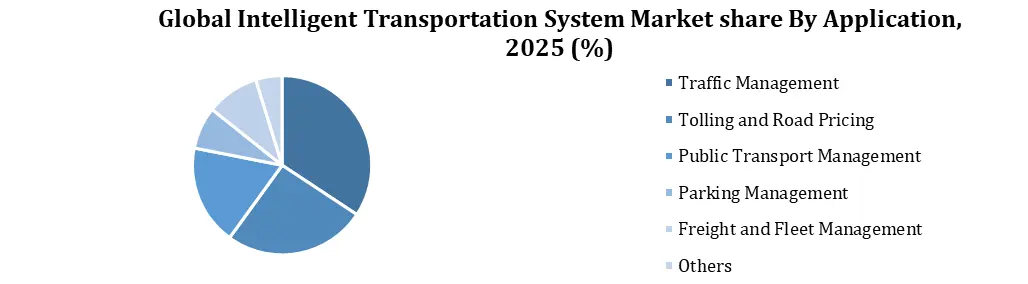
Traffic Management leads with 36% share, supported by congestion control, adaptive signalling, incident response, corridor monitoring, and city traffic command centers. Tolling and Road Pricing grow through ETC, free-flow tolling, congestion charging, and account-based payment systems. Public Transport Management gains from AVL, dispatch, passenger information, and service reliability tools. Parking Management grows through occupancy detection and guidance, while Freight and Fleet Management benefits from logistics routing and telematics.
|
Global Intelligent Transportation System Market |
|||||
|
Report Coverage |
Details |
||||
|
Base Year: |
2025 |
Forecast Period: |
2026-2032 |
||
|
Historical Data: |
2020 to 2025 |
Market Size in 2025: |
USD 55.8 Bn. |
||
|
Forecast Period 2026 to 2032 CAGR: |
7.6% |
Market Size in 2032: |
USD 93.4 Bn. |
||
|
Segments
|
By System Type |
Advanced Traffic Management System Advanced Traveler Information Systems Advanced Public Transportation Systems Electronic Toll Collection and Enforcement Systems Commercial Vehicle and Freight Management Systems Others |
|||
|
By Component
|
Hardware Software Services Communication Networks |
||||
|
By Application |
Traffic Management Tolling and Road Pricing Public Transport Management Parking Management Freight and Fleet Management Others |
||||
|
By Transportation Mode |
Roadways Railways Airways Maritime/Waterways |
||||
|
|
By End User |
Government & Public Sector Commercial Enterprises Logistics & Fleet Operators Smart City Authorities Consumers/Private Vehicle Owners Airport Authorities Railway Operators Maritime Authorities |
|||
Global Intelligent Transportation System Market Competitive analysis
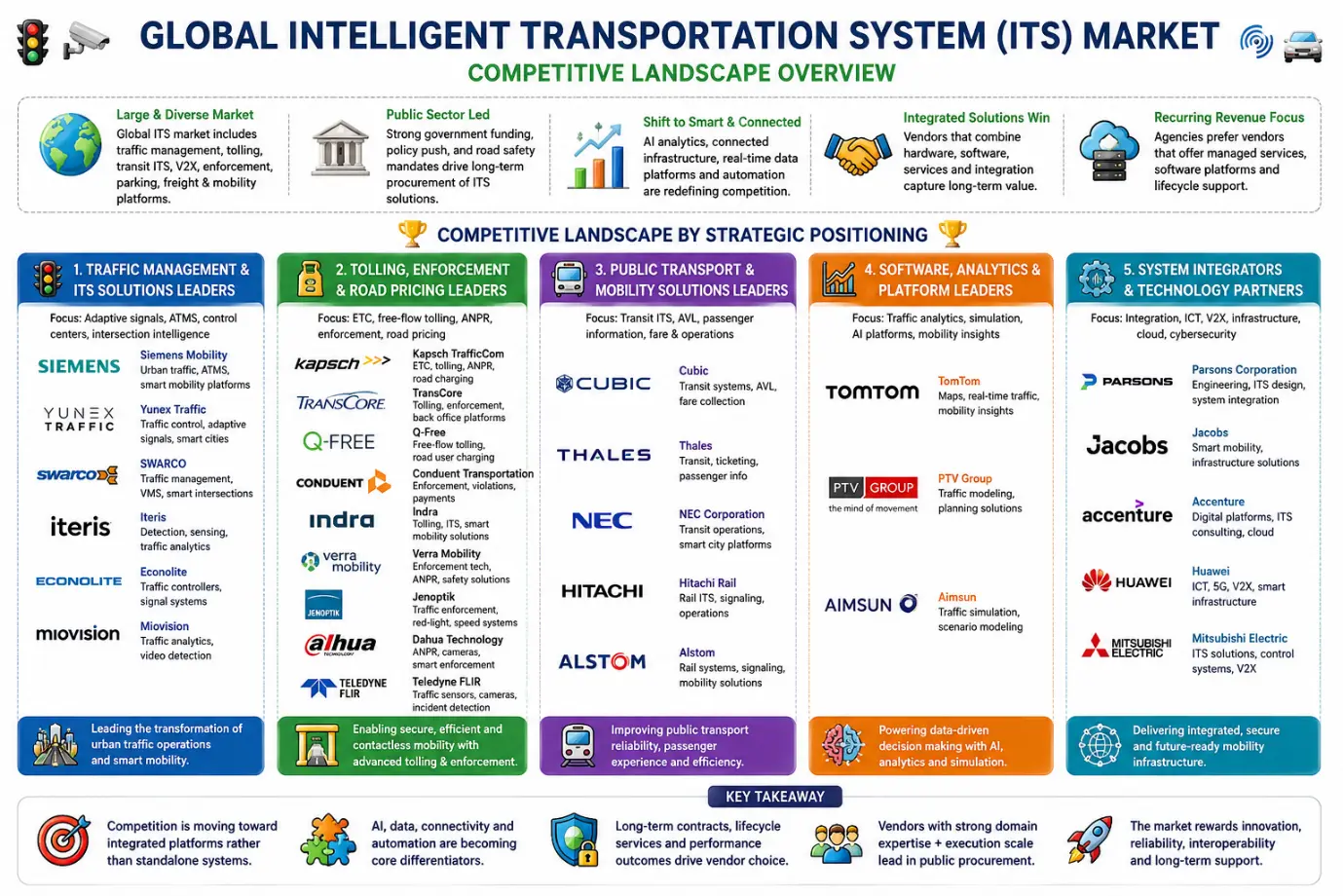
The Intelligent Transportation System Market features a broad mix of specialized technology vendors, tolling companies, transit solution providers, software firms, and system integrators. Siemens Mobility, Yunex Traffic, SWARCO, Econolite, Iteris, and Miovision compete strongly in traffic management, adaptive signal control, intersection intelligence, and urban mobility platforms. These companies stand out through their ability to combine roadside equipment, traffic software, analytics, and control-room capabilities.
Tolling and enforcement vendors form another major competitive group. Kapsch TrafficCom, TransCore, Q-Free, Conduent Transportation, Indra, Verra Mobility, Jenoptik, Dahua Technology, and Teledyne FLIR serve agencies with free-flow tolling, ANPR, speed enforcement, red-light enforcement, account-based tolling, and violation processing solutions. Their strength lies in delivering high-volume, rules-based systems that support revenue collection, compliance, and automated road operations.
Public transport and mobility technology providers add another layer of competition. Cubic, Thales, NEC, Hitachi Rail, and Alstom focus on transit operations, fare systems, passenger information, rail-linked mobility, and service management platforms. Meanwhile, TomTom, PTV Group, and Aimsun compete through traffic data, simulation, routing, and analytics software. Parsons, Jacobs, Accenture, Huawei, and Mitsubishi Electric strengthen the market through large-scale system integration, ICT infrastructure, communications, and end-to-end project delivery.
Global Intelligent Transportation System Recent Movements, 2025
- V2X moved closer to real-world deployment: In 2025, U.S. agencies started turning connected-corridor plans into deployment-ready projects under the National V2X Deployment Plan. This created stronger demand for roadside units, secure communication systems, signal integration, and connected safety applications.
- Europe strengthened ITS interoperability: The EU continued pushing digital road operations through its ITS framework, with a focus on road data sharing, safety information, multimodal services, and coordinated deployment across the TEN-T network.
- India advanced digital tolling: India launched its first Multi-Lane Free Flow tolling system at Choryasi Fee Plaza on NH-48. The system uses FASTag, vehicle-number recognition, and barrier-free toll collection to cut delays and improve toll efficiency.
- Singapore kept road pricing at the center of traffic control: Singapore continued using ERP to manage congestion through demand-based pricing, electronic payments, gantry infrastructure, and traffic-flow management tools.
- AI gained momentum in tolling and enforcement: Agencies showed growing interest in AI-based vehicle recognition, automated classification, and digital toll deduction to reduce delays, prevent revenue leakage, and improve enforcement accuracy.
Global Intelligent Transportation System Regional Market Analysis:
North America leads with a 32% share due to mature freeway management systems, tolling infrastructure, connected mobility projects, and strong government funding. Programs such as the U.S. ATTAIN initiative continue to support the deployment of advanced transportation technologies. Asia Pacific accounted for a 29% market share in 2025 and is expected to register the fastest growth during the forecast period. India’s FASTag, Singapore’s ERP system, China’s smart transport investments, and Japan’s connected-road infrastructure are driving demand for ETC, smart highways, traffic management, and V2X systems.
Europe holds 27% share, supported by ITS Directive implementation, road safety initiatives, congestion management, and public transport digitization. The updated EU ITS framework is accelerating intelligent mobility deployment across member nations. The Middle East & Africa contributes xx% share, driven by smart city transport projects, highway monitoring, and traffic control modernisation. Dubai’s RTA ITS expansion project is a major regional growth contributor. South America represents xx% share, supported by toll-road upgrades, BRT systems, electronic tolling, fleet management, and urban mobility investments across Brazil, Chile, and Colombia.
Key Players Profiles covered in the Global Intelligent Transportation System Market Report
- Siemens Mobility
- Yunex Traffic
- Kapsch TrafficCom
- SWARCO
- Q-Free
- TransCore
- Cubic Transportation Systems
- Indra
- Conduent Transportation
- Iteris
- Econolite
- Miovision
- Parsons Corporation
- NEC Corporation
- Mitsubishi Electric
- Huawei
- Dahua Technology
- Jenoptik
- Teledyne FLIR
- PTV Group
- Verra Mobility
- Sumitomo Electric
- SICE
- VITRONIC
- Pumatronix
- Perkons
- Mobilis
- LectorVision
Frequently Asked Questions
The Intelligent Transportation System Market size is estimated at USD 55.8 billion in 2025, driven by traffic control modernization, electronic toll collection, road safety systems, smart highways, and public transport digitization.
The Global Intelligent Transportation System Market is projected to reach USD 93.4 billion by 2032, growing at a 7.6% CAGR from 2025 to 2032, supported by AI traffic analytics, V2X infrastructure, free-flow tolling, and connected mobility platforms.
Advanced Traffic Management Systems lead the Intelligent Transportation System Market because cities and highway authorities continue to invest in adaptive traffic signals, traffic control centers, cameras, road sensors, incident detection, and real-time traffic analytics.
The key growth drivers include rising urban congestion, road safety investment, electronic tolling adoption, smart highway development, public transport digitization, AI-based traffic management, V2X infrastructure, and demand for real-time mobility data.
1. Intelligent Transportation System Market: Introduction
2. Intelligent Transportation System Market: Executive Summary
2.1. Global Intelligent Transportation System Market Estimates And Forecast (USD Billion)
2.2 Market Definition
2.3 Market Segmentation
2.4 Research Timelines
2.5 Assumptions
2.6 Limitation
3. Intelligent Transportation System Market: Research Methodology
3.1 Data Mining
3.2 Secondary Research
3.3 Primary Research
3.4 Subject Matter Expert Advice
3.5 Quality Check
3.6 Final Review
3.7 Data Triangulation
3.8 Top-Down Approach
3.9 Bottom-Up Approach
3.10 Research Flow
3.11 Data Sources
4. Intelligent Transportation System Market: Market Attractiveness Mapping
4. 1 Global Intelligent Transportation System Market Overview
4.2 Competitive Analysis: Funnel Diagram (Tier 1, Tier 2, Tier 3)
4.3 Global Intelligent Transportation System Market Absolute Market Opportunity
4.4 Global Intelligent Transportation System Market Attractiveness Analysis, By Region
4.5 Global Intelligent Transportation System Market Attractiveness Analysis, By System Type
4.6 Global Intelligent Transportation System Market Attractiveness Analysis, By Component
4.7 Global Intelligent Transportation System Market Attractiveness Analysis, By Application
4.8 Global Intelligent Transportation System Market Attractiveness Analysis, By Transportation Mode
4.9 Global Intelligent Transportation System Market Attractiveness Analysis, By End User
4.10 Future Market Opportunities
5. Intelligent Transportation System Market: Market Outlook
5.1 Global Intelligent Transportation System Market Evolution
5.2 Global Intelligent Transportation System Market Outlook
5.3 Market Drivers
5.4 Market Restraints
5.5 Market Trends
5.6 Market Opportunity
5.7 Porter’s Five Forces Analysis
5.7.1 Threat Of New Entrants
5.7.2 Bargaining Power Of Suppliers
5.7.3 Bargaining Power Of Buyers
5.7.4 Threat Of Substitute Products
5.7.5 Competitive Rivalry Of Existing Competitors
5.8 Value Chain Analysis
5.9 Pricing Analysis
5.10 Geopolitical Impact Analysis on Intelligent Transportation System Market
5.11 Regulatory Standards & Industry Associations
5.12 Technology Analysis
5.13 Strategic ROI & Operational Efficiency Analysis
6. Intelligent Transportation System Market: By System Type
7. Intelligent Transportation System Market: By Component
8. Intelligent Transportation System Market: By Application
9. Intelligent Transportation System Market: By Transportation Mode
10. Intelligent Transportation System Market By End User
11. Intelligent Transportation System Market: Geography
11.1 Intelligent Transportation System Market : North America
11.2 Intelligent Transportation System Market: Europe
11.3 Intelligent Transportation System Market : Asia Pacific
11.4 Intelligent Transportation System Market: South America
11.5 Intelligent Transportation System Market: Middle East And Africa
12. SMR Competitive Matrix
13. Intelligent Transportation System Market: Company Benchmarking
14. Intelligent Transportation System Market: Company Profiles
14.1 Siemens Mobility
14.2 Yunex Traffic
14.3 Kapsch TrafficCom
14.4 SWARCO
14.5 Q-Free
14.6 TransCore
14.7 Cubic Transportation Systems
14.8 Indra
14.9 Conduent Transportation
14.10 Iteris
14.11 Econolite
14.12 Miovision
14.13 Parsons Corporation
14.14 NEC Corporation
14.15 Mitsubishi Electric
14.16 Huawei
14.17 Dahua Technology
14.18 Jenoptik
14.19 Teledyne FLIR
14.20 PTV Group
15. Strategic Opportunity
16. Merger & Acquisition
17. Investments & Funding Analysis
18. Strategic Roadmap
19. Analyst Recommendations