ENG
ENG Japanese
  French
  German
  Korean
Forklift Market Size, Market Share, Growth Trends, Industry Analysis, Key Players, Investment Opportunities and Forecast 2026-2034
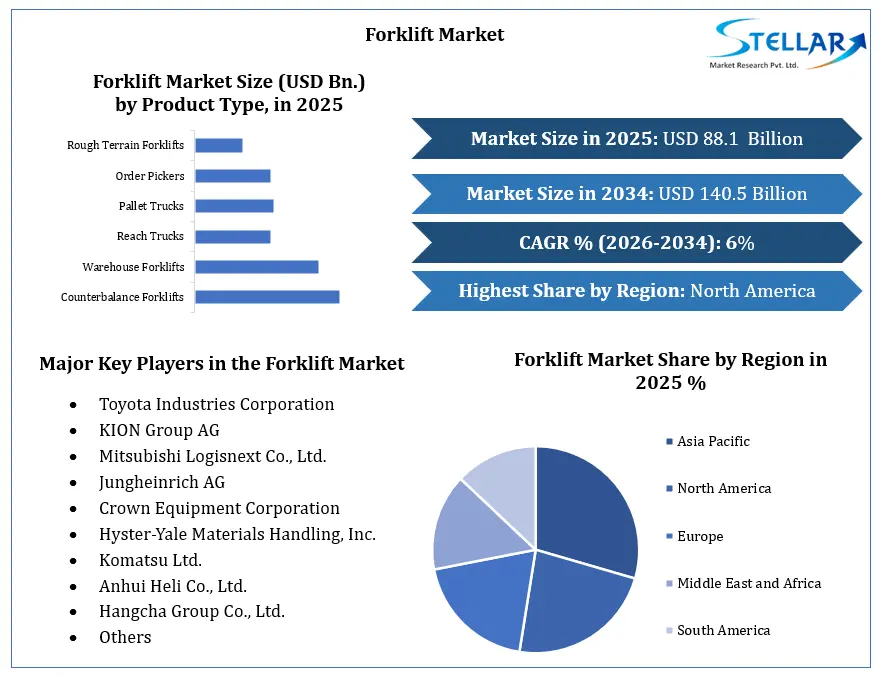
The Forklift Market is estimated to be valued at USD 88.1 billion in 2025 and is expected to touch USD 140.5 billion in 2034, recording a CAGR of 6%. This market growth can be attributed to various factors such as fast growth in warehousing and logistics infrastructures, increasing use of e-commerce and third-party logistics (3PL) services, and increasing investment in manufacturing, construction, and port operations.
Moreover, the growing trend of using electric and autonomous forklifts, due to increasing stringent emission norms and technological advancements in battery technologies, presents huge growth potential in the global forklift market.
Forklift Market Overview
The Forklift Market is experiencing stable growth on account of fast growth in the e-commerce, warehousing, manufacturing, and logistics sectors coupled with high demands for material handling solutions. Growing use of electric and lithium-ion battery-powered forklifts, high automation of warehouses, and developments in autonomous forklifts, telematics, and fleet management solutions are driving the growth in the market. The increasing investment in advanced distribution canters and material handling equipment is anticipated to fuel market growth in the coming years.
To get more Insights: Request Free Sample Report
As per the National Action Plans on Business and Human Rights, the forecasted growth of the global construction industry by USD 4.5 trillion up to USD 15.2 trillion within the coming 10 years will result in a huge increase in demand for forklifts. As China, India, United States, and Indonesia constitute 58.3% of this forecasted growth in the construction sector, there will be a great need for material handling equipment that will help shift heavy construction materials and machinery. Furthermore, investment in sustainable infrastructure in line with the United Nations' Sustainable Development Goals (SDG 9 and SDG 11) and the forecasted addition of 2 billion urban dwellers by 2050 are leading to the creation of new residential and infrastructural projects, which necessitates the use of forklifts.
Market Definition and Scope:
A forklift is a powered industrial truck that is used to load, transport, stack, and lift heavy loads in short-distance transportation in warehouse, factories, construction yards, ports, and distribution facilities. This vehicle is equipped with hydraulic forks that will enable efficient and safe handling of materials.
Forklift Market consists of electric forklifts and internal combustion forklifts, such as counterbalance forklifts, reach trucks, pallet trucks, rough-terrain forklifts, and automated forklifts. The market involves the sale of new equipment, renting, after-sales services, batteries, and fleet management solutions utilized in logistics, manufacturing, construction, retailing, mining, and ports.
Forklift Market Growth Drivers
Surging Investments in Residential, Commercial, and Infrastructure Development
Growth in the number of residential, commercial, industrial and public infrastructure projects due to increasing investments creates a high demand for forklifts, as it generates the necessity to manage construction materials through effective material handling processes. The development of such major projects as highways, bridges, airports, railways, seaports and smart cities needs forklifts for transportation, loading, unloading and stacking of bulky construction materials, steel structures, blocks of concrete, and other equipment safely and efficiently. Moreover, growing trend towards mechanization, speedy construction process execution and safety at work places stimulates usage of electric and rough terrain forklifts worldwide.
Some of the investment that are positively impact on the market growth are as follows:
- On January 2025, India’s government sanctioned 56 Watershed Development Projects, valued at Rs. 700 crore (USD 80.9 million) in January 2025, and the development of infrastructure through programs like PM Gati Shakti, the National Logistics Policy, and the construction of 120 new airports will create more need for forklifts to handle materials.
- On July 2024, the UAE’s government has sanctioned a budget of AED 64.1 billion (USD 17.5 billion) for the year 2024, and the Roads & Transport Authority (RTA) of Dubai has sanctioned 10 infrastructure projects valued at AED 2.5 billion (USD 680 million) for 2024 to 2026. Moreover, UAE’s construction industry is expected to grow by 3.8% per year on an average basis during 2026 to 2028.
Northward Direct Growth In E-commerce & Warehousing Industry
The growth of the e-commerce and warehousing industry acts as one of the main drivers of the forklift industry since the growing online commerce is contributing towards increasing the requirement for material handling within the warehouses, fulfilment centres, and distribution centre’s. The organizations are focusing on developing larger storage capacity, automated warehouse, and logistic infrastructures, thus increasing the demand for different types of forklifts such as electric, reach, pallet, and autonomous forklifts.
According to the Competition Commission of India, the Indian e-commerce industry is estimated to expand from USD 38.5 billion in 2017 to reach USD 200 billion in 2026 due to high penetration rates of the Internet and smartphones in the country. The fast pace of development has intensified investments in warehouse facilities, resulting in an increased need for forklifts that are involved in material handling and inventory management.
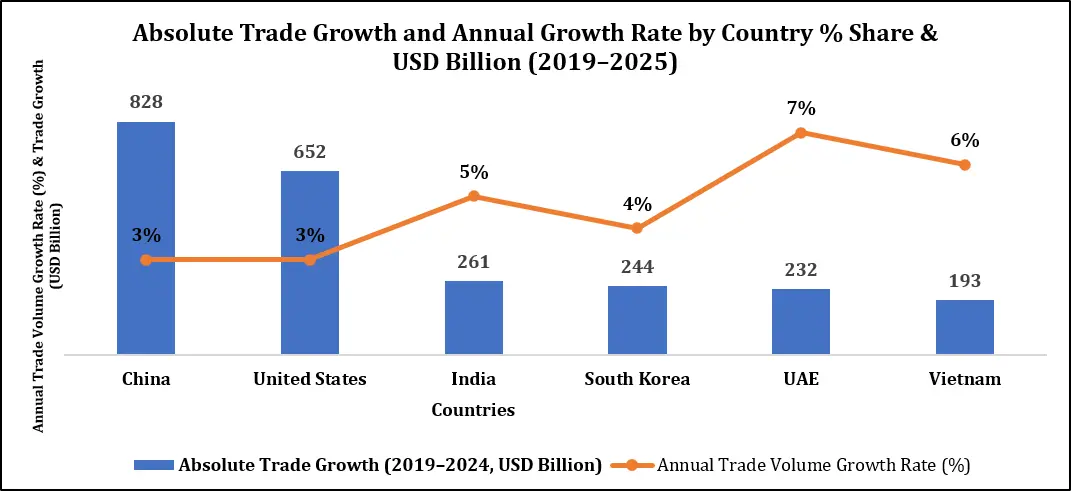
The global organizations have already made investments amounting to over USD 100 billion into Chinese logistics warehouses, manufacturing facilities, office building structures, and logistics facilities over the past decade, underlining the long-term significance of China as a global logistics hub in 2024. Despite having a high vacancy rate of 19.2% in the East China region and 16.5% overall in the country in the first quarter of 2024 due to overproduction, the companies keep investing into development of the logistics warehouse facilities, with another 33 million square meters of logistics warehouse facilities to be completed by the end of 2026. The firms including Forest Logistics Properties are also making investments into development of logistics facilities in the Greater Bay Area, pointing at the confidence towards China's logistics industry in the long run.
Rising Adoption of Electric Forklifts
Emission regulations and sustainability efforts have been fuelling the transition from using internal combustion to electric or lithium-ion forklifts owing to their minimal emissions, lower running cost, increased efficiency, and appropriateness for use in warehouse and logistics operations.
- On June 2026, Hyster Company introduced its E2.2–3.5XN2 series of electric forklifts that have a load capacity of 2,000 to 3,500 kilograms with 20% more efficiency than its competitors and lift and lower operations being performed at a 65% faster speed. Introduction of Lithium-ion and other efficient batteries is an indication of increased adoption of efficient electric forklifts in the industry.
- On November 2025, Vedanta Aluminium increased the size of India’s largest fleet of electric forklifts powered by lithium-ion batteries to 142 units in Odisha and Chhattisgarh, increasing the fleet size by more than double. This move is anticipated to cut down about 4,450 tons of CO? equivalents emissions per annum and diesel use of 16.3 lakh liters per annum.
Forklift Market Opportunities
Advancements in Autonomous and AI-Enabled Forklifts
The use of artificial intelligence (AI), machine vision, telematics, IoT, and fleet management technologies is providing substantial opportunities for growth within the forklift industry. The autonomous forklift improves productivity, enhances safety measures, optimizes fleet performance, and cuts labour dependence, thereby making autonomous forklifts increasingly popular in warehouses, manufacturing plants, and logistics centre’s.
For example, on April 2026, NOBLELIFT introduced NobleOne, which was the industry's first AI-powered forklift platform, at the MODEX 2026 event. The new platform boosts productivity and fleet performance with the use of AI-powered automation and insights.
Rising Investments in Green Logistics and Sustainable Supply Chains
With more and more companies making net zero pledges and launching initiatives for Environmental Social Governance (ESG), in addition to making more investments in green logistics, there are many openings for the forklift industry as more low emission electric forklifts and energy efficient material handling equipment is going to be adopted. For instance, on October 2025, CAF – Development Bank of Latin America and the Caribbean approved funding worth USD 1.086 billion for various sustainable infrastructure projects in countries such as Brazil, Colombia, Uruguay, and Chile. This includes railway infrastructure improvements, urban infrastructure developments, water infrastructure development and green infrastructure development projects. This will help boost the sales of forklifts used in construction and logistics operations.
Forklift Market Trends
Rapid Adoption of Electric and Lithium-Ion Forklifts
Companies are now switching from using diesel forklifts to electric forklifts as well as lithium-ion forklifts to help decrease carbon emissions and save on cost. With fast charging and increased life span of batteries provided by lithium-ion forklifts, the switch to electric and lithium-ion forklifts has become easier and faster.
Development of Hydrogen Fuel Cell Forklifts
Fuel cells based on hydrogen are increasingly used in forklifts, especially in busy warehouse and logistic centre’s, owing to quick re-fuelling, extended working hours, non-emitting exhaust gas, and reliability. Increased financing in hydrogen facilities and clean energy solutions promotes use of hydrogen fuel cell forklifts as an environmentally-friendly alternative to traditional forklifts.Top of Form
Forklift Market Challenges
Limited Charging and Hydrogen Refuelling Infrastructure
The insufficient number of electric charging facilities and hydrogen refuelling stations poses as one of the biggest problems in the forklift industry, thus hindering the proliferation of electric and fuel cell forklifts. It is especially seen in developing countries and isolated industries due to the lack of proper facilities there.
Limited Adoption Among Small and Medium Enterprises (SMEs)
High upfront costs of acquisition, inadequate capital funds, and financing issues prevent many small and medium enterprises from investing in modern electric forklifts, lithium-ion batteries, and autonomous forklifts. Consequently, most small businesses keep using traditional or rental machines.
Forklift Market Segmentation
Forklift Market, By Product Type
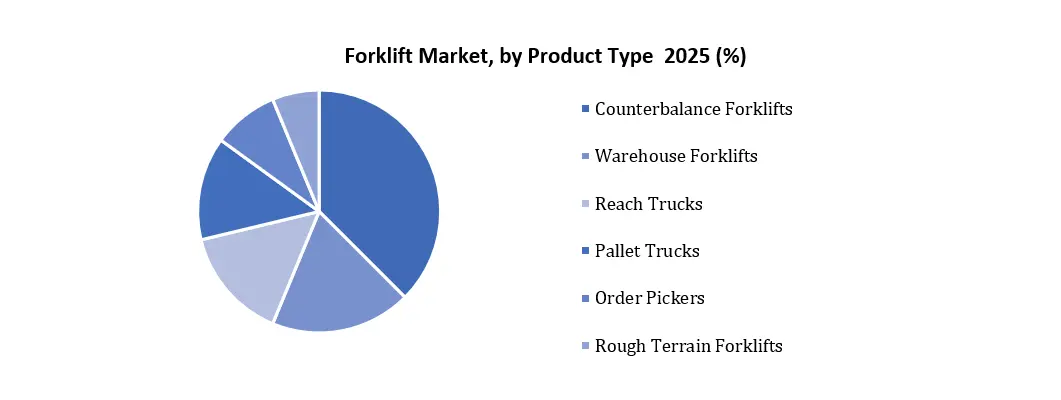
The Counterbalance Forklifts product type holds the dominant position in the Forklift Market and will have a forecasted market share of 38.0% in 2025 due to their widespread usage in the field of manufacturing, warehousing, logistics, and construction for the purposes of material handling. The Warehouse Forklifts product type is the most rapidly growing segment of the market and will witness the highest CAGR of 9.1% throughout the forecast period due to rising e-commerce and automation of warehouses.
Forklift Market, By Power Source
Forklifts with Internal Combustion (Diesel, LPG/CNG, Gasoline) engines are expected to hold the largest market share of 52.0% in 2025 owing to their higher power output, extended operational duration, and capacity to lift heavier weights in tough outdoor applications including construction sites, ports, mining activities, and large industrial units, wherein continuous working is crucial.
On the other hand, Forklifts with Electric Engines are anticipated to register the highest compound annual growth rate (CAGR) of 10.2%. Growth factors like increasing inclination towards low-emitting machines, technological developments in lithium-ion batteries, cost savings in maintenance expenses, and increased use of automatic warehousing solutions have been boosting demand for electric forklifts in logistics, manufacturing, and retail industries.
Forklift Market, By Load Capacity
In terms of market share, the Below 5 Tons segment is expected to dominate with a share of 61.0%, owing to the widespread application of such forklifts in warehouses, manufacturing units, and retail distribution centre’s, where compact, efficient, and cost-effective forklifts are required for performing material handling activities on a regular basis. On the other hand, the 10-20 Tons segment is estimated to witness the highest CAGR of 8.7% during the forecast period, due to rising applications in ports, heavy industries, steel manufacturing units, mining, and infrastructure development projects.
Forklift Market, By Sales Channel
Dealers and Distributors are likely to dominate in terms of the largest market share of 47.0% by 2025 due to having extensive sales network regions, post-sale services, maintenance, financing, and spare parts facilities, thus becoming the most preferred route of purchasing forklifts for various businesses.
Rental and Leasing is poised to become the highest growing sales route owing to the increased trend toward using this option for more flexible fleet management and less upfront investments. Business entities working in logistics, construction, manufacturing, and warehousing are opting for forklift rentals and leasing.
Forklift Market, By End-Use Industry
In 2025, the Manufacturing industry will continue to be the biggest revenue generator and hold an estimated 28.0% share of the total market. Forklifts used to move around raw materials, WIP stock, and finished products from manufacturing units along with advancements in the level of industrial automation have strengthened the dominance of the industry.
The Warehousing & Logistics industry is likely to emerge as the most rapidly growing end-use industry due to the fast growth in the field of e-commerce, 3PLs, and fulfilment centre’s. Increasing spending on modern warehousing and logistics systems is facilitating the use of forklifts.
Forklift Market Regional Analysis:
The Asia-Pacific region is anticipated to rule the Forklift Market with a market share of 46.0% in 2025, owing to the high manufacturing output, industrialization, development of e-commerce, and warehousing facilities in China, India, Japan, and Southeast Asia. The region will continue experiencing steady demand for material handling equipment from various end-use industries like logistics, automotive, construction, and manufacturing.
The Middle East & Africa region is anticipated to be the fastest-growing regional market, owing to rising investments in logistics facilities, smart warehouses, ports, airports, industrial complexes, and infrastructure projects. The government’s drive towards economy diversification and development of efficient supply chain will aid in the rising adoption of forklifts in the region.
Forklift Market Competitive Analysis:
Market of Forklifts is very competitive as there are a number of global as well as regional companies which compete by coming up with innovations and efficient products. Some of the key players that are part of the forklift market include Toyota Industries Corporation, KION Group AG, Mitsubishi Logisnext Co., Ltd., Jungheinrich AG, Crown Equipment Corporation, Hyster-Yale Materials Handling, Inc., Komatsu Ltd., Anhui Heli Co., Ltd., Hangcha Group Co., Ltd., Doosan Bobcat Inc., Clark Material Handling Company, and Noblelift Intelligent Equipment Co., Ltd.
Competitive dynamics revolve around innovations within the sectors of warehouse automation, electric power, battery technology, autonomous material handling, and smart fleet management. Top players gain competitive advantages through innovations in products, partnerships, mergers and acquisitions, international reach, and improved customer service, while smaller companies compete by offering affordable products, tailor-made solutions, and excellent dealer network.
Competitive Landscape: Executive Summary
Forklift Market Competition is very high due to the rising need for automated warehouses, environmentally friendly material handling, electric mobility, and fleet management solutions. Major players are concentrating on the development of electric forklifts, lithium-ion forklifts, hydrogen fuel cells forklifts, self-driving forklifts, and artificial intelligence-driven fleet management systems. The increased usage of smart warehouses, e-commerce fulfillment centre’s, and Industry 4.0 solutions has further heightened the competition in the market.
Competitive Landscape highlights important competitors within the industry such as Toyota Industries Corporation, KION Group AG, Mitsubishi Logisnext Co., Ltd., Jungheinrich AG, Crown Equipment Corporation, Hyster-Yale Materials Handling, Inc., Komatsu Ltd., Anhui Heli Co., Ltd., Hangcha Group Co., Ltd., Doosan Bobcat Inc., Clark Material Handling Company, and Noblelift Intelligent Equipment Co., Ltd. The review considers the companies in terms of their product portfolio, electric forklifts, autonomous forklifts, innovations, geographical presence, manufacturing capacity, distribution channels, and strategy. This segment helps manufacturers, warehouses, logistics companies, distributors, investors, and end users of the products understand competitive positioning and innovation trends in the global forklifts market.
Competitive Benchmarking:
|
Rank (2025) |
Company |
Headquarters |
Key Brands / Business |
|
1 |
Toyota Industries Corporation (Toyota Material Handling) |
Japan |
Toyota, Raymond |
|
2 |
KION Group AG |
Germany |
Linde, STILL, Baoli, Fenwick |
|
3 |
Jungheinrich AG |
Germany |
Jungheinrich Electric Forklifts & Warehouse Equipment |
|
4 |
Mitsubishi Logisnext Co., Ltd. |
Japan |
Mitsubishi Forklift Trucks, UniCarriers, CAT Lift Trucks, Rocla |
|
5 |
Crown Equipment Corporation |
United States |
Crown Electric Forklifts & Warehouse Solutions |
Market of Forklift Recent Market Developments:
- On July 2026, Maxlion introduced a range of its new electrified forklifts in the 4.5-10T range to broaden its line of electric products for heavy duty applications. The line is designed based on the existing internal combustion forklifts but offers diesel-like performance in the form of lithium-powered electric trucks.
- On May 2026, introduction of Multi-Ion Battery Technology by Godrej Enterprises Group has become a major breakthrough in India as the technology is the world's first for electric forklifts. The introduction of this technology will help in ensuring improved equipment availability, resulting in lowering the total cost of ownership by 25 percent.
|
Forklift Market |
|||
|
Report Coverage |
Details |
||
|
Base Year: |
2025 |
Forecast Period: |
2026-2034 |
|
Historical Data: |
2020 to 2025 |
Market Size in 2025: |
USD 88.1 Bn. |
|
Forecast Period 2026 to 2034 CAGR: |
6% |
Market Size in 2034: |
USD 140.5Bn. |
|
Segments
|
By Product Type
|
|
|
|
By Power Source |
|
||
|
By Load Capacity |
|
||
|
By Sales Channel |
|
||
|
By End-Use Industry |
|
||
Forklift Market Key Players
- Toyota Industries Corporation
- KION Group AG
- Mitsubishi Logisnext Co., Ltd.
- Jungheinrich AG
- Crown Equipment Corporation
- Hyster-Yale Materials Handling, Inc.
- Komatsu Ltd.
- Anhui Heli Co., Ltd.
- Hangcha Group Co., Ltd.
- Doosan Bobcat Inc.
- Clark Material Handling Company
- Noblelift Intelligent Equipment Co., Ltd.
- Godrej & Boyce Manufacturing Company Limited
- EP Equipment
- Combilift
- Manitou Group
- Hyundai Material Handling
- Lonking Holdings Limited
- Linde Material Handling
- Baoli Forklifts
- MECALAC Group
- HELI Canada
- Tailift Group
- Hubtex Maschinenbau GmbH & Co. KG
- BYD Forklift
- UniCarriers
- Big Joe Forklifts
- Maxlion Machinery Equipment Co., Ltd.
- Royal Forklift (Xiamen) Co., Ltd.
- LiuGong Machinery Co., Ltd.
- Others
Frequently Asked Questions
Market growth is driven by expanding warehousing and logistics activities, rapid e-commerce growth, increasing industrialization, rising investments in construction and infrastructure, and the growing adoption of electric and automated forklifts for efficient material handling.
The Counterbalance Forklifts segment dominates the market with an estimated 38.0% share in 2025, owing to its versatility and widespread use across manufacturing, warehousing, construction, and logistics operations.
The Internal Combustion (Diesel, LPG/CNG, and Gasoline) segment leads the market with an estimated 52.0% share in 2025, supported by its high lifting capacity and suitability for heavy-duty outdoor applications.
Key opportunities include the adoption of autonomous and AI-enabled forklifts, warehouse automation, expansion of green logistics, increasing use of lithium-ion and hydrogen fuel cell forklifts, and the growth of smart warehouses and fulfillment centre’s.
Major challenges include the high initial cost of advanced forklifts, limited charging and hydrogen refuelling infrastructure, volatile raw material and battery prices, skilled labour shortages, and supply chain disruptions affecting production and deliveries.
- Forklift Market Introduction
- Study Assumption and Market Definition
- Scope of the Study
- Executive Summary
- Forklift Market: Competitive Landscape
- SMR Competition Matrix
- Key Players Benchmarking
- Company Name
- Headquarter
- Product Segment
- End-User Segment
- Revenue Details in 2025
- Market Share (%)
- Growth Rate (%)
- Distribution Channel
- Return on Investment (%)
- Technological Capabilities
- Geographical Presence
- Market Structure
- Market Leaders
- Market Followers
- Emerging Players
- Mergers and Acquisitions Details
- Forklift Market: Dynamics
- Forklift Market Trends
- Forklift Market Dynamics
- Drivers
- Opportunities
- Trends
- Challenges
- PORTER’s Five Forces Analysis
- PESTLE Analysis
- Regulatory Landscape by Region
- Key Opinion Leader Analysis for the Global Industry
- Analysis of Government Schemes and Initiatives for Industry
- Forklift Market: Global Market Size and Forecast by Segmentation (by Value in USD Billion and Volume) (2025-2034)
- Forklift Market Size and Forecast, by Product Type (2025-2034)
- Counterbalance Forklifts
- Warehouse Forklifts
- Reach Trucks
- Pallet Trucks
- Order Pickers
- Rough Terrain Forklifts
- Forklift Market Size and Forecast, by Power Source (2025-2034)
- Electric
- Internal Combustion (Diesel, LPG/CNG, Gasoline)
- Hydrogen Fuel Cell
- Forklift Market Size and Forecast, by Load Capacity (2025-2034)
- Below 5 Tons
- 5–10 Tons
- 10–20 Tons
- Above 20 Tons
- Forklift Market Size and Forecast, by Sales Channel (2025-2034)
- Direct Sales (OEM Sales)
- Dealers & Distributors
- Rental & Leasing
- Online Sales / E-commerce
- Forklift Market Size and Forecast, by End-Use Industry (2025-2034)
- Manufacturing
- Warehousing & Logistics
- Retail & E-commerce
- Construction
- Automotive
- Food & Beverage
- Mining
- Ports & Shipping
- Others
- Forklift Market Size and Forecast, by Region (2025-2034)
- Asia Pacific
- North America
- Europe
- Middle East and Africa
- South America
- Forklift Market Size and Forecast, by Product Type (2025-2034)
- North America Forklift Market Size and Forecast by Segmentation (by Value in USD Billion and Volume) (2025-2034)
- North America Forklift Market Size and Forecast, by Product Type (2025-2034)
- North America Forklift Market Size and Forecast, by Power Source (2025-2034)
- North America Forklift Market Size and Forecast, by Load Capacity (2025-2034)
- North America Forklift Market Size and Forecast, by Sales Channel (2025-2034)
- North America Forklift Market Size and Forecast, by End-Use Industry (2025-2034)
- North America Forklift Market Size and Forecast, by Country (2025-2034)
- United States
- Canada
- Mexico
- Europe Forklift Market Size and Forecast by Segmentation (by Value in USD Billion and Volume) (2025-2034)
- Europe Forklift Market Size and Forecast, By Product Type(2025-2034)
- Europe Forklift Market Size and Forecast, By Power Source (2025-2034)
- Europe Forklift Market Size and Forecast, By Load Capacity (2025-2034)
- Europe Forklift Market Size and Forecast, by Sales Channel (2025-2034)
- Europe Forklift Market Size and Forecast, by End-Use Industry (2025-2034)
- Europe Forklift Market Size and Forecast, by Country (2025-2034)
- United Kingdom
- United Kingdom Forklift Market Size and Forecast, By Product Type(2025-2034)
- United Kingdom Forklift Market Size and Forecast, By Power Source (2025-2034)
- United Kingdom Forklift Market Size and Forecast, By Load Capacity
- United Kingdom Forklift Market Size and Forecast, By End-Use Industry (2025-2034)
- United Kingdom Forklift Market Size and Forecast, By Geography (2025-2034)
- France
- Germany
- Italy
- Spain
- Sweden
- Russia
- Rest of Europe
- United Kingdom
- Asia Pacific Forklift Market Size and Forecast by Segmentation (by Value in USD Billion and Volume) (2025-2034)
- Asia Pacific Forklift Market Size and Forecast, By Product Type (2025-2034)
- Asia Pacific Forklift Market Size and Forecast, By Power Source (2025-2034)
- Asia Pacific Forklift Market Size and Forecast, By Load Capacity (2025-2034)
- Asia Pacific Forklift Market Size and Forecast, By Sales Channel (2025-2034)
- Asia Pacific Forklift Market Size and Forecast, By End-Use Industry (2025-2034)
- Asia Pacific Forklift Market Size and Forecast, by Country (2025-2034)
- China
- S Korea
- Japan
- India
- Australia
- Indonesia
- Malaysia
- Philippines
- Thailand
- Vietnam
- Rest of Asia Pacific
- Middle East and Africa Forklift Market Size and Forecast by Segmentation (by Value in USD Billion and Volume) (2025-2034)
- Middle East and Africa Forklift Market Size and Forecast, By Product Type (2025-2034)
- Middle East and Africa Forklift Market Size and Forecast, By Power Source (2025-2034)
- Middle East and Africa Forklift Market Size and Forecast, By Load Capacity (2025-2034)
- Middle East and Africa Forklift Market Size and Forecast, By Sales Channel (2025-2034)
- Middle East and Africa Forklift Market Size and Forecast, By End-Use Industry (2025-2034)
- Middle East and Africa Forklift Market Size and Forecast, by Country (2025-2034)
- South Africa
- GCC
- Egypt
- Nigeria
- Rest of ME&A
- South America Forklift Market Size and Forecast by Segmentation (by Value in USD Billion and Volume) (2025-2034)
- South America Forklift Market Size and Forecast, By Product Type (2025-2034)
- South America Forklift Market Size and Forecast, By Power Source (2025-2034)
- South America Forklift Market Size and Forecast, By Load Capacity (2025-2034)
- South America Forklift Market Size and Forecast, By Sales Channel (2025-2034)
- South America Forklift Market Size and Forecast, By End-Use Industry (2025-2034)
- South America Forklift Market Size and Forecast, by Country (2025-2034)
- Brazil
- Argentina
- Colombia
- Chile
- Rest Of South America
- Company Profile: Key Players
- Toyota Industries Corporation
- Company Overview
- Business Portfolio
- Financial Overview
- SWOT Analysis
- Strategic Analysis
- Recent Developments
- Recent Developments
- KION Group AG
- Mitsubishi Logisnext Co., Ltd.
- Jungheinrich AG
- Crown Equipment Corporation
- Hyster-Yale Materials Handling, Inc.
- Komatsu Ltd.
- Anhui Heli Co., Ltd.
- Hangcha Group Co., Ltd.
- Doosan Bobcat Inc.
- Clark Material Handling Company
- Noblelift Intelligent Equipment Co., Ltd.
- Godrej & Boyce Manufacturing Company Limited
- EP Equipment
- Combilift
- Manitou Group
- Hyundai Material Handling
- Lonking Holdings Limited
- Linde Material Handling
- Baoli Forklifts
- MECALAC Group
- HELI Canada
- Tailift Group
- Hubtex Maschinenbau GmbH & Co. KG
- BYD Forklift
- UniCarriers
- Big Joe Forklifts
- Maxlion Machinery Equipment Co., Ltd.
- Royal Forklift (Xiamen) Co., Ltd.
- LiuGong Machinery Co., Ltd.
- Others
- Toyota Industries Corporation
- Forklift Market Key Findings
- Forklift Market Analyst Recommendations
- Forklift Market: Research Methodology