ENG
ENG Japanese
  French
  German
  Korean
USA Intelligent Transportation System Market Size Trend Share Analysis and Forecast, 2026–2032
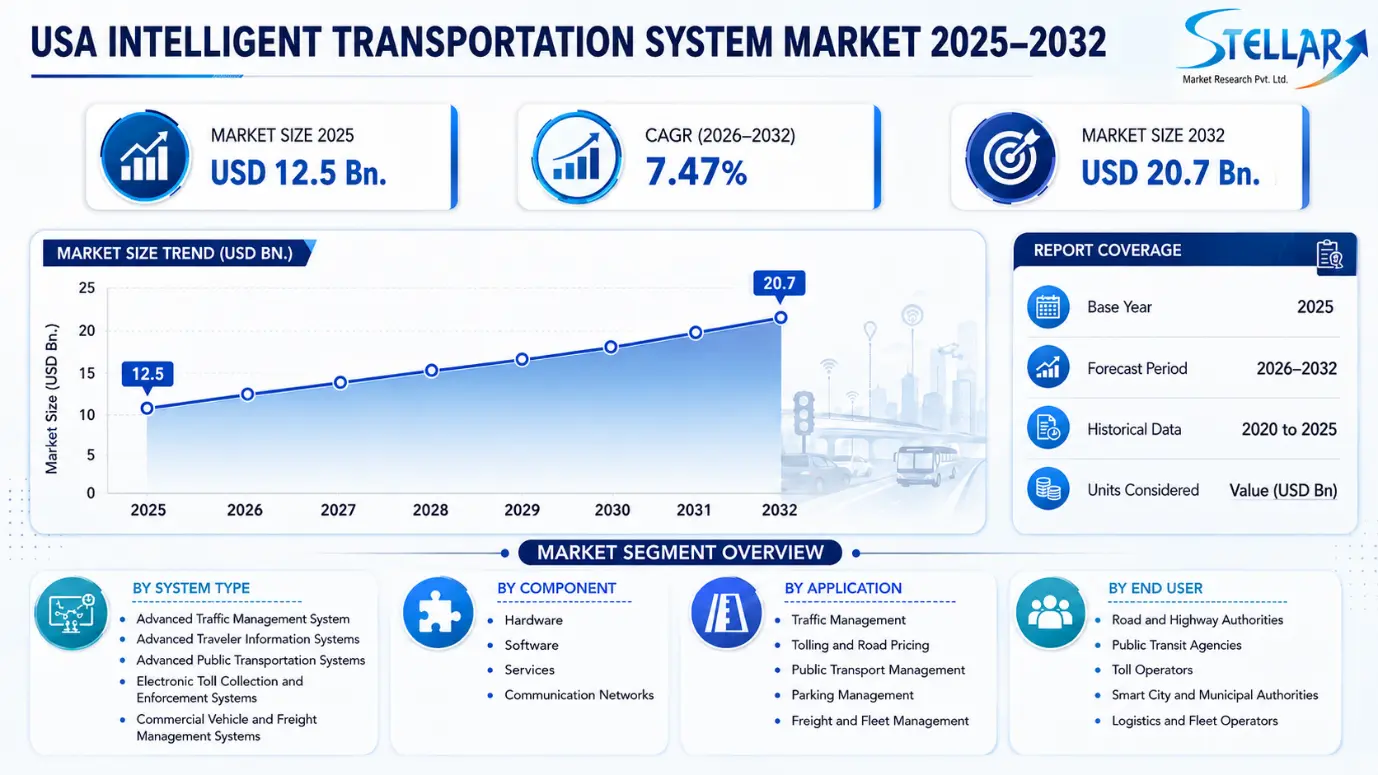
The USA Intelligent Transportation System Market was valued at USD 12.50 billion in 2025 and is projected to reach USD 20.70 billion by 2032, reflecting a 7.47% CAGR.
Growth is led by U.S. investment in tolling modernization, traffic control upgrades, road safety systems, transit ITS, V2X readiness, and recurring mobility software services.
USA Intelligent Transportation System Market Overview:
The U.S. Intelligent Transportation Systems (ITS) market is quickly becoming a critical operating layer for modern transportation networks, including roads, tolling, transit, parking, freight, and connected mobility systems. Transportation agencies are moving beyond basic field equipment and investing in integrated ITS platforms that connect roadside assets, real-time traffic data, tolling systems, transit operations, enforcement tools, and traveller information in one unified environment.
Growth in the U.S. ITS market is strongest in regions facing high congestion, road safety challenges, heavy tolling activity, freight movement, and transit modernization needs. Large states and major metropolitan areas use intelligent transportation systems to improve corridor performance, reduce delays, enhance mobility, and manage traffic more efficiently without relying only on road widening. Toll authorities are also shifting from manual and barrier-based toll collection to all-electronic tolling and free-flow tolling systems.
For instance, one of the major ongoing infrastructure projects in the United States is the California High Speed Rail. The projected cost is estimated to be between $89 and $128 billion. The market for intelligent transportation systems is expanding as a result of these investments, it would create tremendous opportunity for the major companies in the market for intelligent transportation.
At the same time, transit agencies are adopting real-time transit operations platforms to improve service reliability, passenger information, and operational control.
To get more Insights: Request Free Sample Report
USA Intelligent Transportation System Market Dynamics
Growth Drivers
Urban Congestion and Real-Time Traffic Management
With the growing population of the US, the U.S. population stands at approximately 348 million people in 2026 year. The growth rate is currently tracking at about 0.5% annually as per the US Census Bureau. Rising urban congestion is increasing demand for adaptive traffic signals, traffic management centers, incident detection, variable message signs, sensors, cameras, controllers, traffic management software, and real-time traffic analytics. Therefore, these ITS solutions help U.S. agencies improve traffic flow, manage busy corridors, and respond faster to incidents.
Road Safety and Automated Enforcement
Road safety remains a top priority for U.S. transportation agencies. This drives demand for speed enforcement, red-light enforcement, automatic number plate recognition (ANPR), incident detection, road weather systems, and connected vehicle safety applications.
As per the National Safety Council (NSC) the no of accidents has risen by 1.6% in 2026 as compared to March 2025 and the no is yet rising, catalysing the need of road safety, speed enforcement detection and related smart technologies to make road safety more in bounds
Therefore, driving the market at its fullest.
Electronic Tolling, Smart Highways, and Road Pricing
Toll authorities are modernizing toll collection with electronic tolling, open-road tolling, free-flow tolling, ANPR, tolling back-office systems, and violation processing platforms. Road pricing and user-charge programs are also creating demand for account management, vehicle identification, payment, and enforcement solutions.
Public Transport Digitization and Connected Mobility
Transit agencies are using automatic vehicle location, dispatch platforms, real-time passenger information, transit signal priority, fare-linked systems, and operations software to improve service reliability, rider experience, and urban mobility connectivity.
Restraints
High ITS Deployment Cost
Intelligent transportation systems require hardware, software, communication networks, integration, cybersecurity, maintenance, and training. Smaller agencies often deploy ITS projects in phases because full network modernization requires high upfront investment.
Legacy Infrastructure Integration
Many U.S. corridors still use older traffic signals, controllers, communication systems, and roadside devices. Integrating new ITS platforms with legacy infrastructure increases project complexity, cost, and deployment timelines.
Cybersecurity and Data Privacy Risks
ITS platforms manage traffic data, vehicle movement records, payment details, enforcement evidence, and connected infrastructure data. Agencies need strong cybersecurity, data governance, access control, and vendor compliance before scaling deployments.
Budget Delays and Fragmented Procurement
ITS projects often depend on federal grants, state DOT budgets, city funds, toll authority plans, and transit capital programs. Multiple funding sources and long approval cycles can delay project awards and create uneven spending.
Opportunities
AI-Based Traffic Analytics
AI-powered traffic analytics can improve signal timing, incident detection, congestion prediction, video analytics, and corridor monitoring. Agencies are more likely to adopt AI-based ITS solutions when they improve live operations and reduce manual work.
V2X and Connected Infrastructure
Vehicle-to-everything technology is creating demand for roadside units, secure communications, signal integration, connected safety applications, and interoperable corridor platforms. V2X deployment supports the next phase of connected transportation infrastructure in the U.S.
Smart Public Transport and Passenger Information
Real-time arrivals, disruption alerts, dispatch systems, transit signal priority, and integrated operations platforms help transit agencies improve reliability and rider experience. This creates demand for transit ITS software, APIs, cloud hosting, and managed services.
Road User Charging and Next-Generation Tolling
Distance-based charging, congestion pricing, open-road tolling, and all-electronic tolling create opportunities for tolling back-office systems, payment platforms, ANPR, customer account management, and compliance tools.
Market Challenges
U.S. ITS projects face long procurement timelines, legacy infrastructure limits, integration risks, cybersecurity requirements, data governance issues, interoperability gaps, and complex coordination across DOTs, cities, toll operators, transit agencies, and emergency responders.
High maintenance costs, public concerns around enforcement systems, uneven city readiness, vendor lock-in, and fragmented agency ownership also slow adoption. Agencies increasingly prefer open architecture, clear data rights, lifecycle support, cybersecurity assurance, and flexible procurement models before approving large ITS investments.
Market Trends
AI Traffic Management Moving Beyond Pilots
AI traffic management is shifting from pilot projects to live operations, including signal control, video analytics, incident alerts, and predictive congestion management. Agencies want AI-enabled ITS platforms that improve performance, remain auditable, and work with existing traffic management centers.
V2X and Connected Corridors Entering DOT Strategies
State DOTs are adding V2X and connected corridor projects to long-term transportation strategies. Agencies are evaluating roadside equipment, secure messaging, signal integration, interoperability, and connected safety applications.
Tolling Moving Toward Free-Flow Systems
The U.S. tolling market is shifting from lane-based tolling to all-electronic, open-road, account-based, and ANPR-supported free-flow tolling. This shift is increasing demand for tolling software, back-office platforms, violation processing, analytics, and customer systems.
Transit ITS Moving Toward Real-Time Mobility Platforms
Transit ITS is moving beyond basic vehicle tracking to integrated real-time mobility platforms. These platforms combine dispatch, passenger information, disruption management, transit signal priority, and fare-linked data, increasing demand for software, APIs, cloud hosting, and systems integration.
USA Intelligent Transportation System Market Segmentation 2025:
By System Type:
Advanced Traffic Management Systems lead the U.S. Intelligent Transportation System market with a 34% share, as DOTs, city traffic teams, and highway agencies use ITS technologies to reduce congestion, manage crashes, support work zones, and improve freight movement. Traveller information, transit ITS, electronic tolling, and freight management solutions are also growing through real-time alerts, AVL, dispatch systems, ANPR enforcement, free-flow tolling, fleet telematics, and truck corridor monitoring.

By Application
In the U.S. Intelligent Transportation System market, Traffic Management leads with a 36% share as state DOTs, city traffic departments, and highway agencies invest in congestion control, adaptive signalling, incident response, corridor monitoring, and traffic command centers. Tolling and Road Pricing continue to grow through electronic toll collection, free-flow tolling, congestion pricing, and account-based payment systems, while Public Transport Management gains demand from AVL, dispatch platforms, passenger information, and service reliability tools. Parking Management is also expanding through occupancy detection and parking guidance, and Freight and Fleet Management benefits from logistics routing, telematics, and truck corridor monitoring.

USA Intelligent Transportation System Market Recent Market Developments:
2024 U.S. Department of Transportation (USDOT) USDOT released the National V2X Deployment Plan titled Saving Lives with Connectivity to accelerate vehicle-to-everything (V2X) deployment across U.S. transportation infrastructure.
Increased demand for roadside units (RSUs), connected corridor infrastructure, secure communications, signal integration, and V2X-enabled traffic management systems.
2025 Federal Highway Administration (FHWA) FHWA continued expansion of the ATTAIN (Advanced Transportation Technologies and Innovation) program supporting deployment of advanced transportation technologies and intelligent mobility systems.
Supported adoption of smart corridors, adaptive traffic systems, integrated mobility platforms, and AI-enabled transportation technologies across U.S. states and municipalities.
2025 U.S. Department of Transportation (USDOT) The SMART Grants Program continued funding demonstration projects focused on smart transportation technologies, mobility platforms, digital infrastructure, sensors, and safety systems.
Accelerated ITS pilot deployments related to curb management, smart intersections, real-time traffic analytics, and connected mobility ecosystems.
2025 National Highway Traffic Safety Administration (NHTSA) NHTSA released early estimates showing an 8.2% decline in U.S. traffic fatalities during the first half of 2025 while continuing emphasis on roadway safety modernization.
Sustained investment in ITS-based road safety technologies including automated enforcement, incident detection, AI traffic analytics, and connected vehicle safety systems.
|
Intelligent Transportation System Market |
|||
|
Report Coverage |
Details |
||
|
Base Year: |
2025 |
Forecast Period: |
2026-2032 |
|
Historical Data: |
2020 to 2025 |
Market Size in 2025: |
USD 12.5 Bn. |
|
Forecast Period 2025 to 2032 CAGR: |
7.47% |
Market Size in 2032: |
USD 20.7 Bn. |
|
Segments
|
By System Type |
|
|
|
By Component
|
|
||
|
By Application |
|
||
|
By End User |
|
||
Key players:
- Econolite
- Wavetronix
- Daktronics
- MoboTrex
- TAPCO
- Houston Radar
- Eberle Design Inc. / EDI
- Pelco Products
- Skyline Products
- Polara Enterprises
- MS Sedco
- Solar Technology Inc. / SolarTech
- Signal-Tech
- LightGuard Systems
- Applied Concepts Inc. / Stalker Radar
Frequently Asked Questions
What is the USA Intelligent Transportation System Market forecast for 2032?
Advanced Traffic Management Systems hold the largest share at 33%, as U.S. agencies widely use them across highways, urban roads, traffic control centers, and smart corridors.
Electronic toll collection is growing as U.S. toll operators shift toward open-road tolling, free-flow collection, ANPR, account-based payments, congestion pricing, and road user charging models.
1. USA Intelligent Transportation System Market: Executive Summary
1.1. USA Intelligent Transportation System Market Size and Forecast (USD BILLION)
1.2 Market Definition
1.3 Market Segmentation
1.4 Research Timelines
1.5 Assumptions
1.6 Limitation
2. USA Intelligent Transportation System Market: Research Methodology
2.1 Data Mining
2.2 Secondary Research
2.3 Primary Research
2.4 Subject Matter Expert Advice
2.5 Quality Check
2.6 Final Review
2.7 Data Triangulation
2.8 Top-Down Approach
2.9 Bottom-Up Approach
2.10 Research Flow
2.11 Data Sources
3. USA Intelligent Transportation System Market: Market Attractiveness Mapping
3. 1 USA Intelligent Transportation System Market Overview
3.2 Competitive Analysis: Funnel Diagram (Tier 1, Tier 2, Tier 3)
3.3 USA Intelligent Transportation System Market Absolute Market Opportunity
3.4 USA Intelligent Transportation System Market Attractiveness Analysis, By System Type
3.5 USA Intelligent Transportation System Market Attractiveness Analysis, By Components
3.6 USA Intelligent Transportation System Market Attractiveness Analysis, By Application
3.7 USA Intelligent Transportation System Market Attractiveness Analysis, By End User
3.8 Future Market Opportunities
4. USA Intelligent Transportation System Market: Market Outlook
4.1 USA Intelligent Transportation System Market Evolution
4.2 USA Intelligent Transportation System Market Outlook
4.3 Market Drivers
4.4 Market Restraints
4.5 Market Trends
4.6 Market Opportunity
4.7 Porter’s Five Forces Analysis
4.7.1 Threat of New Entrants
4.7.2 Bargaining Power of Suppliers
4.7.3 Bargaining Power of Buyers
4.7.4 Threat of Substitute Products
4.7.5 Competitive Rivalry of Existing Competitors
4.8 Value Chain Analysis
4.9 Pricing and Cost Structure
4.10 Port and Infrastructure Development
4.11 E-commerce USA Intelligent Transportation System
4.12 Geopolitical Impact Analysis on USA Intelligent Transportation System
4.13 Regulatory Standards & Policy Landscape
4.14 Intelligent Transportation System and Sustainability
4.15 Technology Analysis
5. USA Intelligent Transportation System Market: By System Type
5.1 Advanced Traffic Management Systems
5.2 Advanced Traveller Information Systems
5.3 Advanced Public Transportation Systems
5.4 Electronic Toll Collection and Enforcement Systems
5.5 Commercial Vehicle and Freight Management Systems
6. USA Intelligent Transportation System Market: By Component
6.1 Hardware
6.2 Software
6.3 Services
6.4 Communication Networks
7. USA Intelligent Transportation System Market: By Application
7.1 Traffic Management
7.2 Tolling and Road Pricing
7.3Public Transport Management
7.4 Parking Management
7.5 Freight and Fleet Management
8. USA Intelligent Transportation System Market: By End User
8.1 Road and Highway Authorities
8.2 Public Transit Agencies
8.3 Toll Operators
8.4 Smart City and Municipal Authorities
9. SMR Competitive Matrix
10. USA Intelligent Transportation System Market: Company Benchmarking
11. USA Intelligent Transportation System Market: Company Profiles
11.1 Each Profile Covers:
11.2 Company Overview
11.3 Business Portfolio
11.4 Financial Overview
11.5 Industry Focus
11.6 Strategic Analysis
11.7 SWOT Analysis
11.8 Recent Developments
11.9 key players
12. Risk Assessment and Scenario Analysis
13. Strategic Opportunity
14. Investments & Funding Analysis
15. Strategic Roadmap
15.1 Short-Term Roadmap 2026–2027
15.2 Mid-Term Roadmap 2028–2029
15.3 Long-Term Roadmap 2030–2032
16. Analyst Recommendations
16.1 Recommendations for ITS Companies
16.2 Recommendations for Investors
16.3 Recommendations for New Entrants
16.4 Recommendations for Maintenance Firms
16.5 Recommendations for Consulting and Strategy Teams