ENG
ENG Japanese
  French
  German
  Korean
Green Freight and Decarbonization Market: Fleet Electrification, Low-Emission Logistics, and Sustainable Freight Infrastructure Outlook (2026–2032)
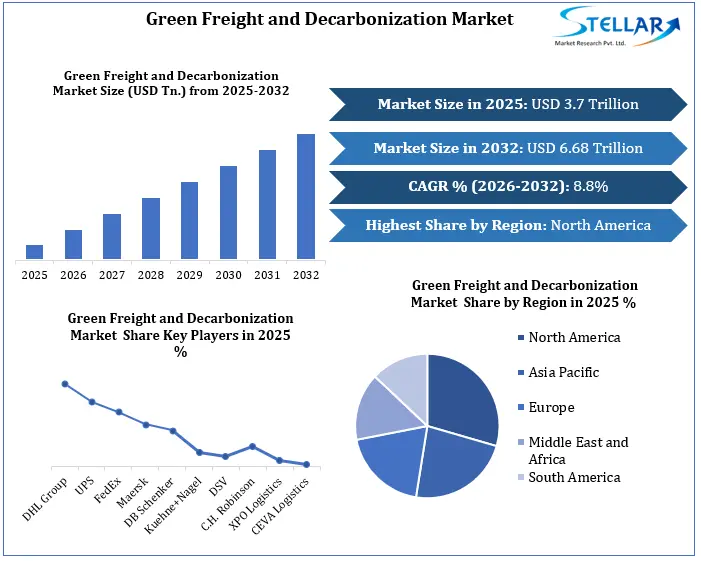
The Green Freight and Decarbonization Market was projected to grow from USD 3.7 trillion in 2025 to USD 6.68 trillion by 2032 at 8.8% CAGR, driven by a rapid shift toward low-emission freight operations supported by cleaner vehicle technologies, fuel transition, and efficiency-led logistics transformation across global transport.
Green Freight and Decarbonization Market Definition
The Green Freight and Decarbonization Market focuses on reducing carbon emissions and improving energy efficiency across commercial freight transportation. It includes solutions that support cleaner transportation of goods across road, rail, air, and maritime routes while also helping improve operational performance, cost control, and supply chain efficiency through lower-emission systems.
The market covers electric and hydrogen-powered freight vehicles, alternative fuels such as biofuels, LNG, and renewable diesel, along with supporting infrastructure like charging stations, hydrogen refuelling networks, and smart logistics hubs. It also includes digital tools such as AI-driven route optimization, telematics, and emissions tracking platforms for monitoring carbon output. Growth is being driven by tighter emission rules, corporate net-zero commitments, rising fuel expenses, and growing pressure from stakeholders to adopt lower-carbon logistics practices.
To get more Insights: Request Free Sample Report
Global Green Freight and Decarbonization Market Dynamics
Global Green Freight and Decarbonization Market Drivers
Rising Freight Emissions and Green Logistics Demand
Growing freight transportation activity and rising carbon emissions are increasing demand for low-emission transport solutions, fuel-efficient fleets, and sustainable logistics infrastructure worldwide. At the same time, stricter environmental regulations and corporate net-zero commitments are pushing logistics companies to adopt electric trucks, alternative fuels, route optimization tools, and carbon tracking systems, accelerating the shift toward green freight solutions.
In India, the freight sector is experiencing strong growth. For instance, according to IBEF, Indian Railways recorded 1.67 billion tonnes of freight loading in FY26, marking a 3.25% YoY increase, supported by higher movement of key commodities including fertilisers, steel, iron ore, and cement. Freight revenue stood at USD17.42 trillion for Apr 2025–Feb 2026, backed by ongoing capacity expansion through dedicated freight corridors and digital logistics systems. This trend also shows a gradual shift toward rail as a lower-emission freight mode, helping reduce overall logistics carbon intensity. The network is further aiming for 1,765 million tonnes in FY27, reflecting continued momentum in freight expansion.
Companies such as DHL Group, Maersk, UPS, FedEx, and Volvo Trucks are supporting this demand through sustainable freight services, low-carbon shipping solutions, electric commercial vehicles, and fleet optimization technologies. For example, DHL Group is expanding its electric delivery fleet for urban logistics, while Maersk is investing in low-emission vessels powered by alternative fuels such as green methanol. Volvo Trucks is also developing battery-electric and hydrogen trucks to support long-haul freight decarbonization.
Thus, increasing investment in sustainable supply chains and low-emission transport systems is expected to support steady growth in the global green freight and decarbonization market.
Expansion of Electric and Alternative Fuel Freight Fleets
Growing adoption of electric trucks, hydrogen-powered commercial vehicles, and low-carbon fuels is supporting the shift toward cleaner freight transportation across global supply chains. Rising fuel costs, stricter emission regulations, and government incentives are also encouraging logistics operators to replace conventional diesel fleets with more energy-efficient transport technologies.
Companies such as Volvo Trucks, BYD, and Daimler Truck are expanding clean freight solutions with battery-electric trucks, hydrogen fuel systems, and next-generation commercial mobility technologies.
The continued investment in alternative fuel infrastructure and the rollout of zero-emission fleets is expected to support a steady increase in the use of sustainable freight transportation systems across the global logistics sector.
Global Green Freight and Decarbonization Market Opportunities
Growth of Low-Carbon Fuel Supply Chains
Expanding use of renewable diesel, biofuels, green ammonia, and hydrogen is widening access to cleaner fuel options for freight operators. This is allowing logistics companies to cut back on conventional diesel use and adopt lower-emission fuels, particularly on long-haul trucking and maritime routes where alternatives were previously limited.
Rising Demand for Sustainable E-commerce Logistics
Rapid growth in e-commerce is driving up parcel volumes and last-mile deliveries, putting more pressure on logistics providers to cut emissions across busy distribution networks. This is pushing companies to invest more in electric delivery vehicles, smaller urban fulfilment hubs, and better planned delivery routes to lower environmental impact.
Global Green Freight and Decarbonization Market Trends
Shift Toward Zero-Emission Heavy-Duty Freight Vehicles
The freight sector is slowly shifting away from diesel trucks toward electric and hydrogen-powered heavy-duty vehicles. This change is supported by better battery range, more efficient hydrogen fuel cells, and a growing network of charging and refuelling stations. As a result, long-haul operators are starting to add zero-emission trucks to their fleets, especially in regions where regulations are stricter and incentives make adoption easier.
Integration of Real-Time Emission Tracking in Logistics Operations
Freight companies are increasingly using digital tools to track and report carbon emissions across shipments. These systems rely on telematics, AI, and IoT sensors to monitor fuel usage, improve route planning, and generate reliable emissions data for customers. This is helping logistics providers meet reporting needs while also making operations more efficient and improving transparency across supply chains.
Global Green Freight and Decarbonization Market Segmentation (2025)
Global Green Freight and Decarbonization Market by Service Type
Fleet Management and Route Optimization Services account for the largest share at around 25%, supported by strong demand for better fuel efficiency, AI-driven routing, and real-time fleet tracking in logistics. Carbon Accounting and Reporting Services are seeing steady growth as ESG disclosure rules tighten and companies need clearer emissions tracking. Sustainable Transportation Services are expanding with rising adoption of electric vehicles and alternative fuel solutions in freight operations. Waste Reduction and Circular Economy Services are growing at a moderate pace, backed by efforts to cut packaging waste and improve material reuse. Emission Monitoring and Compliance Services are the fastest-growing area, driven by stricter regulations and the need for real-time carbon tracking and compliance reporting.

Global Green Freight and Decarbonization Market by Technology
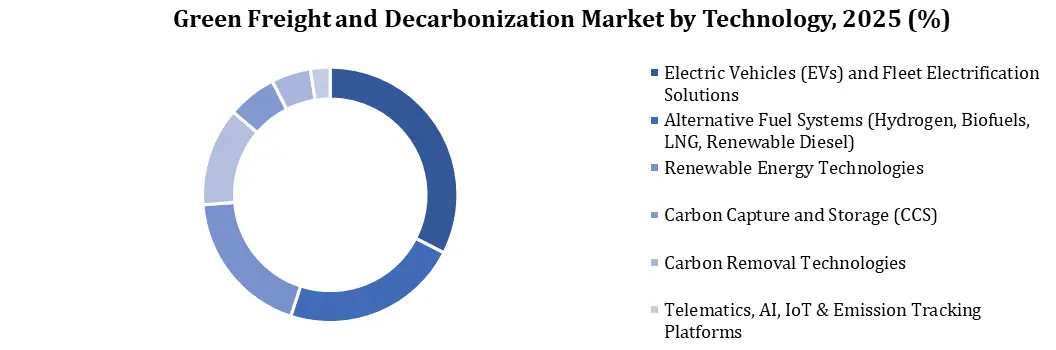
EVs and Fleet Electrification Solutions hold the largest share at 26%, driven by rapid adoption of zero-emission freight vehicles, government support, and fleet electrification across logistics operations. Alternative Fuel Systems are steadily growing with increased use of hydrogen, biofuels, LNG, and renewable diesel for long-haul freight applications. Renewable Energy Technologies are gaining traction through solar and wind integration in logistics hubs and warehouses. Energy Efficiency Solutions are expanding moderately, focused on improving fuel efficiency and optimizing freight operations. CCS remains at an early stage with limited use in freight-heavy industrial sectors, while Carbon Removal Technologies are growing faster due to rising net-zero commitments. Telematics, AI, IoT & Emission Tracking Platforms are also expanding quickly, driven by demand for real-time fleet monitoring, route optimization, and emission reporting.
Global Green Freight and Decarbonization Market by Transportation Mode
Road Freight accounts for the largest share at 62%, supported by high freight movement volumes, growing electrification of truck fleets, and widespread use of route optimization and fuel efficiency solutions across logistics operations. Rail Freight is growing steadily, driven by lower emissions per ton-kilometer and ongoing electrification of rail networks. Air Freight holds a smaller share and is increasingly focused on sustainable aviation fuels and operational efficiency improvements to reduce carbon emissions. Maritime Freight is expanding and is the fastest-growing segment, supported by the adoption of low-emission fuels, energy-efficient vessel designs, and tightening global shipping regulations. Others contribute a minimal share, covering pipeline transport and other niche freight modes, with gradual improvements in efficiency and emissions management.
Global Green Freight and Decarbonization Market by End-Use Industry
Oil & Gas holds the largest share at 21%, supported by heavy freight activity, strict emission compliance needs, and widespread use of carbon tracking and efficiency solutions across upstream and downstream operations. Energy & Utilities is growing steadily as decarbonization efforts advance and renewable energy becomes more integrated into logistics and supply chains. Manufacturing & Industrial continues to expand due to high freight demand and ongoing efficiency improvements across global supply networks. Automotive & Transportation is increasing with faster EV adoption, fleet electrification, and smarter logistics systems. Agriculture is showing moderate growth as attention to sustainable supply chains and emission monitoring increases, while Government & Public Sector is steadily adopting green freight solutions backed by policy and sustainability goals. E-commerce & Retail is expanding strongly on the back of rapid delivery network growth and demand for lower-emission last-mile operations. Logistics & 3PL Providers are the fastest-growing segment, driven by rising demand for integrated low-carbon freight services and digital optimization platforms. Aerospace & Defense is also growing steadily, supported by fuel efficiency initiatives and greater use of sustainable aviation fuels along with improved logistics planning.
Global Green Freight and Decarbonization Competitive Analysis 2025
The Green Freight and Decarbonization Market is led by global logistics companies that are actively reducing emissions through fleet electrification, alternative fuels, and digital supply chain optimization. DHL Group, UPS, FedEx, and Maersk hold strong market positions due to their large-scale investments in electric delivery fleets, low-carbon shipping fuels, and integrated sustainability programs aimed at reducing end-to-end logistics emissions across global trade routes.
Volvo Trucks, Daimler Truck, BYD, and Tesla are key contributors on the technology side, supporting the market through the development of electric and hydrogen-powered freight vehicles, battery systems, and next-generation commercial transport solutions designed for long-haul and urban logistics operations. These companies are enabling the shift from diesel-based freight systems to zero- and low-emission transport networks.
DB Schenker, Kuehne+Nagel, DSV, and C.H. Robinson strengthen market growth through freight forwarding, supply chain optimization, and carbon-efficient logistics services, helping enterprises reduce transportation-related emissions. Meanwhile, technology and mobility players such as Nikola Corporation and other clean mobility innovators are supporting early-stage hydrogen trucking and alternative fuel freight solutions, contributing to the long-term decarbonization of global freight systems.
Global Green Freight and Decarbonization Market Recent Developments
GreenLine Mobility Solutions (May 2026): Announced an investment of nearly USD 167 million over the next three years to expand LNG-powered trucking operations in India. The company plans to scale its fleet to over 10,000 LNG and electric trucks and develop a nationwide network of 50 LNG refuelling stations to support cleaner long-haul freight transportation.
NEVI Program (January 2026): Continued active deployment of EV charging infrastructure under the National Electric Vehicle Infrastructure (NEVI) program following renewed state-level funding and updated implementation guidelines. The program is backed by a USD 5 billion federal investment for FY2022–FY2026, along with an additional USD 885 million allocation for FY2026 to support EV charging expansion and freight corridor electrification.
Global Green Freight and Decarbonization Regional Analysis
North America remained one of the leading regions in the Green Freight and Decarbonization Market in 2025, driven by strong adoption of electric freight fleets, well-developed logistics infrastructure, and heavy investment in charging networks and carbon-reduction technologies across the United States and Canada.
Europe accounted for a significant share, supported by strict emission regulations, rapid rollout of alternative fuel trucks, and increasing use of hydrogen and electric freight solutions across countries such as Germany, France, and the Netherlands.
Asia Pacific is the fastest-growing region, supported by rapid expansion of e-commerce logistics, rising freight demand, and growing adoption of electric commercial vehicles across China, India, Japan, and South Korea. The Middle East & Africa and South America are experiencing gradual growth, driven by ongoing logistics modernization, early-stage adoption of green freight solutions, and a stronger focus on fuel efficiency and more sustainable transport systems.
|
Green Freight and Decarbonization Market |
|||
|
Report Coverage |
Details |
||
|
Base Year: |
2025 |
Forecast Period: |
2026-2032 |
|
Historical Data: |
2020 to 2025 |
Market Size in 2025: |
USD 3.7 Tn. |
|
Forecast Period 2026 to 2032 CAGR: |
8.8% |
Market Size in 2032: |
USD 6.68 Tn. |
|
Segments
|
By Service Type |
|
|
|
By Technology
|
|
||
|
By Transportation Mode |
|
||
|
|
By End-Use Industry |
|
|
Key Players Profiles Covered in the Report
Logistics Providers
- DHL Group
- UPS
- FedEx
- Amazon Logistics
- XPO Logistics
- CEVA Logistics
- GXO Logistics
- Ryder System
- J.B. Hunt Transport Services
- Schneider National
- Coyote Logistics
- SF Express
- Delhivery
- GreenLine Mobility Solutions
- AP Moller–Maersk
Truck OEMs
- Volvo Trucks
- Daimler Truck
- PACCAR
- Scania
- MAN Truck & Bus
- BYD
- Tesla Semi
- Nikola Corporation
- Hyundai Motor Company (Hydrogen Trucks)
- Ashok Leyland
- Tata Motors
Freight Forwarders
- DB Schenker
- Kuehne+Nagel
- DSV
- C.H. Robinson
- Expeditors International
- Nippon Express
- Bolloré Logistics
- Hellmann Worldwide Logistics
- GEODIS
- Sinotrans
- Panalpina
- Kerry Logistics
Digital / Emission Tracking Providers
- Samsara
- Geotab
- Trimble Transportation
- project44
- FourKites
- Descartes Systems Group
- Freightos
- Logistaas
- Freightera
- SAP Logistics Business Network
Fuel / Infrastructure Providers
- Shell Recharge Solutions
- bp pulse
- TotalEnergies
- Air Liquide
- Plug Power
- Cummins Hydrogen Solutions
- Nikola Energy
- ChargePoint
- ABB E-mobility
Frequently Asked Questions
Route optimization reduces unnecessary mileage, idle time, and fuel consumption by using real-time data and AI-based planning, directly lowering emissions without changing vehicle hardware.
Hydrogen enables long-range, high-load freight movement with faster refueling times compared to batteries, making it suitable for heavy-duty and long-haul logistics applications.
They enable companies to measure, report, and manage emissions accurately across supply chains, helping meet regulatory requirements and corporate sustainability targets.
Logistics hubs act as key points for integrating clean energy systems, charging infrastructure, and efficient cargo handling, reducing emissions across multiple freight stages.
1. Green Freight and Decarbonization Market: Introduction
2. Green Freight and Decarbonization Market: Executive Summary
2.1. Global Green Freight and Decarbonization Market Size And Forecast (USD Trillion)
2.2 Market Definition
2.3 Market Segmentation
2.4 Research Timelines
2.5 Assumptions
2.6 Limitation
3. Green Freight and Decarbonization Market: Research Methodology
3.1 Data Mining
3.2 Secondary Research
3.3 Primary Research
3.4 Subject Matter Expert Advice
3.5 Quality Check
3.6 Final Review
3.7 Data Triangulation
3.8 Top-Down Approach
3.9 Bottom-Up Approach
3.10 Research Flow
3.11 Data Sources
4. Green Freight and Decarbonization Market: Market Attractiveness Mapping
4. 1 Global Green Freight and Decarbonization Market Overview
4.2 Competitive Analysis: Funnel Diagram (Tier 1, Tier 2, Tier 3)
4.3 Global Green Freight and Decarbonization Market Absolute Market Opportunity
4.4 Global Green Freight and Decarbonization Market Attractiveness Analysis, By Region
4.5 Global Green Freight and Decarbonization Market Attractiveness Analysis, By Service Type
4.6 Global Green Freight and Decarbonization Market Attractiveness Analysis, By Technology
4.7 Global Green Freight and Decarbonization Market Attractiveness Analysis, By Deployment Mode
4.8 Global Green Freight and Decarbonization Market Attractiveness Analysis, By Transportation Mode
4.9 Global Green Freight and Decarbonization Market Attractiveness Analysis, By End-Use Industry
4.10 Future Market Opportunities
5. Green Freight and Decarbonization Market: Market Outlook
5.1 Global Green Freight and Decarbonization Market Evolution
5.2 Green Freight and Decarbonization Adoption Analysis
5.3 Market Trends
5.4 Market Dynamics
5.4.1 Market Drivers
5.4.2 Market Restraints
5.4.3 Market Trends
5.4.4 Market Opportunity
5.5 Porter’s Five Forces Analysis
5.5.1 Threat Of New Entrants
5.5.2 Bargaining Power Of Suppliers
5.5.3 Bargaining Power Of Buyers
5.5.4 Threat Of Substitute Products
5.5.5 Competitive Rivalry Of Existing Competitors
5.6 PESTEL Analysis
5.7 Value Chain Analysis
5.8 Clean Freight Infrastructure Readiness Analysis
5.9 Pricing Analysis
5.10 Geopolitical Impact Assessment
5.11 Regulatory Framework and Policy Impact Assessment
5.12 Technology Landscape
6. Green Freight and Decarbonization Market: By Service Type, 2026-2032 (USD Trillion)
7. Green Freight and Decarbonization Market: By Technology, 2026-2032 (USD Trillion)
8. Green Freight and Decarbonization Market: By Transportation Mode, 2026-2032 (USD Trillion)
9. Green Freight and Decarbonization Market: By End-Use Industry, 2026-2032 (USD Trillion)
10. Green Freight and Decarbonization Market: Geography, 2026-2032 (USD Trillion)
10.1 North America Green Freight and Decarbonization Market
10.2 Europe Green Freight and Decarbonization Market
10.3 Asia Pacific Green Freight and Decarbonization Market
10.4 South America Green Freight and Decarbonization Market
10.5 Middle East And Africa Green Freight and Decarbonization Market
11. Green Freight and Decarbonization Competitive Matrix
12. Green Freight and Decarbonization Market: Company Benchmarking
13. Merger & Acquisition
14. Green Freight and Decarbonization Market: Company Profiles
1. DHL Group
2. UPS
3. FedEx
4. Amazon Logistics
5. XPO Logistics
6. CEVA Logistics
7. GXO Logistics
8. Ryder System
9. J.B. Hunt Transport Services
10. Schneider National
11. Coyote Logistics
12. SF Express
13. Delhivery
14. GreenLine Mobility Solutions
15. AP Moller–Maersk
16. Volvo Trucks
17. Daimler Truck
18. PACCAR
19. Scania
20. MAN Truck & Bus
21. BYD
22. Tesla Semi
23. Nikola Corporation
24. Hyundai Motor Company (Hydrogen Trucks)
25. Ashok Leyland
26. Tata Motors
27. DB Schenker
28. Kuehne+Nagel
29. DSV
30. C.H. Robinson
31. Expeditors International
32. Nippon Express
33. Bolloré Logistics
34. Hellmann Worldwide Logistics
35. GEODIS
36. Sinotrans
37. Panalpina
38. Kerry Logistics
39. Samsara
40. Geotab
41. Trimble Transportation
42. project44
43. FourKites
44. Descartes Systems Group
45. Freightos
46. Logistaas
47. Freightera
48. SAP Logistics Business Network
49. Shell Recharge Solutions
50. bp pulse
51. TotalEnergies
52. Air Liquide
53. Plug Power
54. Cummins Hydrogen Solutions
55. Nikola Energy
56. ChargePoint
57. ABB E-mobility
15. Risk Assessment and Scenario Analysis
16. Strategic Opportunity
17. Investments & Funding Analysis
18. Strategic Roadmap
19. Analyst Recommendations