ENG
ENG Japanese
  French
  German
  Korean
Japan LiDAR for Mobile Robotics Market Size, Share, Growth Trends, Industry Analysis, Key Players, Investment Opportunities and Forecast 2026-2034
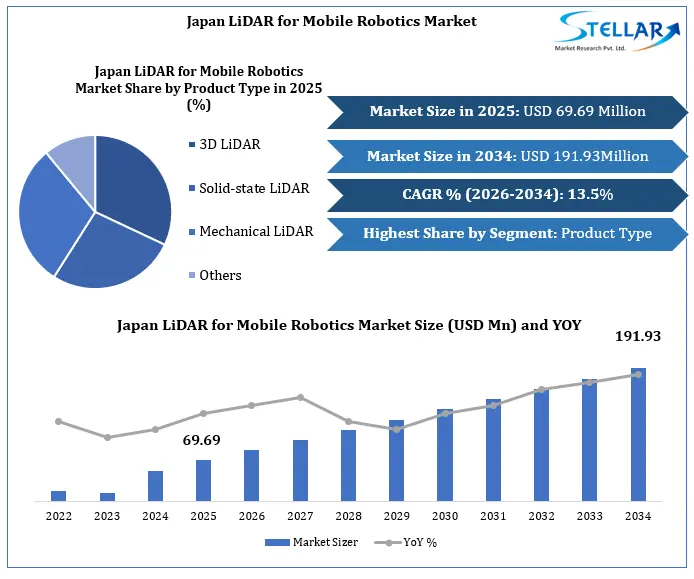
The Japan LiDAR for Mobile Robotics Market was valued at USD 69.69 Million in 2025 and is projected to reach USD 191.93 Million by 2034, reflecting a 13.5% CAGR.
Growth is driven by Japan's labor shortages and aging population, increasing adoption of autonomous mobile robots in warehouses and factories, rising implementation of smart factory and Industry 4.0 initiatives, and growing use of service and delivery robots. In addition, increasing demand for LiDAR-based navigation, mapping, and obstacle detection technologies to improve automation and operational efficiency further supporting the market growth.
Japan LiDAR for Mobile Robotics Market Overview
As the Japan LiDAR for Mobile Robotics Market, LiDAR technology becomes essential in developing autonomous robots that will be used in applications like warehousing, logistics, manufacturing, healthcare, retail, and services robotics. With LiDAR, mobile robots are able to use advanced sensor technologies in order to navigate, map the environment, localize and detect obstacles. Therefore, mobile robots are increasingly used for carrying out flexible tasks in various industries.
The growth of the Japan LiDAR for Mobile Robotics Market is be explained by the rise of automation processes in such places as warehouses, factories and distribution centers, which is influenced by labor shortage and the aging population. Growing popularity of AMRs, increasing smart factory concept and investments in warehouse automation lead to the growing need for LiDAR navigation system. Moreover, the development of small-sized solid-state LiDAR systems improves robot's performance and increases its adoption in various industrial, commercial, healthcare and last-mile delivery applications.
To get more Insights: Request Free Sample Report
Japan LiDAR for Mobile Robotics Market Dynamics
Japan LiDAR for Mobile Robotics Market Drivers
Increasing Utilization of Industrial Robots Fostering the Adoption of Mobile Robotics Using LiDAR Technology
As per data from the International Federation of Robotics (IFR), the nation continues to hold its place as the second largest industrial robots market in the world, installing around 44,500 units in 2024, making up an operational stock of almost 450,500 robots, thus registering a 3% rise compared to the year prior. With more and more robots being implemented in Japanese industrial settings, the need for AMRs and AGVs equipped with LiDAR sensors is on the rise. With Japanese industries facing a shortage of labor force and trying to improve their efficiency, LiDAR-based sensors it’s become critical in enabling self-navigation, mapping, and object detection for these robots.
Growth in the Strong Robotic Manufacturing Industry
Robotics accounts for 38% of the total robot manufacturing in the world. As per data from the International Federation of Robotics (IFR), In the year 2023, the country has exported 160,801 units of robots, which is the lowest compared to the maximum figure of 207,737 units of robots in the year 2022. The other notable aspect in 2023 was the ratio of robot exports that was relatively high, at 78%, and within its historical ratio of 72% to 81%. The huge industry of robotics manufacturing and exports requires high-quality sensor technology such as LiDAR for navigation.
Investment in Automated Warehousing Systems
The rise in investment towards warehouse automation resulted in the adoption of LiDAR-based mobile robots in Japan. This is because of the need to increase productivity, cut costs, and overcome labor shortage issues in the face of large volumes of goods handled by e-commerce firms, retailers, manufacturers, and logistic firms.
For purposes of achieving this, firms have invested in the use of autonomous mobile robots and automated guided vehicles in the movement of goods within the warehouse, picking orders, transporting pallets, and navigating through the warehouses. The sensors enable the robots to map, detect objects, and navigate safely through warehouses.
Japan LiDAR for Mobile Robotics Market Opportunities
Elderly Care & Assisted Living Robotics
The rising concern about automation of elderly care facilities in Japan is expected to generate opportunities for LiDAR-equipped mobile robots within hospitals, nursing homes, and rehab centers, where navigation safety and constant monitoring in human-centric environments continue to be important operational needs.
Last-Mile Delivery Robots Ecosystem
Growing trials of autonomous last-mile delivery robots in urban and suburban environments will create opportunities for LiDAR systems due to the need for accurate obstacle detection and path planning for reliable delivery of goods in complex public environments.
Indoor Mapping-as-a-Service Solutions
The increasing demand for facility digitization in real time will generate opportunities for LiDAR systems within mobile robotics due to the possibility to perform continuous indoor mapping for warehouses, commercial buildings, and other public infrastructures independently from stationary mapping solutions.
Japan LiDAR for Mobile Robotics Market Challenges
Site and Facility Constraints
Many warehousing and manufacturing facilities in Japan is built with manual operations in mind, rather than autonomous processes. This means that there is no proper space for using LiDAR technology. Physical changes in warehouses' structure are needed in order to allow LiDAR mobile robots to be able to move around freely. Consequently, this causes delays in the process of implementation of autonomous navigation systems in factories and warehouses of mid-sized companies.
Limitations of Sensor and Dynamic Environment
In dynamic and unstructured environments, like busy industrial settings or open areas used for disaster relief efforts, there may be some performance limitations of LiDARs because of the occlusion effect due to movement of objects, reflective surfaces, or external environmental interference. It hinders high-quality mapping and decision-making in real time. Such performance limitations do not allow for reliable usage of LiDARs in unpredictable environment conditions, where spatial awareness becomes crucial for autonomous movement.
Difficulties of Workforce Adaptation
Due to demographic changes and reduced working-age population, there is an insufficiency of qualified experts who specialize in robotics engineering, LiDARs, and automation in Japan. It limits the deployment of technologies, their maintenance, and further optimization of the robotic devices. Also, the lack of workforce reduces the spread of technology among smaller enterprises.
Japan LiDAR for Mobile Robotics Market Trends
The shift towards Solid-State LiDAR
As solid-state LiDARs are characterized by lower costs, compact size, and higher durability as compared to mechanical LiDAR, the Japanese mobile robotics industry is inclined to prefer solid-state LiDARs. As there are no moving parts in solid-state LiDAR, this technology does not require any maintenance and provides high reliability in such areas as AMRs, warehouse automation, delivery robots, and service robots. In addition, the light weight of the LiDAR allows creating energy-saving robotic devices, which is be easily commercialized in logistics, retail and healthcare sectors.
Growing Demand for LiDAR in Humanoid Robots
An extremely fast development of humanoid robots takes place in Japan, and this factor causes the growing demand for 3D LiDARs. Mapping the environment, navigation and obstacle detection are required features of the humanoid robots. LiDAR is the technology which allows detecting spatial information and measuring depth, thus ensuring safe interaction with other objects and people. The aging population in Japan leads to the rapid growth of healthcare robotics, and LiDAR is a key element in this sector.
Japan LiDAR for Mobile Robotics Market Segmentation 2025
By Product Type
The 3D LiDAR product type is the largest segment in the market, having an estimated market share of around 42%. The segment's popularity is credited to increasing use of AMRs, warehouse robots, and service robots that need three-dimensional mapping and obstacle detection and localization capabilities. Japanese manufacturers are integrating 3D LiDAR into robotic systems in order to enhance their navigation capability in dynamic indoor environments. Solid-State LiDAR constituted around 28% of the market and proved to be the fastest growing segment owing to its compact size, low cost, and better durability. The absence of any moving components in the system makes the technology highly suited for logistics robots, delivery robots, and humanoid robots that function in harsh industrial and commercial settings on a continuous basis. Mechanical LiDAR accounted for close to 18% of the market, driven by the long range and high precision sensing requirement applications.

By Component
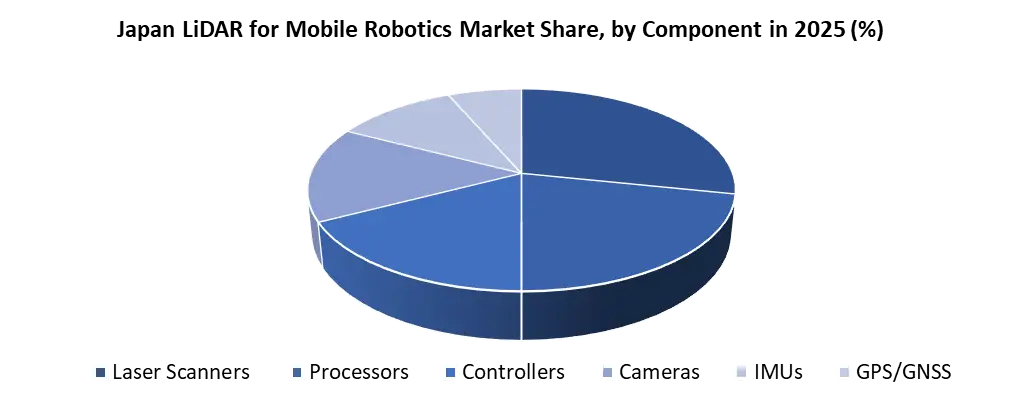
Laser Scanners dominates the component segment with around 26% market share, as they serve as the primary sensing unit for distance measurement and environmental mapping. Processors accounted for nearly 20%, driven by growing demand for real-time data processing and AI-based navigation. Controllers held about 16% share, supporting robot movement and operational control, while Cameras represented 14% due to increasing adoption of sensor fusion technologies. IMUs contributed 10% for localization and motion tracking, whereas GPS/GNSS Receivers accounted for 6%, mainly in outdoor robotic applications.
By Sensors
The 3D LiDAR Sensors is the market leader, accounting for about 58% of the market. The growth of 3D LiDAR sensors is attributed to rising demand for sophisticated perception systems that enable the creation of environmental maps and decision making. The mobile robots working in warehouses, hospitals, and manufacturing plants require 3D sensors in order to safely navigate and avoid any obstacles. The 2D LiDAR Sensors captured about 32% of the market because of their cost-effective nature and their wide application in AGVs and basic level AMRs. The 1D LiDAR Sensors is about 10% share of the market based on their applications in robotics for distance measuring and other applications.
By Application
Warehousing and Logistics led the Market with approximately 38% share in 2025, supported by rising automation in distribution centers and e-commerce fulfillment facilities. Industrial Manufacturing followed with 27% share, driven by Japan’s advanced factory automation ecosystem. Healthcare and Hospital Automation accounted for around 16%, fueled by growing adoption of service and eldercare robots. Retail and Commercial Spaces represented 11%, where LiDAR-enabled robots are increasingly used for cleaning, inventory management, and customer assistance, while other applications contributed the remaining 8% of the market.
Japan LiDAR for Mobile Robotics Market Recent Market Developments:
On May 2024, Hokuyo Automatic, along with Lumotive, announced the commercial release of the YLM-10LX 3D LiDAR sensor, based on Lumotive’s Light Control Metasurface (LCM) beam steering technology. This sensor avoids using any mechanical moving parts by adopting solid-state technology and offers high durability, reliability, cost effectiveness, as well as programmable scanning and high accuracy of 3D object detection. It is meant to be used in the autonomous mobile robot (AMR) industry, as well as for industrial and service robotics.
On August 2025, Advantech Japan Co., Ltd. together with Sony Semiconductor Solutions Corporation and Sunny Optical Intelligence Technology launched the Multi dToF/RGB LiDAR System for Autonomous Mobile Robots (AMRs). This system includes the combination of Advantech’s EBC-RC04 edge computer, Sony’s robotics navigation software, and Sunny OIT’s HYT001-EX 3D sensing camera providing high-accuracy distance measurement, object detection, and autonomous navigation functionality. It will help to increase the use of AMRs in manufacturing, logistics, and retail industries due to enhanced navigation and perception performance.
On May 2026, Panasonic Advanced Technology Co., Ltd. announced that its LiDAR-IMU fusion localization technology, CUBE-LIO, is accepted at IEEE ICRA 2026. The technology improves self-localization and mapping accuracy for autonomous mobile robots, particularly in low-feature industrial environments such as factories, warehouses, and tunnels, supporting more reliable LiDAR-based navigation
|
Japan LiDAR for Mobile Robotics Market |
|||
|
Report Coverage |
Details |
||
|
Base Year: |
2025 |
Forecast Period: |
2026-2034 |
|
Historical Data: |
2020 to 2025 |
Market Size in 2025: |
USD 69.69 Mn. |
|
Forecast Period 2026 to 2034 CAGR: |
13.5% |
Market Size in 2034: |
USD 191.93 Mn. |
|
Segments
|
By Product Type |
|
|
|
By Sensors |
|
||
|
By Component |
|
||
|
|
By Application
|
|
|
Japan LiDAR for Mobile Robotics Market Key Players
- Hokuyo Automatic Co., Ltd.
- Sony Semiconductor Solutions Corporation
- Panasonic Advanced Technology Co., Ltd.
- OMRON Corporation
- KEYENCE Corporation
- Mitsubishi Electric Corporation
- DENSO Corporation
- Yamaha Motor Co., Ltd.
- NEC Corporation
- Fujitsu Limited
- Others
Frequently Asked Questions
The market is projected to reach USD 68.25 Million by 2034, growing at a CAGR of 13.5% during the forecast period, supported by advancements in LiDAR technology, industrial automation, and expanding applications of service and delivery robots.
3D LiDAR holds the largest market share, accounting for approximately 42% of the market in 2025. Its dominance is attributed to its ability to provide accurate 3D mapping, localization, obstacle detection, and navigation for autonomous mobile robots operating in dynamic environments.
LiDAR adoption is increasing due to Japan's labor shortages and aging population, growing deployment of AMRs in warehouses and factories, rising investments in warehouse automation, and the need for reliable navigation and object detection systems in industrial and commercial applications.
1. Japan LiDAR for Mobile Robotics Market: Executive Summary
1.1. Japan LiDAR for Mobile Robotics Market Size and Forecast (USD Million)
1.2 Market Definition
1.3 Market Segmentation
1.4 Research Timelines
1.5 Assumptions
1.6 Limitation
2. Japan LiDAR for Mobile Robotics Market: Research Methodology
2.1 Data Mining
2.2 Secondary Research
2.3 Primary Research
2.4 Subject Matter Expert Advice
2.5 Quality Check
2.6 Final Review
2.7 Data Triangulation
2.8 Top-Down Approach
2.9 Bottom-Up Approach
2.10 Research Flow
2.11 Data Sources
3. Japan LiDAR for Mobile Robotics Market: Market Attractiveness Mapping
3. 1 Japan LiDAR for Mobile Robotics Market Overview
3.2 Competitive Analysis: Funnel Diagram (Tier 1, Tier 2, Tier 3)
3.3 Japan LiDAR for Mobile Robotics Market Absolute Market Opportunity
3.4 Japan LiDAR for Mobile Robotics Market Attractiveness Analysis, By Product Type
3.5 Japan LiDAR for Mobile Robotics Market Attractiveness Analysis, By Components
3.6 Japan LiDAR for Mobile Robotics Market Attractiveness Analysis, By Application
3.7 Japan LiDAR for Mobile Robotics Market Attractiveness Analysis, By Sensors
3.8 Future Market Opportunities
4. Japan LiDAR for Mobile Robotics Market: Market Outlook
4.1 Japan LiDAR for Mobile Robotics Market Evolution
4.2 Japan LiDAR for Mobile Robotics Market Outlook
4.3 Market Drivers
4.4 Market Restraints
4.5 Market Trends
4.6 Market Opportunity
4.7 Porter’s Five Forces Analysis
4.7.1 Threat of New Entrants
4.7.2 Bargaining Power of Suppliers
4.7.3 Bargaining Power of Buyers
4.7.4 Threat of Substitute Products
4.7.5 Competitive Rivalry of Existing Competitors
4.8 Value Chain Analysis
4.9 Pricing and Cost Structure
4.10 Port and Infrastructure Development
4.11 E-commerce USA Intelligent Transportation System
4.12 Geopolitical Impact Analysis on USA Intelligent Transportation System
4.13 Regulatory Standards & Policy Landscape
4.14 Intelligent Transportation System and Sustainability
4.15 Technology Analysis
5. Japan LiDAR for Mobile Robotics Market: By Product Type (2026-2034)
5.1 3D LiDAR
5.2 Solid State LiDAR
5.3 Mechanical LiDAR
6. Japan LiDAR for Mobile Robotics Market: By Component (2026-2034)
6.1 Laser Scanners
6.2 Inertial Measurement Units
6.3 GPS/GNSS Receivers
6.4 Cameras
6.5 Processors
6.6 Controllers
6.7 Others
7. Japan LiDAR for Mobile Robotics Market: By Application (2026-2034)
7.1 Warehousing and Logistics
7.2 Industrial Manufacturing
7.3 Healthcare & Hospital Automation
7.4 Retail & Commercial Space
7.5 Others
8. Japan LiDAR for Mobile Robotics Market: By Sensors (2026-2034)
8.1 1D LiDAR Sensors
8.2 2D LiDAR Sensors
8.3 3D LiDAR Sensors
9. SMR Competitive Matrix
10. Japan LiDAR for Mobile Robotics Market: Company Benchmarking
11. Japan LiDAR for Mobile Robotics Market: Company Profiles
11.1 Each Profile Covers:
11.2 Company Overview
11.3 Business Portfolio
11.4 Financial Overview
11.5 Industry Focus
11.6 Strategic Analysis
11.7 SWOT Analysis
11.8 Recent Developments
11.9 key players
1. Hokuyo Automatic Co., Ltd.
2. Sony Semiconductor Solutions Corporation
3. Panasonic Advanced Technology Co., Ltd.
4. OMRON Corporation
5. KEYENCE Corporation
6. Mitsubishi Electric Corporation
7. DENSO Corporation
8. Yamaha Motor Co., Ltd.
9. NEC Corporation
10. Fujitsu Limited
11. Others
12. Risk Assessment and Scenario Analysis
13. Strategic Opportunity
14. Investments & Funding Analysis
15. Strategic Roadmap
15.1 Short-Term Roadmap 2026–2027
15.2 Mid-Term Roadmap 2028–2029
15.3 Long-Term Roadmap 2030–2032
16. Analyst Recommendations
16.1 Recommendations for ITS Companies
16.2 Recommendations for Investors
16.3 Recommendations for New Entrants
16.4 Recommendations for Maintenance Firms
16.5 Recommendations for Consulting and Strategy Teams