ENG
ENG Japanese
  French
  German
  Korean
LiDAR for Mobile Robotics Market Size, Share, Growth Trends, Industry Analysis, Key Players, Investment Opportunities and Forecast 2026-2034
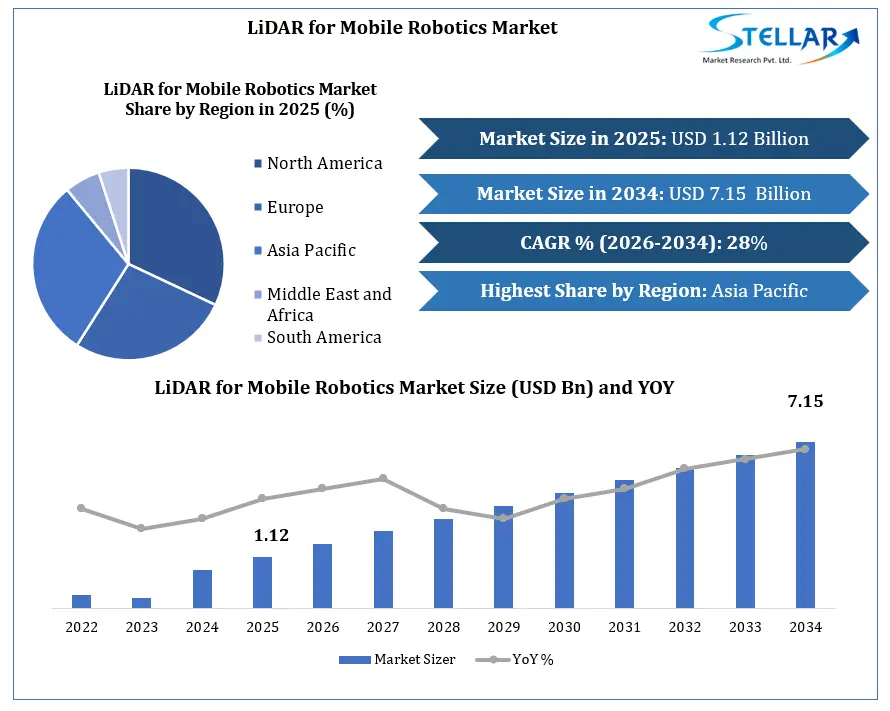
The LiDAR for Mobile Robotics Market was valued at USD 1.12 Billion in 2025 and is forecast to reach USD 7.15 Billion by 2034, growing at a 28% CAGR. rapid expansion of autonomous navigation across industrial and commercial applications is boosting the market.
LiDAR for Mobile Robotics Market Overview:
The LiDAR for Mobile Robotics market is evolving towards sophisticated autonomous robots that use 3D and solid-state LiDAR technology for navigation. These robots facilitate real-time map creation, navigation using SLAM technology, and decision-making based on AI in AGVs, AMRs, delivery robots, and industrial mobile robots. The key demand drivers include automation in warehousing, smart manufacturing practices, and logistics services, backed by affordable and reliable sensor technologies.
The dominant revenue share belongs to North America owing to the massive application of warehouse automation and robots, followed by fast-paced growth in Asia Pacific fueled by efficient manufacturing facilities and growing acceptance of inexpensive LiDAR systems.
To get more Insights: Request Free Sample Report
Market Definition and Scope:
LiDAR for Mobile Robotics can be defined as the deployment of LiDAR technologies on mobile robotics to sense the environment, make real-time maps, and help them navigate through autonomously. The technology is based on lasers and uses distance measurements to provide precise 2D and 3D mapping capabilities, helping robots to avoid any obstructions in their path.
Applications of LiDAR sensors on mobile robotics are found in delivery robots, inspection robots, AMRs, and AGVs in different industries such as manufacturing, warehousing, e-commerce, healthcare, and retail industry. The main factors driving this market include rising automation and advancements in LiDAR technology that include reduced costs, miniaturization, and AI & machine learning capabilities.
LiDAR for Mobile Robotics Market Growth Drivers
- Adoption of Automation in Warehouses and Logistics
The need for AMRs and AGVs has become very high due to the rapid increase in e-commerce and omnichannel retail operations. LiDAR is an essential part of today’s automation processes in logistics centers since it makes it possible for robots to move around easily and avoid any obstacles.
- Increasing Need for Safety and Autonomous Navigation
Growth of Requirement for Safety and Navigation Autonomous robots are increasingly adopted by industries that require little human intervention or pose a lot of safety threats. With LiDAR providing precise real-time mapping of the environment along with object detection, robots is able to operate effectively and safely in industrial sites, healthcare facilities, retail stores, and other industrial environments.
LiDAR for Mobile Robotics Market Opportunities
- The Growth of Industry 4.0 Projects and Smart Warehouses
LiDAR-enabled mobile robots have a lot of potential due to the increasing usage of Industry 4.0 technologies, automated warehouses, and smart factories. The need for sophisticated navigation and autonomous material-handling systems is anticipated to rise as businesses want to boost worker productivity, inventory accuracy, and operational efficiency.
- New Uses in Retail, Last-Mile Delivery, and Healthcare
Robotics are used more widely beyond traditional factory settings to include last mile deliveries, health care organizations, retail outlets, hospitality organizations, and even airports. Robots that feature LiDAR technology have the ability to operate in cluttered spaces
LiDAR for Mobile Robotics Market Trends
- Growing Use of Solid-State LiDAR Technology
Due to solid-state LiDAR's smaller size, better durability, lower power consumption, and cheaper production costs, manufacturers are progressively switching from traditional mechanical LiDAR. LiDAR is becoming more appropriate for small, transportable robotic systems as a result of this development.
- Enhancing Usage of 3D LiDAR for Better Environmental Understanding
The usage of 3D LiDAR technology, which is an advanced technique, is increasing in mobile robotics due to its potential to increase accuracy and improve environmental understanding. 3D LiDAR helps mobile robots build more complex 3D models of their surroundings, thus increasing their understanding of the environment.
LiDAR for Mobile Robotics Market Growth Challenges
- Providing Dependable Performance in Unstructured and Dynamic Environment
Mobile robots typically operate in environments with individuals, vehicles, dynamic environments, and obstacles that are not predicted. LiDAR systems continue to have difficulties in maintaining precise real-time mapping and navigation in such dynamic situations, especially in busy commercial and industrial environments.
- Handling Huge Sensor Data Volumes
For navigation and decision-making, LiDAR sensors provide enormous volumes of spatial data that must be rapidly analyzed. This can increase power consumption and system complexity for mobile robots as it calls for sophisticated algorithms, high-performance processing capabilities, and effective data management systems.
LiDAR for Mobile Robotics Market Segmentation
By Product Type
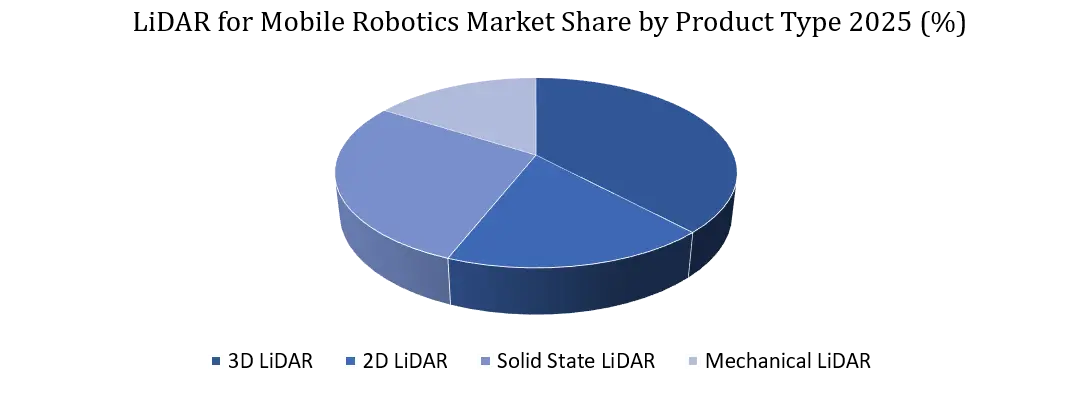
The market includes 3D LiDAR, 2D LiDAR, Solid State LiDAR, Mechanical LiDAR. The 3D LiDAR segment is dominating the market owing to its high operational safety which reduces risk of collision as it has superior obstacle detection. It is the largest market segment as it has 38% market share.
The 2D LiDAR segment has 18% of the market share. this are mostly used for floor level detection. solid state LiDAR is the fastest growing in the market with 28% market share, as it reduces the cost of the robot due to compact nature. Mechanical LiDAR is the declining market share with 16% market share.
By Sensors
1D LiDAR sensors hold a minimal market share due to their limited use in basic distance measurement and simple obstacle detection as secondary sensors in low-cost robots. 2D LiDAR sensors lead the market as they enable accurate planar mapping for navigation and collision avoidance in AGVs and warehouse robots. 3D LiDAR sensors represent the fastest-growing segment, driven by full volumetric scanning capabilities used in advanced AMRs and autonomous forklifts for complex autonomous navigation.

By Component
Laser scanners held around 42% share of the LiDAR market in 2025 as the core sensing units enabling laser emission, signal reception, accurate object detection, and 3D mapping. Demand increased with rising adoption of autonomous vehicles, robotics, and industrial automation, while IMUs, GPS/GNSS, cameras, and processors supported navigation, positioning, and real-time data processing.
By Application
The warehousing and logistics segment is expected to capture the highest market share of nearly 45% due to the high deployment of AGVs and AMRs for e-commerce and distribution purposes. Industrial manufacturing comes in second place in the market, taking up 25% of the market share owing to intralogistics and smart factory automation. Healthcare and hospital automation take third position with 12%, thanks to delivery and disinfection robots.
LiDAR for Mobile Robotics Market Competitive Analysis:
The position of RoboSense in the LiDARs for mobile robotics sector is bolstered by the entry into both automotive and robotics markets, triggered by increasing demand for AMRs, automated industrial processes, and ADAS applications. Seyond has also made itself prominent in the market through collaborations with OEMs such as Nio and international growth after its listing in Hong Kong, with both companies emphasizing the importance of improving range and precision capabilities of LiDAR sensors.
The competition among firms operating within the industry is growing more cost-effective and technology-centric as Chinese vendors dominate the scene due to their massive production capacities and higher demand for EVs and robotics products. Conversely, Western competitors are struggling to compete because of the pressure on pricing and profitability, which forces vendors from both camps to emphasize cost reduction and sensing performance.
Competitive Landscape Executive Summary
The LiDAR for Mobile Robotics Market is highly competitive, with companies focusing on compact sensor design, 3D perception, obstacle detection, mapping accuracy, industrial safety, and cost-effective deployment for autonomous mobile robots, AGVs, warehouse robots, service robots, inspection robots, and outdoor robotic platforms.
The report provides a detailed competitive landscape covering key players such as Hesai Technology, RoboSense, Benewake, Ouster Inc., Luminar Technologies, Innoviz Technologies, Cepton Technologies, LeddarTech, RIEGL Laser Measurement Systems, SICK AG, Hokuyo Automatic, Pepperl+Fuchs, Leuze electronic, ifm electronic, Livox Technology Company, Avantier, and other regional and niche suppliers. Velodyne LiDAR is assessed under Ouster’s expanded market position, while Pandar is treated as a Hesai product line rather than a separate competitor.
The competitive analysis helps users understand how companies are positioned across mobile robotics applications, including indoor navigation, warehouse automation, industrial safety, outdoor autonomy, mapping, smart infrastructure, and robotic perception. The report compares vendors by product portfolio, LiDAR type, range, field of view, pricing strategy, software support, safety certification, regional presence, partnerships, and target end-use industries.
Hesai, RoboSense, Benewake, Livox, and Ouster are analyzed for their growing role in robotics-ready LiDAR solutions, while SICK, Hokuyo, Pepperl+Fuchs, Leuze, and ifm electronic are evaluated for their strong industrial automation and safety sensor presence. Luminar, Innoviz, and Cepton are covered for their high-performance LiDAR technologies and relevance in outdoor robotic systems, smart infrastructure, and autonomous mobility applications.
This section of the report is useful for robotics OEMs, system integrators, investors, and strategy teams because it explains which companies are leading in cost efficiency, performance, industrial reliability, safety compliance, and application-specific LiDAR deployment. It also highlights competitive risks such as price pressure, sensor commoditization, consolidation, supply chain dependency, and the shift from automotive-focused LiDAR toward robotics, logistics, factory automation, and physical AI applications.
LiDAR for Mobile Robotics Market Recent Market Movements:
- December 2025, Seyond Holdings, the manufacturer of LiDAR components for Nio, made its debut on the Hong Kong Stock Exchange by means of a USD 132.4 million de-SPAC merger deal with TechStar Acquisition Corporation. During its trading period, the price of Seyond's stock reached a maximum of USD2.22 after opening at about USD1.28, closing the session at USD1.71. Seyond is a producer of LiDAR sensors for use in ADAS, robotics, autonomous delivery, and industrial automation solutions.
- January 2025, , Luminar Technologies is selling its LiDAR component unit to Quantum Computing Inc. in exchange for USD 22 million provided that a higher bid will emerge during its bidding process. This comes after the firm's previous sale of its semiconductor business for USD110 million and is in sharp contrast with its 2021 valuation of about USD11 billion.
- In October 2025, Hesai Technology upgraded its manufacturing capabilities for the latest solid-state LiDAR to cater to increased demand by autonomous mobile robots and smart logistics, as well as to develop collaborations with worldwide robotics OEMs for an affordable solution for automated warehouses and AMRs.
- In November 2025, RoboSense introduced its series of multi-beam 3D LiDAR, which is specifically designed for industrial and delivery robots that require better SLAM technology, greater distance detection, and cheaper unit prices.
LiDAR for Mobile Robotics Market Regional Analysis:
The Asia Pacific region captures nearly 48% of the market share due to the rising trend of the application of electric automobiles, self-driven cars, and industrial automation. The key market driver in the region is none other than China, which will serve as the hub for the implementation of LiDAR technology in its automobile industry with the involvement of companies like BYD, Nio, Xpeng, and Li Auto fitting LiDAR into their cars. Other market drivers in the region include major manufacturers of LiDARs such as Hesai, RoboSense, and Seyond.
North America is projected to capture a market share of around 27%, thanks to its high investment in autonomous vehicles, robots, logistics automation, and smart infrastructure development. The European region is projected to capture a market share of around 19% due to stringent policies to maintain road safety along with the implementation of advanced driver-assistance systems (ADAS). In addition, the Middle East & Africa and South America regions hold a market share of around 6%.
|
LiDAR for Mobile Robotics Market |
|||
|
Report Coverage |
Details |
||
|
Base Year: |
2025 |
Forecast Period: |
2026-2034 |
|
Historical Data: |
2020 to 2025 |
Market Size in 2025: |
USD 1.12 Bn. |
|
Forecast Period 2026 to 2034 CAGR: |
28% |
Market Size in 2034: |
USD 7.15 Bn. |
|
Segments
|
By Product Type |
|
|
|
By Sensors |
|
||
|
By Component |
|
||
|
|
By Application
|
|
|
LiDAR for Mobile Robotics Market Key players
- Hesai Technology
- Robosense
- Benewake
- Pandar Technologies
- Avantier
- Ouster Inc.
- Velodyne Lidar
- Luminar Technologies
- Innoviz Technologies
- Cepton Technologies
- LeddarTech
- Quanergy Systems
- RIEGL Laser Measurement System
- SICK AG
- Hokuyo Automatic
- Pepperl+Fuchs
- Leuze electronic
- ifm electronic
- Livox Technology Company
- Others
Frequently Asked Questions
Key players include Hesai Technology, RoboSense, Benewake, Livox Technology Company, SICK AG, Hokuyo Automatic, Pepperl+Fuchs, Leuze electronic, ifm electronic, Ouster Inc., Velodyne Lidar, Luminar Technologies, Innoviz Technologies, and Cepton Technologies.
The market is driven by rising demand for warehouse automation, increasing adoption of AMRs in logistics, advancements in 3D sensing and SLAM technology, and the need for real-time high-precision navigation in dynamic environments.
Key trends include the shift toward solid-state LiDAR, AI-powered perception systems, cost reduction in 3D LiDAR, integration with robotics SLAM software, and increasing use of LiDAR in last-mile delivery robots and service robotics applications.
The regulatory regime of the market under study is becoming more rigorous owing to the emphasis on safety, industrial automation, and robustness of autonomous systems. For example, in Europe, safety standards such as EU Machinery Directive, ISO 3691-4, and ISO functional safety guidelines make sure that LiDAR-assisted AGVs and AMRs function safely by detecting obstacles reliably and performing proper human-robot interactins. In the US, OSHA workplace safety guidelines and ANSI/RIA R15.08 standards regulate the use of mobile robots in warehouses and industrial establishments, and the FCC regulates all electronics and sensors. Meanwhile, in the Asia Pacific region, countries such as China, Japan, South Korea, and India encourage industrial automation while adhering to international ISO safety guidelines.
1. LiDAR for Mobile Robotics Market Introduction
1.1. Study Assumption and Market Definition
1.2. Scope of the Study
1.3. Executive Summary
2. Global LiDAR for Mobile Robotics Market: Competitive Landscape
2.1. SMR Competition Matrix
2.2. Key Players Benchmarking
2.2.1. Company Name
2.2.2. Headquarter
2.2.3. Product Segment
2.2.4. End-User Segment
2.2.5. Revenue Details in 2025
2.2.6. Market Share (%)
2.2.7. Growth Rate (%)
2.2.8. Distribution Channel
2.2.9. Return on Investment (%)
2.2.10. Technological Capabilities
2.2.11. Geographical Presence
2.3. Market Structure
2.3.1. Market Leaders
2.3.2. Market Followers
2.3.3. Emerging Players
2.4. Mergers and Acquisitions Details
3. LiDAR for Mobile Robotics Market: Dynamics
3.1. LiDAR for Mobile Robotics Market Trends
3.2. LiDAR for Mobile Robotics Market Dynamics
3.2.1. Drivers
3.2.2. Restraints
3.2.3. Opportunities
3.2.4. Challenges
3.3. PORTER’s Five Forces Analysis
3.4. PESTLE Analysis
3.5. Regulatory Landscape by Region
3.6. Key Opinion Leader Analysis for the Global Industry
3.7. Analysis of Government Schemes and Initiatives for Industry
4. LiDAR for Mobile Robotics Market Technology & Innovation Trends
4.1. Growing Use of Solid-State LiDAR Technology
4.2. Enhancing Usage of 3D LiDAR for Better Environmental Understanding
5. LiDAR for Mobile Robotics Market: Global Market Size and Forecast by Segmentation (by Value in USD Billion and Volume) (2025-2034)
5.1. LiDAR for Mobile Robotics Market Size and Forecast, by Product Type (2025-2034)
5.1.1. 3D LiDAR
5.1.2. 2D LiDAR
5.1.3. Solid State LiDAR
5.1.4. Mechanical LiDAR
5.2. Flash LiDAR
5.3. MEMS LiDAR
5.4 OPA (Optical Phased Array)
5.4. LiDAR for Mobile Robotics Market Size and Forecast, by Sensors (2025-2034)
5.4.1. 1D Sensors
5.4.2. 2D Sensors
5.4.3. 3D Sensors
5.5. LiDAR for Mobile Robotics Market Size and Forecast, by Component (2025-2034)
5.5.1. Laser Scanners
5.5.2. Inertial Measurement Units
5.5.3. GPS/GNSS Receivers
5.5.4. Cameras
5.5.5. Processors
5.5.6. Controllers
5.5.7. Others
5.6. LiDAR for Mobile Robotics Market Size and Forecast, by Application (2025-2034)
5.6.1. Warehousing and Logistics
5.6.2. Industrial Manufacturing
5.6.3. Healthcare & Hospital Automation
5.6.4. Retail & Commercial Space
5.6.5. Others
5.7. LiDAR for Mobile Robotics Market Size and Forecast, by Region (2025-2034)
5.7.1. North America
5.7.2. Europe
5.7.3. Asia Pacific
5.7.4. Middle East and Africa
5.7.5. South America
6. North America LiDAR for Mobile Robotics Market Size and Forecast by Segmentation (by Value in USD Billion and Volume) (2025-2034)
6.1. North America LiDAR for Mobile Robotics Market Size and Forecast, by Product Type (2025-2034)
6.2. North America LiDAR for Mobile Robotics Market Size and Forecast, by Sensors (2025-2034)
6.3. North America LiDAR for Mobile Robotics Market Size and Forecast, by Component (2025-2034)
6.4. North America LiDAR for Mobile Robotics Market Size and Forecast, by Application (2025-2034)
6.5. North America LiDAR for Mobile Robotics Market Size and Forecast, by Country (2025-2034)
6.5.1. United States
6.5.2. Canada
6.5.3. Mexico
7. Europe LiDAR for Mobile Robotics Market Size and Forecast by Segmentation (by Value in USD Billion and Volume) (2025-2034)
7.1. Europe LiDAR for Mobile Robotics Market Size and Forecast, by Product Type (2025-2034)
7.2. Europe LiDAR for Mobile Robotics Market Size and Forecast, by Sensors (2025-2034)
7.3. Europe LiDAR for Mobile Robotics Market Size and Forecast, by Application (2025-2034)
7.4. Europe LiDAR for Mobile Robotics Market Size and Forecast, by Component (2025-2034)
7.5. Europe LiDAR for Mobile Robotics Market Size and Forecast, by Country (2025-2034)
7.5.1. United Kingdom
7.5.1.1. United Kingdom LiDAR for Mobile Robotics Market Size and Forecast, by Product Type (2025-2034)
7.5.1.2. United Kingdom LiDAR for Mobile Robotics Market Size and Forecast, by Sensors (2025-2034)
7.5.1.3. United Kingdom LiDAR for Mobile Robotics Market Size and Forecast, by Component (2025-2034)
7.5.1.4. United Kingdom LiDAR for Mobile Robotics Market Size and Forecast, by Application (2025-2034)
7.5.1.5. United Kingdom LiDAR for Mobile Robotics Market Size and Forecast, by Region (2025-2034)
7.5.2. France
7.5.3. Germany
7.5.4. Italy
7.5.5. Spain
7.5.6. Sweden
7.5.7. Russia
7.5.8. Rest of Europe
8. Asia Pacific LiDAR for Mobile Robotics Market Size and Forecast by Segmentation (by Value in USD Billion and Volume) (2025-2034)
8.1. Asia Pacific LiDAR for Mobile Robotics Market Size and Forecast, by Product Type (2025-2034)
8.2. Asia Pacific LiDAR for Mobile Robotics Market Size and Forecast, by Sensors (2025-2034)
8.3. Asia Pacific LiDAR for Mobile Robotics Market Size and Forecast, by Component (2025-2034)
8.4. Asia Pacific LiDAR for Mobile Robotics Market Size and Forecast, by Application (2025-2034)
8.5. Asia Pacific LiDAR for Mobile Robotics Market Size and Forecast, by Country (2025-2034)
8.5.1. China
8.5.2. S Korea
8.5.3. Japan
8.5.4. India
8.5.5. Australia
8.5.6. Indonesia
8.5.7. Malaysia
8.5.8. Philippines
8.5.9. Thailand
8.5.10. Vietnam
8.5.11. Rest of Asia Pacific
9. Middle East and Africa LiDAR for Mobile Robotics Market Size and Forecast (by Value in USD Billion and Volume) (2025-2034)
9.1. Middle East and Africa LiDAR for Mobile Robotics Market Size and Forecast, By Product Type (2025-2034)
9.2. Middle East and Africa LiDAR for Mobile Robotics Market Size and Forecast, By Sensors (2025-2034)
9.3. Middle East and Africa LiDAR for Mobile Robotics Market Size and Forecast, By Component (2025-2034)
9.4. Middle East and Africa LiDAR for Mobile Robotics Market Size and Forecast, By Application (2025-2034)
9.5. Middle East and Africa LiDAR for Mobile Robotics Market Size and Forecast, by Country (2025-2034)
9.5.1. South Africa
9.5.2. GCC
9.5.3. Egypt
9.5.4. Nigeria
9.5.5. Rest of ME&A
10. South America LiDAR for Mobile Robotics Market Size and Forecast by Segmentation (by Value in USD Billion and Volume) (2025-2034)
10.1. South America LiDAR for Mobile Robotics Market Size and Forecast, By Product Type (2025-2034)
10.2. South America LiDAR for Mobile Robotics Market Size and Forecast, By Sensors (2025-2034)
10.3. South America LiDAR for Mobile Robotics Market Size and Forecast, By Component (2025-2034)
10.4. South America LiDAR for Mobile Robotics Market Size and Forecast, By Application (2025-2034)
10.5. South America LiDAR for Mobile Robotics Market Size and Forecast, By Region (2025-2034)
10.6. South America LiDAR for Mobile Robotics Market Size and Forecast, by Country (2025-2034)
10.6.1. Brazil
10.6.2. Argentina
10.6.3. Colombia
10.6.4. Chile
10.6.5. Rest Of South America
11. Company Profile: Key Players
11.1. Key Player1
11.1.1. Company Overview
11.1.2. Business Portfolio
11.1.3. Financial Overview
11.1.4. SWOT Analysis
11.1.5. Strategic Analysis
11.1.6. Recent Developments
11.1.7. Recent Developments
11.2. Hesai Technology
11.3. Robosense
11.4. Benewake
11.5. Pandar Technologies
11.6. Avantier
11.7. Ouster Inc.
11.8. Velodyne Lidar
11.9. Luminar Technologies
11.10. Innoviz Technologies
11.11. Cepton Technologies
11.12. LeddarTech
11.13. Quanergy Systems
11.14. RIEGL Laser Measurement System
11.15. SICK AG
11.16. Hokuyo Automatic
11.17. Pepperl+Fuchs
11.18. Leuze electronic
11.19. ifm electronic
11.20. Livox Technology Company
11.21. Others
12. LiDAR for Mobile Robotics Market Key Findings
13. LiDAR for Mobile Robotics Market Analyst Recommendations
14. LiDAR for Mobile Robotics Market: Research Methodology