ENG
ENG Japanese
  French
  German
  Korean
U.S LiDAR for Mobile Robotics Market Size Share Trends Innovation Dynamics and Forecast 2026-2034
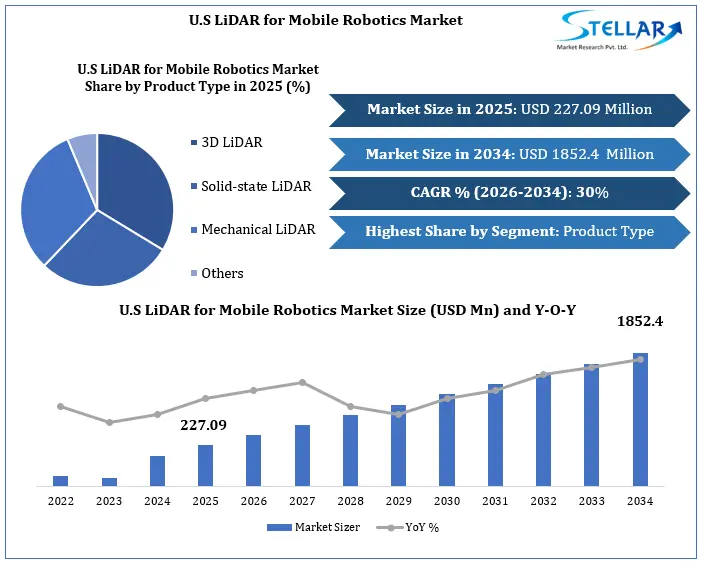
The U.S LiDAR for Mobile Robotics Market was valued at USD 227.09 Million in 2025 and is projected to reach USD 1852.4 Million by 2034, reflecting a 30% CAGR.
Growth is led by U.S. investment in warehouse automation and e-commerce logistics expansion, increasing deployment of Industry 4.0 and smart manufacturing systems, rising adoption of service and healthcare robotics, growing demand for high-precision 3D sensing and navigation technologies, and increasing focus on labor optimization and operational efficiency in industrial and commercial environments.
U.S LiDAR for Mobile Robotics Market Overview
As the U.S LiDAR for Mobile Robotics market develops, LiDAR will serve as an essential underlying technology that will drive the development of next-generation autonomous applications in warehousing, logistics, industrial automation, healthcare, and smart infrastructure. Modern LiDAR-equipped mobile robots will be able to use advanced LiDAR sensors to perform tasks like navigation, precise 3D mapping, obstacle detection, and even human-robot interactions. Thus, these robots will become autonomous devices capable of performing in more flexible and dynamic environments than fixed automation solutions.
U.S LiDAR for Mobile Robotics market growth comes from the fast development of highly automated and labor-intensive industries, including e-commerce warehouses, distribution centers, smart factories, and healthcare facilities. In such cases, automation plays an extremely important role due to high efficiency demands. Growth factors include increased need for autonomous mobile robots, adoption of Industrial Internet concepts, and expansion of the overall smart logistics infrastructure. Solid-state and FMCW LiDARs will help in commercializing new products and services thanks to their advanced characteristics and compact form factor.
To get more Insights: Request Free Sample Report
U.S LiDAR for Mobile Robotics Market Dynamics
U.S LiDAR for Mobile Robotics Market Drivers
Expansion of Autonomous Mobile Robots in Logistics and Warehousing
High deployment of autonomous mobile robots across e-commerce fulfillment and distribution centre’s in the U.S is expected to strengthen LiDAR integration for real-time navigation, obstacle detection, and spatial intelligence in complex operational environments. The Americas
As per the International Federation of Robotics (IFR) the number of robot deployments in the Americas region crossed the 50,000 mark for the fourth consecutive year to stand at 50,100 in 2024, with the United States contributing 68%, or 34,200 deployments. However, the deployment witnessed a marginal decline in comparison to the previous year, the growing uptake of robots and their automation, aided by the robust presence of system integrators in the country, will fuel demand for LiDARs in mobile robots.
With the increasing utilization of AMRs and AGVs in material handling and manufacturing processes in the country, the requirement for navigation, obstacle detection, and real-time mapping will boost LiDAR deployments in the U.S.
Shift Toward Smart Manufacturing and Industrial Automation
Growing adoption of Industry 4.0 frameworks across manufacturing facilities is anticipated to accelerate LiDAR utilization in mobile robotics for precision movement, automated material handling, and synchronized production workflows. smart factory initiatives are estimated to exceed 70% adoption among large manufacturing enterprises, driven by demand for predictive operations, reduced downtime, and enhanced production accuracy.
An example of this is the use of AI, automation, and workflow orchestration technologies at IBM that is predicted to result in savings of up to USD 4.5 billion in terms of productivity by 2025. Such examples show how there is a growing requirement for autonomy in warehouse, manufacturing, data center, and enterprise automation.
With the increasing use of AMR technology and automation powered by AI that can automate material handling, logistics processes, and inventory management in businesses, there is a rising demand for efficient obstacle detection and mapping for the autonomous operation of these robots. This shows how the deployment of LiDAR sensors in mobile robotics in the U.S. is likely to increase rapidly in the coming years.
Investment in Defense-Oriented Autonomous Ground Systems
Rising procurement of autonomous robotic platforms for defense and security applications is likely to expand LiDAR integration for terrain mapping, surveillance operations, and hazard detection in mission-critical environments.
U.S LiDAR for Mobile Robotics Market Opportunities
Increase in the Usage of Last Mile Delivery Robots in Smart Cities
The use of delivery pods on smart city roads creates a great market opportunity for LiDAR technology since it requires 3D mapping and navigation through pedestrians and obstacles like curbs in city environments.
Increase in the Usage of Autonomous Security and Surveillance Robots
An increasing trend in the usage of autonomous security bots in industries, corporations, and military bases creates opportunities for the manufacturer of LiDAR technology because perimeter monitoring and obstacle detection under different environmental conditions are essential.
Increased Automation in Agricultural Activities
Automation of tractor operations and other field activities due to lack of sufficient manpower in agriculture creates an opportunity for rugged LiDAR technology to navigate through difficult conditions such as dust.
Increase in the Need for Precision Farming and Harvesting Robots
A rising need for agricultural robots such as harvesting, fruit picking, and vineyard robots creates opportunities for precision LiDAR technology to enable navigation and crop row recognition
U.S LiDAR for Mobile Robotics Market Challenges
Fierce Competition from AI Vision and Sensor Fusion Solutions
Within the United States robotics market, there is an increase in the adoption of AI vision technology solutions that employ cameras along with sensor fusion solutions, which can be less expensive than lidar. This means intense competition and pricing pressure on lidar technology vendors to demonstrate superior performance through practical use cases.
Stringent Safety, Liability, and Regulation Considerations
United States regulations have extremely strict requirements regarding the safety of robots used in public and industrial settings. Any malfunction that affects the performance of these systems such as human recognition and navigation can result in serious liabilities and expenses associated with insurance coverage and regulatory compliance.
U.S LiDAR for Mobile Robotics Market Trends
Transition to Solid-State and FMCW LiDAR
In the American market, a trend towards the transition from spinning LiDARs to solid-state and FMCW LiDARs. In particular, solid-state LiDARs provide a compact form factor, improved durability, and enhanced performance in vibration-intensive robotic systems. The FMCW LiDAR technology allows detecting distance and speed at once without any interferences from the sun or other sensors.
Integration with Cameras and AI-Powered Perception Systems
The combination of several types of sensors, including LiDAR, cameras, and AI-powered perception systems, is becoming increasingly popular in America. Multiple sensors are being replaced by an intelligent system that performs object detection, navigation, and decision-making for mobile robots in complicated American conditions.
Application in Mapping and Digital Twin Technologies
The U.S. uses mobile robots with LiDAR for building three-dimensional maps and creating digital twins of the surrounding environment. Such technologies can be applied for monitoring progress and inspections at construction sites, factories, and infrastructure development sites.
U.S LiDAR for Mobile Robotics Market Segmentation 2025
By Product Type
The leading segment in the U.S. LiDAR for mobile robotics market, accounting for an estimated 45-50%, is 3D LiDAR. This technology is growing in popularity due to high accuracy in spatial mapping, obstacle detection, and navigation in difficult conditions. The growth of solid-state LiDAR is to be attributed to the need for sensors that have a compact form factor and are capable of withstanding vibrations during deployment are less popular due to moving parts Flash, MEMS, and OPA LiDAR are emerging owing to the benefits of semiconductor integration.

By Sensors
3D LiDAR sensors have captured nearly 55-60% of the market, due to wide adoption in autonomous navigation, SLAM mapping, and obstacle avoidance of mobile robots in both outdoor and indoor settings. Although still relevant in warehouse and indoor robotics applications, where cost savings are important, 2D LiDAR sensors account for a much smaller share due to better capabilities in plane navigation. 1D LiDARs occupy only a small share due to limited functionality in complex autonomy systems.

By Component
Laser scanners and processors collectively lead the U.S. LiDAR component ecosystem with a combined share of around 50–55%, as laser scanners enable high-resolution environmental sensing while processors support real-time AI-driven decision-making and data interpretation in autonomous systems. Cameras and IMUs also account for a significant share due to growing sensor fusion adoption, while GPS/GNSS receivers and controllers support positioning, navigation stability, and system-level coordination in outdoor robotics deployments.
By Application
Warehousing and logistics dominate the market with an estimated 40–45% share, as large-scale automation in e-commerce fulfillment centers, distribution hubs, and inventory operations drives rapid adoption of autonomous mobile robots for navigation, picking, and material movement. Industrial manufacturing follows with strong adoption supported by material handling automation and inspection use cases, while healthcare, retail, and commercial spaces are witnessing steady growth through service robotics, contactless delivery, cleaning systems, and surveillance applications.
U.S LiDAR for Mobile Robotics Market Recent Market Developments:
- On March 2025, International Federation of Robotics, robot installations in the industrial sector in the U.S were up by 11% due to 30% increase in robotics usage in food industry with flexible handling systems powered by LiDAR technology-based mobile robots.
- On April 2026, Voyant Photonics, the company fast-tracked deployment of chip-sized 4D FMCW LiDAR based on the silicon photonics technology with significantly reduced size and cost and improved precision for autonomous mobile robots and robotic arms applications.
- On February 2025, Caterpillar Inc. collaborated with Luminar Technologies to integrate two Iris LiDAR units into Cat Command for hauling autonomous mining trucks, specifically for quarry and aggregate operations, to enhance perception, safety, and obstacle detection in off-highway driverless systems.
|
U.S LiDAR for Mobile Robotics Market |
|||
|
Report Coverage |
Details |
||
|
Base Year: |
2025 |
Forecast Period: |
2026-2034 |
|
Historical Data: |
2020 to 2025 |
Market Size in 2025: |
USD 227.09 Mn. |
|
Forecast Period 2026 to 2034 CAGR: |
30% |
Market Size in 2034: |
USD 1852.4 Mn. |
|
Segments
|
By Product Type |
|
|
|
By Sensors |
|
||
|
By Component |
|
||
|
|
By Application
|
|
|
U.S LiDAR for Mobile Robotics Market Key Players
- Ouster
- Luminar Technologies
- Aeva Technologies
- Cepton Technologies
- MicroVision
- Quanergy Systems
- Seyond
- AEye
- Voyant Photonics
- SOS Lab
- PreAct Technologies
- Blickfeld
- PhasorLab
- Kyber Photonics
- LIDAR U.S
- Others
Frequently Asked Questions
The U.S. LiDAR for Mobile Robotics Market is forecast to reach USD 1852.4 Million by 2034, supported by increasing adoption of solid-state and 3D LiDAR systems, expansion of autonomous delivery robots, and rising investments in AI-based sensor fusion and industrial automation technologies.
3D LiDAR is estimated to hold the largest share in the U.S. market, as it is widely used in autonomous navigation, SLAM-based mapping, and obstacle detection for mobile robots operating in dynamic indoor and outdoor environments such as warehouses and industrial facilities.
LiDAR adoption is witnessing strong growth due to increasing labor shortages, rapid warehouse automation, expansion of e-commerce logistics, and rising demand for safe and accurate autonomous navigation systems in complex environments such as manufacturing plants, healthcare facilities, and smart cities.
1. U.S LiDAR for Mobile Robotics Market: Executive Summary
1.1. U.S LiDAR for Mobile Robotics Market Size and Forecast (USD Million)
1.2 Market Definition
1.3 Market Segmentation
1.4 Research Timelines
1.5 Assumptions
1.6 Limitation
2. U.S LiDAR for Mobile Robotics Market: Research Methodology
2.1 Data Mining
2.2 Secondary Research
2.3 Primary Research
2.4 Subject Matter Expert Advice
2.5 Quality Check
2.6 Final Review
2.7 Data Triangulation
2.8 Top-Down Approach
2.9 Bottom-Up Approach
2.10 Research Flow
2.11 Data Sources
3. U.S LiDAR for Mobile Robotics Market: Market Attractiveness Mapping
3. 1 U.S LiDAR for Mobile Robotics Market Overview
3.2 Competitive Analysis: Funnel Diagram (Tier 1, Tier 2, Tier 3)
3.3 U.S LiDAR for Mobile Robotics Market Absolute Market Opportunity
3.4 U.S LiDAR for Mobile Robotics Market Attractiveness Analysis, By Product Type
3.5 U.S LiDAR for Mobile Robotics Market Attractiveness Analysis, By Components
3.6 U.S LiDAR for Mobile Robotics Market Attractiveness Analysis, By Application
3.7 U.S LiDAR for Mobile Robotics Market Attractiveness Analysis, By Sensors
3.8 Future Market Opportunities
4. U.S LiDAR for Mobile Robotics Market: Market Outlook
4.1 U.S LiDAR for Mobile Robotics Market Evolution
4.2 U.S LiDAR for Mobile Robotics Market Outlook
4.3 Market Drivers
4.4 Market Restraints
4.5 Market Trends
4.6 Market Opportunity
4.7 Porter’s Five Forces Analysis
4.7.1 Threat of New Entrants
4.7.2 Bargaining Power of Suppliers
4.7.3 Bargaining Power of Buyers
4.7.4 Threat of Substitute Products
4.7.5 Competitive Rivalry of Existing Competitors
4.8 Value Chain Analysis
4.9 Pricing and Cost Structure
4.10 Port and Infrastructure Development
4.11 E-commerce U.S Intelligent Transportation System
4.12 Geopolitical Impact Analysis on U.S Intelligent Transportation System
4.13 Regulatory Standards & Policy Landscape
4.14 Intelligent Transportation System and Sustainability
4.15 Technology Analysis
5. U.S LiDAR for Mobile Robotics Market: By Product Type
5.1 3D LiDAR
5.2 Solid State LiDAR
5.3 Mechanical LiDAR
5.4 Others
6. U.S LiDAR for Mobile Robotics Market: By Component
6.1 Laser Scanners
6.2 Inertial Measurement Units
6.3 GPS/GNSS Receivers
6.4 Cameras
6.5 Processors
6.6 Controllers
6.7 Others
7. U.S LiDAR for Mobile Robotics Market: By Application
7.1 Warehousing and Logistics
7.2 Industrial Manufacturing
7.3 Healthcare & Hospital Automation
7.4 Retail & Commercial Space
7.5 Others
8. U.S LiDAR for Mobile Robotics Market: By Sensors
8.1 1D LiDAR Sensors
8.2 2D LiDAR Sensors
8.3 3D LiDAR Sensors
9. SMR Competitive Matrix
10. U.S LiDAR for Mobile Robotics Market: Company Benchmarking
11. U.S LiDAR for Mobile Robotics Market: Company Profiles
11.1 Each Profile Covers:
11.2 Company Overview
11.3 Business Portfolio
11.4 Financial Overview
11.5 Industry Focus
11.6 Strategic Analysis
11.7 SWOT Analysis
11.8 Recent Developments
11.9 Key Players
- Ouster
- Luminar Technologies
- Aeva Technologies
- Cepton Technologies
- MicroVision
- Quanergy Systems
- Seyond
- AEye
- Voyant Photonics
- SOS Lab
- PreAct Technologies
- Blickfeld
- PhasorLab
- Kyber Photonics
- LIDAR U.S
12. Risk Assessment and Scenario Analysis
13. Strategic Opportunity
14. Investments & Funding Analysis
15. Strategic Roadmap
15.1 Short-Term Roadmap 2026–2027
15.2 Mid-Term Roadmap 2028–2029
15.3 Long-Term Roadmap 2030–2032
16. Analyst Recommendations
16.1 Recommendations for ITS Companies
16.2 Recommendations for Investors
16.3 Recommendations for New Entrants
16.4 Recommendations for Maintenance Firms
16.5 Recommendations for Consulting and Strategy Teams