ENG
ENG Japanese
  French
  German
  Korean
US AI in BFSI Market: Intelligent Banking Automation, Fraud Analytics, and AI-Driven Financial Decision Systems Outlook 2026–2032
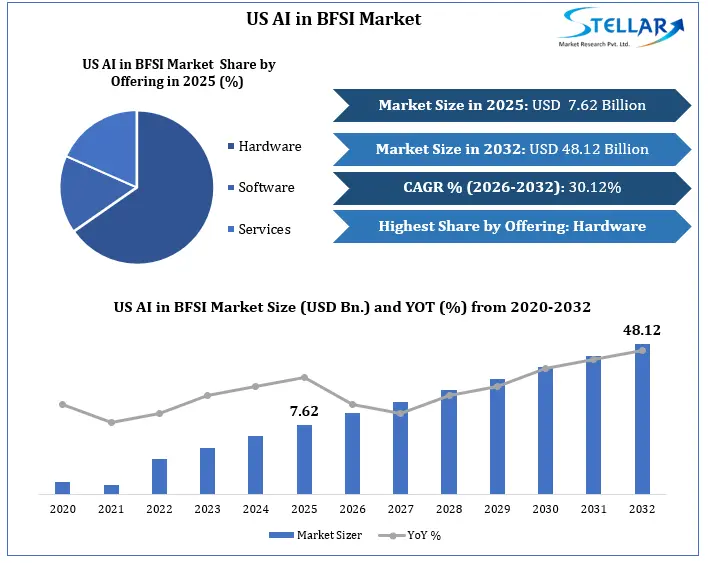
The US AI in BFSI Market was projected to grow from USD 7.62 billion in 2025 to USD 48.12 billion by 2032 at 30.12% CAGR, driven by rising adoption of AI-powered automation, fraud detection, risk management, and personalized digital banking solutions across financial institutions.
US AI in BFSI Market Overview
The AI market in the US BFSI sector is reshaping banking, financial services, and insurance through automation, predictive modelling, and real-time data systems. Financial institutions are increasingly using AI for fraud detection, credit risk evaluation, customer support automation, regulatory compliance, and investment research, leading to better efficiency, stronger security, and improved customer experience across digital platforms.
Market expansion is being fueled by strong digital banking adoption, growing complexity in financial transactions, and an increasing demand for quicker, more accurate decision-making across financial services. Major US institutions including JPMorgan Chase, Bank of America, Citigroup, Morgan Stanley, and Goldman Sachs are investing heavily in AI-based platforms to upgrade core banking infrastructure, strengthen fraud detection, and enable data-led operations. AI is also widely applied in real-time transaction tracking, automated loan processing, and smart advisory services throughout the US BFSI sector.
To get more Insights: Request Free Sample Report
US AI in BFSI Market Definition
The US AI in BFSI market refers to the application of artificial intelligence technologies across banking, financial services, and insurance in the United States to support process efficiency, financial intelligence, and service delivery. It includes machine learning, predictive analytics, natural language processing, and robotic process automation used for advanced financial modelling, automation of complex workflows, and strengthening enterprise-level decision systems across banking and insurance organizations.
The market is growing as US financial institutions increasingly implant AI into core areas such as capital markets operations, enterprise risk management, and automated process systems. AI is also supporting improved decision systems for investment planning, more efficient large-scale financial operations, and stronger data-driven workflows across banking and insurance networks. At the same time, ongoing improvements in AI capabilities within US fintech ecosystems are contributing to more scalable and efficient financial infrastructure development.
US AI in BFSI Market Drivers
Expansion of Cloud Based AI Infrastructure in Financial Services
The financial institutions in the US are increasingly shifting toward cloud-based AI infrastructure to support large-scale data processing and advanced analytics. This move helps banks and insurance providers deploy AI models more quickly, manage growing volumes of financial data more efficiently, and expand digital services without relying heavily on on-premise systems. Cloud platforms also enable near real-time processing of transactions, customer activity, and risk assessments, allowing organizations to respond faster and keep operations more flexible.
Leading US-based financial institutions such as Morgan Stanley, Goldman Sachs, and Citigroup are working with cloud and AI providers to upgrade their core systems. For instance, Goldman Sachs is modernizing its financial infrastructure by combining cloud-based systems with AI-driven analytics to strengthen trading, risk management, and overall efficiency. The firm applies advanced AI models to analyze large volumes of market data in real time, helping traders and analysts react faster and make more informed investment decisions.
This shift is improving system performance, simplifying infrastructure, and enabling more advanced AI use cases such as predictive analytics and automated workflows across banking operations.
Increasing Demand for Real-Time Financial Analytics and Data-Driven Decision-Making
The use of AI to process large volumes of structured and unstructured financial data in real time is increasing in the US. This enables faster understanding of market trends, customer behavior, and transaction patterns, helping banks, insurers, and investment firms improve forecasting accuracy and decision-making speed. AI-driven analytics also supports stronger portfolio management, pricing strategies, and financial planning by turning complex data into more usable outputs.
Leading US financial institutions like JPMorgan Chase, Morgan Stanley, and Citigroup are steadily adopting AI-driven analytics across their core operations. For instance, JPMorgan Chase applies AI models to process market data, customer transactions, and risk indicators in real time, supporting better investment decisions and improving efficiency across its banking and trading functions.
This shift is enabling financial institutions to act more quickly on data, improve the precision of forecasting, and develop more responsive strategies across banking and investment activities in the US.
US AI in BFSI Market Opportunities
Expansion of AI In Credit Decisioning and Financial Inclusion
Banks in the US are increasingly using AI to make lending decisions more practical and faster. Instead of depending only on traditional credit scores, these systems look at a wider set of information like spending patterns, account activity, and cash flow behavior. This gives lenders a more complete view of how someone manages money. It also helps speed up loan approvals and reduces delays in the process. At the same time, people who may not have a long credit history but still show steady financial behavior get a better chance of accessing credit.
Growth of AI In Cybersecurity and Financial Crime Prevention
Banks and insurance companies in the US are putting more money into AI-driven cybersecurity to deal with rising online threats. These systems help spot phishing attempts early, flag unusual login activity that could signal account takeovers, and track suspicious transaction patterns as they happen. AI also supports fraud teams by speeding up investigation work and improving how quickly responses can be made when something looks off. Overall, it helps financial institutions better protect customer data and reduce the chances of financial crime across digital banking platforms.
US AI in BFSI Market Trends
Growth Of AI In Fraud Detection and Risk Management
Banks, insurance companies, and other financial institutions in the United States are increasingly using AI to improve fraud detection, anti-money laundering systems, and real-time risk monitoring. AI models process large volumes of transaction data, customer behaviour, and payment patterns to detect anomalies and suspicious activity more quickly. This supports lower fraud losses, better compliance accuracy, and stronger credit risk assessment, leading to more informed lending and portfolio decisions.
Rising Adoption of Generative AI In Financial Services
The growing use of generative AI across US banks and insurance companies is improving efficiency in areas such as customer engagement, documentation, and internal operations. It enables automated report generation, summarization of regulatory documents, and AI-powered chatbots and virtual assistants for customer support. In banking, it supports more personalized communication and smoother workflow automation, while in insurance it helps speed up claims processing, policy management, and resolution of customer queries, reducing manual effort and improving operational speed.
US AI in BFSI Market Segmentation (2025)
US AI in BFSI Market by Offering
Software accounts for the largest share of the US AI in BFSI market at around 64.0%, driven by growing adoption of AI solutions for fraud detection, risk management, automation, and customer analytics. Services are witnessing steady growth due to rising demand for AI integration, consulting, and deployment across financial institutions. Hardware growth is supported by increasing investments in AI infrastructure, servers, and data processing systems used in advanced financial operations.
US AI in BFSI Market by Technology
Machine Learning (ML) holds the largest share of the AI in BFSI market at around 33.5%, driven by its wide use in financial forecasting, fraud detection, and risk analysis. Natural Language Processing (NLP) and Large Language Models (LLMs) technologies are growing rapidly across customer support and digital banking interactions, while Generative AI is gaining adoption for adapted financial recommendations and intelligent automation. Robotic Process Automation (RPA) continues to improve operational efficiency through automated back-office tasks, and Computer Vision is increasingly used for security verification and digital identity management in financial services.

US AI in BFSI Market by Deployment
Cloud-based deployment holds the largest share of the US AI in BFSI Market at nearly 57.0%, supported by rising adoption of scalable AI platforms, lower infrastructure expenses, faster implementation, and increasing use of digital banking and cloud-based analytics solutions. On-premises deployment continues to maintain a strong position due to demand from financial institutions that require high data security, regulatory compliance, and greater control over sensitive financial data. Meanwhile, hybrid deployment is gaining steady adoption as banks and insurers combine the flexibility of cloud systems with the security benefits of on-premises infrastructure to manage complex financial operations and AI workloads.

US AI in BFSI Market by Solution
Fraud Detection and Prevention holds the largest share of the US AI in BFSI market at around 29.0%, driven by rising digital fraud risks and growing demand for real-time transaction monitoring. Data Analytics and Prediction is widely used for financial forecasting and customer analysis, while chatbots are expanding quickly across digital banking support services. Anti-Money Laundering solutions are seeing higher demand due to stricter compliance requirements, and AI-based Customer Relationship Management tools help financial institutions deliver more personalized services and improve customer engagement.
US AI in BFSI Competitive Landscape 2025
The US AI in BFSI market is largely driven by leading cloud and enterprise AI platform providers that serve as the foundation for AI adoption across banking and insurance. Companies such as Microsoft, Amazon Web Services, Google Cloud, IBM, and Oracle provide AI infrastructure, machine learning platforms, and data processing tools that financial institutions rely on for fraud detection, risk analysis, customer insights, and regulatory compliance.
Specialized US-based financial technology and risk management firms such as FICO, NICE Actimize, SAS Institute, Fiserv, and SS&C Technologies are strengthening the market with AI-driven fraud prevention, credit scoring, anti-money laundering solutions, and real-time transaction monitoring. These companies focus on BFSI-specific applications, helping banks and insurers improve decision accuracy and boost operational efficiency.
In addition, core banking and financial software providers such as Jack Henry & Associates, Salesforce, and ServiceNow are enabling AI integration across banking platforms, customer relationship management systems, and workflow automation tools. AI-focused analytics and platform providers like Palantir Technologies, DataRobot, and NVIDIA further support the ecosystem through predictive analytics, model deployment, and AI infrastructure that power advanced financial intelligence across the US BFSI sector.
US AI in BFSI Market Recent Developments
IBM (April 2025): IBM announced plans to invest USD 150 billion in the U.S. over five years to fuel the economy and accelerate its role in computing. The company has also been tied to a separate USD 1 billion cash commitment for a quantum foundry effort in Albany, New York. (foxbusiness.com)
SAS Institute (May 2023): SAS announced it would invest USD 1 billion over three years in AI-powered industry solutions, including banking, fraud detection, risk management, and compliance use cases. (prnewswire.com)
NICE Actimize (April 2026): NICE Actimize continued expanding its AI-driven fraud and financial crime detection platform for financial institutions, including product updates and the ENGAGE 2026 event. (niceactimize.com)
US AI in BFSI Regional Analysis
In the United States, the Northeast region, particularly New York and Boston, leads the AI in BFSI market, driven by the strong presence of major banks, investment firms, and insurance companies, along with widespread use of AI in trading, fraud detection, and compliance systems. The West Coast, led by California, is the fastest-growing region, supported by a strong fintech ecosystem and major cloud services.
Meanwhile, the Midwest region is growing steadily, primarily driven by large insurance providers, regional banks, and credit unions that are increasingly applying AI for risk assessment, fraud detection, loan processing, and customer service automation. The Southern region is expanding at a faster pace, supported by rising fintech activity, banking growth in cities such as Texas and Florida, and wider adoption of AI for digital payments, credit underwriting, and personalized banking services.
|
AI in BFSI Market |
|||
|
Report Coverage |
Details |
||
|
Base Year: |
2025 |
Forecast Period: |
2026-2032 |
|
Historical Data: |
2020 to 2025 |
Market Size in 2025: |
USD 7.62 Bn. |
|
Forecast Period 2026 to 2032 CAGR: |
30.12% |
Market Size in 2032: |
USD 48.12 Bn. |
|
Segments
|
By Offering |
Hardware Software Services |
|
|
By Technology
|
Machine Learning (ML) Generative AI Robotic Process Automation (RPA) Natural Language Processing (NLP) and Large Language Models (LLMs) Computer Vision Others |
||
|
By Deployment |
Cloud Based On- premises Hybrid |
||
|
By Solution |
Chatbots Fraud Detection and Prevention Anti-Money Laundering Customer Relationship Management Data Analytics and Prediction Others |
||
|
By Financial Institution Type |
Commercial Banks Investment Banks Insurance Companies FinTech Companies Credit Unions Asset Management Firms |
||
Key Players Profiles Covered in the Report
Frequently Asked Questions
AI analyzes transaction patterns in real time to detect anomalies, flag suspicious activities, and prevent fraudulent transactions before they occur.
Banks use AI to deliver personalized product recommendations, instant query resolution through virtual assistants, and faster response times across digital channels.
Key challenges include data privacy concerns, regulatory compliance, integration with legacy systems, and high implementation costs.
Generative AI is being used for automated report generation, customer communication, financial advisory support, and improving internal decision-making processes.
1. US AI in BFSI Market: Introduction
2. US AI in BFSI Market: Executive Summary
2.1. US US AI in BFSI Market Size And Forecast (USD Billion)
2.2 Market Definition
2.3 Market Segmentation
2.4 Research Timelines
2.5 Assumptions
2.6 Limitation
3. US AI in BFSI Market: Research Methodology
3.1 Data Mining
3.2 Secondary Research
3.3 Primary Research
3.4 Subject Matter Expert Advice
3.5 Quality Check
3.6 Final Review
3.7 Data Triangulation
3.8 Top-Down Approach
3.9 Bottom-Up Approach
3.10 Research Flow
3.11 Data Sources
4. US AI in BFSI Market: Market Attractiveness Mapping
4. 1 US AI in BFSI Market Overview
4.2 Competitive Analysis: Funnel Diagram (Tier 1, Tier 2, Tier 3)
4.3 US AI in BFSI Market Absolute Market Opportunity
4.4 US AI in BFSI Market Attractiveness Analysis, By Offering
4.5 US AI in BFSI Market Attractiveness Analysis, By Technology
4.6 US AI in BFSI Market Attractiveness Analysis, By Deployment
4.7 US AI in BFSI Market Attractiveness Analysis, By Solution
4.8 Future Market Opportunities
5. US AI in BFSI Market: Market Outlook
5.1 US AI in BFSI Market Evolution
5.2 US AI in BFSI Adoption Analysis
5.3 Market Trends
5.4 Market Dynamics
5.4.1 Market Drivers
5.4.2 Market Restraints
5.4.3 Market Trends
5.4.4 Market Opportunity
5.5 Porter’s Five Forces Analysis
5.5.1 Threat Of New Entrants
5.5.2 Bargaining Power Of Suppliers
5.5.3 Bargaining Power Of Buyers
5.5.4 Threat Of Substitute Products
5.5.5 Competitive Rivalry Of Existing Competitors
5.6 PESTEL Analysis
5.7 Value Chain Analysis
5.8 AI Infrastructure & Cloud Readiness Analysis
5.9 Pricing Analysis
5.10 Geopolitical Impact Assessment
5.11 Regulatory Framework and Policy Impact Assessment
5.12 Technology Landscape
6. US AI in BFSI Market: By Offering, 2026-2032 (USD Billion)
6.1 Hardware
6.2 Software
6.3 Services
7. US AI in BFSI Market: By Technology, 2026-2032 (USD Billion)
7.1 Machine Learning (ML)
7.2 Generative AI
7.3 Robotic Process Automation (RPA)
7.4 Natural Language Processing (NLP) and Large Language Models (LLMs)
7.5 Computer Vision
7.6 Others
8. US AI in BFSI Market: By Deployment, 2026-2032 (USD Billion)
8.1 Cloud Based
8.2 On- premises
8.3 Hybrid
9. US AI in BFSI Market: By Solution, 2026-2032 (USD Billion)
9.1 Chatbots
9.2 Fraud Detection and Prevention
9.3 Anti-Money Laundering
9.4 Customer Relationship Management
9.5 Data Analytics and Prediction
9.6 Others
10. US AI in BFSI Market: By Financial Institution Type, 2026-2032 (USD Billion)
10.1 Commercial Banks
10.2 Investment Banks
10.3 Insurance Companies
10.4 FinTech Companies
10.5 Credit Unions
10.6 Asset Management Firms
10. US AI in BFSI Competitive Matrix
11. US AI in BFSI Market: Company Benchmarking
12. Merger & Acquisition
13. US AI in BFSI Market: Company Profiles
1. FICO
2. NICE Actimize
3. SAS Institute
4. IBM
5. Oracle
6. Microsoft
7. Amazon Web Services
8. Salesforce
9. Fiserv
10. Jack Henry & Associates
11. SS&C Technologies
12. NVIDIA
13. Palantir Technologies
14. ServiceNow
15. Bloomberg
16. Others
14. Risk Assessment and Scenario Analysis
15. Strategic Opportunity
16. Investments & Funding Analysis
17. Strategic Roadmap
18. Analyst Recommendations