ENG
ENG Japanese
  French
  German
  Korean
AI in BFSI Market: AI-driven Banking Transformation, Intelligent Fraud and Risk Detection, Automated Compliance and AML Systems Outlook 2026–2032
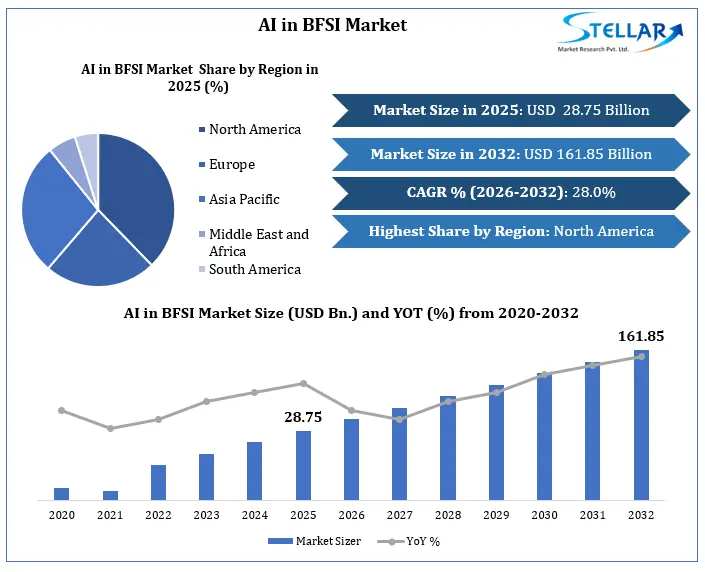
The AI in BFSI Market was projected to grow from USD 28.75 billion in 2025 to USD 161.85 billion by 2032 at 28.0% CAGR, driven by rising adoption of AI-powered automation, fraud detection, risk management, and personalized digital banking solutions across financial institutions.
Global AI in BFSI Market Overview
The AI in BFSI market is modernizing banking, financial services, and insurance operations through intelligent automation, predictive analytics, and real-time decision-making. AI technologies are being widely adopted for fraud detection, risk management, customer support, credit scoring, and regulatory compliance, enabling financial institutions to improve operational efficiency, strengthen security, and deliver better customer experiences.
Market growth is driven by rapid adoption of digital banking, rising cybersecurity concerns, and increasing demand for personalized financial services. Leading institutions such as JPMorgan Chase, HSBC, ICICI Bank, and HDFC Bank are investing in AI-powered solutions to streamline operations, strengthen fraud prevention, and support data-driven financial services. AI is increasingly being applied for anti-money laundering monitoring, customer service automation, predictive analytics, and intelligent risk assessment across the BFSI sector.
To get more Insights: Request Free Sample Report
Global AI in BFSI Market Definition
The AI in BFSI market refers to the use of artificial intelligence technologies across banking, financial services, and insurance operations to improve efficiency, accuracy, and decision-making. Technologies such as machine learning, predictive analytics, natural language processing, and robotic process automation are being widely adopted to automate financial processes, analyze customer and transaction data, and support smarter business operations across the BFSI sector.
The market is growing rapidly due to increasing digital transformation across financial services and rising demand for secure, fast, and personalized banking experiences. AI is being widely used by financial institutions to strengthen fraud detection, automate compliance management, improve financial forecasting, and enhance customer engagement through real-time analytics and data-driven decision-making. In addition, rising investments in intelligent banking infrastructure and increasing focus on operational efficiency are supporting market growth worldwide.
Global AI in BFSI Market Drivers
Rising Digital Transactions and Financial Data Growth
Rising digital transactions and the growing use of online banking and insurance services are increasing the demand for AI in the BFSI sector. Financial institutions are applying AI to strengthen fraud detection, credit scoring, risk management, customer support, and regulatory compliance. At the same time, tighter regulatory requirements are encouraging banks and insurers to adopt AI-driven tools for anti-money laundering checks, reporting, and continuous monitoring, helping reduce manual effort and improve accuracy.
Major players such as JPMorgan Chase, HSBC, ICICI Bank, HDFC Bank, and Citigroup are increasingly embedding AI into their core functions to improve efficiency and support better decision-making. For example, in India, banks such as ICICI Bank and HDFC Bank are using AI-powered chatbots to provide faster and more efficient customer support across digital banking platforms. These chatbots can handle routine banking requests such as balance inquiries, fund transfer assistance, credit card information, loan details, account updates, and transaction history without requiring human intervention.
Growing cybersecurity concerns and higher demand for personalized financial services are also driving wider AI adoption across the BFSI sector.
Rising Need for Operational Efficiency in BFSI
Rising demand for operational efficiency and cost optimization is encouraging BFSI companies to adopt AI-driven automation across core financial operations. Banks, insurers, and fintech firms are using AI to automate repetitive back-office activities such as document processing, loan approvals, claims management, and reconciliation, helping reduce manual workload, improve accuracy, and shorten processing time.
AI-powered automation is supporting faster decision-making in areas such as underwriting and credit evaluation through real-time data analysis. Financial institutions including Bank of America, Wells Fargo, and Axis Bank are implementing AI-based workflow automation to streamline operations and improve customer service efficiency. For example, Bank of America uses its AI-powered virtual assistant “Erica” to help customers check balances, track spending, review transactions, and pay bills through digital banking platforms.
Growing competition and increasing pressure to improve profitability are further accelerating AI adoption across the BFSI sector.
Global AI in BFSI Market Opportunities
Expansion of AI in personalized financial products and advisory services
AI presents strong opportunities for banks and insurers to deliver more personalized financial services by using customer behavior, spending patterns, and financial history. It enables tailored loan offers, investment suggestions, insurance plans, and savings products that better fit individual needs. This leads to better customer engagement and more cross-selling opportunities. AI-powered advisory tools also support wealth management by offering real-time portfolio suggestions and financial planning support at scale.
Growth of AI-powered regulatory technology and compliance automation
The rising complexity of financial regulations is driving increased demand for AI-based regulatory technology solutions in the BFSI sector. AI is being used to automate compliance reporting, track regulatory updates, identify policy violations, and simplify audit processes. It reduces manual compliance effort while improving accuracy and speed in meeting regulatory requirements. This is especially important in areas such as anti-money laundering checks, fraud reporting, and risk governance, where timely and precise compliance is essential.
Global AI in BFSI Market Trends
Growth of AI in fraud detection and risk management
Banks and insurance companies are increasingly using AI to strengthen fraud detection, anti-money laundering systems, and real-time risk monitoring. AI models process large volumes of transaction data, customer behavior, and payment patterns to detect unusual activity faster than traditional systems. This helps financial institutions reduce fraud losses, improve compliance accuracy, and respond more quickly to suspicious transactions. AI is also widely applied in credit risk assessment, supporting more accurate lending decisions and better overall portfolio risk management.
Rising use of generative AI in financial services
Generative AI is increasingly used in BFSI to improve efficiency in customer service, documentation, and internal processes. It helps generate financial reports, summarize regulatory documents, and power chatbots and virtual assistants. In banking, it supports personalized communication and workflow automation, while in insurance it assists with claims processing, policy work, and customer support. Overall, it reduces manual effort and improves speed across routine operations.
Global AI in BFSI Market Segmentation (2025)
Global AI in BFSI Market by Offering
Software accounts for the largest share of the global AI in BFSI market at around 63.5%, driven by growing adoption of AI solutions for fraud detection, risk management, automation, and customer analytics. Services are witnessing steady growth due to rising demand for AI integration, consulting, and deployment across financial institutions. Hardware growth is supported by increasing investments in AI infrastructure, servers, and data processing systems used in advanced financial operations.

Global AI in BFSI Market by Technology
Machine Learning (ML) holds the largest share of the AI in BFSI market at around 34.0%, driven by its wide use in financial forecasting, fraud detection, and risk analysis. Natural Language Processing (NLP) and Large Language Models (LLMs) technologies are growing rapidly across customer support and digital banking interactions, while Generative AI is gaining adoption for adapted financial recommendations and intelligent automation. Robotic Process Automation (RPA) continues to improve operational efficiency through automated back-office tasks, and Computer Vision is increasingly used for security verification and digital identity management in financial services.
Global AI in BFSI Market by Deployment
Cloud-based deployment holds the largest share of the Global AI in BFSI Market at nearly 56.0%, supported by rising adoption of scalable AI platforms, lower infrastructure expenses, faster implementation, and increasing use of digital banking and cloud-based analytics solutions. On-premises deployment continues to maintain a strong position due to demand from financial institutions that require high data security, regulatory compliance, and greater control over sensitive financial data. Meanwhile, hybrid deployment is gaining steady adoption as banks and insurers combine the flexibility of cloud systems with the security benefits of on-premises infrastructure to manage complex financial operations and AI workloads.

Global AI in BFSI Market by Solution
Fraud Detection and Prevention holds the largest share of the global AI in BFSI market at around 28.0%, driven by rising digital fraud risks and growing demand for real-time transaction monitoring. Data Analytics and Prediction is widely used for financial forecasting and customer analysis, while chatbots are expanding quickly across digital banking support services. Anti-Money Laundering solutions are seeing higher demand due to stricter compliance requirements, and AI-based Customer Relationship Management tools help financial institutions deliver more personalized services and improve customer engagement.
Global AI in BFSI Competitive Analysis 2025
The AI in BFSI market is led by global cloud and enterprise AI platform providers that form the core of financial AI adoption. Microsoft, Amazon Web Services, Google Cloud, IBM, and Oracle maintain strong positions through their AI infrastructure, machine learning services, and data platforms that support fraud detection, risk modeling, customer analytics, and regulatory compliance across banks and insurance companies.
Specialized fintech and financial crime technology companies such as FICO, SAS Institute, NICE Actimize, Feedzai, Featurespace, and FIS support the market through AI-based fraud prevention, anti-money laundering systems, credit scoring models, and real-time transaction monitoring solutions. These firms focus on financial services use cases, helping banks and insurers improve decision-making accuracy and operational efficiency.
Core banking and financial software providers such as Temenos, Finastra, FIS, and Salesforce support the ecosystem by integrating AI into banking platforms, lending systems, and customer management tools. AI-driven fintech and lending-focused firms like Upstart and Zest AI contribute to automated underwriting and credit decisioning, while DataRobot supports predictive analytics and model deployment across financial institutions.
Global AI in BFSI Market Recent Developments
Microsoft (2026): Microsoft was projected to spend about USD 145 billion in fiscal 2026 on capital expenditure, mainly for AI infrastructure and cloud expansion. The company also announced an expanded multi-year investment plan for India, with total investments in the country projected to surpass USD 20 billion, including earlier commitments. (finance.yahoo)
Amazon Web Services (2026): Amazon plans to invest nearly USD 200 billion by 2026, with most of the funding directed toward expanding the cloud and AI infrastructure of Amazon Web Services (AWS). (techzine.eu/news)
NVIDIA (March 2026): NVIDIA announced investments of USD 2 billion each in Lumentum and Coherent to strengthen its AI processor supply chain and data center chip ecosystem. The investment is aimed at accelerating the development of advanced optical and photonic technologies required for next-generation AI infrastructure. (reuters.com)
Global AI in BFSI Regional Analysis
North America continues to lead the AI in BFSI market in 2025, driven by strong adoption across banking, insurance, and capital markets. Financial institutions in the region widely apply AI in fraud detection, credit risk assessment, algorithmic trading, customer service automation, and compliance monitoring. The region is supported by advanced digital banking infrastructure, high investment in AI-enabled financial systems, and broad deployment of automation across core banking operations, all of which continue to drive market adoption.
Europe holds a strong position, supported by strict financial regulations and widespread use of AI in AML, risk management, compliance, and customer analytics across major economies including the United Kingdom, Germany, France, and the Netherlands. Asia Pacific is the fastest-growing region, driven by rapid digital banking expansion, fintech growth, and rising AI adoption in payments, lending, and fraud prevention. The Middle East & Africa shows steady growth, supported by banking modernization and digital finance initiatives, while South America is gradually expanding due to increasing fintech activity, better banking access, and growing use of AI in credit scoring and fraud management.
|
AI in BFSI Market |
|||
|
Report Coverage |
Details |
||
|
Base Year: |
2025 |
Forecast Period: |
2026-2032 |
|
Historical Data: |
2020 to 2025 |
Market Size in 2025: |
USD 28.75 Bn. |
|
Forecast Period 2026 to 2032 CAGR: |
28.0% |
Market Size in 2032: |
USD 161.85 Bn. |
|
Segments
|
By Offering |
Hardware Software Services |
|
|
By Technology
|
Machine Learning (ML) Generative AI Robotic Process Automation (RPA) Natural Language Processing (NLP) and Large Language Models (LLMs) Computer Vision Others |
||
|
By Deployment |
Cloud Based On- premises Hybrid |
||
|
By Financial Institution Type |
Commercial Banks Investment Banks Insurance Companies FinTech Companies Credit Unions Asset Management Firms |
||
|
By Solution |
Chatbots Fraud Detection and Prevention Anti-Money Laundering Customer Relationship Management Data Analytics and Prediction Others |
||
Key Players Profiles Covered in the Report
Frequently Asked Questions
AI helps automate compliance checks by monitoring transactions, flagging policy breaches, and generating reports for audits, reducing manual workload in regulatory processes.
AI enhances AML systems by detecting hidden transaction patterns, identifying shell networks, and reducing false alerts through behavioral analysis instead of rule-based monitoring alone.
Financial institutions need to clearly explain AI-driven decisions, especially for loans or claims, to meet regulatory requirements and maintain customer trust in automated outcomes.
Generative AI is being used for drafting financial reports, assisting customer support agents, creating personalized financial content, and summarizing large volumes of regulatory documents quickly.
1. AI in BFSI Market: Introduction
2. AI in BFSI Market: Executive Summary
2.1. Global AI in BFSI Market Size And Forecast (USD Billion)
2.2 Market Definition
2.3 Market Segmentation
2.4 Research Timelines
2.5 Assumptions
2.6 Limitation
3. AI in BFSI Market: Research Methodology
3.1 Data Mining
3.2 Secondary Research
3.3 Primary Research
3.4 Subject Matter Expert Advice
3.5 Quality Check
3.6 Final Review
3.7 Data Triangulation
3.8 Top-Down Approach
3.9 Bottom-Up Approach
3.10 Research Flow
3.11 Data Sources
4. AI in BFSI Market: Market Attractiveness Mapping
4. 1 Global AI in BFSI Market Overview
4.2 Competitive Analysis: Funnel Diagram (Tier 1, Tier 2, Tier 3)
4.3 Global AI in BFSI Market Absolute Market Opportunity
4.4 Global AI in BFSI Market Attractiveness Analysis, By Region
4.5 Global AI in BFSI Market Attractiveness Analysis, By Offering
4.6 Global AI in BFSI Market Attractiveness Analysis, By Technology
4.7 Global AI in BFSI Market Attractiveness Analysis, By Deployment
4.8 Global AI in BFSI Market Attractiveness Analysis, By Solution
4.9 Future Market Opportunities
5. AI in BFSI Market: Market Outlook
5.1 Global AI in BFSI Market Evolution
5.2 AI in BFSI Adoption Analysis
5.3 Market Trends
5.4 Market Dynamics
5.4.1 Market Drivers
5.4.2 Market Restraints
5.4.3 Market Trends
5.4.4 Market Opportunity
5.5 Porter’s Five Forces Analysis
5.5.1 Threat Of New Entrants
5.5.2 Bargaining Power Of Suppliers
5.5.3 Bargaining Power Of Buyers
5.5.4 Threat Of Substitute Products
5.5.5 Competitive Rivalry Of Existing Competitors
5.6 PESTEL Analysis
5.7 Value Chain Analysis
5.8 AI Infrastructure & Cloud Readiness Analysis
5.9 Pricing Analysis
5.10 Geopolitical Impact Assessment
5.11 Regulatory Framework and Policy Impact Assessment
5.12 Technology Landscape
6. AI in BFSI Market: By Offering, 2026-2032 (USD Billion)
6.1 Hardware
6.2 Software
6.3 Services
7. AI in BFSI Market: By Technology, 2026-2032 (USD Billion)
7.1 Machine Learning (ML)
7.2 Generative AI
7.3 Robotic Process Automation (RPA)
7.4 Natural Language Processing (NLP) and Large Language Models (LLMs)
7.5 Computer Vision
7.6 Others
8. AI in BFSI Market: By Deployment, 2026-2032 (USD Billion)
8.1 Cloud Based
8.2 On- premises
8.3 Hybrid
9. AI in BFSI Market: By Solution, 2026-2032 (USD Billion)
9.1 Chatbots
9.2 Fraud Detection and Prevention
9.3 Anti-Money Laundering
9.4 Customer Relationship Management
9.5 Data Analytics and Prediction
9.6 Others
10. AI in BFSI Market: By Financial Institution Type, 2026-2032 (USD Billion)
10.1 Commercial Banks
10.2 Investment Banks
10.3 Insurance Companies
10.4 FinTech Companies
10.5 Credit Unions
10.6 Asset Management Firms
11. AI in BFSI Market: Geography, 2026-2032 (USD Billion)
11.1 North America AI in BFSI Market
11.2 Europe AI in BFSI Market
11.3 Asia Pacific AI in BFSI Market
11.4 South America AI in BFSI Market
11.5 Middle East And Africa AI in BFSI Market
12. AI in BFSI Competitive Matrix
13. AI in BFSI Market: Company Benchmarking
14. Merger & Acquisition
15. AI in BFSI Market: Company Profiles
1. IBM
2. Microsoft
3. Amazon Web Services (AWS)
4. Google Cloud
5. Oracle
6. NVIDIA
7. SAS Institute
8. FICO
9. Salesforce
10. Palantir Technologies
11. Temenos
12. Finastra
13. NICE Actimize
14. Featurespace
15. Feedzai
16. Upstart Holdings
17. Zest AI
18. DataRobot
19. SymphonyAI
20. Others
16. Risk Assessment and Scenario Analysis
17. Strategic Opportunity
18. Investments & Funding Analysis
19. Strategic Roadmap
20. Analyst Recommendations