ENG
ENG Japanese
  French
  German
  Korean
Climate Finance and Green Investments Market: Industry Analysis and Forecast (2026–2032) by Financing Instrument, Investment Type, Application, End User, and Region
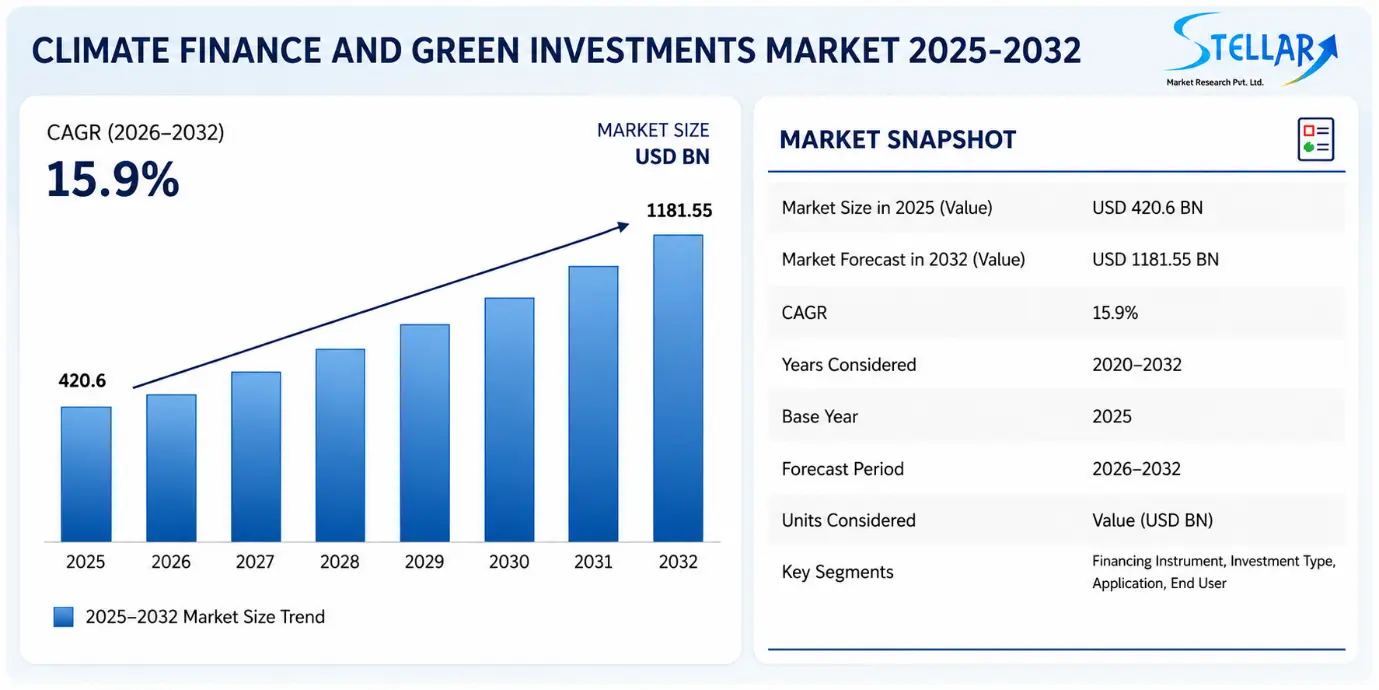
The Climate Finance and Green Investments Market was valued at USD 420.6 Bn in 2025 and is projected to reach USD 1,181.55 Bn by 2032, growing at a CAGR of 15.9% during 2026–2032. Growth is driven by rising capital allocation toward renewable energy, green bonds, sustainability-linked loans, carbon reduction programs, and stricter ESG disclosure frameworks.
Climate Finance and Green Investments Market Overview
The Climate Finance and Green Investments Market focuses on financing activities that support renewable energy projects, sustainable infrastructure development, carbon reduction initiatives, and environmentally responsible investment programs. Governments, financial institutions, and businesses are steadily increasing the use of green bonds, sustainability-linked loans, and climate-based financing models to support cleaner economic growth and meet long-term environmental goals. Growing awareness about climate risks and the shift toward responsible investing are also encouraging stronger participation across public and private sectors.
The market is expanding due to rising interest in sustainable investing, stronger funding for clean energy development, and growing business commitments toward environmental goals. Asset managers and investors are expanding their involvement in climate-related financial products to reduce environmental risks and encourage sustainable business operations. Despite steady growth, the market still faces challenges such as differences in regulatory policies across countries and high financing costs associated with large-scale green development projects.
To get more Insights: Request Free Sample Report
Global Climate, Finance and Green Investment Opportunities 2025
Diversification of Sustainable Financial Products
Financial institutions are expanding their portfolios of green bonds, ESG-oriented funds, and sustainability-linked instruments. These products are increasingly structured to draw long-term investments from both institutional players and individual investors focused on sustainability outcomes.
Acceleration of Clean Energy Funding
The growing global shift toward cleaner energy sources is driving higher levels of investment in solar, wind, hydrogen, and energy storage technologies. Funding support from both governments and private investors is enabling large-scale renewable energy deployment worldwide.
Expansion of Carbon Trading Ecosystems
Carbon markets are growing steadily as trading platforms and offset mechanisms gain wider adoption. These systems are opening new monetization avenues for emission reductions while supporting compliance and voluntary climate action programs.
Advancement of Digital Climate Finance Infrastructure
The integration of fintech solutions, AI-driven ESG assessment tools, and blockchain-based carbon tracking systems is improving data transparency and operational efficiency. These technologies are also helping investors evaluate opportunities and manage sustainable finance activities more effectively.
Global Climate Finance and Green Investments Market Dynamics:
The Global Climate Finance and Green Investments Market is expanding as funding flows increase toward renewable energy, sustainable infrastructure, and carbon reduction initiatives across both public and private sectors.
Governments, financial institutions, and corporations are increasingly using green bonds and sustainability-linked loans to support net-zero targets and strengthen ESG-driven investment approaches.
Market development is also supported by the growing use of carbon finance tools, higher private-sector involvement, and broader inclusion of sustainability factors in investment decision-making.
The market continues to face limitations such as inconsistent ESG reporting practices, high capital requirements for large projects, and regulatory uncertainty, which can affect execution efficiency and investment outcomes.
Climate Finance and Green Investments Market Growth Drivers
Growth in Green Bond Financing
Green bonds are gaining wider acceptance as a preferred financing tool for renewable energy, clean mobility, and sustainable infrastructure projects. Increasing investor interest is improving capital flow toward environmentally responsible developments and long-term climate-focused initiatives.
Expansion of Renewable Energy Investments
Investments in solar, wind, hydrogen, and energy storage projects are increasing steadily to support the transition toward low-carbon energy systems. Rising focus on energy security and clean power generation is also contributing to higher sustainable investment activity worldwide.
Adoption of Sustainability-Linked Loans
Companies across various industries are increasingly adopting sustainability-linked loans as part of their financial planning strategies. Financing conditions and interest structures are now being aligned with environmental and sustainability performance goals.
Government Support for Climate Financing
Government initiatives, supportive regulations, tax benefits, and sustainable finance policies are encouraging investments in green infrastructure and carbon reduction programs. Public funding support is also helping attract greater participation from private investors and financial institutions.
Global Climate Finance and Green Investments Market Challenges
Inconsistent ESG Reporting Standards
Differences in ESG reporting frameworks and sustainability assessment methods are making it difficult for investors to compare financial products and measure performance accurately. The absence of standardized reporting practices is also reducing transparency across the market.
High Investment Costs for Green Projects
Renewable energy and sustainable infrastructure projects often require high initial investments and extended project development periods. Limited access to cost-effective financing is creating challenges for project execution, particularly in price-sensitive regions.
Regulatory Uncertainty Across Markets
Changing environmental regulations and varying climate finance policies across countries are increasing operational challenges for investors and financial institutions. Unclear regulatory direction is also affecting long-term investment planning and funding decisions.
Risk of Greenwashing Practices
Concerns regarding inaccurate sustainability claims in investment products and corporate disclosures are affecting market trust and credibility. Stronger monitoring systems and stricter compliance standards are becoming necessary to improve transparency and strengthen investor confidence.
Global Climate Finance and Green Investments Market Trends
Integration of Climate Risk Analysis
Climate risk assessment is becoming a key part of investment planning and portfolio management activities. Financial institutions are increasingly incorporating environmental risk evaluation into their financial decision-making and long-term investment strategies.
Expansion of Carbon Credit Markets
Participation in carbon trading platforms and emission offset programs is increasing among corporations and investors. Carbon reduction initiatives and regulatory compliance programs are also creating new revenue generation opportunities across multiple industries.
Digitalization in Sustainable Finance
Artificial intelligence, advanced analytics, and fintech-based platforms are improving ESG data management and sustainable investment operations. Digital technologies are also supporting more efficient reporting, tracking, and investment performance monitoring.
Growth of Impact Investment Strategies
Institutional investors are showing greater interest in investment strategies that deliver measurable environmental and social outcomes. Funding activities are increasingly directed toward projects that support sustainability goals and long-term environmental development.
Global Climate Finance and Green Investments Market Segmentation (2025)
Global Climate Finance and Green Investments Market by Financing Instrument
Green Bonds hold the leading position with a 38% share, supported by consistent capital inflows toward renewable energy projects and sustainable infrastructure development, with Corporate Green Bonds contributing xx% of the segment. Sustainability-Linked Loans account for xx%, reflecting the growing adoption of ESG-linked financing structures where lending terms are tied to predefined sustainability performance indicators. Climate Funds represent a xx% share, driven by increasing investor allocation toward renewable energy expansion and climate resilience initiatives. Carbon Finance Instruments comprise xx% of the market, supported by the steady growth of carbon credit trading systems and emission offset mechanisms across regulated and voluntary markets.

Global Climate Finance and Green Investments Market by Investment Type
Equity investments lead the market with a 34.0% share, as more capital is directed toward renewable energy companies, sustainable infrastructure developers, and businesses focused on environmental solutions. Fixed income investments account for 31.0%, supported by the growing issuance of green bonds and sustainable debt instruments used to fund climate-related and environmental projects. Impact investments represent xx%, with funding increasingly targeted toward initiatives that deliver measurable environmental and social outcomes, including climate resilience programs. Alternative sustainable investments hold a xx% share, driven by rising interest in carbon-related assets, sustainable real assets, and other environment-focused investment options.

Global Climate Finance and Green Investments Market by Application
Renewable energy projects account for the largest share at 37.0%, driven by strong capital deployment in solar, wind, and other clean energy initiatives that support the global shift toward low-carbon energy systems. Sustainable infrastructure holds a xx% share, supported by rising investment in green buildings, smart city development, and environmentally responsible urban infrastructure. Clean transportation represents xx%, reflecting increasing funding for electric vehicles, low-emission mobility systems, and greener logistics solutions. Industrial decarbonization makes up xx%, as industries continue adopting energy-efficient technologies, cleaner production methods, and carbon reduction strategies to lower overall emissions.
Global Climate Finance and Green Investments Market by End User
Financial institutions account for a 33.0% share of the market, driven by increasing financing activity in green bonds, sustainability-linked loans, and other climate-focused funding solutions. Governments hold a xx% share, supported by public investment in renewable energy programs, sustainable infrastructure development, and broader climate policy initiatives. Corporates represent xx%, as businesses continue to invest in decarbonization projects, energy transition strategies, and ESG-aligned operations. Institutional investors contribute 18.0%, with pension funds, insurance companies, and asset managers gradually increasing exposure to sustainable and climate-oriented investment assets.
Global Climate Finance and Green Investments Market Competitive Analysis 2025
The Climate Finance and Green Investments Market features institutions with strong sustainable finance capabilities, large capital deployment capacity, and advanced ESG integration frameworks. BlackRock and JPMorgan Chase hold a strong position due to their extensive green bond portfolios, climate investment products, and large-scale sustainable asset management strategies. Similarly, Goldman Sachs and Morgan Stanley maintain a strong presence through structured green financing solutions, sustainability-linked lending, and climate-focused investment banking services.
Financial institutions such as BNP Paribas, HSBC, and Deutsche Bank strengthen Europe’s sustainable finance ecosystem through green lending programs, ESG advisory services, and climate transition financing frameworks. Meanwhile, asset managers and development finance institutions, including UBS, IFC, and the World Bank Group, play a key role in mobilizing global climate capital through
blended finance structures, renewable energy funding, and sustainable infrastructure investments.
Regional financial players such as State Bank of India, ICICI Bank, and Bank of China are expanding their influence by supporting domestic green financing programs, renewable energy project funding, and sustainability-linked credit facilities. These institutions continue to strengthen climate finance adoption through policy-aligned investment initiatives, green banking products, and increased participation in global sustainable investment flows.
Global Climate Finance and Green Investments Market Regional Analysis 2025:
North America Climate Finance and Green Investments Market
North America shows strong activity in climate finance as large investors, banks, and companies put money into renewable energy, green bonds, and sustainability-linked financing. Financial markets in the region actively support clean energy and low-carbon infrastructure projects, supported by clear climate disclosure rules and corporate sustainability commitments.
Europe Climate Finance and Green Investments Market
Europe leads in sustainable finance adoption due to strict climate regulations and well-defined green finance frameworks. Financial institutions regularly include ESG factors in lending and investment decisions, with high participation in green bonds and renewable energy funding that supports long-term carbon reduction goals.
Asia Pacific Climate Finance and Green Investments Market
Asia Pacific demonstrates rapid expansion in climate finance as governments and private companies invest heavily in renewable energy and infrastructure development. Rising demand for electricity, rapid urban development, and strong focus on solar and wind energy projects continue to support green financing activities in the region.
Middle East & Africa Climate Finance and Green Investments Market
Middle East & Africa show increasing involvement in climate finance as countries diversify their economies and invest in clean energy projects such as solar and hydrogen. Government programs, sovereign funds, and international development financing support renewable energy expansion and sustainable infrastructure development across the region.
South America Climate Finance and Green Investments Market
South America is witnessing steady growth in climate finance and green investments due to increasing renewable energy funding, green bond issuance, and carbon reduction initiatives. Brazil leads the regional market through strong investments in bioenergy, wind, and sustainable agriculture projects, while Chile is expanding green hydrogen and solar energy financing. Governments and financial institutions across the region are supporting sustainable infrastructure and ESG-based investment strategies to accelerate low-carbon economic development. However, regulatory uncertainty and financing limitations in developing economies continue to affect large-scale project execution.
|
Global Climate Finance and Green Investments Market |
|||
|
Report Coverage |
Details |
||
|
Base Year: |
2025 |
Forecast Period: |
2026-2032 |
|
Historical Data: |
2020 to 2025 |
Market Size in 2025: |
USD 420.6 Bn. |
|
Forecast Period 2026 to 2032 CAGR: |
15.9% |
Market Size in 2032: |
USD 1181.55 Bn. |
|
Segments
|
By Financing Instrument |
|
|
|
By Investment Type
|
|
||
|
By Application |
|
||
|
By End User |
|
||
Key Players Profiles in the Global Climate Finance and Green Investments Market
Global Players
- BlackRock
- Vanguard
- State Street Corporation
- JPMorgan Chase & Co.
- Goldman Sachs
- Morgan Stanley
- HSBC
- BNP Paribas
- UBS
- Deutsche Bank
- Barclays
- Amundi
- Schroders
- Allianz
- Macquarie Group
North America
- Brookfield Asset Management
- Nuveen
- Carlyle Group
- TIAA
- Fidelity Investments
Europe
- ING Group
- Nordea
- Crédit Agricole
- NatWest Group
Asia Pacific
- Mitsubishi UFJ Financial Group
- Sumitomo Mitsui Financial Group
- DBS Bank
- HDFC Bank
- Industrial and Commercial Bank of China (ICBC)
Middle East & Africa
- First Abu Dhabi Bank
- Emirates NBD
- Qatar National Bank
- Absa Group
- Standard Bank Group
Frequently Asked Questions
Market activity is supported by stricter ESG disclosure requirements, increasing climate-related policy frameworks, rising renewable energy financing, and greater alignment of institutional capital with sustainability objectives.
Green bonds and sustainability-linked loans account for the largest usage, followed by climate funds and carbon credit mechanisms used to finance emissions reduction and transition projects.
Investment flows concentrate in renewable energy generation, sustainable infrastructure development, clean mobility systems, and industrial decarbonization technologies aimed at reducing carbon intensity.
The market faces limitations from inconsistent ESG standards, variations in regulatory frameworks across regions, high capital requirements for large-scale green projects, and ongoing concerns around the credibility of sustainability claims.
1. Climate Finance and Green Investments Market: Introduction
2. Climate Finance and Green Investments Market: Executive Summary
2.1. Climate Finance and Green Investments Market Size and Forecast (USD BILLION)
2.2 Market Definition
2.3 Market Segmentation
2.4 Research Timelines
2.5 Assumptions
2.6 Limitation
3. Climate Finance and Green Investments Market: Research Methodology
3.1 Data Mining
3.2 Secondary Research
3.3 Primary Research
3.4 Subject Matter Expert Advice
3.5 Quality Check
3.6 Final Review
3.7 Data Triangulation
3.8 Top-Down Approach
3.9 Bottom-Up Approach
3.10 Research Flow
3.11 Data Sources
4. Climate Finance and Green Investments Market: Market Attractiveness Mapping
4. 1 Climate Finance and Green Investments Market Overview
4.2 Competitive Analysis: Funnel Diagram (Tier 1, Tier 2, Tier 3)
4.3 Climate Finance and Green Investments Market Absolute Market Opportunity
4.4 Climate Finance and Green Investments Market Attractiveness Analysis, By Financing Instrument
4.5 Climate Finance and Green Investments Market Attractiveness Analysis, By Investment Type
4.6 Climate Finance and Green Investments Market Attractiveness Analysis, By Application
4.7 Climate Finance and Green Investments Market Attractiveness Analysis, By End User
4.8 Future Market Opportunities
5. Climate Finance and Green Investments Market: Market Outlook
5.1 Climate Finance and Green Investments Market Evolution
5.2 Climate Finance and Green Investments Market Outlook
5.3 Market Drivers
5.4 Market Restraints
5.5 Market Trends
5.6 Market Opportunity
5.7 Porter’s Five Forces Analysis
5.7.1 Threat of New Entrants
5.7.2 Bargaining Power of Suppliers
5.7.3 Bargaining Power of Buyers
5.7.4 Threat of Substitute Products
5.7.5 Competitive Rivalry of Existing Competitors
5.8 Value Chain Analysis
5.9 Pricing and Cost Structure
5.10 Renewable Energy Financing Development
5.11 Climate Finance Policy Landscape
5.12 Sustainable Finance Taxonomy Analysis
5.13 Greenwashing Risk and Verification Framework
5.14 Carbon Market and Climate Risk Disclosure Analysis
5.15 Technology Analysis
6. Climate Finance and Green Investments Market: By Financing Instrument
7. Climate Finance and Green Investments Market: By Investment Type
8. Climate Finance and Green Investments Market: By Application
9. Climate Finance and Green Investments Market: By End User
10. SMR Competitive Matrix
11. Climate Finance and Green Investments Market: Company Benchmarking
12. Climate Finance and Green Investments Market: Company Profiles
12.1 BlackRock
12.2 Vanguard
12.3 State Street Corporation
12.4 JPMorgan Chase & Co.
12.5 Goldman Sachs
12.6 Morgan Stanley
12.7 HSBC
12.8 BNP Paribas
12.9 UBS
12.10 Deutsche Bank
12.11 Barclays
12.12 Amundi
12.13 Schroders
12.14 Allianz
12.15 Macquarie Group
12.16 Brookfield Asset Management
12.17 Nuveen
12.18 Carlyle Group
12.19 TIAA
12.20 Fidelity Investments
12.21 ING Group
12.22 Nordea
12.23 Crédit Agricole
12.24 NatWest Group
12.25 Mitsubishi UFJ Financial Group
12.26 Sumitomo Mitsui Financial Group
12.27 DBS Bank
12.28 HDFC Bank
12.29 Industrial and Commercial Bank of China (ICBC)
12.30 First Abu Dhabi Bank
12.31 Emirates NBD
12.32 Qatar National Bank
12.33 Absa Group
12.34 Standard Bank Group
13. Risk Assessment and Scenario Analysis
14. Strategic Opportunity
15. Investments & Funding Analysis
16. Strategic Roadmap
17. Analyst Recommendations