ENG
 Japanese
 French
 German
 Korean

Snack Food Market: Global Industry Analysis, Market Size, Share, Trends and Forecast (2026–2034)
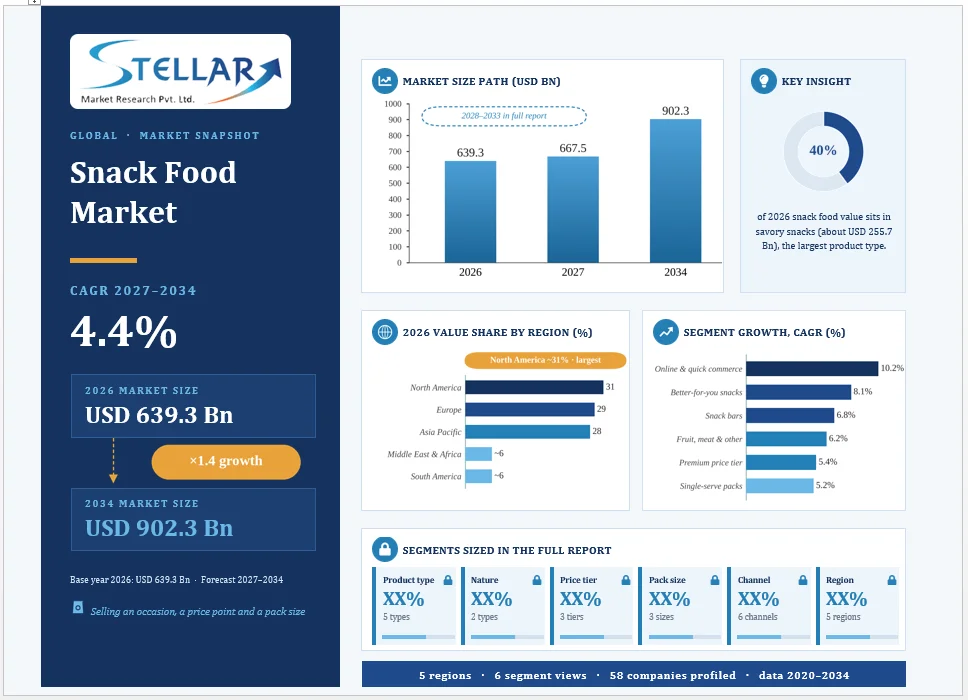
The Global Snack Food Market was valued at USD 639.3 Bn in 2026 and is expected to reach USD 902.3 Bn by 2034, growing at a CAGR of 4.4% during 2027–2034.
The Global Snack Food Market was valued at USD 639.3 Bn in 2026 and is expected to reach USD 902.3 Bn by 2034, growing at a CAGR of 4.4% during 2027–2034. The market covers packaged, ready-to-eat snack foods: savory snacks such as potato chips, tortilla and corn chips, extruded and puffed snacks, popcorn, pretzels, nuts, seeds and ethnic savory snacks; confectionery snacks; biscuit and bakery snacks such as cookies, crackers and snack cakes; snack bars; and fruit, meat and other snacks. Buyers and analysts also call it the packaged snacks market, the ready-to-eat snacks market. The category sells more than food; it sells an occasion, a price point and a pack size, and the companies that win are the ones that match all three to a fast-changing shopper.
This Snack Food Market analysis is written for brand owners, private-label and contract manufacturers, ingredient, flavour and packaging suppliers, retailers, quick commerce platforms, distributors and investors. It answers practical questions on market entry and market strategies: how affordability, portion control and GLP-1 weight-loss medicines change volume, which better-for-you claims earn a price premium, where consumer behavior is heading, how advertising and labelling rules in the United Kingdom, Mexico and the United States reshape portfolios, and which channels, segments and countries deserve capital through 2034.
Savory snacks carry the largest slice of value at about 40% of 2026 revenue, and North America remains the largest regional market. Snack Food Market growth is moving toward protein-rich, functional, and healthy snacks, single-serve packs, online and quick commerce channels, and Asia Pacific, where young populations, modern retail, and local flavours lift volume while developed markets grow mainly on price and mix.
Stellar Market Research delivers a comprehensive Snack Food Market Research Report covering global value by product type, nature, price tier, pack size, distribution channel and region, across 5 regions and their countries, together with a competitive landscape of 58 profiled players, strategic scenarios and growth opportunities. The market research findings, market segmentation, regional insights and competitive intelligence help snack manufacturers, suppliers, retailers and investors decide which products, claims, pack formats and countries to prioritise through 2034. The market synopsis below gives a market overview of the industry landscape and a market summary of the forces shaping it.
Snack Food Market Size, Market Growth and Snack Food Market Outlook to 2034
The Snack Food Market is sized at retail selling value for packaged, ready-to-eat snack foods sold through grocery, convenience, traditional trade, online and other channels. Ice cream, yogurt and chilled dairy desserts, fresh produce sold loose, unpackaged street food and foodservice-prepared snacks are excluded to prevent double counting with adjacent dairy and foodservice markets.
Snack Food Market growth analysis draws on company financial results, trade data and retail tracking to assess demand patterns, pricing strategies and volume performance. PepsiCo reported 2026 revenue growth of 2% to USD 93.9 Bn, supported by 4% effective net pricing, while organic volume declined 2%. Mondel?z recorded 5.8% growth in 2025 net revenue to USD 38.5 Bn, despite a 3.7% decline in volume and mix. However, third-quarter 2026 results indicated a return to volume growth outside North America, with PepsiCo reporting an 11% increase in snack volumes across Asia Pacific and Mondel?z recording 4.9% emerging-market revenue growth. These developments highlight the difference between price-led growth in developed markets and volume-driven demand expansion across emerging economies.
These Snack Food Market trends, industry developments, and market dynamics shape the global market outlook through 2034. Growth opportunities are expanding across protein and functional snacks, snack bars, online retail and quick commerce, particularly in emerging markets such as India, Indonesia, Vietnam, Saudi Arabia and Brazil, where demand growth creates opportunities for branded snack manufacturers. However, affordability pressures, GLP-1-led portion control, evolving health regulations and fluctuations in cocoa, vegetable oil and packaging costs remain important market challenges influencing product pricing, consumer purchasing behaviour and industry growth prospects.
To get more Insights: Request Free Sample Report
Key Findings: Insights Shaping the Global Snack Food Market
Company filings, regulatory texts, trade data, and SMR's retail tracking point to the following key market research findings, highlighting Snack Food Market demand, consumer purchasing trends, revenue generated, and market value creation through 2034.
1. Market Growth. Market size rises from USD 639.3 Bn (2026) to USD 902.3 Bn (2034) at a 4.4% CAGR, adding about USD 263.0 Bn of annual revenue. Price and mix carry most of the gain in developed markets; volume carries it in emerging markets.
2. Savory snacks lead the product mix. Savory snacks held about 40% of 2026 value and grew at 4.9%, led by potato chips, tortilla chips, extruded snacks, popcorn, pretzels and nuts. Snack bars grow fastest at 6.8% from a small base.
3. Better-for-you snacks outgrow conventional snacks. Better-for-you and functional snacks held about 18% of 2026 value and grow at 8.1%, more than twice the 3.6% rate for conventional snacks, as protein, fibre and reduced-sugar claims move into the mainstream.
4. Single-serve packs lead pack-size growth. Single-serve and small packs held about 41% of value and grow at 5.2%, supported by portion control, entry price points and impulse purchase in convenience and quick commerce.
5. North America is the largest region. It held about 31% of 2026 value. PepsiCo cut US prices on Lay's, Doritos, Cheetos and Tostitos by up to 15% in February 2026 to win back volume, a sign that affordability now sets the pace of growth.
6. Asia Pacific is the fastest-growing region. It grows at a 6.1% CAGR, lifting its share from 28% to about 32% by 2034 and passing North America around 2029, led by India, China, Indonesia and Vietnam.
7. Online retail and quick commerce gain share. Online and quick commerce channels rise from about 10% of 2026 value at a 10.2% CAGR, the fastest channel. In India, quick commerce made up 58% of ITC's and 65% of Parle Products' online sales in fiscal 2026.
8. Health regulation reshapes portfolios. The United Kingdom restricted HFSS advertising on TV before 9pm and in paid online media from 5 January 2026, Mexico removed products carrying front-of-pack warning labels from schools from March 2025, and the FDA plans to phase out petroleum-based synthetic dyes by the end of 2026.
9. Consolidation and protein deals reshape the top. Intersnack agreed in July 2026 to take Utz Brands private at an enterprise value of about USD 2.9 Bn, Ferrero agreed in March 2026 to buy Brazilian protein snack maker Bold Snacks, and Mondel?z agreed in October 2026 to take a majority stake in Undercover Snacks.
Snack Food Industry Analysis: Industry Structure and Value Chain
The Snack Food Industry value chain runs from agricultural raw materials through processing, seasoning and packaging to branding, distribution and retail. Potato, corn, wheat, cocoa, sugar, vegetable oil and nut prices, production technology, route-to-market strength, retail structure and consumer preferences influence Snack Food Market demand and margins at every stage.
1. Raw materials: Potatoes, corn, wheat flour, rice, cocoa, sugar, nuts, pulses and vegetable oils; contract farming secures potato varieties for chips.
2. Processing: Frying, baking, popping, extrusion, roasting and enrobing lines; capacity utilisation drives unit cost.
3. Seasoning and flavour: Seasoning houses, natural colours and clean-label flavour systems; flavour is the fastest lever for innovation.
4. Packaging: Flexible films, nitrogen flushing, multipacks and recyclable mono-material laminates.
5. Route to market: Direct-store delivery, distributors, cash-and-carry and dark stores for quick commerce.
6. Retail and consumption: Supermarkets, convenience, traditional trade, discounters, snack chains and online platforms.
Snack Food Market Trends: Consumer Behavior Trends, Emerging Trends and Technology Trends
1. Consumer Behavior Trends, Snacking Replaces Meals: Irregular work patterns and smaller appetites are pushing consumers, Gen Z above all, to replace meals with filling snacks or build meals from snack items. Snack-as-meal occasions reward protein, fibre and satiety claims.
2. Affordability Shapes Purchasing: After several years of price increases, shoppers trade down to private label and smaller packs. PepsiCo cut prices on core salty snack brands in 2026, and Hershey and Mondel?z manage cocoa costs through pack architecture and reformulation.
3. Portion Control and GLP-1 Medicines: Users of GLP-1 weight-loss medicines buy fewer indulgent snacks and more protein, nuts and smaller portions. Brands respond with mini packs, 100-calorie formats and protein-fortified variants rather than leaving the category.
4. Emerging Trends, Clean Labels and Natural Colours: PepsiCo committed to remove artificial colours from Lay's and Tostitos, and Conagra and Smucker set dates to remove synthetic dyes, ahead of the FDA's target to phase out petroleum-based colours by the end of 2026.
5. Technology Trends and Discovery: AI-based product discovery, retail media on quick commerce apps and predictive replenishment change how snack brands win the first purchase and the repeat order.
Snack Food Market Drivers and Growth Catalysts: Convenience, Protein and Functional Snacking, Emerging-Market Consumption and Channel Expansion
Convenience remains the strongest structural driver of the Snack Food Market. Longer commutes, hybrid work patterns and on-the-go eating have made snacks a regular part of daily consumption rather than an occasional treat. Single-serve packs accounted for about 41% of market value in 2026 and are projected to grow at a 5.2% CAGR, reflecting demand for portion-controlled and portable formats. Snack-as-meal occasions and evening consumption alongside streaming entertainment are also increasing the frequency of snacking, particularly among younger adults.
Rising interest in protein-rich and functional foods is creating another growth avenue. Protein bars, roasted nuts, meat snacks, popcorn, pretzels and high-fibre crackers are gaining traction as consumers seek convenient options with added nutritional benefits. Better-for-you snacks are growing at 8.1%, compared with 3.6% for conventional snacks. Hershey's North America salty snacks segment, which includes SkinnyPop, Dot's Pretzels and LesserEvil, grew 28% to USD 357 million in the fourth quarter of 2025, demonstrating the growing commercial appeal of lighter savoury formats and their ability to gain shelf space.
Emerging-market consumption is adding substantial volume to global demand. In India, Haldiram's, Balaji and Bikaji are expanding branded namkeen distribution across tier-2 and tier-3 towns, while China's discount snack chains are extending their reach into county-level markets. Busy Ming surpassed 30,000 signed stores in July 2026, illustrating the scale of this channel expansion. Together, convenience-led consumption, functional snacking and wider retail penetration are shaping the Snack Food Market growth outlook through 2034. The full report ranks each market growth factor according to its revenue contribution across individual forecast phases.
Snack Food Market Constraints and Market Challenges: Affordability, GLP-1 Medicines, Health Regulation and Input Costs
Affordability remains one of the most persistent constraints on Snack Food Market growth. Sustained price increases have pushed many low- and middle-income consumers towards private-label products, smaller pack sizes and fewer shopping trips. In February 2026, PepsiCo's chief executive identified affordability as the biggest friction in the category. SMR forecasts conventional snacks to grow at only 3.6%, while value-oriented product tiers face particularly intense price competition.
Health-related policies and changing consumption patterns are adding further pressure. GLP-1 medicines can reduce demand for chips, cookies and sweet bakery products among users by suppressing appetite. Regulatory measures are also changing how manufacturers promote and distribute indulgent snacks. The United Kingdom's HFSS advertising rules restrict how large brands advertise crisps, sweet biscuits and confectionery, while Mexico's school ban removes products carrying warning labels from more than 200,000 schools. In the United States, state-level legislation in California, West Virginia and Texas targets synthetic dyes and additives. These developments increase reformulation and relabeling requirements while limiting advertising reach, particularly for indulgent product ranges.
Volatility in raw material and operating costs continues to create margin pressure. Cocoa futures fell below USD 4,000 per tonne in early 2026 after reaching record highs in late 2024. However, many chocolate manufacturers had secured supplies at higher prices through hedging arrangements and do not expect meaningful cost relief before 2027. Vegetable oil, energy, and packaging costs also increased manufacturing expenses for fried and baked snacks in early 2026, making cost management and pricing strategies important competitive considerations.
Snack Food Market Opportunities: Protein Snacks, Single-Serve Packs, Quick Commerce and Emerging Markets
Regional demand and product-format innovation offer significant opportunities for Snack Food Market participants. SMR forecasts Asia Pacific to contribute the largest absolute value addition, generating about USD 110.3 Bn in annual revenue between 2026 and 2034. The Middle East and Africa are projected to grow at about 5.6%, supported by young populations and modern retail expansion in Saudi Arabia, the UAE, Egypt, Nigeria, Kenya and Morocco. South America is expected to grow at about 4.9%, with Brazil, Colombia and Argentina supporting regional demand. Across these markets, protein snacks, fibre-rich crackers, baked and air-popped products, millet- and pulse-based healthy snacks, and global flavour combinations offer manufacturers opportunities to address demand for affordable, better-for-you alternatives.
Retail channel expansion is creating additional market opportunities across both established and emerging economies. Quick commerce in Indian metropolitan areas, discount snack chains in China, convenience and forecourt retail in North America, and value-pack ranges in European discount stores are increasing the importance of channel-specific product formats and price points. Manufacturers can use private-label partnerships, variety packs and occasion-led bundles to reach different consumer groups and strengthen distribution. These developments also create longer-term opportunities for contract manufacturers and challenger brands seeking to expand their presence in the global Snack Food Market.
Snack Food Market Dynamics Analysis: Economic Factors, Demand and Supply, Competitive Forces and Regulatory Influences
1. Economic and macroeconomic factors: Consumer spending, real wages, food inflation and food-assistance budgets are the macroeconomic factors that shape snack demand. In 2025, snack value grew mainly on price while volume stayed weak in North America and Europe, so economic indicators point to steady value growth with a continued risk of trade-down.
2. Demand and supply dynamics and gap analysis: Demand comes from daily snacking occasions, while supply depends on potato, corn, wheat, cocoa and oil harvests and on line capacity. The demand and supply balance for cocoa swung from shortage in 2024 to surplus forecasts for 2025/26 and 2026/27, while potato and oil supply depends on weather.
3. Consumer behavior trends and consumer preferences evolution: Shoppers read labels for protein, fibre, sugar and salt, look for natural colours and compare unit prices. Consumer preferences evolution has moved from indulgence alone to permissible indulgence and functional benefits, and customer engagement dynamics now start on social media and quick commerce apps.
4. Competitive forces and competitive landscape shifts: Private label, regional brands and discount snack chains are the main competitive threats to global brands, while acquisitions such as Mars–Kellanova, Ferrero–WK Kellogg and Intersnack–Utz show consolidation. Scale in distribution, brand investment and innovation speed increasingly decide Snack Food Market share.
5. Regulatory influences, regulatory changes, technological advancements and innovation impact: Regulatory changes such as the UK's HFSS advertising rules, Mexico's front-of-pack warnings and school ban, and the FDA's synthetic dye phase-out raise reformulation needs, while air-frying, vacuum frying, extrusion, natural colour systems and AI-based demand planning reduce cost and support new claims.
Snack Food Market Volatility, Market Gap and Industry Resilience
Market volatility in snack foods comes from two places: commodity prices for cocoa, oils, potatoes and grains, and the pace of consumer trade-down when budgets tighten. Both create industry fluctuations that a single CAGR hides, which is why the report's market fluctuation analysis models each forecast phase separately. The widest market gap sits between demand for affordable, filling, better-for-you snacks and the indulgent core of most portfolios, and it is closing fastest where brands add protein and fibre without lifting price.
Companies with diversified portfolios, long-term crop contracts and strong distribution show the most industry resilience, market responsiveness and market adaptability when shocks hit. External market influences such as tariffs, El Niño and energy prices reach the supply side first, while socioeconomic influences and environmental factors, from urbanisation and smaller households to recyclable packaging rules, shape demand. Economic indicators such as real wage growth and food inflation signal when shoppers trade down to private label and value packs.
Strategic market changes, including large acquisitions, portfolio pruning and price cuts, drive market segmentation shifts and competitive landscape shifts toward single-serve packs, better-for-you ranges and online channels. Industry disruptors such as GLP-1 medicines, HFSS rules and discount snack chains redraw the market forces at work, and the report's market trends analysis places each change within the category's industry evolution, along with the demand and supply dynamics for key raw materials and the innovation impact of new processing technology.
Affordability Resets, Portion Control and Changing Consumer Preferences
1. Price Cuts to Restore Volume: PepsiCo cut US prices on core salty snack brands by up to 15% in February 2026 after testing lower prices in some markets during 2025 and finding that volume returned.
2. Protein Moves into Core Brands: PepsiCo launched Doritos Protein, with 10 g of protein per one-ounce serving, and the Good Warrior protein snack brand in March 2026, bringing protein into mainstream salty snacks rather than a separate niche.
3. Better-for-You Extensions of Core Brands: PepsiCo is launching simpler-ingredient lines such as Simply NKD Doritos and Cheetos without artificial colours, while Grupo Bimbo has committed to make its baked goods and snacks with simple, natural recipes.
4. Lighter Savory Formats Win Share: Hershey reported that SkinnyPop popcorn and Dot's Pretzels were among the fastest-growing top salty snack brands in the United States in its February 2026 results for the fourth quarter.
5. Emerging Markets Lead Volume: Mondel?z reported in October 2026 that snacking performed well across all major emerging markets, with volume and mix adding 2.2 percentage points to emerging-market sales.
Snack Food Market Innovations and Industry Disruptors: Protein Fortification, Clean Labels, New Processing and Smart Packaging
The Snack Food Market is being reshaped by five trends: protein and fibre fortification, clean labels and natural colours, healthier processing such as baking, air-popping and vacuum frying, smaller and recyclable packs, and digital discovery through social media and quick commerce. This innovation in the industry follows clear technological advancements in processing and packaging. SMR's launch tracking shows protein or fibre claims in about XX% of new snack launches, natural-colour or no-artificial-ingredient claims in about XX%, and recyclable or reduced-plastic packaging in about XX%, each rising since 2020.
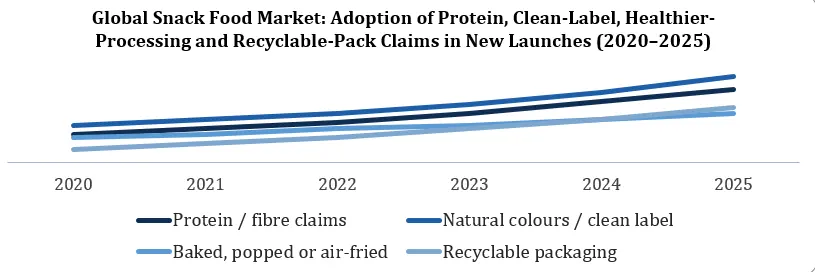
Source: SMR launch tracking. Illustrative trend; values in the full report.
Snack Food Product Landscape: From Potato Chips and Extruded Snacks to Confectionery, Biscuits and Protein Bars
Product type sets the character of demand. Savory snacks held about 40% of 2026 value at 4.9% CAGR, confectionery snacks about 29% at 3.6%, biscuit and bakery snacks about 23% at 4.0%, snack bars about 4% at 6.8% and fruit, meat and other snacks about 4% at 6.2%. Savory snacks combine scale with the strongest pricing power in branded chips, while bars and meat snacks capture the protein shift.
Savory Snacks: Potato Chips, Tortilla Chips, Extruded Snacks, Popcorn, Pretzels, Nuts and Namkeen
Savory snacks held about 40% of the Snack Food Market in 2026, roughly USD 255.7 Bn, and grow at a 4.9% CAGR. Potato chips and crisps remain the largest sub-segment, while tortilla and corn chips, extruded and puffed snacks such as Kurkure and Cheetos, popcorn and pretzels, nuts, seeds and trail mixes, and ethnic savory snacks such as Indian namkeen and bhujia complete the range. Popcorn, pretzels and nuts gain from a lighter, better-for-you image, and regional flavours drive repeat purchase in Asia and Latin America.
Confectionery and Biscuit Snacks: Chocolate, Cookies, Crackers and Snack Cakes
Confectionery snacks held about 29% of value in 2026 and grow at 3.6%, as record cocoa costs in 2024–2025 forced price rises and smaller packs that dented volume. Biscuit and bakery snacks, including sweet biscuits and cookies, crackers and savory biscuits and snack cakes, held about 23% and grow at 4.0%, with emerging markets such as India, China, Mexico and Southeast Asia adding most of the volume through value packs.
Snack Bars, Fruit Snacks and Meat Snacks: Protein, Fibre and Portable Nutrition
Snack bars are the fastest-growing product type at 6.8% CAGR, led by protein and nutrition bars, cereal and granola bars and fruit and nut bars. Fruit, meat and other snacks, including dried and freeze-dried fruit snacks, jerky and meat sticks, seaweed snacks and others, grow at 6.2% as consumers look for portable protein and simpler ingredient lists.
Ingredients, Price Tiers and Raw-Material Supply: Potatoes, Grains, Cocoa, Oils and Nuts
Potatoes, corn, wheat flour, rice, cocoa, sugar, nuts, pulses and vegetable oils form the core of snack formulas, supported by seasonings, flavours, natural colours and emulsifiers. By price tier, value and economy products hold about 34% of value, mainstream products 47% and premium products 19%; premium grows fastest at 5.4% on kettle-cooked chips, artisan crackers, premium chocolate and protein bars. Raw-material supply concentrates in a few origins for cocoa (Côte d'Ivoire and Ghana), palm oil (Indonesia and Malaysia) and almonds (California), so weather and trade policy move costs quickly.
Emerging Snack Food Innovation: Upcycled Ingredients, Millets and Pulses, Cocoa Alternatives and Traceability
Innovation is concentrated in protein from dairy, pulses and insects; millet, chickpea, lentil and cassava bases for gluten-free and high-fibre snacks; upcycled ingredients from brewing and juicing by-products; cocoa alternatives and cultured chocolate, which Puratos expects to commercialise with California Cultured; and traceability tools that prove origin and sustainable sourcing. Large groups such as PepsiCo, Mondel?z, Mars and Ferrero use scale and acquisitions to move quickly, while regional leaders such as Calbee, Haldiram's and Grupo Bimbo build on local taste and distribution.
Regulation sets the pace of reformulation. The UK's HFSS rules restrict paid online advertising and TV advertising before 9 pm across 13 food categories from 5 January 2026, and Mexico requires schools to phase out any product with a front-of-pack warning label. In the United States, the FDA banned Red No. 3, with removal required by January 2027, and announced plans to phase out six remaining petroleum-based colours by the end of 2026, while California, West Virginia and Texas legislate on dyes and additives.
Global Snack Food Market Segmentation:
By Product Type, Nature, Price Tier, Pack Size, Distribution Channel and Region
This Snack Food Market segmentation analysis, the core market segment analysis in the report, starts with product segmentation and gives market share by segment for every category. Each cut by product type, nature, price tier, pack size, and channel is paired with a geographic segmentation of the same categories across five regions, so the industry segmentation stays consistent from global totals down to market subsegments.
By product type, savory snacks led with about 40% of 2026 value, followed by confectionery snacks at xx%, biscuit and bakery snacks at xx%, snack bars at xx% and fruit, meat and other snacks at xx%. Savory snacks earn the strongest branded margins in chips, whereas snack bars lead growth at xx.8% CAGR as protein moves into everyday snacking.
By nature, conventional snacks held about 82% of value and better-for-you and functional snacks 18%. Better-for-you snacks, covering high-protein, high-fibre, reduced-sugar, reduced-salt, baked, organic and gluten-free products, grow at 8.1%, against 3.6% for conventional snacks.
By price tier, value and economy products held about 34% of value, mainstream xx% and premium xx%. Premium grows fastest at xx.4% on kettle-cooked chips, premium chocolate and protein bars, while value packs grow at xx% as shoppers trade down.
By pack size, single-serve and small packs held about 41% of value, sharing, and family packs 39%, and multipacks and variety packs 20%. Single-serve packs grow fastest at 5.2% on portion control and impulse purchase.
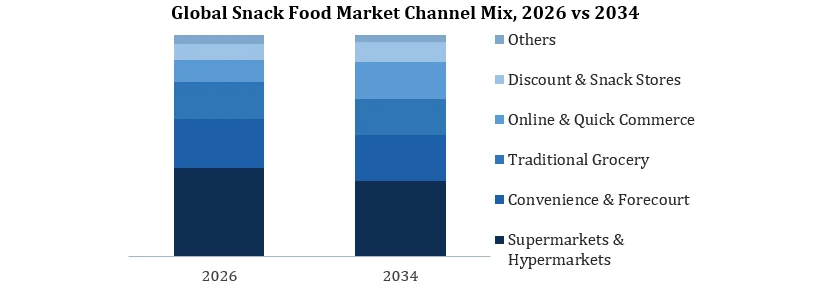
By distribution channel, supermarkets and hypermarkets held about xx% of value, convenience and forecourt stores xx%, traditional grocery and independent retail xx%, online retail and quick commerce xx%, discount and snack specialty stores 7%, and other channels, including vending, foodservice and travel retail, xx%. Online retail and quick commerce grow fastest at xx%, and discount and snack specialty stores at xx%.
Segment Analysis: Target Market, Consumer Demographics, Niche Markets and Segment Attractiveness
SMR's market segment analysis brings together four lenses:
1. Product segmentation and market share by segment: Savory snacks (40%), confectionery snacks (29%), biscuit and bakery snacks (23%), snack bars (4%) and fruit, meat and other snacks (4%) define product segmentation, and snack bars are the most attractive product segment by segment growth analysis at 6.8%.
2. Consumer demographics and customer profiling: Gen Z and millennials snack most often and lead snack-as-meal occasions, parents buy multipacks for school and family use, and older consumers favour portion-controlled and reduced-salt options. Demographic profiling and target market analysis by region sit in the full report.
3. Behavioral segmentation: Customer behavior segmentation identifies five profiles: the indulgence seeker, the protein-focused snacker, the value hunter, the flavour explorer and the mindful portion controller. Each supports segment-based marketing, tailored marketing strategies and customized market strategies.
4. Niche markets and specialized market segments: Protein chips, millet-based namkeen, freeze-dried fruit, seaweed snacks, keto and low-sugar confectionery and GLP-1-friendly mini packs each have their own buyers and price points. SMR's market niche exploration flags these unique market sectors, along with unexplored market niches and untapped market areas such as snacks for older adults, one of the clearest emerging market segments.
Customer Profiling, Demographic Profiling and Behavioral Segmentation
Customer profiling in the report goes beyond age and income. Demographic profiling shows the heaviest snackers as urban consumers aged 18–34, but behavioral segmentation explains what they buy and why. The customer behavior segmentation separates the protein-focused snacker, who pays for function, from the indulgence seeker, who pays for taste and brand, and the value hunter, who buys private label and family packs. The target market analysis for each profile supports segment-based marketing in every region of the report's geographic segmentation.
Niche Markets, Untapped Market Areas and Segment-Specific Opportunities
Specialized market segments such as protein chips and GLP-1-friendly mini packs remain thinly supplied, which makes them some of the clearest untapped market areas and unexplored market niches. Millet and pulse-based snacks in India and seaweed snacks in East Asia are strong emerging market segments. The market niche exploration in the full report ranks these unique market sectors by size and growth, and the segment-specific trends behind them, from air-popped chips to freeze-dried fruit, show where segment-specific opportunities open first.
Segment Attractiveness, Micro-Segmentation and Segmentation Strategies
Segment growth analysis shows snack bars, better-for-you snacks, single-serve packs and online channels outpacing the market, while the competitive segment landscape shows global groups leading branded chips and chocolate and regional champions leading ethnic savory snacks. Micro-segmentation inside each cell, a granular market breakdown and market fragment analysis turn these patterns into segmentation strategies, tailored marketing strategies and customized market strategies for brand owners, retailers and contract manufacturers. Market segment dynamics are tracked year by year in a comprehensive market sector analysis.
Snack Food Market Regional Outlook: North America, Europe, Asia Pacific, Middle East & Africa and South America
The Snack Food Market regional outlook in the report rests on a geographic analysis that compares regional market performance on one scale, so regional market share, market performance by region and market growth by location can be read side by side. Regional market trends and geographical trends differ sharply: value-led growth and affordability resets in North America, private label and health regulation in Europe, and volume-led growth through modern retail and quick commerce in Asia Pacific.
The North America Snack Food Market held the largest Snack Food Market share, about 31% of global value in 2026. The United States anchors demand through salty snacks, confectionery and convenience retail, while price cuts, portfolio pruning and synthetic dye removal reshape the shelf. SMR forecasts growth of about 3.3% CAGR as better-for-you lines and single-serve packs offset flat volume in the core. The Europe Snack Food Market held about 29% of 2026 value, led by the United Kingdom, Germany, France, Italy and Spain, home to strong private label and the strictest advertising rules; growth is about 3.4% CAGR, supported by unit growth in several markets.
The Asia Pacific Snack Food Market is the fastest-growing region, with a 6.1% CAGR through 2034, rising from 28% of 2026 value to about 32% by 2034 and passing North America around 2029. India scales branded namkeen, potato chips and biscuits through quick commerce, China grows through discount snack chains and local brands, Japan and South Korea lead flavour innovation, and Indonesia and Vietnam add volume. The Middle East & Africa Snack Food Market, about 6% of 2026 value, grows at about 5.6% on young populations and modern retail, with Egypt, Nigeria, Algeria, Morocco, Kenya, Ghana and Angola growing faster than the region, while the South America Snack Food Market, about 6%, grows at 4.9% on Brazil, Colombia and Argentina.
Africa Snack Food Market Spotlight: Egypt, South Africa, Nigeria, Algeria, Morocco, Angola, Kenya and Ghana
Africa is the least penetrated snack region in the report and the one where branded supply lags demand most. SMR values the combined Snack Food Market of Egypt, South Africa, Nigeria, Algeria, Morocco, Angola, Kenya and Ghana at about USD 11.7 Bn in 2026, close to 30% of Middle East and Africa value, and forecasts a combined CAGR of about 6.4% over 2027–2034, well ahead of the 4.4% global rate. Young populations, fast urbanisation, rising modern retail and a shift from loose and unbranded snacks to packaged, branded products drive that growth, while per-capita packaged snack spending in most of these countries remains a small fraction of European levels.
Investment is already following. Edita Food Industries, Egypt's largest packaged snack maker, grew first-half 2026 revenue 32.5% to EGP 12.3 Bn and runs a 2026 investment programme of about EGP 4 Bn across Egypt, Morocco and Iraq. PepsiCo and DP World opened an expanded USD 20 million snack plant in Lagos in August 2025, adding local Cheetos production to Lay's and Doritos with about 90% of raw materials sourced in Nigeria. In Algeria, Spain's Vicky Foods began a new sponge-cake line at its Sig plant in July 2026 as part of a EUR 19 million project that doubles capacity.
1. Egypt (about USD XX Bn, 7.0% CAGR): The largest market in the group, led by cakes, croissants, wafers and potato chips sold through traditional grocers. Local champions such as Edita compete on price per pack, and currency swings make local production and local sourcing decisive.
2. South Africa (about USD xx Bn, xx% CAGR): The most developed market, with modern retail, strong private label and established brands such as Simba and Tiger Brands. Growth is slower but margins and channel data are the most reliable on the continent.
3. Nigeria (about USD xx Bn, xx% CAGR): The fastest-growing large market, with Africa's biggest young population. Local manufacturing of global brands, small price-point packs and open-market distribution set the playbook.
4. Algeria (about USD xx Bn, 6.2% CAGR): Import restrictions favour local production; biscuits, cakes and chips dominate, and small local grocers remain the main channel. Foreign players enter through local plants or partnerships.
5. Morocco (about USD xx Bn, xx% CAGR): A stable, tourism-supported market with growing modern retail, used by regional players as an export hub for North and West Africa; Edita Morocco grew first-half 2026 revenue 7.2%.
6. Kenya (about USD xx Bn, X.0% CAGR): East Africa's gateway, with fast-growing supermarkets, mobile payments and demand for crisps, nuts and biscuits; a base for serving Uganda, Tanzania and Rwanda.
7. Ghana (about USD 0.X5 Bn, 7.X% CAGR): A cocoa-producing country with rising urban demand for biscuits, chips and plantain snacks, where local processing of cocoa and cassava opens room for value-added snack brands.
8. Angola (about USD 0.X0 Bn, X.1% CAGR): A largely untapped, import-reliant market where local manufacturing incentives and Portuguese-language trade links create an opening for first movers.
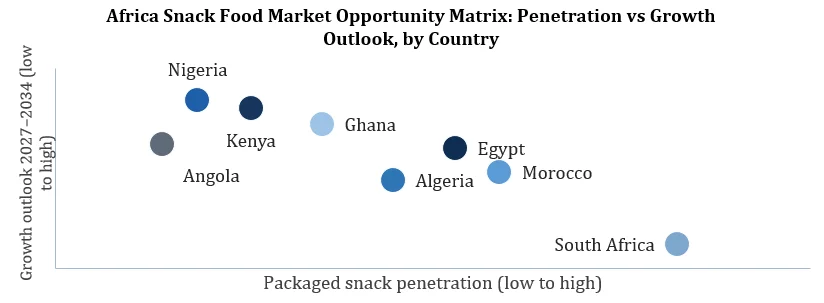
Source: SMR analysis. Country positions are relative; values in the full report.
For snack makers, the matrix separates three plays. Nigeria, Kenya, Ghana and Angola combine low penetration with the fastest growth and reward early local manufacturing, small price-point packs and distributor partnerships. Egypt, Algeria and Morocco offer scale with local champions to partner with or acquire. South Africa is the mature base for regional headquarters, private-label supply and premium launches. The full report sizes each of these area-specific opportunities by product type, pack size and channel to 2034.
Regional Market Entry Strategies, Area-Specific Opportunities and Localized Market Challenges
Regional market entry strategies differ by country. In the United States, convenience and club channels with value-engineered packs form the usual local market entry strategies; in Europe, private-label manufacturing and discounter listings open volume; in India, quick commerce and modern trade carry new brands into metros before traditional trade. Area-specific opportunities include protein snacks in North America, baked and reduced-salt snacks in Europe and halal-certified snacks in the GCC, while regionally-driven opportunities in Southeast Asia centre on seaweed, cassava and local flavours.
Regional market challenges include HFSS advertising rules in the United Kingdom, warning labels and school bans in Mexico and other Latin American markets, import registration in the GCC and fragmented traditional trade in Africa. These localized market challenges, together with regional economic factors and local economic factors such as currency swings and food inflation, explain why market trends in specific regions often diverge from the global average.
Regional Competitive Landscape, Geopolitical Influences and Regional Industry Outlook
The regional competitive landscape of the Snack Food Market reflects the presence of global manufacturers and established local champions. Intersnack and Lorenz maintain strong positions in Germany, while Calbee competes in Japan and Orion and Lotte serve South Korea's snack market. In India, Haldiram's, Balaji and Bikaji compete alongside national brands, while Want Want and Three Squirrels strengthen their presence in China. Universal Robina is a major regional participant in the Philippines, while Grupo Bimbo, Arcor and Nutresa represent key competitors across Latin America. Differences in brand recognition, distribution networks, product preferences and pricing strategies shape market share across individual countries.
Geopolitical influences also affect regional market performance through tariffs on cocoa, nuts and packaging materials, alongside conflict-related fluctuations in energy and vegetable oil prices. The economic impact varies by region depending on import dependence, sourcing exposure and manufacturing costs. These factors influence procurement strategies, product pricing and competitive positioning across the global Snack Food Market.
Each regional chapter provides a country-level industry outlook through 2034, examining the market development and growth prospects of individual economies. The analysis distinguishes region-specific growth drivers, such as quick commerce expansion in Indian metropolitan areas, from broader market shifts, including the growing presence of discount snack chains in China's county-level towns. Local consumer behaviour, demographic trends, flavour preferences, pack-size requirements and purchasing power help explain differences in regional demand. For instance, a flavour, pack size or price point that performs well in Mexico City may have limited acceptance in Munich. The regional market segmentation applies the global framework across individual countries while incorporating local market dynamics, retail structures, climate conditions and other factors influencing snack consumption.
Leading Snack Food Companies: Competitive Landscape and Snack Food Market Key Players
The Snack Food Market competitive landscape comprises global snacking groups, savoury snack specialists, regional manufacturers and emerging better-for-you brands. Global companies such as PepsiCo, Mondelz International, Mars (including Kellanova), Ferrero, Nestlé and The Hershey Company compete through brand portfolios, distribution scale and acquisitions. Savoury snack specialists, including Intersnack, Calbee, Utz Brands, Lorenz and Zweifel, focus on category expertise and regional market strength. Regional players such as Haldiram's, Balaji Wafers, Bikaji, ITC and Britannia in India; Orion, Lotte and Nongshim in South Korea; Want Want and Three Squirrels in China; Universal Robina in the Philippines; and Grupo Bimbo, Arcor and Grupo Nutresa in Latin America compete through local flavours, established distribution networks and market-specific pricing strategies. Better-for-you brands and private-label products further intensify competition by targeting health-conscious and value-seeking consumers.
Competitive positioning increasingly depends on affordability, portfolio diversification, distribution reach and product innovation. PepsiCo reported 2025 net revenue of USD 93.9 Bn, compared with USD 38.5 Bn for Mondel?z and USD 11.69 Bn for Hershey. Grupo Bimbo reported record 2025 revenue of MXN 426,952 million, while Calbee recorded net sales of ¥322.6 Bn for the year to March 2025. These companies performances provide context for evaluating the scale and competitive strength of leading market participants. The report examines how acquisitions, pricing adjustments, portfolio rationalisation and private-label expansion are reshaping the competitive landscape as retailers consolidate suppliers and prioritise brands that deliver affordability, health-oriented offerings and faster product innovation.
Global Snack Food Market Recent Developments, Product Launches and Industry News | 2026
|
Date (2026) |
Company / Organization |
Development |
|
29 Oct 2026 |
Mondelz International |
Agreed to acquire a majority stake in Undercover Snacks, a US maker of chocolate-covered quinoa crisps, and reported third-quarter net revenue up 2.3% to USD 9.97 Bn, with emerging-market revenue up 4.9%. |
|
8 Oct 2026 |
PepsiCo |
Reported third-quarter net revenue up 5.6% to USD 25.27 Bn, with snack volumes up 11% in Asia Pacific and flat in North America. |
|
Aug 2026 |
Edita Food Industries |
Reported first-half 2026 revenue up 32.5% to EGP 12.3 Bn, with Edita Morocco revenue up 7.2%, while expanding production in Egypt, Morocco and Iraq. |
|
Jul 2026 |
Vicky Foods |
Began operating a new sponge-cake line at its plant in Sig, Algeria, the first step in a EUR 19 million project that doubles the plant's capacity. |
|
21 Jul 2026 |
Intersnack Group |
Agreed to take Utz Brands private at about USD 2.9 Bn enterprise value, its first major entry into the US market. |
|
21 Jul 2026 |
Busy Ming Group |
China's largest discount snack chain passed 30,000 signed stores, six months after its Hong Kong listing on 28 January 2026. |
|
8 Jun 2026 |
Second Nature Brands |
Agreed to acquire Tillamook Country Smoker, a clean-label meat snack maker with about USD 175 million in annual revenue, marking its entry into protein snacks. |
|
19 Mar 2026 |
Ferrero Group |
Agreed to acquire Bold Snacks, a Brazilian protein bar company built on a digital-first sales model. |
|
Mar 2026 |
PepsiCo Foods |
Launched Good Warrior, a new protein snack masterbrand starting with beef sticks, at select US retailers. |
|
2 Mar 2026 |
Hain Celestial |
Completed the sale of its North American snacks business, including Terra chips and Garden Veggie Snacks, to Snackruptors. |
|
26 Feb 2026 |
PepsiCo |
Announced Doritos Protein tortilla-style chips with 10 g of protein per one-ounce serving and no artificial colours or flavours, on shelves from March 2026. |
|
6 Feb 2026 |
Eti G?da |
Completed its USD 173 million acquisition of Trubar, a US protein bar brand. |
|
3 Feb 2026 |
PepsiCo |
Announced price cuts of up to 15% on Lay's, Doritos, Cheetos and Tostitos in the United States and faster launches of simpler-ingredient snacks. |
|
5 Jan 2026 |
UK Government |
Restrictions on HFSS advertising came into force, covering TV before 9pm and paid online media for 13 food categories including crisps, sweet biscuits and confectionery. |
Snack Food Competitive Landscape Analysis: Competitor Benchmarking, Market Rivalry Intensity and Market Player Strategies
- Competitor analysis and Snack Food Market share: The report profiles 58 players, benchmarking company revenue, company net sales, snack-related revenue, rival market share, growth rate and profit margin, and groups them by role rather than ranking them as identical producers. Competitor profiling, competitor evaluation and competitive benchmark analysis follow one template.
- Competitive positioning and competitor differentiation: Global groups differentiate on brand scale and distribution, savory specialists on category depth, regional champions on local taste and price, and better-for-you brands on function and ingredients. A competitive advantage assessment and competitive matrix investigation place each company.
- Market rivalry intensity and competitive forces: Rivalry is shaped by private label, discount snack chains, commodity costs, advertising limits and the shift to better-for-you snacks. The market rivalry assessment, rivalry intensity mapping, rivalry impact analysis and competing force scrutiny explain the sectorial rivalry dynamics behind each segment.
- Market player strategies and competitive maneuvers: Leading companies cut prices, prune portfolios, add protein and natural colours, resize packs, build quick commerce partnerships and pursue acquisitions. The competitive strategy review and competitive maneuver examination track industry opposition tactics and competitive market evolution.
Competitor Benchmarking, Competitive Positioning and Rivalry Intensity Mapping
The Snack Food Market competitive benchmarking framework evaluates leading companies using a consistent template covering company revenue, net sales, and market share. Competitive positioning analysis compares the strengths of major participants across product categories and regional markets. PepsiCo leads in savoury snacks, while Mondel?z and Mars hold leading positions in biscuits and chocolate. Haldiram's and Calbee maintain strong competitive positions in their respective home markets. The report profiles and evaluates all 58 companies, assessing their competitive advantages, market positioning and differentiation across key parameters.
Rivalry intensity mapping identifies mainstream potato chips and chocolate tablets as the most competitive product categories, while protein snacks and ethnic savoury niches experience comparatively lower rivalry. The analysis examines market rivalry intensity, its impact on industry participants and the competitive forces shaping category-level performance. It also evaluates how market player strategies, including price adjustments, acquisitions and portfolio expansion, influence competitive positioning and business performance.
The competitive ecosystem analysis examines the relationships between brands, farmers, seasoning manufacturers, packaging suppliers and retailers across the Snack Food Market value chain. The report further evaluates industry player dynamics through company-level competitive assessments, head-to-head brand comparisons and regional competitor profiling. Particular attention is given to how global manufacturers compete with regional champions across India, China and Latin America. Competitive matrix analysis identifies differences in market positioning, emerging competitive trends and potential entry opportunities across product categories and geographies.
The competitive landscape evolution since 2020 highlights how pricing strategies, promotional activity and exclusive retail partnerships have influenced market rivalry. The analysis also examines regional differences in competitive intensity and evaluates major competitive developments and deals during 2026. Together, these insights provide a structured assessment of competitor strategies, market positioning, competitive differentiation and the factors expected to shape the Snack Food Market competitive landscape.
Global Snack Food Market Scope: Inquire before buying
|
Global Snack Food Market |
|||
|
Report Coverage |
Details |
|
|
|
Base Year: |
2026 |
Forecast Period: |
2027–2034 |
|
Historical Data: |
2021 to 2026 |
Market Size in 2026: |
USD 639.3 Billion |
|
Forecast Period 2027 to 2034 CAGR: |
4.4% |
Market Size in 2034: |
USD 902.3 Billion |
|
Snack Food Market Segments Covered: |
By Product Type |
Savory Snacks (Potato Chips & Crisps, Tortilla & Corn Chips, Extruded & Puffed Snacks, Popcorn & Pretzels, Nuts, Seeds & Trail Mixes, Ethnic Savory Snacks); Confectionery Snacks (Chocolate Snacks, Sugar Confectionery & Gum); Biscuit & Bakery Snacks (Sweet Biscuits & Cookies, Crackers & Savory Biscuits, Snack Cakes & Pastries); Snack Bars (Cereal & Granola Bars, Protein & Nutrition Bars, Fruit & Nut Bars); Fruit, Meat & Other Snacks |
|
|
|
By Nature |
Conventional; Better-for-You & Functional (High-Protein, High-Fibre, Reduced Sugar or Salt, Baked or Air-Popped, Organic, Gluten-Free) |
|
|
|
By Price Tier |
Value & Economy; Mainstream; Premium |
|
|
|
By Pack Size |
Single-Serve & Small Packs; Sharing & Family Packs; Multipacks & Variety Packs |
|
|
|
By Distribution Channel |
Supermarkets & Hypermarkets; Convenience & Forecourt Stores; Traditional Grocery & Independent Retail; Online Retail & Quick Commerce; Discount & Snack Specialty Stores; Others (Vending, Foodservice, Travel Retail) |
|
Global Snack Food Market, By Region
North America (United States, Canada, Mexico)
Europe (United Kingdom, Germany, France, Italy, Spain, Netherlands, Belgium, Poland, Sweden, Turkey, Russia, Rest of Europe)
Asia Pacific (China, India, Japan, South Korea, Indonesia, Australia, Thailand, Vietnam, Philippines, Malaysia, Rest of Asia Pacific)
Middle East and Africa (Saudi Arabia, United Arab Emirates, Egypt, South Africa, Nigeria, Algeria, Morocco, Angola, Kenya, Ghana, Rest of Middle East and Africa)
South America (Brazil, Argentina, Colombia, Chile, Rest of South America)
Key Players/Competitors Profiles Covered in the Snack Food Market Report from a Strategic Perspective
North America
1. PepsiCo, Inc. – Frito-Lay (United States)
2. Mondelz International, Inc. (United States)
3. Mars, Incorporated – incl. Kellanova (United States)
4. The Hershey Company (United States)
5. General Mills, Inc. (United States)
6. The Campbell's Company – Snyder's-Lance (United States)
7. Conagra Brands, Inc. (United States)
8. Utz Brands, Inc. (United States)
9. The J.M. Smucker Company – Hostess (United States)
10. Hormel Foods Corporation – Planters (United States)
11. Link Snacks, Inc. – Jack Link's (United States)
12. The Wonderful Company (United States)
13. Blue Diamond Growers (United States)
14. The Simply Good Foods Company – Quest (United States)
15. BellRing Brands, Inc. (United States)
16. Herr Foods Inc. (United States)
17. Old Dutch Foods (Canada)
18. Grupo Bimbo, S.A.B. de C.V. – Barcel (Mexico)
Europe
19. Nestlé S.A. (Switzerland)
20. Ferrero Group (Luxembourg)
21. Intersnack Group GmbH & Co. KG (Germany)
22. Lorenz Snack-World (Germany)
23. Bahlsen GmbH & Co. KG (Germany)
24. Zweifel Pomy-Chips AG (Switzerland)
25. Chocoladefabriken Lindt & Sprüngli AG (Switzerland)
26. pladis Global (United Kingdom)
27. Lotus Bakeries NV (Belgium)
28. Orkla ASA (Norway)
29. Valeo Foods Group (Ireland)
30. Y?ld?z Holding – Ülker (Turkey)
Asia Pacific
31. Calbee, Inc. (Japan)
32. Meiji Holdings Co., Ltd. (Japan)
33. Ezaki Glico Co., Ltd. (Japan)
34. Orion Corporation (South Korea)
35. Lotte Wellfood Co., Ltd. (South Korea)
36. Nongshim Co., Ltd. (South Korea)
37. Want Want China Holdings Limited (China)
38. Three Squirrels Inc. (China)
39. Universal Robina Corporation (Philippines)
40. Liwayway Marketing Corporation – Oishi (Philippines)
41. PT Mayora Indah Tbk (Indonesia)
42. Arnott's Group (Australia)
43. Haldiram Snacks Food Pvt. Ltd. (India)
44. Balaji Wafers Pvt. Ltd. (India)
45. Bikaji Foods International Ltd. (India)
46. ITC Limited (India)
47. Britannia Industries Limited (India)
48. Parle Products Pvt. Ltd. (India)
49. Gopal Snacks Limited (India)
Middle East & Africa
50. Almarai Company (Saudi Arabia)
51. Edita Food Industries S.A.E. (Egypt)
52. Tiger Brands Limited (South Africa)
53. Bisco Misr (Egypt)
South America
54. Arcor Group (Argentina)
55. Grupo Nutresa S.A. (Colombia)
56. Empresas Carozzi S.A. (Chile)
57. M. Dias Branco S.A. (Brazil)
58. Dori Alimentos S.A. (Brazil)
Others
Frequently Asked Questions
Ans. The main growth drivers are convenience and on-the-go eating, protein and functional snacking, snack-as-meal occasions, emerging-market consumption, modern retail and quick commerce, partly offset by affordability pressure, GLP-1 medicines, health regulation and commodity costs.
Ans. North America held the largest share in 2026, about 31% of value, led by the United States. Asia Pacific is the fastest-growing region at about 6.1% CAGR and is expected to surpass North America around 2029, driven by demand in India, China, Indonesia, and Vietnam.
Ans. Savory snacks are the largest product type at about 40% of 2026 value, but snack bars grow fastest at 6.8%. Better-for-you snacks (8.1%), premium products (5.4%), single-serve packs (5.2%), and online retail and quick commerce (10.2%) are other fast-growing segments.
Ans. The main market drivers are convenience, protein and functional snacking, emerging-market consumption and channel expansion. The main market challenges are affordability, GLP-1-led portion control, advertising and labelling rules, and swings in cocoa, oil and packaging costs.
Ans. Protein chips and crisps, millet and pulse-based snacks, freeze-dried fruit, seaweed snacks, low-sugar confectionery, and portion-controlled mini packs are the strongest niche markets and emerging market segments, with demand ahead of supply.
Ans. The Snack Food Market outlook to 2034 shows steady growth at a 4.4% CAGR. India, Indonesia, Vietnam, the Philippines, Saudi Arabia, Egypt, and Brazil are the emerging markets with the strongest growth prospects and market entry potential.
- Executive Market Synopsis and Industry Landscape
- Global Snack Food Market Size (Value USD Billion), 2026–2034
- Market definition, packaged ready-to-eat snack coverage and commercial scope
- Historical assessment during 2020–2025, base year 2026 and forecast framework for 2027–2034
- Revenue generated by product type, nature, price tier, pack size and distribution channel
- Major brand owners, contract and private-label manufacturers, ingredient suppliers and retail partners
- CAGR Analysis of Global Snack Food Market During 2027–2034
- Snack Food Market Dynamics
- Snack Food Market Trends
- Snack Food Market Dynamics
- Drivers
- Restraints
- Opportunities
- Challenges
- PORTER’s Five Forces Analysis
- PESTLE Analysis
- Snack Food Market Macroeconomic and Socioeconomic Factors
- Global GDP growth, disposable income and food spending
- Food inflation, real wages and trade-down to private label and value packs
- Urbanisation, young populations, smaller households and on-the-go lifestyles
- Modern retail, e-commerce, quick commerce and social-commerce reach
- Currency movements, import duties and tariff changes on cocoa, nuts, oils and packaging
- Potato, corn, wheat, cocoa, sugar, vegetable oil and energy cost trends
- Snack Food Industry Trends and Consumer Preferences Evolution
- Snack-as-meal occasions and rising daily snacking frequency
- Protein, fibre and functional snacking
- Permissible indulgence, portion control and GLP-1 medicine users
- Clean labels, natural colours and simpler ingredient lists
- Bold, global and regional flavour innovation
- Affordability resets, price cuts and pack-price architecture
- Snack Food Value Chain and Revenue Pool Assessment
- Agricultural raw materials: potatoes, corn, wheat, rice, cocoa, sugar, nuts, pulses and vegetable oils
- Processing: frying, baking, popping, extrusion, roasting and enrobing
- Seasonings, flavours, natural colours and functional ingredient suppliers
- Flexible packaging, multipacks and recyclable pack formats
- Brand ownership, marketing and route to market (direct-store delivery, distributors, dark stores)
- Retail, discount snack chains and online platforms; margin distribution across value-chain stages
- Savory Snacks Analysis
- Potato chips and crisps: regular, kettle-cooked and fabricated
- Tortilla and corn chips; extruded and puffed snacks
- Popcorn and pretzels
- Nuts, seeds and trail mixes
- Ethnic savory snacks: namkeen, bhujia and regional specialities
- Leading savory snack franchises and competitive positioning
- Confectionery and Biscuit & Bakery Snacks Analysis
- Chocolate snacks: bars, tablets, bites and enrobed snacks
- Sugar confectionery and gum
- Sweet biscuits and cookies
- Crackers and savory biscuits
- Snack cakes, croissants and pastries
- Cocoa cost cycle, shrinkflation and reformulation effects
- Snack Bars, Fruit, Meat and Other Snacks Analysis
- Cereal and granola bars
- Protein and nutrition bars
- Fruit and nut bars
- Dried and freeze-dried fruit snacks
- Meat snacks: jerky and meat sticks
- Seaweed, rice, millet, pulse-based and other snacks
- Consumer Behavior and Customer Profiling Analysis
- Consumer demographics: age, gender, income, household size and urban–rural split
- Behavioral segmentation: indulgence seekers, protein-focused snackers, value hunters, flavour explorers and portion controllers
- Purchase decision journey: impulse, planned, social discovery and repeat purchase
- Snacking occasions: breakfast, mid-day, evening, entertainment and snack-as-meal
- Influence of creators, reviews, retail media and AI-based product discovery
- Impact of GLP-1 medicines on snack baskets and portion sizes
- Distribution Channel and Quick Commerce Analysis
- Supermarkets and hypermarkets
- Convenience and forecourt stores
- Traditional grocery, kiranas and independent retail
- Online retail and quick commerce platforms
- Discount and snack specialty stores, including China's bulk snack chains
- Vending, foodservice and travel retail; channel margins and private-label positioning
- Snack Food Pricing and Price Architecture Analysis
- Retail price corridors by product type
- Average selling price by price tier: value and economy, mainstream and premium
- Price-point packs in emerging markets and pack-size architecture
- Price benchmarks by region and channel
- Promotion, discounting and price-cut strategies
- Price outlook, 2027–2034
- Product Innovation, Technology Trends and Patent Analysis
- Protein and fibre fortification technologies
- Healthier processing: baking, air-popping, vacuum frying and oil reduction
- Natural colour systems and clean-label flavour technologies
- Upcycled ingredients, millets, pulses and cocoa alternatives
- Smart and recyclable packaging, portion packs and shelf-life extension
- AI-based demand planning, product development and patent filings
- Regulatory Landscape and Compliance Framework
- United Kingdom: HFSS advertising restrictions and promotion rules
- Mexico and Latin America: front-of-pack warning labels and school sales bans
- United States: FDA synthetic dye phase-out and state additive laws
- European Union: food information, nutrition labelling and additive rules
- India FSSAI, China SAMR and GCC food registration requirements
- Health claims, nutrient profiling and labelling compliance
- Sustainability and Packaging Assessment
- Recyclable mono-material films and plastic reduction
- Sustainable sourcing of cocoa, palm oil, potatoes and nuts
- Regenerative agriculture and supplier programmes
- Carbon, water and waste reduction across manufacturing and logistics
- Extended producer responsibility and packaging regulations
- Consumer willingness to pay for sustainable snacks
- Snack Food Market Regional Insights and Country-Level Landscape
- North America: salty snacks, confectionery, price resets and convenience retail
- Europe: private label, discounters and HFSS rules
- Asia Pacific: quick commerce, discount snack chains and local flavours
- Middle East & Africa: young populations and modern retail
- South America: traditional trade and regional champions
- Regional market entry strategies and country-level attractiveness
- Africa Snack Food Market Spotlight
- Egypt: cakes, wafers and potato chips; local champions and currency effects
- South Africa: modern retail, private label and established brands
- Nigeria: local manufacturing of global brands and price-point packs
- Algeria and Morocco: import rules, local production and export hubs
- Kenya, Ghana and Angola: early-mover opportunities in underpenetrated markets
- Africa opportunity matrix: snack penetration versus growth outlook by country
- Snack Food Market Size and Forecast by Segmentation (Value USD Billion), 2026–2034
- Snack Food Market Size and Forecast, By Product Type
- Savory Snacks
- Potato Chips & Crisps
- Tortilla & Corn Chips
- Extruded & Puffed Snacks
- Popcorn & Pretzels
- Nuts, Seeds & Trail Mixes
- Ethnic Savory Snacks
- Confectionery Snacks
- Chocolate Snacks
- Sugar Confectionery & Gum
- Biscuit & Bakery Snacks
- Sweet Biscuits & Cookies
- Crackers & Savory Biscuits
- Snack Cakes & Pastries
- Snack Bars
- Cereal & Granola Bars
- Protein & Nutrition Bars
- Fruit & Nut Bars
- Fruit, Meat & Other Snacks
- Savory Snacks
- Snack Food Market Size and Forecast, By Nature
- Conventional
- Better-for-You & Functional
- Snack Food Market Size and Forecast, By Price Tier
- Value & Economy
- Mainstream
- Premium
- Snack Food Market Size and Forecast, By Pack Size
- Single-Serve & Small Packs
- Sharing & Family Packs
- Multipacks & Variety Packs
- Snack Food Market Size and Forecast, By Distribution Channel
- Supermarkets & Hypermarkets
- Convenience & Forecourt Stores
- Traditional Grocery & Independent Retail
- Online Retail & Quick Commerce
- Discount & Snack Specialty Stores
- Others
- Snack Food Market Size and Forecast, By Region
- North America
- United States
- Canada
- Mexico
- Europe
- United Kingdom
- Germany
- France
- Italy
- Spain
- Netherlands
- Belgium
- Poland
- Sweden
- Turkey
- Russia
- Rest of Europe
- Asia Pacific
- China
- India
- Japan
- South Korea
- Indonesia
- Australia
- Thailand
- Vietnam
- Philippines
- Malaysia
- Rest of Asia Pacific
- Middle East And Africa
- Saudi Arabia
- United Arab Emirates
- Egypt
- South Africa
- Nigeria
- Algeria
- Morocco
- Angola
- Kenya
- Ghana
- Rest of Middle East & Africa
- South America
- Brazil
- Argentina
- Colombia
- Chile
- Rest of South America
- North America
- Snack Food Market Size and Forecast, By Product Type
Note: Regional and country estimates follow the same segmentation structure. Historical period: 2020–2025; base year: 2026; forecast period: 2027–2034.
SECTION B – COMPETITIVE INTELLIGENCE & INDUSTRY ECOSYSTEM
- Competitive Landscape
- SMR Competition Matrix
- Competitive Positioning of Key Players by Product Type [Revenue and Market Share]
- Key Players Benchmarking
- Company Name
- Headquarter
- Snack Product Portfolio
- Hero Snack Brands
- Price Tier Positioning
- Distribution and Route-to-Market Strength
- Total Company Revenue (2026)
- Snack Food Revenue (2026, where disclosed)
- Better-for-You Portfolio Share
- Geographic Presence
- Market Structure
- Market Leaders
- Market Followers
- Emerging Players
- Growth Rate/Y-o-Y (%) of Companies
- Profit Margin (%) of Companies
- R&D and Marketing Investments (%) of Companies
- Revenue Vs Net Earnings – Financial Health Benchmarking (2026)
- Revenue Performance And Financial Analysis (2026)
- Mergers and Acquisitions Details
- Recent Key Developments
- Competitor Benchmarking of Hero Snack Brands
- Potato chip and tortilla chip franchises: flavour range, pack architecture and price
- Chocolate and biscuit franchises: portfolio, price tiers and reformulation
- Protein bar, meat snack and better-for-you franchises
- Regional champions in India, China, Southeast Asia, Latin America and Africa
- Retail partnerships, quick commerce performance and creator collaborations
- Patent portfolios and product differentiation
- Contract Manufacturers and Supplier Ecosystem
- Private-label and co-manufacturing snack producers
- Potato, grain, cocoa, nut and vegetable oil suppliers
- Seasoning, flavour, colour and functional ingredient suppliers
- Flexible packaging and processing equipment suppliers
- Capacity, lead times and minimum order flexibility
- Quality, food safety and certification capabilities
- Snack Food Company Strategies and Expansion Plans
- Price resets, portfolio pruning and pack-size strategies
- Portfolio extension into protein, functional and better-for-you snacks
- Geographic expansion into Asia Pacific, Africa and other emerging markets
- Local manufacturing, distributor partnerships and route-to-market expansion
- Quick commerce, social commerce and direct-to-consumer strategies
- Acquisitions, take-privates and brand consolidation
- Snack Food Industry SWOT, Investments and Strategic Developments
- Competitive strengths in brands, distribution and scale
- Commodity exposure, volume softness and operational weaknesses
- Investment opportunities across priority segments and regions
- GLP-1 medicines, health regulation and private-label threats
- Major launches, partnerships and capacity investments
- Investment in R&D, healthier processing and sustainability
- Snack Food Competitive Outlook and Market Positioning
- Concentration at the top and fragmentation below
- Global groups, savory specialists, regional champions and better-for-you brands assessed within peer groups
- Affordability versus premiumisation strategies
- Recurring revenue through replenishment, multipacks and subscriptions
- Emerging participants and opportunities for competitive entry
- Future positioning by category maturity and consumer expectations
- Company Profiles: 58 Key Players
- Detailed Profile considering the parameters:
-
- Overview
- Business Portfolio
- Financial Overview
- SWOT Analysis
- Strategic Analysis
- Recent Developments
North America
-
- PepsiCo, Inc. (Frito-Lay)
- Mondel?z International, Inc.
- Mars, Incorporated (incl. Kellanova)
- The Hershey Company
- General Mills, Inc.
- The Campbell's Company (Snyder's-Lance)
- Conagra Brands, Inc.
- Utz Brands, Inc.
- The J.M. Smucker Company (Hostess)
- Hormel Foods Corporation (Planters)
- Link Snacks, Inc. (Jack Link's)
- The Wonderful Company
- Blue Diamond Growers
- The Simply Good Foods Company (Quest)
- BellRing Brands, Inc.
- Herr Foods Inc.
- Old Dutch Foods
- Grupo Bimbo, S.A.B. de C.V. (Barcel)
Europe
-
- Nestlé S.A.
- Ferrero Group
- Intersnack Group GmbH & Co. KG
- Lorenz Snack-World
- Bahlsen GmbH & Co. KG
- Zweifel Pomy-Chips AG
- Chocoladefabriken Lindt & Sprüngli AG
- pladis Global
- Lotus Bakeries NV
- Orkla ASA
- Valeo Foods Group
- Y?ld?z Holding (Ülker)
Asia Pacific
-
- Calbee, Inc.
- Meiji Holdings Co., Ltd.
- Ezaki Glico Co., Ltd.
- Orion Corporation
- Lotte Wellfood Co., Ltd.
- Nongshim Co., Ltd.
- Want Want China Holdings Limited
- Three Squirrels Inc.
- Universal Robina Corporation
- Liwayway Marketing Corporation (Oishi)
- PT Mayora Indah Tbk
- Arnott's Group
- Haldiram Snacks Food Pvt. Ltd.
- Balaji Wafers Pvt. Ltd.
- Bikaji Foods International Ltd.
- ITC Limited
- Britannia Industries Limited
- Parle Products Pvt. Ltd.
- Gopal Snacks Limited
Middle East & Africa
-
- Almarai Company
- Edita Food Industries S.A.E.
- Tiger Brands Limited
- Bisco Misr
South America
-
- Arcor Group
- Grupo Nutresa S.A.
- Empresas Carozzi S.A.
- M. Dias Branco S.A.
- Dori Alimentos S.A.
SECTION C – KEY INSIGHTS, STRATEGIC OUTLOOK & METHODOLOGICAL FRAMEWORK
C1. Key Findings
C2. Strategic Moves & Industry Outlook
C3. Research Methodology