ENG
 Japanese
 French
 German
 Korean

European Main Battle Tank (MBT) Market Size, Share, Trends and Forecast (2026–2034)
European Main Battle Tank (MBT) Market – Industry Outlook, Market Size and Share Analysis, Platform Family (Leopard 2, K2/K2PL, Abrams, Challenger, Next Generation), Solution, Generation, Main Gun Calibre, Component, Propulsion, Sub-Region and Country Insights, Competitive Landscape, Key Players and Forecast 2026–2034
European Main Battle Tank (MBT) Market Summary
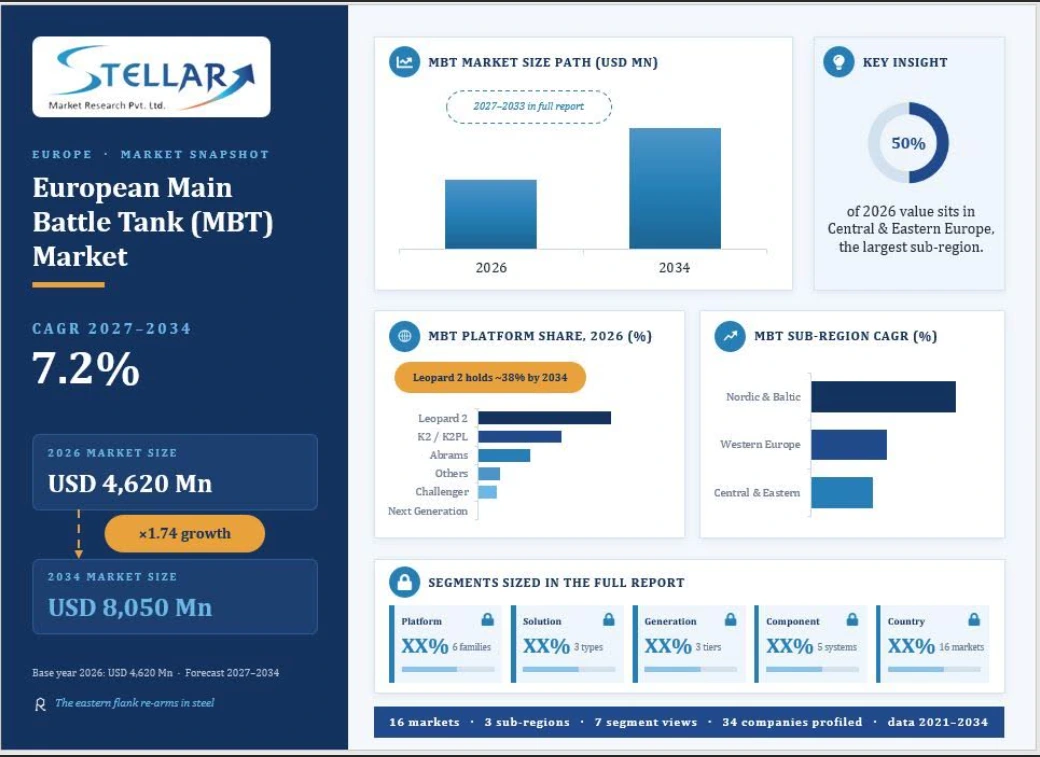
The European Main Battle Tank (MBT) Market is valued at USD 4,620 million in 2026 and is expected to reach USD 8,050 million by 2034, growing at a CAGR of 7.2% during the forecast period, the fastest of any region, according to Stellar Market Research.
Europe is the centre of gravity of the world tank business in this decade. Until 2021, European tank spending meant small upgrade lots and occasional second-hand purchases; the war in Ukraine changed both the quantity and the nature of demand. Armies that had cut tank battalions to two or three are rebuilding brigades, donor nations are replacing tanks given to Ukraine, and every new contract now specifies active protection, digital battle management and growth margin for heavier armour. Poland, Germany, Italy and Romania together account for most new-build value, while smaller fleets move from Soviet-era T-72 derivatives and older Leopard 2 variants to NATO-standard, APS-equipped tanks.
To get more Insights: Request Free Sample Report
Key Market Takeaways
- Europe accounts for about one-third of global main battle tank market value in 2026 and is the fastest-growing region, expanding at a 7.2% CAGR to 2034.
- Central and Eastern Europe holds about half of European value in 2026, led by Poland, the single largest country market in the European main battle tank market.
- The Leopard 2 family holds about 43% of European value in 2026, followed by K2/K2PL at about 27% and Abrams at about 17%.
- New production makes up the majority of European value, a sharp change from the upgrade-dominated European tank market of the 2010s.
- Protection systems are the fastest-growing component pool as the Trophy APS becomes standard on the Leopard 2A8 and counter-drone measures spread across fleets.
- Next-generation designs, led by Italy’s KF51-based new main battle tank, rise to about a fifth of European market value by 2034.
European Main Battle Tank (MBT) Market Overview
European Main Battle Tank Industry Definition and Scope
The European Main Battle Tank (MBT) Market covers tracked, turreted main battle tanks with a main gun of 105 mm or above delivered to, upgraded for, or refurbished for European armies, within the wider European armoured vehicle market. Market value covers new production, upgrade and modernisation, and refurbishment and life extension, phased by year of delivery. Three features set the European market apart: demand is multi-sourced, with German, Korean, American and British designs all holding large European orders; buyers expect local work share, from Polish K2PL assembly in Gliwice to Italian production in La Spezia; and procurement is increasingly coordinated, with joint Leopard 2A8 buys and a common Trophy APS contract across four countries.
European Main Battle Tank (MBT) Market Size and Demand Indicators
|
Year |
USD Million |
Year |
USD Million |
|
2026 |
4,620 |
2030 |
6,360 |
|
2034 |
8,050 |
CAGR 2027–2034 |
7.2% |
European market value rises steeply over 2027–2029 as Polish K2GF deliveries, the German Leopard 2A8 framework and the Dutch, Czech, Lithuanian and Swedish 2A8 orders overlap. After a short plateau around 2030, growth resumes with K2PL production in Poland, Italian new main battle tank deliveries and the expected Romanian Stage II award, which keeps the European battle tank market size on a rising path through 2034.
European Main Battle Tank Industry Ecosystem and Value Chain
The European value chain links armour steel, barrel and optics suppliers with KNDS, Rheinmetall, Hyundai Rotem and their European partners, local assembly lines in Poland and Italy, and the sustainment organisations that support multinational Leopard 2A8 fleets. Bottlenecks in gun barrels, armour steel, transmissions and optics now decide delivery dates as much as budgets do.
|
Value-chain layer |
Representative activities and participants |
Commercial considerations |
|
Materials and forgings |
Armour steel, composite armour, gun-barrel forgings, castings |
Long lead times and limited qualified European suppliers |
|
Subsystems |
RENK transmissions, MTU powerpacks, Hensoldt and Safran optics, Trophy APS |
Capacity limits and export-control exposure |
|
Platform integration |
KNDS, Rheinmetall, Hyundai Rotem, RBSL, LRMV |
Production slots, backlog and design authority |
|
Local assembly and offsets |
Bumar-?ab?dy (K2PL), La Spezia (NMBT), CSG in the Czech Republic |
Work share and technology transfer |
|
Upgrade and modernisation |
Challenger 3, Leclerc XLR, Leopard 2A4/A6 retrofits |
Steady demand alongside new-build programmes |
|
Through-life support |
Shared spares, training and simulation pools for 2A8 users |
Recurring revenue across multinational fleets |
European Main Battle Tank (MBT) Market Dynamics
European Main Battle Tank (MBT) Market Growth Catalysts
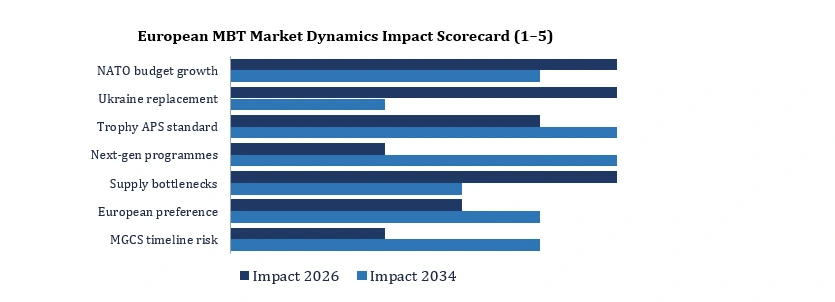
Rising Defence Budgets and Rebuilding of Armoured Brigades
European defence spending is increasing as NATO members strengthen military readiness and rebuild armoured capabilities, particularly along the eastern flank. Poland is expanding its fleet through K2, M1A2 SEPv3 and Leopard 2 acquisitions, while Germany has ordered 123 Leopard 2A8 tanks, with a proposal for 75 additional units under consideration. Romania’s 216-tank Stage II programme further reflects the region’s ongoing modernisation requirements. In parallel, countries that transferred tanks to Ukraine are seeking to replenish their inventories, while Central and Eastern European militaries continue replacing ageing T-72 derivatives. These procurement programmes are supporting sustained demand for European main battle tanks, with acquisition and modernisation requirements extending towards 2030.
EU Funding Instruments and Coordinated Procurement
European Union funding mechanisms are strengthening the financial framework for defence procurement and encouraging greater coordination among member states. The Security Action for Europe (SAFE) instrument provides up to EUR 150 billion in long-term loans to support defence investment, including joint procurement of ground combat capabilities. The European Defence Industrial Strategy also promotes greater cooperation, interoperability and investment in Europe's defence manufacturing base. The Leopard 2A8 user group demonstrates the potential of common platform adoption, while EuroTrophy’s EUR 330 million contract, signed in January 2026, to supply Trophy Active Protection Systems (APS) for Lithuania, the Netherlands, the Czech Republic and Croatia highlights the benefits of standardised equipment procurement. Such collaborative purchasing arrangements can improve procurement efficiency, strengthen supply-chain coordination and support economies of scale across the European MBT market.
European Main Battle Tank (MBT) Market Restraints
Production Bottlenecks in Gun Barrels, Armour Steel, Optics and Transmissions
Capacity constraints across critical components, including gun barrels, specialised armour steel, advanced optics and powertrain systems, continue to restrict the pace of European main battle tank production. Although manufacturers such as KNDS and Rheinmetall are expanding manufacturing capabilities and strengthening supplier networks, specialised components, skilled-labour requirements and lengthy production cycles can delay the conversion of procurement orders into operational deliveries. Consequently, countries placing orders later in the procurement cycle may face delivery schedules extending beyond 2030. Furthermore, Europe's emphasis on strengthening domestic defence manufacturing and reducing reliance on non-European suppliers can complicate sourcing decisions, supplier qualification and contract negotiations. These constraints may increase programme costs, extend procurement timelines and affect the execution of major acquisition programmes, including Romania’s ongoing tank procurement plans.
European Main Battle Tank (MBT) Market Opportunities
Local Assembly and Maintenance Hubs in Poland, Italy, Romania and Hungary
Local manufacturing, assembly and technology-transfer requirements are becoming increasingly important in European main battle tank procurement. Poland’s K2PL programme is creating a domestic production and maintenance ecosystem through Hyundai Rotem’s partnership with Bumar-?ab?dy and other Polish defence companies, supporting local assembly, servicing and adaptation of tanks to Polish requirements. In Italy, Leonardo Rheinmetall Military Vehicles is establishing an industrial base in La Spezia to support the country’s next-generation main battle tank and wider armoured vehicle programmes. Romania’s future tank procurement requirements and Hungary’s involvement in next-generation armoured vehicle development also present opportunities for industrial participation and supplier integration. These developments are creating opportunities for component manufacturers, engineering companies and defence suppliers offering local assembly, maintenance, repair, overhaul and technology-transfer capabilities. As a result, domestic production capacity and local industrial participation are becoming important considerations in European MBT procurement decisions.
APS, Counter-UAS and Digital Turret Retrofits for Existing Fleets
The modernisation of existing main battle tank fleets is creating opportunities beyond new-build procurement. In-service platforms such as the Leopard 2, Challenger and Leclerc require continued upgrades to address evolving battlefield threats, particularly anti-tank missiles, loitering munitions and unmanned aerial systems. This is increasing demand for active protection systems (APS), counter-UAS solutions, enhanced sensors, digital fire-control systems and turret modernisation. France’s Leclerc XLR programme and the UK's Challenger 3 conversion demonstrate the role of protection and digital-system upgrades in extending the operational life of existing platforms. In parallel, the standardised integration of Trophy APS across new Leopard 2A8 user nations is supporting demand for common training, spare parts and through-life maintenance. These requirements create recurring opportunities for defence electronics suppliers, protection-system manufacturers and maintenance providers, allowing the European MBT market to generate aftermarket and upgrade revenue alongside new tank deliveries.
European Main Battle Tank Technology Maturity and Commercial Readiness
Bubble size = indicative 2026 revenue pool. Technology maturity reflects how proven a solution is in service; commercial readiness reflects funded European demand, production availability and export approval.
European Main Battle Tank (MBT) Market Challenges
MGCS Timeline Risk: A Capability Gap Between the Leopard 2A8 and Next-Generation Tanks
The Franco-German Main Ground Combat System (MGCS), Europe's planned next-generation main battle tank, faces uncertainty over its development timeline, industrial work-share arrangements and final configuration. Delays could open a capability gap between current-generation tanks such as the Leopard 2A8 and the arrival of a next-generation European tank. European buyers are therefore still ordering current-generation tanks while keeping flexibility for future platforms. For tank manufacturers, this complicates long-term capacity planning, technology investment and product development, because procurement decisions have to balance immediate fleet needs against the coming shift to next-generation combat systems.
Ukraine Ceasefire Scenarios and Defence Budget Continuity
The pace of European main battle tank procurement depends on the course of the Russia–Ukraine war, national election cycles and competing government budget priorities. A ceasefire could reduce the urgency of replenishment programmes. Fleet modernisation and NATO readiness requirements, however, keep long-term demand for new tanks in place. Stellar Market Research tests three scenarios for the European Main Battle Tank (MBT) Market: Ceasefire, Base and Prolonged Confrontation. Each one shows how geopolitical conditions shift procurement timelines and the rate at which requirements turn into firm orders.
- Contracted programmes are the most predictable demand. Signed Leopard 2A8 and K2 orders hold up in every scenario.
- Unsigned requirements carry the highest timing and approval risk. Germany's proposed follow-on Leopard 2A8 order and Romania's Stage II tank procurement are the main examples.
These uncertainties affect production schedules, capacity utilisation and revenue visibility for European tank manufacturers. That makes procurement execution and budget continuity key factors in the European MBT market outlook to 2034.
European Main Battle Tank (MBT) Market Trends
|
Trend |
Market development |
Commercial implication |
|
Multi-sourced fleets |
Poland combines K2, Abrams and Leopard 2; Romania evaluates several suppliers |
Dual-fleet strategies widen supplier choice |
|
APS as standard fit |
Trophy APS included in the Leopard 2A8 baseline across user nations |
Protection systems gain the largest share increase |
|
Local work share |
K2PL assembly in Gliwice; NMBT production in La Spezia |
Industrial offers decide competitions |
|
Joint procurement |
Leopard 2A8 user group and common APS contract |
Larger orders, shared training and spares |
|
Next-generation firepower |
Italy’s NMBT opens a 130 mm-class path in Europe |
New programmes for gun and ammunition suppliers
|
European Main Battle Tank (MBT) Market Segment Analysis
European Main Battle Tank Market by Platform Family: Leopard 2, K2/K2PL, Abrams, Challenger and Next Generation
The Leopard 2 family holds the largest share of the European Main Battle Tank (MBT) Market throughout the forecast period: about 43% of value in 2026 and about 38% in 2034. Two things support this lead: a broad user community across European armies and the Leopard 2A8 as the new common standard. K2/K2PL holds a strong second position, driven by Poland's large K2 programme. Abrams follows on the strength of Polish and Romanian M1A2 SEPv3 purchases. Next-generation main battle tanks reach about a fifth of European market value by 2034, led by Italy's KF51-based programme. Platform family is an additional, Europe-specific segmentation layer. Europe is the one region where several Western tank families compete directly for new orders, so this view adds buyer and supplier insight; it sits alongside, and reconciles with, the solution, generation, main gun calibre, component and propulsion segmentation used in the Global Main Battle Tank (MBT) Market report.
European Main Battle Tank Market by Solution: New Production, Upgrade and Modernisation, Refurbishment
New-build tank production accounts for most European main battle tank market value, a clear break from the upgrade-dominated market of the 2010s. Upgrade and modernisation remain a large segment in the United Kingdom, France, Spain, Greece and Finland. Refurbishment of surplus Leopard 1 and Leopard 2A4 hulls continues to supply Ukraine and smaller European buyers.
European Main Battle Tank Market by Generation: Third Generation, Gen 3+ and Next Generation
Third-generation-plus tanks such as the Leopard 2A8, K2 and M1A2 SEPv3 account for most European tank deliveries this decade. Older third-generation fleets shrink in value as Leopard 2A4 and T-72 derivatives are retired or upgraded. Next-generation vehicles enter the market through Italy's new main battle tank programme and work related to the Franco-German MGCS.
European Main Battle Tank Market by Component: Protection Systems Grow Fastest
Protection systems are the fastest-growing component segment. The Trophy active protection system (APS) is now standard on the Leopard 2A8, and counter-drone measures are being added across European tank fleets. Powertrain demand is rising too: in October 2026, RENK expanded its HSWL 354 transmission contract with KNDS Deutschland by about EUR 130 million.
European Main Battle Tank Market by Main Gun Calibre: 105 mm, 120–125 mm and 130 mm
The 120–125 mm class holds almost all European main battle tank market value. NATO 120 mm smoothbore guns arm the Leopard 2, K2/K2PL, Abrams and Challenger 3 fleets, while 125 mm guns remain in service on T-72 derivatives across Central and Eastern Europe, a pool that shrinks as those fleets are replaced. The 130 mm class is the emerging segment: Rheinmetall’s 130 mm gun on the KF51 Panther, the basis of Italy’s new main battle tank programme, makes it the main calibre growth area late in the forecast period. The 105 mm class is marginal in Europe.
European Main Battle Tank Market by Propulsion: Diesel, Gas Turbine and Hybrid-Electric
Diesel powerpacks dominate the European military tank market, led by MTU (Rolls-Royce Power Systems) engines paired with RENK transmissions on the Leopard 2 family. Gas-turbine work is concentrated in the Abrams fleets of Poland and Romania, where AGT-1500 support and spares sustain a steady revenue pool. Hybrid-electric propulsion remains a development-stage segment in Europe, linked to next-generation tank concepts, and contributes little value before the end of the forecast period.
European Main Battle Tank (MBT) Market Country Analysis and Regional Market Share
Central and Eastern Europe accounts for about half of European main battle tank market value in 2026. Demand here is threat-driven and time-sensitive. Buyers favour suppliers that can deliver quickly from existing production lines, above all the Korean K2, combined with local production for the longer term.
Western Europe, led by Germany, Italy, the Netherlands, France and the United Kingdom, combines new-build tank programmes with upgrades of existing fleets. The Nordic and Baltic states form a compact but high-value cluster. Poland is the largest single-country market in 2026, followed by Germany. Italy moves up the ranking from 2029 as its new main battle tank deliveries begin, and Romania enters the top five once it selects its Stage II supplier.
Poland Main Battle Tank Market
Poland is the largest main battle tank market in Europe:
- 360 K2 tanks under two contracts, worth USD 3.7 billion and USD 6.5 billion;
- 250 M1A2 SEPv3 Abrams;
- a K2PL production line under construction at Bumar-?ab?dy, making Poland a regional tank production hub as well as a buyer.
Germany Main Battle Tank Market
Germany has ordered 123 Leopard 2A8 tanks, and a proposal for 75 more is in preparation. That makes Germany the largest Western European tank buyer and the anchor customer for KNDS production capacity and its supplier base.
Italy Main Battle Tank Market
In September 2026, Italy launched a EUR 5.14 billion procurement for a new main battle tank and derivative vehicles. It covers about 132 KF51-based tanks to replace the Ariete, alongside Ariete C2 upgrades. Italy becomes one of the fastest-growing tank markets in Europe from 2029.
Romania Main Battle Tank Market
Romania operates 54 M1A2 SEPv3 Abrams from Stage I. Its Stage II programme covers 216 tanks and 76 support vehicles, worth about EUR 6.5 billion, and is the largest open main battle tank competition in Europe.
United Kingdom and France Main Battle Tank Market
The United Kingdom is converting 148 Challenger 2 tanks to the Challenger 3 standard, with trials running to the end of 2026. France is renovating its Leclerc fleet to the XLR standard. Both markets are driven by upgrade and modernisation rather than new-build tanks.
Netherlands and Czech Republic Main Battle Tank Market
The Netherlands has ordered at least 46 Leopard 2A8s, for delivery in 2028–2031, to rebuild a national tank battalion. The Czech Republic has ordered 44 Leopard 2A8s, with an option for 14 more, to replace its T-72M4CZ fleet.
Nordic and Baltic Main Battle Tank Market
Lithuania, Sweden and Norway have ordered 44, 44 and 54 Leopard 2A8s respectively. Norway received its first Leopard 2A8NO tanks at Rena camp on 30 April 2026, and Lithuania is building a new tank battalion around its fleet.
European Main Battle Tank (MBT) Market Recent Developments, 2026
- 19 January 2026: EuroTrophy signed a EUR 330 million contract with KNDS Deutschland for Trophy APS on Leopard 2A8 tanks for Lithuania, the Netherlands, the Czech Republic and Croatia.
- 20 January 2026: Challenger 3 completed its first crewed live firing; Romania announced at IAV 2026 that it intends to accelerate its main battle tank programme.
- 30 April 2026: Norway’s first Leopard 2A8NO tanks arrived at Rena camp.
- June 2026: Leonardo Rheinmetall Military Vehicles showed its new main battle tank demonstrator at Eurosatory 2026.
- 24–25 August 2026: Poland received the first 28 K2GF tanks under its second executive contract with Hyundai Rotem.
- September 2026: Italy launched a EUR 5.14 billion procurement for a new main battle tank and derivative vehicles.
- October 2026: RENK expanded its HSWL 354 transmission contract with KNDS Deutschland by about EUR 130 million.
- 19 October 2026: The UK confirmed delivery of seven Challenger 3 prototypes for trials.
European Main Battle Tank (MBT) Market Competitive Landscape and Key Players
Europe’s tank market is funded and visible to 2030; the open questions are who builds the tanks and where. Buyers now weigh delivery slots and local work share as heavily as vehicle performance, and the European market is the only region where German, Korean, American, and British designs all compete for large orders at the same time.
Among the leading European main battle tank manufacturers, KNDS Deutschland supplies the Leopard 2A8 to seven European armies, Hyundai Rotem holds 360 K2 tanks under contract with Poland and a local K2PL line, General Dynamics Land Systems supplies M1A2 SEPv3s to Poland and Romania, Rheinmetall BAE Systems Land builds the Challenger 3, and Leonardo Rheinmetall Military Vehicles leads Italy’s KF51-based programme. Competitor benchmarking in the full report covers 34 companies.
Key Market Participants
|
Organisation |
Organisation |
|
1. KNDS Deutschland (Krauss-Maffei Wegmann) |
2. KNDS France |
|
3. Rheinmetall |
4. Hyundai Rotem |
|
6. General Dynamics European Land Systems (Santa Bárbara Sistemas) |
|
|
7. Rheinmetall BAE Systems Land (RBSL) |
8. Leonardo Rheinmetall Military Vehicles |
|
9. Leonardo |
10. PGZ / Bumar-?ab?dy |
|
11. CSG (Czechoslovak Group) |
12. BAE Systems |
|
13. RUAG |
14. RENK Group |
|
15. Rolls-Royce Power Systems (MTU) |
16. Diehl Defence |
|
17. HD Hyundai Infracore |
18. SNT Dynamics |
|
19. Hyundai WIA |
20. Hanwha Aerospace |
|
21. Hensoldt |
22. Safran Electronics & Defense |
|
23. Thales |
24. Theon International |
|
25. Indra |
26. Kongsberg Defence & Aerospace |
|
27. EuroTrophy |
28. Rafael Advanced Defense Systems |
|
29. Elbit Systems |
30. Saab |
|
31. Nammo |
32. Pearson Engineering |
|
33. Patria |
34. Babcock International |
European Main Battle Tank (MBT) Market Scope: Inquire before buying
| Coverage parameter | Definition/coverage |
|---|---|
| Market | European Main Battle Tank (MBT) Market |
| Base year | 2026 |
| Historical period | 2021–2026 |
| Forecast period | 2027–2034 |
| 2026 market size | USD 4,620 Million |
| 2034 market forecast | USD 8,050 Million |
| CAGR | 7.2% during 2027–2034 |
| By Platform Family | Leopard 2; K2 / K2PL; Abrams; Challenger; Next Generation (NMBT/KF51, MGCS-related); Others |
| By Solution | New Production; Upgrade and Modernisation; Refurbishment and Life Extension |
| By Generation | Third Generation; Third Generation Plus; Next Generation |
| By Component | Hull and Turret; Armament and Fire Control; Protection and APS; Mobility and Powerpack; C4ISR and Vetronics |
| By Main Gun Calibre | Up to 105 mm; 120–125 mm; Above 125 mm (130 mm class) |
| By Propulsion | Diesel; Gas Turbine; Hybrid-Electric |
| By Sub-Region and Country | Central and Eastern Europe (Poland, Romania, Czech Republic, Hungary, Baltics); Western Europe (Germany, Italy, France, UK, Netherlands, Spain, Greece); Nordic (Sweden, Norway, Finland, Denmark) |
Frequently Asked Questions
The market grows at a 7.2% CAGR over 2027–2034, the fastest of any region worldwide.
Poland, with 360 K2 tanks under firm contract, 250 M1A2 SEPv3s and a planned K2PL production line.
The Leopard 2 family, with the 2A8 standard ordered by seven European armies and about 43% of 2026 value.
Europe accounts for about one-third of global main battle tank market value in 2026.
Italy’s New Main Battle Tank (NMBT), developed by Leonardo Rheinmetall Military Vehicles from KF51 Panther technology to replace the Ariete, backed by a EUR 5.14 billion procurement launched in September 2026.
KNDS, Rheinmetall, Hyundai Rotem, General Dynamics Land Systems, RBSL, Leonardo Rheinmetall Military Vehicles, PGZ/Bumar-?ab?dy, RENK and EuroTrophy, among 34 profiled companies.
SECTION A – EUROPEAN MAIN BATTLE TANK (MBT) MARKET INTRODUCTION
- Executive Market Landscape and Industry Overview
- European Main Battle Tank (MBT) Market Size (Value USD Million and Volume in Units), 2026–2034
- Market definition, platform coverage and commercial scope
- Historical assessment during 2021–2026 and forecast framework for 2027–2034
- New production vs. upgrade vs. refurbishment value split
- Europe’s share of the global main battle tank market
- CAGR Analysis of European Main Battle Tank (MBT) Market During 2027–2034
- European Main Battle Tank (MBT) Market Dynamics
- European Main Battle Tank (MBT) Market Trends
- European Main Battle Tank (MBT) Market Dynamics
- Drivers
- Restraints
- Opportunities
- Challenges
- PORTER’s Five Forces Analysis
- PESTLE Analysis
- European Main Battle Tank (MBT) Market Defence Spending, Policy and Funding Factors
- NATO capability targets and national defence budgets
- EU instruments: SAFE loans, EDIP and joint procurement rules
- Leopard 2A8 user group, common APS and training
- Scenarios: Ceasefire, Base and Prolonged Confrontation
- European Tank Readiness Gap Index: modern tanks per brigade vs. NATO targets
- European Main Battle Tank Industry Trends and Fleet Transition
- Rebuilding of armoured brigades after 2022
- Retirement of T-72 derivatives in Central Europe
- Replacement of tanks transferred to Ukraine
- Multi-sourced fleets and dual-supplier strategies
- European MBT fleet transition map
- European Main Battle Tank Value Chain and Revenue Pool Assessment
- Materials, forgings and armour steel
- Subsystems: transmissions, powerpacks, optics and APS
- Platform integration and joint ventures
- Local assembly and offsets
- Revenue attribution across value-chain stages
- European Main Battle Tank Supply Chain and Production Capacity
- Production capacity by OEM: KNDS, Rheinmetall, Hyundai Rotem/PGZ, RBSL, LRMV
- Critical bottlenecks: barrels, armour steel, transmissions and optics
- Supply Chain Stress Index: lead-time inflation by component, 2022–2026
- Comparative study: Leopard 2A8 vs. K2 vs. Abrams on cost, delivery and work share
- European Main Battle Tank Regional and Country-Level Landscape
- Poland: K2/K2PL, Abrams and Leopard 2PL programmes
- Germany: Leopard 2A8 framework and follow-on orders
- Italy: new main battle tank and Ariete C2
- Romania: Stage I Abrams and Stage II competition
- United Kingdom and France: Challenger 3 and Leclerc XLR
- Netherlands, Czech Republic, Nordics, Baltics and Southern Europe
- European Main Battle Tank (MBT) Market Size and Forecast by Segmentation (Value USD Million and Volume in Units), 2026–2034
- European Main Battle Tank (MBT) Market Size and Forecast, By Platform Family
- Leopard 2
- K2 / K2PL
- Abrams
- Challenger
- Next Generation (NMBT/KF51, MGCS-related)
- Others
- European Main Battle Tank (MBT) Market Size and Forecast, By Solution
- New Production
- Upgrade and Modernisation
- Refurbishment and Life Extension
- European Main Battle Tank (MBT) Market Size and Forecast, By Generation
- Third Generation
- Third Generation Plus
- Next Generation
- European Main Battle Tank (MBT) Market Size and Forecast, By Component
- Hull and Turret
- Armament and Fire Control
- Protection and APS
- Mobility and Powerpack
- C4ISR and Vetronics
- European Main Battle Tank (MBT) Market Size and Forecast, By Main Gun Calibre
- Up to 105 mm
- 120–125 mm
- Above 125 mm (130 mm class)
- European Main Battle Tank (MBT) Market Size and Forecast, By Propulsion
- Diesel
- Gas Turbine
- Hybrid-Electric
- European Main Battle Tank (MBT) Market Size and Forecast, By Sub-Region and Country
- Central and Eastern Europe
- Poland
- Romania
- Czech Republic
- Hungary
- Baltics
- Western Europe
- Germany
- Italy
- France
- United Kingdom
- Netherlands
- Spain
- Greece
- Nordic
- Sweden
- Norway
- Finland
- Denmark
- Central and Eastern Europe
- European Main Battle Tank (MBT) Market Size and Forecast, By Platform Family
Note: Country estimates follow the same segmentation structure. The historical period covers 2021–2026, with 2026 as the base year and forecasts for 2027–2034. Platform Family is a Europe-specific segmentation layer; the Solution, Generation, Main Gun Calibre, Component and Propulsion views follow the Global Main Battle Tank (MBT) Market report, and all European estimates reconcile to it.
SECTION B – COMPETITIVE INTELLIGENCE & INDUSTRY ECOSYSTEM
- Competitive Landscape
- SMR Competition Matrix
- Competitive Positioning of Key Players by Solution Segment [Revenue and Market Share]
- Key Players Benchmarking
- Company Name
- Headquarter
- MBT Platform and Subsystem Portfolio
- Order Backlog and Production Capacity
- Customer Base and Programme Presence
- Total Company Revenue (2026)
- Land Systems / MBT Revenue (2026)
- Geographic Presence
- Strategic Partnerships and Joint Ventures
- Market Structure
- Prime Contractors
- Subsystem and Tier-1 Suppliers
- Emerging Suppliers
- Growth Rate/Y-o-Y (%) of Companies
- Profit Margin (%) of Companies
- R&D Investments (%) of Companies
- Revenue Vs Net Earnings – Financial Health Benchmarking (2026)
- Revenue Performance And Financial Analysis (2026)
- Mergers and Acquisitions Details
- European Main Battle Tank Manufacturers and Platform Benchmarking
- Leopard 2A8, K2/K2PL, M1A2 SEPv3, Challenger 3, NMBT/KF51 and Leclerc XLR
- Platform scorecard: protection, firepower, mobility, delivery speed, local work share and NATO commonality
- Win/loss record in European competitions
- Order backlog and production capacity by OEM
- European Main Battle Tank Company Strategies and Expansion Plans
- Capacity expansion and new production lines
- Local production and technology-transfer agreements
- Next-generation platform development
- Partnerships with subsystem and protection suppliers
- European Main Battle Tank Industry SWOT and Competitive Outlook
- Strengths, weaknesses, opportunities and threats
- Investment attractiveness by country and segment
- Competitive scenarios, 2027–2034
- Strategic recommendations for market participants
- Company Profiles: 34 Key Players
- Detailed Profile considering the parameters:
-
- Overview
- Business Portfolio
- MBT Portfolio
- Contracts and Backlog
- Production Footprint
- Financial Overview
- SWOT Analysis
- Strategic Analysis
- Recent Developments
Platform Manufacturers and Joint Ventures
-
- KNDS Deutschland (Krauss-Maffei Wegmann)
- KNDS France
- Rheinmetall
- Hyundai Rotem
- General Dynamics Land Systems
- General Dynamics European Land Systems (Santa Bárbara Sistemas)
- Rheinmetall BAE Systems Land (RBSL)
- Leonardo Rheinmetall Military Vehicles
- Leonardo
- PGZ / Bumar-?ab?dy
- CSG (Czechoslovak Group)
- BAE Systems
- RUAG
Powertrain, Mobility and Gun Suppliers
-
- RENK Group
- Rolls-Royce Power Systems (MTU)
- Diehl Defence
- HD Hyundai Infracore
- SNT Dynamics
- Hyundai WIA
- Hanwha Aerospace
Optronics, Electronics and Protection Suppliers
-
- Hensoldt
- Safran Electronics & Defense
- Thales
- Theon International
- Indra
- Kongsberg Defence & Aerospace
- EuroTrophy
- Rafael Advanced Defense Systems
- Elbit Systems
- Saab
Ammunition, Engineering and Support
-
- Nammo
- Pearson Engineering
- Patria
- Babcock International
SECTION C – KEY INSIGHTS, STRATEGIC OUTLOOK & METHODOLOGICAL FRAMEWORK
C1. Key Findings
C2. Strategic Moves & Industry Outlook
C3. Research Methodology