ENG
 Japanese
 French
 German
 Korean

Global Main Battle Tank (MBT) Market Size, Share, Trends & Forecast 2026–2034
The Global Main Battle Tank (MBT) Market was valued at USD 13,850 million in 2026 and is expected to reach USD 21,420 million by 2034, growing at a CAGR of 5.6%
Global Main Battle Tank (MBT) Market Overview
The Global Main Battle Tank (MBT) Market was valued at USD 13,850 million in 2026 and is expected to reach USD 21,420 million by 2034, growing at a CAGR of 5.6% during the forecast period, according to Stellar Market Research.
For roughly three decades after the Cold War, the military tank market was a maintenance business: shrinking armoured inventories in the United States, Germany and the United Kingdom kept new-build lines at minimal output, and budgets went mainly to refurbishing tank fleets built in the 1980s. That picture changed decisively after 2022. Higher defence spending, sharper geopolitical tension, heavy armour losses in Ukraine and accelerated land-systems procurement across Europe, the Middle East and Asia Pacific have turned main battle tank demand from a replacement cycle into a sustained procurement cycle, while active protection systems, third-generation thermal sights, digital turrets and modular armour raise the value of every tank delivered.
Key Market Takeaways
- New-build tank production holds the largest share of the main battle tank market in 2026, led by K2 deliveries to Poland, Leopard 2A8 production for Germany and its partners, Altay output in Türkiye and Merkava Barak production in Israel.
- Tank upgrade and modernisation is the fastest-growing solution segment, because the installed base of Western third-generation tanks is several times larger than annual new-build output.
- Europe holds the largest regional market share at about one-third of 2026 value and leads growth through 2034, anchored by Poland, Germany, Italy and Romania.
- Production capacity, not funding, is the binding constraint: KNDS, General Dynamics Land Systems, Hyundai Rotem and Rheinmetall all carry multi-year order backlogs, so delivery slots decide which armies receive tanks first.
- Active protection, overhead armour and counter-drone systems have moved from options to baseline requirements, shifting component value toward protection systems and C4ISR.
- Next-generation designs such as the M1E3 Abrams and Italy’s new main battle tank move from a negligible share of value today to about a quarter of market value by 2034.
FIVE FORCES RESHAPING THE MAIN BATTLE TANK INDUSTRY
|
01 REARMAMENT NATO eastern flank |
02 REPLENISHMENT Ukraine-related losses |
03 SURVIVABILITY APS and counter-drone |
04 LOCALISATION In-country production |
05 NEXT GENERATION M1E3, NMBT, MGCS |
Global Main Battle Tank (MBT) Market Overview
Global Main Battle Tank Industry Definition and Scope
The Global Main Battle Tank (MBT) Market covers heavily armoured, tracked, turreted combat vehicles armed with a direct-fire main gun of 105 mm or above and designed to defeat other armoured vehicles. Within the wider armoured vehicle market, light tanks, wheeled tank destroyers and infantry fighting vehicles fall outside the definition; chassis derivatives such as armoured bridge layers, recovery and engineer vehicles are tracked separately as adjacent demand. Market value is the value of MBT hardware delivered in a year across new-build tank production, tank upgrade and modernisation, and refurbishment and life extension, with contract values spread across delivery years so a framework agreement adds value only as tanks are handed over. Domestic procurement in Russia and China is tracked from open sources but excluded from the headline value, while their exports, such as NORINCO VT4 deliveries, are counted in the importing region.
To get more Insights: Request Free Sample Report
Global Main Battle Tank (MBT) Market Size and Demand Indicators
|
Year |
USD Million |
Year |
USD Million |
|
2026 |
13,850 |
2030 |
17,230 |
|
2034 |
21,420 |
CAGR 2027–2034 |
5.6% |
Firm programme data confirm the depth of demand behind these battle tank market size estimates. Poland holds 360 K2 tanks under two executive contracts; Leopard 2A8 orders from Germany, the Netherlands, the Czech Republic, Lithuania, Sweden, Norway and Croatia form the largest Western tank backlog since the 1980s; Romania is running a 216-tank second-phase programme and Saudi Arabia has approval for nearly 300 M1 Abrams. Deliveries step up sharply in 2027–2029 as these orders reach peak production, level off around 2030 as current-generation contracts complete, and accelerate again from 2031 as next-generation tanks enter serial production.
Main Battle Tank Industry Ecosystem and Value Chain
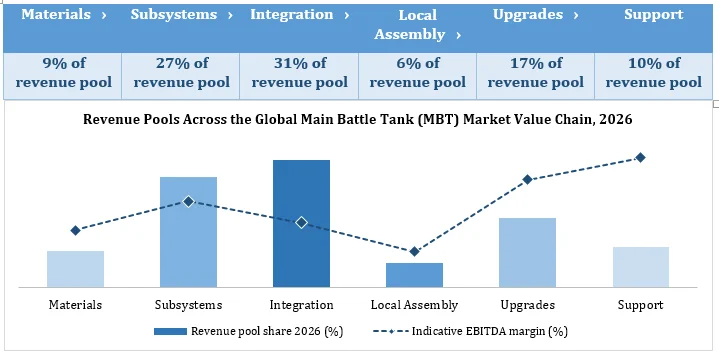
The main battle tank value chain links armour steel and forging suppliers with subsystem makers, prime contractors, local assembly partners and the through-life support organisations that keep fleets in service for 30 to 40 years. Value concentrates at platform integration and in high-technology subsystems, while upgrades and sustainment provide the steadiest long-term revenue.
|
Value-chain layer |
Representative activities and participants |
Commercial considerations |
|
Materials and forgings |
Armour steel, composite and ceramic armour, gun-barrel forgings, castings |
Long lead times, limited qualified suppliers and rising input costs |
|
Subsystems |
Powerpacks, transmissions, fire control, thermal sights, APS, vetronics |
High technology content, export-control exposure and strong margins |
|
Platform integration |
KNDS, GDLS, Hyundai Rotem, Rheinmetall, BMC, MANTAK, NORINCO |
Production slots, order backlog and design authority |
|
Local assembly and offsets |
Bumar-?ab?dy (K2PL), LRMV in Italy, planned plant in Peru |
Technology transfer, local content and industrial participation |
|
Upgrade and modernisation |
APS, sight, armour and powerpack retrofits to existing fleets |
Steady demand independent of new-build timing |
|
Through-life support |
Spares, depot overhaul, training and simulation |
Recurring revenue across a 30–40 year service life |
Main Battle Tank Value Chain and Revenue Pools.
Global Main Battle Tank (MBT) Market Dynamics
Global Main Battle Tank (MBT) Market Growth Catalysts
Rearmament Across NATO’s Eastern Flank and Replacement of Tanks Transferred to Ukraine
Rising defence expenditure and military modernisation initiatives across NATO’s eastern flank are strengthening demand for new-generation main battle tanks in Europe. Poland is developing a diversified armoured fleet comprising K2, M1A2 SEPv3 Abrams and Leopard 2 tanks, while Romania is advancing a 216-tank second-phase procurement programme. Germany's plans to procure an additional 75 Leopard 2A8 tanks, following its existing order of 123 units, further reinforce the long-term demand outlook for the European MBT market. These procurement programmes are expected to support main battle tank production and fleet expansion well into the 2030s. Additionally, countries that transferred Leopard 2, M1 Abrams and Challenger 2 tanks to Ukraine are increasingly prioritising inventory replenishment through new procurement and refurbishment initiatives. The refurbishment of Leopard 1 and Leopard 2 tanks from existing industrial stocks is also creating additional opportunities in the military tank refurbishment and modernisation market.
Growing Demand for Advanced Protection Against Drones and Top-Attack Munitions
The increasing use of unmanned aerial vehicles (UAVs), loitering munitions and top-attack weapons in modern warfare has intensified the need for advanced tank survivability solutions. Active protection systems (APS), overhead armour and electronic counter-drone technologies are becoming increasingly important features of modern main battle tank configurations. In January 2026, EuroTrophy secured a EUR 330 million contract to standardise the Trophy active protection system across four national Leopard 2A8 fleets. Similar protection system upgrades and retrofit programmes are also progressing across Leopard 2A4/A6, M1A1 Abrams and Merkava fleets. The growing integration of advanced armour protection, threat detection and interception technologies is increasing the value of individual MBT platforms while creating additional revenue opportunities for defence technology and subsystem suppliers.
Global Main Battle Tank (MBT) Market Restraints
Supply Chain Bottlenecks, Extended Lead Times and Rising Unit Costs
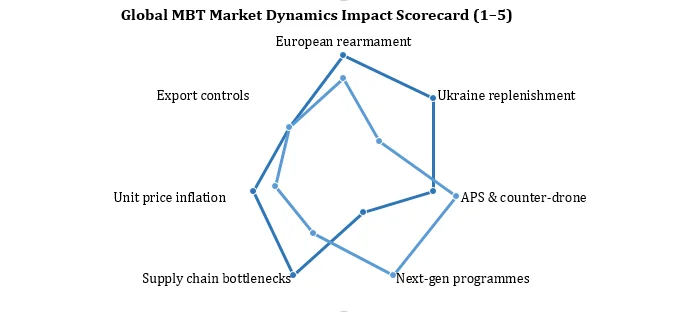
Supply chain constraints remain a significant challenge for the global main battle tank industry, particularly in the procurement of specialised armour steel, gun barrels, transmissions and advanced thermal imaging sensors. Limited component availability, specialised manufacturing requirements and extended production cycles are increasing delivery lead times and pushing main battle tank unit costs higher. In 2026, the UK Ministry of Defence acknowledged that supply chain delays had disrupted Challenger 3 demonstration activities, highlighting the impact of manufacturing constraints on major defence procurement programmes. Similar challenges across international defence supply chains are affecting production schedules and the timely execution of tank modernisation initiatives. Furthermore, export controls and approval requirements for US- and German-origin components can extend procurement timelines for international buyers. These capacity constraints may restrict production scalability, delay contract fulfilment and limit the pace of growth in the global MBT market, even as defence budgets and procurement commitments continue to increase.
Global Main Battle Tank (MBT) Market Opportunities
Local Production and Industrial Participation Creating New Market Opportunities
The growing preference for domestic manufacturing and industrial participation is creating additional opportunities in the global main battle tank market. Defence procurement programmes increasingly favour suppliers offering local assembly, technology transfer and domestic component manufacturing, making industrial participation an important factor in international tank procurement decisions. Poland’s planned K2PL production line at Bumar-?ab?dy, Italy’s proposed main battle tank assembly facility at La Spezia and Peru’s planned FAME–Hyundai Rotem manufacturing facility illustrate the increasing importance of local production partnerships. These arrangements enable defence manufacturers to strengthen their market presence while supporting domestic industrial capabilities and reducing dependence on imported military equipment. As a result, technology transfer, local content commitments, and domestic manufacturing capabilities are becoming important competitive differentiators in main battle tank procurement across Europe, the Middle East and Latin America.
Tank Modernisation and Upgrade Opportunities Across the Installed Fleet
The large installed base of ageing main battle tanks represents a substantial opportunity for equipment manufacturers, technology providers and defence system integrators. Existing fleets of Leopard 2A4, M1A1 Abrams and T-72 derivative platforms continue to require modernisation to meet evolving battlefield requirements and improve operational performance. Upgrade programmes involving active protection systems (APS), advanced thermal imaging sights, digital fire-control systems and next-generation powerpacks are extending vehicle service life while enhancing combat effectiveness. Unlike new-build procurement, which depends on long-term defence budgets and production schedules, tank modernisation programmes can progress independently through phased retrofit and equipment replacement initiatives. This creates recurring revenue opportunities for subsystem suppliers and regional upgrade integrators while supporting the long-term growth of the global military tank modernisation market.
Main Battle Tank Technology Maturity and Commercial Readiness
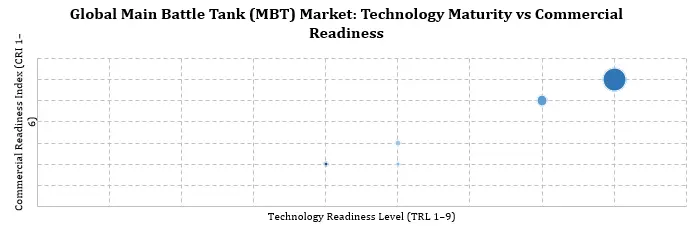
Bubble size = indicative 2026 revenue pool. Technology maturity reflects how proven a solution is in service; commercial readiness reflects funded demand, production availability, and export approval.
Global Main Battle Tank (MBT) Market Challenges
Uncertainty Over the Role of Main Battle Tanks on Drone-Saturated Battlefields
The increasing deployment of unmanned aerial vehicles (UAVs), loitering munitions and precision-guided weapons is raising questions about the operational effectiveness and survivability of traditional heavy armoured vehicles. Military forces are reassessing the role of main battle tanks within modern combat environments, balancing investments in heavily protected platforms against lighter direct-fire vehicles and unmanned ground systems. This evolving battlefield landscape is making procurement requirements more complex, as defence authorities increasingly evaluate active protection systems, counter-drone capabilities and battlefield adaptability before committing to large-scale tank acquisition programmes. Uncertainty surrounding future operational requirements may extend procurement decision-making cycles and influence the configuration, specifications and delivery timelines of next-generation main battle tanks.
Programme Delays and Uncertainty in Development Timelines and Industrial Work-Share
Long development cycles, technological complexities and industrial coordination challenges create uncertainties for next-generation main battle tank programmes. The Franco-German Main Ground Combat System (MGCS), for instance, faces uncertainties surrounding programme timelines, industrial responsibilities and work-share arrangements, potentially delaying the introduction of next-generation platforms beyond 2034. Similarly, the M1E3 Abrams development programme and Italy’s planned next-generation main battle tank programme depend on sustained budget allocations, production approvals and long-term industrial commitments. Changes in defence priorities, procurement approvals and funding continuity across successive government terms may affect development schedules and production readiness. Such uncertainties can delay the transition from existing tank platforms to next-generation systems, creating challenges for defence manufacturers, technology suppliers and military procurement authorities.
Global Main Battle Tank (MBT) Market Trends
|
Trend |
Market development |
Commercial implication |
|
Active protection as standard fit |
Trophy and other APS ordered with new Leopard 2A8, K2 and Abrams tanks and retrofitted to older fleets |
Protection systems gain the largest share increase among components |
|
Reduced-crew and unmanned turrets |
M1E3 Abrams and KF51-based designs adopt autoloaders and remote turrets |
Value shifts toward automation, vetronics and crew-machine teaming |
|
Larger-calibre guns |
A 130 mm class opens with Rheinmetall’s Future Gun System |
Ammunition and fire-control suppliers gain new programmes |
|
Hybrid-electric drives |
Next-generation tanks test hybrid powerpacks for silent watch and lower fuel use |
Powerpack and transmission suppliers re-engineer product lines |
|
Dual-fleet and local production strategies |
Poland, Romania and Gulf buyers combine suppliers and demand local assembly |
Industrial offers become a deciding factor in competitions |
Recent delivery and contract developments highlight the simultaneous expansion of new-build procurement, tank modernisation and lifecycle support activities in the global main battle tank market. Poland received the first 28 K2GF tanks under its second executive contract in August 2026, while Türkiye confirmed deliveries of at least 10 Altay tanks during 2026. In the United States, the Army awarded General Dynamics Land Systems a USD 716.2 million, five-year Abrams sustainment contract in April 2026. These developments demonstrate how new tank deliveries, fleet upgrades, and long-term maintenance requirements are generating parallel revenue opportunities for defence manufacturers and support service providers, strengthening the overall growth outlook for the global MBT industry.
Global Main Battle Tank (MBT) Market Segment Analysis
Main Battle Tank Market by Solution: New Production, Upgrade and Modernisation, Refurbishment
New-build main battle tanks account for a significant portion of market demand, supported by fleet replacement, military rearmament and expansion of armoured capabilities. Upgrade and modernisation programmes cover active protection systems (APS), advanced sights, digital fire control, armour enhancements and powerpack upgrades, while sustainment includes spare parts, depot overhaul, maintenance and training. The 30–40-year operational life of MBTs creates recurring lifecycle revenue opportunities. The market model analyses segment-wise growth, segment attractiveness, segment profitability, micro-segmentation, niche opportunities and procurement behaviour across new-build, upgrade and sustainment categories.
Main Battle Tank Market by Generation: Third Generation, Gen 3+ and Next Generation
Third-generation-plus tanks, including the Leopard 2A7/2A8, M1A2 SEPv3, K2, Merkava IV Barak, Challenger 3 and Altay, account for most market value through 2034. Older third-generation fleets shrink in value as they are retired or upgraded, while next-generation main battle tanks such as the M1E3 Abrams and Italy’s new main battle tank grow from a negligible share in 2026 to about a quarter of market value by 2034.
Main Battle Tank Market by Main Gun Calibre: 105 mm, 120–125 mm and 130 mm
The 120–125 mm class holds almost all main battle tank market value, covering NATO 120 mm smoothbore guns and 125 mm guns on Russian-derived and Chinese designs. A 130 mm segment opens with Rheinmetall’s Future Gun System on KF51-derived vehicles, while 105 mm demand is limited to legacy fleets and export variants.
Main Battle Tank Market by Component: Protection Systems and C4ISR Gain Share
Hull, turret and structure accounts for the largest component share, followed by armament and fire control, protection systems, mobility and powerpack, and C4ISR and electronics. Protection systems gain the most share through 2034 as active protection moves from an option to a standard fit and add-on armour responds to top-attack threats, while C4ISR and electronics grow with digital turrets and crew-machine teaming.
Main Battle Tank Market by Propulsion: Diesel, Gas Turbine and Hybrid-Electric
Diesel powerpacks from MTU (Rolls-Royce Power Systems), Doosan, MAN and other suppliers remain the norm across the military tank market. Gas-turbine propulsion is specific to the Abrams fleet, and the M1E3 programme’s shift toward hybrid-electric drive marks the start of a hybrid-electric segment that gains share as next-generation tanks enter production.
Global Main Battle Tank (MBT) Market Regional Analysis and Regional Market Share
Europe is the largest regional market, accounting for approximately one-third of global value in 2026, and is also the fastest-growing region. Poland, Germany, Italy, Romania, the Netherlands and Nordic countries drive procurement through K2/K2PL, Leopard 2A8 and new-generation tank programmes. Replacement of ageing T-72 fleets, NATO rearmament and expanding domestic production, including K2 manufacturing at Bumar-?ab?dy, strengthen regional demand. Asia Pacific holds approximately 31% of 2026 market value, supported by South Korea's K2 production, India's Arjun Mk1A and Future Ready Combat Vehicle programmes, Japan's Type 10 sustainment and Australia's M1A2 SEPv3 deliveries.
North America holds about 16.5% of 2026 value and remains an established market, driven by the US Army's M1E3 Abrams programme, Abrams SEPv3 sustainment, fleet modernisation and Foreign Military Sales. The M1E3 prototype unveiled in January 2026 and targeted production from 2027 supports next-generation procurement opportunities. The Middle East & Africa market, at about 17.2% of 2026 value, is supported by Saudi Arabia's planned procurement of nearly 300 Abrams, Israel's Merkava Barak programme, Türkiye's Altay production ramp-up, Egypt's Abrams programme and NORINCO VT4 exports. South America, at about 2.3% of value, represents a smaller but active market, led by Peru's K2 framework agreement, Chile's Leopard 2A4 modernisation and Brazil's Leopard 1A5 revitalisation. Regional market share, procurement momentum, local industrial capabilities, regional growth drivers, market trends, competitive landscape and country-specific opportunities are analysed across all five regions.
Poland Main Battle Tank Market
Poland is the single largest buyer of new tanks in Europe, with 360 K2 tanks under two executive contracts with Hyundai Rotem, M1A2 SEPv3 Abrams deliveries and Leopard 2 fleets. The first 28 K2GF tanks under the second contract arrived in August 2026, and K2PL production at Bumar-?ab?dy adds a domestic production line.
Germany Main Battle Tank Market
Germany has ordered 123 Leopard 2A8 tanks and plans 75 more, making it the anchor customer for KNDS and its supplier base, including RENK transmissions and MTU powerpacks.
United States Main Battle Tank Market
The United States drives North American value through the M1E3 Abrams programme, SEPv3 sustainment and Foreign Military Sales support, including a USD 716.2 million, five-year Abrams sustainment contract awarded to General Dynamics Land Systems in April 2026.
South Korea Main Battle Tank Market
South Korea combines domestic K2 batch production with the strongest export position among Asian manufacturers, led by Hyundai Rotem’s contracts with Poland and Peru.
India Main Battle Tank Market
India operates one of the world’s largest tank fleets, dominated by T-72 and T-90 variants. Arjun Mk1A production and the Future Ready Combat Vehicle programme to replace T-72 tanks make India a major long-term source of new-build and upgrade demand.
Saudi Arabia Main Battle Tank Market
Saudi Arabia’s planned purchase of nearly 300 M1 Abrams, together with the September 2026 approval of 60 AGT-1500 engines, positions the Kingdom as the largest Gulf buyer of main battle tanks.
Türkiye and Israel Main Battle Tank Market
Türkiye confirmed at least 10 Altay deliveries in 2026, up from three in 2025, while Israel is accelerating Merkava Barak production, giving the region two domestic main battle tank industries.
Global Main Battle Tank (MBT) Market Recent Developments, 2026
- January 2026: The US Army unveiled the first M1E3 Abrams early prototype at the North American International Auto Show in Detroit.
- 19 January 2026: EuroTrophy signed a EUR 330 million contract with KNDS Deutschland for Trophy APS on Leopard 2A8 tanks for Lithuania, the Netherlands, the Czech Republic and Croatia.
- 20 January 2026: Rheinmetall BAE Systems Land completed the first crewed live firing of the Challenger 3.
- 1 February 2026: Türkiye confirmed that at least 10 Altay main battle tanks are to be delivered to the Turkish Land Forces in 2026, up from three in 2025.
- 30 April 2026: The US Army awarded General Dynamics Land Systems a USD 716.2 million, five-year contract to sustain the Abrams family of vehicles.
- 24–25 August 2026: Poland received the first 28 K2GF tanks under its second executive contract with Hyundai Rotem.
- 4 September 2026: The US State Department approved a possible sale of 60 AGT-1500 engines for Saudi Arabia’s M1 Abrams fleet.
- September 2026: Italy’s Ministry of Defence launched a EUR 5.14 billion procurement for a new main battle tank and derivative vehicles.
- October 2026: RENK and KNDS Deutschland expanded their contract for HSWL 354 transmissions for the Leopard 2 family by about EUR 130 million.
Global Main Battle Tank (MBT) Market Competitive Landscape and Key Players
The market is concentrated at platform level: four prime contractors, KNDS, General Dynamics Land Systems, Hyundai Rotem and Rheinmetall, account for most Western new-build value, while BMC, the Israeli MoD’s MANTAK, Uralvagonzavod and NORINCO serve national and price-led export markets. Competition increasingly turns on delivery speed, local production offers and survivability rather than price alone, and subsystem suppliers of powerpacks, transmissions, sights and APS capture a growing share of value. Competitor benchmarking in the full report covers 44 companies.
Among the leading main battle tank manufacturers, KNDS holds the largest European backlog, with the Leopard 2A8 ordered by seven nations alongside the Leclerc. General Dynamics Land Systems is the US Army prime for the M1A2 SEPv3 and the next-generation M1E3 Abrams and supports Foreign Military Sales fleets in Poland, Romania and Australia. Hyundai Rotem has 360 K2 tanks under firm contract with Poland, a K2PL production line at Bumar-?ab?dy and a framework agreement with Peru. Rheinmetall competes with the KF51 Panther and 120/130 mm guns, leads Italy’s new main battle tank work through Leonardo Rheinmetall Military Vehicles and builds the Challenger 3 through Rheinmetall BAE Systems Land.
Competitive Positioning by Participant Type
|
Participant type |
Representative organisations |
Basis of competition |
|
Western prime contractors |
KNDS; General Dynamics Land Systems; Rheinmetall; BAE Systems |
Order backlog, NATO interoperability and production scale |
|
Asian tank exporters |
Hyundai Rotem; Mitsubishi Heavy Industries; Heavy Vehicles Factory (AVNL); Hanwha Aerospace; Heavy Industries Taxila |
Delivery speed, price and local production offers |
|
National and regional producers |
BMC; Israel MoD (MANTAK); Bumar-?ab?dy (PGZ); Otokar; Czechoslovak Group (CSG) |
Domestic demand, sovereign capability and export ambition |
|
Russian and Chinese producers |
Uralvagonzavod; NORINCO |
Domestic scale and price-led exports |
|
Subsystem and protection suppliers |
RENK; Rolls-Royce Power Systems (MTU); Rafael; Elbit Systems; Hensoldt; Safran; Thales; Hyundai WIA; Hanwha Systems; HD Hyundai Infracore; SNT Dynamics; BEL; Saab; Kongsberg; Plasan; Northrop Grumman; Japan Steel Works |
Technology, retrofit capability and export approval |
|
Joint ventures and upgrade integrators |
RBSL; LRMV; EuroTrophy; Iveco Defence Vehicles; John Cockerill Defense; Larsen & Toubro |
Programme-specific integration and local work share |
Key Market Participants
|
Organisation |
Organisation |
|
1. KNDS (Krauss-Maffei Wegmann, Nexter) |
2. General Dynamics Land Systems |
|
3. Hyundai Rotem |
4. Rheinmetall |
|
5. Rheinmetall BAE Systems Land (RBSL) |
6. Leonardo Rheinmetall Military Vehicles (LRMV) |
|
7. Israel Ministry of Defense – MANTAK |
8. Elbit Systems |
|
9. Rafael Advanced Defense Systems |
10. BMC |
|
11. ASELSAN |
12. Uralvagonzavod |
|
13. NORINCO |
14. Heavy Vehicles Factory (Armoured Vehicles Nigam Ltd) |
|
15. Mitsubishi Heavy Industries |
16. Bumar-?ab?dy (PGZ) |
|
17. RENK Group |
18. Rolls-Royce Power Systems (MTU) |
|
19. Hanwha Aerospace |
20. Honeywell Aerospace |
|
21. Leonardo DRS |
22. Hensoldt |
|
23. Safran Electronics & Defense |
24. Thales |
|
25. EuroTrophy |
26. Denel Land Systems |
|
27. FAMAE |
28. Northrop Grumman |
|
29. BAE Systems |
30. Iveco Defence Vehicles |
|
31. John Cockerill Defense |
32. Czechoslovak Group (CSG) |
|
33. Saab |
34. Kongsberg Defence & Aerospace |
|
35. Hyundai WIA |
36. Hanwha Systems |
|
37. HD Hyundai Infracore |
38. SNT Dynamics |
|
39. Bharat Electronics Limited (BEL) |
40. Larsen & Toubro (L&T) |
|
41. Heavy Industries Taxila |
42. Japan Steel Works |
|
43. Otokar |
44. Plasan |
Market Scope and Research Coverage: Inquire before buying
|
Coverage parameter |
Definition/coverage |
|
Market |
Global Main Battle Tank (MBT) Market |
|
Base year |
2026 |
|
Historical period |
2021–2026 |
|
Forecast period |
2027–2034 |
|
2026 market size |
USD 13,850 Million |
|
2034 market forecast |
USD 21,420 Million |
|
CAGR |
5.6% during 2027–2034 |
|
By Solution |
New Production; Upgrade and Modernisation; Refurbishment and Life Extension |
|
By Generation |
Third Generation; Third Generation Plus (Gen 3+); Next Generation |
|
By Main Gun Calibre |
Up to 105 mm; 120–125 mm; Above 125 mm (130 mm class) |
|
By Component |
Hull, Turret and Structure; Armament and Fire Control; Protection Systems (Armour and APS); Mobility and Powerpack; C4ISR and Vetronics |
|
By Propulsion |
Diesel; Gas Turbine; Hybrid-Electric |
|
Regions |
North America; Europe; Asia Pacific; Middle East and Africa; South America (30 countries) |
Frequently Asked Questions
The market grows at a 5.6% CAGR over 2027–2034, with tank upgrade and modernisation growing fastest.
Europe holds the largest regional market share in 2026, at about one-third of value, and is also the fastest-growing region, led by Poland, Germany, Italy and Romania.
New production holds the largest share of value in 2026, while upgrade and modernisation grows fastest through 2034.
KNDS, General Dynamics Land Systems, Hyundai Rotem, Rheinmetall, the Israeli MoD’s MANTAK, BMC, Otokar, Uralvagonzavod and NORINCO lead platform supply, supported by subsystem specialists such as RENK, MTU, Hyundai WIA, Hanwha Systems, Rafael, Elbit Systems, Hensoldt and Saab. The full report profiles 44 companies.
European rearmament, replacement of tanks sent to Ukraine, protection upgrades against drones and top-attack weapons, Gulf procurement and the transition to next-generation designs.
Designs such as the M1E3 Abrams, the KF51-based Italian new main battle tank and future MGCS concepts, featuring reduced crews, unmanned turrets, hybrid drives and larger guns.
- Executive Market Landscape and Industry Overview
- Global Main Battle Tank (MBT) Market Size (Value USD Million and Volume in Units), 2026–2034
- Market definition, platform coverage and commercial scope
- Historical assessment during 2021–2026 and forecast framework for 2027–2034
- New production vs. upgrade vs. refurbishment value split
- Major tank manufacturers, subsystem suppliers and procurement agencies
- CAGR Analysis of Global Main Battle Tank (MBT) Market During 2027–2034
- Main Battle Tank (MBT) Market Dynamics
- Main Battle Tank (MBT) Market Trends
- Main Battle Tank (MBT) Market Dynamics
- Drivers
- Restraints
- Opportunities
- Challenges
- PORTER’s Five Forces Analysis
- PESTLE Analysis
- Main Battle Tank (MBT) Market Macroeconomic and Defence Spending Factors
- Global defence expenditure and land-equipment budget share
- NATO spending targets and European rearmament plans
- Gulf and Asia Pacific defence budget outlook
- Inflation, steel prices and defence industrial input costs
- Currency movements and export financing for defence contracts
- Geopolitical conflict, Ukraine settlement scenarios and deterrence demand
- Three-scenario outlook: Restrained, Base and Accelerated Rearmament
- Main Battle Tank Industry Trends and Emerging Requirements
- Shift from replacement cycle to sustained procurement cycle
- Active protection systems as standard fit
- Counter-drone and top-attack protection requirements
- Reduced-crew designs, autoloaders and unmanned turrets
- Digital turret architectures and AI-assisted targeting
- Dual-fleet strategies and local production requirements
- Main Battle Tank Value Chain and Revenue Pool Assessment
- Armour steel, composites and gun-barrel forgings
- Subsystems: powerpacks, transmissions, fire control and sights
- Platform integration and prime contractors
- Local assembly, offsets and technology transfer
- Upgrade, modernisation and through-life support
- Revenue attribution and margin distribution across value-chain stages
- Fleet Age and Replacement Cycle Analysis
- Installed MBT base by platform family and generation
- Fleet Renewal Pressure Index: share of national fleets older than 30 years, 2026–2034
- Retirement of Soviet-era T-72 derivatives in Central Europe
- Replacement of tanks transferred to Ukraine
- Global MBT installed base heatmap
- Replacement demand outlook by region
- New-Build Main Battle Tank Production
- K2 and K2PL production for Poland and export customers
- Leopard 2A8 production and multinational orders
- M1A2 SEPv3 Abrams production and Foreign Military Sales
- Altay, Merkava Barak, Arjun Mk1A and other national programmes
- Production capacity, delivery slots and order backlogs
- Unit pricing trends for new-build tanks
- Main Battle Tank Upgrade, Modernisation and Refurbishment
- Leopard 2A4/A6 modernisation programmes
- M1A1 and M1A2 Abrams upgrade packages
- T-72 and T-90 derivative upgrades
- Refurbished Leopard 1 and Leopard 2 hulls for resale and military aid
- Life-extension and depot overhaul programmes
- Upgrade value per vehicle and retrofit economics
- Main Battle Tank Technology and Platform Roadmap
- Protection: armour, APS and counter-drone systems
- Firepower: 120 mm, 125 mm and 130 mm guns, programmable ammunition
- Mobility: diesel, gas-turbine and hybrid-electric powerpacks
- C4ISR, vetronics and crew-machine teaming with UAVs and UGVs
- Weight growth and mobility trade-offs
- Technology readiness of next-generation subsystems
- Next-Generation Main Battle Tank Programmes
- M1E3 Abrams (United States)
- Italian New Main Battle Tank (NMBT) and KF51 Panther
- Main Ground Combat System (MGCS), Germany and France
- K3 and other Asian next-generation concepts
- Next-Gen Readiness Index: technology maturity and funding status by programme
- Share of next-generation tanks in market value, 2026–2034
- Defence Procurement Models and Buyer Intelligence
- Direct commercial sale, FMS, government-to-government and joint programmes
- Framework agreements vs. executive contracts
- Procurement drivers by army: threat, interoperability, industrial offset
- Shift from single-source to dual-fleet strategies
- Delivery lead times and contract phasing
- Global MBT procurement timeline, 2024–2030
- Export Controls, Offset Policy and Regulatory Framework
- ITAR and US Foreign Military Sales rules
- German export rules and European arms export policy
- Korean and Turkish export financing
- Local-content and technology-transfer requirements
- Sanctions and restrictions affecting Russian and Chinese exports
- Recent policy and procurement developments
- Main Battle Tank Pricing, Contract Values and Programme Economics
- Unit price benchmarks by platform and generation
- Contract value structure: vehicles, support, training and ammunition
- Price escalation from supply chain constraints
- Upgrade kit pricing and integration cost
- Through-life support and sustainment value
- Programme economics for local production
- Main Battle Tank Supply Chain and Industrial Capacity
- Armour steel and forging capacity
- Powerpack and transmission supply
- Thermal sights, fire control and electronics supply
- Production ramp-up plans of leading manufacturers
- Supply chain bottlenecks and lead times
- Industrial resilience and dual-sourcing strategies
- Main Battle Tank Regional and Country-Level Market Landscape
- North America: M1E3 programme and Abrams sustainment
- Europe: rearmament, Leopard 2A8 and K2PL production
- Asia Pacific: K2 batches, Arjun Mk1A, FRCV and Australian SEPv3
- Middle East & Africa: Saudi Abrams, Merkava Barak, Altay and Egypt
- South America: Peru K2, Chile and Brazil upgrades
- Comparative study: unit price, delivery lead time and offset depth by region
- Main Battle Tank (MBT) Market Size and Forecast by Segmentation (Value USD Million and Volume in Units), 2026–2034
- Main Battle Tank (MBT) Market Size and Forecast, By Solution
- New Production
- Upgrade and Modernisation
- Refurbishment and Life Extension
- Main Battle Tank (MBT) Market Size and Forecast, By Generation
- Third Generation
- Third Generation Plus (Gen 3+)
- Next Generation
- Main Battle Tank (MBT) Market Size and Forecast, By Main Gun Calibre
- Up to 105 mm
- 120–125 mm
- Above 125 mm (130 mm class)
- Main Battle Tank (MBT) Market Size and Forecast, By Component
- Hull, Turret and Structure
- Armament and Fire Control
- Protection Systems (Armour and APS)
- Mobility and Powerpack
- C4ISR and Vetronics
- Main Battle Tank (MBT) Market Size and Forecast, By Propulsion
- Diesel
- Gas Turbine
- Hybrid-Electric
- Main Battle Tank (MBT) Market Size and Forecast, By Region
- North America
- United States
- Canada
- Europe
- Germany
- United Kingdom
- France
- Italy
- Poland
- Romania
- Netherlands
- Nordics
- Rest of Europe
- Asia Pacific
- South Korea
- India
- Japan
- Australia
- Rest of Asia Pacific
- Middle East And Africa
- Saudi Arabia
- Israel
- Türkiye
- Egypt
- UAE
- Morocco
- South Africa
- Rest of Middle East & Africa
- South America
- Brazil
- Chile
- Peru
- Argentina
- Rest of South America
- North America
- Main Battle Tank (MBT) Market Size and Forecast, By Solution
Note: Regional and country estimates follow the same segmentation structure. Historical period covers 2021–2026, with 2026 as the base year and forecasts for 2027–2034. Domestic procurement in Russia and China is tracked from open sources and excluded from headline value.
SECTION B – COMPETITIVE INTELLIGENCE & INDUSTRY ECOSYSTEM
- Competitive Landscape
- SMR Competition Matrix
- Competitive Positioning of Key Players by Solution Segment [Revenue and Market Share]
- Key Players Benchmarking
- Company Name
- Headquarter
- MBT Platform and Subsystem Portfolio
- Order Backlog and Production Capacity
- Export Reach and Customer Base
- Total Company Revenue (2026)
- Land Systems / MBT Revenue (2026)
- Geographic Presence
- Strategic Partnerships and Joint Ventures
- Market Structure
- Prime Contractors
- Subsystem and Tier-1 Suppliers
- Emerging Exporters
- Growth Rate/Y-o-Y (%) of Companies
- Profit Margin (%) of Companies
- R&D Investments (%) of Companies
- Revenue Vs Net Earnings – Financial Health Benchmarking (2026)
- Revenue Performance And Financial Analysis (2026)
- Mergers and Acquisitions Details
- Main Battle Tank Prime Contractors and Platform Manufacturers
- Western prime contractors: KNDS, GDLS and Rheinmetall
- Asian tank exporters: Hyundai Rotem, MHI and HVF/AVNL
- National and regional producers: BMC, MANTAK and Bumar-?ab?dy
- Russian and Chinese producers: Uralvagonzavod and NORINCO
- Order backlog and production capacity by OEM
- Competitor Benchmarking Scorecard: protection, firepower, mobility, digital architecture, delivery speed and local offer
- Subsystem, Protection and Upgrade Suppliers
- Powerpack and transmission suppliers
- Active protection and armour suppliers
- Fire control, sights and optronics suppliers
- C4ISR and vetronics integrators
- Joint ventures and upgrade integrators: RBSL, LRMV and EuroTrophy
- Retrofit and modernisation capabilities
- Main Battle Tank Company Strategies and Expansion Plans
- Production capacity expansion and new lines
- Local production and technology-transfer agreements
- Next-generation platform development
- Partnerships with subsystem and protection suppliers
- Export campaigns in Europe, the Middle East and Latin America
- Contracts, joint ventures and capacity investments
- Main Battle Tank Industry SWOT Investments and Strategic Developments
- Competitive strengths: backlog, design authority and NATO interoperability
- Weaknesses: capacity limits, supply chain dependence and price inflation
- Investment opportunities across priority solutions and regions
- Threats: drone warfare, budget shifts and export controls
- Venture and corporate investment in defence technology
- Strategic alliances and joint development programmes
- Main Battle Tank Competitive Outlook and Market Positioning
- Concentration at platform level and fragmentation in subsystems
- Delivery speed and local offers as competitive differentiators
- Korean and Turkish entrants vs. German and US incumbents
- Upgrade and sustainment as recurring revenue
- Future competitive scenarios, 2027–2034
- Strategic recommendations for market participants
- Company Profiles: 44 Key Players
- Detailed Profile considering the parameters:
-
- Overview
- Business Portfolio
- MBT Portfolio
- Contracts and Backlog
- Production Footprint
- Financial Overview
- SWOT Analysis
- Strategic Analysis
- Recent Developments
North America
-
- General Dynamics Land Systems
- Honeywell Aerospace
- Leonardo DRS
- Northrop Grumman
Europe
-
- KNDS (Krauss-Maffei Wegmann, Nexter)
- Rheinmetall
- Rheinmetall BAE Systems Land (RBSL)
- Leonardo Rheinmetall Military Vehicles (LRMV)
- Bumar-?ab?dy (PGZ)
- RENK Group
- Rolls-Royce Power Systems (MTU)
- Hensoldt
- Safran Electronics & Defense
- Thales
- EuroTrophy
- Uralvagonzavod
- BAE Systems
- Iveco Defence Vehicles
- John Cockerill Defense
- Czechoslovak Group (CSG)
- Saab
- Kongsberg Defence & Aerospace
Asia Pacific
-
- Hyundai Rotem
- Hanwha Aerospace
- Mitsubishi Heavy Industries
- Heavy Vehicles Factory (Armoured Vehicles Nigam Ltd)
- NORINCO
- Hyundai WIA
- Hanwha Systems
- HD Hyundai Infracore
- SNT Dynamics
- Bharat Electronics Limited (BEL)
- Larsen & Toubro (L&T)
- Heavy Industries Taxila
- Japan Steel Works
Middle East & Africa
-
- Israel Ministry of Defense – MANTAK
- Elbit Systems
- Rafael Advanced Defense Systems
- BMC
- ASELSAN
- Denel Land Systems
- Otokar
- Plasan
South America
-
- FAMAE
SECTION C – KEY INSIGHTS, STRATEGIC OUTLOOK & METHODOLOGICAL FRAMEWORK
C1. Key Findings
C2. Strategic Moves & Industry Outlook
C3. Research Methodology