ENG
 Japanese
 French
 German
 Korean

South America Fire Fighting Aircraft Market & Forecast 2026 - 2034
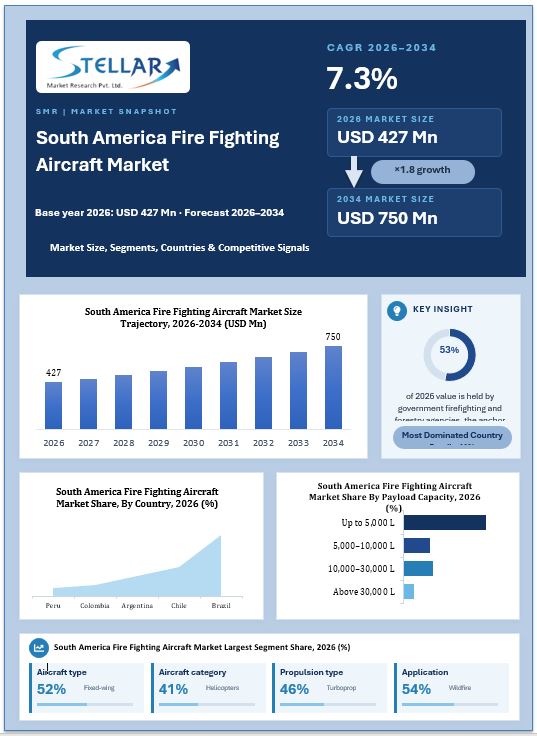
South America Fire Fighting Aircraft Market was valued at USD 0.43 billion in 2026 and is projected to reach USD 0.75 billion by 2034, growing at a CAGR of 7.3% during 2027–2034
The South America Fire Fighting Aircraft Market was valued at USD 0.43 billion in 2026 and is projected to reach USD 0.75 billion by 2034, growing at a CAGR of 7.3% during 2027–2034, according to Stellar Market Research (SMR). South America is a smaller market whose demand is concentrated in Brazil, Chile, Argentina and Colombia. Governments rely on helicopters, single-engine air tankers and military transports, and private forestry companies co-fund fleets, while the Amazon and Pantanal create demand for remote-area detection and response. Fire fighting aircraft are fixed-wing aircraft, helicopters and unmanned aircraft built, converted or configured to drop water, foam or fire retardant, scoop water from lakes and the sea, and support fire detection and aerial supervision. The South America Fire Fighting Aircraft Market is shaped by Brazil, Chile, Argentina and Colombia, and this report tracks South American Firefighting Aircraft Market Size, South America Firefighting Aircraft Market Forecast and South America Firefighting Aircraft Market Growth across the South American Aerial Firefighting Market, the South America Wildfire Suppression Aircraft Market and the South American Firefighting Aircraft Industry. This South America Fire Fighting Aircraft Market overview and Fire Fighting Aircraft Market synopsis summarizes the Fire Fighting Aircraft Market size, Fire Fighting Aircraft revenue generated, Fire Fighting Aircraft growth prospects and Fire Fighting Aircraft Market outlook, based on SMR's Fire Fighting Aircraft Market research findings.
This South America Fire Fighting Aircraft Market analysis answers both sides of the search: what the Fire Fighting Aircraft Market size and forecast mean for aircraft manufacturers, conversion specialists, operators and investors, and what forestry agencies, civil protection services and defense ministries want to know, from how an air tanker differs from a water scooper to payload classes, certification, fleet availability and cost of ownership. Demand spans the South America Water Bomber Aircraft Market, the South America Air Tanker Market, the South America Firefighting Helicopter Market and the Brazil Firefighting Aircraft Market, which are supplied by South American Firefighting Aircraft Manufacturers and shaped by South America Firefighting Aircraft Demand from the South America Forest Fire Aircraft Market, the South American Aerial Fire Suppression Market and Amazon Rainforest Fire Suppression Aircraft needs. The Fire Fighting Aircraft Market insights also cover Firefighting Aircraft Demand, Fire Fighting Aircraft consumer behavior (how agencies and contractors buy, lease and contract aircraft), Fire Fighting Aircraft industry trends and Firefighting Aircraft Market Trends in South America.
To get more Insights: Request Free Sample Report
Government agencies anchor the South America market at about 53% of 2026 value, and firefighting helicopters are the largest platform at 41%, but Fire Fighting Aircraft Market growth is shifting toward amphibious water bombers, aircraft conversions, unmanned surveillance platforms and leased and contracted fleets as wildfire seasons lengthen and Firefighting Aircraft Fleet Modernization replaces ageing aircraft. South America Firefighting Aircraft Procurement, the South American Firefighting Aircraft Fleet and the South America Firefighting Aviation Market together define the South America Firefighting Aircraft Industry Outlook. The Fire Fighting Aircraft industry landscape is shaped by Fire Fighting Aircraft growth drivers, market dynamics, challenges and market opportunities that influence the Firefighting Aircraft Industry Outlook.
Stellar Market Research provides comprehensive analysis of the South America Fire Fighting Aircraft Market size, share, aircraft type, aircraft category, propulsion type, payload capacity, application, end user, ownership model, sales and service model and country segmentation, the competitive landscape, strategic scenarios and growth opportunities. The report helps manufacturers, conversion and modification specialists, aerial firefighting operators, lessors, engine and avionics suppliers and investors decide which segments, procurement programs and countries to prioritize through 2034. Fire Fighting Aircraft market segmentation, key players and market strategies, including Firefighting Aircraft Technology choices, support Fire Fighting Aircraft market entry decisions.
|
2026 | BASE YEAR |
2034 | FORECAST |
GROWTH RATE |
LARGEST MARKET |
|
USD 0.43 Bn |
USD 0.75 Bn |
7.3% |
Brazil |
South America Fire Fighting Aircraft Market Overview: Fire Fighting Aircraft Market Size, Share, Trends and Outlook to 2034
The market is measured at product-and-service level across fixed-wing air tankers, amphibious water bombers, firefighting helicopters, unmanned platforms and specialized mission aircraft supplied in South America to government forestry and firefighting agencies, military and defense organizations, private aerial firefighting contractors, leasing companies and industrial operators. Revenue covers new aircraft sales, used and refurbished aircraft, conversion and retrofitting, leasing and rental services and maintenance, repair and overhaul (MRO) services. Volume is estimated at about 40 aircraft deliveries (new-build, converted and refurbished units) in 2026, rising to about 60 units by 2034, implying a market-level value of roughly USD 11 million per delivered unit once leasing, conversion and MRO revenue are included; this is a market ratio, not an aircraft price. Firefighting chemicals, ground equipment and standalone fire-detection services are excluded. This Fire Fighting Aircraft Market summary also reflects economic factors, macroeconomic factors, technological advancements and regulatory influences that determine Fire Fighting Aircraft consumption across emerging markets.
Three shifts shape 2026–2034 in South America: demand is broadening from legacy air tankers and helicopters into amphibious scoopers, converted transports and unmanned surveillance aircraft; value is moving toward leased, contracted and government-owned multi-year fleets and toward conversion and MRO capacity; and the market is growing at 7.3% a year against a global rate of 7.0%. Four trends stand out through 2034: public-private fleet funding in Chile, Brazilian military airlift using the KC-390 and MAFFS II, regional aircraft sharing between neighbours, and satellite and drone detection for remote forest areas. These Fire Fighting Aircraft Market shifts and emerging trends highlight industry evolution, growth catalysts and competitive forces across the industry.
Key Findings: Eight Insights Shaping the South America Fire Fighting Aircraft Market
SMR's analysis of published market data, government procurement announcements, manufacturer statements and industry reports points to eight findings that explain where South America Fire Fighting Aircraft Market growth and value are created through 2034. This Fire Fighting Aircraft Market trends analysis also identifies growth catalysts, the Fire Fighting Aircraft market gap and the competitive landscape shifts affecting key players.
|
Sr.No. |
Findings |
Evidence |
So what |
|
1 |
The market grows about 1.8× by 2034 |
USD 0.43 Bn (2026) to USD 0.75 Bn (2034) at 7.3% CAGR; about 40 to 60 unit deliveries |
Supply chains, conversion slots and MRO capacity must scale with demand |
|
2 |
Government agencies are the anchor buyer |
Government firefighting agencies 53% of 2026 value; military and defense 24%; private contractors 12% |
Budgets and multi-year contracts set the pace of demand |
|
3 |
Brazil is the largest sub-market in South America |
41% of 2026 value; fastest sub-market Argentina at 7.6% CAGR |
Country plans and budgets decide where aircraft are based |
|
4 |
Firefighting Helicopters are the largest category |
41% of 2026 value; amphibious aircraft 8.7% CAGR and very large tankers 5.5% CAGR |
Platform choice follows terrain, water access and payload needs |
|
5 |
Leased and contracted fleets matter |
Leased and contracted fleets 30% of 2026 value; government-owned 58%; 8.3% CAGR for leased fleets |
Availability contracts reduce capital burden for agencies |
|
6 |
Conversion and retrofit add capacity |
Conversion and retrofit 10% of 2026 value at 8.7% CAGR; MRO 14% |
Conversion and MRO capacity is a lever for suppliers |
|
7 |
Unmanned and surveillance platforms outgrow |
UAS 15.7% CAGR and surveillance applications 11.9% CAGR versus 7.3% for the market |
Detection and mission-management data become differentiators |
|
8 |
Delivery slots and certification gate supply |
Medium-capacity aircraft grow at 8.5% CAGR as buyers upgrade fleets |
Early orders and certified platforms win multi-year programs |
South America Fire Fighting Aircraft Market Dynamics: Growth Drivers, Restraints, Opportunities and Trends
South America Fire Fighting Aircraft Market Growth Drivers: Wildfire Severity, Government Funding, Fleet Modernization and Multi-Mission Capability
Large and seasonal fire events drive demand. Brazil burned 12.7 million hectares in 2025, 58% less than in 2024, while Amazonas recorded 1,380 fire foci in just 1 to 10 October 2026. Chile's 2025-26 national fleet comprised 77 aircraft run by CONAF, including a 737 FireLiner and a C-130, with funding of more than USD 167 million, and on 28 October 2026 Chile announced a 2026-27 plan of 133 aircraft (77 CONAF and 56 private) backed by more than CLP 160 billion of public funds and USD 130 million from forestry firms. Government agencies hold about 53% of 2026 value and military and defense organizations 24%. These Fire Fighting Aircraft market drivers and market growth factors show how Fire Fighting Aircraft demand and supply are shaped by economic factors and macroeconomic factors such as public budgets and defense spending, and by consumer behavior trends in how agencies, civil protection services and contractors procure aircraft.
Military airlift is expanding the toolkit. The Brazilian Air Force used a KC-390 in the Pantanal in June 2024 and bought a second MAFFS II unit in December 2024, and Embraer has completed C-390 MAFFS II flight tests. Cross-border help is also growing: Chile sent an AT-802 and an AS350 B3 to Argentina in January 2026. Leased and contracted fleets hold 30% of value as countries buy seasonal availability. Technological advancements in avionics, precision-drop systems and thermal imaging, together with innovation in the industry such as autonomous and electric-powered platforms, are accelerating Firefighting Aircraft Fleet Modernization and Firefighting Aircraft Technology adoption, with market adaptability and industry resilience improving as operators diversify fleets.
South America Fire Fighting Aircraft Market Restraints: Acquisition Cost, Supply-Chain Delays, Certification and Seasonal Utilization
Constraints include tight public budgets, currency volatility, seasonal use, remote and poorly mapped terrain, limited airtanker bases and a shortage of trained pilots and technicians. Fire events vary sharply from year to year (Brazil's burned area fell 58% in 2025), so procurement is often reactive, and import dependence and long delivery times limit rapid fleet growth. Market fluctuation analysis shows how industry fluctuations in fuel, insurance and crew costs, together with market volatility in contracting and exclusive-use awards, affect operators' willingness to commit to new fleets. These market constraints and market challenges also limit market responsiveness when a severe season arrives early.
Regulation, safety and trade policy add further friction. Aircraft must hold type, production and special-mission approvals, and modified or converted aircraft need supplemental certification before they can be contracted. Regulatory influences and regulatory changes, including aviation safety rules, retardant environmental limits and export controls on military-derived aircraft, extend timelines. Environmental factors such as drought and smoke, external market influences such as currency swings and defense budgets, and industry disruptors such as pilot and technician shortages remain key market constraints.
What Are the Biggest South America Fire Fighting Aircraft Market Opportunities Through 2034?
Opportunities lie in helicopters, single-engine air tankers, leased and contracted fleets, military roll-on/roll-off kits such as MAFFS II on the KC-390, and Chile's public-private funding model. Unmanned aircraft are growing at 15.7% CAGR and surveillance applications at 11.9%, and aerial detection across the Amazon and Pantanal offers niche demand. Leased and contracted fleets are projected to grow at 8.3% CAGR and public-private partnership fleets at 8.8%. These market opportunities and growth catalysts, along with a persistent market gap in large and night-capable capacity, strengthen long-term Firefighting Aircraft Demand.
Emerging niches and new platforms offer further routes to growth. Amphibious aircraft are projected to grow at 8.7% CAGR, medium-capacity aircraft at 8.5%, conversion and retrofit work at 8.7% and electric and hybrid-electric propulsion at 18.6% from a very small base, while MRO, avionics upgrades and aerial-intelligence services provide recurring revenue. Fire Fighting Aircraft emerging markets, market entry options and unexplored market niches offer regionally driven opportunities and help producers refine market strategies and strengthen socioeconomic resilience to wildfire.
Firefighting Aircraft Market Trends in South America: Fleet Modernization, Conversion, Roll-On/Roll-Off Kits and Unmanned Surveillance
Four trends stand out through 2034: public-private fleet funding in Chile, Brazilian military airlift using the KC-390 and MAFFS II, regional aircraft sharing between neighbours, and satellite and drone detection for remote forest areas. Together these market trends analysis points, technology trends and innovation impact reflect industry evolution, market forces and strategic market changes across the market dynamics, while competitive forces and competitive landscape shifts redistribute share among manufacturers and operators. Emerging trends and market shifts, including market segmentation shifts toward leased and amphibious fleets, reflect consumer preferences evolution and customer engagement dynamics among agencies, while socioeconomic influences and economic indicators such as public budgets and demand and supply dynamics set the pace of fleet spending.
South America Fire Fighting Aircraft Market Segmentation: By Aircraft Type, Aircraft Category, Propulsion Type, Payload Capacity, Application, End User, Ownership Model and Sales and Service Model
Fire Fighting Aircraft Market by End User and Sales and Service Model: Government Agencies, Military, Private Contractors and Leasing
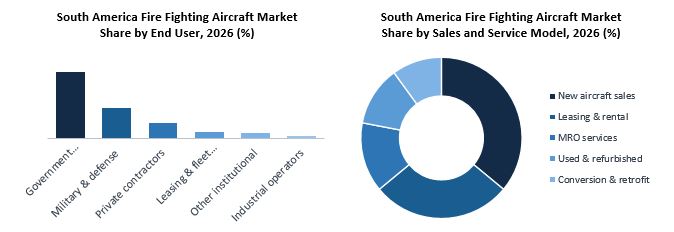
By end user, government firefighting agencies hold about 53% of 2026 value, private aerial firefighting contractors 12%, military and defense organizations 24%, commercial leasing and fleet operators 5%, industrial and infrastructure operators 2% and other institutional users 4%. By sales and service model, new aircraft sales account for about 36%, leasing and rental services 28%, MRO services 14%, aircraft conversion and retrofitting 10% and used and refurbished aircraft 12%. This market segment analysis and industry segmentation supports target market analysis and customer profiling, including behavioral segmentation of how buyers split spending between ownership and contracted availability. Geographic segmentation by country and fire regime further refines the picture.
Aircraft Type, Category, Propulsion, Payload and Ownership Analysis of the Fire Fighting Aircraft Market
Fixed-wing aircraft hold about 52% of 2026 value, rotary-wing aircraft 41% and unmanned aircraft systems 7%; UAS is the fastest at 15.7% CAGR. By category, firefighting helicopters hold 41%, amphibious water-bombing aircraft 4%, single-engine air tankers 24%, land-based air tankers 14%, multi-engine air tankers 6% and very large air tankers 4%. By propulsion, turboprop engines hold 46%, turboshaft 32%, turbofan 11%, piston 7%, turbojet 2% and electric and hybrid-electric 2%. By payload, small-capacity aircraft up to 5,000 litres hold 55%, medium capacity 18%, large capacity 20% and very large capacity above 30,000 litres 7%. By ownership, government-owned fleets hold 58%, leased and contracted fleets 30%, privately owned fleets 9% and public-private partnership fleets 3%. This product segmentation, market share by segment and segment growth analysis, covering market subsegments, segment attractiveness and the competitive segment landscape, highlights emerging market segments, specialized market segments and segment-specific trends.
Fire Fighting Aircraft Applications: Wildfire Suppression, Grassland Fires, Urban-Wildland Interface, Industrial Support and Aerial Surveillance
Wildfire and forest fire suppression is the largest application at about 54% of 2026 value, followed by urban-wildland interface suppression at 7%, grassland and vegetation fires at 14%, aerial fire surveillance and reconnaissance at 9%, emergency response and firefighter transportation at 8%, industrial and infrastructure firefighting support at 4% and other applications at 4%. Surveillance is the fastest application at 11.9% CAGR. Segment-based marketing and segmentation strategies increasingly rely on demographic profiling of agencies by fire regime, consumer demographics of the communities protected, and micro-segmentation by terrain and water access, while niche markets such as night operations, remote-area support and industrial site protection point to unexplored market niches and untapped market areas. Tailored marketing strategies and customized market strategies, supported by granular market breakdown, market fragment analysis, unique market sectors, segment-specific opportunities, market niche exploration, customer behavior segmentation, market segment dynamics and comprehensive market sector analysis, help suppliers prioritize the right platforms.
South America Fire Fighting Aircraft Market Regional Analysis: Brazil, Chile, Argentina, Colombia, Peru and Other Markets
Brazil is the largest sub-market at 41% of 2026 value, followed by Chile at 20%, Argentina at 14%, Colombia at 8% and Peru at 6%. Brazil grows at 7.3% CAGR, Argentina is the fastest of the named markets at 7.6%, and Chile grows at 6.8% from a base already supported by its funded fleet. This geographic analysis highlights regional market trends, area-specific market dynamics, market performance by region, regional market segmentation and local market influences, with geographic segmentation of how each country buys. Regional economic factors, local consumer behavior and regional market challenges all shape the mix of aircraft that agencies buy. Geographical trends point to faster growth where fleets are youngest and budgets are rising.
Demand follows fire regimes: central Chile and Patagonia have Mediterranean-style summer fires, Brazil's Amazon, Cerrado and Pantanal have dry-season fires, and Argentina and Colombia have mixed regimes. Fleets are national and often shared across borders. Area-specific opportunities, regional market development, local market entry strategies and regional market entry strategies shape regional Fire Fighting Aircraft demand and supply. Market growth by location, economic impact by region, territorial dynamics, locational market nuances, area-centric market shifts, geographic market intricacies, regional consumer patterns, local economic factors, regional market performance, territorial competitive landscape, demographic trends by region, localized market challenges, regionally-driven opportunities, locational market share, geo-strategic influences, area-centric growth factors, regional industry outlook, market trends in specific regions, market trends in designated areas, regional market share, the regional competitive landscape, region-specific industry outlook and geopolitical influences, including sanctions and defense cooperation, all affect where aircraft are sold and based.
South America Fire Fighting Aircraft Companies and Competitive Landscape: Who Are the Top Firefighting Aircraft Manufacturers and Operators?
The competitive landscape combines Embraer, Air Tractor, Bell, Airbus, Sikorsky and Lockheed Martin as suppliers with national air forces, forestry agencies such as CONAF and private contractors as operators. Competitors should not be ranked as though they were identical producers. This competitor analysis draws on competitive intelligence, competitor profiling, competitive positioning and competitor benchmarking of key players, including company revenue and company net sales, and on industry rivals examination and competitor evaluation.
Competition turns on price, delivery time, local support and financing. Chile's USD 130 million private co-funding, Brazil's KC-390 MAFFS II capability and the AT-802 and helicopter fleets used by CONAF show how a few buyers shape rival market share. Market rivalry assessment, market rivalry intensity and rivalry impact analysis suggest that competitive landscape trends will favor firms that combine aircraft supply with conversion, MRO and operations. Competitive strategy review, competitive advantage assessment, competitor differentiation, market player strategies, industry competition overview, rival market share, competitive market evolution and competitive benchmark analysis point to partnerships and consolidation, while industry player dynamics, market rival scrutiny, industry adversary exploration, competitive ecosystem analysis, rivalry landscape intricacies, competitive matrix investigation, business opponent profiling, sectorial rivalry dynamics, competitive maneuver examination, competing force scrutiny, rivalry intensity mapping, opponent landscape divergence, industry opposition tactics and strategic analysis show where positions are contested.
South America Fire Fighting Aircraft Market Recent Developments, Procurement Milestones and Industry News | 2024–2026
|
Date |
Development |
Why it matters |
|
Jun 2024 |
Brazilian Air Force uses a KC-390 for firefighting in the Pantanal |
Demonstrates military airlift in the region |
|
Dec 2024 |
Brazil buys a second MAFFS II unit |
Expands Brazil's roll-on/roll-off firefighting capacity |
|
2025 |
Brazil records 12.7 million hectares burned, 58% less than 2024 |
Shows year-to-year volatility in demand |
|
Jan 2026 |
Chile sends an AT-802 and an AS350 B3 to Argentina |
Shows cross-border aircraft sharing |
|
Oct 2026 |
Amazonas records 1,380 fire foci in 1-10 October |
Highlights Amazon detection and response needs |
|
Oct 2026 |
Chile announces a 133-aircraft 2026-27 plan with more than CLP 160 billion in public funds and USD 130 million from forestry firms (28 October) |
Largest public-private fleet plan in the region |
South America Fire Fighting Aircraft Market Scope
|
South America Fire Fighting Aircraft Market |
|||
|
Report Coverage |
Details |
||
|
Base Year: |
2026 |
Forecast Period: |
2027-2034 |
|
Historical Data: |
2021 to 2026 |
Market Size in 2026: |
USD 0.43 billion |
|
Forecast Period 2027 to 2034 CAGR: |
7.3% |
Market Size in 2034: |
USD 0.75 billion |
|
Segments Covered: |
By Aircraft Type |
Fixed-Wing Aircraft; Rotary-Wing Aircraft; Unmanned Aircraft Systems (UAS) |
|
|
By Aircraft Category |
Amphibious Water-Bombing Aircraft; Land-Based Air Tankers; Single-Engine Air Tankers (SEATs); Multi-Engine Air Tankers; Very Large Air Tankers (VLATs); Firefighting Helicopters; Other Specialized Firefighting Aircraft |
||
|
By Propulsion Type |
Turboprop Engine; Turbojet Engine; Turbofan Engine; Piston Engine; Turboshaft Engine; Electric and Hybrid-Electric Propulsion |
||
|
By Payload Capacity |
Small Capacity (Up to 5,000 Litres); Medium Capacity (Above 5,000 to 10,000 Litres); Large Capacity (Above 10,000 to 30,000 Litres); Very Large Capacity (Above 30,000 Litres) |
||
|
By Application |
Wildfire and Forest Fire Suppression; Grassland and Vegetation Fire Suppression; Urban-Wildland Interface Fire Suppression; Industrial and Infrastructure Firefighting Support; Aerial Fire Surveillance and Reconnaissance; Emergency Response and Firefighter Transportation; Other Specialized Applications |
||
|
By End User |
Government Firefighting and Forestry Agencies; Military and Defense Organizations; Private Aerial Firefighting Contractors; Commercial Aircraft Leasing and Fleet Operators; Industrial and Infrastructure Operators; Other Institutional End Users |
||
|
By Ownership Model |
Government-Owned Aircraft Fleets; Privately Owned Aircraft Fleets; Public-Private Partnership Aircraft Fleets; Leased and Contracted Aircraft Fleets |
||
|
By Sales and Service Model |
New Aircraft Sales; Used and Refurbished Aircraft Sales; Aircraft Conversion and Retrofitting; Aircraft Leasing and Rental Services; Maintenance, Repair and Overhaul Services |
||
South America Fire Fighting Aircraft Market, By Country
- Brazil
- Chile
- Argentina
- Colombia
- Peru
Rest of South America
South America Fire Fighting Aircraft Market, Key Players
- Air Tractor, Inc.
- Embraer S.A.
- Airbus SE
- Leonardo S.p.A.
- Lockheed Martin Corporation
- Textron Aviation Inc.
- Bell Textron Inc.
- De Havilland Aircraft of Canada Limited
- Bombardier Inc.
- Conair Group Inc.
South America Fire Fighting Aircraft Market Research Methodology
SMR sized the South America market from the global 2026 base of USD 8.54 billion, which was split into regions, and applied a 7.3% CAGR for 2027–2034 to the USD 0.43 billion 2026 regional value. Estimates were triangulated against published market reports, government procurement and budget announcements, manufacturer and operator statements, and industry announcements through November 2026, including CONAF, the Brazilian Air Force, Embraer, national forestry and civil protection agencies. Segment shares and country splits are SMR estimates anchored to the structure of government, military and contractor demand in South America and are normalized so every segment sums to the regional total. Volume of about 40 units in 2026 is an SMR estimate at a market-level value of about USD 11 million per unit including leasing, conversion and MRO revenue. Historical values for 2021–2025 are SMR back-cast estimates and annual forecast values are constant-CAGR interpolation. Segment CAGRs are effective rates after normalization.
Frequently Asked Questions
Brazil is the largest at about 41% of 2026 value, while Argentina is the fastest-growing at 7.6% CAGR.
Unmanned aircraft (15.7% CAGR), aerial surveillance (11.9%), conversion and retrofit (8.7%) and medium-capacity aircraft (8.5%) grow faster than the 7.3% market average; helicopters (41%) and wildfire suppression (54%) are the largest segments.
Chile's 2026-27 plan covers 133 aircraft (77 from CONAF and 56 private), backed by more than CLP 160 billion of public funds plus USD 130 million from forestry companies. This public-private model is spreading demand for helicopters and single-engine air tankers.
Brazil is the largest sub-market at about 41% of 2026 value. The Brazilian Air Force flew a KC-390 in the Pantanal in 2024, bought a second MAFFS II unit and Embraer has completed C-390 MAFFS II flight tests, adding roll-on/roll-off capability.
Table Of Content – South America Fire Fighting Aircraft Market
1. Executive Market Landscape and Industry Overview
1.1. South America Fire Fighting Aircraft Market Size (Value USD Billion and Volume in Metric Tons (MT)), 2026–2034
1.2. Evolution of Aerial Firefighting and Specialized Firefighting Aircraft
1.3. Definition, Scope and Classification of Fire Fighting Aircraft
1.4. Aircraft Design, Structural Configuration and Firefighting Capabilities
1.5. Role of Fire Fighting Aircraft in Wildfire and Forest Fire Suppression
1.6. South America Demand for Fire Fighting Aircraft Across Government and Commercial Operators
1.7. CAGR Analysis of the South America Fire Fighting Aircraft Market During 2027–2034
2. Fire Fighting Aircraft Market Dynamics
2.1. Fire Fighting Aircraft Market Trends
2.2. Fire Fighting Aircraft Market Dynamics
2.2.1. Drivers
2.2.2. Restraints
2.2.3. Opportunities
2.2.4. Challenges
2.3. PORTER's Five Forces Analysis
2.4. PESTLE Analysis
3. Fire Fighting Aircraft Market Macroeconomic Factors
3.1. South America Wildfire Incidence and Forest Fire Occurrence Trends
3.2. Government Expenditure on Wildfire Prevention and Emergency Response
3.3. Climate Change, Drought Conditions and Rising Temperature Patterns
3.4. South America Aerospace and Defense Industry Production and Investment Trends
3.5. Aircraft Manufacturing Costs, Aviation Fuel Prices and Operating Economics
3.6. Government Procurement Policies, Import Duties and International Aircraft Trade
3.7. Foreign Exchange Movements and South America Aerospace Supply Chain Developments
4. Fire Fighting Aircraft Industry Trends & Emerging Technology Requirements
4.1. Increasing Adoption of Specialized Aerial Firefighting Aircraft
4.2. Growing Demand for Amphibious Water-Bombing Aircraft
4.3. Modernization of Ageing Firefighting Aircraft Fleets
4.4. Increasing Deployment of Large and Very Large Air Tankers
4.5. Growing Adoption of Multi-Mission Aircraft for Emergency Response
4.6. Integration of Advanced Avionics, Navigation and Precision Dropping Systems
4.7. Increasing Adoption of Unmanned Aircraft Systems for Wildfire Monitoring
5. Fire Fighting Aircraft Technology Architecture & Ecosystem Landscape
5.1. Aircraft Airframe Design and Structural Engineering Requirements
5.2. Fire Retardant Tank, Water Storage and Suppressant Delivery Systems
5.3. Water Scooping, Loading and Aerial Release Mechanisms
5.4. Amphibious Landing and Water-Refilling Technologies
5.5. Aircraft Propulsion, Engine and Power Management Systems
5.6. Flight Control, Navigation and Mission Management Technologies
5.7. Fire Detection, Thermal Imaging and Satellite-Based Monitoring Integration
6. Fire Fighting Aircraft Types, Structural Configuration & Design Landscape
6.1. Fixed-Wing Fire Fighting Aircraft
6.2. Rotary-Wing Fire Fighting Aircraft
6.3. Unmanned Firefighting Aircraft and Aerial Platforms
6.4. Amphibious Aircraft Configurations
6.5. Land-Based Firefighting Aircraft Configurations
6.6. Aircraft Conversion and Multi-Role Firefighting Configurations
6.7. Specialized Firefighting Aircraft Design and Mission Configuration Requirements
7. Fire Fighting Aircraft Propulsion, Engine & Performance Characteristics
7.1. Turboprop-Powered Fire Fighting Aircraft
7.2. Turbojet and Turbofan-Powered Fire Fighting Aircraft
7.3. Piston-Engine Fire Fighting Aircraft
7.4. Turboshaft-Powered Firefighting Helicopters
7.5. Aircraft Engine Performance and Power-to-Weight Requirements
7.6. Flight Endurance, Operating Range and Mission Performance
7.7. Fuel Efficiency, Engine Reliability and Maintenance Requirements
8. Fire Fighting Aircraft Payload Capacity, Tank Systems & Suppression Equipment
8.1. Aircraft Water and Fire Retardant Storage Systems
8.2. Small Payload Capacity (Up to 5,000 Litres)
8.3. Medium Payload Capacity (Above 5,000 to 10,000 Litres)
8.4. Large Payload Capacity (Above 10,000 to 30,000 Litres)
8.5. Very Large Payload Capacity (Above 30,000 Litres)
8.6. Aerial Fire Suppressant Release and Precision Dropping Systems
8.7. Water Scooping, Helicopter Buckets and External Tank Systems
Note: Capacity categories refer to nominal liquid suppressant payload capacity, not aircraft maximum take-off weight. Actual capacities vary by aircraft configuration.
9. Fire Fighting Aircraft Manufacturing Processes & Production Technologies
9.1. Aircraft Design, Engineering and Prototype Development
9.2. Airframe Manufacturing and Structural Assembly
9.3. Aircraft Engine Integration and Propulsion System Installation
9.4. Water Tank and Fire Retardant Delivery System Manufacturing
9.5. Avionics, Navigation and Mission Control System Integration
9.6. Aircraft Testing, Flight Validation and Certification
9.7. Final Assembly, Quality Inspection and Aircraft Delivery
10. Fire Fighting Aircraft Components, Systems & Equipment Ecosystem
10.1. Aircraft Fuselage, Wings and Structural Components
10.2. Aircraft Engines, Propellers and Propulsion Components
10.3. Water Tanks, Retardant Tanks and Storage Assemblies
10.4. Pumps, Valves, Doors and Suppressant Release Mechanisms
10.5. Avionics, Flight Control and Navigation Systems
10.6. Communication, Surveillance and Thermal Imaging Systems
10.7. Landing Gear, Amphibious Floats and Water-Scooping Equipment
11. Fire Fighting Aircraft Maintenance, Repair, Overhaul & Fleet Modernization
11.1. Aircraft Maintenance, Repair and Overhaul (MRO) Services
11.2. Airframe Inspection and Structural Maintenance
11.3. Engine Overhaul and Propulsion System Maintenance
11.4. Water Tank and Fire Retardant Delivery System Maintenance
11.5. Avionics Upgrades and Mission System Modernization
11.6. Aircraft Refurbishment and Civilian-to-Firefighting Conversion
11.7. Fleet Availability, Maintenance Costs and Aircraft Lifecycle Management
12. Fire Fighting Aircraft Testing, Certification & Technical Evaluation
12.1. Aircraft Airworthiness and Flight Performance Testing
12.2. Aircraft Payload and Suppressant Delivery Testing
12.3. Water Scooping and Aerial Release Performance Evaluation
12.4. Engine Performance and Endurance Testing
12.5. Structural Integrity and Environmental Testing
12.6. Avionics, Navigation and Communication System Validation
12.7. Aircraft Safety, Reliability and Mission Readiness Assessment
13. Fire Fighting Aircraft Applications in Wildfire & Forest Fire Management
13.1. Aerial Suppression of Forest Fires
13.2. Wildfire Containment and Fireline Protection
13.3. Grassland and Vegetation Fire Suppression
13.4. Mountainous and Remote-Area Firefighting Operations
13.5. Urban-Wildland Interface Fire Suppression
13.6. Large-Scale Regional and Cross-Border Wildfire Response
13.7. Emergency Firefighting Support and Disaster Management
14. Fire Fighting Aircraft Applications in Industrial & Infrastructure Fire Protection
14.1. Industrial Facility and Manufacturing Plant Fire Response
14.2. Oil and Gas Facility Fire Suppression Support
14.3. Power Generation and Energy Infrastructure Fire Response
14.4. Transportation Infrastructure and Remote Industrial Site Protection
14.5. Chemical and Petrochemical Facility Emergency Response
14.6. Mining and Large-Scale Industrial Site Fire Management
14.7. Specialized Infrastructure Firefighting Support Operations
15. Fire Fighting Aircraft Applications in Aerial Surveillance & Emergency Response
15.1. Wildfire Detection and Aerial Reconnaissance
15.2. Thermal Imaging and Fire Perimeter Monitoring
15.3. Fire Behaviour Assessment and Incident Mapping
15.4. Firefighter and Emergency Response Personnel Transportation
15.5. Emergency Equipment and Firefighting Supply Transportation
15.6. Post-Fire Assessment and Disaster Impact Monitoring
15.7. Real-Time Aerial Intelligence and Emergency Coordination
16. Fire Fighting Aircraft Procurement, Leasing & Fleet Acquisition Ecosystem
16.1. Government Procurement of Fire Fighting Aircraft
16.2. Direct Aircraft Purchases from Original Equipment Manufacturers
16.3. Aircraft Leasing and Long-Term Fleet Rental Models
16.4. Aircraft Conversion and Refurbishment Procurement
16.5. Public-Private Partnerships and Government Fleet Contracts
16.6. Multi-Year Aircraft Acquisition and Replacement Programs
16.7. Procurement Evaluation, Tendering and Aircraft Delivery Timelines
17. Fire Fighting Aircraft Production, Manufacturing Capacity & Industrial Infrastructure
17.1. South America Fire Fighting Aircraft Manufacturing Facilities
17.2. Fixed-Wing Firefighting Aircraft Production Infrastructure
17.3. Rotary-Wing Aircraft Manufacturing and Assembly Facilities
17.4. Amphibious Aircraft Manufacturing and Assembly Capabilities
17.5. Aircraft Conversion and Modification Facilities
17.6. Production Capacity Expansion and Manufacturing Investments
17.7. Manufacturing Infrastructure, Workforce and Production Efficiency Benchmarking
18. Fire Fighting Aircraft Pricing, Business Models & Cost Economics
18.1. Fire Fighting Aircraft Pricing Across Different Aircraft Categories
18.2. New Aircraft Procurement and Acquisition Costs
18.3. Aircraft Conversion and Retrofitting Cost Structure
18.4. Aircraft Leasing and Rental Pricing Models
18.5. Aircraft Maintenance, Repair and Overhaul Cost Economics
18.6. Fuel, Insurance, Crew and Operational Expenditure
18.7. Total Cost of Ownership and Aircraft Lifecycle Economics
19. Fire Fighting Aircraft Distribution, Sales & Procurement Landscape
19.1. Direct Sales Through Aircraft Original Equipment Manufacturers
19.2. Government-to-Government Aircraft Procurement
19.3. Authorized Aircraft Dealers and Regional Representatives
19.4. Specialized Aerospace and Defense Procurement Contractors
19.5. Aircraft Leasing Companies and Fleet Financing Providers
19.6. Aircraft Conversion and Modification Service Providers
19.7. After-Sales Support, Spare Parts and Technical Service Networks
20. Fire Fighting Aircraft Supply Chain & Operational Ecosystem
20.1. Aircraft Raw Material and Aerospace Component Sourcing
20.2. Aircraft Engine and Propulsion System Supplier Networks
20.3. Avionics, Navigation and Mission System Supply Chains
20.4. Water Tank and Fire Suppression Equipment Suppliers
20.5. Aircraft Assembly, Integration and Modification Networks
20.6. International Aircraft Transportation and Delivery Logistics
20.7. Supply Chain Resilience, Supplier Qualification and Operational Risk Management
21. Fire Fighting Aircraft Technology Innovation, R&D & Product Development
21.1. Development of Next-Generation Fire Fighting Aircraft
21.2. Advanced Amphibious Aircraft and Water-Scooping Technologies
21.3. High-Capacity Water and Fire Retardant Delivery Systems
21.4. AI-Based Flight Management and Precision Fire Suppression
21.5. Autonomous and Unmanned Firefighting Aircraft Development
21.6. Satellite Connectivity, Thermal Imaging and Real-Time Fire Mapping
21.7. Research Investments, Intellectual Property and Aerospace Collaborations
22. Fire Fighting Aircraft Market Adoption, Fleet Utilization & Customer Economics
22.1. South America Fire Fighting Aircraft Fleet Deployment Trends
22.2. Government and Commercial Fleet Acquisition Patterns
22.3. Aircraft Utilization Rates and Annual Flight Hours
22.4. Seasonal Demand and Aircraft Deployment Cycles
22.5. Aircraft Replacement Demand and Fleet Modernization Requirements
22.6. Customer Procurement Preferences and Long-Term Fleet Contracts
22.7. Aircraft Availability, Operational Efficiency and Customer Satisfaction
23. Fire Fighting Aircraft Market Regulatory, Safety & Technical Standards
23.1. International Civil Aviation Organization (ICAO) Aviation Safety Framework
23.2. National Aviation Authority Requirements (Brazil, Chile, Argentina, Colombia)
23.3. FAA and EASA Type Certificate Validation for Imported Aircraft
23.4. Aircraft Airworthiness and Special Mission Certification
23.5. Aircraft Modification and Supplemental Type Certification Requirements
23.6. Aerial Firefighting Operational Safety and Flight Crew Standards
23.7. Fire Retardant Handling, Environmental Compliance and Aviation Regulations
24. Fire Fighting Aircraft Regional & Country-Level Market Landscape
24.1. Brazilian Air Force and Federal Fire Management Aircraft Deployment
24.2. Chilean Public-Private Aerial Firefighting Fleet (CONAF and Forestry Companies)
24.3. Amazon, Cerrado and Pantanal Fire Response and Remote-Area Detection
24.4. Argentina, Colombia and Peru: Procurement and Cross-Border Aircraft Sharing
24.5. Country-Level Market Assessment: Brazil, Chile, Argentina, Colombia, Peru and Rest of South America
24.6. Regional Aircraft Fleet Availability, Import Trends, Procurement Investments and Operational Capacity
Special regional focus: Brazil, Chile, Argentina, Colombia, Peru and other South American countries will receive dedicated country-level analysis, including aircraft fleet, procurement, demand drivers, operational deployment and future investment opportunities.
25. Fire Fighting Aircraft Market: Market Size and Forecast by Segmentation (Value USD Billion and Volume in Metric Tons (MT)) (2026–2034)
25.1. Fire Fighting Aircraft Market Size and Forecast, By Aircraft Type
25.1.1. Fixed-Wing Aircraft
25.1.2. Rotary-Wing Aircraft
25.1.3. Unmanned Aircraft Systems (UAS)
25.2. Fire Fighting Aircraft Market Size and Forecast, By Aircraft Category
25.2.1. Amphibious Water-Bombing Aircraft
25.2.2. Land-Based Air Tankers
25.2.3. Single-Engine Air Tankers (SEATs)
25.2.4. Multi-Engine Air Tankers
25.2.5. Very Large Air Tankers (VLATs)
25.2.6. Firefighting Helicopters
25.2.7. Other Specialized Firefighting Aircraft
25.3. Fire Fighting Aircraft Market Size and Forecast, By Propulsion Type
25.3.1. Turboprop Engine
25.3.2. Turbojet Engine
25.3.3. Turbofan Engine
25.3.4. Piston Engine
25.3.5. Turboshaft Engine
25.3.6. Electric and Hybrid-Electric Propulsion
25.4. Fire Fighting Aircraft Market Size and Forecast, By Payload Capacity
25.4.1. Small Capacity (Up to 5,000 Litres)
25.4.2. Medium Capacity (Above 5,000 to 10,000 Litres)
25.4.3. Large Capacity (Above 10,000 to 30,000 Litres)
25.4.4. Very Large Capacity (Above 30,000 Litres)
25.5. Fire Fighting Aircraft Market Size and Forecast, By Application
25.5.1. Wildfire and Forest Fire Suppression
25.5.2. Grassland and Vegetation Fire Suppression
25.5.3. Urban-Wildland Interface Fire Suppression
25.5.4. Industrial and Infrastructure Firefighting Support
25.5.5. Aerial Fire Surveillance and Reconnaissance
25.5.6. Emergency Response and Firefighter Transportation
25.5.7. Other Specialized Applications
25.6. Fire Fighting Aircraft Market Size and Forecast, By End User
25.6.1. Government Firefighting and Forestry Agencies
25.6.2. Military and Defense Organizations
25.6.3. Private Aerial Firefighting Contractors
25.6.4. Commercial Aircraft Leasing and Fleet Operators
25.6.5. Industrial and Infrastructure Operators
25.6.6. Other Institutional End Users
25.7. Fire Fighting Aircraft Market Size and Forecast, By Ownership Model
25.7.1. Government-Owned Aircraft Fleets
25.7.2. Privately Owned Aircraft Fleets
25.7.3. Public-Private Partnership Aircraft Fleets
25.7.4. Leased and Contracted Aircraft Fleets
25.8. Fire Fighting Aircraft Market Size and Forecast, By Sales and Service Model
25.8.1. New Aircraft Sales
25.8.2. Used and Refurbished Aircraft Sales
25.8.3. Aircraft Conversion and Retrofitting
25.8.4. Aircraft Leasing and Rental Services
25.8.5. Maintenance, Repair and Overhaul Services
25.9. Fire Fighting Aircraft Market Size and Forecast, By Country
25.9.1. Brazil
25.9.2. Chile
25.9.3. Argentina
25.9.4. Colombia
25.9.5. Peru
25.9.6. Rest of South America
26. Fire Fighting Aircraft Market Competitive Landscape
26.1. SMR Competition Matrix
26.2. Competitive Positioning of Leading Key Players
26.3. Key Players Benchmarking
26.3.1. Company Name
26.3.2. Headquarters
26.3.3. Fire Fighting Aircraft Product Portfolio
26.3.4. Aircraft Models and Technical Specifications
26.3.5. Aircraft Manufacturing and Assembly Capabilities
26.3.6. Aircraft Production and Delivery Capabilities
26.3.7. Aircraft Payload and Fire Suppression Capabilities
26.3.8. Total Company Revenue (2026)
26.3.9. Firefighting-Related Revenue (2026), Where Available
26.3.10. Geographic Presence
26.3.11. Government and Commercial Customer Base
26.3.12. Strategic Partnerships and Aerospace Collaborations
26.4. Market Structure
26.4.1. Established Aircraft OEMs
26.4.2. Specialized Firefighting Aircraft Manufacturers
26.4.3. Aircraft Conversion and Modification Providers
26.4.4. Aerial Firefighting Service Operators
26.4.5. Emerging Aircraft and Technology Developers
26.5. Market Share Analysis of Leading Companies
26.6. Revenue Growth Rate / Y-o-Y (%) of Companies
26.7. Profit Margin (%) of Companies, Where Available
26.8. Aircraft Production and Delivery Benchmarking
26.9. Revenue vs. Net Earnings – Financial Health Benchmarking
26.10. Mergers, Acquisitions and Strategic Partnerships
26.11. Recent Key Developments
27. Fire Fighting Aircraft Manufacturers & Original Equipment Manufacturers Landscape
27.1. Fixed-Wing Firefighting Aircraft Manufacturers
27.2. Amphibious Firefighting Aircraft Manufacturers
27.3. Single-Engine Air Tanker Manufacturers
27.4. Military Transport and Large Air Tanker Platform Manufacturers
27.5. Firefighting Helicopter Manufacturers
27.6. Unmanned Firefighting Aircraft and Drone Manufacturers
27.7. Aircraft Manufacturing Capacity, Product Portfolio and Technical Capability Benchmarking
28. Fire Fighting Aircraft Conversion, Modification & Retrofitting Providers
28.1. Fixed-Wing Aircraft Conversion Companies
28.2. Large Air Tanker Conversion Specialists
28.3. Amphibious Aircraft Modification Providers
28.4. Fire Retardant Tank and Suppressant Delivery System Integrators
28.5. Aircraft Avionics and Mission System Modification Providers
28.6. Aircraft Refurbishment and Structural Upgrade Providers
28.7. Conversion Capacity, Certification and Technical Capability Benchmarking
29. Aerial Firefighting Aircraft Operations & Fleet Management Providers
29.1. Fixed-Wing Air Tanker Operators
29.2. Amphibious Water-Bomber Operators
29.3. Helicopter Firefighting Service Providers
29.4. Large and Very Large Air Tanker Operators
29.5. Government-Contracted Aerial Firefighting Operators
29.6. International Aerial Firefighting Fleet Management Companies
29.7. Fleet Size, Operational Coverage and Contract Capability Benchmarking
30. Fire Fighting Aircraft Components, Equipment & Technology Suppliers
30.1. Aircraft Engine and Propulsion System Suppliers
30.2. Aircraft Avionics and Navigation System Providers
30.3. Water Tank and Fire-Retardant Delivery System Suppliers
30.4. Helicopter Water Bucket and External Tank Manufacturers
30.5. Aircraft Hydraulic and Fluid Management System Providers
30.6. Thermal Imaging, Surveillance and Fire Detection Technology Providers
30.7. Aircraft Component Supply, Technical Performance and Supplier Capability Benchmarking
31. Fire Fighting Aircraft Maintenance, Repair & Technical Support Providers
31.1. Aircraft Maintenance and Repair Companies
31.2. Aircraft Engine Maintenance and Overhaul Providers
31.3. Aircraft Structural Inspection and Repair Specialists
31.4. Avionics and Flight Control System Maintenance Providers
31.5. Aircraft Spare Parts and Replacement Component Suppliers
31.6. Aircraft Lifecycle Support and Fleet Management Companies
31.7. MRO Infrastructure, Service Coverage and Technical Capability Benchmarking
32. Fire Fighting Aircraft Leasing, Financing & Aviation Support Providers
32.1. Aircraft Leasing and Rental Companies
32.2. Aerospace and Aviation Financing Institutions
32.3. Government Aircraft Procurement and Financing Contractors
32.4. Aircraft Insurance and Risk Management Providers
32.5. Aviation Training and Flight Crew Development Providers
32.6. Aircraft Logistics and Delivery Support Companies
32.7. Leasing Models, Financing Structures and Service Capability Benchmarking
33. Fire Fighting Aircraft Manufacturers' Strategies & Expansion Plans
33.1. Expansion of Specialized Firefighting Aircraft Manufacturing Capacity
33.2. Development of Next-Generation Amphibious Aircraft
33.3. Introduction of High-Capacity Water-Bombing Aircraft
33.4. Expansion of Aircraft Conversion and Retrofitting Capabilities
33.5. Development of Advanced Aircraft Mission Management Systems
33.6. Expansion of International Aircraft Sales and Service Networks
33.7. Partnerships with Government Agencies and Aerial Firefighting Operators
33.8. Mergers, Acquisitions and Strategic Aerospace Collaborations
34. Fire Fighting Aircraft Industry SWOT, Investments & Strategic Developments
34.1. Competitive Strengths of Established Aircraft Manufacturers
34.2. High Aircraft Acquisition Costs and Manufacturing Constraints
34.3. Growing Investment Opportunities in Wildfire Management
34.4. Ageing Aircraft Fleets and Aircraft Replacement Opportunities
34.5. Technological Challenges in Autonomous Firefighting Aircraft
34.6. Investments in Aircraft Manufacturing and Conversion Infrastructure
34.7. Investments in Advanced Avionics, Navigation and Fire Suppression Technologies
34.8. Major Aircraft Orders, Product Launches and Industry Developments
35. Fire Fighting Aircraft Competitive Outlook & Market Positioning
35.1. Competitive Dynamics Across Fixed-Wing and Rotary-Wing Aircraft
35.2. Market Concentration Across South America Firefighting Aircraft Manufacturers
35.3. Product Differentiation Through Payload Capacity and Operational Performance
35.4. Competitive Positioning of Aircraft OEMs and Conversion Specialists
35.5. Competitive Positioning of Aerial Firefighting Service Operators
35.6. Expansion of Firefighting Aircraft Fleets in Emerging Markets
35.7. Long-Term Competitive Positioning of Leading Industry Participants
36. Company Profile: Key Players
Detailed Profile Considering the Parameters
- Overview
- Establishment Year
- Headquarters
- Company Type
- Business Portfolio
- Fire Fighting Aircraft Product Portfolio
- Aircraft Models and Technical Specifications
- Manufacturing and Production Capabilities
- Aircraft Production and Delivery Capacity
- Aircraft Conversion and Modification Capabilities
- Geographic Presence
- Government and Commercial Contracts
- Financial Overview
- SWOT Analysis
- Strategic Analysis
- Recent Developments
South America Fire Fighting Aircraft Market, Key Players
- Air Tractor, Inc.
- Embraer S.A.
- Airbus SE
- Leonardo S.p.A.
- Lockheed Martin Corporation
- Textron Aviation Inc.
- Bell Textron Inc.
- De Havilland Aircraft of Canada Limited
- Bombardier Inc.
- Conair Group Inc.
- Coulson Aviation
37. Key Findings
38. Strategic Moves & Industry Outlook
39. Research Methodology