ENG
 Japanese
 French
 German
 Korean

Global Fire Fighting Aircraft Market Size, Share, Trends and Forecast, 2026–2034
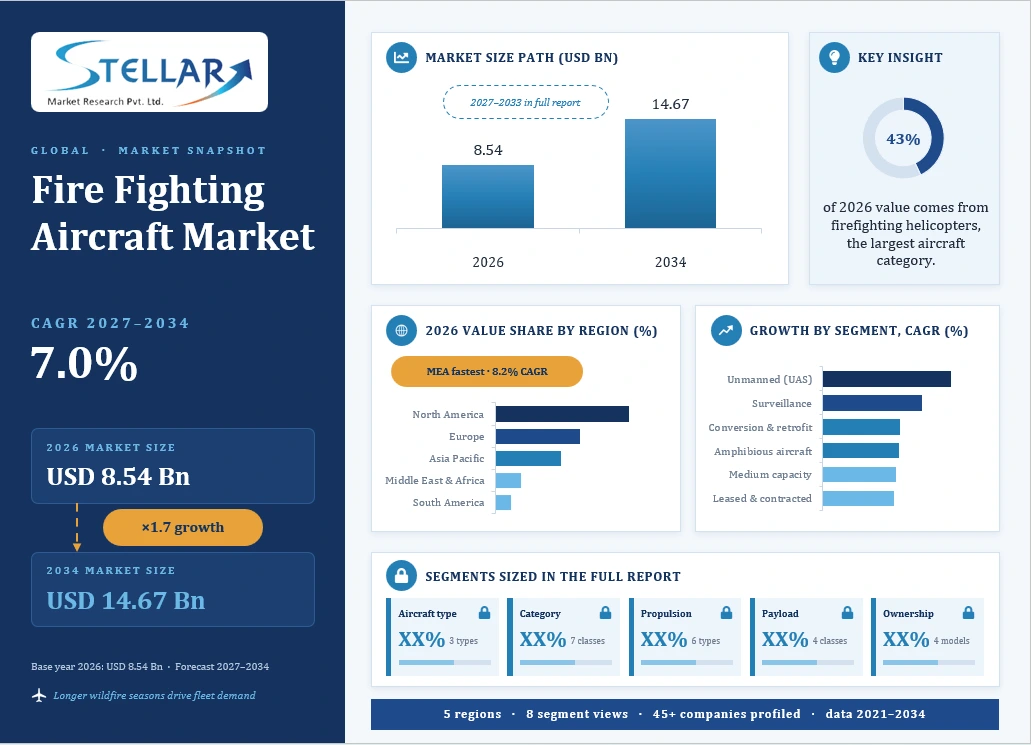
The Global Fire Fighting Aircraft Market was valued at USD 8.54 billion in 2026 and is projected to reach USD 14.67 billion by 2034, growing at a CAGR of 7.0% during 2027–2034
The Global Fire Fighting Aircraft Market was valued at USD 8.54 billion in 2026 and is projected to reach USD 14.67 billion by 2034, growing at a CAGR of 7.0% during 2027–2034, according to Stellar Market Research (SMR). Fire fighting aircraft are fixed-wing aircraft, helicopters and unmanned aircraft that are built, converted or configured to drop water, foam or fire retardant, to scoop water from lakes and the sea, and to support fire detection, aerial supervision and emergency transport. They are operated by forestry agencies, civil protection services, militaries and private aerial firefighting contractors. This Fire Fighting Aircraft Market overview and Fire Fighting Aircraft Market synopsis summarizes the Fire Fighting Aircraft Market size, Fire Fighting Aircraft revenue generated, Fire Fighting Aircraft growth prospects and Fire Fighting Aircraft Market outlook, based on SMR's Fire Fighting Aircraft Market research findings.
This Fire Fighting Aircraft Market analysis answers both sides of the search: what the Fire Fighting Aircraft Market size and Fire Fighting Aircraft Market Forecast mean for aircraft manufacturers, conversion specialists, operators and investors, and what forestry agencies, civil protection services and defense ministries want to know, from how an air tanker differs from a water scooper to payload classes, certification, fleet availability and cost of ownership. The Fire Fighting Aircraft Market insights also cover Firefighting Aircraft Demand, the Aerial Fire Suppression Market and Fire Fighting Aircraft Market Growth by region, along with Fire Fighting Aircraft consumer behavior (how agencies and contractors buy, lease and contract aircraft), Fire Fighting Aircraft industry trends and Firefighting Aircraft Market Trends.
Government and military buyers anchor the Fire Fighting Aircraft Market and helicopters and fixed-wing air tankers are the largest platforms, but Fire Fighting Aircraft Market growth is shifting toward amphibious water bombers, aircraft conversions, unmanned surveillance platforms, leased and contracted fleets and the Middle East & Africa as wildfire seasons lengthen and as Firefighting Aircraft Fleet Modernization replaces ageing CL-215, S-2 and DC-type tankers. The Fire Fighting Aircraft industry landscape is shaped by Fire Fighting Aircraft growth drivers, Fire Fighting Aircraft market dynamics, Fire Fighting Aircraft challenges and Fire Fighting Aircraft market opportunities that influence the Firefighting Aircraft Industry Outlook. The Firefighting Air Tanker Market, the Firefighting Helicopter Market, the Fixed Wing Firefighting Aircraft Market and the Amphibious Firefighting Aircraft Market are the main product pools within the global market.
Stellar Market Research provides comprehensive analysis of the global Fire Fighting Aircraft Market size, share, aircraft type, aircraft category, propulsion type, payload capacity, application, end user, ownership model, sales and service model and regional segmentation, the Fire Fighting Aircraft competitive landscape, strategic scenarios and growth opportunities. The report helps Firefighting Aircraft Manufacturers, conversion and modification specialists, aerial firefighting operators, lessors, engine and avionics suppliers and investors decide which segments, procurement programs and countries to prioritize through 2034. Fire Fighting Aircraft market segmentation, key players and market strategies, including Firefighting Aircraft Technology choices, support Fire Fighting Aircraft market entry decisions.
|
2026 | BASE YEAR |
2034 | FORECAST |
GROWTH RATE |
LARGEST REGION |
|
USD 8.54 Bn |
USD 14.67 Bn |
7.0% |
North America |
Global Fire Fighting Aircraft Market Overview: Fire Fighting Aircraft Market Size, Share, Trends and Outlook to 2034
The market is measured at product-and-service level across fixed-wing air tankers, amphibious water bombers, firefighting helicopters, unmanned platforms and specialized mission aircraft, supplied worldwide to government forestry and firefighting agencies, military and defense organizations, private aerial firefighting contractors, leasing companies and industrial operators. Revenue covers new aircraft sales, used and refurbished aircraft, conversion and retrofitting, leasing and rental services and maintenance, repair and overhaul (MRO) services. Volume is estimated at about 570 aircraft deliveries (new-build, converted and refurbished units) in 2026, rising to about 880 units by 2034, implying a market-level value of roughly USD 15 million per delivered unit once leasing, conversion and MRO revenue are included; this is a market ratio, not an aircraft price. Firefighting chemicals, ground equipment and fire-detection services sold on their own are excluded. This Fire Fighting Aircraft Market summary also reflects the Fire Fighting Aircraft economic factors, macroeconomic factors, technological advancements and regulatory influences that determine Fire Fighting Aircraft consumption across emerging markets.
Three shifts shape 2026–2034: demand is broadening from legacy air tankers and bucket helicopters into amphibious scoopers, converted airliners and transports, and unmanned surveillance aircraft; value is moving toward leased, contracted and government-owned multi-year fleets and toward conversion and MRO capacity; and growth is rotating toward Europe, Asia Pacific and the Middle East & Africa. Producers are answering supply-chain delays and certification bottlenecks with restarted production lines, roll-on/roll-off kits and regional assembly. These Fire Fighting Aircraft Market shifts and emerging trends highlight industry evolution, growth catalysts and competitive forces across the industry.
To get more Insights: Request Free Sample Report
Key Findings: Eight Insights Shaping the Global Fire Fighting Aircraft Market
SMR's analysis of published market data, government procurement announcements, manufacturer statements, regulatory filings and industry reports points to eight findings that explain where Fire Fighting Aircraft Market growth and value are created through 2034. This Fire Fighting Aircraft Market trends analysis also identifies growth catalysts, the Fire Fighting Aircraft market gap and the competitive landscape shifts affecting key players
|
Sr.No. |
Findings |
Evidence |
So what |
|
1 |
The market grows about 1.7× by 2034 |
USD 8.54 Bn (2026) to USD 14.67 Bn (2034) at 7.0% CAGR; deliveries about 570 to 880 units |
OEM lines, conversion slots and MRO capacity must scale about 1.5× by 2034 |
|
2 |
Government agencies are the anchor buyer |
Government firefighting and forestry agencies 46% of 2026 value; military and defense 17% |
Multi-year contracts and national budgets set the pace of demand |
|
3 |
North America is the largest region |
41% share in 2026; the US Forest Service manages more than 400 aircraft including 29 large airtankers |
US contract and fleet decisions shape global supplier volumes |
|
4 |
Middle East & Africa is the fastest-growing region |
8.2% CAGR from a small base; Saudi Arabia, Turkey, Morocco, Israel and Algeria are building fleets |
Import-dependent buyers favor turnkey aircraft, training and support packages |
|
5 |
Europe is the amphibious procurement hot spot |
De Havilland Canada reports 38 DHC-515 aircraft on order, sold out through 2034; EU joint procurement covers 22 aircraft for six countries |
Delivery slots, not demand, constrain amphibious supply, so leasing and conversion fill the gap |
|
6 |
Conversion and roll-on/roll-off kits add capacity fastest |
Conversion and retrofit 8.4% CAGR; France flew the Airbus A400M firefighting kit operationally in July 2026 |
Military airlifters add surge capacity without dedicated fleets |
|
7 |
Unmanned and surveillance platforms outgrow |
UAS 14.0% CAGR and surveillance applications 10.9% CAGR versus 7.0% for the market |
Detection, mission-management and data services become differentiators |
|
8 |
Certification gates market entry |
China's AG600 received a type certificate in April 2025 and a production certificate in June 2025; the DHC-515 order book is sold out through 2034 |
Certification timelines and parts supply decide who can deliver aircraft before 2030 |
Global Fire Fighting Aircraft Market Dynamics: Growth Drivers, Restraints, Opportunities and Trends
Global Fire Fighting Aircraft Market Growth Drivers: Wildfire Severity, Government Funding, Fleet Modernization and Multi-Mission Capability
The Global Fire Fighting Aircraft Market is supported by longer, hotter and more destructive wildfire seasons and by the budgets governments commit in response. The European Union recorded about 1.08 million hectares burned in 2025, the highest total in the EFFIS record, and wildfire preparedness has moved from a seasonal expense to a standing capital program. Government firefighting and forestry agencies account for about 46% of 2026 value and military and defense organizations for 17%, which gives manufacturers and operators a stable, contract-backed demand base. These Fire Fighting Aircraft market drivers and market growth factors show how Fire Fighting Aircraft demand and supply are shaped by economic factors and macroeconomic factors such as public budgets and defense spending, and by consumer behavior trends in how agencies, civil protection services and contractors procure aircraft.
Fleet modernization and multi-mission capability add a second layer of demand. Ageing piston and early-turbine tankers are being replaced by turbine amphibians, converted regional airliners and purpose-configured helicopters, while roll-on/roll-off systems let military transports such as the C-130 and the Airbus A400M fly fire missions and return to cargo duty. Amphibious water bombers are projected to grow at 8.3% CAGR, medium-capacity aircraft at 8.0% and conversion and retrofit work at 8.4%. Technological advancements in avionics, precision-drop systems, thermal imaging and satellite connectivity, together with innovation in the industry such as autonomous and electric-powered platforms, are accelerating Firefighting Aircraft Fleet Modernization and Firefighting Aircraft Technology adoption, with market adaptability and industry resilience improving as operators diversify fleets.
Global Fire Fighting Aircraft Market Restraints: Acquisition Cost, Supply-Chain Delays, Certification and Seasonal Utilization
High acquisition and operating costs, long delivery lead times and seasonal utilization are the main restraints. A new amphibious water bomber or large air tanker is a multi-year, multi-hundred-million-dollar commitment for a government buyer, and aircraft sit idle for much of the year in single-season markets. The DHC-515 order book of 38 aircraft is already sold out through 2034, so new buyers face long waits for delivery. Market fluctuation analysis shows how industry fluctuations in fuel, insurance and crew costs, together with market volatility in contracting and exclusive-use awards, affect operators' willingness to commit to new fleets. These Fire Fighting Aircraft market constraints and market challenges also limit market responsiveness when a severe season arrives early.
Regulation, safety and trade policy add further friction. Aircraft must hold type, production and special-mission approvals from authorities such as the FAA, EASA and the CAAC, and modified or converted aircraft need supplemental type certificates and agency approvals before they can be contracted. Regulatory influences and regulatory changes, including aviation safety rules, retardant environmental limits and export controls on military-derived aircraft, extend timelines, while sanctions limit access to Russian-built helicopters and amphibians in some markets. Environmental factors such as drought and smoke, external market influences such as currency swings and defense budgets, and industry disruptors such as pilot and technician shortages remain key market constraints.
What Are the Biggest Fire Fighting Aircraft Market Opportunities Through 2034?
Amphibious aircraft, conversions and leased or contracted capacity represent the most significant opportunities because they add capability faster than new-build programs. Leased and contracted fleets are projected to grow at 7.8% CAGR and public-private partnership fleets at 8.3%, as governments that cannot fund full ownership buy availability by the season. Conversion of regional airliners such as the Dash 8-400 and Boeing 737, and of military transports, offers a route to large-capacity tankers at lower cost than a clean-sheet design. These Fire Fighting Aircraft market opportunities and growth catalysts, along with a persistent market gap in very large and night-capable capacity, strengthen long-term Firefighting Aircraft Demand.
Emerging markets and new platforms offer further routes to growth. The Middle East & Africa is projected to be the fastest-growing region at 8.2% CAGR as Saudi Arabia, Turkey, Morocco, Algeria and Israel expand fleets, Europe adds permanent EU-funded aircraft and Asia Pacific scales its own amphibious production, led by China's AG600. Unmanned aircraft systems, at 14.0% CAGR, and electric and hybrid-electric propulsion, at 18.4% CAGR from a very small base, open niche markets, while MRO, avionics upgrades and aerial-intelligence services provide recurring revenue. Fire Fighting Aircraft emerging markets, market entry options and unexplored market niches offer regionally driven opportunities and help producers refine market strategies and strengthen socioeconomic resilience to wildfire.
Firefighting Aircraft Market Trends: Amphibious Scoopers, Aircraft Conversion, Roll-On/Roll-Off Kits and Unmanned Surveillance
Four Firefighting Aircraft Market Trends stand out through 2034. First, amphibious scoopers: purpose-built turboprop amphibians and a new large Chinese amphibian are growing faster than the market as governments favor repeated water drops near coastlines and lakes. Second, conversion and roll-on/roll-off systems: converted airliners and military transports with removable tanks, such as the C-130 MAFFS family, the Airbus A400M kit and the Embraer C-390 MAFFS II, add surge capacity. Third, unmanned and surveillance platforms: drones, multi-mission aircraft and satellite-linked mapping speed up detection and drop planning. Fourth, leasing and contracted availability: operators sell seasonal availability rather than aircraft. Together these market trends analysis points, technology trends and innovation impact reflect industry evolution, market forces and strategic market changes across the Fire Fighting Aircraft market dynamics, while competitive forces and competitive landscape shifts redistribute share among manufacturers and operators. Emerging trends and market shifts, including market segmentation shifts toward leased and amphibious fleets, reflect consumer preferences evolution and customer engagement dynamics among agencies, while socioeconomic influences and economic indicators such as public budgets and demand and supply dynamics set the pace of fleet spending.
Global Fire Fighting Aircraft Market Segmentation: By Aircraft Type, Aircraft Category, Propulsion Type, Payload Capacity, Application, End User, Ownership Model and Sales and Service Model
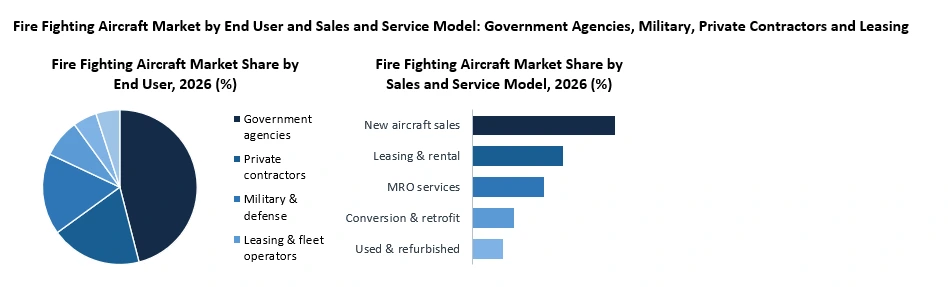
By end user, government firefighting and forestry agencies hold about 46% of 2026 value, private aerial firefighting contractors 19%, military and defense organizations 17%, commercial leasing and fleet operators 8%, industrial and infrastructure operators 5% and other institutional users 5%. By sales and service model, new aircraft sales account for about 38%, leasing and rental services 24%, MRO services 19%, aircraft conversion and retrofitting 11% and used and refurbished aircraft 8%. This market segment analysis and industry segmentation supports target market analysis and customer profiling, including behavioral segmentation of how buyers split spending between ownership and contracted availability. Geographic segmentation by country and fire regime further refines the picture.
Aircraft Type, Category, Propulsion, Payload and Ownership Analysis of the Fire Fighting Aircraft Market
Fixed-wing aircraft are the largest aircraft type at about 50% of 2026 value, followed by rotary-wing aircraft at 43% and unmanned aircraft systems at 7%; UAS is the fastest at 14.0% CAGR. By category, firefighting helicopters lead at 43%, amphibious water-bombing aircraft hold 14%, single-engine air tankers 11%, land-based air tankers 10%, multi-engine air tankers 9% and very large air tankers 6%. By propulsion, turboprop engines hold 40%, turboshaft 37%, turbofan 10%, piston 7%, turbojet 4% and electric and hybrid-electric 2%. By payload, small-capacity aircraft up to 5,000 litres hold 46%, medium capacity 24%, large capacity 22% and very large capacity above 30,000 litres 8%. By ownership, government-owned fleets hold 44%, leased and contracted fleets 34%, privately owned fleets 14% and public-private partnership fleets 8%. This product segmentation, market share by segment and segment growth analysis, covering market subsegments, segment attractiveness and the competitive segment landscape, highlights emerging market segments, specialized market segments and segment-specific trends.
Fire Fighting Aircraft Applications: Wildfire Suppression, Grassland Fires, Urban-Wildland Interface, Industrial Support and Aerial Surveillance
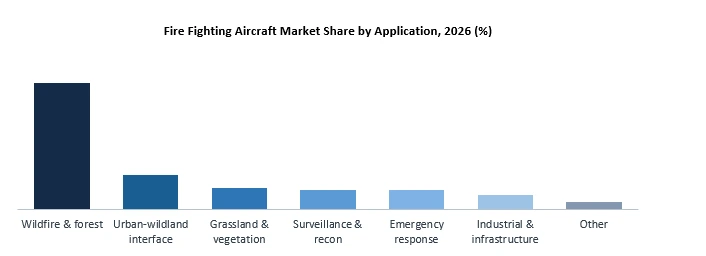
Wildfire and forest fire suppression is the largest application at about 52% of 2026 value, followed by urban-wildland interface suppression at 14%, grassland and vegetation fires at 9%, aerial fire surveillance and reconnaissance at 8%, emergency response and firefighter transportation at 8%, industrial and infrastructure firefighting support at 6% and other applications at 3%. Surveillance is the fastest application at 10.9% CAGR. Segment-based marketing and segmentation strategies increasingly rely on demographic profiling of agencies by fire regime, consumer demographics of the communities protected, and micro-segmentation by terrain and water access, while niche markets such as night operations, remote-area support and industrial site protection point to unexplored market niches and untapped market areas. Tailored marketing strategies and customized market strategies, supported by granular market breakdown, market fragment analysis, unique market sectors, segment-specific opportunities, market niche exploration, customer behavior segmentation, market segment dynamics and comprehensive market sector analysis, help suppliers prioritize the right platforms.
Global Fire Fighting Aircraft Market Regional Analysis: North America, Europe, Asia Pacific, Middle East & Africa and South America
North America is the largest regional market, accounting for about 41% of global value in 2026, and is projected to grow at about 5.7% CAGR. The United States dominates through the US Forest Service, which manages more than 400 aircraft including 29 large airtankers, the new US Wildland Fire Service launched under the Department of the Interior in January 2026, and state fleets such as CAL FIRE, which operates 17 Sikorsky S-70i Firehawk helicopters and has put four of a planned seven C-130H airtankers into service. Canada adds demand through provincial orders such as Alberta's five DHC-515 amphibians and the new Pan-Canadian Aerial Asset Program. Europe holds about 26% and is projected to grow at about 8.0% CAGR, driven by EU rescEU procurement, national fleets in Spain, France, Italy, Greece, Portugal and Croatia, and the first operational use of the Airbus A400M firefighting kit. Asia Pacific holds about 20% and is expected to grow at about 7.7% CAGR, supported by China's AG600 series production and Australia's National Aerial Firefighting Centre fleet of about 175 contracted aircraft. This geographic analysis highlights regional market trends, market performance by region, regional economic factors, local consumer behavior and regional market segmentation, with area-specific market dynamics and local market influences visible in how each region buys. Geographical trends point to faster growth where fleets are youngest and budgets are rising.
The Middle East & Africa is projected to be the fastest-growing region, with an 8.2% CAGR through 2034 from about 8% of 2026 value. Saudi Arabia plans a national aerial firefighting service built around eight Thrush 710P aircraft, Morocco operates eight Canadair CL-415 amphibians, and Turkey and Israel rely on large Air Tractor and amphibian fleets and on international help during peak fires. South America, about 5% of 2026 value, is projected to grow at about 7.3% CAGR, led by Brazil, Chile, Argentina and Colombia, where the Brazilian Air Force uses the KC-390 and Chile's national forestry corporation fields a fleet of 77 aircraft. Regional market share, the regional competitive landscape and region-specific industry outlook vary by territory, with area-specific opportunities, regional market development, local market entry strategies and regional market entry strategies shaping regional Fire Fighting Aircraft demand and supply. Market growth by location, economic impact by region, territorial dynamics, locational market nuances, area-centric market shifts, geographic market intricacies, regional consumer patterns, local economic factors, regional market performance, territorial competitive landscape, demographic trends by region, localized market challenges, regionally-driven opportunities, locational market share, geo-strategic influences, area-centric growth factors, regional industry outlook, market trends in specific regions, market trends in designated areas, regional market challenges and geopolitical influences, including sanctions and defense cooperation, all affect where aircraft are sold and based.
Fire Fighting Aircraft Companies and Competitive Landscape: Who Are the Top Firefighting Aircraft Manufacturers and Operators?
The Fire Fighting Aircraft competitive landscape includes several distinct groups rather than a single set of comparable companies. Established aircraft OEMs such as Lockheed Martin, Airbus, Leonardo, Textron (Bell), Bombardier, Embraer, Saab and Kawasaki Heavy Industries supply or convert transports, helicopters and amphibians; specialized builders such as De Havilland Aircraft of Canada, Air Tractor, Thrush Aircraft, Beriev and ShinMaywa build purpose-designed tankers and amphibians; conversion specialists and operators such as Conair, Coulson Aviation, Neptune Aviation, Erickson, 10 Tanker Air Carrier, Bridger Aerospace and Avincis fly and modify tankers under government contract; and emerging developers such as AeroVironment and Guangzhou EHang work on unmanned platforms. These groups compete on different dimensions and should not be ranked as though they were identical producers. This competitor analysis draws on competitive intelligence, competitor profiling, competitive positioning and competitor benchmarking of key players, including company revenue and company net sales, and on industry rivals examination and competitor evaluation.
Competition is increasingly shaped by delivery slots, certification, payload and operating cost, and the ability to field aircraft in the northern and southern hemisphere seasons. De Havilland Canada reported 38 DHC-515 amphibians on order and sold out through 2034, while Bridger Aerospace, a listed operator, guided to 2026 revenue of USD 135 million to USD 145 million after USD 122.8 million in 2025. Government awards such as the ten-year US Forest Service large-airtanker contract with Coulson Aviation, with a potential value of USD 7.2 billion, show how exclusive-use contracts lock in share. Market rivalry assessment, market rivalry intensity and rivalry impact analysis suggest that competitive landscape trends will favor firms that combine aircraft supply with conversion, MRO and operations. Competitive strategy review, competitive advantage assessment, competitor differentiation, market player strategies, industry competition overview, rival market share, competitive market evolution and competitive benchmark analysis point to consolidation and partnerships, while industry player dynamics, market rival scrutiny, industry adversary exploration, competitive ecosystem analysis, rivalry landscape intricacies, competitive matrix investigation, business opponent profiling, sectorial rivalry dynamics, competitive maneuver examination, competing force scrutiny, rivalry intensity mapping, opponent landscape divergence, industry opposition tactics and strategic analysis show where positions are contested.
Global Fire Fighting Aircraft Market Recent Developments, Procurement Milestones and Industry News | 2025–2026
|
Date |
Development |
Why it matters |
|
Feb 2026 |
Alberta signs a roughly CAD 400 million agreement for five DHC-515 amphibious aircraft |
Extends the DHC-515 order book beyond Europe and supports scale-up of production |
|
May 2026 |
Canada secures ten aircraft for 2026 through CIFFC from Conair, Coldstream and VIH (25 May) |
Adds a national pool of contracted aircraft under the Pan-Canadian Aerial Asset Program |
|
Jun 2026 |
France orders two additional DHC-515 aircraft |
Confirms launch-customer demand and lifts the European order total |
|
Jul 2026 |
France deploys the Airbus A400M firefighting kit operationally for the first time (20,000 litre tank) |
Shows that military airlifters can add heavy surge capacity |
|
Oct 2026 |
China's AG600 completes its 2026 forest firefighting deployment in Heilongjiang |
Moves the large amphibian toward regular deployment |
Global Fire Fighting Aircraft Market Scope: Inquire before buying
| Global Fire Fighting Aircraft Market | |||
|---|---|---|---|
| Report Coverage | Details | ||
| Base Year: | 2026 | Forecast Period: | 2027-2034 |
| Historical Data: | 2021 - 2026 | Market Size in 2026: | USD 8.54 billion |
| Forecast Period 2027 to 2034 CAGR: | 7.0% | Market Size in 2034: | USD 14.67 billion |
| Segments Covered: | By Aircraft Type | Fixed-Wing Aircraft; Rotary-Wing Aircraft; Unmanned Aircraft Systems (UAS) | |
| By Aircraft Category | Amphibious Water-Bombing Aircraft; Land-Based Air Tankers; Single-Engine Air Tankers (SEATs); Multi-Engine Air Tankers; Very Large Air Tankers (VLATs); Firefighting Helicopters; Other Specialized Firefighting Aircraft | ||
| By Propulsion Type | Turboprop Engine; Turbojet Engine; Turbofan Engine; Piston Engine; Turboshaft Engine; Electric and Hybrid-Electric Propulsion | ||
| By Payload Capacity | Small Capacity (Up to 5,000 Litres); Medium Capacity (Above 5,000 to 10,000 Litres); Large Capacity (Above 10,000 to 30,000 Litres); Very Large Capacity (Above 30,000 Litres) | ||
| By Application | Wildfire and Forest Fire Suppression; Grassland and Vegetation Fire Suppression; Urban-Wildland Interface Fire Suppression; Industrial and Infrastructure Firefighting Support; Aerial Fire Surveillance and Reconnaissance; Emergency Response and Firefighter Transportation; Other Specialized Applications | ||
| By End User | Government Firefighting and Forestry Agencies; Military and Defense Organizations; Private Aerial Firefighting Contractors; Commercial Aircraft Leasing and Fleet Operators; Industrial and Infrastructure Operators; Other Institutional End Users | ||
| By Ownership Model | Government-Owned Aircraft Fleets; Privately Owned Aircraft Fleets; Public-Private Partnership Aircraft Fleets; Leased and Contracted Aircraft Fleets | ||
| By Sales and Service Model | New Aircraft Sales; Used and Refurbished Aircraft Sales; Aircraft Conversion and Retrofitting; Aircraft Leasing and Rental Services; Maintenance, Repair and Overhaul Services | ||
Global Fire Fighting Aircraft Market, By Region
North America (United States, Canada, Mexico, Rest of North America)
Europe (France, Spain, Italy, Greece, Portugal, Germany, United Kingdom, Croatia, Russia, Rest of Europe)
Asia Pacific (China, India, Japan, South Korea, Australia, New Zealand, Indonesia, Thailand, Rest of Asia Pacific)
Middle East & Africa (Saudi Arabia, United Arab Emirates, Israel, Turkey, South Africa, Morocco, Algeria, Egypt, Rest of Middle East & Africa)
South America (Brazil, Argentina, Chile, Colombia, Peru, Rest of South America)
Global Fire Fighting Aircraft Market, 45+ Key Players
North America
- Lockheed Martin Corporation
- De Havilland Aircraft of Canada Limited
- Air Tractor, Inc.
- Textron Inc. (Bell)
- Bombardier Inc.
- Conair Group Inc.
- Coulson Aviation
- Erickson Incorporated
- Neptune Aviation Services
- Bridger Aerospace Group Holdings, LLC
- 10 Tanker Air Carrier, LLC
- Aero-Flite, Inc.
- Dauntless Air, Inc.
- Global SuperTanker Services
- Minden Air Corporation
- Billings Flying Service
- Columbia Helicopters
- Helicopter Express
- Precision Helicopters
- United Rotorcraft
- Kaman Corporation
- MD Helicopters, Inc.
- Marsh Aviation Company
- Thrush Aircraft, LLC
- AeroVironment, Inc.
- Others
Europe
- Airbus SE
- Leonardo S.p.A.
- Saab AB
- HYNAERO SAS
- Avincis Aviation Group
- Babcock International Group
- Patria Group
- Daher
- Singular Aircraft
- Pilatus Aircraft Ltd.
- Russian Helicopters JSC
- Beriev Aircraft Company
- Others
Asia Pacific
- ShinMaywa Industries, Ltd.
- Kawasaki Heavy Industries, Ltd.
- Mitsubishi Heavy Industries, Ltd.
- Korea Aerospace Industries Ltd.
- Guangzhou EHang Intelligent Technology Co., Ltd.
- China Aerospace Science and Technology Corporation (CASC)
- China Aerospace Science and Industry Corporation (CASIC)
- Others
Middle East & Africa
- Israel Aerospace Industries Ltd.
- Kishugu Aviation
- CAMAIR S.A.
- Others
South America
- Embraer S.A.
- Others
Frequently Asked Questions
North America holds the largest Fire Fighting Aircraft market share at about 41% in 2026, led by the United States, followed by Europe (about 26%) and Asia Pacific (about 20%). The Middle East & Africa is the fastest-growing region at an 8.2% CAGR.
Helicopters are the largest category at about 43% of 2026 value and wildfire suppression is the largest application at about 52%, but unmanned aircraft (14.0% CAGR), aerial surveillance (10.9%), amphibious aircraft (8.3%), conversion and retrofit (8.4%) and medium-capacity aircraft (8.0%) are growing faster than the 7.0% market average.
Leading names include De Havilland Aircraft of Canada, Lockheed Martin (C-130 and Sikorsky), Air Tractor, Airbus, Embraer, Thrush Aircraft, Beriev and ShinMaywa among manufacturers, and Conair, Coulson Aviation, Bridger Aerospace, Neptune Aviation, Erickson and Avincis among operators and conversion specialists. Competitive positioning depends on delivery slots, payload, certification, fleet availability and support.
Amphibious aircraft such as the Canadair CL-415 and DHC-515 scoop water from lakes or the sea while skimming, so they can make many short drops without returning to a base, but they need suitable water within range. Land-based air tankers, including converted airliners and C-130 aircraft, carry retardant loaded at an airtanker base, so they offer larger payloads and longer reach but depend on runways and retardant logistics.
1. Executive Market Landscape and Industry Overview
1.1. Global Fire Fighting Aircraft Market Size (Value USD Million and Volume in Units), 2026–2034
1.2. Evolution of Aerial Firefighting and Specialized Firefighting Aircraft
1.3. Definition, Scope and Classification of Fire Fighting Aircraft
1.4. Aircraft Design, Structural Configuration and Firefighting Capabilities
1.5. Role of Fire Fighting Aircraft in Wildfire and Forest Fire Suppression
1.6. Global Demand for Fire Fighting Aircraft Across Government and Commercial Operators
1.7. CAGR Analysis of the Global Fire Fighting Aircraft Market During 2027–2034
2. Fire Fighting Aircraft Market Dynamics
2.1. Fire Fighting Aircraft Market Trends
2.2. Fire Fighting Aircraft Market Dynamics
2.2.1. Drivers
2.2.2. Restraints
2.2.3. Opportunities
2.2.4. Challenges
2.3. PORTER's Five Forces Analysis
2.4. PESTLE Analysis
3. Fire Fighting Aircraft Market Macroeconomic Factors
3.1. Global Wildfire Incidence and Forest Fire Occurrence Trends
3.2. Government Expenditure on Wildfire Prevention and Emergency Response
3.3. Climate Change, Drought Conditions and Rising Temperature Patterns
3.4. Global Aerospace and Defense Industry Production and Investment Trends
3.5. Aircraft Manufacturing Costs, Aviation Fuel Prices and Operating Economics
3.6. Government Procurement Policies, Import Duties and International Aircraft Trade
3.7. Foreign Exchange Movements and Global Aerospace Supply Chain Developments
4. Fire Fighting Aircraft Industry Trends & Emerging Technology Requirements
4.1. Increasing Adoption of Specialized Aerial Firefighting Aircraft
4.2. Growing Demand for Amphibious Water-Bombing Aircraft
4.3. Modernization of Ageing Firefighting Aircraft Fleets
4.4. Increasing Deployment of Large and Very Large Air Tankers
4.5. Growing Adoption of Multi-Mission Aircraft for Emergency Response
4.6. Integration of Advanced Avionics, Navigation and Precision Dropping Systems
4.7. Increasing Adoption of Unmanned Aircraft Systems for Wildfire Monitoring
5. Fire Fighting Aircraft Technology Architecture & Ecosystem Landscape
5.1. Aircraft Airframe Design and Structural Engineering Requirements
5.2. Fire Retardant Tank, Water Storage and Suppressant Delivery Systems
5.3. Water Scooping, Loading and Aerial Release Mechanisms
5.4. Amphibious Landing and Water-Refilling Technologies
5.5. Aircraft Propulsion, Engine and Power Management Systems
5.6. Flight Control, Navigation and Mission Management Technologies
5.7. Fire Detection, Thermal Imaging and Satellite-Based Monitoring Integration
6. Fire Fighting Aircraft Types, Structural Configuration & Design Landscape
6.1. Fixed-Wing Fire Fighting Aircraft
6.2. Rotary-Wing Fire Fighting Aircraft
6.3. Unmanned Firefighting Aircraft and Aerial Platforms
6.4. Amphibious Aircraft Configurations
6.5. Land-Based Firefighting Aircraft Configurations
6.6. Aircraft Conversion and Multi-Role Firefighting Configurations
6.7. Specialized Firefighting Aircraft Design and Mission Configuration Requirements
7. Fire Fighting Aircraft Propulsion, Engine & Performance Characteristics
7.1. Turboprop-Powered Fire Fighting Aircraft
7.2. Turbojet and Turbofan-Powered Fire Fighting Aircraft
7.3. Piston-Engine Fire Fighting Aircraft
7.4. Turboshaft-Powered Firefighting Helicopters
7.5. Aircraft Engine Performance and Power-to-Weight Requirements
7.6. Flight Endurance, Operating Range and Mission Performance
7.7. Fuel Efficiency, Engine Reliability and Maintenance Requirements
8. Fire Fighting Aircraft Payload Capacity, Tank Systems & Suppression Equipment
8.1. Aircraft Water and Fire Retardant Storage Systems
8.2. Small Payload Capacity (Up to 5,000 Litres)
8.3. Medium Payload Capacity (Above 5,000 to 10,000 Litres)
8.4. Large Payload Capacity (Above 10,000 to 30,000 Litres)
8.5. Very Large Payload Capacity (Above 30,000 Litres)
8.6. Aerial Fire Suppressant Release and Precision Dropping Systems
8.7. Water Scooping, Helicopter Buckets and External Tank Systems
Note: Capacity categories refer to nominal liquid suppressant payload capacity, not aircraft maximum take-off weight. Actual capacities vary by aircraft configuration.
9. Fire Fighting Aircraft Manufacturing Processes & Production Technologies
9.1. Aircraft Design, Engineering and Prototype Development
9.2. Airframe Manufacturing and Structural Assembly
9.3. Aircraft Engine Integration and Propulsion System Installation
9.4. Water Tank and Fire Retardant Delivery System Manufacturing
9.5. Avionics, Navigation and Mission Control System Integration
9.6. Aircraft Testing, Flight Validation and Certification
9.7. Final Assembly, Quality Inspection and Aircraft Delivery
10. Fire Fighting Aircraft Components, Systems & Equipment Ecosystem
10.1. Aircraft Fuselage, Wings and Structural Components
10.2. Aircraft Engines, Propellers and Propulsion Components
10.3. Water Tanks, Retardant Tanks and Storage Assemblies
10.4. Pumps, Valves, Doors and Suppressant Release Mechanisms
10.5. Avionics, Flight Control and Navigation Systems
10.6. Communication, Surveillance and Thermal Imaging Systems
10.7. Landing Gear, Amphibious Floats and Water-Scooping Equipment
11. Fire Fighting Aircraft Maintenance, Repair, Overhaul & Fleet Modernization
11.1. Aircraft Maintenance, Repair and Overhaul (MRO) Services
11.2. Airframe Inspection and Structural Maintenance
11.3. Engine Overhaul and Propulsion System Maintenance
11.4. Water Tank and Fire Retardant Delivery System Maintenance
11.5. Avionics Upgrades and Mission System Modernization
11.6. Aircraft Refurbishment and Civilian-to-Firefighting Conversion
11.7. Fleet Availability, Maintenance Costs and Aircraft Lifecycle Management
12. Fire Fighting Aircraft Testing, Certification & Technical Evaluation
12.1. Aircraft Airworthiness and Flight Performance Testing
12.2. Aircraft Payload and Suppressant Delivery Testing
12.3. Water Scooping and Aerial Release Performance Evaluation
12.4. Engine Performance and Endurance Testing
12.5. Structural Integrity and Environmental Testing
12.6. Avionics, Navigation and Communication System Validation
12.7. Aircraft Safety, Reliability and Mission Readiness Assessment
13. Fire Fighting Aircraft Applications in Wildfire & Forest Fire Management
13.1. Aerial Suppression of Forest Fires
13.2. Wildfire Containment and Fireline Protection
13.3. Grassland and Vegetation Fire Suppression
13.4. Mountainous and Remote-Area Firefighting Operations
13.5. Urban-Wildland Interface Fire Suppression
13.6. Large-Scale Regional and Cross-Border Wildfire Response
13.7. Emergency Firefighting Support and Disaster Management
14. Fire Fighting Aircraft Applications in Industrial & Infrastructure Fire Protection
14.1. Industrial Facility and Manufacturing Plant Fire Response
14.2. Oil and Gas Facility Fire Suppression Support
14.3. Power Generation and Energy Infrastructure Fire Response
14.4. Transportation Infrastructure and Remote Industrial Site Protection
14.5. Chemical and Petrochemical Facility Emergency Response
14.6. Mining and Large-Scale Industrial Site Fire Management
14.7. Specialized Infrastructure Firefighting Support Operations
15. Fire Fighting Aircraft Applications in Aerial Surveillance & Emergency Response
15.1. Wildfire Detection and Aerial Reconnaissance
15.2. Thermal Imaging and Fire Perimeter Monitoring
15.3. Fire Behaviour Assessment and Incident Mapping
15.4. Firefighter and Emergency Response Personnel Transportation
15.5. Emergency Equipment and Firefighting Supply Transportation
15.6. Post-Fire Assessment and Disaster Impact Monitoring
15.7. Real-Time Aerial Intelligence and Emergency Coordination
16. Fire Fighting Aircraft Procurement, Leasing & Fleet Acquisition Ecosystem
16.1. Government Procurement of Fire Fighting Aircraft
16.2. Direct Aircraft Purchases from Original Equipment Manufacturers
16.3. Aircraft Leasing and Long-Term Fleet Rental Models
16.4. Aircraft Conversion and Refurbishment Procurement
16.5. Public-Private Partnerships and Government Fleet Contracts
16.6. Multi-Year Aircraft Acquisition and Replacement Programs
16.7. Procurement Evaluation, Tendering and Aircraft Delivery Timelines
17. Fire Fighting Aircraft Production, Manufacturing Capacity & Industrial Infrastructure
17.1. Global Fire Fighting Aircraft Manufacturing Facilities
17.2. Fixed-Wing Firefighting Aircraft Production Infrastructure
17.3. Rotary-Wing Aircraft Manufacturing and Assembly Facilities
17.4. Amphibious Aircraft Manufacturing and Assembly Capabilities
17.5. Aircraft Conversion and Modification Facilities
17.6. Production Capacity Expansion and Manufacturing Investments
17.7. Manufacturing Infrastructure, Workforce and Production Efficiency Benchmarking
18. Fire Fighting Aircraft Pricing, Business Models & Cost Economics
18.1. Fire Fighting Aircraft Pricing Across Different Aircraft Categories
18.2. New Aircraft Procurement and Acquisition Costs
18.3. Aircraft Conversion and Retrofitting Cost Structure
18.4. Aircraft Leasing and Rental Pricing Models
18.5. Aircraft Maintenance, Repair and Overhaul Cost Economics
18.6. Fuel, Insurance, Crew and Operational Expenditure
18.7. Total Cost of Ownership and Aircraft Lifecycle Economics
19. Fire Fighting Aircraft Distribution, Sales & Procurement Landscape
19.1. Direct Sales Through Aircraft Original Equipment Manufacturers
19.2. Government-to-Government Aircraft Procurement
19.3. Authorized Aircraft Dealers and Regional Representatives
19.4. Specialized Aerospace and Defense Procurement Contractors
19.5. Aircraft Leasing Companies and Fleet Financing Providers
19.6. Aircraft Conversion and Modification Service Providers
19.7. After-Sales Support, Spare Parts and Technical Service Networks
20. Fire Fighting Aircraft Supply Chain & Operational Ecosystem
20.1. Aircraft Raw Material and Aerospace Component Sourcing
20.2. Aircraft Engine and Propulsion System Supplier Networks
20.3. Avionics, Navigation and Mission System Supply Chains
20.4. Water Tank and Fire Suppression Equipment Suppliers
20.5. Aircraft Assembly, Integration and Modification Networks
20.6. International Aircraft Transportation and Delivery Logistics
20.7. Supply Chain Resilience, Supplier Qualification and Operational Risk Management
21. Fire Fighting Aircraft Technology Innovation, R&D & Product Development
21.1. Development of Next-Generation Fire Fighting Aircraft
21.2. Advanced Amphibious Aircraft and Water-Scooping Technologies
21.3. High-Capacity Water and Fire Retardant Delivery Systems
21.4. AI-Based Flight Management and Precision Fire Suppression
21.5. Autonomous and Unmanned Firefighting Aircraft Development
21.6. Satellite Connectivity, Thermal Imaging and Real-Time Fire Mapping
21.7. Research Investments, Intellectual Property and Aerospace Collaborations
22. Fire Fighting Aircraft Market Adoption, Fleet Utilization & Customer Economics
22.1. Global Fire Fighting Aircraft Fleet Deployment Trends
22.2. Government and Commercial Fleet Acquisition Patterns
22.3. Aircraft Utilization Rates and Annual Flight Hours
22.4. Seasonal Demand and Aircraft Deployment Cycles
22.5. Aircraft Replacement Demand and Fleet Modernization Requirements
22.6. Customer Procurement Preferences and Long-Term Fleet Contracts
22.7. Aircraft Availability, Operational Efficiency and Customer Satisfaction
23. Fire Fighting Aircraft Market Regulatory, Safety & Technical Standards
23.1. International Civil Aviation Organization (ICAO) Aviation Safety Framework
23.2. Federal Aviation Administration (FAA) Aircraft Certification Requirements
23.3. European Union Aviation Safety Agency (EASA) Certification Requirements
23.4. Aircraft Airworthiness and Special Mission Certification
23.5. Aircraft Modification and Supplemental Type Certification Requirements
23.6. Aerial Firefighting Operational Safety and Flight Crew Standards
23.7. Fire Retardant Handling, Environmental Compliance and Aviation Regulations
24. Fire Fighting Aircraft Regional & Country-Level Market Landscape
24.1. North American Aircraft Manufacturing, Fleet Modernization and Wildfire Response Demand
24.2. European Firefighting Aircraft Procurement, Cross-Border Cooperation and Fleet Development
24.3. Asia-Pacific Aircraft Manufacturing, Government Procurement and Wildfire Response Requirements
24.4. Middle East & Africa Aircraft Procurement, Import Dependency and Emergency Response Infrastructure
24.5. South American Firefighting Aircraft Demand, Forest Fire Management and Fleet Deployment
24.6. Country-Level Market Assessment: United States, Canada, Mexico, Germany, France, Italy, Spain, United Kingdom, Greece, Portugal, China, Japan, India, South Korea, Australia, New Zealand, Brazil, Chile, Argentina, South Africa and Other Key Markets
24.7. Regional Aircraft Fleet Availability, Import-Export Trends, Procurement Investments and Operational Capacity
Special regional focus: North America, Europe, Asia Pacific, Middle East & Africa and South America will receive dedicated country-level analysis, including aircraft fleet, procurement, manufacturing presence, demand drivers, operational deployment and future investment opportunities.
25. Fire Fighting Aircraft Market: Market Size and Forecast by Segmentation (Value USD Million and Volume in Units) (2026–2034)
25.1. Fire Fighting Aircraft Market Size and Forecast, By Aircraft Type
25.1.1. Fixed-Wing Aircraft
25.1.2. Rotary-Wing Aircraft
25.1.3. Unmanned Aircraft Systems (UAS)
25.2. Fire Fighting Aircraft Market Size and Forecast, By Aircraft Category
25.2.1. Amphibious Water-Bombing Aircraft
25.2.2. Land-Based Air Tankers
25.2.3. Single-Engine Air Tankers (SEATs)
25.2.4. Multi-Engine Air Tankers
25.2.5. Very Large Air Tankers (VLATs)
25.2.6. Firefighting Helicopters
25.2.7. Other Specialized Firefighting Aircraft
25.3. Fire Fighting Aircraft Market Size and Forecast, By Propulsion Type
25.3.1. Turboprop Engine
25.3.2. Turbojet Engine
25.3.3. Turbofan Engine
25.3.4. Piston Engine
25.3.5. Turboshaft Engine
25.3.6. Electric and Hybrid-Electric Propulsion
25.4. Fire Fighting Aircraft Market Size and Forecast, By Payload Capacity
25.4.1. Small Capacity (Up to 5,000 Litres)
25.4.2. Medium Capacity (Above 5,000 to 10,000 Litres)
25.4.3. Large Capacity (Above 10,000 to 30,000 Litres)
25.4.4. Very Large Capacity (Above 30,000 Litres)
25.5. Fire Fighting Aircraft Market Size and Forecast, By Application
25.5.1. Wildfire and Forest Fire Suppression
25.5.2. Grassland and Vegetation Fire Suppression
25.5.3. Urban-Wildland Interface Fire Suppression
25.5.4. Industrial and Infrastructure Firefighting Support
25.5.5. Aerial Fire Surveillance and Reconnaissance
25.5.6. Emergency Response and Firefighter Transportation
25.5.7. Other Specialized Applications
25.6. Fire Fighting Aircraft Market Size and Forecast, By End User
25.6.1. Government Firefighting and Forestry Agencies
25.6.2. Military and Defense Organizations
25.6.3. Private Aerial Firefighting Contractors
25.6.4. Commercial Aircraft Leasing and Fleet Operators
25.6.5. Industrial and Infrastructure Operators
25.6.6. Other Institutional End Users
25.7. Fire Fighting Aircraft Market Size and Forecast, By Ownership Model
25.7.1. Government-Owned Aircraft Fleets
25.7.2. Privately Owned Aircraft Fleets
25.7.3. Public-Private Partnership Aircraft Fleets
25.7.4. Leased and Contracted Aircraft Fleets
25.8. Fire Fighting Aircraft Market Size and Forecast, By Sales and Service Model
25.8.1. New Aircraft Sales
25.8.2. Used and Refurbished Aircraft Sales
25.8.3. Aircraft Conversion and Retrofitting
25.8.4. Aircraft Leasing and Rental Services
25.8.5. Maintenance, Repair and Overhaul Services
25.9. Fire Fighting Aircraft Market Size and Forecast, By Region
25.9.1. North America
25.9.1.1. United States
25.9.1.2. Canada
25.9.1.3. Mexico
25.9.1.4. Rest of North America
25.9.2. Europe
25.9.2.1. France
25.9.2.2. Germany
25.9.2.3. United Kingdom
25.9.2.4. Italy
25.9.2.5. Spain
25.9.2.6. Portugal
25.9.2.7. Greece
25.9.2.8. Croatia
25.9.2.9. Russia
25.9.2.10. Rest of Europe
25.9.3. Asia Pacific
25.9.3.1. China
25.9.3.2. India
25.9.3.3. Japan
25.9.3.4. South Korea
25.9.3.5. Australia
25.9.3.6. New Zealand
25.9.3.7. Indonesia
25.9.3.8. Thailand
25.9.3.9. Rest of Asia Pacific
25.9.4. Middle East & Africa
25.9.4.1. Saudi Arabia
25.9.4.2. United Arab Emirates
25.9.4.3. Israel
25.9.4.4. Turkey
25.9.4.5. South Africa
25.9.4.6. Morocco
25.9.4.7. Algeria
25.9.4.8. Egypt
25.9.4.9. Rest of Middle East & Africa
25.9.5. South America
25.9.5.1. Brazil
25.9.5.2. Argentina
25.9.5.3. Chile
25.9.5.4. Colombia
25.9.5.6. Venezuela
25.9.5.7. Peru
25.9.5.8. Rest of South America
26. Fire Fighting Aircraft Market Competitive Landscape
26.1. SMR Competition Matrix
26.2. Competitive Positioning of Leading Key Players
26.3. Key Players Benchmarking
26.3.1. Company Name
26.3.2. Headquarters
26.3.3. Fire Fighting Aircraft Product Portfolio
26.3.4. Aircraft Models and Technical Specifications
26.3.5. Aircraft Manufacturing and Assembly Capabilities
26.3.6. Aircraft Production and Delivery Capabilities
26.3.7. Aircraft Payload and Fire Suppression Capabilities
26.3.8. Total Company Revenue (2026)
26.3.9. Firefighting-Related Revenue (2026), Where Available
26.3.10. Geographic Presence
26.3.11. Government and Commercial Customer Base
26.3.12. Strategic Partnerships and Aerospace Collaborations
26.4. Market Structure
26.4.1. Established Aircraft OEMs
26.4.2. Specialized Firefighting Aircraft Manufacturers
26.4.3. Aircraft Conversion and Modification Providers
26.4.4. Aerial Firefighting Service Operators
26.4.5. Emerging Aircraft and Technology Developers
26.5. Market Share Analysis of Leading Companies
26.6. Revenue Growth Rate / Y-o-Y (%) of Companies
26.7. Profit Margin (%) of Companies, Where Available
26.8. Aircraft Production and Delivery Benchmarking
26.9. Revenue vs. Net Earnings – Financial Health Benchmarking
26.10. Mergers, Acquisitions and Strategic Partnerships
26.11. Recent Key Developments
27. Fire Fighting Aircraft Manufacturers & Original Equipment Manufacturers Landscape
27.1. Fixed-Wing Firefighting Aircraft Manufacturers
27.2. Amphibious Firefighting Aircraft Manufacturers
27.3. Single-Engine Air Tanker Manufacturers
27.4. Military Transport and Large Air Tanker Platform Manufacturers
27.5. Firefighting Helicopter Manufacturers
27.6. Unmanned Firefighting Aircraft and Drone Manufacturers
27.7. Aircraft Manufacturing Capacity, Product Portfolio and Technical Capability Benchmarking
28. Fire Fighting Aircraft Conversion, Modification & Retrofitting Providers
28.1. Fixed-Wing Aircraft Conversion Companies
28.2. Large Air Tanker Conversion Specialists
28.3. Amphibious Aircraft Modification Providers
28.4. Fire Retardant Tank and Suppressant Delivery System Integrators
28.5. Aircraft Avionics and Mission System Modification Providers
28.6. Aircraft Refurbishment and Structural Upgrade Providers
28.7. Conversion Capacity, Certification and Technical Capability Benchmarking
29. Aerial Firefighting Aircraft Operations & Fleet Management Providers
29.1. Fixed-Wing Air Tanker Operators
29.2. Amphibious Water-Bomber Operators
29.3. Helicopter Firefighting Service Providers
29.4. Large and Very Large Air Tanker Operators
29.5. Government-Contracted Aerial Firefighting Operators
29.6. International Aerial Firefighting Fleet Management Companies
29.7. Fleet Size, Operational Coverage and Contract Capability Benchmarking
30. Fire Fighting Aircraft Components, Equipment & Technology Suppliers
30.1. Aircraft Engine and Propulsion System Suppliers
30.2. Aircraft Avionics and Navigation System Providers
30.3. Water Tank and Fire-Retardant Delivery System Suppliers
30.4. Helicopter Water Bucket and External Tank Manufacturers
30.5. Aircraft Hydraulic and Fluid Management System Providers
30.6. Thermal Imaging, Surveillance and Fire Detection Technology Providers
30.7. Aircraft Component Supply, Technical Performance and Supplier Capability Benchmarking
31. Fire Fighting Aircraft Maintenance, Repair & Technical Support Providers
31.1. Aircraft Maintenance and Repair Companies
31.2. Aircraft Engine Maintenance and Overhaul Providers
31.3. Aircraft Structural Inspection and Repair Specialists
31.4. Avionics and Flight Control System Maintenance Providers
31.5. Aircraft Spare Parts and Replacement Component Suppliers
31.6. Aircraft Lifecycle Support and Fleet Management Companies
31.7. MRO Infrastructure, Service Coverage and Technical Capability Benchmarking
32. Fire Fighting Aircraft Leasing, Financing & Aviation Support Providers
32.1. Aircraft Leasing and Rental Companies
32.2. Aerospace and Aviation Financing Institutions
32.3. Government Aircraft Procurement and Financing Contractors
32.4. Aircraft Insurance and Risk Management Providers
32.5. Aviation Training and Flight Crew Development Providers
32.6. Aircraft Logistics and Delivery Support Companies
32.7. Leasing Models, Financing Structures and Service Capability Benchmarking
33. Fire Fighting Aircraft Manufacturers' Strategies & Expansion Plans
33.1. Expansion of Specialized Firefighting Aircraft Manufacturing Capacity
33.2. Development of Next-Generation Amphibious Aircraft
33.3. Introduction of High-Capacity Water-Bombing Aircraft
33.4. Expansion of Aircraft Conversion and Retrofitting Capabilities
33.5. Development of Advanced Aircraft Mission Management Systems
33.6. Expansion of International Aircraft Sales and Service Networks
33.7. Partnerships with Government Agencies and Aerial Firefighting Operators
33.8. Mergers, Acquisitions and Strategic Aerospace Collaborations
34. Fire Fighting Aircraft Industry SWOT, Investments & Strategic Developments
34.1. Competitive Strengths of Established Aircraft Manufacturers
34.2. High Aircraft Acquisition Costs and Manufacturing Constraints
34.3. Growing Investment Opportunities in Wildfire Management
34.4. Ageing Aircraft Fleets and Aircraft Replacement Opportunities
34.5. Technological Challenges in Autonomous Firefighting Aircraft
34.6. Investments in Aircraft Manufacturing and Conversion Infrastructure
34.7. Investments in Advanced Avionics, Navigation and Fire Suppression Technologies
34.8. Major Aircraft Orders, Product Launches and Industry Developments
35. Fire Fighting Aircraft Competitive Outlook & Market Positioning
35.1. Competitive Dynamics Across Fixed-Wing and Rotary-Wing Aircraft
35.2. Market Concentration Across Global Firefighting Aircraft Manufacturers
35.3. Product Differentiation Through Payload Capacity and Operational Performance
35.4. Competitive Positioning of Aircraft OEMs and Conversion Specialists
35.5. Competitive Positioning of Aerial Firefighting Service Operators
35.6. Expansion of Firefighting Aircraft Fleets in Emerging Markets
35.7. Long-Term Competitive Positioning of Leading Industry Participants
36. Company Profile: Key Fire Fighting Aircraft Market Players
Detailed Profile Considering the Parameters
- Overview
- Establishment Year
- Headquarters
- Company Type
- Business Portfolio
- Fire Fighting Aircraft Product Portfolio
- Aircraft Models and Technical Specifications
- Manufacturing and Production Capabilities
- Aircraft Production and Delivery Capacity
- Aircraft Conversion and Modification Capabilities
- Geographic Presence
- Government and Commercial Contracts
- Financial Overview
- SWOT Analysis
- Strategic Analysis
- Recent Developments
Global Fire Fighting Aircraft Market, 45+ Key Players
North America
- Lockheed Martin Corporation
- De Havilland Aircraft of Canada Limited
- Air Tractor, Inc.
- Textron Inc. (Bell)
- Bombardier Inc.
- Conair Group Inc.
- Coulson Aviation
- Erickson Incorporated
- Neptune Aviation Services
- Bridger Aerospace Group Holdings, LLC
- 10 Tanker Air Carrier, LLC
- Aero-Flite, Inc.
- Dauntless Air, Inc.
- Global SuperTanker Services
- Minden Air Corporation
- Billings Flying Service
- Columbia Helicopters
- Helicopter Express
- Precision Helicopters
- United Rotorcraft
- Kaman Corporation
- MD Helicopters, Inc.
- Marsh Aviation Company
- Thrush Aircraft, LLC
- AeroVironment, Inc.
Others
Europe
- Airbus SE
- Leonardo S.p.A.
- Saab AB
- HYNAERO SAS
- Avincis Aviation Group
- Babcock International Group
- Patria Group
- Daher
- Singular Aircraft
- Pilatus Aircraft Ltd.
- Russian Helicopters JSC
- Beriev Aircraft Company
Others
Asia Pacific
- ShinMaywa Industries, Ltd.
- Kawasaki Heavy Industries, Ltd.
- Mitsubishi Heavy Industries, Ltd.
- Korea Aerospace Industries Ltd.
- Guangzhou EHang Intelligent Technology Co., Ltd.
- China Aerospace Science and Technology Corporation (CASC)
- China Aerospace Science and Industry Corporation (CASIC)
Others
Middle East & Africa
- Israel Aerospace Industries Ltd.
- Kishugu Aviation
- CAMAIR S.A.
Others
South America
- Embraer S.A.
Others
37. Key Findings
38. Strategic Moves & Industry Outlook
39. Research Methodology