ENG
 Japanese
 French
 German
 Korean

Europe Naval Combat Weapons Market Size, Share and Forecast 2026–2034
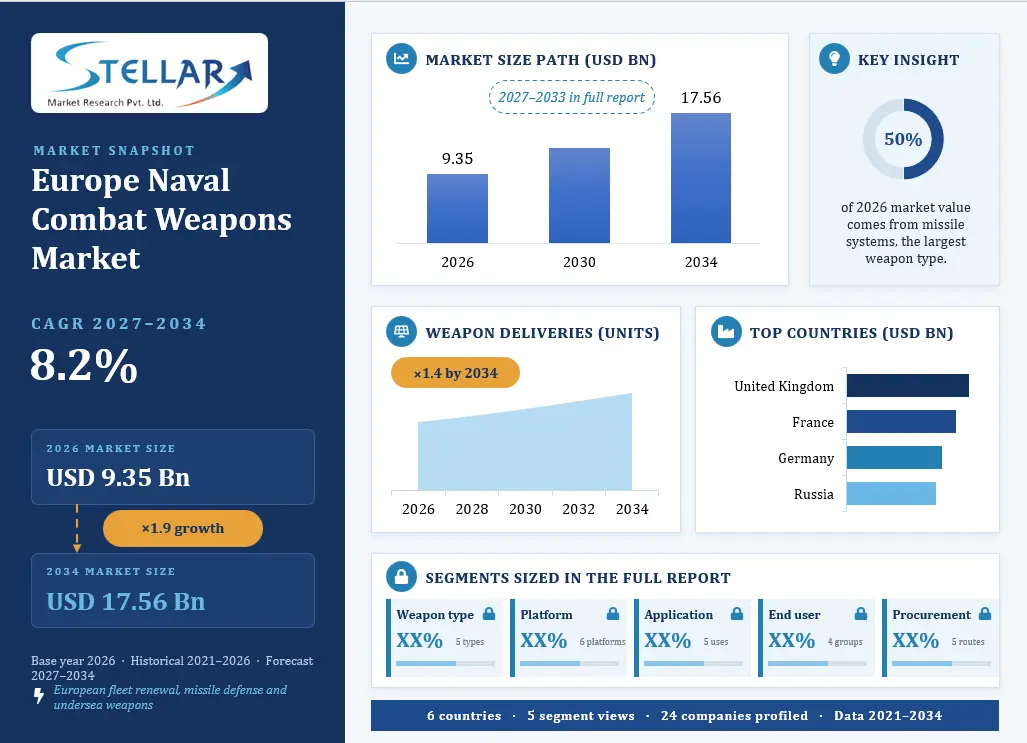
The Europe Naval Combat Weapons Market is valued at USD 9.35 billion in 2026 and is projected to reach USD 17.56 billion by 2034, growing at a CAGR of 8.2% during 2027–2034
The Europe Naval Combat Weapons Market is valued at USD 9.35 billion in 2026 and is projected to reach USD 17.56 billion by 2034, growing at a CAGR of 8.2% during 2027–2034, according to SMR. Naval combat weapons are the ship-, submarine- and unmanned-vessel-launched armaments that let navies sink ships, defend fleets against aircraft and missiles, hunt submarines and strike targets ashore, and the category spans guided missiles that dominate today’s revenue, naval guns, torpedoes, close-in weapon systems, and mines, countermeasures and directed-energy weapons that are moving into wider service.
This Europe Naval Combat Weapons Market analysis answers both sides of the search: what the market is worth for weapon manufacturers, shipbuilders, combat-system integrators and investors, and what navies, coast guards, defense ministries and procurement teams want to know, from what counts as a naval combat weapon to the naval missile systems market, naval gun systems market, naval torpedo systems market, close-in weapon systems market and anti-ship missile systems market. The report covers market overview, Europe Naval Combat Weapons Market industry landscape, market analysis, market insights, industry trends, market dynamics, market size, key players, competitive landscape, Europe Naval Combat Weapons Market segmentation, growth prospects, market opportunities, with a clear market outlook for stakeholders.
Missile systems and navy procurement anchor the market and the United Kingdom is the largest country market in Europe, but Europe Naval Combat Weapons Market growth is shifting toward Germany, air and missile defense, unmanned maritime systems and directed-energy and counter-drone weapons as fleet expansion, munition replenishment, undersea competition and drone-and-missile threats at sea widen the number of weapon-intensive missions. The analysis also looks at challenges, consumer behavior, market entry, emerging markets, market outlook, Europe Naval Combat Weapons Market research findings, market summary, revenue generated, growth drivers, market synopsis, market strategies across the naval defense weapons market.
SMR provides comprehensive analysis of the Europe Naval Combat Weapons Market size, share, weapon type, platform, application, end user, procurement route and country segmentation, the naval defense weapons market, strategic scenarios and growth opportunities. The report helps naval weapon manufacturers, shipbuilders and combat-system integrators, seeker, propulsion and warhead suppliers, defense ministries, navies, coast guards and investors decide which programs, segments and countries to prioritize through 2034. This Europe Naval Combat Weapons Market study of naval defense modernization also covers European naval missile systems, naval gun systems, naval torpedo systems and European shipborne weapon systems.
|
2026 | BASE YEAR |
2034 | FORECAST |
CAGR | 2027–2034 |
LARGEST COUNTRY |
|
USD 9.35 Bn |
USD 17.56 Bn |
8.2% |
United Kingdom |
Europe Naval Combat Weapons Market Overview: Size, Share, Trends and Outlook, 2026–2034
The market is measured at weapon-manufacturer revenue level across naval missile systems, naval gun systems, naval torpedo and anti-submarine weapons, close-in weapon systems, and naval mines, countermeasures and directed-energy weapons, including production, launchers and fire-control sold as part of weapon systems and munition replenishment and life-extension contracts. Ships and hulls, standalone radars, sonars and combat-management systems, aircraft-launched, land-based and army air-defense weapons, and unguided gun ammunition are excluded. Europe accounts for about 20.5% of the global total of USD 45.60 Bn in 2026, and country values add up to the regional total of USD 9.35 Bn.
Three shifts shape 2027–2034: demand is broadening from legacy anti-ship and point-defense weapons to long-range, multi-mission and layered air and missile defense weapons; value is moving toward munition replenishment, multi-year production contracts and co-production in Europe; and naval warfare is moving toward cheaper, higher-volume weapons, including directed energy, counter-drone systems and unmanned launchers, as fleets face drone and missile saturation. Manufacturers are answering with multi-year contracts, capacity expansion and supplier consolidation. This market synopsis reflects the key market dynamics, Europe Naval Combat Weapons Market industry fluctuations, economic factors, consumer behavior trends, demand and supply, competitive forces.
On a volume basis, SMR estimates weapon deliveries in Europe of about 4,450 units in 2026, rising to about 6,380 units by 2034 at a CAGR of roughly 4.6% during 2027–2034. Value grows faster than volume (8.2% versus 4.6% CAGR during 2027–2034) because the mix is shifting toward long-range missiles, interceptors, advanced torpedoes, directed-energy installations and replenishment contracts, lifting average revenue per unit from about USD 2.1 million in 2026 to about USD 2.8 million in 2034. Volume figures are modeled estimates of new-build deliveries of guided missiles, torpedoes, gun mounts, close-in weapon systems, mines and directed-energy installations; unguided gun ammunition is excluded.
To get more Insights: Request Free Sample Report
Key Findings: Eight Insights Shaping the Europe Naval Combat Weapons Market
SMR’s analysis of published market data, company announcements, budget documents and industry developments points to eight findings that explain where Europe Naval Combat Weapons Market growth and value are created through 2034. These market insights summarize the Europe Naval Combat Weapons Market forecast, market segmentation and competitive landscape in one view.
|
Sr. No. |
Findings |
Evidence |
So what |
|
1 |
The market grows about 1.9× by 2034 |
USD 9.35 Bn (2026) to USD 17.56 Bn (2034) at 8.2% CAGR during 2027–2034 |
Missile, seeker, rocket-motor and launcher capacity must scale in step with multi-year naval programs |
|
2 |
Missile systems are the base, mines, countermeasures and directed-energy weapons the growth edge |
Missile systems ~50% of 2026 value at 8.5% CAGR during 2027–2034; mines, countermeasures and directed-energy weapons 9.2% CAGR |
Established weapon lines fund the technology base while newer categories add upside |
|
3 |
The United Kingdom is the largest country market |
~18% of 2026 regional value (USD 1.68 Bn), with 7.8% CAGR during 2027–2034 |
Anchor-country programs set requirements and supplier selection for the region |
|
4 |
Germany is the fastest-growing major market |
9.8% CAGR during 2027–2034, adding USD 1.46 Bn by 2034; region as a whole grows at 8.2% |
New fleet programs and exports open revenue pools for local and foreign suppliers |
|
5 |
Air and missile defense remain the core application |
Air and missile defense ~34% of 2026 value at 9.7% CAGR during 2027–2034; anti-surface warfare ~28% |
Sensor fusion, interceptor depth and weapon integration anchor competitiveness |
|
6 |
Unmanned maritime systems outgrow the market |
Unmanned maritime systems 24.1% CAGR during 2027–2034 from 2% of 2026 value; mines, countermeasures and directed-energy weapons 9.2% CAGR |
Low-cost, distributed launch and new weapon types lift value from a small base |
|
7 |
Procurement is government-led and program-based |
Domestic procurement ~44%; cooperative programs ~22%; replenishment and life-extension contracts ~16% |
Budget cycles, export approvals and offsets shape contract timing and supplier selection |
|
8 |
Frigate programs reset weapon fits |
France’s fifth FDI (Mar 2026), Sweden’s four FDI (May 2026) and Aster load doubled to 32 (Nov 2026) |
Early program selection locks in supplier positions for the next two decades |
Europe Naval Combat Weapons Market Dynamics: Growth Drivers, Restraints, Opportunities and Trends
Europe Naval Combat Weapons Market Growth Drivers: Frigate and Submarine Programs, Layered Air Defense, Anti-Ship Missile Orders, NATO Readiness and Munition Stockpiles
The Europe Naval Combat Weapons Market is driven by new frigate and submarine programs, NATO readiness requirements and the need to deepen magazines. France ordered its fifth FDI frigate in March 2026, Sweden selected the FDI in May 2026 for four ships carrying Aster 30, CAMM-ER and the RBS15 anti-ship missile, and in November 2026 France finalized an order to double the Aster load of its FDI frigates from 16 to 32. Naval Strike Missile orders from Denmark and a Latvian coastal-defense system add demand on Europe’s northern flank. However, budgets, export approvals, industrial capacity and delivery timelines remain key market constraints. Demand is also shaped by market drivers, market challenges, technological advancements, Europe Naval Combat Weapons Market regulatory influences, emerging trends.
Technological advancements are creating additional growth opportunities through the Aster 15 and 30 and CAMM-ER interceptors, Exocet MM40 Block 3C and Naval Strike Missile anti-ship weapons, MU90 and Torpedo 47 torpedoes and a planned European supersonic strike missile under development by Kongsberg, Diehl Defence and MBDA. Germany is the fastest-growing major national market at 9.8% CAGR during 2027–2034, supported by Type 212CD submarines and naval modernization. These developments shape market drivers, emerging trends, competitive dynamics and long-term growth opportunities. Analysts also track market opportunities, innovation in the industry, macroeconomic factors, market growth factors, market constraints.
Europe Naval Combat Weapons Market Restraints: Fragmented Procurement, Production Capacity, Shipbuilding Delays and Russia Sanctions
Fragmented procurement and production capacity are the main restraints. European navies buy different national weapons for similar frigates, which limits economies of scale, and missile, rocket-motor and seeker capacity is concentrated in a few suppliers such as MBDA, Kongsberg, Saab and Naval Group. Export controls and political conditions add approval time, and currency and budget shifts affect purchasing power. Industry disruptors, Europe Naval Combat Weapons Market shifts, environmental factors, socioeconomic influences, market trends analysis, demand and supply dynamics shape supply and the constraints that suppliers must manage.
Platform timing and sanctions also limit growth. New frigates and submarines take years to deliver, so weapon fits follow ship schedules, and sanctions restrict Russia, whose market grows at only 4.6% CAGR during 2027–2034, the slowest in the region. Navies weigh the cost of high-end interceptors against cheap drones, and land-based fires and air-launched missiles compete for the same budgets. Market forces, economic indicators, industry evolution, Europe Naval Combat Weapons Market competitive landscape shifts, consumer preferences evolution, regulatory changes also influence how quickly new entrants can scale.
What Are the Biggest Europe Naval Combat Weapons Market Opportunities Through 2034?
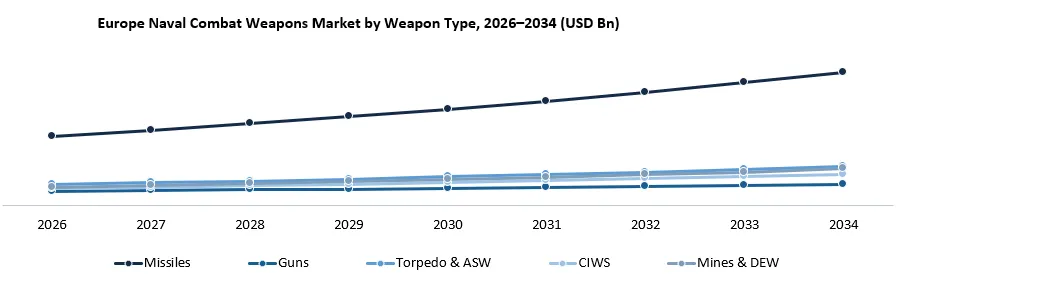
Layered air defense, frigate weapon fits and cooperative programs represent the most significant Europe Naval Combat Weapons Market opportunities because they extend revenue beyond single weapon sales into launchers, magazines and refits. Unmanned maritime systems are projected to grow at 24.1% CAGR during 2027–2034 from a 2% base, mines, countermeasures and directed-energy weapons at 9.2%, and air and missile defense at 9.7%, while missile systems, the largest weapon type, grow at 8.5%. Innovation impact, technology trends, market responsiveness, external market influences, market adaptability are assessed for each segment.
Cooperative production, Nordic and Baltic modernization and export platforms offer further routes to growth. Rest of Europe, which includes the Nordic, Baltic, Dutch, Polish and Greek navies, is projected to grow at 9.9% CAGR during 2027–2034 and Germany at 9.8%, while Rest of Europe, Germany and the United Kingdom add the largest absolute value gains. Cooperative programs, industrial participation and local final assembly can widen market access and shorten delivery cycles. Europe Naval Combat Weapons Market strategic market changes, market segmentation shifts, customer engagement dynamics, industry resilience create attractive segment-specific opportunities and untapped market areas.
Europe Naval Combat Weapons Market Trends: Long-Range Layered Weapons, Magazine Depth, Directed Energy and Unmanned Launch
Four Europe Naval Combat Weapons Market trends stand out through 2034. First, layered air defense: Aster, CAMM-ER and VL MICA NG combine on frigates with larger launch-cell counts. Second, common anti-ship fires: Exocet Block 3C, Naval Strike Missile and RBS15 compete for national and shared procurement frameworks. Third, northern-flank and coastal defense: Nordic and Baltic navies buy coastal missile systems and submarines. Fourth, European supplier consolidation and co-production: joint missile development and multi-nation buys aim to raise output. Market fluctuation analysis, growth catalysts, market volatility, market gap determine how naval weapon manufacturers respond.
Europe Naval Combat Weapons Market Segmentation: By Weapon Type, Platform, Application, End User and Procurement Route
Naval Missile Systems Market, Naval Gun Systems Market, Naval Torpedo Systems Market, Weapon Type and Platform
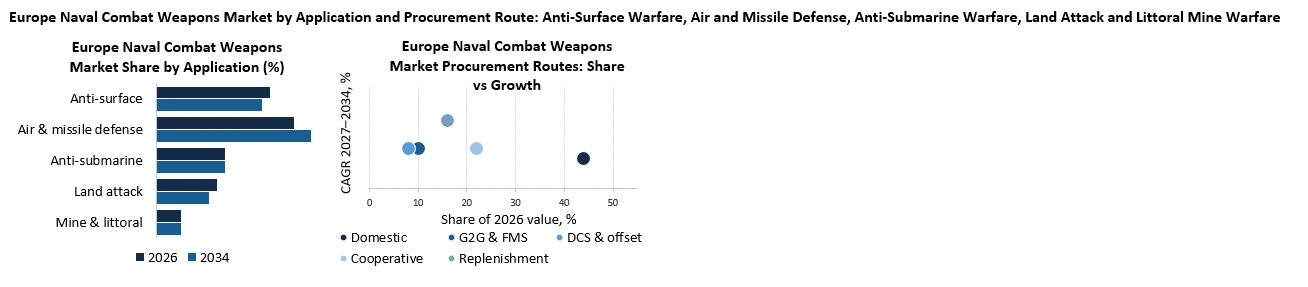
Missile systems dominate the Europe Naval Combat Weapons Market, accounting for approximately 50% of 2026 value, followed by torpedo & ASW weapons (15%) and mines, countermeasures and directed-energy weapons (13%). By platform, frigates & corvettes lead with a 32% share, while unmanned maritime systems are the fastest-growing category at a 24.1% CAGR during 2027–2034. By application, air & missile defense account for 34%, followed by anti-surface warfare (28%). Domestic procurement leads purchasing channels at 44%, followed by cooperative programs (22%) and replenishment & life-extension contracts (16%). Blue-water navies represent the largest end-user category, contributing approximately 44% of market value.
This Europe Naval Combat Weapons Market segmentation analysis examines weapon types, platforms, applications, end users and procurement routes, covering market shares, growth trends, competitive positioning and emerging opportunities. It applies market segment analysis, Europe Naval Combat Weapons Market industry segmentation, target market analysis, consumer demographics, product segmentation, geographic segmentation, market subsegments, niche markets, customer profiling, Europe Naval Combat Weapons Market share by segment, segment growth analysis, competitive segment landscape, emerging market segments, segment attractiveness, behavioral segmentation, segment-based marketing, customized market strategies, and then turns to Europe Naval Combat Weapons Market demographic profiling, market niche exploration, micro-segmentation, segmentation strategies, market segment dynamics, customer behavior segmentation, specialized market segments, unexplored market niches, Europe Naval Combat Weapons Market segment-specific trends, untapped market areas, segment-specific opportunities, tailored marketing strategies, market fragment analysis, unique market sectors, granular market breakdown, comprehensive market sector analysis across the naval missile systems market, naval gun systems market and naval torpedo systems market.
Naval Combat Weapon Types: Where Missile, Gun, Torpedo, Close-In and Mine, Countermeasure and Directed-Energy Demand Sits
Europe Naval Combat Weapons Market Regional Analysis: United Kingdom, France, Germany, Russia, Italy, Spain and Rest of Europe
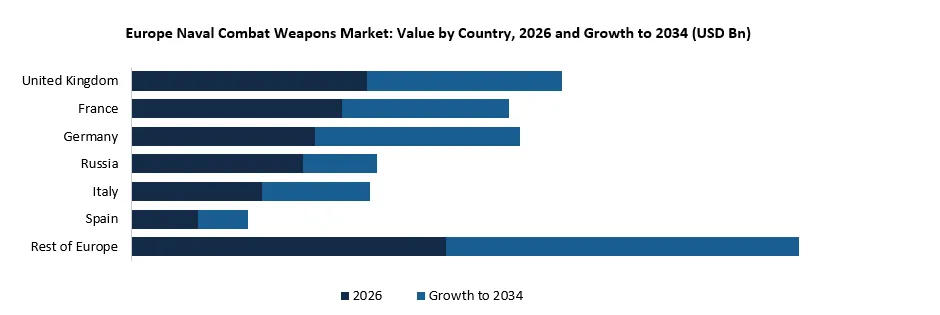
The United Kingdom is the largest national market in Europe, accounting for about 18% of regional value in 2026 and growing at 7.8% CAGR during 2027–2034, followed by France at 16% and 7.6% CAGR. France is supported by the FDI frigate series, Aster and Exocet production and a fifth FDI ordered in March 2026. Germany holds 14% of regional value and is the fastest-growing major market at 9.8% CAGR during 2027–2034, supported by Type 212CD submarines and naval modernization. Geographic analysis, Europe Naval Combat Weapons Market regional market trends, area-specific market dynamics, local market influences, market performance by region, regional market segmentation, geographical trends, regional economic factors, local consumer behavior, Europe Naval Combat Weapons Market regional market challenges show how local consumer behavior and regional economic factors influence naval weapon demand.
Russia holds about 13% of 2026 value and is projected to grow at only 4.6% CAGR during 2027–2034 as sanctions and industrial limits slow procurement. Italy (10%) and Spain (5%) grow at 7.8% and 7.4% CAGR during 2027–2034. Rest of Europe, about 24% of 2026 value, is projected to grow at 9.9% CAGR during 2027–2034, led by Sweden’s four-ship FDI program, Denmark’s additional Naval Strike Missile order and Latvia’s coastal-defense system.
The geographical analysis of the Europe Naval Combat Weapons Market examines area-specific opportunities, regional competitive landscape, market growth by location, region-specific industry outlook, local market entry strategies, regional market share, economic impact by region, Europe Naval Combat Weapons Market regional market development, market trends in specific regions, territorial dynamics.
Furthermore, it explores locational market nuances, area-centric market shifts, geographic market intricacies, regional consumer patterns, local economic factors, Europe Naval Combat Weapons Market regional market performance, regional market segmentation, territorial competitive landscape, demographic trends by region, localized market challenges, regionally-driven opportunities, locational market share, geo-strategic influences, Europe Naval Combat Weapons Market regional market entry strategies, area-centric growth factors, regional industry outlook, market trends in designated areas, geopolitical influences.
Europe Naval Combat Weapons Market Companies and Competitive Landscape: Who Are the Top European Naval Weapons Manufacturers and Players?
The Europe Naval Combat Weapons Market competitive landscape comprises distinct groups, including missile makers such as MBDA, Kongsberg, Saab, Diehl Defence and Leonardo; naval guns and close-in suppliers such as BAE Systems, Rheinmetall, Nammo and KNDS; torpedo makers such as Naval Group, Atlas Elektronik and WASS (Fincantieri); and shipbuilders and integrators such as Thyssenkrupp Marine Systems, Fincantieri, Navantia and Babcock. Russian suppliers such as Almaz-Antey and the Tactical Missiles Corporation serve a separate, sanctioned market. These companies compete across different weapon categories, making direct comparisons based solely on company revenue or market share unsuitable. Analysts compare company revenue, Europe Naval Combat Weapons Market company net sales, competitor analysis, industry rivals examination, competitive intelligence, market rivalry assessment, competitor benchmarking, competitive strategy review, industry player dynamics, Europe Naval Combat Weapons Market rivalry impact analysis, competitor evaluation, competitive landscape trends, competitive positioning, market rivalry intensity, competitor profiling, competitive advantage assessment, industry competition overview.
Competition is primarily influenced by technological capabilities, program contracts, production capacity, export approvals, pricing, local manufacturing partnerships and after-sales support. Established manufacturers benefit from national programs and multinational frameworks, while smaller players focus on niche weapons and domestic production. The competitive analysis evaluates company positioning, revenue, product portfolios, market presence, strategic partnerships, competitive advantages and emerging opportunities to assess the industry's overall competitive landscape. The study also covers Europe Naval Combat Weapons Market player strategies, competitive benchmark analysis, rival market share, competitive market evolution, competitor differentiation, market rival scrutiny, industry adversary exploration, competitive ecosystem analysis, Europe Naval Combat Weapons Market rivalry landscape intricacies, competitive matrix investigation, business opponent profiling, sectorial rivalry dynamics, competitive maneuver examination, competing force scrutiny, rivalry intensity mapping, opponent landscape divergence, Europe Naval Combat Weapons Market industry opposition tactics, strategic analysis.
Europe Naval Combat Weapons Market Recent Developments, Contract Awards and Industry Positioning
|
Period |
Development |
Why it matters |
|
Mar 2026 |
France ordered its fifth FDI frigate from Naval Group, the last in the planned class, with delivery planned for 2032 |
Secures serial FDI production and weapon demand for Aster, Exocet and MU90 |
|
Mar 2026 |
Kongsberg won a contract worth about USD 45.5 million for a Naval Strike Missile Coastal Defense System for Latvia |
Extends anti-ship missile demand to Baltic coastal defense |
|
May 2026 |
Sweden selected Naval Group’s FDI for four Luleå-class frigates, valued at about USD 4.25 billion, with Aster 30, CAMM-ER and RBS15 |
Creates a new northern-European buyer of layered air-defense and anti-ship missiles |
|
Aug 2026 |
Sweden formally signed the FDI frigate contract with France |
Locks in orders for the Aster, CAMM-ER and RBS15 weapon fit |
|
Oct 2026 |
Denmark ordered additional Naval Strike Missiles in a deal worth about USD 42 million |
Shows incremental anti-ship missile buying across the Nordic region |
|
Nov 2026 |
France finalized an order to double the Aster missile load of its FDI frigates from 16 to 32; Saab won an order of about SEK 2 billion for Sweden’s FDI weapon fit |
Confirms layered air-defense demand and a larger magazine per frigate |
Europe Naval Combat Weapons Market Scope: Inquire before buying
| Europe Naval Combat Weapons Market | |||
|---|---|---|---|
| Report Coverage | Details | ||
| Base Year: | 2026 | Forecast Period: | 2027–2034 |
| Historical Data: | 2021 to 2026 | Market Size in 2026: | USD 9.35 Billion |
| CAGR Period: 2027–2034 | 8.2% | Market Size in 2034: | USD 17.56 Billion |
| Segments Covered: | By Weapon Type | Naval Missile Systems; Naval Gun Systems; Naval Torpedo and ASW Weapons; Close-In Weapon Systems; Naval Mines, Countermeasures and Directed-Energy Weapons | |
| By Platform | Destroyers and Cruisers; Frigates and Corvettes; Submarines; Aircraft Carriers and Amphibious Ships; Patrol and Coastal Combatants; Unmanned Maritime Systems | ||
| By Application | Anti-Surface Warfare; Air and Missile Defense; Anti-Submarine Warfare; Land Attack and Naval Strike; Mine and Littoral Warfare | ||
| By End User | Blue-Water Navies; Regional and Littoral Navies; Coast Guards and Maritime Security Agencies; Naval Infantry and Special Warfare Forces | ||
| By Procurement Route | Domestic National Procurement; Government-to-Government and FMS Imports; Direct Commercial Sales and Offset-Linked Imports; Multinational Cooperative and Co-Production Programs; Munition Replenishment and Life-Extension Contracts | ||
Europe Naval Combat Weapons Market, By Country
United Kingdom
France
Germany
Russia
Italy
Spain
Rest of Europe (Sweden, Norway, Denmark, Poland, Netherlands, Greece, Finland and Others)
Europe Naval Combat Weapons Market, Key Players
A. Missile Manufacturers
- MBDA – France
- Kongsberg Defence & Aerospace – Norway
- Saab AB – Sweden
- Diehl Defence – Germany
- Leonardo S.p.A. – Italy
B. Naval Gun and Close-In Weapon Suppliers
- BAE Systems plc – United Kingdom
- Rheinmetall AG – Germany
- KNDS – France
- Nammo AS – Norway
C. Torpedo and Undersea Weapon Makers
- Naval Group – France
- Atlas Elektronik – Germany
- WASS Submarine Systems (Fincantieri) – Italy
D. Shipbuilders and Integrators
- Thyssenkrupp Marine Systems – Germany
- Fincantieri S.p.A. – Italy
- Navantia – Spain
- Babcock International Group – United Kingdom
- Damen Naval – Netherlands
E. Sensor, Combat System and Russian Suppliers
- Thales Group – France
- Hensoldt AG – Germany
- Almaz-Antey – Russia
- Tactical Missiles Corporation – Russia
Frequently Asked Questions
The United Kingdom holds the largest share at about 18% of regional value in 2026, followed by France at 16% and Germany at 14%. Germany is the fastest-growing major market at 9.8% CAGR during 2027–2034, while the region grows at 8.2% and holds about 20.5% of global value in 2026.
Missile systems are the largest weapon type at about 50% of 2026 value, while unmanned maritime systems (24.1% CAGR during 2027–2034), mines, countermeasures and directed-energy weapons (9.2% CAGR) and air and missile defense (9.7% CAGR) grow fastest. Replenishment and life-extension contracts grow at 9% CAGR during 2027–2034.
Leading names include MBDA, Kongsberg, Saab, Diehl Defence, Leonardo, BAE Systems, Rheinmetall, Naval Group, Atlas Elektronik, Thyssenkrupp Marine Systems, Fincantieri, Navantia, Babcock and Thales. They compete in different segments, from missiles and torpedoes to guns, directed energy and shipbuilding.
France’s FDI frigate series (fifth ship ordered March 2026, Aster load doubled to 32 in November 2026), Sweden’s four FDI frigates with Aster 30, CAMM-ER and RBS15, Germany’s Type 212CD submarines and Nordic and Baltic Naval Strike Missile orders lead demand.
1. Executive Market Landscape and Industry Overview
1.1. Europe Naval Combat Weapons Market Size (Value USD Billion & Volume Weapon Units), 2026–2034
1.2. Evolution of Naval Combat Weapons from Gun Cruisers and Anti-Ship Missiles to Networked Long-Range Strike
1.3. Definition, Scope and Classification of Naval Combat Weapons
1.4. Performance Envelope and Technical Characteristics of Naval Weapons
1.5. Role of Naval Weapons in Anti-Surface, Air Defense, Anti-Submarine and Land-Attack Missions
1.6. Integration of Directed-Energy, Hypersonic and Unmanned Launch Technologies
1.7. Key Findings and Strategic Takeaways
2. Europe Naval Combat Weapons Market Dynamics
2.1. Europe Naval Combat Weapons Market Trends
2.2. Europe Naval Combat Weapons Market Dynamics
2.2.1. Drivers
2.2.2. Restraints
2.2.3. Opportunities
2.3. Impact of the 2026 Iran Conflict on Munition Stocks and Demand
2.4. Porter’s Five Forces and Competitive Intensity
2.5. Market Gap and Growth Catalysts
3. Europe Naval Combat Weapons Market Macroeconomic Factors
3.1. Global Defense Expenditure and Naval Budget Trends
3.2. Shipbuilding Plans and Fleet Size Targets
3.3. Munition Stockpile Levels and Replenishment Funding
3.4. Inflation, Currency and Input-Cost Trends
3.5. Maritime Security Threats and Chokepoint Risk
3.6. Alliances, Defense Pacts and Burden-Sharing
3.7. Offset, Industrial Participation and Local Content Policies
4. Europe Naval Combat Weapons Market Industry Trends & Emerging Customer Requirements
4.1. Rising Demand for Long-Range and Hypersonic Strike Capability
4.2. Layered Air and Missile Defense Requirements
4.3. Low-Cost Interceptors and Cost-per-Engagement Pressure
4.4. Directed-Energy and Counter-Drone Requirements
4.5. Unmanned Surface and Underwater Weapon Platforms
4.6. Magazine Depth, Reload at Sea and Containerized Launchers
4.7. Fleet Modernization and Service-Life Extension Programs
5. Europe Naval Combat Weapons Market Value Chain & Business Ecosystem Landscape
5.1. Energetics, Rocket Motors and Raw Material Supply
5.2. Seeker, Guidance and Microelectronics Suppliers
5.3. Missile, Torpedo and Gun Manufacturers
5.4. Launcher, Magazine and Fire-Control Integrators
5.5. Shipbuilders and Platform Integrators
5.6. Testing, Range and Qualification Services
5.7. Sustainment, Replenishment and Life-Extension Providers
5.8. Navies, Coast Guards and Government Customers
6. Europe Naval Combat Weapons Market Product Portfolio & Classification Landscape
6.1. Naval Missile Systems
6.2. Naval Gun Systems
6.3. Naval Torpedo and Anti-Submarine Weapons
6.4. Close-In Weapon Systems
6.5. Naval Mines, Countermeasures and Directed-Energy Weapons
6.6. Experimental and Technology Demonstrator Weapons
7. Europe Naval Combat Weapons Market Performance Envelope & Technical Characteristics
7.1. Range, Speed and Warhead Performance
7.2. Guidance, Seeker and Datalink Technologies
7.3. Survivability and Electronic Warfare Resistance
7.4. Launch Cell, Canister and Tube Compatibility
7.5. Reliability, Storage Life and Maintenance
7.6. Cost per Round and Operating Economics
8. Europe Naval Combat Weapons Market Energetics, Materials & Raw Material Sourcing Landscape
8.1. Solid Rocket Propellants and Energetic Materials
8.2. Titanium, Aluminum and Composite Airframe Materials
8.3. Rare Earths, Magnets and Specialty Metals
8.4. Electronic Components and Microelectronics
8.5. Warhead and Explosive Materials
8.6. Supply Concentration and Material Risk Management
9. Europe Naval Combat Weapons Market Manufacturing & Industrial Production Landscape
9.1. Missile Airframe and Motor Production
9.2. Seeker and Electronics Assembly
9.3. Torpedo and Gun Mount Production
9.4. Automation, Digital Engineering and Quality Control
9.5. Test and Acceptance Facilities
9.6. Production Capacity, Backlog and Delivery Schedules
10. Europe Naval Combat Weapons Market Propulsion, Seekers & Guidance Technologies
10.1. Solid-Rocket and Ramjet Propulsion
10.2. Turbojet and Turbofan Cruise Engines
10.3. Active Radar, Infrared and Imaging Seekers
10.4. Inertial, Satellite and Datalink Guidance
10.5. Hypersonic Boost-Glide and Scramjet Technologies
10.6. Testing, Qualification and Sustainment
11. Naval Missile Programs and Applications
11.1. Land-Attack Cruise Missile Programs
11.2. Surface-to-Air and Ballistic Missile Defense Interceptors
11.3. Anti-Ship Cruise Missile Programs
11.4. Submarine-Launched Missile Programs
11.5. Export Competitions and Orders
12. Naval Gun & Close-In Weapon Programs
12.1. Medium-Caliber Naval Guns
12.2. Large-Caliber and Precision Guided Rounds
12.3. Close-In Weapon Systems and Remote Weapon Stations
12.4. Fire Control and Ammunition Handling
13. Torpedo & Anti-Submarine Weapon Applications
13.1. Heavyweight Submarine-Launched Torpedoes
13.2. Lightweight Ship- and Air-Launched Torpedoes
13.3. Anti-Submarine Rockets and Depth Weapons
13.4. Torpedo Countermeasures and Decoys
14. Mines, Countermeasures & Littoral Warfare Applications
14.1. Naval Mines and Mine-Laying Systems
14.2. Mine Countermeasures and Unmanned Mine Hunting
14.3. Soft-Kill Decoys and Chaff Systems
14.4. Littoral and Coastal Defense Weapons
15. Directed-Energy & Counter-Drone Weapons
15.1. Shipboard High-Energy Lasers
15.2. Optical Dazzlers and Non-Kinetic Systems
15.3. High-Power Microwave and Electronic Attack
15.4. Power, Cooling and Ship-Integration Requirements
16. Unmanned & Distributed Launch Systems
16.1. Unmanned Surface Vessels with Weapon Payloads
16.2. Unmanned Underwater Vehicles and Torpedo Carriers
16.3. Containerized and Modular Launchers
16.4. Teaming of Crewed and Uncrewed Ships
17. Fire Control, Sensors & Combat Management Integration
17.1. Radar and Sonar Interfaces
17.2. Combat Management System Integration
17.3. Electronic Warfare and Self-Protection Interfaces
17.4. Targeting, Datalinks and Over-the-Horizon Cueing
17.5. Cyber Resilience and Software Updates
18. Launchers, Vertical Launch Systems & Magazine Integration
18.1. Vertical Launch Systems and Cell Counts
18.2. Canister, Tube and Inclined Launchers
18.3. Reload, Cross-Deck and Resupply at Sea
18.4. Submarine Torpedo Rooms and Vertical Payload Modules
19. Sustainment, Life-Extension & Replenishment
19.1. Performance-Based Logistics and Sustainment Contracts
19.2. Mid-Life Upgrades and Technology Refresh
19.3. Munition Replenishment and Multi-Year Buys
19.4. Depot Maintenance and Recertification
19.5. Predictive Maintenance and Digital Inventory Management
20. Naval Weapon Procurement, Contracting & Sales Models
20.1. Domestic and Direct Government Contracting
20.2. Multi-Year, Block-Buy and Framework Agreements
20.3. Government-to-Government and FMS Channels
20.4. Direct Commercial Sales and Offset-Linked Imports
20.5. Cooperative Development and Co-Production Models
21. Naval Weapon Pricing, Production Economics & Lifecycle Cost Structure
21.1. Average Unit Cost by Weapon Class
21.2. Learning Curves and Rate Production Effects
21.3. Cost per Engagement and Magazine Economics
21.4. Warhead, Seeker and Motor Cost Drivers
21.5. Lifecycle Cost and Total Ownership Cost
22. Naval Weapon Supply Chain, Offsets & Export Control
22.1. Export Control Regimes, Licensing and Offset Obligations
22.2. Critical Material and Component Supply Risk
22.3. Dual-Source and Second-Source Strategies
22.4. Logistics, Spare Parts and Delivery Scheduling
23. Naval Weapon Sustainability & Environmental Impact
23.1. Energetics Manufacturing and Emissions
23.2. Range Testing and Marine Environmental Considerations
23.3. Demilitarization and Disposal of Obsolete Munitions
23.4. Recycling and Materials Recovery
24. Naval Weapon Regulatory Compliance & Qualification
24.1. Insensitive Munitions and Safety Qualification Standards
24.2. Arms Export Controls and End-Use Rules
24.3. Shock, Vibration and Environmental Test Standards
24.4. Treaty, Sanctions and Humanitarian Rules
25. Europe Naval Combat Weapons Market Regional & Country-Level Landscape
25.1. United Kingdom Naval Weapon Programs and Demand
25.2. France Naval Weapon Programs and Demand
25.3. Germany Naval Weapon Programs and Demand
25.4. Russia Naval Weapon Programs and Demand
25.5. Italy Naval Weapon Programs and Demand
26. Europe Naval Combat Weapons Market: Market Size and Forecast by Segmentation (Value USD Billion & Volume Weapon Units) (2026–2034)
26.1. Europe Naval Combat Weapons Market Size and Forecast, By Weapon Type
26.1.1. Naval Missile Systems
26.1.2. Naval Gun Systems
26.1.3. Naval Torpedo and ASW Weapons
26.1.4. Close-In Weapon Systems
26.1.5. Naval Mines, Countermeasures and Directed-Energy Weapons
26.2. Europe Naval Combat Weapons Market Size and Forecast, By Platform
26.2.1. Destroyers and Cruisers
26.2.2. Frigates and Corvettes
26.2.3. Submarines
26.2.4. Aircraft Carriers and Amphibious Ships
26.2.5. Patrol and Coastal Combatants
26.2.6. Unmanned Maritime Systems
26.3. Europe Naval Combat Weapons Market Size and Forecast, By Application
26.3.1. Anti-Surface Warfare
26.3.2. Air and Missile Defense
26.3.3. Anti-Submarine Warfare
26.3.4. Land Attack and Naval Strike
26.3.5. Mine and Littoral Warfare
26.4. Europe Naval Combat Weapons Market Size and Forecast, By End User
26.4.1. Blue-Water Navies
26.4.2. Regional and Littoral Navies
26.4.3. Coast Guards and Maritime Security Agencies
26.4.4. Naval Infantry and Special Warfare Forces
26.5. Europe Naval Combat Weapons Market Size and Forecast, By Procurement Route
26.5.1. Domestic National Procurement
26.5.2. Government-to-Government and FMS Imports
26.5.3. Direct Commercial Sales and Offset-Linked Imports
26.5.4. Multinational Cooperative and Co-Production Programs
26.5.5. Munition Replenishment and Life-Extension Contracts
26.6. Europe Naval Combat Weapons Market Size and Forecast, By Country
26.6.1. United Kingdom
26.6.2. France
26.6.3. Germany
26.6.4. Russia
26.6.5. Italy
26.6.6. Spain
26.6.7. Rest of Europe
27. Europe Naval Combat Weapons Market Competitive Landscape
27.1. SMR Competition Matrix
27.2. Market Share and Positioning of Key Players
27.3. Company Benchmarking
27.3.1. Product Portfolio
27.3.2. Production Capacity
27.3.3. Regional Presence
27.3.4. Contract Backlog
27.3.5. Financial Performance
27.3.6. Strategic Initiatives
28. Missile & Strike Weapon Manufacturers
28.1. Land-Attack and Strike Missile Manufacturers
28.2. Anti-Ship Missile Manufacturers
28.3. Air and Missile Defense Interceptor Manufacturers
28.4. Hypersonic and Next-Generation Missile Developers
29. Gun, Close-In & Directed-Energy Weapon Manufacturers
29.1. Naval Gun and Ammunition Manufacturers
29.2. Close-In Weapon System Manufacturers
29.3. Directed-Energy Weapon Developers
29.4. Fire-Control and Gun-Mount Suppliers
30. Undersea Weapon Manufacturers
30.1. Heavyweight Torpedo Manufacturers
30.2. Lightweight Torpedo Manufacturers
30.3. Mine and Countermeasure Manufacturers
30.4. Unmanned Undersea Weapon Developers
31. Fire-Control, Sensor & Tier-1 Subsystem Suppliers
31.1. Radar and Sonar Suppliers
31.2. Combat Management System Suppliers
31.3. Seeker, Motor and Warhead Suppliers
31.4. Launcher and Magazine Suppliers
32. Shipbuilders, Integrators & Sustainment Service Providers
32.1. Surface Combatant Shipbuilders
32.2. Submarine Shipbuilders
32.3. Weapon Integration and Sustainment Providers
32.4. Training, Simulation and Test Providers
33. Europe Naval Combat Weapons Market Companies' Strategies & Expansion Plans
33.1. Expansion of Production Lines and Delivery Capacity
33.2. Multi-Year Contracts and Framework Agreements
33.3. Co-Production and Local Assembly Partnerships
33.4. Technology Investment in Hypersonic, Directed-Energy and Autonomy
33.5. Digital Engineering and Sustainment Strategies
34. Europe Naval Combat Weapons Market SWOT, Investments & Strategic Developments
34.1. Competitive Strengths of Established Weapon Manufacturers
34.2. Weaknesses and Capacity Constraints
34.3. Opportunities and Threats
34.4. Recent Investments, Contracts and Strategic Developments
35. Europe Naval Combat Weapons Market Competitive Outlook & Market Positioning
35.1. Competitive Dynamics Across Weapon Categories
35.2. Role of Cooperation and Consolidation
35.3. Entry Barriers and New-Entrant Strategies
35.4. Future Competitive Landscape Through 2034
36. Company Profile: Key Players
Detailed Profile Considering the Parameters
- Overview
- Business Portfolio
- Naval Weapon Product Portfolio
- Weapon Specifications and Performance Envelope
- Platform Integration and Product Availability
- Manufacturing Facilities and Production Capacity
- Supply Chain and Sourcing Network
- Guidance, Seeker and Propulsion Capabilities
- Order Backlog, Delivery and Support Network
- Total Company Revenue
- Naval Weapon-Related Revenue, Where Available
- Geographic Presence
- Certifications and Qualification Standards
- SWOT Analysis
- Strategic Analysis
- Recent Developments
37. Key Players – Europe Naval Combat Weapons Market
Missile Manufacturers
France, Norway, Sweden, Germany and Italy
- MBDA
- Kongsberg Defence & Aerospace
- Saab AB
- Diehl Defence
- Leonardo S.p.A.
Naval Gun and Close-In Weapon Suppliers
United Kingdom, Germany, France and Norway
- BAE Systems plc
- Rheinmetall AG
- KNDS
- Nammo AS
Torpedo and Undersea Weapon Makers
France, Germany and Italy
- Naval Group
- Atlas Elektronik
- WASS Submarine Systems (Fincantieri)
Shipbuilders and Integrators
Germany, Italy, Spain, United Kingdom and Netherlands
- Thyssenkrupp Marine Systems
- Fincantieri S.p.A.
- Navantia
- Babcock International Group
- Damen Naval
Sensor, Combat System and Russian Suppliers
France, Germany, Netherlands and Russia
- Thales Group
- Hensoldt AG
- Almaz-Antey
- Tactical Missiles Corporation
38. Key Findings
39. Strategic Moves & Industry Outlook
40. Research Methodology