ENG
ENG Japanese
  French
  German
  Korean
U.S. Delta Robots Market Size, Share, Growth Trends, Industry Analysis, Key Players, Investment Opportunities and Forecast 2026-2034
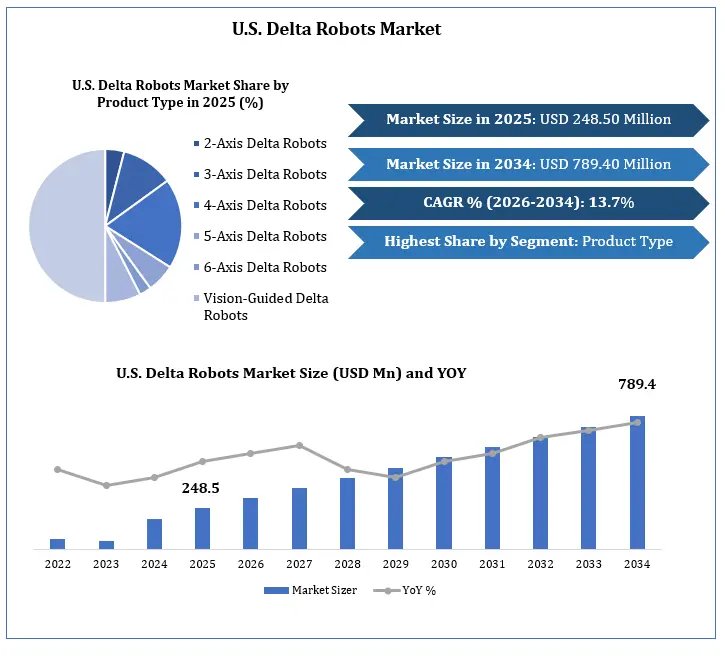
The U.S. Delta Robots Market was valued at USD 248.50 Million in 2025 and is projected to reach USD 789.40 Million by 2034, reflecting a 13.7% CAGR.
Growth is driven by increasing adoption of automation across manufacturing facilities, expansion of e-commerce fulfilment centres, growing labor shortages in logistics and industrial sectors, rising implementation of Industry 4.0 and smart factory initiatives, and increasing demand for high-speed pick-and-place, packaging, and sorting solutions. In addition, advancements in machine vision technologies, AI-integrated robotics, and intelligent motion control systems are further supporting market growth.
U.S. Delta Robots Market Overview
As the U.S. Delta Robots Market continues to expand, Delta robot technology has become a critical component of industrial automation systems across manufacturing, food processing, pharmaceuticals, logistics, electronics, and consumer goods industries. Delta robots are parallel robots designed for high-speed pick-and-place, sorting, packaging, assembly, and material handling applications. Their lightweight design, high precision, and rapid cycle times make them ideal for modern automated production environments.
The growth of the U.S. Delta Robots Market can be attributed to increasing automation investments across warehouses, factories, and distribution centers, driven by labor shortages, rising labor costs, and the need for higher operational efficiency. Growing adoption of autonomous production systems, expansion of smart manufacturing facilities, and increasing investment in warehouse automation are boosting demand for Delta robot solutions. Furthermore, developments in machine vision, AI-powered robotics, and collaborative robotic systems are enhancing robot performance and accelerating adoption across industrial and commercial sectors.
To get more Insights: Request Free Sample Report
U.S. Delta Robots Market Dynamics
U.S. Delta Robots Market Drivers
Increasing Adoption of Industrial Automation Driving Delta Robot Deployment
According to automation industry trends, manufacturers across the United States are increasingly investing in robotics solutions to improve productivity and operational efficiency. Delta robots have become an essential component in automated production lines due to their speed, precision, and ability to handle repetitive tasks. As manufacturers continue to modernize facilities and implement Industry 4.0 strategies, demand for Delta robots continues to rise.
Growth in E-Commerce and Fulfillment Centers
The rapid growth of e-commerce operations across the United States is driving demand for warehouse automation technologies. Delta robots are increasingly deployed for sorting, order picking, packaging, and parcel handling applications. Major retailers, logistics providers, and third-party fulfillment companies are investing heavily in robotic automation to improve throughput and reduce operational costs.
Investment in Smart Manufacturing Facilities
Growing investments in smart factories and digital manufacturing infrastructure are accelerating Delta robot adoption. These robots enable flexible production processes, improve product quality, reduce downtime, and support real-time production monitoring. Manufacturers across automotive, electronics, pharmaceutical, and food processing industries are integrating Delta robots into advanced manufacturing systems.
U.S. Delta Robots Market Opportunities
Expansion of AI-Powered Vision Systems
The increasing integration of artificial intelligence and machine vision technologies creates significant opportunities for Delta robot manufacturers. Advanced vision-guided robots can identify, inspect, sort, and manipulate products with greater accuracy, enabling deployment in more complex industrial applications.
Growth of Pharmaceutical Automation
Increasing automation across pharmaceutical manufacturing and packaging facilities creates opportunities for Delta robots. High-speed robotic systems are increasingly used for packaging medicines, assembling medical devices, quality inspection, and laboratory automation processes.
Development of Flexible Manufacturing Systems
The growing need for customized production and flexible manufacturing environments is expected to create demand for advanced Delta robot solutions capable of rapid reconfiguration and multi-product handling.
U.S. Delta Robots Market Challenges
High Initial Capital Investment
The implementation of Delta robot systems requires significant investment in robotics hardware, vision systems, software integration, and facility upgrades. This remains a challenge for small and medium-sized manufacturers.
Complex System Integration
Integrating Delta robots into existing production lines often requires process redesign, employee training, and software customization, increasing deployment complexity and implementation time.
Shortage of Skilled Automation Professionals
The growing demand for robotics engineers, automation specialists, and maintenance professionals continues to create workforce challenges for organizations deploying advanced robotic systems.
U.S. Delta Robots Market Trends
Growing Adoption of Vision-Guided Delta Robots
Manufacturers are increasingly integrating machine vision systems with Delta robots to improve object recognition, quality inspection, sorting accuracy, and packaging efficiency.
Expansion of Collaborative Delta Robots
Collaborative robotic systems are gaining popularity across manufacturing facilities because they can safely operate alongside human workers while improving productivity and operational flexibility.
AI-Enabled Predictive Maintenance
Artificial intelligence is increasingly being used to monitor robot performance, predict equipment failures, reduce downtime, and optimize maintenance schedules.
U.S. Delta Robots Market Segmentation 2025
By Product Type
The 4-Axis Delta Robots product type is the largest segment in the market, having an estimated market share of around 44%. The segment's dominance is attributed to increasing adoption across packaging, food processing, electronics assembly, and logistics applications requiring high-speed motion and flexibility. Vision-Guided Delta Robots represent one of the fastest-growing segments due to increasing demand for intelligent automation systems. 3-Axis Delta Robots continue to be widely used for conventional pick-and-place applications, while higher-axis configurations are gaining traction in advanced manufacturing environments.

By Component
Robot Arms dominate the component segment with around 28% market share, as they represent the primary mechanical structure of Delta robot systems. Controllers account for nearly 21%, driven by growing demand for intelligent motion control. Vision Systems hold approximately 16% share due to increasing adoption of machine vision technologies. Servo Motors contribute about 14%, while End Effectors represent 10%. Sensors account for around 7%, and Software & Analytics solutions contribute approximately 4%.
By Payload Capacity
The 1-3 Kg Payload Capacity segment leads the market with approximately 39% share, driven by widespread use in packaging, food processing, and electronics assembly operations. The Up to 1 Kg segment accounts for approximately 28%, while the 3-8 Kg segment represents nearly 23% of the market. Payload capacities above 8 Kg account for the remaining market share, mainly used in industrial material handling applications.

By Application
Packaging and Pick-and-Place applications led the market with approximately 41% share in 2025, supported by growing automation across manufacturing and logistics facilities. Sorting applications accounted for nearly 23%, while Assembly represented approximately 18%. Material Handling contributed around 11%, and Palletizing and Quality Inspection applications accounted for the remaining market share.
By End-Use Industry
Food & Beverage led the market with approximately 29% share in 2025, supported by increasing adoption of automated packaging and processing solutions. Logistics & Warehousing accounted for nearly 24%, driven by e-commerce growth and warehouse automation investments. Electronics & Semiconductor represented approximately 18%, while Pharmaceuticals contributed around 14%. Consumer Goods, Automotive, Healthcare, and other industries accounted for the remaining market share.
U.S. Delta Robots Market Share Analysis, 2025
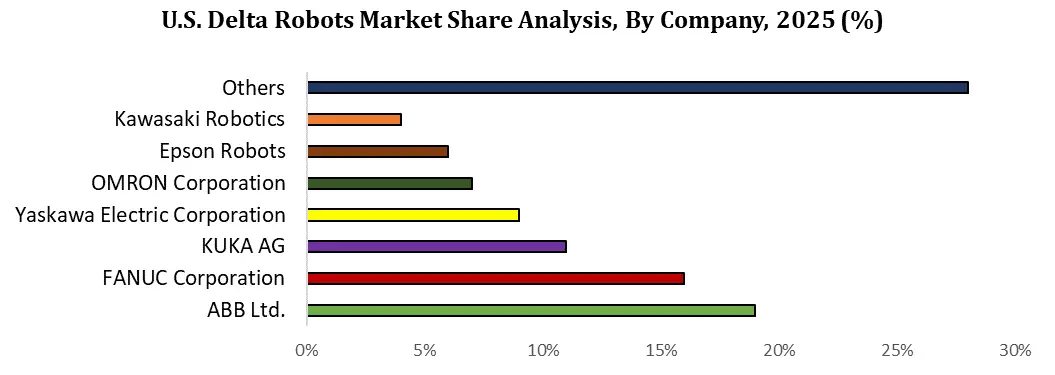
The U.S. Delta Robots Market remains moderately consolidated, with leading automation companies accounting for a significant portion of overall market revenue. Established robotics manufacturers benefit from strong distribution networks, advanced automation portfolios, extensive system integration capabilities, and long-standing relationships with manufacturing and logistics customers. ABB Ltd. and FANUC Corporation collectively account for a substantial share of the market, while KUKA AG, Yaskawa Electric Corporation, OMRON Corporation, and Epson Robots continue expanding their presence through technological innovation and AI-enabled automation solutions.
U.S. Delta Robots Market Recent Market Developments
On March 2025, ABB expanded its FlexPicker Delta robot portfolio with enhanced machine vision and AI-enabled automation capabilities designed for food processing, packaging, and pharmaceutical manufacturing applications.
On July 2025, FANUC America introduced next-generation high-speed Delta robots optimized for warehouse automation, parcel sorting, and e-commerce fulfillment center operations.
On February 2026, Omron Automation launched intelligent Delta robotic systems integrating AI-powered vision inspection and predictive maintenance technologies for smart manufacturing environments.
On May 2026, Yaskawa Electric announced advanced motion control software upgrades designed to improve Delta robot accuracy, speed, and operational efficiency in industrial production facilities.
|
U.S. Delta Robots Market |
|||
|
Report Coverage |
Details |
||
|
Base Year: |
2025 |
Forecast Period: |
2026-2034 |
|
Historical Data: |
2020 to 2025 |
Market Size in 2025: |
USD 248.50 Mn. |
|
Forecast Period 2026 to 2034 CAGR: |
13.7% |
Market Size in 2034: |
USD 789.40 Mn. |
|
Segments
|
By Product Type |
|
|
|
By Payload Capacity
|
|
||
|
By Component |
|
||
|
|
By Application
|
|
|
|
|
By End User |
|
|
U.S. Delta Robots Market Key Players
- ABB Ltd.
- FANUC Corporation
- KUKA AG
- Yaskawa Electric Corporation
- OMRON Corporation
- Epson Robots
- Kawasaki Robotics
- Codian Robotics
- Bosch Rexroth Corporation
- Rockwell Automation, Inc.
- Others
Frequently Asked Questions
The market is projected to reach USD 789.40 Million by 2034, growing at a CAGR of 13.7% during the forecast period, supported by increasing automation investments, AI-powered robotics technologies, and warehouse modernization initiatives.
4-Axis Delta Robots hold the largest market share, accounting for approximately 44% of the market in 2025. Their dominance is attributed to superior flexibility, speed, and suitability for packaging, assembly, and material handling applications.
Delta robot adoption is increasing due to labor shortages, growth in e-commerce fulfillment operations, rising warehouse automation investments, expansion of Industry 4.0 initiatives, and increasing demand for high-speed robotic packaging and sorting systems.
1. U.S. Delta Robots Market: Executive Summary
1.1 U.S. Delta Robots Market Size and Forecast (USD Million)
1.2 Market Definition
1.3 Market Segmentation
1.4 Research Timelines
1.5 Assumptions
1.6 Limitation
2. U.S. Delta Robots Market: Research Methodology
2.1 Data Mining
2.2 Secondary Research
2.3 Primary Research
2.4 Subject Matter Expert Advice
2.5 Quality Check
2.6 Final Review
2.7 Data Triangulation
2.8 Top-Down Approach
2.9 Bottom-Up Approach
2.10 Research Flow
2.11 Data Sources
3. U.S. Delta Robots Market: Market Attractiveness Mapping
3.1 U.S. Delta Robots Market Overview
3.2 Competitive Analysis: Funnel Diagram (Tier 1, Tier 2, Tier 3)
3.3 U.S. Delta Robots Market Absolute Market Opportunity
3.4 U.S. Delta Robots Market Attractiveness Analysis, By Axis Type
3.5 U.S. Delta Robots Market Attractiveness Analysis, By Payload Capacity
3.6 U.S. Delta Robots Market Attractiveness Analysis, By Application
3.7 U.S. Delta Robots Market Attractiveness Analysis, By End-Use Industry
3.8 Future Market Opportunities
4. U.S. Delta Robots Market: Market Outlook
4.1 U.S. Delta Robots Market Evolution
4.2 U.S. Delta Robots Market Outlook
4.3 Market Drivers
4.4 Market Restraints
4.5 Market Trends
4.6 Market Opportunity
4.7 Porter’s Five Forces Analysis
4.7.1 Threat of New Entrants
4.7.2 Bargaining Power of Suppliers
4.7.3 Bargaining Power of Buyers
4.7.4 Threat of Substitute Products
4.7.5 Competitive Rivalry of Existing Competitors
4.8 Value Chain Analysis
4.9 Pricing and Cost Structure
4.10 Manufacturing and Supply Chain Analysis
4.11 E-commerce and Warehouse Automation Impact Analysis
4.12 Geopolitical Impact Analysis on U.S. Delta Robots Market
4.13 Regulatory Standards & Policy Landscape
4.14 Sustainability and Energy Efficiency Analysis
4.15 Technology Analysis
5. U.S. Delta Robots Market: By Axis Type (2026-2034)
5.1 2-Axis Delta Robots
5.2 3-Axis Delta Robots
5.3 4-Axis Delta Robots
5.4 5-Axis Delta Robots
5.5 6-Axis Delta Robots
6. U.S. Delta Robots Market: By Payload Capacity (2026-2034)
6.1 Up to 1 kg
6.2 1–3 kg
6.3 3–8 kg
6.4 Above 8 kg
7. U.S. Delta Robots Market: By Application (2026-2034)
7.1 Pick and Place
7.2 Packaging
7.3 Assembly
7.4 Sorting
7.5 Material Handling
7.6 Palletizing
8. U.S. Delta Robots Market: By End-Use Industry (2026-2034)
8.1 Food & Beverage
8.2 Electronics & Semiconductor
8.3 Pharmaceuticals
8.4 Consumer Goods
8.5 Logistics & Warehousing
8.6 Cosmetics & Personal Care
8.7 Others
9. SMR Competitive Matrix
10. U.S. Delta Robots Market: Company Benchmarking
11. U.S. Delta Robots Market: Company Profiles
11.1 Each Profile Covers:
11.2 Company Overview
11.3 Business Portfolio
11.4 Financial Overview
11.5 Industry Focus
11.6 Strategic Analysis
11.7 SWOT Analysis
11.8 Recent Developments
11.9 Key Players
1. ABB Ltd.
2. FANUC America Corporation
3. KUKA Robotics Corporation
4. Yaskawa Motoman Robotics
5. Epson Robots
6. Omron Automation Americas
7. Kawasaki Robotics (USA), Inc.
8. Codian Robotics (ABB Group)
9. Bosch Rexroth Corporation
10. Mitsubishi Electric Automation, Inc.
11. Others
12. Risk Assessment and Scenario Analysis
13. Strategic Opportunity
14. Investments & Funding Analysis
15. Strategic Roadmap
15.1 Short-Term Roadmap 2026–2027
15.2 Mid-Term Roadmap 2028–2029
15.3 Long-Term Roadmap 2030–2034
16. Analyst Recommendations
16.1 Recommendations for Delta Robot Manufacturers
16.2 Recommendations for Investors
16.3 Recommendations for New Entrants
16.4 Recommendations for System Integrators and Automation Providers
16.5 Recommendations for Consulting and Strategy Teams