ENG
 Japanese
 French
 German
 Korean

US Main Battle Tank (MBT) Market Size, Share, Trends & Forecast 2026–2034
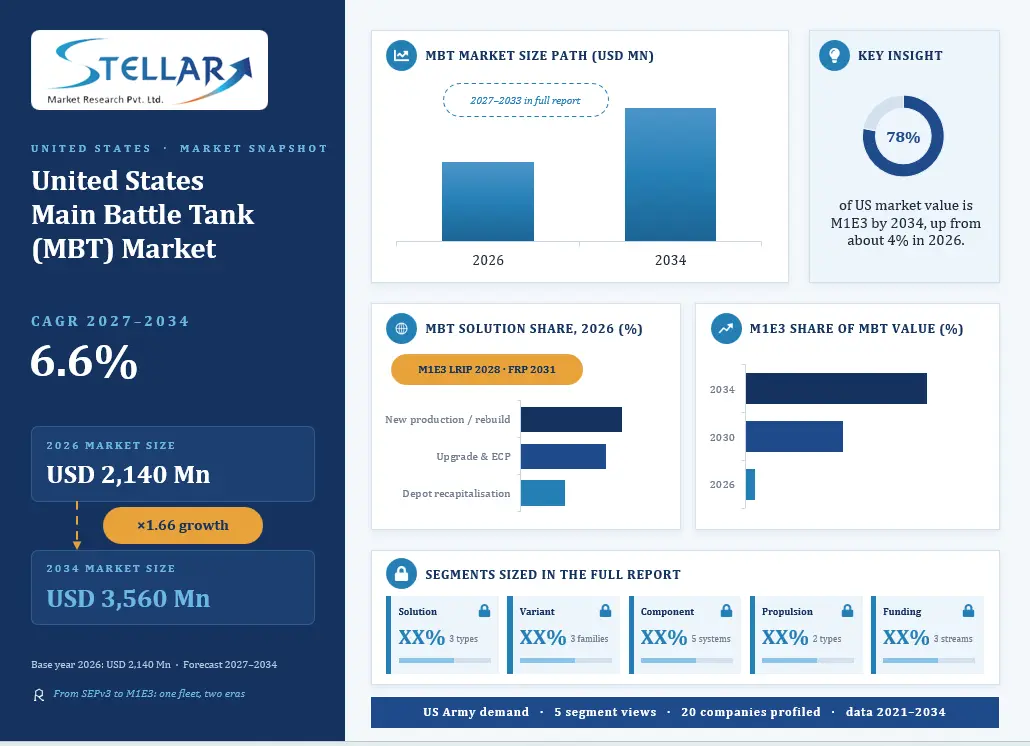
The US Main Battle Tank (MBT) Market is valued at USD 2.14 billion in 2026 and is expected to reach USD 3.56 billion by 2034, growing at a CAGR of 6.6% during the forecast period, according to Stellar Market Research.
US Main Battle Tank (MBT) Market Summary
The US Main Battle Tank (MBT) Market is valued at USD 2.14 billion in 2026 and is expected to reach USD 3.56 billion by 2034, growing at a CAGR of 6.6% during the forecast period, according to Stellar Market Research.
The US main battle tank (MBT) market stands at a structural turning point. The United States has not ordered a brand-new tank hull since the early 1990s; every Abrams tank delivered since then is a remanufactured hull, rebuilt at the Joint Systems Manufacturing Center (JSMC) in Lima, Ohio. That rebuild-led model now faces its biggest change in four decades. In September 2023, the US Army cancelled the planned M1A2 SEPv4 upgrade and launched the M1E3 Abrams, a lighter, hybrid-electric successor. Its first early prototype was unveiled in Detroit in January 2026, roughly six years ahead of the original 2032 plan, which speeds up US Army tank modernisation and brings new-vehicle value into the market far earlier than expected.
For defence contractors, sub-tier suppliers and investors, the M1E3 transition redefines where value sits in the US Abrams tank market. Rebuild-led revenue tied to the M1A2 SEPv3 gives way to new-content opportunities in hybrid-electric propulsion, active protection systems (APS), open-architecture vetronics and AI-enabled fire control. Depot sustainment of the legacy Abrams fleet continues to provide a stable revenue floor. This US MBT market report quantifies that shift by solution, variant, component, propulsion, and funding stream, and benchmarks the companies best placed to capture M1E3 content through 2034.
To get more Insights: Request Free Sample Report
Key Market Takeaways
- New production and rebuild work holds the largest share of the US main battle tank market, about 44% of 2026 value, as the value base shifts from SEPv3 rebuilds to M1E3 vehicles.
- M1E3 grows from about 4% of US market value in 2026 to about 42% in 2030 and about 78% by 2034 in the base case.
- Market value dips slightly in 2027 as SEPv3 deliveries taper, then rises steadily from 2028 as M1E3 engineering, test vehicles, and low-rate production add new value.
- Mobility and powertrain shows the biggest component change, as the AGT-1500 gas turbine gives way to a hybrid-electric architecture.
- General Dynamics Land Systems holds the large majority of US MBT market value as prime contractor for the Abrams and M1E3; competition takes place one tier down.
- Foreign Military Sales are excluded from US market value but keep JSMC Lima and sub-tier suppliers loaded during the SEPv3-to-M1E3 gap.
FIVE FORCES RESHAPING THE US MAIN BATTLE TANK INDUSTRY
|
01 M1E3 TRANSITION Prototypes ahead of plan |
02 HYBRID DRIVE 40–50% fuel saving |
03 SURVIVABILITY APS and counter-UAS |
04 OPEN SYSTEMS Faster upgrades |
05 FMS DEMAND Industrial base loading |
US Main Battle Tank (MBT) Market Overview
US Main Battle Tank Industry Definition and Scope
The US Main Battle Tank (MBT) Market covers US Army spending on Abrams main battle tanks within the wider US armoured vehicle market: new production and rebuild of vehicles, upgrades and engineering change proposals, and depot recapitalisation at Anniston Army Depot and JSMC Lima. Procurement, RDT&E and operations and maintenance accounts are tracked separately. Foreign Military Sales work is analysed as industrial context but excluded from US market value, so export orders do not inflate domestic figures or double count with importing regions.
The FY2026 budget request includes USD 723.5 million for Abrams modernisation, covering M1E3 development and the remaining M1A2 SEPv3 work. Stellar's base case places M1E3 low-rate initial production in 2028 and full-rate production from 2031. Sustainment-linked depot work continues throughout the forecast period, giving US main battle tank market size a stable floor while new-vehicle value builds. These demand indicators show that the US MBT market depends less on fleet expansion than on replacing SEPv3 content with M1E3 content. Programme timing is therefore the most important variable in the US Abrams market forecast.
US Main Battle Tank Industry Ecosystem and Value Chain
The Joint Systems Manufacturing Center (JSMC) in Lima, Ohio, is the only tank production facility in the United States. Anniston Army Depot supports it, together with more than 400 Abrams sub-tier suppliers grouped into five component systems. JSMC Lima's loading depends on both US Army work and Foreign Military Sales (FMS), which together shape industrial capacity and supplier economics across the US tank value chain. This single-site structure concentrates industrial risk. It also gives qualified suppliers long, predictable revenue streams across Abrams rebuild, upgrade and sustainment work.
|
Value-chain layer |
Representative activities and participants |
Commercial considerations |
|
Materials and structures |
Armour, hull and turret structures, castings |
Single-source parts and long lead times |
|
Powertrain |
Honeywell AGT-1500, Allison X1100; hybrid-electric content for M1E3 |
Largest new-content pool on M1E3 |
|
Fire control and electronics |
Leonardo DRS, Elbit America, L3Harris, Northrop Grumman |
Open architecture and software assurance |
|
Prime integration |
General Dynamics Land Systems at JSMC Lima |
Sole prime; production rate tied to Army and FMS demand |
|
Protection and APS |
Rafael Trophy (integrated with Leonardo DRS) |
APS and counter-UAS retrofits on SEPv3 |
|
Depot and sustainment |
Anniston Army Depot, GDLS sustainment contract |
Stable work across the fleet’s life |
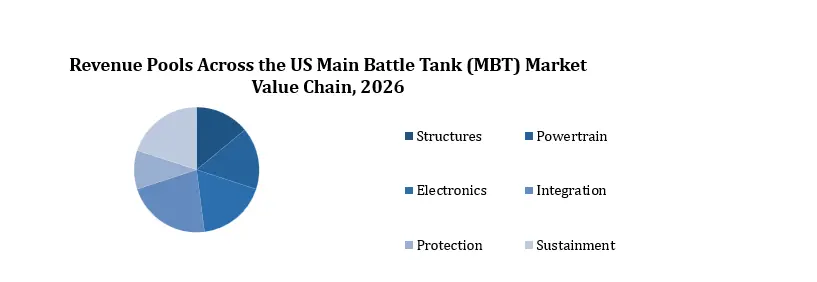
US Main Battle Tank Value Chain and Revenue Pools.
|
Structures › |
Powertrain › |
Electronics › |
Integration › |
Protection › |
Sustainment |
|
14% of revenue pool |
16% of revenue pool |
18% of revenue pool |
22% of revenue pool |
10% of revenue pool |
20% of revenue pool |
US Main Battle Tank (MBT) Market Dynamics
M1E3 Acceleration: Abrams Prototypes Delivered Years Ahead of Plan
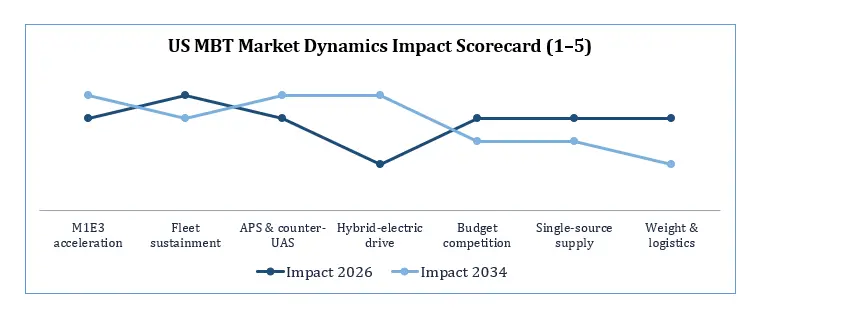
The pace of the M1E3 Abrams programme is the strongest growth catalyst in the US main battle tank market. Army leaders said in 2024 that the M1E3 was not expected until 2032. The first early prototype was delivered in December 2025 and unveiled in January 2026, and four prototypes are due to reach the 1st Armored Brigade Combat Team, 1st Cavalry Division by the end of 2026. In March 2026, the Army stated that it hopes to begin producing a finalised M1E3 in 2027. This brings new-vehicle value into the US MBT market far earlier than previously expected, and it opens near-term content opportunities for powertrain, protection and electronics suppliers.
Lessons from Ukraine and Sustainment of a Large Abrams Fleet
Combat experience in Ukraine has made active protection systems (APS), top-attack protection and counter-UAS measures clear priorities for US armour modernisation. At the same time, about 2,500 Abrams tanks in the active and reserve components need continuous sustainment. In April 2026, General Dynamics Land Systems (GDLS) received a USD 716.2 million, five-year contract to sustain the Abrams family, the Joint Assault Bridge and the Assault Breacher Vehicle. This combination of protection upgrades and large-fleet sustainment supports steady, recurring demand across the US Abrams tank market.
US Main Battle Tank (MBT) Market Restraints
Budget Competition, Single-Source Supply and Weight Growth
Abrams funding competes directly with long-range fires, air and missile defence, and unmanned systems in US Army budgets, which limits the pace of armour recapitalisation. The US tank industrial base also relies on a single prime contractor, a single production facility and a single engine type, which concentrates supply chain risk. SEPv3 weight growth adds an operational constraint by restricting bridge crossing and strategic transport. A fast prototype does not guarantee a fast production ramp: a downside case with M1E3 production starting in 2030 lowers 2034 US main battle tank market value materially
US Main Battle Tank (MBT) Market Opportunities
Hybrid-Electric Drive, Batteries and Power Management for the M1E3 Abrams
The M1E3's hybrid-electric drive, expected to cut fuel use by 40–50%, opens a large new content pool in the US main battle tank market. It brings in engine, generator, battery and power-electronics suppliers that have not supplied the Abrams before. Content on the first M1E3 test fleet tends to carry into production, which makes 2026–2028 the critical qualification window. Suppliers that secure positions on the M1E3 test fleet gain a multi-decade revenue stream across production, spares and sustainment, which is the most attractive long-term opportunity in the US Abrams supply chain.
Open-Architecture Electronics and APS Retrofits
The M1E3's open systems architecture lets the US Army insert new sensors and software without a full engineering change cycle. This favours suppliers of sights, AI-enabled fire control and vetronics. Active protection system (APS) and counter-UAS kits for the remaining SEPv3 fleet add a parallel stream of retrofit revenue. For the US Army, open architecture lowers through-life upgrade cost; for suppliers, it lowers the barrier to entry and turns software and sensor refresh into recurring revenue across the US MBT market.
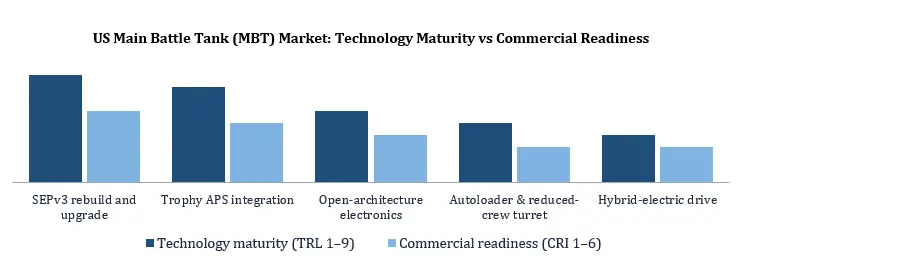
Technology maturity is scored on the TRL 1–9 scale and commercial readiness on the CRI 1–6 scale. Maturity reflects how proven a solution is in service; readiness reflects funded demand, production availability and approvals. Scores are Stellar analyst judgements.
US Main Battle Tank (MBT) Market Challenges
Requirements Stability as the US Army Revisits Force Structure
The US Army is reviewing the role of armour within its transformation initiative and its Armored Brigade Combat Team structure. Any change in requirements or quantities can shift M1E3 production timing and alter the balance between new M1E3 vehicles and sustainment of the legacy Abrams fleet. Requirements risk is therefore the main source of uncertainty in the US main battle tank market forecast, and the full report models alternative M1E3 production timelines to reflect it.
Keeping JSMC Lima Loaded and Securing Open Architectures
Keeping the JSMC Lima workforce and its suppliers loaded between SEPv3 and M1E3 production depends heavily on Foreign Military Sales (FMS) orders from Poland, Romania, Saudi Arabia and Egypt. A gap in production loading raises unit costs and risks the loss of specialist skills among Abrams sub-tier suppliers, which weakens the US tank industrial base. At the same time, the M1E3's open systems architecture introduces new cybersecurity and software assurance requirements, adding qualification cost and complexity for electronics and software suppliers in the US MBT market.
US Main Battle Tank (MBT) Market Trends
|
Trend |
Market development |
Commercial implication |
|
Lighter tank design |
M1E3 designed around lower weight for strategic and tactical mobility |
New structures and protection approaches |
|
Hybrid-electric drive |
Fuel use cut by an expected 40–50% |
Powertrain content opens to new suppliers |
|
Integrated APS |
APS built into M1E3; retrofits on SEPv3 |
Protection suppliers gain share |
|
Reduced-crew turret |
Autoloader and reduced-crew turret on M1E3 |
Value shifts toward automation and fire control |
|
Software pipeline |
Open systems architecture for faster insertion |
Recurring software and electronics revenue |
US Main Battle Tank (MBT) Market Segment Analysis
US Main Battle Tank Market by Solution: New Production / Rebuild, Upgrade and Depot Recapitalisation
New production and rebuild work holds the largest share of the US main battle tank market in 2026, at about 44% of value. It keeps that lead through 2034 as the value base shifts from SEPv3 rebuilds to new M1E3 vehicles. Upgrades and engineering change proposals (ECPs) form the second-largest pool, covering APS integration, sight and software upgrades and power improvements. Depot recapitalisation at Anniston Army Depot and JSMC Lima grows modestly as the fleet ages. From a segment attractiveness standpoint, new production offers the largest absolute revenue gain. Upgrades and ECPs provide the most accessible entry point for new tier-1 and tier-2 suppliers.
US Main Battle Tank Market by Variant: Legacy M1A1/M1A2, M1A2 SEPv3 and M1E3
Legacy M1A1/M1A2 and M1A2 SEPv3 work dominates US MBT market value in 2026. In the base case, the M1E3 passes half of the market value around 2031 and approaches four-fifths by 2034, which makes the M1E3 transition the single most important variable in the US Abrams tank market forecast. The Variant view also serves as the generation view used in the Global Main Battle Tank (MBT) Market report: legacy M1A1/M1A2 tanks correspond to third generation, the M1A2 SEPv3 to third generation plus, and the M1E3 to next generation.
US Main Battle Tank Market by Component: Where M1E3 Value Sits
Mobility and powertrain shows the biggest change in the component mix, rising from about 17% of vehicle value on the SEPv3 to about 24% on the M1E3. Over the same transition, hull and turret structure falls from about 31% to 22%, while protection, APS and C4ISR also gain share on the new tank. For Abrams component suppliers, this shift moves value away from structure and armour and toward powertrain, electrification, protection and electronics.
US Main Battle Tank Market by Propulsion: Gas Turbine and Hybrid-Electric
Gas-turbine work, including AGT-1500 overhaul, spares and remanufacture, continues for the legacy Abrams fleet and for Foreign Military Sales (FMS) users. Hybrid-electric propulsion is the growth segment from 2028 as M1E3 production builds. The result is a dual-track propulsion market in which legacy turbine support and new hybrid-electric content coexist throughout the forecast period.
US Main Battle Tank Market by Funding Stream: Procurement, RDT&E and O&M
The report tracks three US Army funding streams separately: procurement; research, development, test and evaluation (RDT&E); and operations and maintenance (O&M). Each moves on a different budget cycle and supports a different supplier group. RDT&E carries the M1E3 development effort, procurement funds vehicle production and O&M supports depot and fleet sustainment. Tracking these funding streams helps suppliers align business development with the budget lines that fund their products.
US Main Battle Tank (MBT) Market Industrial Base and Foreign Military Sales Context
The United States accounts for most of North America's main battle tank market value. JSMC Lima in Ohio and Anniston Army Depot in Alabama form the core of the US tank industrial base, and their loading depends on both US Army work and Foreign Military Sales.
FMS orders are excluded from US market value in this report to avoid double counting with importing regions, but they shape production capacity and supplier economics. Polish, Romanian, Saudi and Egyptian Abrams work keeps JSMC Lima and its sub-tier suppliers busy through the SEPv3-to-M1E3 transition.
JSMC Lima and Anniston Army Depot
As the sole US tank production site, JSMC Lima sets the pace of SEPv3 rebuilds and M1E3 production. Anniston Army Depot handles depot recapitalisation of the Abrams fleet. Capacity, workforce and utilisation at the two sites together determine how quickly the US Army can move from legacy rebuilds to new M1E3 output.
US Main Battle Tank (MBT) Market Recent Developments, 2026
- 14 January 2026: The US Army unveiled the first M1E3 Abrams early prototype at the North American International Auto Show in Detroit.
- 25 March 2026: Army officials said they hope to begin production of a finalised M1E3 in 2027.
- 13 April 2026: Army Contracting Command Detroit awarded GDLS a sole-source Abrams armour R&D integration contract (W912CH-26-D-0002).
- 24 April 2026: A USD 13.5 million modification took GDLS’s Abrams technical support contract past USD 1 billion cumulative value.
- 30 April 2026: GDLS received a USD 716.2 million, five-year contract to sustain the Abrams family, Joint Assault Bridge and Assault Breacher Vehicle, including FMS.
- 13 August 2026: At GVSETS 2026, the Army said four M1E3 prototypes are to reach 1st Cavalry Division by the end of 2026.
- 4 September 2026: The State Department approved 60 AGT-1500 engines for Saudi Arabia’s Abrams fleet.
US Main Battle Tank (MBT) Market Competitive Landscape and Key Players
|
Organisation |
Organisation |
|
1. General Dynamics Land Systems |
2. Joint Systems Manufacturing Center (JSMC) Lima |
|
3. Anniston Army Depot |
4. Watervliet Arsenal |
|
5. DEVCOM Ground Vehicle Systems Center |
|
|
8. Cummins |
|
|
9. Rolls-Royce Solutions America |
10. Oshkosh Defense |
|
11. Leonardo DRS |
12. Rafael Advanced Defense Systems |
|
13. Elbit America |
14. L3Harris Technologies |
|
15. Raytheon (RTX) |
16. Northrop Grumman |
|
17. Kongsberg Defense Systems |
18. BAE Systems |
|
19. Curtiss-Wright |
20. General Dynamics Ordnance and Tactical Systems |
US Main Battle Tank (MBT) Market Scope: Inquire before buying
| Coverage parameter | Definition/coverage |
|---|---|
| Market | US Main Battle Tank (MBT) Market |
| Base year | 2026 |
| Historical period | 2021–2026 |
| Forecast period | 2027–2034 |
| 2026 market size | USD 2.14 Billion |
| 2034 market forecast | USD 3.56 Billion |
| CAGR | 6.6% during 2027–2034 |
| By Solution | New Production / Rebuild; Upgrade and Engineering Change; Depot Recapitalisation |
| By Variant | Legacy M1A1 / M1A2; M1A2 SEPv3; M1E3 |
| By Component | Hull and Turret Structure; Mobility and Powertrain; Armament, Autoloader and Fire Control; Protection and APS; C4ISR and Vetronics |
| By Propulsion | Gas Turbine; Hybrid-Electric |
| By Funding Stream | Procurement; RDT&E; Operations and Maintenance |
Frequently Asked Questions
The market grows at a 6.6% CAGR over 2027–2034, driven mainly by M1E3 development and production.
The Army’s next Abrams version, designed to be lighter, more fuel-efficient through hybrid-electric drive, and easier to upgrade through an open architecture.
New production and rebuild work leads with about 44% of 2026 value, ahead of upgrades and engineering change and depot recapitalisation.
General Dynamics Land Systems, as prime contractor for the Abrams and M1E3, supported by tier-1 suppliers such as Honeywell, Allison, Leonardo DRS and Rafael.
Accelerated M1E3 Abrams development, sustainment of a fleet of about 2,500 Abrams tanks, and US Army priorities for active protection, top-attack protection and counter-UAS capability drawn from combat experience in Ukraine.
SECTION A – US MAIN BATTLE TANK (MBT) MARKET INTRODUCTION
- Executive Market Landscape and Industry Overview
- US Main Battle Tank (MBT) Market Size (Value USD Million and Volume in Units), 2026–2034
- Market definition, funding coverage and commercial scope
- Historical assessment during 2021–2026 and forecast framework for 2027–2034
- Market value by solution and funding stream
- Abrams fleet size by variant, active and reserve components
- CAGR Analysis of US Main Battle Tank (MBT) Market During 2027–2034
- US Main Battle Tank (MBT) Market Dynamics
- US Main Battle Tank (MBT) Market Trends
- US Main Battle Tank (MBT) Market Dynamics
- Drivers
- Restraints
- Opportunities
- Challenges
- PORTER’s Five Forces Analysis
- PESTLE Analysis
- US Main Battle Tank (MBT) Market Budget, Policy and Acquisition Factors
- Armour in the Army Transformation Initiative and ABCT structure
- Procurement, RDT&E and O&M lines, FY2022–FY2027
- Abrams Funding Stability Index: year-on-year volatility of Abrams budget lines
- M1E3 acquisition pathway: middle-tier acquisition, prototyping and production decisions
- FMS policy, approved and pending cases
- US Main Battle Tank Platform and Technology Roadmap
- M1A2 SEPv3 configuration and upgrade path
- M1E3 hybrid-electric drive and power management
- Autoloader and reduced-crew turret
- Open systems architecture and software pipeline
- Trophy APS, overhead protection and counter-UAS
- Predictive maintenance, digital twins and additive manufacturing at depots
- US Main Battle Tank Value Chain and Industrial Base
- JSMC Lima and Anniston Army Depot: capacity, workforce and utilisation
- Sub-tier supplier map: 400+ suppliers by component system
- Single-Point Failure Index: share of value from sole-source parts
- Comparative study: SEPv3 vs. M1E3 on unit cost, weight, fuel use, crew and sustainment cost
- M1E3 Transition Scenarios
- Production start in 2027, 2028 or 2030
- Effect on SEPv3 line rates
- US MBT Market Value Bridge, 2026–2034
- US Main Battle Tank (MBT) Market Size and Forecast by Segmentation (Value USD Million and Volume in Units), 2026–2034
- US Main Battle Tank (MBT) Market Size and Forecast, By Solution
- New Production / Rebuild
- Upgrade and Engineering Change
- Depot Recapitalisation
- US Main Battle Tank (MBT) Market Size and Forecast, By Variant
- Legacy M1A1 / M1A2
- M1A2 SEPv3
- M1E3
- US Main Battle Tank (MBT) Market Size and Forecast, By Component
- Hull and Turret Structure
- Mobility and Powertrain
- Armament, Autoloader and Fire Control
- Protection and APS
- C4ISR and Vetronics
- US Main Battle Tank (MBT) Market Size and Forecast, By Propulsion
- Gas Turbine
- Hybrid-Electric
- US Main Battle Tank (MBT) Market Size and Forecast, By Funding Stream
- Procurement
- RDT&E
- Operations and Maintenance
- US Main Battle Tank (MBT) Market Size and Forecast, By Solution
Note: Historical period covers 2021–2026, with 2026 as the base year and forecasts for 2027–2034. Foreign Military Sales are excluded from US market value. Values in constant 2026 USD. Variant replaces the Global RD’s Generation view, because each Abrams variant maps directly to one generation tier. Main Gun Calibre is not segmented, as the in-service Abrams fleet uses a single 120 mm main gun. Funding Stream is a US-specific view.
SECTION B – COMPETITIVE INTELLIGENCE & INDUSTRY ECOSYSTEM
- Competitive Landscape
- SMR Competition Matrix
- Competitive Positioning of Key Players by Solution Segment [Revenue and Market Share]
- Key Players Benchmarking
- Company Name
- Headquarter
- MBT Platform and Subsystem Portfolio
- Order Backlog and Production Capacity
- Customer Base and Programme Presence
- Total Company Revenue (2026)
- Land Systems / MBT Revenue (2026)
- Geographic Presence
- Strategic Partnerships and Joint Ventures
- Market Structure
- Prime Contractors
- Subsystem and Tier-1 Suppliers
- Emerging Suppliers
- Growth Rate/Y-o-Y (%) of Companies
- Profit Margin (%) of Companies
- R&D Investments (%) of Companies
- Revenue Vs Net Earnings – Financial Health Benchmarking (2026)
- Revenue Performance And Financial Analysis (2026)
- Mergers and Acquisitions Details
- US Main Battle Tank Prime and Tier-1 Positions
- Prime and tier-1 supplier positions
- M1E3 Content Opportunity Map
- Competitor benchmarking: Abrams heritage, hybrid/electric, software, capacity, test and qualification
- US Main Battle Tank Company Strategies and Outlook
- Positioning for M1E3 content
- Retrofit and sustainment strategies
- Competitive scenarios, 2026–2034
- Strategic recommendations for market participants
- Company Profiles: 20 Key Players
- Detailed Profile considering the parameters:
-
- Overview
- Business Portfolio
- MBT Portfolio
- Contracts and Backlog
- Production Footprint
- Financial Overview
- SWOT Analysis
- Strategic Analysis
- Recent Developments
Prime Contractor and Government Industrial Base
-
- General Dynamics Land Systems
- Joint Systems Manufacturing Center (JSMC) Lima
- Anniston Army Depot
- Watervliet Arsenal
- DEVCOM Ground Vehicle Systems Center
Powertrain and Mobility Suppliers
-
- Honeywell Aerospace
- Allison Transmission
- Cummins
- Rolls-Royce Solutions America
- Oshkosh Defense
Electronics, Fire Control and Protection Suppliers
-
- Leonardo DRS
- Rafael Advanced Defense Systems
- Elbit America
- L3Harris Technologies
- Raytheon (RTX)
- Northrop Grumman
- Kongsberg Defense Systems
- BAE Systems
- Curtiss-Wright
Ammunition Suppliers
-
- General Dynamics Ordnance and Tactical Systems
SECTION C – KEY INSIGHTS, STRATEGIC OUTLOOK & METHODOLOGICAL FRAMEWORK
C1. Key Findings
C2. Strategic Moves & Industry Outlook
C3. Research Methodology