ENG
 Japanese
 French
 German
 Korean

South America Military Load Carriage System Market : Size , Share and Forecast 2034
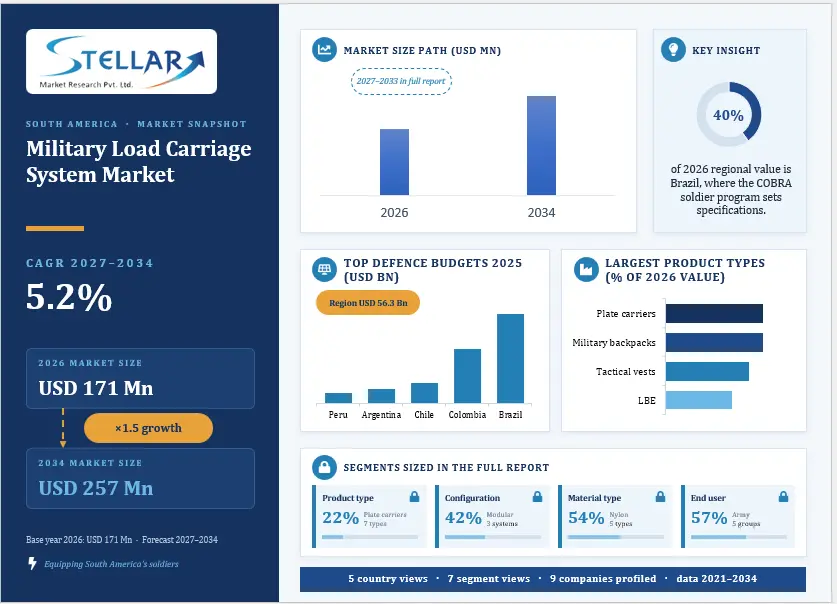
The South America Military Load Carriage System Market stands at USD 171 Million in 2026 and is projected to reach USD 257 Million by 2034, registering a CAGR of 5.2% during 2027–2034.
The South America Military Load Carriage System Market stands at USD 171 Million in 2026 and is projected to reach USD 257 Million by 2034, registering a CAGR of 5.2% during 2027–2034, according to Stellar Market Research (SMR). South America holds about 5% of the global military load carriage system market (SMR estimates), reported as Central & South America in SMR's global regional split. A military load carriage system is the body-worn framework that lets a soldier carry weapons, ammunition, body armor, water, communications and medical kit while keeping mobility, balance and endurance. The market covers tactical vests, load-bearing equipment (LBE), plate carriers, chest rigs, military backpacks, belts and pouches, and modular load carriage accessories, built from nylon, polyester, ultra-high-molecular-weight polyethylene (UHMWPE), aramid fibers and other advanced materials, and bought by South American armies, navies, air forces and special operations forces through direct government procurement, defence contractors and system integrators, and military equipment distributors.
Market volume. In volume terms, SMR estimates South American shipments at about 1.0 million units in 2026, rising to about 1.4 million units by 2034, a volume CAGR of 4.1%. The blended average selling price is about USD 170 per unit in 2026 and rises roughly 1.1% a year as plate-ready and modular carriers replace legacy load-bearing equipment, so value (a 5.2% CAGR) grows faster than units.
Demand is anchored by Brazil and by internal-security needs. SIPRI reports that South American military expenditure rose 3.4% to USD 56.3 billion in 2025, with Brazil up 13% to USD 23.9 billion, driven by naval modernization, and Guyana up 16% amid its dispute with Venezuela. Colombia (about USD 14.5 billion), Chile (about USD 5.3 billion), Argentina (about USD 3.9 billion) and Peru (about USD 2.6 billion) follow, although the first three spent less in 2025 than in 2024. Border security, counter-narcotics and organized-crime operations keep infantry and police-style units buying vests, plates and packs.
Soldier modernization is led by Brazil. The Brazilian Army's Combatente Brasileiro (COBRA) program is built around a "Brazilian Combat System" that includes vests, helmets, assault backpacks and radios, with a Load Carry and Protection element covering an advanced cargo-carrying vest and pouches. Brazil's government proposed BRL 141.9 billion (about USD 26.4 billion) for defence in its 2026 budget, up 6.23%, yet personnel costs consume 74% to 80% of the budget, and MercoPress reported in October 2026 that nearly three-quarters of the 2027 defence budget is again earmarked for personnel and pensions. Equipment volumes therefore depend on a thin acquisition budget, estimated by GlobalData at about USD 1.5 billion in 2026.
This report answers both sides of the search: what the South America military load carriage system market is worth for manufacturers, defence contractors, distributors and investors, and what buyers ask most, from South America military load carriage system market size and share to plate carrier market growth, modular military tactical vests, lightweight tactical vest materials and special operations load carriage requirements. Buyers and investors look for the South America Military Load Carriage System Market, the Latin America military load bearing equipment market, the South American military tactical gear market, the South America soldier equipment market and the Latin America military backpack market, and for related topics such as South American infantry load bearing systems, Latin American military rucksack equipment, modular military tactical vests, military load distribution equipment and Latin American soldier modernization programs. The same audience asks about South America military load carriage system market size, Latin America military load carriage market forecast, military load bearing equipment suppliers in South America, advanced tactical load carriage systems for Latin American armies and South American military equipment procurement trends, and uses short search terms such as South American military gear, tactical equipment, military rucksacks, combat vests and infantry gear.
Stellar Market Research provides a segment-level analysis of the South American military load carriage system market size, share and forecast by product type, load carriage configuration, material type, load capacity, application, end user and procurement channel, together with country-level analysis of Brazil, Colombia, Chile and Argentina, value-chain mapping, competitive landscape and strategic scenarios through 2034.
To get more Insights: Request Free Sample Report
Key Findings: Eight Insights Shaping the South America Military Load Carriage System Market
SMR's analysis of SIPRI, Brazilian Army and U.S. International Trade Administration publications, Janes, MercoPress, GlobalData and company releases points to eight findings that explain where South American military load carriage system value is created through 2034.
|
# |
Finding |
Evidence |
So what |
|
1 |
South America grows about 1.5x by 2034 |
USD 171 Mn (2026) to USD 257 Mn (2034) at 5.2% CAGR (SMR) |
Steady, budget-constrained growth |
|
2 |
Brazil anchors regional demand |
SIPRI: Brazil USD 23.9 Bn in 2025, up 13%; about 40% of regional demand (SMR) |
Brazilian programs set the specification |
|
3 |
Regional spending is rising |
SIPRI: South America USD 56.3 Bn in 2025, up 3.4% |
Modest but positive budget backdrop |
|
4 |
COBRA includes load carriage |
Brazilian Army COBRA project bought vests, helmets, assault backpacks and radios; includes a Load Carry and Protection element |
Local specification and local suppliers |
|
5 |
Personnel costs squeeze equipment |
Janes: personnel is 74% to 80% of Brazil's defence budget; MercoPress: nearly three-quarters of 2027 budget |
Order sizes stay small and phased |
|
6 |
Colombia and Chile are next-largest buyers |
SIPRI: Colombia about USD 14.5 Bn (down 1%), Chile about USD 5.3 Bn (down 3.2%) |
Selective, program-by-program buying |
|
7 |
Border and internal security widen buyers |
Brazil's SISFRON integrated border monitoring system opened a new acquisition phase (U.S. ITA) |
Tactical support and police-style units buy carriers |
|
8 |
National industry supplies home armies |
IMBEL, Taurus Armas, CBC Group, Inbra, Indumil and FAMAE appear in SMR's key-player map |
Local content favors national makers |
South America Military Load Carriage System Market Dynamics: Growth Drivers, Restraints and Opportunities
Market dynamics. South America market dynamics are shaped by industry fluctuations in defence budgets, wider economic factors and consumer behavior trends among armed forces and soldier-users. Demand and supply are tied to multi-year contract awards, while competitive forces from specialist OEMs, armor makers and fiber suppliers set pricing. The main market drivers are soldier modernization and weight reduction; the main market challenges are qualification time and material cost. Technological advancements in UHMWPE and aramid fibers, regulatory influences from military qualification standards and emerging trends such as female-contoured and size-inclusive designs open further market opportunities, and innovation in the industry keeps lifting modular platforms. Macroeconomic factors and market growth factors, including defence spending and infantry modernization budgets, are balanced by market constraints such as brand-name specifications and set-aside rules.
Industry disruptors such as lighter plates, smart textiles and soldier-system integration cause market shifts, and environmental factors such as heat, dust and moisture raise durability requirements, while socioeconomic influences, from recruitment patterns to the share of women in service, change sizing needs. A market trends analysis built on economic indicators, industry evolution and competitive landscape shifts shows the demand and supply dynamics and the market forces at work. Consumer preferences evolution, regulatory changes, innovation impact and technology trends test market responsiveness and market adaptability, and external market influences such as conflicts and sanctions force strategic market changes and market segmentation shifts. Customer engagement dynamics, industry resilience and market fluctuation analysis identify growth catalysts, manage market volatility and point to the market gap between lightweight, plate-ready kit and equipment that is actually fielded.
South America Military Load Carriage System Market Growth Drivers: Brazil's Soldier Program, Border Security and Local Industry
- Soldier modernization programs. Brazil's COBRA project is transforming the individual combatant into a "Brazilian Combat System" and has purchased vests, helmets, assault backpacks and radios.
- Rising regional budgets. SIPRI reports South American military expenditure up 3.4% to USD 56.3 billion in 2025, with Brazil up 13% to USD 23.9 billion.
- Border and internal security. Brazil's SISFRON integrated border monitoring system, counter-narcotics operations and organized-crime responses sustain demand for vests, plates and packs in army and police-style units.
- Local industry. IMBEL, Taurus Armas, CBC Group, Inbra, Indumil and FAMAE supply home armies, supporting domestic content and shorter lead times.
- Lighter plates and fibers. The Army's LSAPI plates are about 30% lighter than ESAPI Gen III, Avient says Dyneema UD supports soft armor vests up to 20% lighter, and DuPont launched Kevlar EXO for hard armor in December 2025.
South America Military Load Carriage System Market Restraints: Personnel Costs, Budget Cycles and Currency Risk
- Personnel-heavy budgets. Personnel costs are 74% to 80% of Brazil's defence budget, and nearly three-quarters of the 2027 budget is again earmarked for personnel and pensions.
- Uneven spending. Colombia, Chile and Argentina all spent less in 2025 than in 2024, so demand varies by country.
- Import dependence for advanced materials. UHMWPE and aramid fibers are largely imported and cost more than nylon, which slows conversion in cost-sensitive fleets.
- Currency and trade risk. Imported plates, fibers and hardware are priced in dollars or euros, which raises costs when local currencies weaken.
What Are the Biggest South America Military Load Carriage System Market Opportunities Through 2034?
- Brazil's COBRA program: phased purchases of vests, backpacks and pouches create repeat orders for local and international carrier makers.
- Border and police-style forces: tactical support units buy durable, affordable carriers and vests in volume.
- Local manufacturing partnerships: IMBEL, CBC Group, Indumil and FAMAE can license or co-produce modern carriers and plates.
- Lightweight and modular upgrades: replacing legacy load-bearing equipment with modular, plate-ready systems.
- Tropical and jungle design: ventilated, quick-drying carriers for Amazon and tropical operations (SMR assessment).
- Distributor channels: smaller armies and police forces buy standard carriers off catalog.
South America Military Load Carriage System Market Segmentation: By Product Type, Configuration, Material, Load Capacity, Application, End User and Procurement Channel
Market segment analysis. SMR's market segment analysis applies industry segmentation across product, configuration, material, load capacity, application, end user and procurement channel, supported by target market analysis and consumer demographics such as the age, body type and gender mix of the force. Product segmentation and geographic segmentation are broken into market subsegments and niche markets, and customer profiling of armies, navies, air forces and special operations units supports market share by segment, segment growth analysis and a view of the competitive segment landscape. Emerging market segments and segment attractiveness are scored alongside behavioral segmentation and segment-based marketing, so that customized market strategies can follow demographic profiling and market niche exploration. Micro-segmentation, segmentation strategies and market segment dynamics are tied to customer behavior segmentation within specialized market segments, exposing unexplored market niches, segment-specific trends and untapped market areas. Segment-specific opportunities feed tailored marketing strategies, and the market fragment analysis of unique market sectors provides a granular market breakdown and comprehensive market sector analysis for the South America market.
Military Load Carriage System Market by Product Type: Tactical Vests, LBE, Plate Carriers, Chest Rigs, Backpacks, Belts and Pouches and Modular Accessories
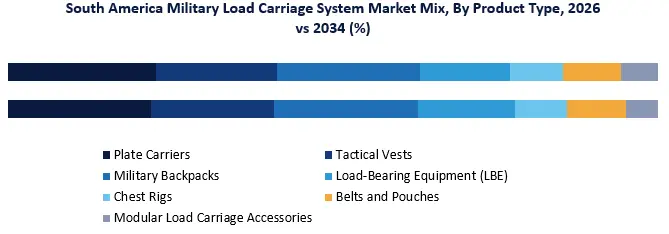
Plate carriers lead with about 22% of 2026 value and a 5.7% CAGR as armies adopt plate-ready carriers. Military backpacks hold 22% (5.2% CAGR), as assault and long-range packs are central to COBRA and to jungle and border operations, tactical vests 19% (5.0%) and load-bearing equipment (LBE) 15% (4.2%). Belts and pouches hold 9% (5.1% CAGR), chest rigs 8% (5.6%) and modular load carriage accessories 5% (7.0%). Modular load carriage accessories are the fastest-growing product type, at a 7.0% CAGR from a small base.
Military Load Carriage System Market by Load Carriage Configuration: Integrated, Modular and Standalone Systems
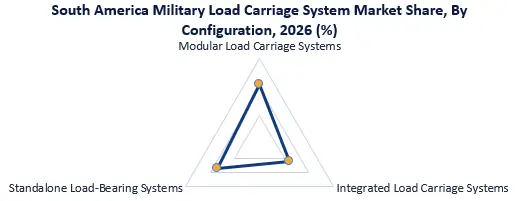
Modular load carriage systems lead with about 42% of 2026 value and a 5.9% CAGR, because a scalable base carrier lets one issue item serve several missions. Standalone load-bearing systems hold 34% (4.5% CAGR), still common where armies buy basic vests and belts in volume and integrated load carriage systems 24% (5.1%). Modular load carriage systems are also the fastest-growing configuration.
Military Load Carriage System Market by Material Type: Nylon, Polyester, UHMWPE, Aramid Fibers and Other Advanced Materials
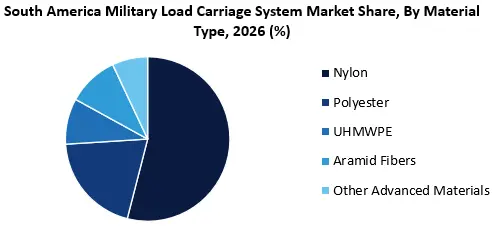
Nylon leads with about 54% of 2026 value and a 4.7% CAGR because Cordura-type fabrics remain the standard shell for carriers and packs. Polyester holds 20% (4.5% CAGR), aramid fibers 10% (5.8%), supported by DuPont's Kevlar EXO launch for hard armor in December 2025 and UHMWPE 9% (7.0%), the fiber family behind Dyneema, largely imported. Other advanced materials hold 7% (7.3% CAGR). Other advanced materials are the fastest-growing material type, at a 7.3% CAGR from a small base.
Military Load Carriage System Market by Load Capacity: Lightweight, Medium-Load and Heavy-Load Systems
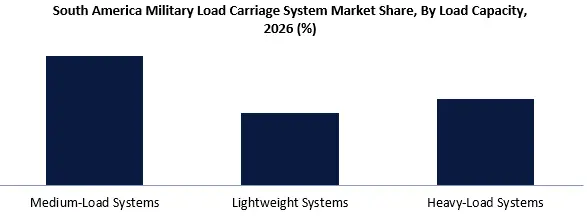
Medium-load systems lead with about 45% of 2026 value and a 5.0% CAGR, covering standard fighting and approach loads. Heavy-load systems hold 30% (4.6% CAGR), for long patrols and border operations and lightweight systems 25% (6.1%). Lightweight systems are the fastest-growing load capacity, at a 6.1% CAGR, as heat and humidity make every pound more costly.
Military Load Carriage System Market by Application: Infantry, Special Operations, Reconnaissance, Tactical Support and Training
Infantry and ground combat leads with about 48% of 2026 value and a 4.8% CAGR. Tactical support operations holds 16% (5.2% CAGR), reflecting border security and internal-security missions, special operations 14% (6.3%) and reconnaissance and surveillance 12% (5.6%). Training and military exercises holds 10% (4.9% CAGR). Special operations is the fastest-growing application, at a 6.3% CAGR, as elite units buy specialist carriers.
Military Load Carriage System Market by End User: Army, Navy, Air Force, Special Operations Forces and Other Military Forces
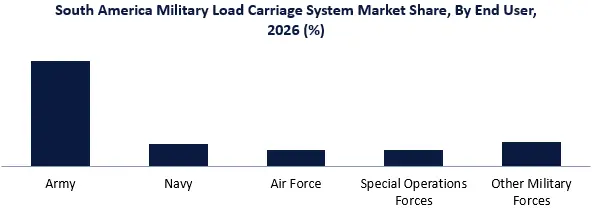
Army leads with about 57% of 2026 value and a 5.1% CAGR, reflecting the scale of infantry and border fleets and programs such as COBRA. Other military forces hold 13% (5.4% CAGR), including marine, border and gendarmerie-style units, Navy 12% (4.9%) and Air Force 9% (4.8%). Special operations forces hold 9% (6.4% CAGR). Special operations forces are the fastest-growing end user, at a 6.4% CAGR.
Military Load Carriage System Market by Procurement Channel: Direct Government, Defence Contractors and Distributors
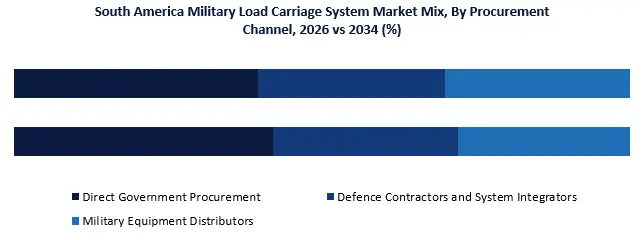
Direct government procurement leads with about 42% of 2026 value and a 4.4% CAGR, through army and ministry of defence contracts and state arms makers. Defence contractors and system integrators hold 30% (5.3% CAGR) and military equipment distributors 28% (6.1%). Military equipment distributors are the fastest-growing procurement channel, at a 6.1% CAGR as smaller forces buy standard carriers off catalog.
South America Military Load Carriage System Market Regional Analysis: Brazil, Colombia, Chile, Argentina and Rest of South America
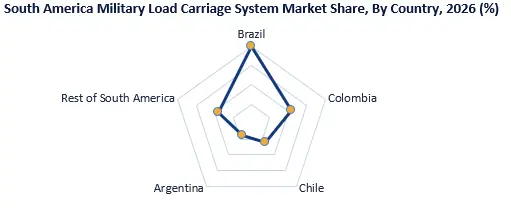
Brazil is the largest national market at about 40% of 2026 value (5.5% CAGR), anchored by COBRA, SISFRON and a 13% rise in 2025 defence spending. Colombia holds 22% (4.6%), shaped by internal-security needs, Chile 12% (5.0%) and Argentina 8% (4.0%). Rest of South America, including Peru, Ecuador, Venezuela, Uruguay, Paraguay, Bolivia and Guyana, holds 18% and is the fastest-growing group at 5.9%, helped by Guyana's 16% jump in 2025 spending. Country shares are SMR estimates.
Geographic analysis. The geographic analysis of the South American market reviews regional market trends and area-specific market dynamics, including local market influences such as national procurement rules. Market performance by region and regional market segmentation show geographical trends shaped by regional economic factors and local consumer behavior, while regional market challenges and area-specific opportunities define the regional competitive landscape. Market growth by location, the region-specific industry outlook and local market entry strategies are set against regional market share, economic impact by region and regional market development, with market trends in specific regions tracked at country level. Territorial dynamics, locational market nuances, area-centric market shifts and geographic market intricacies explain regional consumer patterns and local economic factors, and regional market performance is compared across the territorial competitive landscape. Demographic trends by region, localized market challenges and regionally-driven opportunities shape locational market share, geo-strategic influences and regional market entry strategies, supported by area-centric growth factors, a regional industry outlook, market trends in designated areas and the wider geopolitical influences on defence demand.
Defence Spending Benchmarks: What SIPRI Says About South American Demand
Public sources frame the demand cycle. SIPRI reports South American military expenditure of USD 56.3 billion in 2025, up 3.4%, with Brazil at USD 23.9 billion (up 13%), Colombia at about USD 14.5 billion (down 1%), Chile at about USD 5.3 billion (down 3.2%), Argentina at about USD 3.9 billion (down 7.2%) and Peru at about USD 2.6 billion (up 2%).
South America Military Load Carriage System Ecosystem: From Fibers to Fielded Soldier Kit
|
Layer |
What happens |
Examples |
|
1. Fibers and fabrics |
Nylon and polyester are sourced locally or imported; UHMWPE and aramid are mostly imported |
Avient (Dyneema), DuPont (Kevlar), regional textile mills |
|
2. Armor and plate makers |
Soft armor and plates are produced locally or imported to national specifications |
Combat Armor Defence (CBC Group), Inbra Aerospace & Defense |
|
3. Carrier and pack makers |
Vests, plate carriers, chest rigs, packs, belts and pouches are cut, sewn and assembled |
IMBEL, Taurus Armas, Indumil, FAMAE |
|
4. Contracting and distribution |
Governments buy direct, through state arms makers, or via contractors and distributors |
Army and ministry of defence procurement offices, regional distributors |
|
5. Armed forces |
Armies, navies, air forces and border units are issued and sustain the systems |
Brazilian Army (COBRA, SISFRON), Colombian, Chilean and Argentine forces |
|
6. Government and standards |
Requirements, testing and evaluation |
Brazilian Army Science and Technology Department, national standards bodies |
South America Military Load Carriage System Companies and Competitive Landscape: Who Supplies the South American Market?
The South American market is led by state arms makers and national industrial groups. IMBEL, Taurus Armas, Combat Armor Defence (CBC Group), Inbra Aerospace & Defense, Indumil and FAMAE appear in SMR's key-player map, while Avient (Dyneema), DuPont (Kevlar) and Honeywell (Spectra) supply fibers that are mostly imported. Competition varies by country: local content, price, delivery time and compatibility with national soldier programs such as COBRA decide awards.
Government disclosures show how demand is shaped. The Brazilian Army's COBRA project purchased vests, helmets, assault backpacks and radios, and the Army's strategic programs portfolio sets a modernization roadmap through 2040. DuPont introduced Kevlar EXO for hard armor in December 2025, and the U.S. Army's LSAPI orders in September 2025 show how lighter plate designs are moving from specification to production.
Competitor analysis. SMR's competitor analysis combines company revenue and company net sales with competitive intelligence to deliver an industry rivals examination and market rivalry assessment. Competitor benchmarking, a competitive strategy review and industry player dynamics feed a rivalry impact analysis, competitor evaluation and competitive landscape trends, with competitive positioning and market rivalry intensity measured for each supplier. Competitor profiling and competitive advantage assessment give an industry competition overview, covering market player strategies, competitive benchmark analysis and rival market share. Competitive market evolution and competitor differentiation are examined through market rival scrutiny and industry adversary exploration, while competitive ecosystem analysis maps rivalry landscape intricacies and a competitive matrix investigation. Business opponent profiling, sectorial rivalry dynamics, competitive maneuver examination and competing force scrutiny support rivalry intensity mapping, opponent landscape divergence and industry opposition tactics, rounded off by a strategic analysis of each leading company.
Competitive Strategies in the South America Military Load Carriage System Market
- Local manufacturing: in-country production and state arms-maker partnerships to meet domestic content goals.
- Program compatibility: alignment with COBRA and other national soldier-modernization specifications.
- Price-performance: durable, affordable carriers for large, budget-constrained fleets.
- Modular platforms: base carriers with swappable front flaps, panels and pouches.
- Tropical design: ventilated, quick-drying fabrics for jungle and humid operations.
South America Military Load Carriage System Market Recent Developments
|
Date |
Development |
|
27 Apr 2026 |
SIPRI reports South American military expenditure of USD 56.3 billion in 2025, up 3.4%, and Brazil up 13% to USD 23.9 billion |
|
17 May 2026 |
Brazil confirmed as South America's leading defence spender; Uruguay posts one of the largest relative rises |
|
30 Oct 2026 |
Brazil to spend nearly three-quarters of its 2027 defence budget on personnel and pensions |
South America Military Load Carriage System Market Scope: Inquire before buying
|
South America Military Load Carriage System Market Segmentation |
|
|
Report Coverage |
Details |
|
Base Year |
2026 |
|
Historical Data |
2021 to 2026 |
|
Forecast Period |
2027-2034 |
|
Market Size in 2026 |
USD 171 Million |
|
Market Size in 2034 |
USD 257 Million |
|
CAGR (2027-2034) |
5.2% |
|
By Product Type |
Tactical Vests Load-Bearing Equipment (LBE) Plate Carriers Chest Rigs Military Backpacks Belts and Pouches Modular Load Carriage Accessories |
|
By Load Carriage Configuration |
Integrated Load Carriage Systems Modular Load Carriage Systems Standalone Load-Bearing Systems |
|
By Material Type |
Nylon Polyester Ultra-High-Molecular-Weight Polyethylene (UHMWPE) Aramid Fibers Other Advanced Materials |
|
By Load Capacity |
Lightweight Systems Medium-Load Systems Heavy-Load Systems |
|
By Application |
Infantry and Ground Combat Special Operations Reconnaissance and Surveillance Tactical Support Operations Training and Military Exercises |
|
By End User |
Army Navy Air Force Special Operations Forces Other Military Forces |
|
By Procurement Channel |
Direct Government Procurement Defence Contractors and System Integrators Military Equipment Distributors |
South America Military Load Carriage System Market, By Country:
- Brazil
- Colombia
- Chile
- Venezuela
- Argentina
- Rest of South America
Military Load Carriage System Market Key Players:
South America
Fiber Suppliers Active in South America
- Avient (Dyneema)
- DuPont (Kevlar)
- Honeywell (Spectra)
Frequently Asked Questions
Ans: It is the body-worn equipment that carries a soldier's weapons, ammunition, armor, water and mission kit, including tactical vests, plate carriers, chest rigs, load-bearing equipment, backpacks, belts, pouches and modular accessories.
Ans: SIPRI reports South American military expenditure up 3.4% to USD 56.3 billion in 2025, led by Brazil at USD 23.9 billion (up 13%). Border security, counter-narcotics and organized-crime operations sustain demand for vests, plates and packs.
Ans: Plate carriers and military backpacks each hold about 22% of 2026 value (SMR). Modular load carriage accessories are the fastest-growing product type at a 7.0% CAGR.
Ans: In SMR estimates other advanced materials grow at 7.3%, UHMWPE at 7.0% and aramid fibers at 5.8%, ahead of nylon at 4.7%. DuPont introduced Kevlar EXO for hard armor in December 2025.
Ans: Brazil leads with about 40% of 2026 value, followed by Colombia at 22% (SMR estimates).
Ans: The Brazilian Army's Combatente Brasileiro (COBRA) project turns the individual combatant into a "Brazilian Combat System", and purchases have included vests, helmets, assault backpacks and radios, with a Load Carry and Protection element.
Ans: Through army and ministry of defence contracts, state arms makers, defence contractors and distributors. Personnel costs are 74% to 80% of Brazil's defence budget, so purchases are phased.
Ans: SMR estimates about 1.0 million units in 2026, rising to about 1.4 million units by 2034, a 4.1% volume CAGR.
Ans: South America holds about 5% of the global military load carriage system market in 2026 (USD 171 Million of USD 3.42 Billion), according to SMR estimates.
1. Military Load Carriage System Market – Executive Summary & Industry Overview
1.1. South America Military Load Carriage System Market Size and Growth Outlook
1.2. Historical Evolution of Military Load-Bearing Equipment and Systems
1.3. Military Load Carriage Systems Definition, Classification and Operational Scope
1.4. Role of Load Carriage Systems in Soldier Equipment Modernization
1.5. South America Military Load Carriage System Production and Deployment Overview
1.6. Market Growth Assessment and Long-Term Defence Demand Outlook
2. Military Load Carriage System Market Dynamics
2.1. Emerging Trends in Soldier Load Management and Equipment Modernization
2.2. Market Dynamics Analysis
- Drivers
- Restraints
- Opportunities
- Challenges
2.3. Porter's Five Forces Analysis of Military Equipment Suppliers
2.4. PESTLE Analysis of South America Military Load Carriage Procurement
2.5. Defence Modernization Priorities and Tactical Equipment Replacement Cycles
2.6. Military Operational Requirements Influencing Equipment Adoption Decisions
3. Military Load Carriage System Market – Macroeconomic Factors
3.1. South America Defence Expenditure and Military Modernization Budget Allocations
3.2. Infantry Modernization Programs and Soldier Equipment Investment Trends
3.3. International Military Procurement Spending and Defence Contract Allocations
3.4. Military Textile Manufacturing Costs and Advanced Material Pricing
3.5. Geopolitical Conflicts and Cross-Border Defence Equipment Requirements
3.6. Currency Fluctuations and International Military Equipment Trade Dynamics
4. Military Load Carriage System Industry Trends & Technology Developments
4.1. Increasing Demand for Lightweight Soldier Equipment and Mobility
4.2. Integration of Modular Load-Bearing Platforms Across Infantry Units
4.3. Development of Ergonomic Systems for Extended Operational Deployments
4.4. Adoption of Advanced Fabrics for Tactical Equipment Durability
4.5. Integration of Body Armor and Load Distribution Technologies
4.6. Development of Smart Load Carriage and Soldier Integration Systems
5. Military Load Carriage System Technical Specifications & Engineering Landscape
5.1. Structural Design and Configuration of Military Load Carriage Equipment
5.2. Load Distribution Mechanisms and Soldier Weight Management Characteristics
5.3. Ergonomic Design, Adjustability and Human Body Compatibility Requirements
5.4. Equipment Durability Under Extreme Operational and Environmental Conditions
5.5. Attachment Interfaces, Modular Compatibility and Equipment Interoperability Standards
5.6. Performance Testing, Field Validation and Military Qualification Requirements
6. Military Load Carriage System Manufacturing & Material Ecosystem
6.1. Nylon Fabric Selection and High-Tenacity Textile Manufacturing Processes
6.2. Polyester Fabric Applications in Tactical Equipment Construction
6.3. UHMWPE Material Integration and Lightweight Protection Applications
6.4. Aramid Fiber Utilization in Reinforced Military Equipment Components
6.5. Advanced Composite Materials and Specialized Fabric Development
6.6. Material Sourcing, Fabrication Efficiency and Manufacturing Cost Optimization
7. Military Load Carriage System Product Architecture & Configuration Landscape
7.1. Tactical Vest Construction and Integrated Equipment Carrying Arrangements
7.2. Plate Carrier Design and Body Armor Compatibility Requirements
7.3. Load-Bearing Equipment Architecture and Belt-Based Carrying Configurations
7.4. Chest Rig Construction and Mission-Specific Equipment Placement
7.5. Military Backpack Frames and Extended Load-Carrying Capabilities
7.6. Modular Pouches, Belts and Accessory Attachment Systems
8. Military Load Carriage System Load Management & Capacity Landscape
8.1. Lightweight Load Carriage Systems for High-Mobility Operations
8.2. Medium-Load Equipment Configurations for Standard Infantry Missions
8.3. Heavy-Load Systems for Extended Tactical Deployment Requirements
8.4. Weight Distribution Across Torso, Waist and Shoulder Interfaces
8.5. Equipment Carrying Capacity and Mission-Specific Load Allocation
8.6. Soldier Fatigue Management and Load-Bearing Performance Optimization
9. Military Load Carriage System Application & Operational Deployment Landscape
9.1. Infantry Equipment Requirements Across Ground Combat Operations
9.2. Special Operations Load Configurations and Mission-Specific Equipment Requirements
9.3. Reconnaissance Missions and Lightweight Equipment Carrying Arrangements
9.4. Surveillance Operations and Specialized Tactical Equipment Integration
9.5. Tactical Support Missions and Equipment Transportation Requirements
9.6. Military Training Exercises and Field Equipment Utilization Patterns
10. Military Load Carriage System Integration & Soldier Equipment Compatibility
10.1. Integration with Ballistic Protection and Personal Armor Equipment
10.2. Compatibility with Tactical Communication and Radio Carrying Systems
10.3. Weapon Accessory Storage and Ammunition Carrying Configurations
10.4. Hydration Systems Integration and Field Water Transportation Requirements
10.5. Compatibility with Night Vision and Electronic Soldier Equipment
10.6. Interoperability Across Existing Military Personal Equipment Platforms
11. Military Load Carriage System Design Innovation & Ergonomic Development
11.1. Shoulder Strap Engineering and Pressure Distribution Optimization
11.2. Waist Belt Design and Lower Body Load Transfer
11.3. Ventilation Structures and Thermal Comfort Improvement Technologies
11.4. Adjustable Suspension Systems and Individual Soldier Fit Customization
11.5. Quick-Release Mechanisms and Emergency Equipment Detachment Capabilities
11.6. Anthropometric Design Adaptations for Diverse Military Personnel Requirements
12. Military Load Carriage System Quality, Durability & Performance Assessment
12.1. Fabric Tear Resistance and Abrasion Performance Evaluation
12.2. Stitching Strength and Structural Component Reliability Testing
12.3. Environmental Resistance Against Moisture, Heat and Dust
12.4. Load-Bearing Capacity and Long-Duration Stress Testing
12.5. Hardware Corrosion Resistance and Attachment Component Durability
12.6. Military Field Trials and Product Performance Qualification Procedures
13. Military Load Carriage System Safety, Standards & Regulatory Compliance
13.1. Military Equipment Qualification and Defence Procurement Standard Requirements
13.2. Ballistic Protection Compatibility and Personal Equipment Safety Considerations
13.3. Textile Material Compliance and Restricted Substance Testing Requirements
13.4. Operational Safety Standards for Soldier-Carried Equipment Systems
13.5. Equipment Reliability Certification and Military Acceptance Procedures
13.6. Regional Defence Standards and International Compliance Frameworks
14. Military Load Carriage System Research, Development & Product Innovation
14.1. Advanced Lightweight Materials and Next-Generation Equipment Development
14.2. Modular Load Carriage Platform Research and Design Advancements
14.3. Ergonomic Research and Soldier Mobility Improvement Initiatives
14.4. Smart Textiles and Integrated Soldier Equipment Development
14.5. Defence Research Investments and Military Technology Collaborations
14.6. Product Commercialization and Advanced Equipment Portfolio Expansion Strategies
15. Military Load Carriage System Supply Chain & Manufacturing Operations
15.1. Raw Material Procurement and Specialized Textile Supplier Networks
15.2. Fabric Cutting, Stitching and Tactical Equipment Assembly Operations
15.3. Component Sourcing and Modular Equipment Manufacturing Coordination
15.4. Production Capacity and Military Contract Fulfilment Capabilities
15.5. Inventory Management and Defence Equipment Distribution Networks
15.6. Supply Chain Resilience and Strategic Material Sourcing Requirements
16. Military Load Carriage System Pricing, Procurement & Cost Economics
16.1. Product Pricing Across Military Load Carriage Equipment Categories
16.2. Material Costs and Tactical Equipment Manufacturing Economics
16.3. Modular System Pricing and Configuration-Based Cost Variations
16.4. Government Contract Pricing and Defence Procurement Mechanisms
16.5. Lifecycle Costs and Military Equipment Replacement Expenditure
16.6. Cost Competitiveness Across International Military Equipment Manufacturers
17. Military Load Carriage System Distribution & Procurement Landscape
17.1. Direct Government Procurement and Military Contracting Arrangements
17.2. Defence Contractors and System Integrator Procurement Networks
17.3. Military Equipment Distributors and Specialized Supply Channels
17.4. Government Tendering Processes and Defence Supplier Qualification
17.5. Framework Agreements and Long-Term Military Supply Contracts
17.6. International Defence Sales and Cross-Border Equipment Distribution
18. Military Load Carriage System End-User & Defence Requirements Analysis
18.1. Army Infantry Equipment Requirements and Standardization Priorities
18.2. Naval Personnel Equipment and Maritime Operational Carrying Requirements
18.3. Air Force Ground Personnel and Specialized Equipment Requirements
18.4. Special Operations Forces and Mission-Specific Load Configurations
18.5. Other Military Forces and Specialized Tactical Equipment Requirements
18.6. Inter-Service Procurement Requirements and Equipment Standardization Initiatives
19. Military Load Carriage System Adoption & Operational Utilization
19.1. Military Adoption Across Infantry and Specialized Operational Units
19.2. Soldier Equipment Standardization and Platform Replacement Requirements
19.3. Deployment Frequency and Operational Equipment Utilization Patterns
19.4. Procurement Preferences Across Military Organizations and Defence Agencies
19.5. Equipment Interoperability and Existing Platform Replacement Considerations
19.6. Soldier Feedback and Field-Based Product Improvement Requirements
20. Military Load Carriage System Regional & Country-Level Market Landscape
20.1. Brazil COBRA Soldier Programme and Army Equipment Procurement Landscape
20.2. Colombia Internal-Security Requirements and Equipment Procurement
20.3. Chile and Argentina Military Modernization and Equipment Landscape
20.4. Rest of South America Border Security and Defence Procurement
20.5. South American State Arms Makers and National Industry Landscape
20.6. Regional Production Capabilities and International Defence Trade Flows
21. Military Load Carriage System Market Size & Forecast by Segmentation (Value USD Million), 2027–2034
21.1. Military Load Carriage System Market Size and Forecast, By Product Type
- Tactical Vests
- Load-Bearing Equipment (LBE)
- Plate Carriers
- Chest Rigs
- Military Backpacks
- Belts and Pouches
- Modular Load Carriage Accessories
21.2. Military Load Carriage System Market Size and Forecast, By Load Carriage Configuration
- Integrated Load Carriage Systems
- Modular Load Carriage Systems
- Standalone Load-Bearing Systems
21.3. Military Load Carriage System Market Size and Forecast, By Material Type
- Nylon
- Polyester
- Ultra-High-Molecular-Weight Polyethylene (UHMWPE)
- Aramid Fibers
- Other Advanced Materials
21.4. Military Load Carriage System Market Size and Forecast, By Load Capacity
- Lightweight Systems
- Medium-Load Systems
- Heavy-Load Systems
21.5. Military Load Carriage System Market Size and Forecast, By Application
- Infantry and Ground Combat
- Special Operations
- Reconnaissance and Surveillance
- Tactical Support Operations
- Training and Military Exercises
21.6. Military Load Carriage System Market Size and Forecast, By End User
- Army
- Navy
- Air Force
- Special Operations Forces
- Other Military Forces
21.7. Military Load Carriage System Market Size and Forecast, By Procurement Channel
- Direct Government Procurement
- Defence Contractors and System Integrators
- Military Equipment Distributors
21.8. Military Load Carriage System Market Size and Forecast, By Country
- Brazil
- Colombia
- Chile
- Argentina
- Rest of South America
22. Military Load Carriage System Market Competitive Landscape
22.1. SMR Competition Matrix and Competitive Positioning Assessment
22.2. Competitive Positioning of Leading Military Equipment Manufacturers
22.3. Key Players Benchmarking
- Company Name and Corporate Headquarters
- Military Load Carriage Product Portfolio and Offerings
- Manufacturing Capabilities and Production Capacity
- Material Technologies and Product Engineering Capabilities
- Defence Contracts and Military Customer Relationships
- Geographic Presence and Distribution Network
22.4. Market Structure and Competitive Participant Categorization
- Specialized Tactical Equipment Manufacturers
- Defence and Military Equipment Manufacturers
- Ballistic Protection and Armor System Providers
- Military Textile and Equipment Suppliers
22.5. Company Revenue Growth and Financial Performance Benchmarking
22.6. Manufacturing Capacity and Production Scale Comparison
22.7. Military Contract Portfolio and Defence Customer Benchmarking
22.8. Product Portfolio Breadth and Equipment Configuration Comparison
22.9. Corporate Financial Performance and Business Portfolio Analysis
22.10. Mergers, Acquisitions and Strategic Collaborations
22.11. Recent Product Launches and Military Equipment Developments
23. Military Load Carriage System Manufacturers & Tactical Equipment Specialists
23.1. Tactical Vest and Plate Carrier Manufacturing Company Landscape
23.2. Load-Bearing Equipment and Modular Chest Rig Manufacturers
23.3. Military Backpack and Specialized Load-Carrying Equipment Providers
23.4. Tactical Belt, Pouch and Accessory Manufacturing Companies
23.5. Product Customization and Mission-Specific Equipment Manufacturing Capabilities
23.6. Manufacturing Capacity, Product Availability and Supply Reliability Assessment
24. Military Load Carriage System Materials & Component Supplier Landscape
24.1. High-Tenacity Nylon and Polyester Fabric Supplier Ecosystem
24.2. UHMWPE and Aramid Fiber Material Supplier Landscape
24.3. Tactical Equipment Hardware and Attachment Component Manufacturers
24.4. Specialized Webbing, Buckle and Fastening Component Providers
24.5. Advanced Textile Processing and Material Engineering Capabilities
24.6. Material Quality, Procurement Reliability and Supplier Diversification Assessment
25. Military Load Carriage System Market Manufacturers' Strategies & Expansion Plans
25.1. Expansion of Military Equipment Manufacturing and Production Capabilities
25.2. Development of Lightweight and High-Durability Load Carriage Products
25.3. Modular Equipment Portfolio Expansion and Configuration Customization Initiatives
25.4. Strategic Partnerships with Defence Contractors and Military Organizations
25.5. Expansion into International Defence Procurement and Military Markets
25.6. Investments in Advanced Materials and Product Engineering Technologies
26. Military Load Carriage System Industry SWOT, Investments & Strategic Developments
26.1. Competitive Strengths of Established Tactical Equipment Manufacturers
26.2. Manufacturing Constraints and Military Procurement Market Limitations
26.3. Emerging Opportunities in Infantry Modernization and Soldier Equipment
26.4. Competitive Threats from Alternative Equipment and Material Technologies
26.5. Investments in Modular Platforms and Lightweight Material Development
26.6. Product Launches, Defence Partnerships and Strategic Industry Developments
27. Military Load Carriage System Competitive Outlook & Market Positioning
27.1. Competitive Dynamics Across Military Load Carriage Product Categories
27.2. Market Concentration Across Specialized Tactical Equipment Manufacturers
27.3. Competitive Differentiation Through Material Quality and Ergonomic Design
27.4. Established Defence Suppliers Versus Specialized Tactical Equipment Manufacturers
27.5. Competitive Positioning Across Military End-User and Application Categories
27.6. Future Market Opportunities and Military Procurement Expansion Potential
28. Company Profiles: Key Military Load Carriage System Market Participants
Detailed Company Profile Parameters
- Company Overview and Business Operations
- Military Load Carriage Product Portfolio
- Manufacturing Facilities and Production Capabilities
- Material Technologies and Product Engineering Capabilities
- Defence Contracts and Military Customer Relationships
- Financial Overview and Revenue Performance
- Geographic Presence and Distribution Network
- SWOT Analysis
- Strategic Analysis and Growth Initiatives
- Recent Developments, Partnerships and Expansion Activities
South America
- IMBEL
- Taurus Armas
- Combat Armor Defence (CBC Group)
- Inbra Aerospace & Defense
- Indumil
- FAMAE
Fiber Suppliers Active in South America
- Avient (Dyneema)
- DuPont (Kevlar)
- Honeywell (Spectra)
29. Key Findings
30. Strategic Moves & Industry Outlook
31. Research Methodology