ENG
 Japanese
 French
 German
 Korean

US Military Load Carriage System Market Analysis from 2026 to 2034
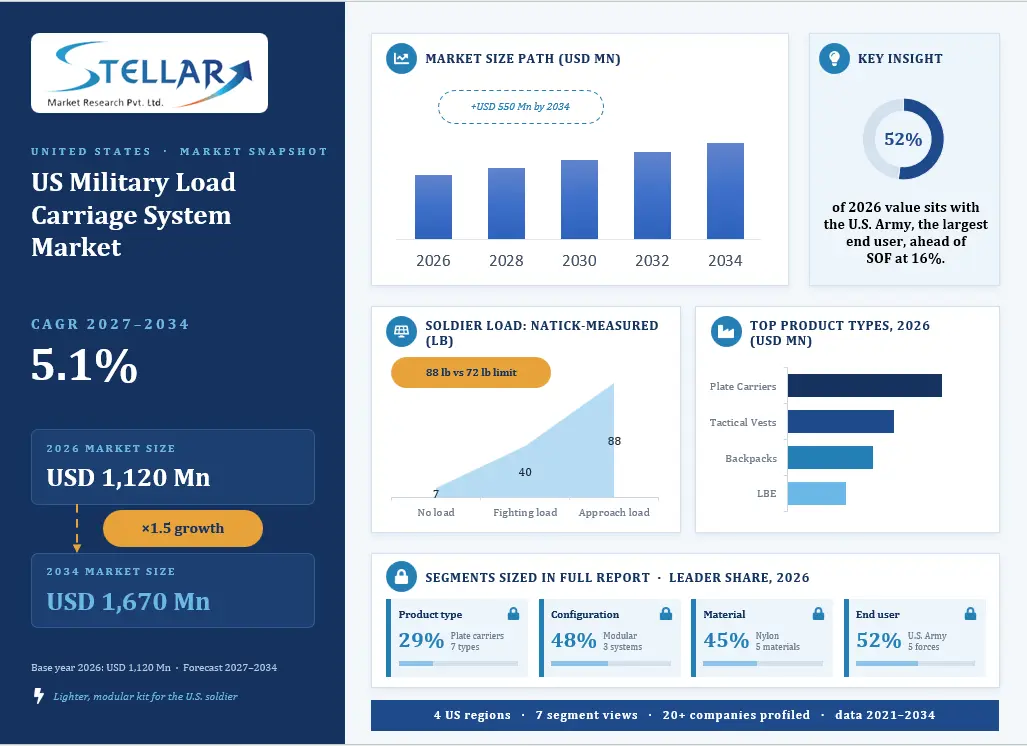
The US Military Load Carriage System Market was valued at USD 1.12 billion in 2026 and is projected to reach USD 1.67 Billion by 2034, growing at a CAGR of 5.1% during 2027-2034.
The US Military Load Carriage System Market was valued at USD 1.12 Billion in 2026 and is projected to reach USD 1.67 Billion by 2034, growing at a CAGR of 5.1% during 2027-2034, according to Stellar Market Research (SMR). A military load carriage system is the body-worn framework that lets a U.S. service member carry weapons, ammunition, body armor, water, communications and medical kit while keeping mobility, balance and endurance. The market covers tactical vests, load-bearing equipment (LBE), plate carriers, chest rigs, military backpacks, belts and pouches, and modular load carriage accessories, built from nylon, polyester, ultra-high-molecular-weight polyethylene (UHMWPE), aramid fibers and other advanced materials, and bought by the Army, Navy, Air Force, special operations forces and other military forces through direct government procurement, defence contractors and system integrators, and military equipment distributors.
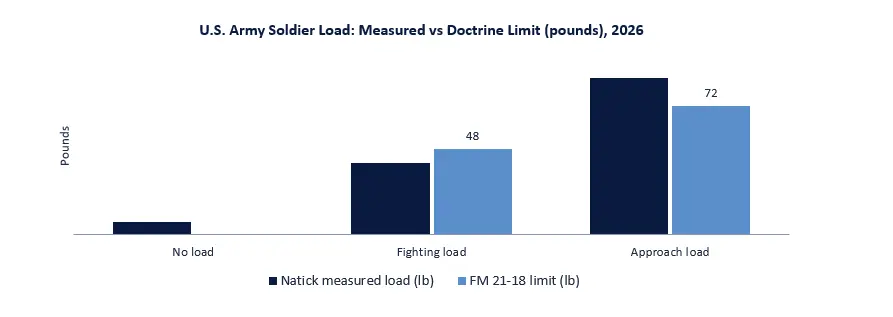
Demand is anchored by the weight problem. The U.S. Army's Natick Soldier Research, Development and Engineering Center has described a fighting load of about 40 pounds and an approach load of about 88 pounds in its biomechanics studies, against the 48-pound and 72-pound limits set in Army doctrine (FM 21-18). That gap keeps lightweight, modular and better-distributed carriage systems at the top of U.S. modernization lists. The Defense Logistics Agency (DLA) states that it has provided 235,200 Modular Scalable Vests (MSVs) on the original Army contract since 2021, and the Department of Defense's fiscal year 2027 request of about USD 1.5 trillion (USD 1.1 trillion discretionary plus USD 350.0 billion mandatory, per the Congressional Research Service) is the largest on record.
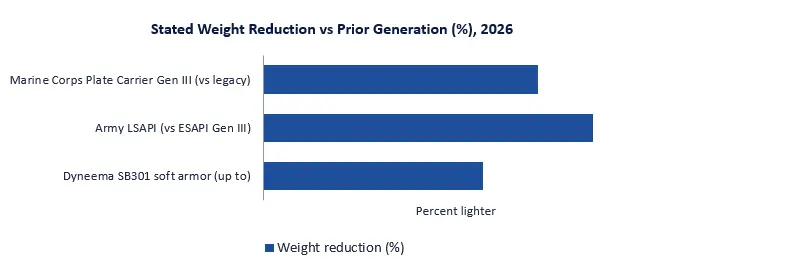
Materials and plates are changing carrier design. On 11 September 2026 the U.S. Army awarded USD 65.56 million in delivery orders to Hardwire LLC and Leading Technology Composites, Inc. for 72,179 Lightweight Small Arms Protective Inserts (LSAPI), plates about 30% lighter than the current ESAPI that integrate with MSV Gen II. The Marine Corps describes its Plate Carrier Generation III as nearly 25% lighter than the legacy carrier. Avient's Dyneema launched next-generation UD material in October 2023 that it says lets makers design soft armor vests 10-20% lighter, and DuPont launched Kevlar EXO for hard armor in December 2025. Each step lowers carrier weight and rewards modular designs that spread load across the torso and hips.
This report answers both sides of the search: what the US military load carriage system market is worth for manufacturers, defence contractors, distributors and investors, and what buyers ask most, from US military load carriage system market size and share to plate carrier market growth, modular MOLLE load bearing equipment, lightweight tactical vest materials and special operations load carriage requirements.
Stellar Market Research provides a segment-level analysis of the US military load carriage system market size, share and forecast by product type, load carriage configuration, material type, load capacity, application, end user and procurement channel, together with federal procurement analysis, value-chain mapping, competitive landscape and strategic scenarios through 2034.
US Military Load Carriage System Market Overview: Size, Share, Trends and Outlook to 2034
SMR measures the market at manufacturer-revenue level across tactical vests, load-bearing equipment, plate carriers, chest rigs, military backpacks, belts and pouches and modular accessories sold to the U.S. armed services, prime contractors and distributors. The defining traits are specification-driven federal procurement, long qualification cycles, brand-name requirements for some special operations buys, the pull of lighter ballistic plates and fibers, and a doctrine-level concern with the service member's combat load.
The United States accounts for roughly one-third of global military load carriage system value in SMR's model, equal to about 33% of the USD 3.42 Billion global market in 2026. Three shifts shape 2026-2034: demand moves from fixed, single-purpose vests toward modular platforms that a service member can configure by mission; value shifts toward lightweight systems built with UHMWPE, aramid and other advanced materials; and a record federal budget request lifts procurement accounts, including a 28.7% discretionary increase in Army procurement funding in the FY2027 request.
To get more Insights: Request Free Sample Report
Key Findings: Eight Insights Shaping the US Military Load Carriage System Market
SMR's analysis of U.S. Army, PEO Soldier, Marine Corps Systems Command, Defense Logistics Agency, DOT&E, DoD Comptroller and Congressional Research Service publications, and company releases from Avient (Dyneema), DuPont, Crye Precision and Mystery Ranch, points to eight findings that explain where US military load carriage value is created through 2034.
|
# |
Finding |
Evidence |
So what |
|
1 |
The market grows about 1.5x by 2034 |
USD 1.12 Bn (2026) to USD 1.67 Bn (2034) at 5.1% CAGR (SMR) |
Steady, modernization-led growth |
|
2 |
Combat load is the core problem |
Natick: fighting load about 40 lb, approach load about 88 lb; FM 21-18 limits 48 lb and 72 lb |
Lighter, better-distributed carriage wins programs |
|
3 |
Federal budgets are expanding |
DoD FY2027 request about USD 1.5 Tn vs USD 1.01 Tn FY2026 enacted (CRS); Army procurement +28.7% discretionary |
Larger procurement pool for soldier equipment |
|
4 |
Modular vests are standard issue |
DLA: 235,200 MSVs provided since 2021; DOT&E: MSV Gen II and VTP Gen III fielding expected to complete 4QFY28 |
Scalable carriers set the volume base |
|
5 |
Lighter plates reshape carrier design |
Army: USD 65,564,335.70 LSAPI orders for 72,179 plates, about 30% lighter than ESAPI, delivery by 15 Mar 2027 |
Carriers must integrate lighter plates |
|
6 |
Marines also cut carrier weight |
Marine Corps Systems Command: Plate Carrier Gen III nearly 25% lighter than the legacy carrier |
Plate carriers lead product demand |
|
7 |
Fibers are the lever for lighter armor |
Avient/Dyneema: soft armor 10-20% lighter (Oct 2023); DuPont: Kevlar EXO for hard armor (Dec 2026) |
UHMWPE and aramid outgrow nylon |
|
8 |
Weight distribution gets its own gear |
DOT&E: Army moved to buy a Battle Belt as a stand-alone weight distribution system |
Belts and pouches gain relevance |
US Military Load Carriage System Market Dynamics: Growth Drivers, Restraints and Opportunities
US Military Load Carriage System Market Growth Drivers: Soldier Modernization, Weight Reduction and Modular Design
- Soldier modernization programs. The Army's Soldier Protection System combines the Modular Scalable Vest with extremity protection and a weight distribution approach, and DLA has provided 235,200 MSVs on the original Army contract since 2021.
- Record federal budget request. The FY2027 DoD request is about USD 1.5 trillion, against USD 1.01 trillion enacted for FY2026, and the Army's request of about USD 253 billion includes a 28.7% discretionary increase in procurement funding.
- Combat load reduction. Natick figures of about 40 pounds for a fighting load and about 88 pounds for an approach load, versus FM 21-18 limits of 48 and 72 pounds, keep lighter carriers and plates in demand.
- Lighter plates and fibers. LSAPI plates are about 30% lighter than ESAPI, the Marine Corps carrier is nearly 25% lighter than its predecessor, and Avient says Dyneema UD supports soft armor vests 10-20% lighter.
- Modularity. MSV is built around a four-tier configuration that lets the wearer tailor protection to the mission, a pattern now copied by commercial OEMs.
US Military Load Carriage System Market Restraints: Budget Cycles, Qualification Time and Weight Trade-Offs
- Long procurement cycles. DOT&E expects MSV Gen II and VTP Gen III fielding to complete only in the fourth quarter of fiscal 2028, so volume follows multi-year award timing.
- Ballistic requirements. DOT&E reports show subsystems must clear first article and lot acceptance testing before fielding; its FY2024 report counts more than 250 lot acceptance tests with one failure, which lengthens development and limits design freedom.
- Appropriations risk. Part of the FY2027 request is mandatory funding that depends on separate legislation, so enacted amounts may differ from the request.
- Material cost. UHMWPE and aramid solutions cost more than nylon, which slows conversion in cost-sensitive fleets.
What Are the Biggest US Military Load Carriage System Market Opportunities Through 2034?
- Lightweight plate carriers and soft armor: LSAPI-class plates and next-generation UD fibers favor carriers that cut combat load.
- Modular accessories: pouches, panels and attachment systems sell repeatedly on top of a base carrier.
- Weight distribution gear: the Army's plan for a stand-alone Battle Belt shows demand for belts that move load from shoulders to hips.
- Special operations and sustained-operations carriage: company catalogs from Crye Precision (Sustained Operations Plate Carrier, 2026) and Mystery Ranch (military packs and custom load carriage) target mission-specific buyers.
- Distributor and integrator channels: defence contractors and system integrators bundle carriers with plates, comms and medical kit.
US Military Load Carriage System Market Segmentation: By Product Type, Configuration, Material, Load Capacity, Application, End User and Procurement Channel
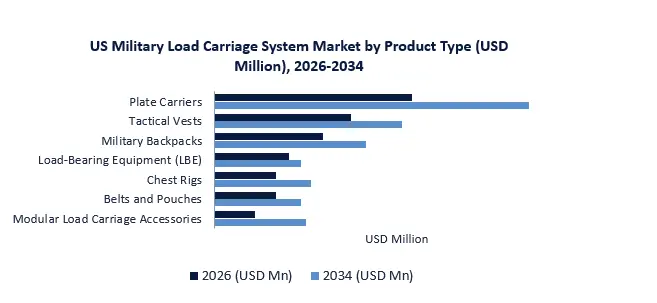
US Military Load Carriage System Market by Product Type: Tactical Vests, LBE, Plate Carriers, Chest Rigs, Backpacks, Belts and Pouches and Modular Accessories
Plate carriers hold about 29% of 2026 value and grow at a 6.0% CAGR as the services adopt lightweight, plate-ready carriers such as the Army's MSV Gen II and the Marine Corps Plate Carrier Gen III. Tactical vests hold 20% (4.1% CAGR) and military backpacks 16% (4.3%). Load-bearing equipment holds 11% with a 1.8% CAGR as legacy fleets age out. Chest rigs hold 9% (5.8%), belts and pouches 9% (4.4%), and modular load carriage accessories 6%, the fastest-growing product type at a 10.6% CAGR from a small base.
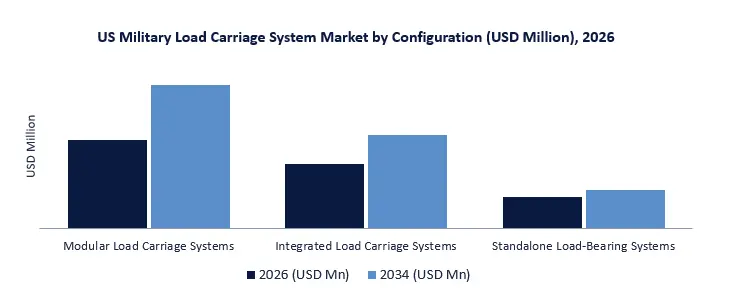
US Military Load Carriage System Market by Load Carriage Configuration: Integrated, Modular and Standalone Systems
Modular load carriage systems lead with about 48% of 2026 value and a 6.2% CAGR, because a scalable base carrier lets one issue item serve several missions. Integrated load carriage systems hold 35% (4.7% CAGR), typified by vest-plus-protection programs such as the Soldier Protection System. Standalone load-bearing systems hold 17% and grow at 2.6% as modular platforms replace single-purpose kit.
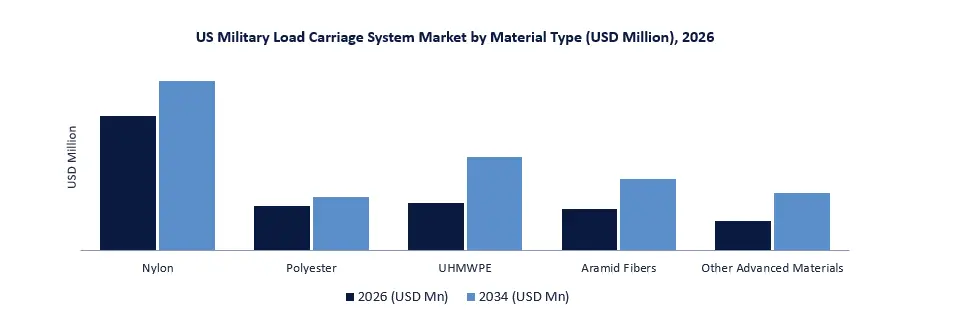
US Military Load Carriage System Market by Material Type: Nylon, Polyester, UHMWPE, Aramid Fibers and Other Advanced Materials
Nylon holds about 45% of 2026 value (2.9% CAGR) because Cordura-type fabrics remain the standard shell for carriers and packs. Polyester holds 15% (2.2%). UHMWPE, the fiber family behind Dyneema and Spectra, holds 16% and grows at 8.7% as armor makers pursue weight cuts; Avient says its next-generation Dyneema UD supports soft armor vests 10-20% lighter. Aramid fibers hold 14% (6.9% CAGR), supported by DuPont's Kevlar EXO launch for hard armor in December 2026. Other advanced materials hold 10% and grow at 8.6%.
US Military Load Carriage System Market by Load Capacity: Lightweight, Medium-Load and Heavy-Load Systems
Medium-load systems hold about 44% of 2026 value (4.8% CAGR), covering standard fighting and approach loads. Lightweight systems hold 33% and grow fastest at 7.3%, in line with the Army and Natick focus on reducing combat load. Heavy-load systems hold 23% (1.9% CAGR) for sustainment, weapons-team and long-duration patrol carriage.
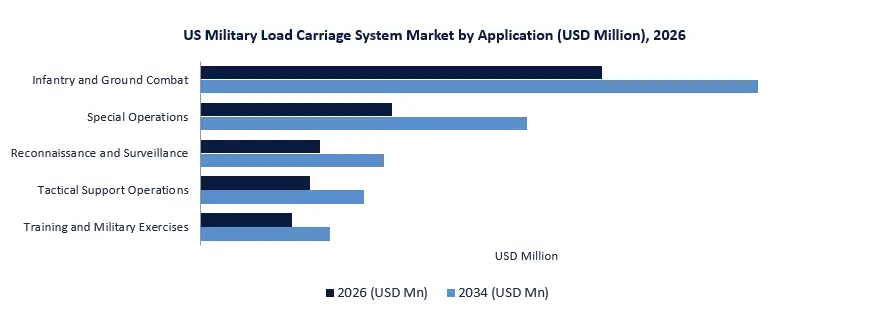
US Military Load Carriage System Market by Application: Infantry, Special Operations, Reconnaissance, Tactical Support and Training
Infantry and ground combat leads at about 44% of 2026 value (4.2% CAGR). Special operations holds 21% and is the fastest-growing application at 6.9%, helped by mission-specific purchasing. Reconnaissance and surveillance holds 13% (5.6%), tactical support operations 12% (5.1%) and training and military exercises 10% (4.4%).
US Military Load Carriage System Market by End User: Army, Navy, Air Force, Special Operations Forces and Other Military Forces
The Army leads at about 52% of 2026 value (4.3% CAGR), reflecting the scale of infantry fleets and programs such as MSV Gen II and LSAPI. Special operations forces hold 16% and grow fastest at 7.4%. Navy and Air Force hold 11% (4.5% CAGR) and 10% (4.4%), and other military forces, including the Marine Corps, Coast Guard and National Guard units, hold 11% (6.2%).
US Military Load Carriage System Market by Procurement Channel: Direct Government, Defence Contractors and Distributors
Direct government procurement holds about 50% of 2026 value (3.7% CAGR), through contracts such as Army Contracting Command awards and DLA ordering on Army contracts. Defence contractors and system integrators hold 36% (6.5%), bundling carriers with plates and mission kit. Military equipment distributors hold 14% and grow at 6.0%.
Soldier Load Benchmarks: What U.S. Army Sources Say About Combat Load
Government sources frame the carriage problem. U.S. Army doctrine in FM 21-18 sets a 48-pound fighting load and a 72-pound approach march load, and DTIC-hosted Army research restates the guidance as 22 kg and 33 kg, or 30% and 45% of body weight. A Natick biomechanics researcher described a no-load configuration of about 6 to 7 pounds (helmet and weapon), a fighting load of about 40 pounds and an approach load of about 88 pounds.
Federal Budget Context: DoD and Army Funding Requests
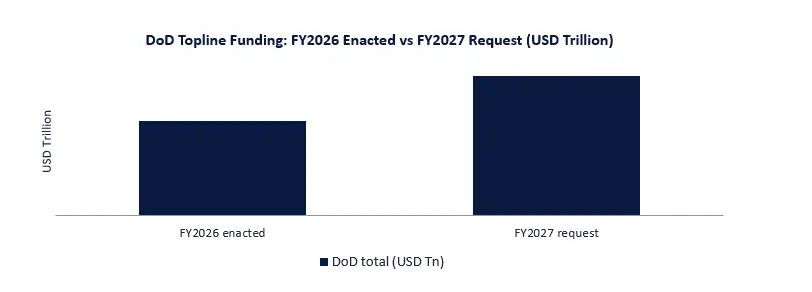
The DoD fiscal year 2027 request is about USD 1.5 trillion, made up of USD 1.1 trillion in discretionary funding and USD 350.0 billion in mandatory funding, compared with USD 1.01 trillion enacted for FY2026 (Congressional Research Service). The Army's request is about USD 253 billion and includes a 28.7% discretionary increase in procurement funding (U.S. Army, 21 April 2026).
Weight Reduction Claims in U.S. Government and Company Releases
Government and company releases quantify how much lighter new carriers, plates and fibers are. They explain why lightweight systems grow faster than heavy-load systems in SMR's model.
US Military Load Carriage System Ecosystem: From Fibers to Fielded Soldier Kit
|
Layer |
What happens |
Examples |
|
1. Fibers and fabrics |
Nylon, polyester, UHMWPE and aramid are produced and woven or laminated |
Avient (Dyneema), DuPont (Kevlar), Honeywell (Spectra) |
|
2. Armor and plate makers |
Soft armor and hard plates are produced to Army and Marine Corps specifications |
Hardwire LLC, Leading Technology Composites, Point Blank Enterprises, KDH Defense Systems |
|
3. Carrier and pack makers |
Vests, plate carriers, chest rigs, packs, belts and pouches are cut, sewn and assembled |
Crye Precision, Eagle Industries, Mystery Ranch, TYR Tactical, FirstSpear, Spiritus Systems |
|
4. Contracting and distribution |
Government buys direct, through DLA, or via contractors and distributors |
Army Contracting Command, DLA Troop Support |
|
5. Armed forces |
Army, Navy, Air Force, Marine Corps and special operations units are issued and sustain the systems |
PEO Soldier, Marine Corps Systems Command, USSOCOM units |
|
6. Government and standards |
Requirements, testing and evaluation |
DOT&E, Army Project Manager Soldier Survivability, Natick |
US Military Load Carriage System Companies and Competitive Landscape: Who Supplies the U.S. Market?
The market combines specialist tactical-gear brands, body-armor producers, plate makers and fiber suppliers. Crye Precision, Eagle Industries, Mystery Ranch, TYR Tactical, FirstSpear, Spiritus Systems, Point Blank Enterprises, KDH Defense Systems, Hardwire LLC and Leading Technology Composites appear in U.S. government awards, company releases or trade announcements, while Avient (Dyneema), DuPont (Kevlar) and Honeywell (Spectra) supply the fibers. Competition varies by product: weight, fit, modularity, compatibility with Army and Marine Corps plates, and brand specification decide awards.
Company and government disclosures show how suppliers respond to demand. The Army placed USD 65.56 million in LSAPI delivery orders with Hardwire LLC and Leading Technology Composites in September 2026. Avient launched next-generation Dyneema UD in October 2023, and DuPont introduced Kevlar EXO for hard armor in December 2026, after announcing an exclusive North American body armor agreement with Point Blank Enterprises in February 2024. Marine Corps Systems Command has tested the Mystery Ranch Military Light Frame in a limited user evaluation, and Spiritus Systems released its LV-120 plate carrier in December 2026.
Competitive Strategies in the US Military Load Carriage System Market
- Weight leadership: fibers and plates that cut combat load, such as Dyneema UD, Kevlar EXO and LSAPI-class plates.
- Modular platforms: base carriers with swappable panels and pouches, and open standards for plate carrier modularity proposed by Ferro Concepts and Spiritus Systems in January 2026.
- Integration with government programs: compatibility with MSV Gen II, Plate Carrier Gen III and the Soldier Protection System.
- Domestic manufacturing: the Army highlighted the LSAPI award as a win for domestic manufacturing.
- Special operations focus: specialist OEMs showcase mission-specific carriers and custom load carriage at SOF Week and SHOT Show.
US Military Load Carriage System Market Recent Developments
|
Date |
Development |
Source |
|
7 Apr 2020 |
Marine Corps begins fielding Plate Carrier Gen III, nearly 25% lighter than the legacy carrier |
Marine Corps Systems Command |
|
Since 2021 |
DLA has provided 235,200 MSVs on the original Army contract |
Defense Logistics Agency |
|
5 Oct 2023 |
Avient launches next-generation Dyneema UD (SB301) for soft armor up to 10-20% lighter |
Avient / Dyneema |
|
28 Feb 2024 |
DuPont and Point Blank Enterprises announce exclusive agreement for body armor made with Kevlar EXO in North America |
Point Blank Enterprises |
|
Jul 2026 |
Marine Corps Systems Command tests the Mystery Ranch Military Light Frame in a limited user evaluation |
Trade release (Soldier Systems) |
|
11 Sep 2026 |
Army awards USD 65.56 million LSAPI delivery orders for 72,179 plates; plates about 30% lighter than ESAPI (announced 24 Sep 2026) |
PEO Soldier, U.S. Army |
|
5 Dec 2025 |
DuPont launches Kevlar EXO for hard armor including helmets and plate inserts |
DuPont |
|
18 Dec 2025 |
Spiritus Systems announces the LV-120 modular plate carrier |
Spiritus Systems |
|
21 Apr 2026 |
DoD and Army release FY2027 budget requests (about USD 1.5 Tn DoD; about USD 253 Bn Army) |
DoD Comptroller, U.S. Army |
Global Ammonium Polyphosphate Market Scope: Inquire before buying
| Report Coverage | Details |
|---|---|
| Base Year | 2026 |
| Historical Data | 2021 to 2026 |
| Forecast Period | 2027-2034 |
| Market Size in 2026 | USD 1.12 Billion |
| Market Size in 2034 | USD 1.67 Billion |
| CAGR (2027-2034) | 5.1% |
| By Product Type | Tactical Vests Load-Bearing Equipment (LBE) Plate Carriers Chest Rigs Military Backpacks Belts and Pouches Modular Load Carriage Accessories |
| By Load Carriage Configuration | Integrated Load Carriage Systems Modular Load Carriage Systems Standalone Load-Bearing Systems |
| By Material Type | Nylon Polyester High-Performance Polyethylene (UHMWPE) Aramid Fibers Other Advanced Materials |
| By Load Capacity | Lightweight Systems Medium-Load Systems Heavy-Load Systems |
| By Application | Infantry and Ground Combat Special Operations Reconnaissance and Surveillance Tactical Support Operations Training and Military Exercises |
| By End User | Army Navy Air Force Special Operations Forces Other Military Forces |
| By Procurement Channel | Direct Government Procurement Defence Contractors and System Integrators Military Equipment Distributors |
US Military Load Carriage System Market Key Players:
- General Dynamics
- BAE Systems
- L3Harris Technologies
- Honeywell International
- Lockheed Martin
- Oshkosh Corporation (Oshkosh Defense)
- Northrop Grumman
- ADS Inc. (Atlantic Diving Supply)
- Point Blank Enterprises
- Safariland Group
- Crye Precision
- FirstSpear
- Eagle Industries
- KDH Defense Systems
- TYR Tactical
- Velocity Systems
- Ferro Concepts
- Spiritus Systems
- Haley Strategic
- RTS Tactical
- HRT Tactical
- Mystery Ranch
- Tactical Tailor
- Blackhawk
- 5.11 Tactical
- Condor Outdoor
- Eberlestock
- Kifaru
- Maxpedition
- GORUCK
- ATS Tactical Gear
- Kelty
- Propper International
- CamelBak
- London Bridge Trading (LBT)
Frequently Asked Questions
It is the body-worn equipment that carries a service member's weapons, ammunition, armor, water and mission kit, including tactical vests, plate carriers, chest rigs, load-bearing equipment, backpacks, belts, pouches and modular accessories. The Army's Soldier Protection System pairs the Modular Scalable Vest with weight distribution equipment.
U.S. Army doctrine in FM 21-18 sets a 48-pound fighting load and a 72-pound approach march load. A Natick researcher described about 40 pounds for a fighting load and about 88 pounds for an approach load.
Plate carriers lead with about 29% of 2026 value (SMR). Modular load carriage accessories are the fastest-growing product type at a 10.6% CAGR.
In SMR estimates other advanced materials grow at 8.6%, UHMWPE at 8.7% and aramid fibers at 6.9%, ahead of nylon at 2.9%. Avient says Dyneema UD supports soft armor vests 10-20% lighter, and DuPont introduced Kevlar EXO for hard armor in December 2026.
Through direct government contracts, DLA ordering on Army contracts, defence contractors and system integrators, and distributors. DLA states it has provided 235,200 MSVs on the original Army contract since 2021.
A plate carrier holds ballistic plates and soft armor and often accepts modular pouches, while a chest rig is a lighter front-mounted pouch system without armor. The Army says LSAPI plates are about 30% lighter than ESAPI and integrate with MSV Gen II.
The DoD request is about USD 1.5 trillion, made up of USD 1.1 trillion discretionary and USD 350.0 billion mandatory funding, compared with USD 1.01 trillion enacted for FY2026 (Congressional Research Service).
1. US Military Load Carriage System Market Overview
1.1. US Military Load Carriage System Market Size (Value USD Million), 2026–2034
1.2. Historical Evolution of Military Load Carriage Equipment
1.3. Military Load Carriage System Definition and Product Classification
1.4. Role of Load Carriage in Modern Soldier Equipment
1.5. US Military Load Carriage Production and Demand Overview
1.6. Market CAGR Analysis and Long-Term Growth Outlook
2. US Military Load Carriage System Market Dynamics
2.1. Emerging Trends in Soldier Load Management Technologies
2.2. Market Dynamics Analysis
- 2.2.1. Drivers
- 2.2.2. Restraints
- 2.2.3. Opportunities
- 2.2.4. Challenges
2.3. PORTER's Five Forces Analysis
2.4. PESTLE Analysis
3. US Military Load Carriage System Macroeconomic Factors
3.1. US Defense Budget Allocation and Military Equipment Expenditure
3.2. Army Modernization Programs and Soldier Equipment Investments
3.3. Military Procurement Spending and Defense Contracting Trends
3.4. Domestic Textile Manufacturing and Advanced Material Production Costs
3.5. Military Personnel Deployment and Operational Readiness Expenditure
3.6. Defense Industrial Base Capacity and Manufacturing Investment Trends
4. US Military Load Carriage Industry Trends and Technology Requirements
4.1. Increasing Demand for Lightweight Soldier Load Carriage Equipment
4.2. Growing Adoption of Modular Tactical Load-Bearing Configurations
4.3. Integration of Ballistic Protection with Load-Bearing Platforms
4.4. Advancements in Ergonomic Weight Distribution and Mobility
4.5. Increasing Demand for Mission-Specific Soldier Equipment Configurations
4.6. Development of Next-Generation Soldier Load Management Technologies
5. Military Load Carriage System Design and Technical Landscape
5.1. Load Distribution Architecture and Soldier Weight Management Principles
5.2. Ergonomic Design Parameters and Musculoskeletal Load Reduction
5.3. Equipment Attachment Interfaces and Modular Compatibility Standards
5.4. Structural Durability Under Operational Stress and Environmental Exposure
5.5. Adjustable Fitting Mechanisms and Individual Soldier Configuration
5.6. Equipment Integration with Existing Soldier Combat Systems
6. Military Load Carriage Materials and Manufacturing Ecosystem
6.1. Nylon Fabric Selection and Tactical Equipment Manufacturing Applications
6.2. Polyester Material Utilization in Load-Bearing Equipment
6.3. UHMWPE Applications in Lightweight Military Equipment Construction
6.4. Aramid Fiber Integration for Advanced Protective Equipment
6.5. Advanced Composite Materials and High-Strength Textile Development
6.6. Material Testing, Manufacturing Quality and Durability Assessment
7. Military Load Carriage Product Architecture and Configuration Landscape
7.1. Integrated Load Carriage Systems and Equipment Integration Requirements
7.2. Modular Load Carriage Systems and Interchangeable Equipment Configurations
7.3. Standalone Load-Bearing Systems and Independent Equipment Applications
7.4. MOLLE Attachment Architecture and Pouch Configuration Compatibility
7.5. Load-Bearing Harness Design and Equipment Mounting Mechanisms
7.6. Interoperability Across Tactical Vests, Packs and Accessories
8. Tactical Vests, Plate Carriers and Chest Rigs Landscape
8.1. Tactical Vest Construction and Load-Bearing Performance Requirements
8.2. Plate Carrier Architecture and Integrated Equipment Mounting Capabilities
8.3. Chest Rig Configurations and Mission-Specific Equipment Distribution
8.4. Cummerbund Systems, Shoulder Straps and Attachment Interfaces
8.5. Armor Compatibility and Load-Bearing Equipment Integration Requirements
8.6. Tactical Vest Customization and Operational Performance Differentiation
9. Military Backpacks, Belts and Pouches Landscape
9.1. Military Backpack Design and Load Distribution Capabilities
9.2. Rucksack Frame Architecture and Heavy-Load Carrying Requirements
9.3. Tactical Belt Systems and Equipment Attachment Configurations
9.4. Ammunition Pouches and Mission-Specific Storage Arrangements
9.5. Hydration Carriers and Integrated Water Transportation Equipment
9.6. Modular Accessories and Specialized Load-Bearing Equipment Components
10. Military Load Capacity and Soldier Weight Management
10.1. Lightweight Systems and Individual Equipment Carrying Requirements
10.2. Medium-Load Systems and Standard Infantry Equipment Configurations
10.3. Heavy-Load Systems and Extended Mission Equipment Requirements
10.4. Combat Equipment Weight Distribution Across Soldier Body Regions
10.5. Load Reduction Technologies and Soldier Mobility Enhancement
10.6. Operational Endurance and Physical Performance Under Carried Loads
11. Military Load Carriage Applications and Operational Requirements
11.1. Infantry Combat Equipment and Dismounted Ground Operations Requirements
11.2. Special Operations Equipment and Mission-Specific Load Configurations
11.3. Reconnaissance Equipment and Extended Surveillance Mission Requirements
11.4. Tactical Support Equipment and Operational Logistics Applications
11.5. Military Training Exercises and Standardized Equipment Requirements
11.6. Combat Deployment Conditions and Environmental Equipment Adaptability
12. Soldier Modernization and Integrated Equipment Ecosystem
12.1. Soldier-Borne Power Systems and Electronic Equipment Integration
12.2. Tactical Communication Devices and Antenna Mounting Requirements
12.3. Navigation Equipment and Mission Computer Carrying Configurations
12.4. Hydration, Medical Kits and Essential Equipment Integration
12.5. Weapon Accessories and Ammunition Carrying System Compatibility
12.6. Integrated Soldier Systems and Equipment Interoperability Requirements
13. Military Load Carriage Procurement and Defense Contracting Landscape
13.1. US Department of Defense Equipment Procurement Framework
13.2. Army Soldier Equipment Modernization and Acquisition Programs
13.3. Government Defense Contracts and Equipment Supplier Selection Processes
13.4. Military Equipment Tendering and Contract Award Procedures
13.5. Defense Contractor Integration and Government Supplier Qualification Requirements
13.6. Domestic Manufacturing Preferences and Defense Procurement Compliance Requirements
14. Military Load Carriage End-User and Customer Landscape
14.1. US Army Load Carriage Equipment Requirements and Procurement
14.2. US Navy Tactical Equipment and Maritime Load-Bearing Requirements
14.3. US Air Force Personnel Equipment and Deployment Requirements
14.4. Special Operations Forces Mission-Specific Equipment Procurement Requirements
14.5. Other Military Forces and Specialized Operational Equipment Requirements
14.6. End-User Preferences and Military Equipment Replacement Cycles
15. US Military Load Carriage Supply Chain and Manufacturing Ecosystem
15.1. Raw Material Sourcing and Advanced Textile Supplier Networks
15.2. Military Equipment Design and Product Development Processes
15.3. Domestic Manufacturing Facilities and Production Capacity Assessment
15.4. Component Sourcing and Tactical Equipment Assembly Operations
15.5. Defense Contractor Networks and Military Equipment Distribution
15.6. Inventory Management, Delivery Timelines and Supply Chain Resilience
16. Military Load Carriage Product Testing, Standards and Compliance
16.1. Military Equipment Durability Testing and Performance Validation Procedures
16.2. Textile Strength Testing and Abrasion Resistance Requirements
16.3. Environmental Testing Under Extreme Military Operating Conditions
16.4. Equipment Load Testing and Structural Integrity Assessment
16.5. Military Specification Compliance and Procurement Qualification Requirements
16.6. Quality Assurance, Product Certification and Manufacturing Standards
17. Military Load Carriage Safety, Ergonomics and Operational Performance
17.1. Soldier Musculoskeletal Injury Risks and Equipment Weight Management
17.2. Pressure Distribution and Long-Duration Equipment Carrying Comfort
17.3. Heat Management and Breathability Across Tactical Equipment
17.4. Movement Restrictions and Mobility During Combat Operations
17.5. Equipment Retention and Load Stability During Physical Activities
17.6. Soldier Safety Improvements Through Ergonomic Equipment Design
18. Military Load Carriage Technology Innovation, R&D and Product Development
18.1. Advanced Textile Development for Lightweight Military Equipment Manufacturing
18.2. Modular Attachment Innovations and Interchangeable Equipment Platforms
18.3. Smart Load Monitoring and Soldier Performance Technologies
18.4. Advanced Materials Research and Protective Equipment Integration
18.5. Research Investments and Military Equipment Development Collaborations
18.6. Product Innovation and Next-Generation Soldier Equipment Commercialization
19. Military Load Carriage Pricing, Cost Economics and Procurement Models
19.1. Military Load Carriage Equipment Pricing Across Product Categories
19.2. Tactical Vest and Plate Carrier Manufacturing Cost Structures
19.3. Material Procurement Costs and Advanced Textile Price Movements
19.4. Government Contract Pricing and Bulk Procurement Economics
19.5. Product Lifecycle Costs and Military Equipment Replacement Expenditure
19.6. Supplier Margins and Defense Equipment Contract Profitability
20. US Military Load Carriage Regional Market Landscape
20.1. Northeast US Military Equipment Manufacturing and Procurement Landscape
20.2. Midwest Defense Manufacturing and Tactical Equipment Production Capabilities
20.3. Southern US Military Installations and Defense Procurement Demand
20.4. Western US Defense Technology and Equipment Manufacturing Ecosystem
20.5. Regional Defense Contractor Presence and Manufacturing Concentration
20.6. Regional Military Spending and Equipment Procurement Opportunities
21. US Military Load Carriage System Market Size and Forecast by Segmentation (Value USD Million), 2026–2034
21.1. Market Size and Forecast, By Product Type
- 21.1.1. Tactical Vests
- 21.1.2. Load-Bearing Equipment (LBE)
- 21.1.3. Plate Carriers
- 21.1.4. Chest Rigs
- 21.1.5. Military Backpacks
- 21.1.6. Belts and Pouches
- 21.1.7. Modular Load Carriage Accessories
21.2. Market Size and Forecast, By Load Carriage Configuration
- 21.2.1. Integrated Load Carriage Systems
- 21.2.2. Modular Load Carriage Systems
- 21.2.3. Standalone Load-Bearing Systems
21.3. Market Size and Forecast, By Material Type
- 21.3.1. Nylon
- 21.3.2. Polyester
- 21.3.3. High-Performance Polyethylene (UHMWPE)
- 21.3.4. Aramid Fibers
- 21.3.5. Other Advanced Materials
21.4. Market Size and Forecast, By Load Capacity
- 21.4.1. Lightweight Systems
- 21.4.2. Medium-Load Systems
- 21.4.3. Heavy-Load Systems
21.5. Market Size and Forecast, By Application
- 21.5.1. Infantry and Ground Combat
- 21.5.2. Special Operations
- 21.5.3. Reconnaissance and Surveillance
- 21.5.4. Tactical Support Operations
- 21.5.5. Training and Military Exercises
21.6. Market Size and Forecast, By End User
- 21.6.1. Army
- 21.6.2. Navy
- 21.6.3. Air Force
- 21.6.4. Special Operations Forces
- 21.6.5. Other Military Forces
21.7. Market Size and Forecast, By Procurement Channel
- 21.7.1. Direct Government Procurement
- 21.7.2. Defense Contractors and System Integrators
- 21.7.3. Military Equipment Distributors
21.8. Market Size and Forecast, By Region
- 21.8.1. Northeast
- 21.8.2. Midwest
- 21.8.3. South
- 21.8.4. West
Section B: US Military Load Carriage System Market – Competitive Analysis
22. US Military Load Carriage System Market Competitive Landscape
22.1. SMR Competition Matrix
22.2. Competitive Positioning of Leading Market Participants
22.3. Key Players Benchmarking
- 22.3.1. Company Name and Corporate Headquarters
- 22.3.2. Military Load Carriage Product Portfolio and Offerings
- 22.3.3. Tactical Equipment Manufacturing and Production Capabilities
- 22.3.4. Modular Systems and Equipment Integration Capabilities
- 22.3.5. Military Procurement Contracts and Government Customer Relationships
- 22.3.6. Geographic Presence and Defense Distribution Network
22.4. Market Structure and Competitive Participant Classification
22.5. Company Revenue Growth Rate Benchmarking
22.6. Company Profitability and Financial Performance Benchmarking
22.7. Product Portfolio and Manufacturing Capability Comparison
22.8. Revenue Versus Net Earnings Financial Benchmarking
22.9. Mergers, Acquisitions and Strategic Collaborations
22.10. Recent Product Launches and Industry Developments
23. US Military Load Carriage Prime Defense Contractors and System Integrators
23.1. Defense Prime Contractors and Military Equipment Integration Providers
23.2. Soldier Modernization Programs and Equipment Integration Capabilities
23.3. Defense Electronics and Tactical Equipment Integration Portfolio
23.4. Military Platform Compatibility and Integrated Equipment Development
23.5. Government Defense Contracts and Program Participation Assessment
23.6. Defense Manufacturing Capabilities and Strategic Partnership Benchmarking
24. US Military Load Carriage Tactical Equipment Manufacturers
24.1. Tactical Vest and Plate Carrier Manufacturing Companies
24.2. Modular Load-Bearing Equipment and Chest Rig Manufacturers
24.3. Military Backpack and Tactical Storage Equipment Manufacturers
24.4. Tactical Belts, Pouches and Accessories Manufacturing Companies
24.5. Product Customization and Mission-Specific Equipment Development Capabilities
24.6. Manufacturing Capacity, Product Availability and Supplier Reliability Assessment
25. US Military Load Carriage Advanced Materials and Component Suppliers
25.1. Advanced Textile Manufacturers and Military Fabric Suppliers
25.2. High-Performance Fiber and Protective Material Technology Providers
25.3. Military Equipment Hardware and Attachment Component Manufacturers
25.4. Lightweight Material Innovation and Product Durability Benchmarking
25.5. Material Testing, Quality Assurance and Technical Certification Capabilities
25.6. Domestic Sourcing and Defense Supply Chain Integration Assessment
26. US Military Load Carriage Military Backpack and Specialized Equipment Providers
26.1. Military Backpack Manufacturers and Tactical Carrying Equipment Specialists
26.2. Heavy-Load Rucksack and Frame System Product Providers
26.3. Hydration Systems and Soldier Water-Carrying Equipment Manufacturers
26.4. Specialized Tactical Storage and Equipment Organization Providers
26.5. Product Durability and Operational Performance Capability Benchmarking
26.6. Military Customer Relationships and Distribution Network Assessment
27. US Military Load Carriage Manufacturers' Strategies and Expansion Plans
27.1. Expansion of Domestic Tactical Equipment Manufacturing Capabilities
27.2. Development of Advanced Modular Load-Bearing Product Portfolios
27.3. Lightweight Material Innovation and Manufacturing Process Improvements
27.4. Expansion into Military Modernization and Defense Procurement Programs
27.5. Strategic Partnerships with Defense Contractors and Military Customers
27.6. Product Customization and Specialized Military Application Expansion Strategies
28. US Military Load Carriage Industry SWOT, Investments and Strategic Developments
28.1. Competitive Strengths of Domestic Military Equipment Manufacturers
28.2. Supply Chain Vulnerabilities and Manufacturing Cost Constraints
28.3. Emerging Opportunities Across Soldier Modernization Programs and Procurement
28.4. Competitive Threats from Alternative Equipment and Material Technologies
28.5. Investments in Advanced Textile and Modular Equipment Technologies
28.6. Product Launches, Defense Contracts and Strategic Industry Developments
29. US Military Load Carriage Competitive Outlook and Market Positioning
29.1. Competitive Dynamics Across Military Load Carriage Product Categories
29.2. Market Concentration Across Tactical Equipment Manufacturing Participants
29.3. Competitive Differentiation Through Ergonomics and Modular Design Capabilities
29.4. Established Defense Contractors Versus Specialized Tactical Equipment Manufacturers
29.5. Competitive Positioning Across Military End-User Procurement Categories
29.6. Long-Term Growth Opportunities and Market Expansion Potential
30. Company Profiles: Key US Military Load Carriage Market Participants
Detailed Company Profile Parameters
- Company Overview and Business Operations
- Military Load Carriage Product Portfolio
- Tactical Equipment Manufacturing Capabilities
- Military Procurement Contracts and Defense Customer Relationships
- Manufacturing Facilities and Operational Capabilities
- Financial Overview and Revenue Performance
- Geographic Presence and Distribution Network
- SWOT Analysis
- Strategic Analysis and Growth Initiatives
- Recent Developments, Partnerships and Expansion Activities
Key Company Profiles
- General Dynamics
- BAE Systems
- L3Harris Technologies
- Honeywell International
- Lockheed Martin
- Oshkosh Corporation (Oshkosh Defense)
- Northrop Grumman
- ADS Inc. (Atlantic Diving Supply)
- Point Blank Enterprises
- Safariland Group
- Crye Precision
- FirstSpear
- Eagle Industries
- KDH Defense Systems
- TYR Tactical
- Velocity Systems
- Ferro Concepts
- Spiritus Systems
- Haley Strategic
- RTS Tactical
- HRT Tactical
- Mystery Ranch
- Tactical Tailor
- Blackhawk
- 5.11 Tactical
- Condor Outdoor
- Eberlestock
- Kifaru
- Maxpedition
- GORUCK
- ATS Tactical Gear
- Kelty
- Propper International
- CamelBak
- London Bridge Trading (LBT)
31. Key Findings
32. Strategic Moves and Industry Outlook
33. Research Methodology