ENG
 Japanese
 French
 German
 Korean

South America Naval Combat Weapons Market : Size, Share and Forecast 2026–2034
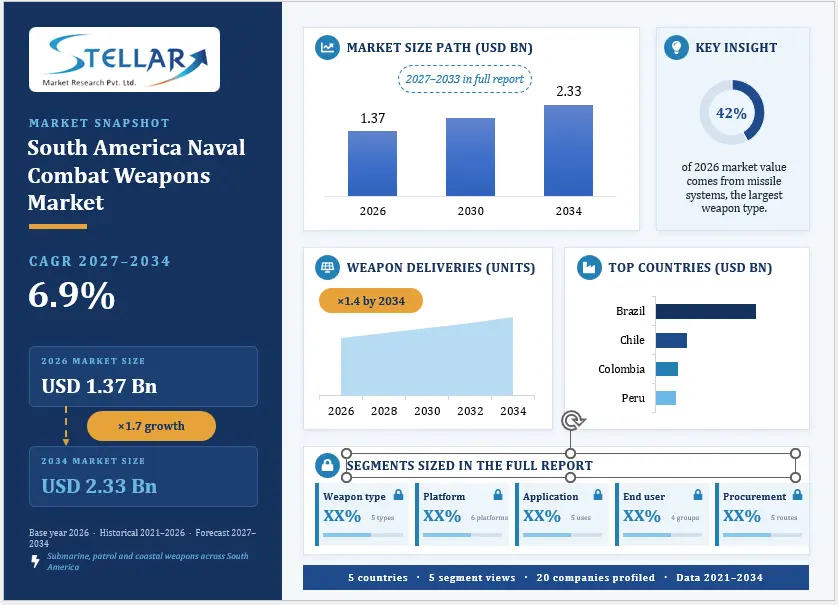
The South America Naval Combat Weapons Market is valued at USD 1.37 billion in 2026 and is projected to reach USD 2.33 billion by 2034, growing at a CAGR of 6.9% during 2027–2034.
The South America Naval Combat Weapons Market is valued at USD 1.37 billion in 2026 and is projected to reach USD 2.33 billion by 2034, growing at a CAGR of 6.9% during 2027–2034, according to SMR. Naval combat weapons are the ship-, submarine- and unmanned-vessel-launched armaments that let navies sink ships, defend fleets against aircraft and missiles, hunt submarines and strike targets ashore, and the category spans guided missiles that dominate today’s revenue, naval guns, torpedoes, close-in weapon systems, and mines, countermeasures and directed-energy weapons that are moving into wider service.
The South America Naval Combat Weapons Market analysis examines market value and opportunities for weapon manufacturers, shipbuilders, combat-system integrators and investors, while addressing the information needs of navies, coast guards, defense ministries and procurement teams. It provides an overview of naval combat weapons and evaluates key categories, including the naval missile systems market, naval gun systems market, naval torpedo systems market, close-in weapon systems market and anti-ship missile systems market. The report covers the industry landscape, market analysis, market insights, industry trends, market dynamics, market size, key players, competitive landscape, market segmentation, growth prospects and emerging market opportunities, offering a comprehensive outlook for industry stakeholders.
Missile systems and naval procurement remain central to the South America Naval Combat Weapons Market, with Brazil representing the largest country market in the region. However, growth opportunities are increasingly emerging in Peru, anti-surface warfare, unmanned maritime systems, directed-energy weapons and counter-drone systems. Fleet modernization, munition replenishment, growing undersea competition and evolving drone and missile threats at sea are expanding naval defense requirements and weapon-intensive missions. The analysis further examines market challenges, procurement behavior, market entry opportunities, emerging markets, growth drivers, revenue generation, competitive strategies and research findings, providing a structured market summary and outlook for the regional naval defense weapons industry.
SMR provides comprehensive analysis of the South America Naval Combat Weapons Market size, share, weapon type, platform, application, end user, procurement route and country segmentation, the naval defense weapons market, strategic scenarios and growth opportunities. The report helps naval weapon manufacturers, shipbuilders and combat-system integrators, seeker, propulsion and warhead suppliers, defense ministries, navies, coast guards and investors decide which programs, segments and countries to prioritize through 2034. This South America Naval Combat Weapons Market study of naval defense modernization also covers South American submarine weapons, South American shipborne weapon systems and Latin America anti-ship missile systems.
|
2026 | BASE YEAR |
2034 | FORECAST |
CAGR | 2027–2034 |
LARGEST COUNTRY |
|
USD 1.37 Bn |
USD 2.33 Bn |
6.9% |
Brazil |
South America Naval Combat Weapons Market Overview: Size, Share, Trends and Outlook, 2026–2034
The South America Naval Combat Weapons Market is measured at the weapon-manufacturer revenue level across naval missile systems, naval gun systems, naval torpedo and anti-submarine weapons, close-in weapon systems, and naval mines, countermeasures and directed-energy weapons. The scope includes weapon production, launchers and fire-control equipment supplied with weapon systems, munition replenishment and life-extension contracts. It excludes ships and hulls, standalone radars, sonars and combat-management systems, aircraft-launched, land-based and army air-defense weapons, and unguided gun ammunition. South America accounts for approximately 3% of the global market valued at USD 45.60 billion in 2026, with country estimates aggregating to USD 1.37 billion.
Three major shifts will shape the market during 2027–2034: increasing demand for long-range, multi-mission and layered air and missile defense weapons; rising value from munition replenishment, multi-year production contracts and regional co-production; and growing adoption of cost-effective, high-volume weapons, including directed-energy, counter-drone systems and unmanned launchers. These trends are driving manufacturers toward capacity expansion, long-term contracts and supplier consolidation. The market synopsis evaluates key market dynamics, industry fluctuations, economic factors, procurement trends, demand and supply conditions, and competitive forces shaping the regional naval defense weapons industry.
On a volume basis, SMR estimates weapon deliveries in South America of about 880 units in 2026, rising to about 1,200 units by 2034 at a CAGR of roughly 4.0% during 2027–2034. Value grows faster than volume (6.9% versus 4.0% CAGR during 2027–2034) because the mix is shifting toward long-range missiles, interceptors, advanced torpedoes, directed-energy installations and replenishment contracts, lifting average revenue per unit from about USD 1.6 million in 2026 to about USD 1.9 million in 2034. Volume figures are modeled estimates of new-build deliveries of guided missiles, torpedoes, gun mounts, close-in weapon systems, mines and directed-energy installations; unguided gun ammunition is excluded.
To get more Insights: Request Free Sample Report
Key Findings: Eight Insights Shaping the South America Naval Combat Weapons Market
SMR’s analysis of published market data, company announcements, budget documents and industry developments points to eight findings that explain where South America Naval Combat Weapons Market growth and value are created through 2034. These market insights summarize the South America Naval Combat Weapons Market forecast, market segmentation and competitive landscape in one view.
|
Sr. No. |
Findings |
Evidence |
So what |
|
1 |
The market grows about 1.7× by 2034 |
USD 1.37 Bn (2026) to USD 2.33 Bn (2034) at 6.9% CAGR during 2027–2034 |
Missile, seeker, rocket-motor and launcher capacity must scale in step with multi-year naval programs |
|
2 |
Missile systems are the base, missile systems the growth edge |
Missile systems ~42% of 2026 value at 8.1% CAGR during 2027–2034; |
Established weapon lines fund the technology base while newer categories add upside |
|
3 |
Brazil is the largest country market |
~50% of 2026 regional value (USD 0.68 Bn), with 6.9% CAGR during 2027–2034 |
Anchor-country programs set requirements and supplier selection for the region |
|
4 |
Peru is the fastest-growing major market |
7.6% CAGR during 2027–2034, adding USD 0.11 Bn by 2034; region as a whole grows at 6.9% |
New fleet programs and exports open revenue pools for local and foreign suppliers |
|
5 |
Anti-surface warfare remain the core application |
Anti-surface warfare ~38% of 2026 value at 5.8% CAGR during 2027–2034; air and missile defense ~22% |
Sensor fusion, interceptor depth and weapon integration anchor competitiveness |
|
6 |
Unmanned maritime systems outgrow the market |
Unmanned maritime systems 19.9% CAGR during 2027–2034 from 2% of 2026 value; missile systems 8.1% CAGR |
Low-cost, distributed launch and new weapon types lift value from a small base |
|
7 |
Procurement is government-led and program-based |
Domestic procurement ~30%; G2G and FMS imports ~26%; DCS and offset imports ~24% |
Budget cycles, export approvals and offsets shape contract timing and supplier selection |
|
8 |
Domestic shipbuilding resets demand |
Tamandaré commissioned (Apr 2026), four more frigates planned (Jul 2026) and 24-navy UNITAS 2026 in Peru |
Local content and shipbuilding partnerships shape supplier selection |
South America Naval Combat Weapons Market Dynamics: Growth Drivers, Restraints, Opportunities and Trends
South America Naval Combat Weapons Market Growth Drivers: Frigate and Submarine Programs, Amazônia Azul Security, Fleet Renewal and Allied Shipbuilding Partnerships
The South America Naval Combat Weapons Market is driven by fleet renewal, offshore resource protection and shipbuilding partnerships. Brazil commissioned its first Tamandaré-class frigate on 24 April 2026 and has announced plans for four more, taking the class to eight ships, while its Riachuelo-class submarine Humaitá trained with the USS Nimitz in May 2026 and a nuclear-powered submarine is under construction. Chile needs to replace at least eight frigates averaging more than 30 years in service, and Peru is building ships with HD Hyundai under a 2024 contract. However, budgets, export approvals, industrial capacity and delivery timelines remain key market constraints. Demand is also shaped by market drivers, market challenges, technological advancements, South America Naval Combat Weapons Market regulatory influences, emerging trends.
Technological advancements are creating additional growth opportunities through anti-submarine torpedoes such as the MK 54 used by Brazil, anti-ship missiles, close-in weapons and local assembly. Brazil, Colombia and Peru build ships at home through Itaguaí, COTECMAR and SIMA, and each program adds weapon fits. Peru is the fastest-growing major market at 7.6% CAGR during 2027–2034, followed by Colombia at 7%. These developments shape market drivers, emerging trends, competitive dynamics and long-term growth opportunities. Analysts also track market opportunities, innovation in the industry, macroeconomic factors, market growth factors, market constraints.
South America Naval Combat Weapons Market Restraints: Budget Limits, Import Dependence, Slow Program Timelines and Political Uncertainty
Budget limits and import dependence are the main restraints. Most navies rely on imported missiles, torpedoes and combat systems, so license and political conditions add approval time, and currency swings affect purchasing power. Shephard Defence Insight forecasts about USD 5.52 billion of Brazilian naval vessel spending in 2026–2032, but weapon budgets are only a fraction of ship budgets. Industry disruptors, South America Naval Combat Weapons Market shifts, environmental factors, socioeconomic influences, market trends analysis, demand and supply dynamics shape supply and the constraints that suppliers must manage.
Program delays and political uncertainty also limit growth. Frigate and submarine programs take years, weapon fits follow ship schedules, and elections and fiscal pressure freeze decisions, as with Peru’s fighter decision in 2026. Chile is projected to grow at 6.5% CAGR during 2027–2034 as its frigate replacement decision is still pending, and patrol and coastal vessels compete with larger combatants for funds. Market forces, economic indicators, industry evolution, South America Naval Combat Weapons Market competitive landscape shifts, consumer preferences evolution, regulatory changes also influence how quickly new entrants can scale.
What Are the Biggest South America Naval Combat Weapons Market Opportunities Through 2034?
Frigate weapon fits, submarine torpedoes and local assembly represent the most significant South America Naval Combat Weapons Market opportunities because they extend revenue beyond single weapon sales into launchers, spares and training. Cooperative programs are projected to grow fastest at 9% CAGR during 2027–2034, air and missile defense at 8.6%, missile systems at 8.1% and unmanned maritime systems at 19.9% from a 2% base, while missile systems, the largest weapon type, grow at 8.1%. Innovation impact, technology trends, market responsiveness, external market influences, market adaptability are assessed for each segment.
Regional co-production and second-hand and new ship sales offer further routes to growth. Brazil is the anchor at 50% of 2026 regional value and 6.9% CAGR during 2027–2034, Peru is projected to grow at 7.6%, and Chile, where Hanwha Ocean and Babcock are competing for frigate and submarine programs, at 6.5%. Brazil used the Fraterno XXXIX exercise in August 2026 to offer its Tamandaré frigate and Riachuelo submarine to Argentina. Cooperative programs, industrial participation and local final assembly can widen market access and shorten delivery cycles. South America Naval Combat Weapons Market strategic market changes, market segmentation shifts, customer engagement dynamics, industry resilience create attractive segment-specific opportunities and untapped market areas.
South America Naval Combat Weapons Market Trends: Long-Range Layered Weapons, Magazine Depth, Directed Energy and Unmanned Launch
Four South America Naval Combat Weapons Market trends stand out through 2034. First, domestic frigate and submarine building: Brazil’s Tamandaré class and PROSUB submarines, Colombia’s COTECMAR frigates and Peru’s SIMA ships create local weapon-integration work. Second, European and Asian shipbuilding partnerships: Naval Group, TKMS, Damen, HD Hyundai and Hanwha compete for programs. Third, regional naval cooperation: exercises such as UNITAS 2026 in Peru bring 24 navies together and support interoperability. Fourth, offshore-resource protection: patrol and coastal combatants gain weapons as navies secure exclusive economic zones. Market fluctuation analysis, growth catalysts, market volatility, market gap determine how naval weapon manufacturers respond.
South America Naval Combat Weapons Market Segment Analysis: By Weapon Type, Platform, Application, End User and Procurement Route
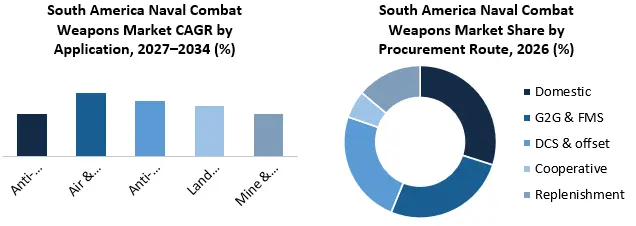
South America Naval Combat Weapons Market by Application and Procurement Route: Anti-Surface Warfare, Air and Missile Defense, Anti-Submarine Warfare, Land Attack and Littoral Mine Warfare
Naval Missile Systems Market, Naval Gun Systems Market, Naval Torpedo Systems Market, Weapon Type and Platform
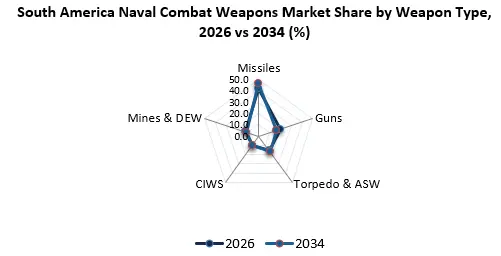
Missile systems dominate the South America Naval Combat Weapons Market, accounting for approximately 42% of 2026 value, followed by gun systems (20%) and torpedo & ASW weapons (16%). By platform, frigates & corvettes lead with a 36% share, while unmanned maritime systems are the fastest-growing category at a 19.9% CAGR during 2027–2034. By application, anti-surface warfare account for 38%, followed by air & missile defense (22%). Domestic procurement leads purchasing channels at 30%, followed by G2G & FMS imports (26%) and DCS & offset imports (24%). Regional & littoral navies represent the largest end-user category, contributing approximately 68% of market value.
This South America Naval Combat Weapons Market segmentation analysis evaluates weapon types, platforms, applications, end users and procurement routes, highlighting market shares, segment growth trends, competitive positioning and emerging opportunities. It covers industry segmentation, product and geographic segmentation, target market analysis, customer profiling, market subsegments, niche markets, segment attractiveness and competitive landscape. The analysis also examines demographic and behavioral segmentation, market segment dynamics, emerging and untapped market opportunities, segment-specific trends and tailored market strategies across the naval missile systems market, naval gun systems market and naval torpedo systems market.
Naval Combat Weapon Types: Where Missile, Gun, Torpedo, Close-In and Mine, Countermeasure and Directed-Energy Demand Sits
South America Naval Combat Weapons Market Regional Analysis: Brazil, Chile, Colombia, Peru, Argentina and Rest of South America
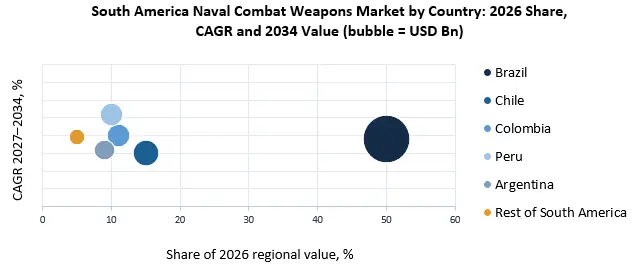
Brazil is the largest national market, accounting for approximately 50% of South America's naval combat weapons market value in 2026 and growing at a 6.9% CAGR during 2027–2034, supported by Tamandaré-class frigates, Riachuelo-class submarines and its nuclear-powered submarine program. Chile represents 15% of regional value, with a 6.5% CAGR, driven by plans to replace aging frigates.
Colombia accounts for 11% of 2026 value and is projected to grow at a 7% CAGR, supported by the Damen–COTECMAR frigate agreement. Peru holds a 10% share and is expected to record the fastest growth among major markets at a 7.6% CAGR, supported by SIMA shipbuilding collaboration with HD Hyundai. Argentina accounts for 9%, with a 6.6% CAGR, as it evaluates frigate procurement options. The Rest of South America represents the remaining 5% and is projected to grow at a 7% CAGR. Overall, the region accounts for approximately 3% of global market value in 2026 and is forecast to grow at a 6.9% CAGR during 2027–2034, compared with the global rate of 7.2%.
The geographical analysis examines South America Naval Combat Weapons Market regional trends, area-specific market dynamics, local market influences, economic factors, competitive landscape, market performance and regional market share. It also evaluates country-level growth opportunities, market entry strategies, regional challenges and the impact of territorial and procurement dynamics on naval weapon demand.
Furthermore, it explores locational market nuances, area-centric market shifts, geographic market intricacies, regional consumer patterns, local economic factors, South America Naval Combat Weapons Market regional market performance, regional market segmentation, territorial competitive landscape, demographic trends by region, localized market challenges, regionally-driven opportunities, locational market share, geo-strategic influences, South America Naval Combat Weapons Market regional market entry strategies, area-centric growth factors, regional industry outlook, market trends in designated areas, geopolitical influences.
South America Naval Combat Weapons Market Companies and Competitive Landscape: Who Are the Top Naval Weapons Suppliers and Players?
The South America Naval Combat Weapons Market competitive landscape comprises international weapon suppliers such as RTX, Lockheed Martin, MBDA, Kongsberg, Saab and Atlas Elektronik; shipbuilders and system integrators such as Naval Group, Itaguaí Construções Navais, the TKMS–Embraer Águas Azuis consortium, Damen, HD Hyundai Heavy Industries, Hanwha Ocean and Babcock; and regional organizations including ASMAR, COTECMAR, SIMA Peru and Avibras. These companies operate across different weapon categories and value-chain activities, making direct comparisons based solely on company revenue or market share unsuitable. The competitor analysis covers company net sales, competitor benchmarking, competitive intelligence, market positioning, industry rivalry, competitor profiling and competitive advantage assessment.
Competition is shaped by technological capabilities, program contracts, local content requirements, export approvals, pricing, financing and after-sales support. International suppliers benefit from shipbuilding partnerships, while regional players emphasize domestic assembly and support capabilities. The competitive landscape analysis evaluates company positioning, revenue, product portfolios, regional presence, strategic partnerships, player strategies, competitor differentiation and market share to assess competitive intensity, emerging opportunities and the evolving rivalry across the South American naval defense industry.
South America Naval Combat Weapons Market Recent Developments, Contract Awards and Industry Positioning
|
Period |
Development |
Why it matters |
|
Apr 2026 |
Brazil commissioned the frigate Tamandaré (F200), the first domestically built warship in 46 years |
Starts a frigate class that adds weapon-integration work for Brazilian industry |
|
May 2026 |
Brazil’s Riachuelo-class submarine Humaitá trained with the USS Nimitz |
Supports demand for submarine weapons, training and sustainment in Brazil’s submarine fleet |
|
Jul 2026 |
President Lula announced plans to order four more frigates, taking the class to eight, supported by the Merchant Marine Fund |
Widens the weapon-fit and sustainment pipeline |
|
Jul 2026 |
Hanwha Ocean entered the competition for Chile’s submarine and frigate programs during South Korean President Lee Jae-myung’s state visit to Chile |
Shows Asian shipbuilders competing for programs that carry weapon fits |
|
Aug 2026 |
Brazil offered its Tamandaré frigate and Riachuelo submarine to Argentina during the Fraterno XXXIX exercise |
Opens potential export and cooperation routes in the region |
|
Sep 2026 |
UNITAS 2026 opened in Peru with 24 navies |
Joint exercises support demand for interoperable weapons and munitions across regional navies |
South America Naval Combat Weapons Market Scope: Inquire before buying
|
South America Naval Combat Weapons Market |
|||
|
Report Coverage |
Details |
||
|
Base Year: |
2026 |
Forecast Period: |
2027–2034 |
|
Historical Data: |
2021 to 2026 |
Market Size in 2026: |
USD 1.37 Billion |
|
CAGR Period: 2027–2034 |
6.9% |
Market Size in 2034: |
USD 2.33 Billion |
|
Segments Covered: |
By Weapon Type |
Naval Missile Systems Naval Gun Systems Naval Torpedo and ASW Weapons Close-In Weapon Systems Naval Mines, Countermeasures and Directed-Energy Weapons |
|
|
By Platform |
Destroyers and Cruisers Frigates and Corvettes Submarines Aircraft Carriers and Amphibious Ships Patrol and Coastal Combatants Unmanned Maritime Systems |
||
|
By Application |
Anti-Surface Warfare Air and Missile Defense Anti-Submarine Warfare Land Attack and Naval Strike Mine and Littoral Warfare |
||
|
By End User |
Blue-Water Navies Regional and Littoral Navies Coast Guards and Maritime Security Agencies Naval Infantry and Special Warfare Forces |
||
|
By Procurement Route |
Domestic National Procurement Government-to-Government and FMS Imports Direct Commercial Sales and Offset-Linked Imports Multinational Cooperative and Co-Production Programs Munition Replenishment and Life-Extension Contracts |
||
South America Naval Combat Weapons Market, By Country
Brazil
Chile
Colombia
Peru
Argentina
Venezuela
Rest of South America (Ecuador, Uruguay, Paraguay and Others)
South America Naval Combat Weapons Market, Key Players
A. Brazil
- Itaguaí Construções Navais – Brazil
- Águas Azuis Consortium (TKMS and Embraer) – Brazil
- Avibras Indústria Aeroespacial – Brazil
- Embraer Defense & Security – Brazil
B. Chile and Argentina
- ASMAR – Chile
- Complejo Industrial Naval Argentino (CINAR) – Argentina
C. Colombia and Peru
- COTECMAR – Colombia
- SIMA Perú – Peru
D. International Weapon Suppliers
- RTX Corporation (Raytheon) – United States
- Lockheed Martin Corporation – United States
- MBDA – France
- Kongsberg Defence & Aerospace – Norway
- Saab AB – Sweden
- Atlas Elektronik – Germany
E. International Shipbuilders
- Naval Group – France
- Thyssenkrupp Marine Systems – Germany
- Damen Naval – Netherlands
- HD Hyundai Heavy Industries – South Korea
- Hanwha Ocean – South Korea
- Babcock International Group – United Kingdom
Frequently Asked Questions
Brazil holds the largest share at about 50% of regional value in 2026, followed by Chile at 15% and Colombia at 11%. Peru is the fastest-growing major market at 7.6% CAGR during 2027–2034, while the region grows at 6.9% and holds about 3% of global value in 2026.
Missile systems are the largest weapon type at about 42% of 2026 value, while unmanned maritime systems (19.9% CAGR during 2027–2034), missile systems (8.1% CAGR) and air and missile defense (8.6% CAGR) grow fastest. Cooperative programs grow at 9% CAGR during 2027–2034.
Leading names include Itaguaí Construções Navais, the Águas Azuis consortium, Avibras, ASMAR, COTECMAR and SIMA Perú, alongside international suppliers RTX, Lockheed Martin, MBDA, Kongsberg, Saab, Atlas Elektronik, Naval Group, TKMS and HD Hyundai. They compete in different segments, from missiles and torpedoes to guns, directed energy and shipbuilding.
Brazil leads with the Tamandaré-class frigates (first commissioned in April 2026, four more planned) and Riachuelo-class submarines, while Chile is replacing at least eight aging frigates, Peru works with HD Hyundai and SIMA and Colombia builds frigates with Damen and COTECMAR.
1. Executive Market Landscape and Industry Overview
1.1. South America Naval Combat Weapons Market Size (Value USD Billion & Volume Weapon Units), 2026–2034
1.2. Evolution of Naval Combat Weapons from Gun Cruisers and Anti-Ship Missiles to Networked Long-Range Strike
1.3. Definition, Scope and Classification of Naval Combat Weapons
1.4. Performance Envelope and Technical Characteristics of Naval Weapons
1.5. Role of Naval Weapons in Anti-Surface, Air Defense, Anti-Submarine and Land-Attack Missions
1.6. Integration of Directed-Energy, Hypersonic and Unmanned Launch Technologies
1.7. Key Findings and Strategic Takeaways
2. South America Naval Combat Weapons Market Dynamics
2.1. South America Naval Combat Weapons Market Trends
2.2. South America Naval Combat Weapons Market Dynamics
2.2.1. Drivers
2.2.2. Restraints
2.2.3. Opportunities
2.3. Impact of the 2026 Iran Conflict on Munition Stocks and Demand
2.4. Porter’s Five Forces and Competitive Intensity
2.5. Market Gap and Growth Catalysts
3. South America Naval Combat Weapons Market Macroeconomic Factors
3.1. Global Defense Expenditure and Naval Budget Trends
3.2. Shipbuilding Plans and Fleet Size Targets
3.3. Munition Stockpile Levels and Replenishment Funding
3.4. Inflation, Currency and Input-Cost Trends
3.5. Maritime Security Threats and Chokepoint Risk
3.6. Alliances, Defense Pacts and Burden-Sharing
3.7. Offset, Industrial Participation and Local Content Policies
4. South America Naval Combat Weapons Market Industry Trends & Emerging Customer Requirements
4.1. Rising Demand for Long-Range and Hypersonic Strike Capability
4.2. Layered Air and Missile Defense Requirements
4.3. Low-Cost Interceptors and Cost-per-Engagement Pressure
4.4. Directed-Energy and Counter-Drone Requirements
4.5. Unmanned Surface and Underwater Weapon Platforms
4.6. Magazine Depth, Reload at Sea and Containerized Launchers
4.7. Fleet Modernization and Service-Life Extension Programs
5. South America Naval Combat Weapons Market Value Chain & Business Ecosystem Landscape
5.1. Energetics, Rocket Motors and Raw Material Supply
5.2. Seeker, Guidance and Microelectronics Suppliers
5.3. Missile, Torpedo and Gun Manufacturers
5.4. Launcher, Magazine and Fire-Control Integrators
5.5. Shipbuilders and Platform Integrators
5.6. Testing, Range and Qualification Services
5.7. Sustainment, Replenishment and Life-Extension Providers
5.8. Navies, Coast Guards and Government Customers
6. South America Naval Combat Weapons Market Product Portfolio & Classification Landscape
6.1. Naval Missile Systems
6.2. Naval Gun Systems
6.3. Naval Torpedo and Anti-Submarine Weapons
6.4. Close-In Weapon Systems
6.5. Naval Mines, Countermeasures and Directed-Energy Weapons
6.6. Experimental and Technology Demonstrator Weapons
7. South America Naval Combat Weapons Market Performance Envelope & Technical Characteristics
7.1. Range, Speed and Warhead Performance
7.2. Guidance, Seeker and Datalink Technologies
7.3. Survivability and Electronic Warfare Resistance
7.4. Launch Cell, Canister and Tube Compatibility
7.5. Reliability, Storage Life and Maintenance
7.6. Cost per Round and Operating Economics
8. South America Naval Combat Weapons Market Energetics, Materials & Raw Material Sourcing Landscape
8.1. Solid Rocket Propellants and Energetic Materials
8.2. Titanium, Aluminum and Composite Airframe Materials
8.3. Rare Earths, Magnets and Specialty Metals
8.4. Electronic Components and Microelectronics
8.5. Warhead and Explosive Materials
8.6. Supply Concentration and Material Risk Management
9. South America Naval Combat Weapons Market Manufacturing & Industrial Production Landscape
9.1. Missile Airframe and Motor Production
9.2. Seeker and Electronics Assembly
9.3. Torpedo and Gun Mount Production
9.4. Automation, Digital Engineering and Quality Control
9.5. Test and Acceptance Facilities
9.6. Production Capacity, Backlog and Delivery Schedules
10. South America Naval Combat Weapons Market Propulsion, Seekers & Guidance Technologies
10.1. Solid-Rocket and Ramjet Propulsion
10.2. Turbojet and Turbofan Cruise Engines
10.3. Active Radar, Infrared and Imaging Seekers
10.4. Inertial, Satellite and Datalink Guidance
10.5. Hypersonic Boost-Glide and Scramjet Technologies
10.6. Testing, Qualification and Sustainment
11. Naval Missile Programs and Applications
11.1. Land-Attack Cruise Missile Programs
11.2. Surface-to-Air and Ballistic Missile Defense Interceptors
11.3. Anti-Ship Cruise Missile Programs
11.4. Submarine-Launched Missile Programs
11.5. Export Competitions and Orders
12. Naval Gun & Close-In Weapon Programs
12.1. Medium-Caliber Naval Guns
12.2. Large-Caliber and Precision Guided Rounds
12.3. Close-In Weapon Systems and Remote Weapon Stations
12.4. Fire Control and Ammunition Handling
13. Torpedo & Anti-Submarine Weapon Applications
13.1. Heavyweight Submarine-Launched Torpedoes
13.2. Lightweight Ship- and Air-Launched Torpedoes
13.3. Anti-Submarine Rockets and Depth Weapons
13.4. Torpedo Countermeasures and Decoys
14. Mines, Countermeasures & Littoral Warfare Applications
14.1. Naval Mines and Mine-Laying Systems
14.2. Mine Countermeasures and Unmanned Mine Hunting
14.3. Soft-Kill Decoys and Chaff Systems
14.4. Littoral and Coastal Defense Weapons
15. Directed-Energy & Counter-Drone Weapons
15.1. Shipboard High-Energy Lasers
15.2. Optical Dazzlers and Non-Kinetic Systems
15.3. High-Power Microwave and Electronic Attack
15.4. Power, Cooling and Ship-Integration Requirements
16. Unmanned & Distributed Launch Systems
16.1. Unmanned Surface Vessels with Weapon Payloads
16.2. Unmanned Underwater Vehicles and Torpedo Carriers
16.3. Containerized and Modular Launchers
16.4. Teaming of Crewed and Uncrewed Ships
17. Fire Control, Sensors & Combat Management Integration
17.1. Radar and Sonar Interfaces
17.2. Combat Management System Integration
17.3. Electronic Warfare and Self-Protection Interfaces
17.4. Targeting, Datalinks and Over-the-Horizon Cueing
17.5. Cyber Resilience and Software Updates
18. Launchers, Vertical Launch Systems & Magazine Integration
18.1. Vertical Launch Systems and Cell Counts
18.2. Canister, Tube and Inclined Launchers
18.3. Reload, Cross-Deck and Resupply at Sea
18.4. Submarine Torpedo Rooms and Vertical Payload Modules
19. Sustainment, Life-Extension & Replenishment
19.1. Performance-Based Logistics and Sustainment Contracts
19.2. Mid-Life Upgrades and Technology Refresh
19.3. Munition Replenishment and Multi-Year Buys
19.4. Depot Maintenance and Recertification
19.5. Predictive Maintenance and Digital Inventory Management
20. Naval Weapon Procurement, Contracting & Sales Models
20.1. Domestic and Direct Government Contracting
20.2. Multi-Year, Block-Buy and Framework Agreements
20.3. Government-to-Government and FMS Channels
20.4. Direct Commercial Sales and Offset-Linked Imports
20.5. Cooperative Development and Co-Production Models
21. Naval Weapon Pricing, Production Economics & Lifecycle Cost Structure
21.1. Average Unit Cost by Weapon Class
21.2. Learning Curves and Rate Production Effects
21.3. Cost per Engagement and Magazine Economics
21.4. Warhead, Seeker and Motor Cost Drivers
21.5. Lifecycle Cost and Total Ownership Cost
22. Naval Weapon Supply Chain, Offsets & Export Control
22.1. Export Control Regimes, Licensing and Offset Obligations
22.2. Critical Material and Component Supply Risk
22.3. Dual-Source and Second-Source Strategies
22.4. Logistics, Spare Parts and Delivery Scheduling
23. Naval Weapon Sustainability & Environmental Impact
23.1. Energetics Manufacturing and Emissions
23.2. Range Testing and Marine Environmental Considerations
23.3. Demilitarization and Disposal of Obsolete Munitions
23.4. Recycling and Materials Recovery
24. Naval Weapon Regulatory Compliance & Qualification
24.1. Insensitive Munitions and Safety Qualification Standards
24.2. Arms Export Controls and End-Use Rules
24.3. Shock, Vibration and Environmental Test Standards
24.4. Treaty, Sanctions and Humanitarian Rules
25. South America Naval Combat Weapons Market Regional & Country-Level Landscape
25.1. Brazil Naval Weapon Programs and Demand
25.2. Chile Naval Weapon Programs and Demand
25.3. Colombia Naval Weapon Programs and Demand
25.4. Peru Naval Weapon Programs and Demand
25.5. Argentina Naval Weapon Programs and Demand
26. South America Naval Combat Weapons Market: Market Size and Forecast by Segmentation (Value USD Billion & Volume Weapon Units) (2026–2034)
26.1. South America Naval Combat Weapons Market Size and Forecast, By Weapon Type
26.1.1. Naval Missile Systems
26.1.2. Naval Gun Systems
26.1.3. Naval Torpedo and ASW Weapons
26.1.4. Close-In Weapon Systems
26.1.5. Naval Mines, Countermeasures and Directed-Energy Weapons
26.2. South America Naval Combat Weapons Market Size and Forecast, By Platform
26.2.1. Destroyers and Cruisers
26.2.2. Frigates and Corvettes
26.2.3. Submarines
26.2.4. Aircraft Carriers and Amphibious Ships
26.2.5. Patrol and Coastal Combatants
26.2.6. Unmanned Maritime Systems
26.3. South America Naval Combat Weapons Market Size and Forecast, By Application
26.3.1. Anti-Surface Warfare
26.3.2. Air and Missile Defense
26.3.3. Anti-Submarine Warfare
26.3.4. Land Attack and Naval Strike
26.3.5. Mine and Littoral Warfare
26.4. South America Naval Combat Weapons Market Size and Forecast, By End User
26.4.1. Blue-Water Navies
26.4.2. Regional and Littoral Navies
26.4.3. Coast Guards and Maritime Security Agencies
26.4.4. Naval Infantry and Special Warfare Forces
26.5. South America Naval Combat Weapons Market Size and Forecast, By Procurement Route
26.5.1. Domestic National Procurement
26.5.2. Government-to-Government and FMS Imports
26.5.3. Direct Commercial Sales and Offset-Linked Imports
26.5.4. Multinational Cooperative and Co-Production Programs
26.5.5. Munition Replenishment and Life-Extension Contracts
26.6. South America Naval Combat Weapons Market Size and Forecast, By Country
26.6.1. Brazil
26.6.2. Chile
26.6.3. Colombia
26.6.4. Peru
26.6.5. Argentina
26.6.6. Venezuela
26.6.7. Rest of South America
27. South America Naval Combat Weapons Market Competitive Landscape
27.1. SMR Competition Matrix
27.2. Market Share and Positioning of Key Players
27.3. Company Benchmarking
27.3.1. Product Portfolio
27.3.2. Production Capacity
27.3.3. Regional Presence
27.3.4. Contract Backlog
27.3.5. Financial Performance
27.3.6. Strategic Initiatives
28. Missile & Strike Weapon Manufacturers
28.1. Land-Attack and Strike Missile Manufacturers
28.2. Anti-Ship Missile Manufacturers
28.3. Air and Missile Defense Interceptor Manufacturers
28.4. Hypersonic and Next-Generation Missile Developers
29. Gun, Close-In & Directed-Energy Weapon Manufacturers
29.1. Naval Gun and Ammunition Manufacturers
29.2. Close-In Weapon System Manufacturers
29.3. Directed-Energy Weapon Developers
29.4. Fire-Control and Gun-Mount Suppliers
30. Undersea Weapon Manufacturers
30.1. Heavyweight Torpedo Manufacturers
30.2. Lightweight Torpedo Manufacturers
30.3. Mine and Countermeasure Manufacturers
30.4. Unmanned Undersea Weapon Developers
31. Fire-Control, Sensor & Tier-1 Subsystem Suppliers
31.1. Radar and Sonar Suppliers
31.2. Combat Management System Suppliers
31.3. Seeker, Motor and Warhead Suppliers
31.4. Launcher and Magazine Suppliers
32. Shipbuilders, Integrators & Sustainment Service Providers
32.1. Surface Combatant Shipbuilders
32.2. Submarine Shipbuilders
32.3. Weapon Integration and Sustainment Providers
32.4. Training, Simulation and Test Providers
33. South America Naval Combat Weapons Market Companies' Strategies & Expansion Plans
33.1. Expansion of Production Lines and Delivery Capacity
33.2. Multi-Year Contracts and Framework Agreements
33.3. Co-Production and Local Assembly Partnerships
33.4. Technology Investment in Hypersonic, Directed-Energy and Autonomy
33.5. Digital Engineering and Sustainment Strategies
34. South America Naval Combat Weapons Market SWOT, Investments & Strategic Developments
34.1. Competitive Strengths of Established Weapon Manufacturers
34.2. Weaknesses and Capacity Constraints
34.3. Opportunities and Threats
34.4. Recent Investments, Contracts and Strategic Developments
35. South America Naval Combat Weapons Market Competitive Outlook & Market Positioning
35.1. Competitive Dynamics Across Weapon Categories
35.2. Role of Cooperation and Consolidation
35.3. Entry Barriers and New-Entrant Strategies
35.4. Future Competitive Landscape Through 2034
36. Company Profile: Key Players
Detailed Profile Considering the Parameters
- Overview
- Business Portfolio
- Naval Weapon Product Portfolio
- Weapon Specifications and Performance Envelope
- Platform Integration and Product Availability
- Manufacturing Facilities and Production Capacity
- Supply Chain and Sourcing Network
- Guidance, Seeker and Propulsion Capabilities
- Order Backlog, Delivery and Support Network
- Total Company Revenue
- Naval Weapon-Related Revenue, Where Available
- Geographic Presence
- Certifications and Qualification Standards
- SWOT Analysis
- Strategic Analysis
- Recent Developments
37. Key Players – South America Naval Combat Weapons Market
Brazil
- Itaguaí Construções Navais
- Águas Azuis Consortium (TKMS and Embraer)
- Avibras Indústria Aeroespacial
- Embraer Defense & Security
Chile and Argentina
- ASMAR
- Complejo Industrial Naval Argentino (CINAR)
Colombia and Peru
- COTECMAR
- SIMA Perú
International Weapon Suppliers
United States, France, Norway, Sweden and Germany
- RTX Corporation (Raytheon)
- Lockheed Martin Corporation
- MBDA
- Kongsberg Defence & Aerospace
- Saab AB
- Atlas Elektronik
International Shipbuilders
France, Germany, Netherlands, South Korea and United Kingdom
- Naval Group
- Thyssenkrupp Marine Systems
- Damen Naval
- HD Hyundai Heavy Industries
- Hanwha Ocean
- Babcock International Group
38. Key Findings
39. Strategic Moves & Industry Outlook
40. Research Methodology