ENG
 Japanese
 French
 German
 Korean

Rotavators Market: Global Industry Analysis, Market Size, Share, Trends and Forecast (2027–2034)
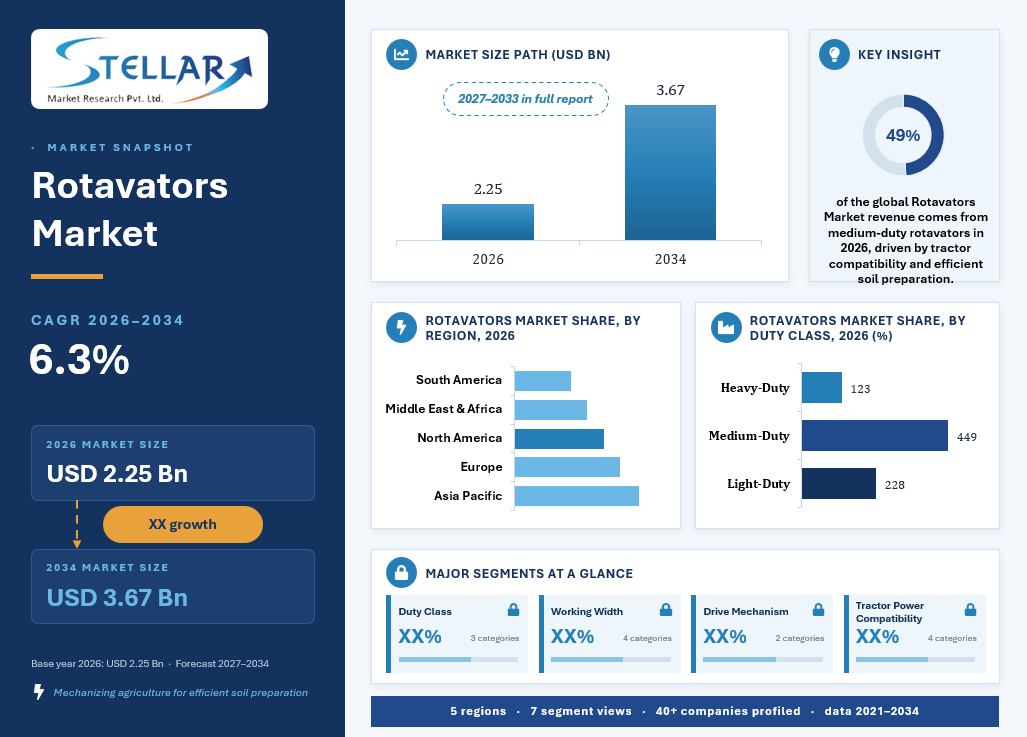
The Global Rotavators Market was valued at USD 2.25 Bn in 2026 and is expected to reach USD 3.67 Bn by 2034, growing at a CAGR of 6.3% during 2027–2034.
The Global Rotavators Market was valued at USD 2.25 Bn in 2026 and is expected to reach USD 3.67 Bn by 2034, growing at a CAGR of 6.3% during 2027–2034.
A rotavator, also called a rotary tiller or rotary cultivator, is a tractor-driven soil preparation implement. A rotating shaft fitted with L-type or C-type blades is powered through the tractor power take-off (PTO) and a gearbox or chain drive, cutting, pulverizing and mixing the soil in a single pass to create a seedbed. The market spans light-duty, medium-duty and heavy-duty rotavators across working widths from compact units for mini tractors to wide machines for high-horsepower tractors, sold through tractor OEMs, authorized dealers, independent farm equipment retailers and online channels.
The global Rotavators Market covers agricultural rotavators, tractor-mounted rotary tillage equipment, PTO-driven rotavators, heavy-duty rotavators, rotavator blades and related replacement parts used in farm mechanization. Agricultural rotavators are available in working widths ranging from 1.2 to 2.5 meters, with models compatible with tractors rated from 20 HP to over 100 HP. These machines typically operate at 540 RPM PTO speed and feature 24–70 blades, depending on equipment specifications, supporting efficient soil preparation, crop residue incorporation and agricultural productivity.
Tractor OEMs, rotavator manufacturers, suppliers, distributors and investors leverage this study for strategic planning. It analyzes rotavator pricing, ASP, profitability, lifecycle costs, replacement demand, subsidies and technological advancements. Competitive benchmarking, investment opportunities and market forecasts across duty classes, tractor power ranges, applications and regions support informed business decisions through 2034.
Medium-duty rotavators and gear-driven models accounted for the largest shares of Rotavators Market sales in 2026, at about 49% and XX% of value, respectively, while Asia Pacific led the regional split with about XX%. Rotavators Market growth is shifting toward heavy-duty and wide-width models, rotavators matched to tractors above 50 HP, crop residue incorporation, orchard and plantation configurations, custom hiring services and online sales. Rising tractor penetration, labor shortages, falling tractor ownership barriers and government farm mechanization programs are accelerating demand across India, China, Southeast Asia, Africa and South America.
Stellar Market Research delivers a comprehensive Rotavators Market Research Report covering global value (USD Million) and volume (000’Units) by duty class, working width, drive mechanism, tractor power compatibility, application, end user, sales channel and region, across 5 regions and 48 countries, together with a competitive landscape, strategic scenarios and growth opportunities. The report also examines rotavator production and sales statistics, manufacturing costs, supply chain dynamics, equipment pricing, regulatory and safety standards, investment trends, competitive benchmarking, buyer procurement patterns and strategic recommendations for Rotavators Market entry and growth.
Rotavators Market Size and Growth: Industry Outlook to 2034
The Rotavators Market is sized at the equipment level: complete tractor-mounted rotary tillage machines (frame, rotor shaft, blades, gearbox or chain drive, PTO shaft and depth-control assemblies) supplied to farmers, cooperatives, custom hiring centers and corporate farms, together with rotavator blades and wear parts sold as replacement items. Rotavators Market size is measured as manufacturer revenue and excludes tractors, ploughs, harrows, seed drills, power tillers and other tillage categories. The forecast rests on rising tractor sales and installed base, wider government farm mechanization programs and the steady switch from animal-drawn and conventional tillage to rotary tillage, supporting the Rotavators Market growth outlook across Asia Pacific, Europe, North America, Africa and South America. India alone recorded record tractor wholesales of about 1.16 million units in FY26, providing a strong base for rotavator demand in subsequent agricultural seasons.
Frequently Asked Questions
1. Executive Market Landscape and Industry Overview
1.1. Global Rotavators Market Size (Value USD Million and Volume Units), 2027–2034
1.2. Evolution of Agricultural Rotavators and Rotary Tillage Equipment
1.3. Market Definition, Scope and Product Classification
1.4. Role of Rotavators in Agricultural Mechanization and Soil Preparation
1.5. Global Rotavators Industry Structure and Value Chain
1.6. Tractor Mechanization, Farm Productivity and Rotavator Adoption
1.7. CAGR Analysis of Global Rotavators Market During 2027-2034
2. Rotavators Market Dynamics
2.1. Rotavators Market Trends
2.2. Rotavators Market Dynamics
2.2.1. Drivers
2.2.2. Restraints
2.2.3. Opportunities
2.2.4. Challenges
2.3. PORTER's Five Forces Analysis
2.4. PESTLE Analysis
3. Rotavators Market Macroeconomic Factors
3.1. Global Agricultural Mechanization Investment and Capital Expenditure
3.2. Government Agricultural Equipment Subsidies and Farm Mechanization Programs
3.3. Agricultural Land Utilization, Cultivated Area and Cropping Intensity
3.4. Farm Labor Availability, Wage Inflation and Mechanization Demand
3.5. Tractor Production, Sales and Installed Base Analysis
3.6. Steel Prices, Fuel Costs and Agricultural Machinery Manufacturing Economics
3.7. Agricultural Equipment Imports, Exports and Trade Policies
4. Rotavators Industry Trends and Emerging Technical Requirements
4.1. Increasing Adoption of Tractor-Mounted Rotary Tillage Equipment
4.2. Growing Demand for Fuel-Efficient and Multi-Speed Rotavators
4.3. Expansion of Mechanized Seedbed Preparation and Residue Incorporation
4.4. Adoption of Heavy-Duty Rotavators for Commercial Farming
4.5. Development of Lightweight Rotavators for Small and Medium Farms
4.6. Integration of Precision Farming and Tractor Implement Technologies
4.7. Increasing Demand for Durable Blades and Low-Maintenance Equipment
5. Rotavator Equipment Architecture and Technology Ecosystem
5.1. Rotavator Structural Design and Operating Principles
5.2. Tractor Power Take-Off and Transmission Architecture
5.3. Rotor Shaft, Blade Arrangement and Tillage Configuration
5.4. Gearbox, Side Transmission and Drive Mechanism Design
5.5. Working Depth, Rotor Speed and Soil Pulverization Performance
5.6. Three-Point Hitch, Tractor Compatibility and Implement Adjustment
5.7. Equipment Reliability, Safety and Operational Performance
6. Rotavator Components and Equipment Configuration
6.1. Main Frame, Chassis and Structural Assemblies
6.2. Rotor Shaft, Flanges and Blade Mounting Systems
6.3. L-Type, C-Type and Other Rotary Tillage Blades
6.4. Gearboxes, Gears, Chains and Transmission Components
6.5. PTO Shafts, Universal Joints and Safety Clutches
6.6. Depth Control Skids, Rear Covers and Leveling Equipment
6.7. Bearings, Seals, Fasteners and Protective Components
7. Light-Duty Rotavators Market Landscape
7.1. Light-Duty Rotavator Design and Operating Characteristics
7.2. Compact Tractor Compatibility and Power Requirements
7.3. Lightweight Frame and Rotor Configuration
7.4. Applications in Small Farms and Horticultural Operations
7.5. Soil Preparation Efficiency and Operating Performance
7.6. Equipment Pricing, Maintenance and Ownership Economics
7.7. Light-Duty Rotavator Adoption and Market Opportunities
8. Medium-Duty Rotavators Market Landscape
8.1. Medium-Duty Rotavator Design and Technical Specifications
8.2. Tractor Compatibility and Transmission Requirements
8.3. Working Width, Rotor Speed and Blade Configuration
8.4. Applications in General Agricultural Field Preparation
8.5. Soil Pulverization, Fuel Consumption and Productivity
8.6. Equipment Manufacturing Costs and Average Selling Prices
8.7. Medium-Duty Rotavator Demand and Competitive Positioning
9. Heavy-Duty Rotavators Market Landscape
9.1. Heavy-Duty Rotavator Architecture and Structural Requirements
9.2. High-Horsepower Tractor Compatibility
9.3. Reinforced Frame, Gearbox and Rotor Construction
9.4. Applications in Intensive and Large-Scale Farming
9.5. Performance in Hard Soil and High-Residue Conditions
9.6. Heavy-Duty Equipment Maintenance and Lifecycle Costs
9.7. Heavy-Duty Rotavator Technology and Market Adoption
10. Rotavator Drive Mechanism and Transmission Technologies
10.1. Gear-Driven Rotavator Operating Principles
10.2. Chain-Driven Rotavator Operating Principles
10.3. Transmission Efficiency and Power Transfer Characteristics
10.4. Gearbox Ratios and Multi-Speed Transmission Configurations
10.5. Drive Mechanism Durability and Maintenance Requirements
10.6. Manufacturing Cost and Component Replacement Analysis
10.7. Gear Drive versus Chain Drive Performance Benchmarking
11. Rotavator Blades and Soil Engagement Technologies
11.1. Rotavator Blade Design and Functional Requirements
11.2. L-Type Blade Configuration and Applications
11.3. C-Type Blade Configuration and Applications
11.4. Blade Materials, Hardness and Wear Resistance
11.5. Blade Arrangement, Cutting Angle and Soil Pulverization
11.6. Blade Replacement Frequency and Aftermarket Demand
11.7. Blade Manufacturing Technology and Performance Benchmarking
12. Rotavator Power Transmission and Tractor Integration
12.1. PTO Power Transmission and Rotational Speed Requirements
12.2. Tractor Horsepower and Implement Compatibility
12.3. Three-Point Hitch Integration and Mounting Requirements
12.4. Torque Transmission, Overload Protection and Safety Systems
12.5. Tractor Fuel Consumption and Field Operating Efficiency
12.6. Implement Weight, Stability and Tractor Load Requirements
12.7. Tractor–Rotavator Compatibility and Performance Benchmarking
13. Rotavator Manufacturing and Production Workflow
13.1. Product Design and Technical Specification Development
13.2. Raw Material Procurement and Supplier Qualification
13.3. Steel Fabrication, Cutting, Bending and Welding
13.4. Rotor Shaft, Blade and Gearbox Manufacturing
13.5. Transmission Assembly and Structural Integration
13.6. Surface Treatment, Painting and Corrosion Protection
13.7. Final Assembly, Quality Inspection and Production Optimization
14. Rotavator Manufacturing Automation and Digital Technologies
14.1. Computer-Aided Design and Engineering Simulation
14.2. CNC Machining and Precision Component Manufacturing
14.3. Automated Welding and Robotic Fabrication
14.4. Digital Manufacturing and Production Monitoring
14.5. Predictive Maintenance in Agricultural Equipment Manufacturing
14.6. Manufacturing Quality Control and Traceability Systems
14.7. Industry 4.0 Adoption Among Rotavator Manufacturers
15. Rotavator Applications in Primary Tillage
15.1. Primary Soil Preparation Requirements
15.2. Rotavator Performance in Previously Untilled or Compacted Soil
15.3. Working Depth and Soil Cutting Requirements
15.4. Tractor Power and Fuel Consumption Analysis
15.5. Soil Texture, Moisture and Operating Conditions
15.6. Field Productivity and Cost per Hectare
15.7. Primary Tillage Rotavator Adoption Trends
16. Rotavator Applications in Secondary Tillage and Seedbed Preparation
16.1. Secondary Tillage and Seedbed Preparation Requirements
16.2. Soil Pulverization and Seedbed Uniformity
16.3. Rotavator Applications in Cereals, Vegetables and Field Crops
16.4. Working Speed, Depth and Blade Configuration
16.5. Soil Structure, Moisture Retention and Agronomic Performance
16.6. Equipment Operating Costs and Field Productivity
16.7. Secondary Tillage Equipment Demand and Adoption
17. Rotavator Applications in Crop Residue Incorporation
17.1. Agricultural Crop Residue Management Requirements
17.2. Rotavator Applications in Residue Mixing and Incorporation
17.3. Blade Configuration for High-Residue Soil Conditions
17.4. Residue Decomposition and Soil Organic Matter Management
17.5. Rotavator Performance in Post-Harvest Field Preparation
17.6. Fuel Consumption and Residue Incorporation Economics
17.7. Agricultural Residue Management Equipment Opportunities
18. Rotavator Applications in Orchards and Plantation Soil Management
18.1. Orchard and Plantation Soil Cultivation Requirements
18.2. Rotavator Applications in Fruit Orchards and Plantation Crops
18.3. Narrow-Width and Offset Rotavator Configurations
18.4. Inter-Row Soil Preparation and Weed Incorporation
18.5. Equipment Maneuverability and Tractor Compatibility
18.6. Operating Costs and Maintenance Requirements
18.7. Orchard and Plantation Rotavator Adoption Trends
19. Rotavator Buyers and Procurement Requirements
19.1. Individual Farmers and Agricultural Landowners
19.2. Agricultural Cooperatives and Farmer Producer Organizations
19.3. Custom Hiring Centers and Agricultural Equipment Rental Operators
19.4. Corporate and Institutional Agricultural Enterprises
19.5. Rotavator Procurement and Supplier Selection Criteria
19.6. Equipment Financing, Warranty and Service Requirements
19.7. Customer Purchasing Behavior and Replacement Preferences
20. Rotavator Customization, Integration and Product Configuration
20.1. Rotavator Customization for Soil Conditions and Cropping Systems
20.2. Working Width and Tractor Horsepower Matching
20.3. Blade Configuration and Rotor Speed Customization
20.4. Gearbox and Transmission Configuration Options
20.5. Rotavator Integration with Existing Tractor Fleets
20.6. Equipment Retrofitting and Performance Upgrades
20.7. Customization Costs and Manufacturing Lead Times
21. Rotavator Testing, Validation and Quality Assurance
21.1. Rotavator Equipment Testing Infrastructure
21.2. PTO Power and Transmission Efficiency Testing
21.3. Rotor Balance, Vibration and Structural Durability Testing
21.4. Blade Wear Resistance and Soil Engagement Testing
21.5. Working Depth, Soil Pulverization and Field Performance Validation
21.6. Equipment Safety and Reliability Testing
21.7. Product Quality Certification and Technical Compliance
22. Rotavator Pricing, Business Models and Cost Economics
22.1. Rotavator Equipment Pricing by Duty Class
22.2. Rotavator Pricing by Working Width and Tractor Compatibility
22.3. Raw Material and Component Manufacturing Costs
22.4. Labor, Energy and Production Overhead Costs
22.5. Equipment Maintenance and Lifecycle Operating Costs
22.6. Direct Sales, Dealer Sales and Equipment Rental Business Models
22.7. Average Selling Price (ASP), Gross Margin and Profitability Analysis
23. Rotavator Sales, Distribution and Market Delivery Landscape
23.1. Direct Sales by Rotavator Manufacturers
23.2. Authorized Agricultural Equipment Dealers and Distributors
23.3. Independent Agricultural Machinery Retailers
23.4. Online Agricultural Equipment Sales Platforms
23.5. Tractor OEM and Implement Manufacturer Partnerships
23.6. Export Distribution and International Dealer Networks
23.7. After-Sales Support, Warranty and Customer Service Networks
24. Rotavator Manufacturing Supply Chain and Operational Ecosystem
24.1. Steel and Metal Fabrication Supply Chains
24.2. Gearbox, Transmission and Drivetrain Component Suppliers
24.3. Rotavator Blade and Wear Component Manufacturers
24.4. Bearings, Seals and Mechanical Component Suppliers
24.5. Global Rotavator Manufacturing Clusters
24.6. Rotavator Import, Export and Logistics Networks
24.7. Manufacturing Capacity, Localization and Supply Chain Resilience
25. Rotavator Technology Innovation, R&D and Product Development
25.1. Advanced Blade Materials and Wear-Resistant Coatings
25.2. Fuel-Efficient Rotor and Transmission Designs
25.3. Lightweight and High-Strength Structural Materials
25.4. Multi-Speed Gearbox and Adjustable Rotor Technologies
25.5. Precision Tillage and Smart Implement Integration
25.6. Improved Safety, Reliability and Maintenance Technologies
25.7. Rotavator Technology Patents, R&D Investment and Collaborations
26. Rotavator Deployment, Utilization and Lifecycle Economics
26.1. Installed Base of Agricultural Rotavators
26.2. New Equipment Sales and Replacement Demand
26.3. Annual Equipment Utilization and Operating Hours
26.4. Equipment Replacement Cycles and Service Life
26.5. Maintenance Frequency and Spare Parts Expenditure
26.6. Field Productivity, Fuel Efficiency and Cost per Hectare
26.7. Total Cost of Ownership and Return on Investment
27. Rotavator Regulatory, Quality and Technical Standards
27.1. Agricultural Machinery Safety Regulations
27.2. Tractor PTO and Implement Compatibility Standards
27.3. Agricultural Equipment Testing and Performance Standards
27.4. Rotavator Manufacturing Quality Certification
27.5. Operator Safety and Equipment Protection Requirements
27.6. Environmental and Soil Conservation Regulations
27.7. Agricultural Machinery Import and Export Compliance
27.8. Government Farm Mechanization Subsidies and Incentives
28. Rotavators Regional and Country-Level Market Landscape
28.1. North American Agricultural Mechanization and Rotavator Demand
28.2. European Agricultural Equipment Modernization and Rotary Tillage Adoption
28.3. Asia Pacific Tractor Mechanization and Rotavator Manufacturing Expansion
28.4. Middle East & Africa Agricultural Equipment Investment and Mechanization
28.5. South American Commercial Farming and Rotary Tillage Equipment Demand
28.6. Country-Level Rotavator Production, Sales and Import–Export Analysis
28.7. Regional Manufacturing Investments and Equipment Adoption Trends
29. Rotavators Market: Market Size and Forecast by Segmentation
Value (USD Million), Volume (000’Units), 2027–2034
29.1. By Duty Class
29.1.1. Light-Duty Rotavators
29.1.2. Medium-Duty Rotavators
29.1.3. Heavy-Duty Rotavators
29.2. By Working Width
29.2.1. Up to 1.25 m
29.2.2. Above 1.25–1.75 m
29.2.3. Above 1.75–2.25 m
29.2.4. Above 2.25 m
29.3. By Drive Mechanism
29.3.1. Gear-Driven Rotavators
29.3.2. Chain-Driven Rotavators
29.4. By Tractor Power Compatibility
29.4.1. Up to 30 HP
29.4.2. Above 30–50 HP
29.4.3. Above 50–75 HP
29.4.4. Above 75 HP
29.5. By Application
29.5.1. Primary Tillage
29.5.2. Secondary Tillage and Seedbed Preparation
29.5.3. Crop Residue Incorporation
29.5.4. Orchard and Plantation Soil Management
29.5.5. Others
29.6. By End User
29.6.1. Individual Farmers
29.6.2. Agricultural Cooperatives and Farmer Producer Organizations
29.6.3. Custom Hiring and Equipment Rental Service Providers
29.6.4. Corporate and Institutional Farms
29.6.5. Others
29.7. By Sales Channel
29.7.1. OEM/Manufacturer Direct Sales
29.7.2. Authorized Dealers and Distributors
29.7.3. Independent Agricultural Equipment Retailers
29.7.4. Online Direct Sales
29.7.5. Others
29.8. By Region
29.8.1. North America
29.8.1.1. United States
29.8.1.2. Canada
29.8.1.3. Mexico
29.8.2. Europe
29.8.2.1. Germany
29.8.2.2. United Kingdom
29.8.2.3. France
29.8.2.4. Italy
29.8.2.5. Spain
29.8.2.6. Netherlands
29.8.2.7. Switzerland
29.8.2.8. Sweden
29.8.2.9. Denmark
29.8.2.10. Belgium
29.8.2.11. Austria
29.8.2.25. Poland
29.8.2.13. Rest of Europe
29.8.3. Asia Pacific
29.8.3.1. China
29.8.3.2. Japan
29.8.3.3. India
29.8.3.4. South Korea
29.8.3.5. Australia
29.8.3.6. New Zealand
29.8.3.7. Thailand
29.8.3.8. Malaysia
29.8.3.9. Indonesia
29.8.3.10. Vietnam
29.8.3.11. Philippines
29.8.3.12. Pakistan
29.8.3.13. Bangladesh
29.8.3.14. Rest of Asia Pacific
29.8.4. Middle East and Africa
29.8.4.1. Saudi Arabia
29.8.4.2. United Arab Emirates
29.8.4.3. Turkey
29.8.4.4. Israel
29.8.4.5. South Africa
29.8.4.6. Egypt
29.8.4.7. Nigeria
29.8.4.8. Morocco
29.8.4.9. Kenya
29.8.4.10. Rest of Middle East and Africa
29.8.5. South America
29.8.5.1. Brazil
29.8.5.2. Argentina
29.8.5.3. Chile
29.8.5.4. Colombia
29.8.5.5. Rest of South America
30. Rotavators Market Competitive Landscape
30.1. SMR Competition Matrix
30.2. Competitive Positioning of Leading Key Players (Rotavator Revenue and Market Share %)
30.3. Key Players Benchmarking
30.3.1. Company Name
30.3.2. Headquarters
30.3.3. Rotavator Product Portfolio
30.3.4. Duty Class and Working Width Coverage
30.3.5. Gearbox, Transmission and Blade Technologies
30.3.6. Product Quality and Technical Certifications
30.3.7. Tractor OEM Partnerships and Customer Portfolio
30.3.8. Total Company Revenue (2026)
30.3.9. Rotavator-Related Revenue (2026)
30.3.10. Geographic Presence
30.3.11. Manufacturing Capacity and Production Capabilities
30.3.12. Strategic Partnerships and Technology Collaborations
30.4. Market Structure
30.4.1. Market Leaders
30.4.2. Market Followers
30.4.3. Emerging Players
30.4.4. Specialized Rotavator Manufacturers
30.5. Growth Rate / Y-o-Y (%) of Companies
30.6. Profit Margin (%) of Companies
30.7. R&D and Technology Development Investments (%) of Companies
30.8. Revenue versus Net Earnings – Financial Health Benchmarking (2026)
30.9. Revenue Performance and Financial Analysis (2026)
30.10. Mergers and Acquisitions Details
30.11. Recent Key Developments
31. Global Rotavator Manufacturers
31.1. Light-Duty Agricultural Rotavator Manufacturers
31.2. Medium-Duty Agricultural Rotavator Manufacturers
31.3. Heavy-Duty Agricultural Rotavator Manufacturers
31.4. Tractor-Mounted Rotary Tillage Equipment Manufacturers
31.5. Specialized Orchard and Plantation Rotavator Manufacturers
31.6. Rotavator Product and Technology Benchmarking
31.7. Global Rotavator Manufacturing Competitive Positioning
32. Advanced Rotavator Technology and Transmission Providers
32.1. Multi-Speed Gearbox Technology Providers
32.2. Gear and Chain Transmission Manufacturers
32.3. PTO Drivetrain and Safety Clutch Suppliers
32.4. Advanced Rotor and Blade Technology Providers
32.5. Precision Tillage and Tractor Implement Technology Providers
32.6. Transmission Efficiency and Durability Benchmarking
32.7. Emerging Rotavator Technology Innovations
33. Rotavator Component and Equipment Suppliers
33.1. Rotavator Blade Manufacturers
33.2. Rotor Shaft and Structural Component Suppliers
33.3. Gearbox and Transmission Component Manufacturers
33.4. Bearings, Seals and Mechanical Parts Suppliers
33.5. PTO Shaft and Driveline Equipment Providers
33.6. Agricultural Implement Steel Fabrication Suppliers
33.7. Supplier Quality, Manufacturing Capacity and Cost Benchmarking
34. Rotavator Manufacturing Automation and Engineering Technology Providers
34.1. Agricultural Equipment Design and Engineering Software Providers
34.2. CNC Machining and Precision Manufacturing Equipment Suppliers
34.3. Automated Welding and Robotic Fabrication Providers
34.4. Manufacturing Quality Inspection and Testing Technology Providers
34.5. Production Monitoring and Manufacturing Execution Systems
34.6. Digital Product Development and Engineering Simulation Providers
34.7. Manufacturing Automation Performance and Technology Benchmarking
35. Tractor OEMs, Agricultural Equipment Dealers and Distribution Companies
35.1. Tractor OEMs with Rotavator Product Portfolios
35.2. Agricultural Implement Dealers and Distributors
35.3. Agricultural Machinery Importers and Exporters
35.4. Independent Farm Equipment Retail Networks
35.5. Online Agricultural Equipment Sales Platforms
35.6. Rotavator Distribution Partnerships and Dealer Expansion
35.7. Distribution Network Performance and Competitive Benchmarking
36. Rotavator Aftermarket, Maintenance and Lifecycle Service Providers
36.1. Rotavator Blade Replacement and Spare Parts Suppliers
36.2. Gearbox and Transmission Repair Service Providers
36.3. Agricultural Equipment Maintenance Contractors
36.4. Rotavator Refurbishment and Equipment Reconditioning Companies
36.5. Equipment Inspection and Technical Support Providers
36.6. Warranty, Spare Parts and Lifecycle Management Networks
36.7. Maintenance Service Pricing and Cost Benchmarking
37. Rotavator Manufacturers' Strategies and Expansion Plans
37.1. Expansion of Agricultural Rotavator Product Portfolios
37.2. Development of Fuel-Efficient and Heavy-Duty Rotavators
37.3. Localization of Rotavator Manufacturing
37.4. Expansion into Emerging Agricultural Mechanization Markets
37.5. Strategic Partnerships with Tractor Manufacturers and Dealers
37.6. Investment in Advanced Blades and Transmission Technologies
37.7. Manufacturing Capacity Expansion and Supply Chain Development
37.8. Mergers, Acquisitions and Strategic Collaborations
38. Rotavators Industry SWOT, Investments and Strategic Developments
38.1. Competitive Strengths of Established Rotavator Manufacturers
38.2. Raw Material Costs, Equipment Pricing and Maintenance Challenges
38.3. Opportunities in Farm Mechanization and Equipment Replacement Demand
38.4. Competitive Threats from Alternative Tillage Technologies
38.5. Strategic Investments in Rotavator Manufacturing
38.6. Government Agricultural Mechanization Programs and Funding Opportunities
38.7. Major Product Launches, Partnerships and Industry Developments
39. Rotavators Competitive Outlook and Market Positioning
39.1. Competitive Dynamics Across Rotavator Duty Classes
39.2. Market Concentration Among Global Rotavator Manufacturers
39.3. Product Differentiation Through Durability, Fuel Efficiency and Pricing
39.4. Competitive Positioning of Established and Emerging Manufacturers
39.5. Regional Manufacturing Expansion and Localization
39.6. Future Developments in Advanced Tillage and Precision Agriculture
39.7. Long-Term Competitive Positioning of Leading Rotavator Companies
40. Company Profile: Key Rotavators Market Players
Detailed Profile Considering the Parameters:
- Overview
- Business Portfolio
- Rotavator Product Portfolio
- Manufacturing and Technology Capabilities
- Production Capacity and Distribution Network
- Financial Overview
- Geographic Presence
- SWOT Analysis
- Strategic Analysis
- Recent Developments
North America
- Deere & Company (United States)
- AGCO Corporation (United States)
- CNH Industrial – New Holland (United States Operations)
- Kubota Tractor Corporation (United States)
- Great Plains Manufacturing – Land Pride (United States)
- Alamo Group – Bush Hog (United States)
- Woods Equipment Company (United States)
- Befco Inc. (United States)
Europe
- Maschio Gaspardo S.p.A. (Italy)
- KUHN Group (France)
- LEMKEN GmbH & Co. KG (Germany)
- SDF Group (Italy)
- Celli S.p.A. (Italy)
- Alpego S.p.A. (Italy)
- SICMA S.p.A. (Italy)
- Kverneland Group (Norway)
- CLAAS KGaA mbH (Germany)
Asia Pacific
- Mahindra & Mahindra Ltd. (India)
- Shaktiman Agro Equipment / Tirth Agro Technology Pvt. Ltd. (India)
- Beri Udyog Pvt. Ltd. – Fieldking (India)
- Landforce (India)
- International Tractors Ltd. – Sonalika (India)
- Preet Agro Industries Pvt. Ltd. (India)
- Escorts Kubota Limited – Farmpower (India)
- Tractors and Farm Equipment Ltd. – TAFE (India)
- Indo Farm Equipment Ltd. (India)
- Piara Singh and Sons (India)
- Kubota Corporation (Japan)
- Yanmar Holdings Co., Ltd. (Japan)
- Iseki & Co., Ltd. (Japan)
- Daedong Corporation – KIOTI (South Korea)
- YTO Group Corporation (China)
- Weichai Lovol Intelligent Agricultural Technology Co., Ltd. (China)
- Howard Australia (Australia)
Middle East & Africa
- Mahindra South Africa (South Africa)
- KUHN South Africa (South Africa)
- Deere & Company – Sub-Saharan Africa Operations
- AGCO Africa Operations (Africa)
- Kubota Middle East FZE (United Arab Emirates)
South America
- Baldan Implementos Agrícolas S.A. (Brazil)
- Tatu Marchesan (Brazil)
- KUHN do Brasil (Brazil)
- Maschio Gaspardo Brasil (Brazil)
- John Deere Brasil (Brazil)
- AGCO do Brasil (Brazil)
41. Key Findings
41.1. Global Rotavators Market Size, Growth and Revenue Opportunities
41.2. Leading Duty Classes, Working Widths and Applications
41.3. Regional Market Leadership and Country-Level Growth Opportunities
41.4. Tractor Mechanization, Equipment Production and Sales Trends
41.5. Competitive Positioning of Leading Rotavator Manufacturers
41.6. Manufacturing, Supply Chain and Distribution Insights
41.7. Strategic Implications for Manufacturers, Dealers and Investors
42. Strategic Moves and Industry Outlook
42.1. Strategic Opportunities in Agricultural Mechanization and Rotary Tillage
42.2. Expansion of Fuel-Efficient and Advanced Rotavator Technologies
42.3. Localization of Rotavator Equipment Manufacturing
42.4. Agricultural Equipment Distribution and Dealer Network Expansion
42.5. Emerging Market Entry and Geographic Expansion Opportunities
42.6. Strategic Partnerships, Acquisitions and Product Development
42.7. Long-Term Rotavators Market Outlook Through 2034
43. Research Methodology
43.1. Research Objectives, Market Definition and Scope
43.2. Primary Research Methodology
43.2.1. Interviews with Rotavator Manufacturers
43.2.2. Interviews with Tractor OEMs and Agricultural Equipment Dealers
43.2.3. Interviews with Farmers and Custom Hiring Operators
43.2.4. Interviews with Component Suppliers and Agricultural Machinery Experts
43.2.5. Rotavator Equipment Procurement and Field Utilization Assessment
43.3. Secondary Research Methodology
43.3.1. Company Annual Reports and Financial Statements
43.3.2. Government Agricultural Mechanization and Tractor Sales Statistics
43.3.3. Agricultural Machinery Industry Associations
43.3.4. International Agricultural Equipment Trade and Customs Databases
43.3.5. Agricultural Equipment Manufacturing and Technology Publications
43.4. Market Size Estimation Methodology
43.4.1. Bottom-Up Market Estimation
43.4.2. Top-Down Market Estimation
43.4.3. Rotavator Production and Sales Volume Analysis
43.4.4. Average Selling Price (ASP) Analysis
43.4.5. Revenue-Based Market Size Validation
43.5. Market Forecasting Methodology
43.6. Data Triangulation and Validation
43.7. Assumptions, Limitations and Research Quality Control