ENG
 Japanese
 French
 German
 Korean

Global Trichloroisocyanuric Acid (TCCA) Market Size & Forecast 2026 - 2034
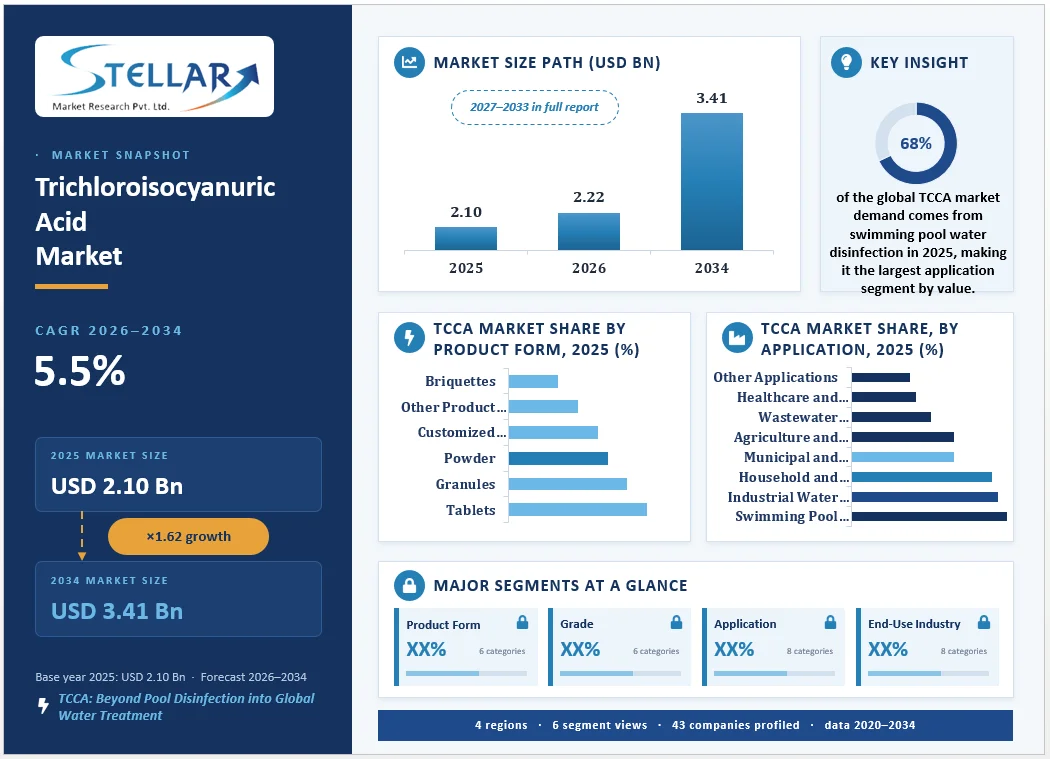
The Global Trichloroisocyanuric Acid (TCCA) Market was valued at USD 2.10 billion in 2025 and is projected to reach USD 3.41 billion by 2034, growing at a CAGR of 5.5% during 2026–2034
The Global Trichloroisocyanuric Acid (TCCA) Market was valued at USD 2.10 billion in 2025 and is projected to reach USD 3.41 billion by 2034, growing at a CAGR of 5.5% during 2026–2034, according to Stellar Market Research (SMR). TCCA, also sold as trichlor or symclosene, is a solid organic chlorine compound used to disinfect swimming pools, spas, drinking and industrial water, wastewater, aquaculture ponds and hard surfaces. The U.S. International Trade Commission (USITC) describes trichlor as carrying about 90% available chlorine and releasing it slowly, which is why it is the default sanitizer for weekly-dosed pools.
This trichloroisocyanuric acid market analysis answers both sides of the search: what the market is worth for producers, distributors and investors, and what buyers and regulators want to know, from how TCCA tablets work and what available chlorine content means to how anti-dumping duties in the United States, the European Union and India are reshaping supply.
Swimming pool water disinfection and tablet-form products anchor demand, and China is the main manufacturing hub, but TCCA market growth is rotating towards municipal and drinking water treatment, healthcare and institutional sanitation, customized solid formulations and online sales as trade remedies, safety rules and supply-chain resilience change how TCCA is made and bought.
Stellar Market Research provides comprehensive analysis of the global TCCA market size, share, product form, grade, available chlorine content, application, end-use industry, distribution channel and regional segmentation, the competitive landscape, trade-remedy scenarios and growth opportunities. The report helps TCCA manufacturers, cyanuric acid and chlor-alkali suppliers, pool chemical brands, water treatment companies, distributors and investors decide which segments, channels and countries to prioritise through 2034.
|
2025 ? BASE YEAR |
2034 ? FORECAST |
GROWTH RATE |
LARGEST REGION |
|
USD 2.10 Bn |
USD 3.41 Bn |
5.5% |
North America |
Global Trichloroisocyanuric Acid Market Overview: Size, Share, Trends and Outlook to 2034
The market is measured at product level across TCCA tablets, granules, powder, briquettes and customized solid formulations sold worldwide for swimming pool, municipal, industrial, wastewater, agricultural, healthcare and cleaning use. Sodium dichloroisocyanurate (dichlor), calcium hypochlorite and liquid chlorine are treated as substitutes and are excluded from the market value.
Three shifts shape 2026–2034: trade remedies are redrawing supply routes, with the European Union maintaining anti-dumping duties of 3.2% to 42.6% on Chinese TCCA and India imposing duties of up to USD 986 per tonne from March 2025; demand is broadening from pools into water treatment, institutional sanitation and aquaculture; and value is moving towards tablets, blended formulations and branded retail packs, which carry higher conversion costs than bulk granules. Producers are answering with capacity rebuilds, such as KIK’s USD 250 million BioLab plant in Louisiana, and with more diversified customer bases.
To get more Insights: Request Free Sample Report
TCCA Quick Answers: 20 Most-Searched Questions About Trichloroisocyanuric Acid
|
Question people search |
Short answer |
Section |
|
How big is the TCCA market? |
USD 2.10 Bn in 2025 (SMR); USD 3.41 Bn by 2034 at 5.5% CAGR |
Market Size |
|
How fast is the TCCA market growing? |
5.5% CAGR over 2026–2034 on SMR’s base; customized solid formulations are the fastest product form at 8.1% |
Market Size |
|
Which region has the largest TCCA market share? |
North America at about 38% (SMR); the European Commission calls the U.S. the largest TCCA market and the EU the second largest |
Regional |
|
What is trichloroisocyanuric acid? |
A solid chlorinated isocyanurate (symclosene) with about 90% available chlorine, used to disinfect water (USITC) |
Overview |
|
How does TCCA work in a pool? |
It dissolves slowly and releases chlorine; weekly tablet dosing keeps pool chlorine under 4 parts per million (USITC) |
Product Form |
|
TCCA or dichlor: what is the difference? |
Trichlor has about 90% available chlorine and releases it slowly; dichlor has 56–63% and releases it fast, suiting shock treatment (USITC) |
Chlorine Content |
|
What is the largest TCCA product form? |
Tablets, at about 46% of 2025 value (SMR); granules follow at about 27% |
Product Form |
|
Which TCCA grade is largest? |
Swimming pool grade, at about 44% of 2025 value (SMR) |
Grade |
|
Which available chlorine range leads? |
Above 88%–90% available chlorine, at about 41% of 2025 value (SMR) |
Chlorine Content |
|
What is the largest TCCA application? |
Swimming pool water disinfection, about 68% (SMR); in the U.S., pools and spas account for the bulk of the market (USITC) |
Application |
|
Which application grows fastest? |
Healthcare and institutional sanitation at 7.9%, ahead of municipal water at 7.2% (SMR) |
Application |
|
Who buys TCCA? |
Residential pool facilities about 41% and commercial recreation and hospitality about 24% of 2025 value (SMR) |
End-Use Industry |
|
Which distribution channel is largest? |
Direct sales, about 28%; online sales grow fastest at 9.2% (SMR) |
Distribution Channel |
|
Who makes TCCA? |
OxyChem, Clearon and BioLab in the U.S.; Ercros and Electroquímica de Hernani in the EU; many Chinese producers; Nissan Chemical, Shikoku Chemicals and Nankai in Japan |
Competitive |
|
How large is China’s TCCA capacity? |
At least 755,000 t a year in 2022, up from 278,000 t in 2015 (European Commission) |
Competitive |
|
Which anti-dumping duties apply? |
EU 3.2%–42.6% on Chinese TCCA; India up to USD 986 per tonne from Mar 2025; U.S. orders on China and Spain continued in Feb 2023 |
Regulation |
|
How big is the EU TCCA market? |
60,000–70,000 t in Oct 2021–Sep 2022, of which Chinese imports were 39,826 t (European Commission) |
Regional |
|
What caused the 2020–21 price spike? |
A pool-building boom, stockpiling and the Aug 2020 fire at BioLab’s plant (European Commission, USITC) |
Dynamics |
|
Which safety rules apply to TCCA? |
In the U.S., EPA registration as a pesticide; CDC counted about 4,535 pool-chemical injury ED visits a year in 2008–2017 |
Regulation |
|
What does bulk TCCA cost? |
Chinese TCCA entered the EU at EUR 1,307–2,559 per tonne in 2019–Sep 2022 and about EUR 1,501 in May 2023 (European Commission) |
Pricing |
Key Findings: Eight Insights Shaping the Global TCCA Market
SMR’s analysis of official trade-remedy findings, public-health data, company announcements and its own market model points to eight findings that explain where TCCA market growth and value are created through 2034.
|
Sr.No. |
Findings |
Evidence |
So what |
|
1 |
The market grows about 1.6× by 2034 |
USD 2.10 Bn (2025) to USD 3.41 Bn (2034) at 5.5% CAGR (SMR) |
Chlorine, cyanuric acid and tableting capacity must scale with pool and water demand |
|
2 |
Pools anchor demand |
Pools about 68% of 2025 value (SMR); USITC says pools and spas are the bulk of the U.S. market, with industrial and cleanser uses making up most of the remaining 10–15% |
Weather and pool-build cycles drive volatility |
|
3 |
Tablets carry the value |
Tablets about 46% of value (SMR); EC cost data show depreciation and packaging at 25.9% of tablet manufacturing cost versus 8.5% for bulk |
Margin sits in tableting, blends and branded packs |
|
4 |
China dominates supply |
Capacity of at least 755,000 t and exports of about 225,000 t in 2022; around 110,000 t a year to the U.S. (European Commission) |
Trade remedies decide who can sell where |
|
5 |
Trade remedies redraw routes |
EU duties 3.2%–42.6%; India up to USD 986 per tonne (Mar 2025); U.S. orders on China and Spain continued (Feb 2023) |
Local capacity and compliant sourcing win contracts |
|
6 |
Supply shocks move prices |
Chinese import prices into the EU rose from EUR 1,307 per tonne (2020) to EUR 2,559 (Oct 2021–Sep 2022) after the Aug 2020 BioLab fire (European Commission) |
Dual sourcing and safety stock protect pool-season supply |
|
7 |
Water treatment and institutional uses grow faster |
Municipal 7.2%, healthcare and institutional 7.9% CAGR (SMR); USITC noted non-pool disinfection rose to about 2% of the U.S. market during COVID |
Approvals and documentation become the entry ticket |
|
8 |
Safety and regulation raise the bar |
CDC: about 4,535 pool-chemical injury ED visits a year in 2008–2017; 36% of 2015–2017 visits involved people under 18 |
Child-resistant packs, labels and training support brand trust |
Global Trichloroisocyanuric Acid Market Size, Share and Forecast, 2025–2034
SMR sizes the Global TCCA Market at USD 2.10 billion in 2025, rising to USD 2.22 billion in 2026 and USD 3.41 billion in 2034, a 5.5% CAGR. The forecast adds about USD 1.31 billion over the period, so roughly 38% of 2034 revenue is demand that does not exist today. Official agencies publish volumes, prices and trade-remedy findings rather than USD market values, so SMR triangulates its value base against those anchors: the European Commission puts EU consumption at 60,000–70,000 tonnes in October 2021–September 2022, up from 41,217 tonnes in 2013, and USITC recorded U.S. apparent consumption of 148,251 short tons in 2004 against 125,166 in 2002. Estimates from different publishers differ with whether bulk granules, tablets and branded retail packs are all counted; SMR’s base includes all solid TCCA forms.
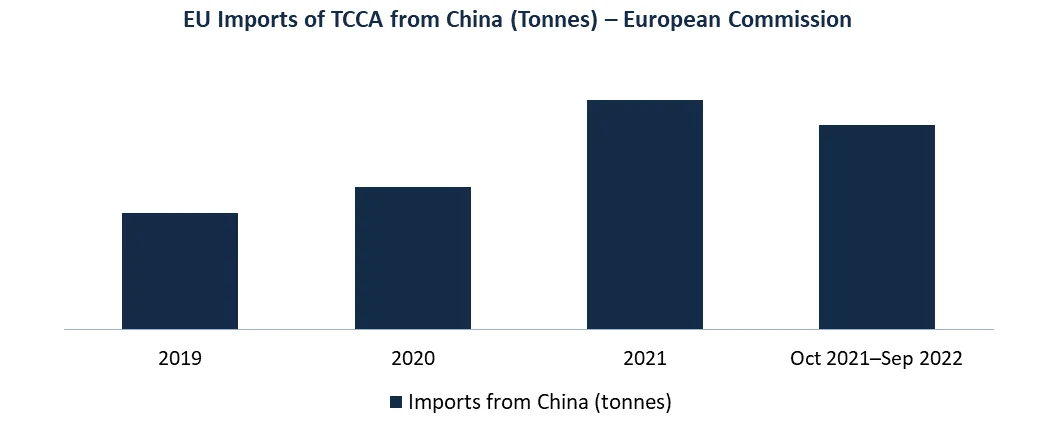
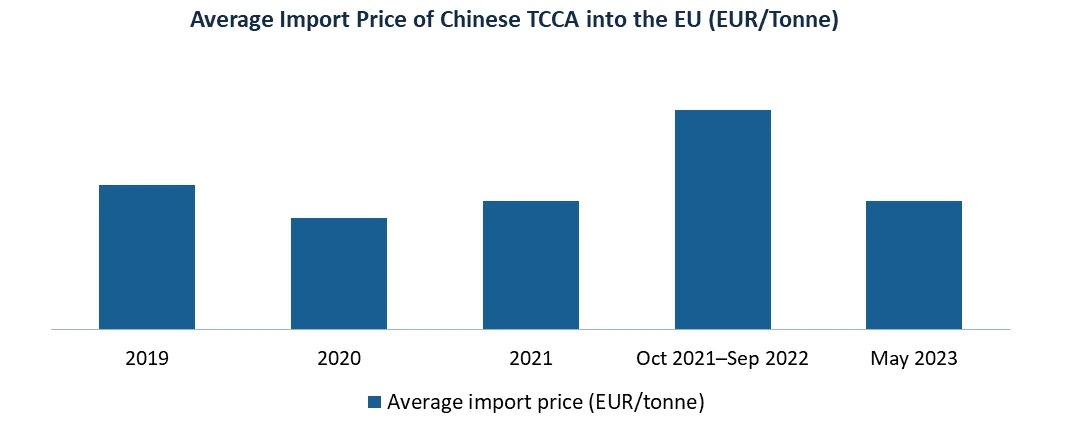
The two charts above use European Commission data. Chinese exporters supplied 39,826 tonnes to the EU in October 2021–September 2022, 76% more than in 2019 (22,680 tonnes), while prices swung from EUR 1,307 per tonne in 2020 to EUR 2,559 during the supply squeeze and back to about EUR 1,501 per tonne by May 2023.
Global TCCA Market Dynamics:
Growth Drivers, Restraints, Opportunities and Trends
Global TCCA Market Growth Drivers: Pool Demand, Water Safety, Domestic Capacity Support and Institutional Sanitation
The Global TCCA Market is supported by steady pool use and the need for safe water. USITC reported that all responding U.S. producers and most purchasers saw chlorinated isocyanurate demand rise after 2016, and the European Commission found EU consumption grew from 41,217 tonnes in 2013 to 48,662 tonnes in the review period ending September 2016 and to 60,000–70,000 tonnes in the period ending September 2022. The Commission attributed the 2020–21 jump partly to the many swimming pools built and to stockpiling, which eased as demand normalised. Because every pool needs weekly dosing, TCCA gives producers a recurring, season-linked revenue base.
Supply security is a second driver. KIK Consumer Products said it invested USD 250 million to rebuild BioLab’s Louisiana trichlor plant after Hurricane Laura destroyed it in 2020, and reopened it on 2 November 2022 ahead of the 2023 pool season. In India, the Directorate General of Trade Remedies found that the sole domestic producer could serve the country’s entire demand but had not broken even since 2017, and the finance ministry’s March 2025 duties are meant to restore that capacity’s viability. Wider demand comes from municipal, industrial and healthcare uses, where TCCA’s solid, stable form simplifies storage and dosing.
Global TCCA Market Restraints: Dumping, Raw Material and Energy Costs, Weather and Safety
Trade distortion and cost swings are the main restraints. The European Commission calculated dumping margins of 240–275% for Chinese TCCA in its 2023 expiry review, using Mexican benchmarks for chlorine, caustic soda and cyanuric acid, and noted Chinese capacity far above what its home market can absorb. Producers outside China face volatile chlorine, caustic soda and power costs: USITC recorded one U.S. producer’s output interrupted by chlorine and caustic soda shortages, and Spain’s Ercros, an EU TCCA producer, reported a EUR 54 million loss for 2025 against EUR 8 million of EBITDA, citing weak demand and high energy costs.
Demand is also seasonal and weather-dependent. USITC found that purchases peak in spring and summer and track new pool installations and weather, and earlier reviews cited competition from saltwater chlorination systems. Safety adds compliance cost: CDC estimated about 4,535 emergency department visits a year for pool-chemical injuries in 2008–2017, with 65% in the Memorial Day to Labor Day season and 56% at home, which keeps pressure on labelling, packaging and storage rules. In the U.S., trichlor sold for pool and spa use must also be registered with the EPA as a pesticide.
What Are the Biggest TCCA Market Opportunities Through 2034?
Customized solid formulations, water treatment and institutional sanitation offer the largest upside because they lift value per tonne beyond standard pool tablets. USITC notes that some tablets are blended with copper sulfate as an algicide or aluminum sulfate as a clarifier, and SMR expects customized solid formulations to grow at 8.1% CAGR as brands add multi-function products. Municipal and drinking water treatment (7.2%), wastewater (7.0%) and healthcare and institutional sanitation (7.9%) add recurring demand outside the pool season.
Regional manufacturing and digital channels offer further routes to growth. India’s duties open space for domestic supply, Asia Pacific is projected to grow at 7.5% CAGR, and online sales are forecast at 9.2% CAGR as pool owners and small water-treatment buyers order tablets, granules and refills through e-commerce platforms. Producers with EPA, ECHA and BIS-ready documentation, safe packaging and reliable cyanuric acid and chlorine supply are best placed to win long-term contracts.
TCCA Market Trends: Trade Remedies, Capacity Rebuilds, Formulation Value-Add and Safer Packaging
Four TCCA market trends stand out through 2034. First, regionalised trade: the U.S. continued its antidumping orders on China and Spain in February 2023, the EU re-imposed duties in December 2023 and amended them in November 2025, and India followed in March 2025. Second, resilience: after the 2020 fire and the 2021 shortage, buyers favour suppliers with domestic or dual-source capacity. Third, formulation value-add: tablets, blended multi-function products and tailored chlorine concentrations command higher conversion value. Fourth, safety and digital: better labelling, child-resistant packs, training and e-commerce fulfilment are becoming standard purchase criteria.
Global TCCA Market Segmentation:
By Product Form, Grade, Available Chlorine Content, Application, End-Use Industry and Distribution Channel
SMR segments the TCCA market into six dimensions that match the sections of the report (26.1 to 26.6). Shares below are SMR estimates of 2025 value; the growth rates are 2026–2034 CAGRs.
Trichloroisocyanuric Acid Market Size and Forecast, By Product Form
Tablets are the largest product form at about 46% of 2025 value, followed by granules, powder, customized solid formulations, other forms and briquettes. USITC says chlorinated isocyanurates reach consumers as granules, tablets or sticks, usually in 1-inch or 3-inch tablets, and the European Commission lists powder, granules, tablets and chips, noting that tablets sell at higher prices than granules or powder. Its cost data show packaging and depreciation at 25.9% of tablet manufacturing cost versus 8.5% for bulk, which explains why tableting and branded packs hold most of the margin. Customized solid formulations are the fastest-growing form at 8.1% CAGR, driven by blended algicide and clarifier tablets, while granules (4.8%) and powder (4.1%) grow more slowly as commodity feedstock for tableters and water treatment.
Trichloroisocyanuric Acid Market Size and Forecast, By Grade
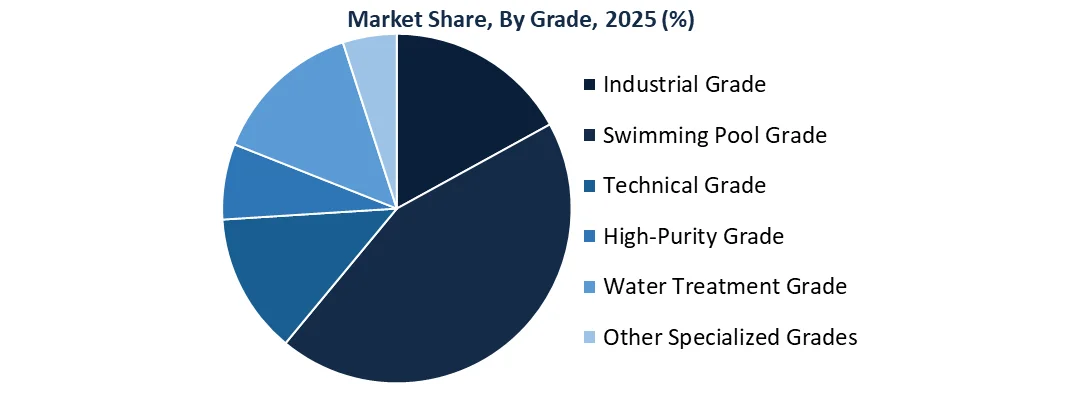
Swimming pool grade is the largest at about 44% of 2025 value, ahead of industrial grade (17%), water treatment grade (14%), technical grade (13%), high-purity grade (7%) and other specialized grades (5%). In the U.S., any trichlor used for pools and spas must be registered with the EPA, which is why pool grade is bound to registered, labelled supply. High-purity grade is the fastest-growing at 7.8% CAGR as municipal, healthcare and food-adjacent buyers specify tighter impurity limits, and water treatment grade follows at 6.6%.
Trichloroisocyanuric Acid Market Size and Forecast, By Application
Swimming pool water disinfection is the largest application, followed by industrial water treatment, household and commercial cleaning, municipal and drinking water treatment, agriculture and aquaculture, wastewater treatment, healthcare and institutional sanitation and other uses. The European Commission lists pools and spas as the primary use, with septic tanks, cooling towers and kitchen appliance cleaning among others. Healthcare and institutional sanitation grows fastest at 7.9% CAGR, followed by municipal water (7.2%), wastewater (7.0%) and agriculture and aquaculture (6.8%). USITC noted that hard-surface disinfection rose to about 2% of the U.S. market during the COVID period.
|
Segmentation |
Largest segment (2025) |
Fastest segment (CAGR) |
SMR view |
|
Product form |
Tablets |
Customized solid formulations (8.1%) |
Defend tablets, scale blends |
|
Grade |
Swimming pool grade |
High-purity grade (7.8%) |
Registered pool supply anchors volume |
|
Available chlorine content |
Above 88%–90% |
Customized concentrations (8.4%) |
Chlorine density and consistency drive price |
|
Application |
Swimming pool water disinfection |
Healthcare and institutional sanitation (7.9%) |
Pools anchor, institutions add growth |
|
End-use industry |
Residential pool facilities |
Healthcare and institutional facilities (7.7%) |
Contract buyers outgrow retail buyers |
|
Distribution channel |
Direct sales |
Online sales and e-commerce (9.2%) |
Direct for bulk, online for refills |
|
Region |
North America |
Asia Pacific (7.5%) |
Local capacity decides share gains |
Global TCCA Market Regional Analysis:
North America, Europe, Asia Pacific, Middle East & Africa and South America
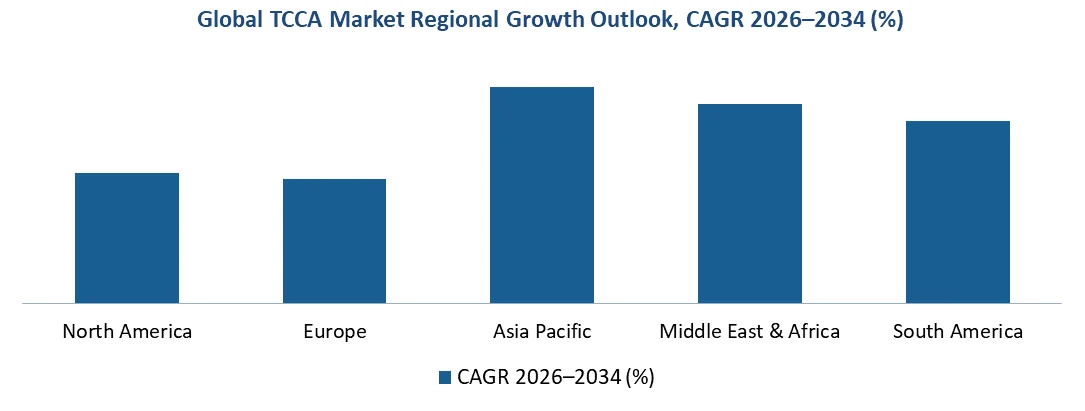
North America is the largest regional market, accounting for about 38% of global value in 2025. The European Commission describes the United States as the world’s largest TCCA market, supplied by three integrated U.S. producers (OxyChem, Clearon and BioLab), by imports and by roughly 110,000 tonnes a year of Chinese exports. Antidumping orders on China and Spain, plus a countervailing duty order on Chinese product in place since November 2014, shape pricing, and USITC notes that EPA registration is required for pool and spa sales. Mexico adds a local producer, ROT Química. The region is mature, so SMR projects about 4.5% CAGR, led by customized formulations and water treatment.
Europe holds about 24% of 2025 value. The EU is the second-largest TCCA market, with consumption of 60,000–70,000 tonnes against EU production of 30,000–40,000 tonnes from Ercros and Electroquímica de Hernani, and Chinese imports holding a 50–70% market share despite duties of 3.2% to 42.6%. SMR projects 4.3% CAGR as pool demand normalises and duties protect local producers. Asia Pacific is projected to be the fastest-growing region at 7.5% CAGR. China had at least 755,000 tonnes of capacity in 2022 and exported about 225,000 tonnes, Japan has three producers (Nissan Chemical, Shikoku Chemicals and Nankai Chemical), and India’s duties support its sole domestic producer.
Middle East & Africa holds about 7% of 2025 value and is projected to grow at 6.9% CAGR as hospitality, municipal and desalination-linked water treatment expand; the European Commission listed Saudi Arabia among destinations for Chinese exports in 2023. South America holds about 10% and is projected to grow at 6.3% CAGR; USITC listed Brazil among the three largest destinations for Chinese triazine-compound exports in 2021, a category that includes chlorinated isocyanurates, which shows how import-dependent the region is.
TCCA Companies and Competitive Landscape: Who Are the Top Trichloroisocyanuric Acid Manufacturers and Players?
The TCCA competitive landscape is a mix of integrated chlor-alkali and cyanuric acid producers, specialist pool-chemical brands and tableters, and large Asian exporters. Official proceedings give a clear view of who is who. USITC reports that three integrated U.S. producers, BioLab, Clearon and OxyChem, accounted for all domestic granular production in 2021. The European Commission reports two EU producers, Ercros and Electroquímica de Hernani, representing 100% of EU production, and names Hebei Jiheng Chemical, Heze Huayi Chemical and Puyang Cleanway Chemicals among Chinese exporters.
Competition is increasingly shaped by feedstock integration, cost position, trade-remedy exposure and the ability to supply registered, branded and customized products reliably. BioLab’s USD 250 million rebuild shows how much capital supply resilience needs, while the EU’s review of its duties in 2024–2025 and India’s 2025 duties show that market access can change in a single year. Consolidation among tableters, noted by USITC, and the growth of private-label and online brands continue to reshape the downstream layer.
Top TCCA Companies: Integrated Producers, Exporters, Formulators and Distributors
SMR separates participants by role, because an integrated producer, an exporting manufacturer and a tableter do not compete on the same terms.
|
Group |
Examples |
Role |
|
Integrated U.S. producers |
OxyChem, Clearon, BioLab (KIK Consumer Products) |
Granular TCCA, tablets, retail and distributor supply |
|
EU producers |
Ercros, Electroquímica de Hernani |
Regional TCCA supply under EU duty protection |
|
Chinese producers and exporters |
Hebei Jiheng Chemical, Heze Huayi Chemical, Puyang Cleanway Chemicals, Shandong Daming Science and Technology, Shandong Lantian Disinfection Technology, Shandong Goldenstar Water Environment Technology |
Bulk granules, powder and tablets for global export |
|
Japanese producers |
Nissan Chemical, Shikoku Chemicals, Nankai Chemical |
Domestic Japanese supply and specialty exports |
|
Mexican producers |
ROT Química |
Regional supply in North America |
|
Tableters, importers and brands |
Independent U.S. tableters, Brushby, Inquide, Productos QP, Fluidra, Chimigien |
Conversion, repackaging, private label and retail supply |
TCCA Company Benchmark: Disclosed Results and Strategic Signals
|
Company |
Strategic signal |
|
OxyChem, Clearon and BioLab |
USITC: the three integrated producers made all U.S. granular output in 2021; BioLab produced none that year after its August 2020 plant fire |
|
BioLab (KIK Consumer Products) |
Rebuilt Louisiana trichlor plant for USD 250 million; reopened 2 Nov 2022 with improved production flexibility |
|
Ercros |
FY2025 EBITDA EUR 8 million and net loss EUR 54 million; EU TCCA producer under duty protection |
|
Electroquímica de Hernani |
Second EU TCCA producer; applicant for the 2023 EU expiry review with Ercros |
|
Hebei Jiheng, Heze Huayi, Puyang Cleanway |
Chinese exporters subject to EU duties; Puyang Cleanway also faces USD 773 per MT in India |
|
Nissan Chemical, Shikoku Chemicals, Nankai Chemical |
Japanese producers; Japanese exports to India face USD 276 per MT duty |
Global TCCA Market Recent Developments, Trade Actions and Industry News | 2026
|
Date |
Company / Organization |
Recent Development |
Market Impact |
|
January 2026 |
Berkshire Hathaway and OxyChem |
Berkshire Hathaway completes the acquisition of OxyChem from Occidental for USD 9.7 billion. |
Reshapes the competitive landscape of the North American chlorinated chemicals industry. |
|
June 2026 |
European Commission |
Reopens the anti-dumping investigation into Chinese TCCA imports to assess the effectiveness of existing duties. |
Increases regulatory scrutiny and pricing uncertainty for Chinese exporters. |
|
September 2026 |
Ercros and Electroquímica de Hernani |
The U.S. Department of Commerce preliminarily finds no dumping by the two Spanish producers during the review period. |
Supports the competitive positioning of Spanish chlorinated disinfectant suppliers. |
|
September 2026 |
U.S. Department of Commerce |
Preliminary findings identify Chinese chlorinated isocyanurate imports sold below normal value during the review period. |
Reinforces trade protection and influences international procurement strategies. |
|
November 2026 |
Heze Huayi Chemical Co., Ltd. |
The U.S. Department of Commerce finalizes a countervailable subsidy rate of 18.71% for the Chinese manufacturer. |
Influences import costs, supplier selection and domestic manufacturing competitiveness. |
Global Trichloroisocyanuric Acid Market : Inquire before buying
|
Global Trichloroisocyanuric Acid Market |
|||
|
Report Coverage |
Details |
||
|
Base Year: |
2025 |
Forecast Period: |
2026-2034 |
|
Historical Data: |
2020 to 2025 |
Market Size in 2025: |
USD 2.10 Billion |
|
Forecast Period 2026 to 2034 CAGR: |
5.5% |
Market Size in 2034: |
USD 3.41 Billion |
|
Segments Covered: |
By Product Form |
Tablets; Granules; Powder; Briquettes; Customized Solid Formulations; Other Product Forms |
|
|
By Grade |
Industrial Grade; Swimming Pool Grade; Technical Grade; High-Purity Grade; Water Treatment Grade; Other Specialized Grades |
||
|
By Available Chlorine Content |
Below 85%; 85%–88%; Above 88%–90%; Above 90%; Customized Chlorine Concentrations; Other Available Chlorine Specifications |
||
|
By Application |
Swimming Pool Water Disinfection; Municipal and Drinking Water Treatment; Industrial Water Treatment; Wastewater Treatment; Agriculture and Aquaculture; Healthcare and Institutional Sanitation; Household and Commercial Cleaning; Other Applications |
||
|
By End-Use Industry |
Residential Swimming Pool Facilities; Commercial Recreation and Hospitality Facilities; Municipal Water Treatment Authorities; Industrial Manufacturing Facilities; Agriculture and Aquaculture Enterprises; Healthcare and Institutional Facilities; Household and Commercial Cleaning Businesses; Other End-Use Industries |
||
|
By Distribution Channel |
Direct Sales; Chemical Distributors and Wholesalers; Specialty Pool Chemical Suppliers; Industrial Chemical Retailers; Online Sales and E-Commerce Platforms; Government and Institutional Procurement |
||
Global Trichloroisocyanuric Acid Market, By Region
North America (United States, Canada, Mexico)
Europe (Germany, United Kingdom, France, Italy, Spain, Netherlands, Portugal, Poland, Rest of Europe)
Asia Pacific (China, Japan, India, South Korea, Australia, Singapore, Thailand, Indonesia, Vietnam, Rest of Asia Pacific)
Middle East & Africa (United Arab Emirates, Saudi Arabia, Israel, Turkey, South Africa, Egypt, Rest of Middle East & Africa)
South America (Brazil, Argentina, Chile, Colombia, Rest of South America)
Global Trichloroisocyanuric Acid Market, Key Players
North America
- Occidental Chemical Corporation (OxyChem)
- Clearon Corp.
- Bio-Lab Inc. (KIK Consumer Products)
- Nissan Chemical America Corporation
- Olin Corporation
- FMC Corporation
- Axiall Corporation (Westlake Corporation)
- Dijon Chemical Co., Inc.
- Arch Chemicals, Inc. (Lonza/Nomix)
- Haviland Pool Products
Europe
11. Ercros S.A.
12. Solvay S.A.
13. Arkema Group
14. INEOS Group
15. BASF SE
16. AkzoNobel N.V.
17. Lonza Group
18. Nippon Soda Co., Ltd.
19. Proquel S.A.
20. KRONOS Worldwide, Inc.
Asia-Pacific
21. Shikoku Chemicals Corporation
22. Nissan Chemical Corporation
23. Tosoh Corporation
24. Bodal Chemicals Ltd.
25. Gujarat Alkalies and Chemicals Ltd.
26. Juancheng Kangtai Chemical Co., Ltd.
27. Shandong Gaomi Gaoyuan Chemical Industry Co., Ltd.
28. Heze Huayi Chemical Co., Ltd.
29. Shandong Hongda Chemical Co., Ltd.
30. Shandong Lantian Disinfection Technology Co., Ltd.
31. Acuro Organics Limited
32. Trion Chemicals
Middle East & Africa
33. Solenis
34. SABIC
35. ADNOC Distribution
36. Chemipol MEA
37. AECI Limited
South America
38. Unipar Carbocloro
39. Química Amparo
40. Elekeiroz S.A.
41. Solvay Indupa
42. Derivados de Cloro S.A.
43. Orbia
Frequently Asked Questions
Ans: North America holds the largest TCCA market share at about 38% in 2025, anchored by the United States, which the European Commission calls the world’s largest TCCA market. Europe follows at about 24% and Asia Pacific at about 21%; Asia Pacific is the fastest-growing region at 7.5% CAGR.
Ans: Tablets are the largest product form at about 46% of 2025 value, while customized solid formulations grow fastest at 8.1% CAGR. Healthcare and institutional sanitation (7.9%), high-purity grade (7.8%) and online sales (9.2%) also outgrow the 5.5% market rate.
Ans: Available chlorine is the share of the compound that can act as chlorine disinfectant. USITC states that trichlor has 90% available chlorine, compared with 63% for anhydrous dichlor and 56% for dihydrate dichlor, and that trichlor releases it more slowly, which suits weekly-dosed pools.
Ans: In the U.S., BioLab, Clearon and OxyChem are the three integrated producers. In the EU, Ercros and Electroquímica de Hernani are the producers, and in Asia, Chinese exporters such as Hebei Jiheng, Heze Huayi and Puyang Cleanway plus Japan’s Nissan Chemical, Shikoku Chemicals and Nankai Chemical lead supply.
Ans: Authorities in the U.S., EU and India found that low-priced imports from China (and in India’s case Japan) injured local producers. The EU applies duties of 3.2% to 42.6% on Chinese TCCA, India imposed duties of up to USD 986 per tonne in March 2025, and U.S. orders on China and Spain were continued in February 2023.
Ans: Yes. In the U.S., sanitizers such as trichlor are controlled pesticides that must be registered with the EPA before pool and spa sale. CDC estimated about 4,535 emergency department visits a year for pool-chemical injuries in 2008–2017, so labelling, storage and handling rules are central to the market.
1. Executive Market Landscape and Industry Overview
1.1. Global Trichloroisocyanuric Acid Market Size, 2025–2034 (Value USD Million)
1.2. Historical Evolution of Trichloroisocyanuric Acid Manufacturing and Applications
1.3. Chemical Definition, Molecular Structure and Industrial Classification
1.4. Role of TCCA in Chlorine-Based Disinfection and Sanitation
1.5. Global Production, Consumption and Trade Overview of TCCA
1.6. CAGR Analysis of Global Trichloroisocyanuric Acid Market During 2025–2034
2. Trichloroisocyanuric Acid Market Dynamics
2.1. Trichloroisocyanuric Acid Market Trends
2.2. Trichloroisocyanuric Acid Market Dynamics
- 2.2.1. Drivers
- 2.2.2. Restraints
- 2.2.3. Opportunities
- 2.2.4. Challenges
2.3. PORTER's Five Forces Analysis of TCCA Industry
2.4. PESTLE Analysis of Global TCCA Manufacturing Industry
2.5. Competitive Intensity Across Global Chlorinated Disinfectant Manufacturers
2.6. Substitution Risks from Alternative Water Disinfection Chemicals
3. Trichloroisocyanuric Acid Market Macroeconomic Factors
3.1. Global Chemical Industry Production and Investment Expenditure Trends
3.2. Municipal Water Treatment Infrastructure Development and Government Spending
3.3. Swimming Pool Construction and Recreational Facility Investments
3.4. Industrial Water Consumption and Sanitation Expenditure Trends
3.5. International Trade Policies and Chlorinated Chemical Import Regulations
3.6. Raw Material Price Fluctuations and Manufacturing Cost Pressures
4. TCCA Industry Trends and Emerging Technology Requirements
4.1. Increasing Demand for Stable Chlorine-Based Water Disinfection Solutions
4.2. Growing Adoption of TCCA Tablets for Swimming Pools
4.3. Expansion of Municipal Drinking Water Disinfection Applications Worldwide
4.4. Rising Industrial Demand for Efficient Chlorination Chemicals
4.5. Development of Controlled-Release Chlorine Formulations and Products
4.6. Increasing Focus on Safer Chemical Handling and Storage
5. Trichloroisocyanuric Acid Chemistry and Raw Material Ecosystem
5.1. Chemical Composition and Molecular Properties of Trichloroisocyanuric Acid
5.2. Cyanuric Acid Production and Industrial Raw Material Sourcing
5.3. Chlorine Gas Procurement and Chemical Feedstock Requirements
5.4. Sodium Hydroxide Utilization in TCCA Manufacturing Processes
5.5. Reaction Chemistry and Chlorination Mechanisms in TCCA Synthesis
5.6. Chemical Purity, Moisture Content and Stability Characteristics Assessment
6. Trichloroisocyanuric Acid Manufacturing and Production Process
6.1. Industrial Manufacturing Routes for Trichloroisocyanuric Acid Production
6.2. Cyanuric Acid Preparation and Precursor Processing Operations
6.3. Chlorination Reactions and Intermediate Compound Formation Processes
6.4. Crystallization, Separation and Product Recovery Operations in Manufacturing
6.5. Drying, Granulation and Final Product Processing Technologies
6.6. Production Yield, Energy Consumption and Process Optimization Assessment
7. TCCA Product Forms and Physical Configuration Landscape
7.1. TCCA Tablet Manufacturing and Compression Technology Requirements
7.2. TCCA Granules Production and Particle Size Specifications
7.3. TCCA Powder Formulations and Fine Particle Applications
7.4. TCCA Briquettes and Large-Format Solid Disinfectant Configurations
7.5. Slow-Dissolving TCCA Products and Controlled Release Formulations
7.6. Customized TCCA Shapes, Packaging and Product Configurations
8. Trichloroisocyanuric Acid Grades and Quality Specifications
8.1. Industrial Grade TCCA and Commercial Disinfection Applications
8.2. Swimming Pool Grade TCCA and Chlorine Specifications
8.3. High-Purity TCCA and Specialized Water Treatment Requirements
8.4. Technical Grade TCCA and Industrial Processing Applications
8.5. Available Chlorine Content and Product Concentration Specifications
8.6. Moisture, Insoluble Matter and Chemical Purity Requirements
9. TCCA Performance Characteristics and Disinfection Mechanisms
9.1. Available Chlorine Release and Disinfection Efficiency Characteristics
9.2. Microbial Inactivation Mechanisms Across Different Water Conditions
9.3. Bacterial Control and Pathogen Reduction Performance Assessment
9.4. Algae Prevention and Microbiological Growth Control Capabilities
9.5. Dissolution Rates and Residual Chlorine Maintenance Performance
9.6. Storage Stability and Shelf Life Performance Characteristics
10. TCCA Applications in Swimming Pools and Recreational Water
10.1. Residential Swimming Pool Water Disinfection and Maintenance
10.2. Commercial Swimming Pool Chlorination and Sanitation Requirements
10.3. Public Aquatic Centres and Recreational Water Treatment
10.4. Hotel, Resort and Hospitality Swimming Pool Applications
10.5. Waterpark and Sports Complex Disinfection Chemical Requirements
10.6. Spa, Jacuzzi and Recreational Water Sanitation Applications
11. TCCA Applications in Municipal and Drinking Water Treatment
11.1. Municipal Water Disinfection and Drinking Water Chlorination
11.2. Rural Drinking Water Treatment and Community Sanitation
11.3. Emergency Water Purification and Disaster Relief Applications
11.4. Groundwater Disinfection and Community Water Supply Management
11.5. Surface Water Treatment and Microbial Contamination Control
11.6. Water Storage Tank and Distribution Network Disinfection
12. TCCA Applications in Industrial Water Treatment
12.1. Industrial Cooling Tower Water Disinfection and Maintenance
12.2. Process Water Chlorination Across Industrial Manufacturing Facilities
12.3. Wastewater Treatment and Industrial Effluent Disinfection Applications
12.4. Power Plant Cooling Water Microbial Growth Control
12.5. Textile Processing Water Disinfection and Contamination Management
12.6. Food Processing Water Sanitation and Industrial Hygiene Applications
13. TCCA Applications in Agriculture and Aquaculture
13.1. Agricultural Irrigation Water Disinfection and Pathogen Management
13.2. Greenhouse Water Sanitation and Crop Protection Applications
13.3. Aquaculture Pond Disinfection and Microbial Contamination Control
13.4. Fish Hatchery Water Treatment and Disease Prevention
13.5. Livestock Drinking Water Disinfection and Hygiene Management
13.6. Agricultural Equipment Cleaning and Farm Sanitation Applications
14. TCCA Applications in Healthcare and Institutional Sanitation
14.1. Hospital Surface Disinfection and Healthcare Facility Sanitation
14.2. Medical Equipment Cleaning and Infection Prevention Applications
14.3. Institutional Laundry Disinfection and Textile Hygiene Management
14.4. Public Sanitation and Community Hygiene Chemical Applications
14.5. Healthcare Wastewater Disinfection and Pathogen Control Requirements
14.6. Emergency Sanitation and Infection Control Chemical Requirements
15. TCCA Applications in Household and Commercial Cleaning
15.1. Household Water Tank Disinfection and Cleaning Applications
15.2. Household Surface Cleaning and Germicidal Chemical Applications
15.3. Commercial Facility Sanitation and Hygiene Maintenance Requirements
15.4. Institutional Cleaning and Large-Scale Disinfection Applications
15.5. Laundry Whitening and Chlorine-Based Cleaning Formulations
15.6. Commercial Janitorial Products and Sanitation Chemical Applications
16. TCCA Handling, Storage and Transportation Ecosystem
16.1. Chemical Packaging Materials and Moisture Protection Requirements
16.2. Bulk Storage Facilities and Inventory Management Practices
16.3. Temperature, Humidity and Ventilation Controlled Storage Conditions
16.4. Hazardous Chemical Transportation and Regulatory Compliance Requirements
16.5. Chemical Segregation and Incompatible Material Storage Management
16.6. Occupational Safety Procedures and Emergency Response Management
17. TCCA Manufacturing Quality Control and Testing Standards
17.1. Available Chlorine Content Testing and Analytical Verification
17.2. Chemical Purity Assessment and Impurity Detection Procedures
17.3. Moisture Content Measurement and Product Stability Testing
17.4. Particle Size Distribution and Dissolution Rate Testing
17.5. Manufacturing Batch Consistency and Product Performance Validation
17.6. Laboratory Testing Protocols and Quality Assurance Requirements
18. TCCA Pricing, Cost Structure and Business Economics
18.1. Global TCCA Price Trends Across Major Producing Countries
18.2. Raw Material Procurement Costs and Manufacturing Expenditure Analysis
18.3. Production Costs Across Different TCCA Product Forms
18.4. Price Differentiation Across Industrial and Specialty Grades
18.5. Import Export Price Variations and Regional Pricing Dynamics
18.6. Profit Margins, Operating Costs and Manufacturer Revenue Economics
19. TCCA Distribution, Sales and Procurement Landscape
19.1. Direct Sales Through TCCA Manufacturers and Producers
19.2. Authorized Chemical Distributors and Regional Supply Networks
19.3. Industrial Chemical Wholesalers and Bulk Procurement Channels
19.4. Online Chemical Marketplaces and E-Commerce Distribution Platforms
19.5. Government Tenders and Municipal Water Treatment Procurement
19.6. Swimming Pool Supply Retailers and Specialty Distributors
20. TCCA Manufacturing Supply Chain and Operational Ecosystem
20.1. Cyanuric Acid Sourcing and Upstream Supplier Relationships
20.2. Chlorine Procurement and Chemical Feedstock Supply Arrangements
20.3. Manufacturing Equipment Procurement and Industrial Plant Infrastructure
20.4. Packaging Material Sourcing and Finished Product Distribution
20.5. International Logistics and Cross-Border Chemical Trade Operations
20.6. Inventory Management and Supply Chain Risk Mitigation Strategies
21. TCCA Technology Innovation, R&D and Product Development
21.1. Advancements in High-Purity TCCA Manufacturing Technologies and Processes
21.2. Development of Improved Dissolution and Chlorine Release Formulations
21.3. Innovations in Tablet Compression and Granulation Technologies
21.4. Improvements in Product Stability and Moisture Resistance
21.5. Research into Efficient Chlorination and Production Processes
21.6. Strategic R&D Investments and Manufacturing Technology Collaborations
22. TCCA Market Adoption, Utilization and Customer Economics
22.1. TCCA Adoption Across Municipal and Industrial Water Treatment
22.2. Swimming Pool Chemical Consumption and Replacement Demand Patterns
22.3. Customer Preferences for Available Chlorine Concentration Specifications
22.4. Bulk Procurement Frequency Across Industrial Chemical Consumers
22.5. Manufacturer Selection Based on Quality and Pricing
22.6. Customer Retention and Long-Term Chemical Supply Agreements
23. TCCA Regulatory, Environmental and Safety Standards
23.1. International Chemical Classification and Hazard Communication Requirements
23.2. Chlorinated Disinfectant Registration and Product Approval Regulations
23.3. Drinking Water Treatment Chemical Standards and Compliance
23.4. Industrial Chemical Storage and Transportation Safety Regulations
23.5. Environmental Discharge Regulations and Chlorinated Wastewater Management
23.6. Worker Exposure Limits and Occupational Chemical Safety Standards
24. TCCA Environmental Impact and Sustainability Landscape
24.1. Chlorinated Chemical Residues and Environmental Contamination Concerns
24.2. Cyanuric Acid Accumulation and Water Quality Implications
24.3. Wastewater Chlorine Residual Management and Neutralization Practices
24.4. Chemical Manufacturing Emissions and Industrial Waste Management
24.5. Sustainable Production Practices and Resource Efficiency Improvements
24.6. Environmental Alternatives and Emerging Disinfection Technology Developments
25. TCCA Market Regional and Country-Level Landscape
25.1. North American TCCA Manufacturing and Swimming Pool Demand
25.2. European Water Treatment Regulations and Industrial Chemical Consumption
25.3. Asia-Pacific TCCA Production Capacity and Export Competitiveness
25.4. Middle Eastern Water Desalination and Disinfection Chemical Requirements
25.5. African Water Infrastructure Development and Sanitation Chemical Demand
25.6. South American Swimming Pool and Municipal Water Treatment Demand
26. Trichloroisocyanuric Acid Market Size and Forecast by Segmentation (Value USD Million), 2025–2034
26.1. Trichloroisocyanuric Acid Market Size and Forecast, By Product Form
- 26.1.1. Tablets
- 26.1.2. Granules
- 26.1.3. Powder
- 26.1.4. Briquettes
- 26.1.5. Customized Solid Formulations
- 26.1.6. Other Product Forms
26.2. Trichloroisocyanuric Acid Market Size and Forecast, By Grade
- 26.2.1. Industrial Grade
- 26.2.2. Swimming Pool Grade
- 26.2.3. Technical Grade
- 26.2.4. High-Purity Grade
- 26.2.5. Water Treatment Grade
- 26.2.6. Other Specialized Grades
26.3. Trichloroisocyanuric Acid Market Size and Forecast, By Available Chlorine Content
- 26.3.1. Below 85% Available Chlorine
- 26.3.2. 85%–88% Available Chlorine
- 26.3.3. Above 88%–90% Available Chlorine
- 26.3.4. Above 90% Available Chlorine
- 26.3.5. Customized Chlorine Concentrations
- 26.3.6. Other Available Chlorine Specifications
26.4. Trichloroisocyanuric Acid Market Size and Forecast, By Application
- 26.4.1. Swimming Pool Water Disinfection
- 26.4.2. Municipal and Drinking Water Treatment
- 26.4.3. Industrial Water Treatment
- 26.4.4. Wastewater Treatment
- 26.4.5. Agriculture and Aquaculture
- 26.4.6. Healthcare and Institutional Sanitation
- 26.4.7. Household and Commercial Cleaning
- 26.4.8. Other Applications
26.5. Trichloroisocyanuric Acid Market Size and Forecast, By End-Use Industry
- 26.5.1. Residential Swimming Pool Facilities
- 26.5.2. Commercial Recreation and Hospitality Facilities
- 26.5.3. Municipal Water Treatment Authorities
- 26.5.4. Industrial Manufacturing Facilities
- 26.5.5. Agriculture and Aquaculture Enterprises
- 26.5.6. Healthcare and Institutional Facilities
- 26.5.7. Household and Commercial Cleaning Businesses
- 26.5.8. Other End-Use Industries
26.6. Trichloroisocyanuric Acid Market Size and Forecast, By Distribution Channel
- 26.6.1. Direct Sales
- 26.6.2. Chemical Distributors and Wholesalers
- 26.6.3. Specialty Pool Chemical Suppliers
- 26.6.4. Industrial Chemical Retailers
- 26.6.5. Online Sales and E-Commerce Platforms
- 26.6.6. Government and Institutional Procurement
26.7. Trichloroisocyanuric Acid Market Size and Forecast, By Region
- 26.7.1. North America
- United States
- Canada
- Mexico
- 26.7.2. Europe
- Germany
- United Kingdom
- France
- Spain
- Italy
- Netherlands
- Rest of Europe
- 26.7.3. Asia-Pacific
- China
- Japan
- India
- South Korea
- Australia
- Rest of Asia-Pacific
- 26.7.4. Middle East and Africa
- Saudi Arabia
- United Arab Emirates
- South Africa
- Egypt
- Rest of Middle East and Africa
- 26.7.5. South America
- Brazil
- Argentina
- Chile
- Colombia
- Rest of South America
27. Trichloroisocyanuric Acid Market Competitive Landscape
27.1. SMR Competition Matrix and Competitive Positioning Assessment
27.2. Competitive Positioning of Leading TCCA Manufacturers Globally
27.3. Key Players Benchmarking
- 27.3.1. Company Name and Corporate Headquarters
- 27.3.2. TCCA Product Portfolio and Available Grades
- 27.3.3. Manufacturing Capacity and Production Infrastructure
- 27.3.4. Available Chlorine Content and Product Quality
- 27.3.5. Geographic Presence and Distribution Network
- 27.3.6. Research Investments and Product Innovation Capabilities
27.4. Market Structure and Manufacturer Competitive Classification
27.5. Revenue Growth and Profitability Benchmarking Across Companies
27.6. Manufacturing Capacity and Production Volume Benchmarking
27.7. TCCA Revenue Contribution and Financial Performance Assessment
27.8. Mergers, Acquisitions and Strategic Partnership Developments
28. TCCA Manufacturers' Strategies and Expansion Plans
28.1. Expansion of TCCA Manufacturing Capacity Across Key Regions
28.2. Development of Advanced Chlorine-Based Disinfection Product Portfolios
28.3. Strengthening International Distribution and Chemical Supply Networks
28.4. Investments in Manufacturing Efficiency and Production Optimization
28.5. Expansion into Emerging Municipal and Industrial Markets
28.6. Strategic Partnerships with Water Treatment Chemical Distributors
29. Trichloroisocyanuric Acid Industry SWOT, Investments and Strategic Developments
29.1. Competitive Strengths of Established Global TCCA Manufacturers
29.2. Manufacturing Limitations and Raw Material Dependency Challenges
29.3. Emerging Opportunities in Municipal and Industrial Disinfection
29.4. Competitive Threats from Alternative Chlorination Technologies and Chemicals
29.5. Strategic Investments in Production Capacity and Technology
29.6. Major Product Launches, Partnerships and Industry Developments
30. TCCA Competitive Outlook and Market Positioning
30.1. Competitive Dynamics Across Global TCCA Product Manufacturers
30.2. Market Concentration Across Major Regional Manufacturing Hubs
30.3. Competitive Differentiation Through Product Quality and Pricing
30.4. Export Competitiveness of Leading Chinese TCCA Manufacturers
30.5. Regional Expansion Strategies of International Chemical Producers
30.6. Long-Term Competitive Positioning of Leading TCCA Companies
31. Company Profiles: Key Players in the Global TCCA Market
Detailed Company Profiles Considering the Following Parameters:
- Company Overview
- Business Portfolio
- TCCA Product Portfolio
- Manufacturing and Production Capabilities
- Geographic Presence
- Financial Overview
- SWOT Analysis
- Strategic Analysis
- Recent Developments
North America
- Occidental Chemical Corporation (OxyChem)
- Clearon Corp.
- Bio-Lab Inc. (KIK Consumer Products)
- Nissan Chemical America Corporation
- Olin Corporation
- FMC Corporation
- Axiall Corporation (Westlake Corporation)
- Dijon Chemical Co., Inc.
- Arch Chemicals, Inc. (Lonza/Nomix)
- Haviland Pool Products
Europe
11. Ercros S.A.
12. Solvay S.A.
13. Arkema Group
14. INEOS Group
15. BASF SE
16. AkzoNobel N.V.
17. Lonza Group
18. Nippon Soda Co., Ltd.
19. Proquel S.A.
20. KRONOS Worldwide, Inc.
Asia-Pacific
21. Shikoku Chemicals Corporation
22. Nissan Chemical Corporation
23. Tosoh Corporation
24. Bodal Chemicals Ltd.
25. Gujarat Alkalies and Chemicals Ltd.
26. Juancheng Kangtai Chemical Co., Ltd.
27. Shandong Gaomi Gaoyuan Chemical Industry Co., Ltd.
28. Heze Huayi Chemical Co., Ltd.
29. Shandong Hongda Chemical Co., Ltd.
30. Shandong Lantian Disinfection Technology Co., Ltd.
31. Acuro Organics Limited
32. Trion Chemicals
Middle East & Africa
33. Solenis
34. SABIC
35. ADNOC Distribution
36. Chemipol MEA
37. AECI Limited
South America
38. Unipar Carbocloro
39. Química Amparo
40. Elekeiroz S.A.
41. Solvay Indupa
42. Derivados de Cloro S.A.
43. Orbia
32. Key Findings
33. Strategic Moves and Industry Outlook
34. Research Methodology