ENG
 Japanese
 French
 German
 Korean

Global MBS Resin Market Size, Share & Forecast 2027 – 2034
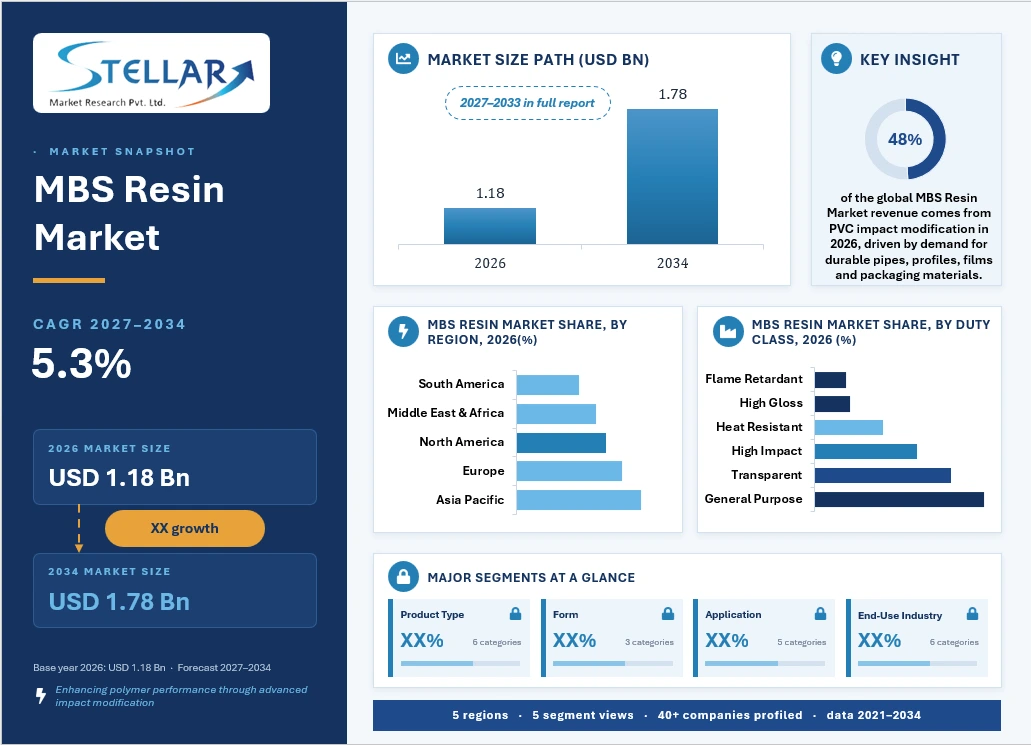
The Global MBS Resin Market was valued at USD 1.18 Billion in 2026 and is projected to reach USD 1.78 Billion by 2034, growing at a CAGR of 5.3% during 2027-2034.
The Global MBS Resin Market was valued at USD 1.18 Billion in 2026 and is projected to reach USD 1.78 Billion by 2034, growing at a CAGR of 5.3% during 2027-2034, according to Stellar Market Research (SMR). MBS (methyl methacrylate-butadiene-styrene) resin is a core-shell impact modifier: a butadiene rubber core absorbs impact energy and a methyl methacrylate-styrene shell bonds the core to the host polymer. The market covers transparent, general purpose, high impact, high gloss, heat resistant and flame retardant MBS resin, supplied as powder, granules and other forms for PVC impact modification, PVC processing enhancement, transparency and clarity, surface gloss and heat resistance. Buyers are PVC compounders, film and sheet converters, pipe and profile extruders, engineering-plastic blenders and medical-device makers, served through direct sales, distributors and wholesalers and online sales.
Demand is anchored by rigid and semi-rigid PVC. The U.S. Census Bureau estimated U.S. construction spending at a seasonally adjusted annual rate of USD 2,157.6 billion in July 2026, with public construction at USD 543.4 billion, which keeps pipe, profile, sheet and fittings demand in place. Kaneka, a leading MBS producer, lists sheets, food-packaging film, bottles, pharmaceutical blister packs, pipes and fittings as typical applications of its Kane Ace B series MBS impact modifiers for indoor rigid and semi-rigid PVC, and offers Kane Ace M grades for engineering plastics such as PC, PBT and ABS alloys.
Regulation and compliance shape grade selection. The U.S. Food and Drug Administration sets conditions for polymer modifiers in semirigid and rigid vinyl chloride food-contact plastics under 21 CFR 178.3790, which allows modifier polymers built from monomers such as methyl methacrylate, butadiene and styrene within stated composition and extractive limits. India’s Department of Chemicals and Petrochemicals, whose remit includes plastics, publishes Quality Control Orders in its Annual Report 2025-26 that affect PVC and polymer supply chains.
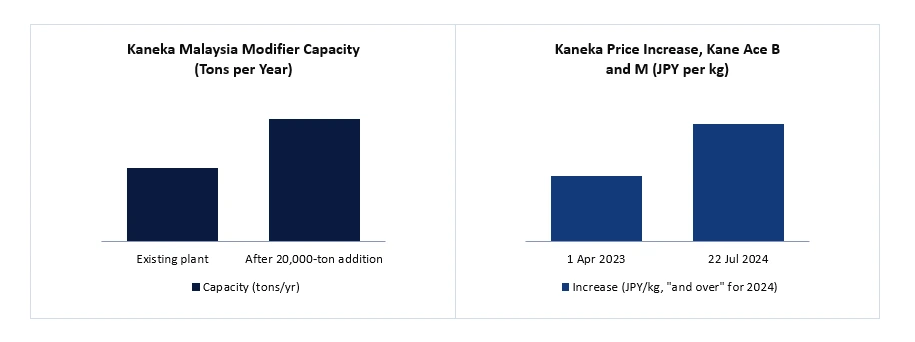
Supply is expanding in Asia and prices follow raw-material costs. Kaneka’s Malaysian plant produces 30,000 tons of modifiers a year, and the company added a 20,000-ton facility to serve rising Asian demand for PVC and engineering plastics, with modifier plants in Japan, Europe, the United States and Asia. Producer notices show cost pressure: Kaneka announced increases of JPY 45 per kg for Kane Ace B and M impact modifiers from 1 April 2023 and JPY 80 per kg and over from 22 July 2024.
This report answers both sides of the search: what the MBS resin market is worth for producers, compounders, distributors and investors, and what buyers ask most, from MBS resin market size, MBS resin price trends and MBS resin demand to transparent MBS resin, MBS impact modifier for PVC, heat resistant and flame retardant MBS resin, and the regulations that shape food-contact and medical use.
Stellar Market Research provides a segment-level analysis of the global MBS resin market size, share and forecast by product type, form, application, end-use industry and distribution channel, together with regional analysis, value-chain mapping, competitive landscape and strategic scenarios through 2034.
To get more Insights: Request Free Sample Report
Global MBS Resin Market Overview: Size, Share, Trends and Outlook to 2034
SMR measures the market at producer-revenue level across MBS impact modifier resin sold as powder, granules and other forms to PVC compounders, converters, engineering-plastic blenders and distributors. The defining traits are grade-by-grade qualification (clarity, crease whitening, impact efficiency, gloss), concentration among a few core-shell polymer producers, pass-through of butadiene and methyl methacrylate costs, and a strong link to PVC pipe, profile, sheet, film and packaging output.
Three shifts shape 2026-2034: volume growth moves toward Asia Pacific as producers such as Kaneka add local modifier capacity; value shifts toward transparent, heat resistant and flame retardant grades that serve packaging, electronics and engineering-plastic blends; and distributors and online channels widen reach to small and mid-size compounders while direct sales stay the base for large accounts.
Key Findings: Eight Insights Shaping the Global MBS Resin Market
SMR’s analysis of U.S. Census Bureau and FDA publications, India’s Department of Chemicals and Petrochemicals reporting and company disclosures from Kaneka points to eight findings that explain where MBS resin value is created through 2034.
|
# |
Finding |
Evidence |
So what |
|
1 |
The market grows about 1.5x by 2034 |
USD 1.18 Bn (2026) to USD 1.78 Bn (2034) at 5.3% CAGR (SMR) |
Specialty-additive growth that tracks PVC and engineering plastics |
|
2 |
PVC impact modification is the core use |
Kaneka: Kane Ace B series serves sheets, food-packaging film, bottles, blister packs, pipes and fittings; SMR: 48% of 2026 value |
Rigid and semi-rigid PVC sets the volume base |
|
3 |
Construction anchors volume |
U.S. Census Bureau: USD 2,157.6 Bn annual rate in July 2026; public USD 543.4 Bn |
Pipe, profile and fittings demand stays resilient |
|
4 |
Clarity earns a premium |
Kaneka Kane Ace B611 and B28A target transparency with low crease whitening or high impact; SMR: transparent grades 25% share, 5.9% CAGR |
Packaging and medical film favor clear grades |
|
5 |
Asia adds capacity |
Kaneka Malaysia: 30,000 tons plus a 20,000-ton addition; SMR: Asia Pacific 51% share, 6.4% CAGR |
Local supply wins Asian PVC and engineering-plastic accounts |
|
6 |
Raw-material costs pass through |
Kaneka: JPY 45/kg (Apr 2023) and JPY 80/kg and over (Jul 2024); Kaneka North America: USD 0.08/lb (Jan 2017) |
Butadiene and MMA swings move producer margins |
|
7 |
Regulation shapes food and medical grades |
FDA 21 CFR 178.3790 covers polymer modifiers in semirigid and rigid vinyl chloride food-contact plastics |
Compliant grades support packaging and healthcare |
|
8 |
Engineering plastics widen the market |
Kaneka Kane Ace M grades (e.g., M-711) target PC, PBT and ABS alloys; SMR: heat resistant 6.8% and flame retardant 7.1% CAGR |
Heat and flame performance grades outgrow general purpose |
Global MBS Resin Market Dynamics: Growth Drivers, Restraints and Opportunities
MBS Resin Market Growth Drivers: PVC Demand, Clarity Requirements and Engineering Plastics
- Construction and infrastructure demand. The U.S. Census Bureau put construction spending at an annual rate of USD 2,157.6 billion in July 2026, including USD 543.4 billion of public construction, sustaining pipe, profile and sheet demand for PVC impact modifiers.
- Rigid and semi-rigid PVC applications. Kaneka’s MBS range targets sheets, food-packaging film, bottles, pharmaceutical blister packs, pipes and fittings, giving the resin a broad base across packaging and building products.
- Clarity without crease whitening. Kaneka’s Kane Ace B611 is designed for transparency with non-crease whitening, and B28A for transparency with high impact, which supports clear film, sheet and bottle conversion.
- Engineering plastic modification. Kaneka’s Kane Ace M series, including the M-711 grade for opaque PC, PBT and ABS alloys, extends MBS use beyond PVC into heat-resistant and flame-retardant compounds.
- Regional capacity close to demand. Kaneka expanded its Malaysian modifier capacity from 30,000 tons by adding 20,000 tons to meet Asian PVC and engineering-plastic demand.
MBS Resin Market Restraints: Raw-Material Costs, Indoor-Use Limits and Substitutes
- Raw-material cost pass-through. Kaneka’s price notices of JPY 45 per kg (April 2023) and JPY 80 per kg and over (July 2024), and Kaneka North America’s USD 0.08 per pound increase (January 2017), show how butadiene, methyl methacrylate and styrene costs reach buyers.
- Indoor-use positioning. Kaneka positions the Kane Ace B MBS series for indoor rigid and semi-rigid PVC, and offers all-acrylic Kane Ace FM grades for outdoor, UV-resistant PVC, which limits MBS in weathering applications.
- Compliance burden. Food-contact and medical grades must meet rules such as FDA 21 CFR 178.3790, which lengthens qualification and limits formulation freedom.
- Construction cyclicality. U.S. Census Bureau data show spending in the USD 2.1 trillion range through 2026, so building-linked demand depends on housing and non-residential cycles.
What Are the Biggest MBS Resin Market Opportunities Through 2034?
- Transparent grades for packaging and healthcare: blister packs, clear bottles and medical film favor high-clarity MBS.
- Heat resistant and flame retardant grades: electronics, automotive and engineering-plastic blends reward higher-performance modifiers.
- Asia Pacific localization: local plants such as Kaneka’s in Malaysia and Japan shorten lead times for PVC and engineering-plastic compounders.
- India and emerging markets: India’s Department of Chemicals and Petrochemicals oversees plastics policy and Quality Control Orders that reshape PVC supply chains and local compounding.
- Distributor and online reach: distributors such as Palmer Holland represent Kaneka’s modifier range in North America, and digital channels reach smaller buyers.
- Customized grades: tailored impact efficiency, clarity and processing behavior create differentiation against commodity modifiers.
Global MBS Resin Market Segmentation: By Product Type, Form, Application, End-Use Industry and Distribution Channel
MBS Resin Market by Product Type: Transparent, General Purpose, High Impact, High Gloss, Heat Resistant and Flame Retardant
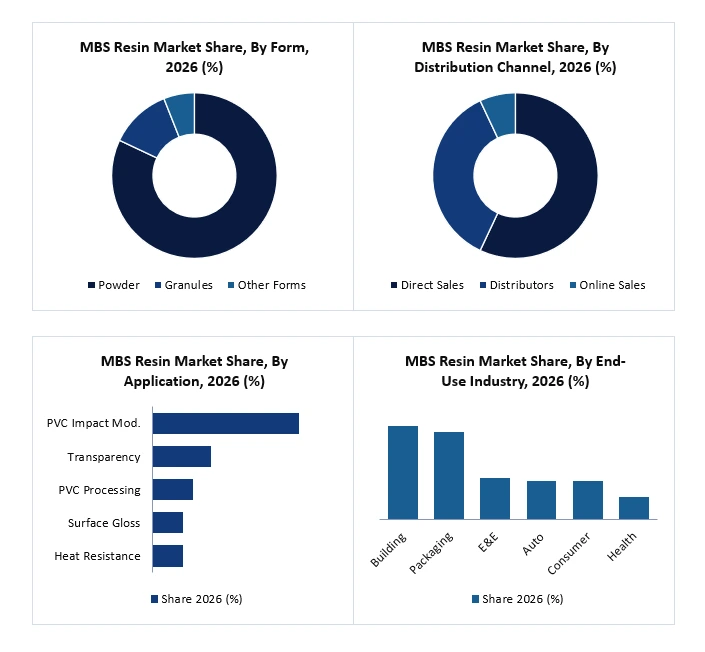
General purpose MBS resin holds about 27% of 2026 value and grows at a 4.2% CAGR, serving standard PVC film, sheet and profile. Transparent MBS resin holds 25% with a 5.9% CAGR, supported by clear packaging and low-crease-whitening grades such as Kaneka’s Kane Ace B611. High impact MBS resin holds 17% (5.4% CAGR) for pipe, fittings and bottles, and heat resistant MBS resin holds 12% (6.8% CAGR) for engineering-plastic blends. High gloss MBS resin holds 10% (4.8% CAGR), and flame retardant MBS resin holds 9% and is the fastest-growing type at a 7.1% CAGR from a small base.
MBS Resin Market by Form: Powder, Granules and Other Forms
Powder holds about 82% of 2026 value and grows at 5.0%; Kaneka’s Kane Ace B660, for example, is supplied as a fine white powder with a bulk density of 0.32 g/cm³ and 0.5% volatile matter. Granules hold 12% and grow at 6.4% as compounders seek less dust and easier handling, and other forms hold 6% with the fastest growth at 7.0%.
MBS Resin Market by Application: PVC Impact Modification, Processing Enhancement, Transparency, Surface Gloss and Heat Resistance
PVC impact modification dominates at about 48% of 2026 value and grows at 4.8%. Transparency and clarity enhancement holds 19% (6.0% CAGR), PVC processing enhancement 13% (4.6%), surface gloss improvement 10% (4.9%), and heat resistance enhancement 10%, which is the fastest-growing application at a 6.9% CAGR as MBS enters engineering-plastic blends.
MBS Resin Market by End-Use Industry: Building and Construction, Packaging, Automotive, Electrical and Electronics, Consumer Goods and Healthcare
Building and construction leads at about 29% of 2026 value (4.5% CAGR), followed by packaging at 27% (5.5%). Electrical and electronics holds 13% (6.0%), automotive 12% (5.8%) and consumer goods 12% (4.9%). Healthcare and medical devices holds 7% but is the fastest-growing end use at a 7.2% CAGR, driven by blister packs, clear films and device housings.
MBS Resin Market by Distribution Channel: Direct Sales, Distributors and Wholesalers and Online Sales
Direct sales hold about 57% of 2026 value (4.9% CAGR), reflecting qualification-heavy contracts with large compounders and converters. Distributors and wholesalers hold 36% (5.4%), including partners such as Palmer Holland for Kaneka’s modifiers in North America. Online sales hold 7% and grow fastest at a 9.4% CAGR from a small base.
Global MBS Resin Market Regional Analysis: North America, Europe, Asia Pacific, Middle East & Africa, Central & South America
Asia Pacific is the largest region at about 51% of 2026 value and the fastest-growing at a 6.4% CAGR, led by China, Japan, South Korea and India. Kaneka’s Malaysian modifier plant (30,000 tons plus a 20,000-ton addition) shows how producers localize supply for Asian PVC and engineering-plastic demand. Europe holds 19%, supported by Kaneka Belgium’s Westerlo site, which operates production for high performance MBS and acrylic polymers. North America holds 18%, with U.S. construction spending at USD 2,157.6 billion in July 2026 (U.S. Census Bureau) and Kaneka North America, based in Pasadena, Texas, supplying Kane Ace MBS modifiers. Middle East & Africa (6%) and Central & South America (6%) are smaller but growing with infrastructure and packaging programs.
MBS Resin Ecosystem: From Monomers to Finished PVC and Engineering Plastics
|
Layer |
What happens |
Examples |
|
1. Monomer feedstocks |
Butadiene, methyl methacrylate and styrene are supplied to polymer producers |
Petrochemical and MMA producers |
|
2. MBS polymer production |
Core-shell MBS resin is polymerized, grafted and dried into powder or granules |
Kaneka, Mitsubishi Chemical, LG Chem, Dow, Arkema, Denka, Formosa Plastics |
|
3. Distribution |
Producers sell direct or through distributors, wholesalers and online platforms |
Palmer Holland (Kaneka modifiers, North America) |
|
4. Compounding and conversion |
PVC and engineering-plastic compounders blend MBS into film, sheet, bottles, pipes and parts |
PVC compounders, sheet and film converters, extruders |
|
5. End users |
Construction, packaging, automotive, electronics, consumer goods and healthcare buyers |
Building products, blister packs, device housings |
|
6. Government and standards |
Policy, statistics and food-contact rules |
FDA, U.S. Census Bureau, India DCPC |
MBS Resin Companies and Competitive Landscape: Who Supplies the Global MBS Resin Market?
The global MBS resin market combines Japanese and Korean specialty-chemical groups, U.S. and European polymer producers and fast-growing Chinese suppliers. Kaneka, Mitsubishi Chemical, LG Chem, Dow, Arkema, Denka, Formosa Plastics and Shandong Ruifeng Chemical are among the producers active in MBS impact modifiers. Competition varies by grade: clarity and low crease whitening, impact efficiency, processing behavior and consistent particle quality decide qualification.
Company disclosures show how producers respond to demand and costs. Kaneka announced a total capital investment of around JPY 12 billion in Malaysia, including an additional modifier facility that raises annual capacity by 20,000 tons from 30,000 tons, and states that it will operate four modifier plants in Japan, Europe, the United States and Asia. Kaneka also announced price increases of JPY 45 per kg for Kane Ace B and M grades from 1 April 2023 and JPY 80 per kg and over from 22 July 2024.
Competitive Strategies in the MBS Resin Market
- Regional capacity close to customers: Kaneka’s Malaysian expansion and four-region plant network.
- Grade portfolios by clarity and impact: Kaneka’s B-series grades range from moderate impact with high clarity (B611) to very high impact for opaque use (B660).
- Engineering-plastic extension: Kane Ace M grades target PC, PBT and ABS alloys that require heat resistance.
- Price discipline against feedstock swings: announced per-kg price increases tied to raw-material and energy costs.
- Distribution partnerships: Palmer Holland distributes Kaneka’s MBS and acrylic modifiers across North America.
MBS Resin Standards and Regulation: Key Frameworks and Policy
- FDA 21 CFR 178.3790: polymer modifiers in semirigid and rigid vinyl chloride plastics for food contact, with composition and extractive limits.
- FDA 21 CFR Part 177 (Indirect Food Additives: Polymers): the part of the Code of Federal Regulations covering polymers used as basic components of food-contact surfaces.
- India Department of Chemicals and Petrochemicals, Annual Report 2025-26: lists Quality Control Orders and plastics-sector policy that affect PVC and polymer supply.
- U.S. Census Bureau Value of Construction Put in Place survey: the monthly source for U.S. construction spending used as a demand indicator.
- EU REACH and national chemical controls: registration and safety-data requirements for polymers and monomers placed on regional markets.
Global MBS Resin Market Recent Developments
|
Date |
Development |
Source |
|
2026 |
India’s Department of Chemicals and Petrochemicals publishes Annual Report 2025-26 covering plastics policy and QCOs |
Govt. of India, DCPC |
|
Sep 2026 |
U.S. Census Bureau reports July 2026 construction spending at USD 2,157.6 Bn annual rate |
U.S. Census Bureau
|
|
Global MBS Resin Market Segmentation |
|||
|
Report Coverage |
Details |
||
|
Base Year: |
2026 |
Forecast Period: |
2027-2034 |
|
Historical Data: |
2021 to 2026 |
Market Size in 2026: |
USD 1.18 Billion |
|
Forecast Period 2027 to 2034 CAGR: |
5.3% |
Market Size in 2034: |
USD 1.78 Billion |
|
MBS Resin Market Segments Covered: |
By Product Type |
Transparent MBS Resin General Purpose MBS Resin High Impact MBS Resin High Gloss MBS Resin Heat Resistant MBS Resin Flame Retardant MBS Resin |
|
|
By Form |
Powder Granules Other Forms |
||
|
By Application |
PVC Impact Modification PVC Processing Enhancement Transparency and Clarity Enhancement Surface Gloss Improvement Heat Resistance Enhancement |
||
|
By End-Use Industry |
Building and Construction Packaging Automotive Electrical and Electronics Consumer Goods Healthcare and Medical Devices |
||
|
By Distribution Channel |
Direct Sales Distributors and Wholesalers Online Sales |
||
Global MBS Resin Market, By Region:
- North America (United States, Canada, Mexico, Rest of North America)
- Europe (Germany, France, United Kingdom, Italy, Spain, Russia, Rest of Europe)
- Asia Pacific (China, Japan, South Korea, India, Taiwan, Southeast Asia, Australia, Rest of Asia Pacific)
- Middle East & Africa (Saudi Arabia, United Arab Emirates, South Africa, Rest of Middle East & Africa)
- Central & South America (Brazil, Argentina, Rest of Central & South America)
Global MBS Resin Market Key Players:
North America
- Dow Inc.
- SI Group, Inc.
- Chevron Phillips Chemical Company
- Americas Styrenics LLC
- Eastman Chemical Company
- DuPont
- Huntsman Corporation
- Chemours
Europe
- Arkema S.A.
- INEOS Styrolution
- BASF SE
- LANXESS AG
- Wacker Chemie AG
- Covestro AG
- Allnex GmbH
- Evonik Industries AG
Asia-Pacific
- Kaneka Corporation
- Mitsubishi Chemical Corporation
- Denka Company Limited
- Sumitomo Chemical Co., Ltd.
- Mitsui Chemicals, Inc.
- Toray Industries, Inc.
- Nippon Shokubai Co., Ltd.
- Kuraray Co., Ltd.
- LG Chem Ltd.
- Formosa Plastics Corporation
- Shandong Ruifeng Chemical Co., Ltd.
- Shandong Novista Chemicals Co., Ltd. (Novista Group)
- En-Door Polymer Additives Co., Ltd.
- Sundow Polymers Co., Ltd.
- Hebei Baofeng Chemical Co., Ltd.
- Qingdao Hairuite Chemical Material Co., Ltd.
- Foshan Sunbreak Polymer Manufacturing Co., Ltd.
- Indofil Industries Limited
- Platinum Industries Ltd.
- SNG Microns Pvt. Ltd.
- Perfect Colourants & Plastics Pvt. Ltd. (PCPPL)
- Vizag Chemical
- RX Chemicals
Middle East & Africa
- SABIC
- Akdeniz Kimya San. ve Tic. A.?.
- Sasol Limited
South America
- Braskem S.A.
- Unipar Carbocloro S.A.
- OXITENO (Indorama Ventures)
Frequently Asked Questions
MBS resin is mainly an impact modifier for PVC. Kaneka lists sheets, food-packaging film, bottles, pharmaceutical blister packs, pipes and fittings as typical applications of its Kane Ace B series, and Kane Ace M grades for engineering plastics such as PC, PBT and ABS alloys.
In SMR’s estimates flame retardant MBS resin grows fastest at a 7.1% CAGR, followed by heat resistant MBS resin at 6.8% and transparent MBS resin at 5.9%.
Asia Pacific leads with about 51% of 2026 value and the fastest growth at a 6.4% CAGR (SMR). Kaneka’s Malaysian plant, at 30,000 tons plus a 20,000-ton addition, shows producers building capacity in the region.
MBS resin prices follow butadiene, methyl methacrylate and styrene costs. Kaneka announced increases of JPY 45 per kg (April 2023) and JPY 80 per kg and over (July 2024) for Kane Ace B and M grades.
The FDA’s 21 CFR 178.3790 sets conditions for polymer modifiers in semirigid and rigid vinyl chloride food-contact plastics, including modifier polymers derived from monomers such as methyl methacrylate, butadiene and styrene, subject to composition and extraction limits.
MBS modifiers use a butadiene rubber core and suit indoor, transparent or opaque PVC, while all-acrylic modifiers such as Kaneka’s Kane Ace FM grades are positioned for outdoor, UV-resistant PVC.
Direct sales lead with about 57% of 2026 value, ahead of distributors and wholesalers at 36%, while online sales hold 7% and grow fastest at 9.4% (SMR).
1. MBS Resin Market Overview & Industry Landscape
1.1. Global MBS Resin Market Size (Value USD Million), 2026–2034
1.2. Historical Development of MBS Resin Manufacturing Industry
1.3. MBS Resin Definition, Composition and Commercial Classification
1.4. Positioning of MBS Resin Within Acrylic Modifiers
1.5. Global MBS Resin Production, Consumption and Trade Overview
1.6. MBS Resin Market CAGR and Long-Term Growth Outlook
2. MBS Resin Market Dynamics
2.1. Emerging Trends Across MBS Resin Applications
2.2. Market Dynamics Analysis
- 2.2.1. Drivers
- 2.2.2. Restraints
- 2.2.3. Opportunities
- 2.2.4. Challenges
2.3. PORTER's Five Forces Analysis of MBS Resin Industry
2.4. PESTLE Analysis of the Global MBS Resin Market
3. MBS Resin Market Macroeconomic Factors
3.1. Global PVC Production and Downstream Processing Industry Trends
3.2. Construction Industry Investments and Infrastructure Development Expenditure
3.3. Automotive Production and Plastic Component Manufacturing Investments
3.4. Global Packaging Industry Growth and Material Consumption Patterns
3.5. Petrochemical Feedstock Prices and Polymer Manufacturing Economics
3.6. International Trade Flows and Foreign Exchange Movements
4. MBS Resin Industry Trends & Emerging Technology Requirements
4.1. Growing Adoption of MBS Modifiers in Rigid PVC
4.2. Increasing Demand for Transparent Impact Modified PVC Products
4.3. Development of Advanced Core-Shell Polymer Modification Technologies
4.4. Rising Preference for High-Gloss PVC Product Formulations
4.5. Growing Focus on Heat-Resistant and Flame-Retardant Grades
4.6. Sustainable Polymer Processing and Material Efficiency Innovations
5. MBS Resin Chemistry, Composition & Technical Characteristics
5.1. Methyl Methacrylate Butadiene Styrene Polymer Composition Analysis
5.2. Core-Shell Morphology and Polymer Particle Structure Characteristics
5.3. Rubber Phase Composition and Impact Absorption Mechanisms
5.4. Graft Copolymerization Chemistry and Molecular Structure Characteristics
5.5. Particle Size Distribution and Dispersion Performance Assessment
5.6. Optical, Mechanical and Thermal Property Evaluation Parameters
6. MBS Resin Manufacturing & Production Process Landscape
6.1. Raw Material Selection and Polymerization Feedstock Requirements
6.2. Emulsion Polymerization Process and Reaction Mechanism Analysis
6.3. Core-Shell Particle Formation and Grafting Process Optimization
6.4. Coagulation, Separation and Resin Recovery Process Technologies
6.5. Drying, Powder Processing and Granulation Manufacturing Operations
6.6. Production Yield, Process Efficiency and Manufacturing Cost Analysis
7. MBS Resin Raw Materials & Feedstock Supply Ecosystem
7.1. Methyl Methacrylate Procurement and Feedstock Availability Assessment
7.2. Butadiene Sourcing and Rubber Phase Production Requirements
7.3. Styrene Procurement and Polymer Manufacturing Supply Dynamics
7.4. Initiators, Emulsifiers and Additive Consumption Requirements Analysis
7.5. Raw Material Pricing and Supplier Dependency Assessment
7.6. Feedstock Availability, Import Dependency and Supply Vulnerabilities
8. MBS Resin Product Portfolio & Grade Specifications
8.1. Transparent MBS Resin Formulation and Optical Performance Characteristics
8.2. General Purpose MBS Resin Composition and Functional Applications
8.3. High Impact MBS Resin Toughness and Modification Performance
8.4. High Gloss MBS Resin Surface Appearance Enhancement Characteristics
8.5. Heat Resistant MBS Resin Thermal Stability Specifications
8.6. Flame Retardant MBS Resin Formulation and Safety Requirements
9. MBS Resin Physical Form & Processing Characteristics
9.1. Powder MBS Resin Particle Characteristics and Handling Requirements
9.2. Granular MBS Resin Processing and Material Feeding Characteristics
9.3. Alternative Commercial Forms and Specialized Product Configurations
9.4. Bulk Density, Particle Distribution and Flowability Assessment
9.5. Storage Stability and Moisture Sensitivity Across Resin Forms
9.6. Form Selection Based on Processing Equipment Compatibility
10. MBS Resin Quality Standards & Performance Specifications
10.1. Impact Strength Testing and Mechanical Performance Evaluation
10.2. Light Transmittance and Haze Measurement Specifications Analysis
10.3. Gloss Retention and Surface Finish Quality Assessment
10.4. Thermal Stability and Processing Temperature Performance Requirements
10.5. Melt Flow Characteristics and Processing Consistency Evaluation
10.6. Batch Quality Control and Customer Qualification Standards
11. MBS Resin Applications in PVC Impact Modification
11.1. Rigid PVC Impact Strength Improvement and Toughness Enhancement
11.2. PVC Pipe Formulations and Mechanical Durability Requirements
11.3. PVC Fittings Manufacturing and Impact Resistance Optimization
11.4. Window Profiles and Building Component Impact Modification
11.5. PVC Sheets and Extruded Product Performance Enhancement
11.6. Impact Modifier Loading Levels and Formulation Compatibility
12. MBS Resin Applications in PVC Processing Enhancement
12.1. PVC Melt Processing Behavior and Flowability Improvement
12.2. Polymer Fusion Characteristics and Processing Cycle Optimization
12.3. Extrusion Performance and Manufacturing Throughput Improvement Opportunities
12.4. Injection Molding Efficiency and Product Quality Enhancement
12.5. Processing Temperature Stability and Thermal Degradation Control
12.6. Resin Compatibility with PVC Compounds and Additives
13. MBS Resin Applications in Optical & Surface Enhancement
13.1. Transparent PVC Product Clarity and Light Transmission Improvement
13.2. Optical Haze Reduction in Transparent PVC Formulations
13.3. High Gloss Surface Finishing and Appearance Enhancement
13.4. Color Consistency and Visual Quality Retention Requirements
13.5. Transparent Packaging Components and Optical Performance Applications
13.6. Surface Appearance Optimization Across Finished PVC Products
14. MBS Resin Applications in Heat Resistance & Flame Retardancy
14.1. Thermal Performance Improvement in Specialized PVC Formulations
14.2. Heat Resistant Resin Applications in Electrical Components
14.3. Flame Retardant Formulations for Safety-Critical PVC Products
14.4. Thermal Degradation Resistance During High Temperature Processing
14.5. Fire Safety Requirements Across Industrial Plastic Applications
14.6. Additive Compatibility and Formulation Stability Under Heat
15. MBS Resin End-Use Industry Demand Landscape
15.1. Building and Construction PVC Product Manufacturing Demand
15.2. Packaging Industry Transparent and Rigid Plastic Applications
15.3. Automotive Interior Components and Plastic Part Manufacturing
15.4. Electrical and Electronics Housing and Insulation Applications
15.5. Consumer Goods Manufacturing and Decorative Plastic Product Demand
15.6. Healthcare and Medical Device Plastic Component Requirements
16. MBS Resin Pricing, Cost Structure & Commercial Economics
16.1. MBS Resin Pricing Across Commercial Grades and Forms
16.2. Raw Material Cost Contribution to Resin Manufacturing Economics
16.3. Production Costs and Polymerization Process Expense Analysis
16.4. Grade-Based Pricing Differences and Product Premium Assessment
16.5. Distributor Margins and Regional Resin Pricing Variations
16.6. Customer Procurement Economics and Bulk Purchasing Considerations
17. MBS Resin Distribution, Sales & Procurement Landscape
17.1. Direct Sales Through Resin Manufacturers and Producers
17.2. Distributors and Wholesalers Serving Regional Polymer Markets
17.3. Online Sales Platforms and Digital Procurement Channels
17.4. Industrial Customer Contracts and Long-Term Supply Agreements
17.5. Technical Sales Support and Formulation Assistance Requirements
17.6. Distribution Network Coverage and Customer Service Differentiation
18. MBS Resin Supply Chain & Operational Ecosystem
18.1. Petrochemical Feedstock Sourcing and Raw Material Procurement Networks
18.2. Polymer Manufacturing Facilities and Production Capacity Distribution
18.3. Resin Packaging, Warehousing and Inventory Management Operations
18.4. Domestic Transportation and International Resin Distribution Networks
18.5. Import Export Trade Flows and Regional Supply Dependencies
18.6. Supply Chain Resilience and Operational Risk Management
19. MBS Resin Regulatory, Environmental & Compliance Landscape
19.1. Chemical Registration and Polymer Manufacturing Compliance Requirements
19.2. Environmental Regulations Governing Polymer Production Facilities Operations
19.3. Workplace Safety and Chemical Handling Standards Assessment
19.4. Product Specifications and Industrial Material Certification Requirements
19.5. Restricted Substances and Regulatory Compliance Across Applications
19.6. Regional Regulatory Differences and Market Entry Considerations
20. MBS Resin Technology Innovation, R&D & Product Development
20.1. Advanced Core-Shell Polymer Architecture and Particle Engineering Innovations
20.2. Development of Improved Impact Modification Resin Formulations
20.3. Optical Performance Enhancement Through Particle Morphology Optimization
20.4. Thermal Stability Improvement and Specialized Grade Development
20.5. Research Investments and Strategic Technical Collaboration Activities
20.6. New Product Development and Commercialization Strategies Assessment
21. MBS Resin Market Adoption & Customer Procurement Landscape
21.1. MBS Resin Adoption Across PVC Processing Industries
21.2. Customer Preferences Across Resin Grades and Performance Requirements
21.3. Resin Qualification Testing and Supplier Approval Procedures
21.4. Switching Costs and Alternative Impact Modifier Considerations
21.5. Bulk Procurement Patterns and Repeat Purchase Frequency Analysis
21.6. Customer Satisfaction and Long-Term Supplier Relationship Assessment
22. MBS Resin Substitution & Competitive Material Landscape
22.1. Acrylic Impact Modifiers and Application-Based Performance Comparison
22.2. CPE Impact Modifiers and PVC Compatibility Benchmarking
22.3. ABS Modifiers and Mechanical Performance Comparison Analysis
22.4. ASA Modifiers and Weatherability Performance Considerations
22.5. Alternative Polymer Modifier Pricing and Substitution Economics
22.6. Material Selection Based on Application-Specific Performance Requirements
23. MBS Resin Regional & Country-Level Market Landscape
23.1. North American MBS Resin Production and Consumption Dynamics
23.2. European MBS Resin Manufacturing and Application Demand Patterns
23.3. Asia-Pacific MBS Resin Production and Export Leadership Analysis
23.4. Middle East & Africa MBS Resin Market Development
23.5. South American MBS Resin Consumption and Import Dependency
23.6. Regional Capacity Expansion and Cross-Border Trade Opportunities
24. MBS Resin Market Size & Forecast by Segmentation (Value USD Million), 2026–2034
24.1. MBS Resin Market Size and Forecast, By Product Type
24.1.1. Transparent MBS Resin
24.1.2. General Purpose MBS Resin
24.1.3. High Impact MBS Resin
24.1.4. High Gloss MBS Resin
24.1.5. Heat Resistant MBS Resin
24.1.6. Flame Retardant MBS Resin
24.2. MBS Resin Market Size and Forecast, By Form
24.2.1. Powder
24.2.2. Granules
24.2.3. Other Forms
24.3. MBS Resin Market Size and Forecast, By Application
24.3.1. PVC Impact Modification
24.3.2. PVC Processing Enhancement
24.3.3. Transparency and Clarity Enhancement
24.3.4. Surface Gloss Improvement
24.3.5. Heat Resistance Enhancement
24.4. MBS Resin Market Size and Forecast, By End-Use Industry
24.4.1. Building and Construction
24.4.2. Packaging
24.4.3. Automotive
24.4.4. Electrical and Electronics
24.4.5. Consumer Goods
24.4.6. Healthcare and Medical Devices
24.5. MBS Resin Market Size and Forecast, By Distribution Channel
24.5.1. Direct Sales
24.5.2. Distributors and Wholesalers
24.5.3. Online Sales
24.6. MBS Resin Market Size and Forecast, By Region
24.6.1. North America
- United States
- Canada
- Mexico
24.6.2. Europe
- Germany
- United Kingdom
- France
- Italy
- Spain
- Netherlands
- Belgium
- Rest of Europe
24.6.3. Asia-Pacific
- China
- Japan
- India
- South Korea
- Taiwan
- Australia
- Rest of Asia-Pacific
24.6.4. Middle East & Africa
- Saudi Arabia
- United Arab Emirates
- South Africa
- Turkey
- Rest of Middle East & Africa
24.6.5. South America
- Brazil
- Argentina
- Chile
- Rest of South America
25. MBS Resin Market Competitive Landscape
25.1. SMR Competition Matrix and Competitive Positioning Analysis
25.2. Competitive Structure of Global MBS Resin Manufacturers
25.3. Key Players Benchmarking
- 25.3.1. Company Name and Corporate Headquarters
- 25.3.2. MBS Resin Product Portfolio and Grade Availability
- 25.3.3. Manufacturing Capacity and Production Facility Assessment
- 25.3.4. Product Quality and Technical Performance Benchmarking
- 25.3.5. Geographic Presence and Distribution Network Comparison
- 25.3.6. Customer Industries and Application Coverage Analysis
25.4. Market Structure and Manufacturer Categorization
- 25.4.1. Integrated Petrochemical and Specialty Polymer Manufacturers
- 25.4.2. Dedicated MBS Resin Production Companies
- 25.4.3. Specialty Polymer Additive and Modifier Suppliers
- 25.4.4. Regional Resin Manufacturers and Distribution Participants
25.5. Company Revenue Growth and Financial Performance Benchmarking
25.6. MBS Resin Production Capacity and Utilization Comparison
25.7. Product Portfolio Breadth and Grade Availability Benchmarking
25.8. Regional Market Presence and Competitive Strength Assessment
25.9. Mergers, Acquisitions and Strategic Collaboration Activities
25.10. Recent Product Launches and Manufacturing Expansion Developments
26. MBS Resin Manufacturers' Strategies & Expansion Plans
26.1. Expansion of MBS Resin Manufacturing Capacity and Facilities
26.2. Development of High-Performance and Specialized Resin Grades
26.3. Strengthening Raw Material Sourcing and Supply Chain Integration
26.4. Geographic Expansion Across Emerging Polymer Consumption Markets
26.5. Strategic Partnerships with PVC Compounders and Processors
26.6. Investment in Manufacturing Efficiency and Product Innovation
27. MBS Resin Industry SWOT, Investments & Strategic Developments
27.1. Competitive Strengths of Established MBS Resin Manufacturers
27.2. Raw Material Dependency and Manufacturing Cost Limitations
27.3. Emerging Opportunities Across Transparent and Rigid PVC Applications
27.4. Competitive Threats from Alternative Polymer Impact Modifiers
27.5. Investments in Advanced Polymerization and Production Technologies
27.6. Product Launches, Partnerships and Strategic Industry Developments
28. MBS Resin Competitive Outlook & Market Positioning
28.1. Competitive Dynamics Across MBS Resin Product Categories
28.2. Market Concentration Across Global Manufacturing and Supply Networks
28.3. Competitive Differentiation Through Product Quality and Performance
28.4. Established Manufacturers Versus Emerging Regional Resin Producers
28.5. Competitive Positioning Across End-Use Application Industries
28.6. Long-Term Market Opportunities and Industry Growth Potential
29. Company Profiles: Key MBS Resin Market Participants
Detailed Company Profile Parameters
29.1. Company Overview and Business Operations
29.2. MBS Resin Product Portfolio and Grade Specifications
29.3. Manufacturing Facilities and Production Capacity Assessment
29.4. Financial Overview and Revenue Performance Analysis
29.5. Geographic Presence and Distribution Network Coverage
29.6. SWOT Analysis and Strategic Growth Initiatives
North America
- Dow Inc.
- SI Group, Inc.
- Chevron Phillips Chemical Company
- Americas Styrenics LLC
- Eastman Chemical Company
- DuPont
- Huntsman Corporation
- Chemours
Europe
- Arkema S.A.
- INEOS Styrolution
- BASF SE
- LANXESS AG
- Wacker Chemie AG
- Covestro AG
- Allnex GmbH
- Evonik Industries AG
Asia-Pacific
- Kaneka Corporation
- Mitsubishi Chemical Corporation
- Denka Company Limited
- Sumitomo Chemical Co., Ltd.
- Mitsui Chemicals, Inc.
- Toray Industries, Inc.
- Nippon Shokubai Co., Ltd.
- Kuraray Co., Ltd.
- LG Chem Ltd.
- Formosa Plastics Corporation
- Shandong Ruifeng Chemical Co., Ltd.
- Shandong Novista Chemicals Co., Ltd. (Novista Group)
- En-Door Polymer Additives Co., Ltd.
- Sundow Polymers Co., Ltd.
- Hebei Baofeng Chemical Co., Ltd.
- Qingdao Hairuite Chemical Material Co., Ltd.
- Foshan Sunbreak Polymer Manufacturing Co., Ltd.
- Indofil Industries Limited
- Platinum Industries Ltd.
- SNG Microns Pvt. Ltd.
- Perfect Colourants & Plastics Pvt. Ltd. (PCPPL)
- Vizag Chemical
- RX Chemicals
Middle East & Africa
- SABIC
- Akdeniz Kimya San. ve Tic. A.?.
- Sasol Limited
South America
- Braskem S.A.
- Unipar Carbocloro S.A.
- OXITENO (Indorama Ventures)
30. Key Findings
31. Strategic Moves & Industry Outlook
32. Research Methodology