ENG
 Japanese
 French
 German
 Korean

Pyromellitic Dianhydride (PMDA) Market Size, Share & Forecast 2027 – 2034
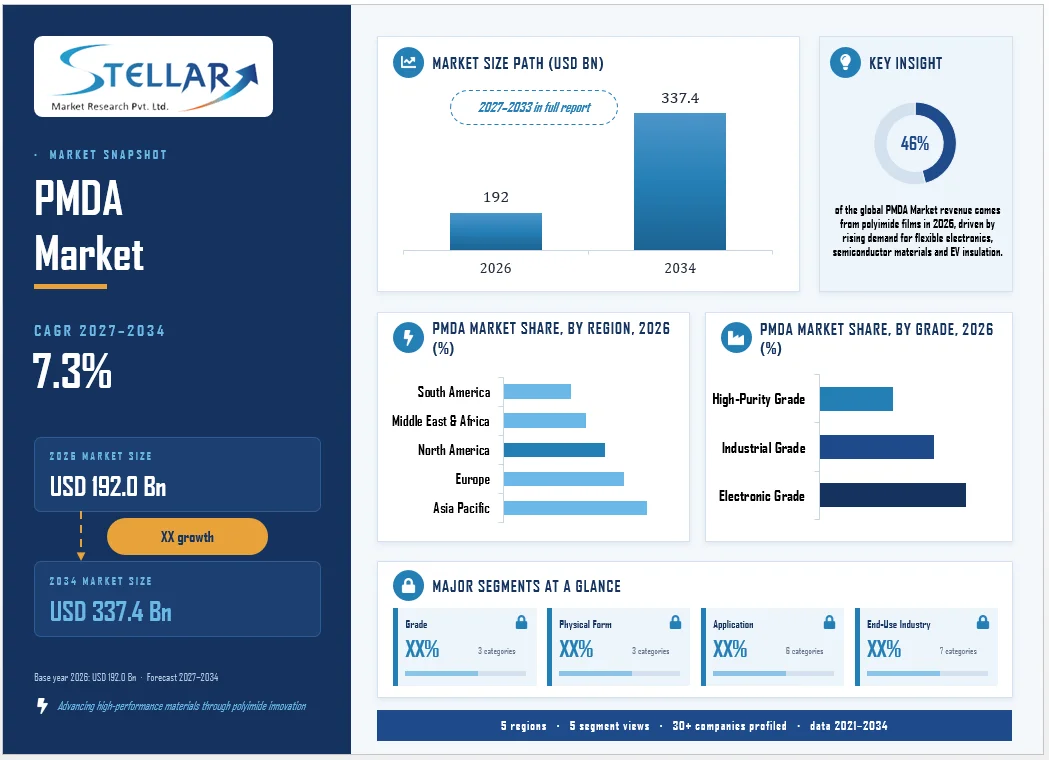
The Global Pyromellitic Dianhydride (PMDA) Market was valued at USD 192.0 Million in 2026 and is projected to reach USD 337.4 Million by 2034, growing at a CAGR of 7.3% during 2027-2034
The Global Pyromellitic Dianhydride (PMDA) Market was valued at USD 192.0 Million in 2026 and is projected to reach USD 337.4 Million by 2034, growing at a CAGR of 7.3% during 2027-2034, according to Stellar Market Research (SMR). Pyromellitic dianhydride (CAS 89-32-7), also known as 1,2,4,5-benzenetetracarboxylic dianhydride, is the aromatic dianhydride monomer behind high-temperature polyimide chemistry. The market covers electronic grade, industrial grade and high-purity grade PMDA supplied as powder, crystalline and granular forms, and used in polyimide resins, polyimide films, high-temperature coatings, adhesives and sealants, electrical insulation materials and specialty chemical intermediates. Buyers are polyimide manufacturers, specialty chemical manufacturers, electrical insulation material producers, advanced material manufacturers and industrial chemical formulators.
Demand follows the polyimide value chain. Polyimide film is the largest outlet for PMDA because the monomer, reacted with 4,4’-oxydianiline (ODA), forms the Kapton-type polyimide that NASA research identifies as a PMDA-ODA material. Kaneka, a leading polyimide film producer, stated in 2012 that its total film capacity would reach 3,200 tons across Japan, the United States and Malaysia, and announced a further 30% capacity increase in 2018 for communication, in-vehicle, medical and industrial uses. In semiconductor materials, Asahi Kasei is investing about ¥16 billion to double its PIMEL photosensitive polyimide capacity in Fuji City, Japan, by 2030 against its 2024 level.
Electrification and chip investment set the growth pace. The International Energy Agency (IEA) reports that global electric car sales grew 20% to exceed 20 million in 2025, one in four new cars sold, and expects about 23 million in 2026, or 28% of car sales. Electric drivetrains, battery packs and charging equipment use polyimide insulation films, tapes and varnishes, which lifts demand for high-purity and electronic grade PMDA. In the United States, the CHIPS and Science Act provides USD 52.7 billion, including USD 39 billion in manufacturing incentives administered by the CHIPS Program Office at NIST, supporting a semiconductor sector that relies on polyimide dielectric and flexible circuit materials.
Prices and feedstock costs are firming. Kaneka raised polyimide film prices by 15% per square metre from 1 January 2022 and by 20% from 16 April 2026, citing raw material, energy and shipping costs linked to conditions in the Middle East. Records at the Canadian Intellectual Property Office describe vapor-phase catalytic oxidation of durene (1,2,4,5-tetramethylbenzene) as the industrial route to PMDA, so aromatic feedstock and energy costs pass quickly from monomer to film converters and favor producers with stable purity and supply.
This report answers both sides of the search: what the PMDA market is worth for monomer producers, polyimide manufacturers, film converters and investors, and what buyers ask most, from PMDA market size, PMDA price trend and PMDA supply and demand to electronic grade PMDA, polyimide film raw materials, PMDA-ODA polyimide, high-purity PMDA suppliers and the regulations and trade policies that shape procurement.
Stellar Market Research provides a segment-level analysis of the global pyromellitic dianhydride market size, share and forecast by grade, physical form, application, end-use industry and end-user type, together with regional analysis, value-chain mapping, competitive landscape and strategic scenarios through 2034.
To get more Insights: Request Free Sample Report
Global Pyromellitic Dianhydride (PMDA) Market Overview: Size, Share, Trends and Outlook to 2034
SMR measures the market at vendor-revenue level for pyromellitic dianhydride sold as a monomer and intermediate: electronic, industrial and high-purity grades, in powder, crystalline and granular form, to polyimide manufacturers, specialty chemical makers, electrical insulation material producers, advanced material manufacturers and industrial chemical formulators. The defining traits are a narrow production base, purity-driven pricing, moisture-sensitive handling and tight qualification by film and resin customers.
Three shifts shape 2026-2034: demand moves from wire enamels and industrial coatings toward electronic grade and high-purity PMDA for flexible circuits, battery and EV insulation and semiconductor materials; production and qualification advantages concentrate in Asia Pacific while Japan, Europe and the United States focus on high-end grades; and cost pass-through, as in Kaneka’s 2026 film price increase, pushes buyers toward longer supply agreements and dual sourcing.
Key Findings: Eight Insights Shaping the Global Pyromellitic Dianhydride (PMDA) Market
SMR’s analysis of IEA, NIST, patent-office and company disclosures from Kaneka and Asahi Kasei points to eight findings that explain where PMDA value is created through 2034.
|
# |
Finding |
Evidence |
So what |
|
1 |
The market grows about 1.8x by 2034 |
USD 192.0 Mn (2026) to USD 337.4 Mn (2034) at 7.3% CAGR (SMR) |
PMDA moves from a niche monomer to a structural growth chemical |
|
2 |
Polyimide films anchor demand |
Polyimide films hold 46% of 2026 value (SMR); Kaneka announced a 30% film capacity increase in 2018 |
Film capacity decisions set PMDA volumes |
|
3 |
Electrification adds a second leg |
IEA: electric car sales above 20 million in 2025 (+20%); about 23 million expected in 2026 |
EV insulation lifts high-purity grade demand |
|
4 |
Semiconductor policy supports materials demand |
NIST/Commerce: USD 52.7 Bn CHIPS funding, USD 39 Bn in manufacturing incentives |
Electronic grade PMDA gains from fab and packaging build-out |
|
5 |
Film prices are being repriced upward |
Kaneka: +15% from Jan 2022 and +20% from 16 Apr 2026 per square metre |
Cost pass-through reaches monomer contracts |
|
6 |
Purity defines the premium |
Electronic and high-purity grades hold 58% of 2026 value and outgrow industrial grade (SMR) |
Producers with purification and QC depth earn the margin |
|
7 |
Asia Pacific leads supply and demand |
Asia Pacific holds 62% of 2026 value (SMR); Shandong Helishi lists 2,000 t/y PMDA capacity |
Regional supply security becomes a procurement theme |
|
8 |
The process route is mature |
Canadian patent records describe vapor-phase oxidation of durene as the industrial route |
Differentiation is purity, consistency and logistics, not chemistry |
Global Pyromellitic Dianhydride (PMDA) Market Dynamics: Growth Drivers, Restraints and Opportunities
PMDA Market Growth Drivers: Polyimide Film Demand, Electrification and Semiconductor Policy
- Polyimide film and flexible electronics demand. NASA technical records describe Kapton as a polyimide made from PMDA and 4,4’-oxydianiline, and Kaneka’s 2018 release cites IoT, AI, in-vehicle, medical and industrial demand for ultra-heat resistant polyimide film as the reason for a 30% capacity increase.
- Vehicle electrification. The IEA counts more than 20 million electric car sales in 2025 and expects about 23 million in 2026; motors, battery packs and charging systems rely on polyimide insulation films and varnishes.
- Semiconductor investment. The CHIPS and Science Act provides USD 52.7 billion, with USD 39 billion in manufacturing incentives, and Asahi Kasei is spending about ¥16 billion to double photosensitive polyimide capacity by 2030.
- Aerospace and defense qualification. NASA research on PMDA-ODA polyimide composites targets atomic-oxygen resistance in low Earth orbit, which supports steady specialty demand for flight-qualified material.
- High-purity grade upgrading. Shandong Helishi lists PMDA at 99.80% minimum assay with free acid at 0.5% maximum, the type of specification band that electronic buyers use to qualify supply.
- Pricing power downstream. Kaneka’s 20% polyimide film price increase from 16 April 2026 shows that film makers are passing cost through, which supports contract resets for monomers.
PMDA Market Restraints: Feedstock Costs, Moisture Sensitivity and Occupational Health Rules
- Feedstock and energy cost volatility. Kaneka cited raw material, energy and shipping costs in its 2022 and 2026 price increases; PMDA is made by oxidizing durene, so margins follow aromatic feedstock and energy prices.
- Qualification time and a narrow producer base. Film and resin makers qualify PMDA lots on assay, free acid and consistency, which slows supplier switching and limits new entrants.
- Moisture sensitivity and hazard labelling. Thermo Scientific and TCI product listings describe PMDA as moisture sensitive, with hazard statements H317, H318 and H334 for skin sensitization, serious eye damage and respiratory sensitization.
- Occupational health scrutiny. A 2019 paper indexed by the U.S. National Library of Medicine (PMC) reports that PMDA may cause occupational asthma, which raises handling, ventilation and exposure-control costs.
- Substitution by other dianhydrides. Canadian Intellectual Property Office records show copolyimide films that combine PMDA with 3,3’,4,4’-biphenyltetracarboxylic dianhydride (BPDA) to cut thermal expansion and water uptake, which dilutes PMDA content per film.
What Are the Biggest PMDA Market Opportunities Through 2034?
- Low-loss films for communication: Kaneka’s 2018 expansion tied ultra-heat resistant polyimide film demand to communication systems and IoT devices, a growth area for high-purity PMDA.
- Electronic-grade purification: TCI lists sublimation-purified PMDA at 99.0% or higher by HPLC alongside 98.0% grades, showing the premium tier that producers can target.
- EV and battery insulation: The IEA expects electric cars to reach 28% of global car sales in 2026, widening demand for insulating films, tapes and wire coatings.
- Semiconductor materials: CHIPS funding and Asahi Kasei’s plan to double PIMEL capacity by 2030 point to rising polyimide use in chip manufacturing.
- Space and defense materials: NASA studies of PMDA-ODA polyimide composites support continued specialty demand for atomic-oxygen resistant films.
- Epoxy curing and specialty intermediates: Thermo Scientific describes PMDA as a curing agent for epoxy resins used in adhesives, coatings and molding powders, and as a monomer for polyesters and plasticizers.
Global Pyromellitic Dianhydride (PMDA) Market Segmentation: By Grade, Physical Form, Application, End-Use Industry and End-User Type
PMDA Market by Grade: Electronic Grade, Industrial Grade and High-Purity Grade
Electronic grade PMDA holds about 38% of 2026 value and grows at 8.0% CAGR, sold to flexible circuit film, semiconductor and EV insulation buyers that require tight assay, low free acid and low metal content. Industrial grade (42%) serves wire enamels, coatings, epoxy curing and plasticizers and grows more slowly at 5.8%. High-purity grade (20%) is the fastest-growing at 9.0%. Grade bands follow SMR purity definitions; supplier catalogues show the range, from TCI’s 98.0% and sublimation-purified 99.0% (HPLC) lots to Shandong Helishi’s 99.80% minimum assay.
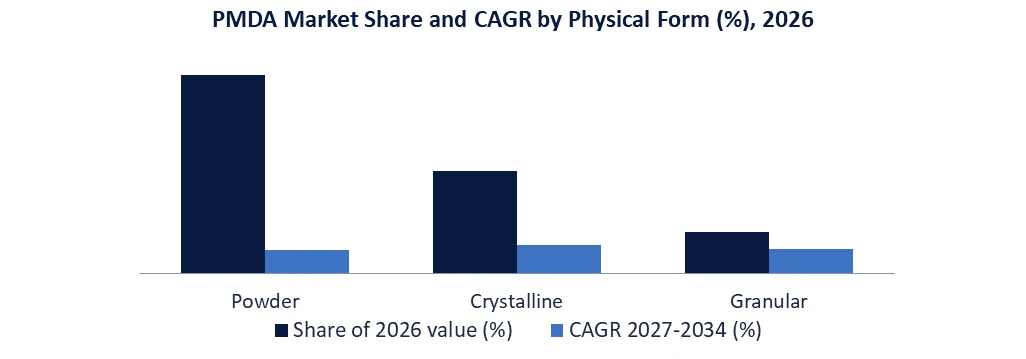
PMDA Market by Physical Form: Powder, Crystalline and Granular
Powder is the leading form at about 58% of 2026 value and grows at 6.9%, preferred for dissolution in aprotic solvents such as NMP or DMAc to make polyamic acid. Crystalline PMDA (30%) grows fastest at 8.2% because sublimation-purified crystalline lots meet electronic specifications; TCI lists a sublimation-purified crystalline powder. Granular PMDA (12%, 7.1% CAGR) reduces dust and eases metering, which matters for a material carrying a respiratory sensitizer (H334) hazard statement.
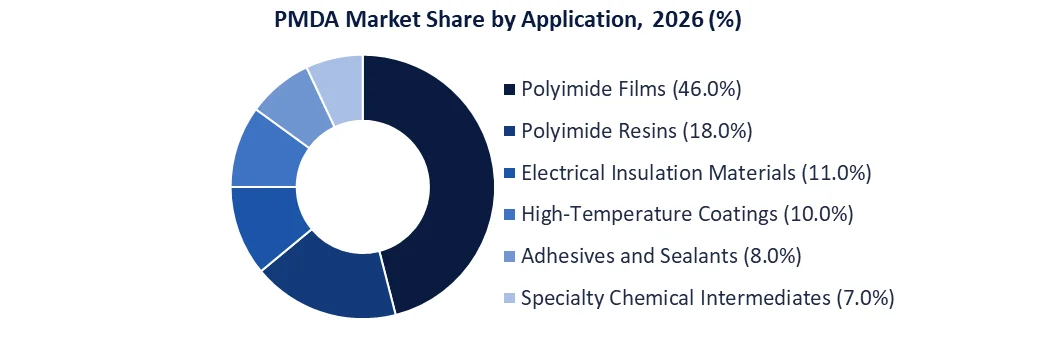
PMDA Market by Application: Polyimide Films, Resins, Coatings, Adhesives, Insulation and Intermediates
Polyimide films dominate at about 46% of 2026 value and grow at 8.0% CAGR, since NASA research identifies Kapton as a PMDA and 4,4’-oxydianiline polyimide. Polyimide resins hold 18% (7.1%), electrical insulation materials 11% (6.9%), high-temperature coatings 10% (6.5%), adhesives and sealants 8% (6.1%) and specialty chemical intermediates 7% (6.6%), the last covering epoxy curing agents, polyester crosslinkers and plasticizers.
PMDA Market by End-Use Industry: Electronics, Automotive, Aerospace, Electrical, Industrial and Healthcare
Electronics and semiconductors lead at 36% of 2026 value with a 7.8% CAGR, supported by flexible circuits and CHIPS-funded fabrication. Automotive and transportation holds 17% and is the fastest-growing at 8.3%, tied to IEA-tracked electric car sales above 20 million in 2025. Aerospace and defense holds 15% (6.8%), electrical and electronics manufacturing 14% (6.5%), industrial manufacturing 13% (5.7%) and healthcare and medical devices 5% (7.3%).
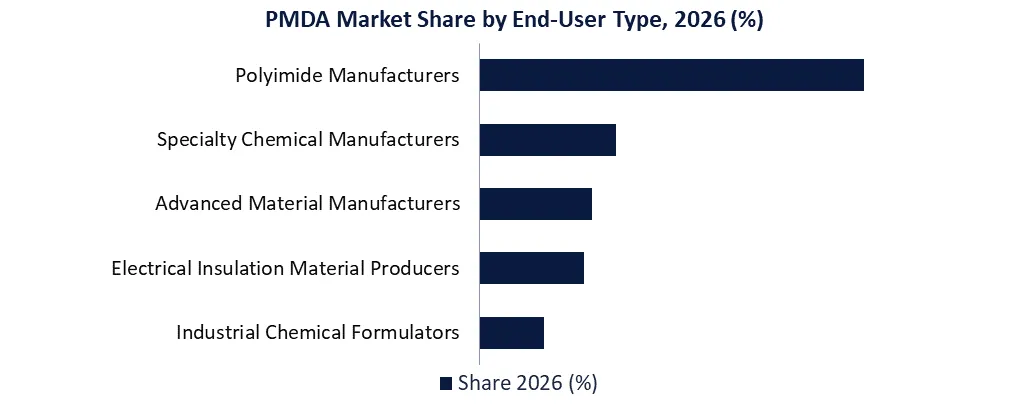
PMDA Market by End-User Type: Polyimide Manufacturers, Specialty Chemical Makers, Insulation Producers and Formulators
Polyimide manufacturers lead at 48% of 2026 value, followed by specialty chemical manufacturers at 17%, advanced material manufacturers at 14%, electrical insulation material producers at 13% and industrial chemical formulators at 8%. Advanced material manufacturers are the fastest-growing buyer group at 8.3% CAGR as they develop low-loss, transparent and high-modulus polyimides; polyimide manufacturers grow at 7.7%.
Global Pyromellitic Dianhydride (PMDA) Market Regional Analysis: Asia Pacific, Europe, North America, Middle East & Africa, Central & South America
Asia Pacific is the largest region at about 62% of 2026 value and the fastest-growing at 8.0% CAGR, led by China, Japan and South Korea’s polyimide film, flexible circuit and semiconductor materials chains; Kaneka runs film capacity in Japan and Malaysia and Shandong Helishi lists 2,000 t/y of PMDA capacity in China. Europe holds 17% (5.9%), with specialty producers focused on high-purity grades under EU chemical regulation (EC number 201-898-9). North America holds 14% (6.5%), supported by USD 52.7 billion in CHIPS funding and aerospace demand. Middle East & Africa (4%) and Central & South America (3%) are smaller but growing with electrical equipment and vehicle assembly.
PMDA Ecosystem: From Durene to Polyimide Products
|
Layer |
What happens |
Examples |
|
1. Feedstock and synthesis |
Durene (1,2,4,5-tetramethylbenzene) is oxidized in the vapor phase over vanadium-based catalysts to PMDA |
Shandong Helishi, Jiangsu Hualun Chemical, Arxada |
|
2. Purification and grading |
Crude PMDA is purified, including by sublimation, into industrial, electronic and high-purity grades |
TCI, Thermo Scientific Chemicals, Shandong Helishi |
|
3. Polyimide synthesis |
PMDA reacts with diamines such as ODA to form polyamic acid, then imidizes to polyimide |
Kaneka, DuPont (Kapton), Ube |
|
4. Film, coating and insulation converting |
Polyamic acid is cast into film, varnish, resin, adhesive or photosensitive coating |
Kaneka, Asahi Kasei, SKC Kolon PI |
|
5. End-use industries and standards |
Electronics, EV, aerospace and industrial users; data, funding and chemical registries |
NASA, NIST, IEA, ECHA, PubChem (NIH) |
PMDA Companies and Competitive Landscape: Who Supplies the Global PMDA Market?
The PMDA market combines specialty chemical multinationals, regional Chinese producers and downstream polyimide majors that buy the monomer. Arxada, Jiangsu Hualun Chemical, Puyang Hengfeng Electronic, Puyang Shenghuade Chemical, Shandong Helishi and Shijiazhuang Hope Chemical are among named producers, while Kaneka, DuPont, Asahi Kasei and other film and resin makers set the qualification standards as buyers.
Company disclosures show how buyers respond to cost and demand shifts. Kaneka planned total polyimide film capacity of 3,200 tons with its Malaysian plant in 2013, announced a 30% capacity increase in 2018 and raised film prices 20% for shipments from 16 April 2026. Asahi Kasei committed about ¥16 billion in August 2025 to double photosensitive polyimide capacity by 2030, and Shandong Helishi lists 2,000 t/y of PMDA capacity at 99.80% minimum assay.
Competitive Strategies in the PMDA Market
- Purity differentiation: suppliers compete on assay, free acid and metal content, with catalogue grades running from 98% to a 99.80% minimum assay.
- Downstream integration: Kaneka converts polyimide film into high thermal conductive graphite sheets, capturing value beyond the monomer.
- Capacity close to demand: Kaneka’s Malaysian film plant and Shandong Helishi’s 2,000 t/y PMDA line show capacity sited near electronics manufacturing.
- Cost pass-through: Kaneka’s 15% (2022) and 20% (2026) film price increases show how feedstock and energy costs are transferred to buyers.
- Application-led expansion: Asahi Kasei’s ¥16 billion photosensitive polyimide expansion aligns capacity with semiconductor customers.
PMDA Standards and Regulation: Key Frameworks and Policy
- CAS 89-32-7 and EC 201-898-9: registry identifiers used in ECHA, TSCA and customs documentation; NIH PubChem lists the compound as CID 6966.
- GHS classification: supplier safety data carry H317, H318 and H334 hazard statements for skin sensitization, serious eye damage and respiratory sensitization.
- TSCA listing: TCI and Thermo Scientific product listings mark PMDA as TSCA listed for U.S. commerce.
- CHIPS and Science Act: USD 52.7 billion in funding, including USD 39 billion in manufacturing incentives administered through NIST’s CHIPS Program Office.
- Occupational health research: a 2019 paper indexed by the U.S. National Library of Medicine reports PMDA may cause occupational asthma, informing workplace controls.
- IEA Global EV Outlook: the annual reference for electric car sales and fleet data used to size EV-linked polyimide demand.
Global Pyromellitic Dianhydride (PMDA) Market Recent Developments (2026)
|
Date |
Development |
Source |
|
Mar 2026 |
Kaneka raises polyimide film (Apical, Pixeo) prices 20% for shipments from 16 April |
Kaneka |
|
May 2026 |
IEA Global EV Outlook 2026: more than 20 million electric cars sold in 2025; about 23 million expected in 2026 |
IEA |
Global Pyromellitic Dianhydride (PMDA) Market Scope: Inquire before buying
|
Global Pyromellitic Dianhydride (PMDA) Market |
|||
|
Report Coverage |
Details |
||
|
Base Year: |
2026 |
Forecast Period: |
2027-2034 |
|
Historical Data: |
2021 to 2026 |
Market Size in 2026: |
USD 192.0 Mn |
|
Forecast Period 2027 to 2034 CAGR: |
7.3% |
Market Size in 2034: |
USD 337.4 Mn |
|
PMDA Market Segments Covered: |
By Grade |
Electronic Grade Industrial Grade High-Purity Grade |
|
|
By Physical Form |
Granular |
||
|
By Application |
Polyimide Resins Polyimide Films High-Temperature Coatings Adhesives and Sealants Electrical Insulation Materials Specialty Chemical Intermediates |
||
|
By End-Use Industry |
Electronics and Semiconductors Aerospace and Defense Automotive and Transportation Electrical and Electronics Manufacturing Industrial Manufacturing Healthcare and Medical Devices |
||
|
|
By End-User Type |
Polyimide Manufacturers Specialty Chemical Manufacturers Electrical Insulation Material Producers Advanced Material Manufacturers Industrial Chemical Formulators |
|
Global Pyromellitic Dianhydride (PMDA) Market, By Region:
- North America (United States, Canada, Mexico, Rest of North America)
- Europe (Germany, United Kingdom, France, Switzerland, Rest of Europe)
- Asia Pacific (China, Japan, South Korea, India, Taiwan, Rest of Asia Pacific)
- Middle East & Africa (Namibia, Niger, South Africa, Malawi, Tanzania, Botswana, Zambia, Central African Republic)
- Central & South America (Brazil, Argentina, Rest of Central & South America)
Global Pyromellitic Dianhydride (PMDA) Market Key Players:
Asia-Pacific (APAC)
- Jiangsu Hualun Chemical Co., Ltd.
- Puyang Hengfeng Electronic Insulation Materials Co., Ltd.
- Puyang Shenghuade Chemical Co., Ltd.
- Mitsubishi Gas Chemical Company, Inc.
- Toray Industries, Inc.
- Ube Industries, Ltd.
- Kaneka Corporation
- DIC Corporation
- Tokyo Chemical Industry Co., Ltd. (TCI Chemicals)
- TNJ Chemical
- Zibo Anquan Chemical Co., Ltd.
- ALTAIR ALCHEMY Laboratories
- Cosmos Plastics & Chemicals
- Spectrochem Private Limited
- P.C. Chem India
North America
- SKC Inc.
- Huntsman Corporation
- Alfa Aesar (Thermo Fisher Scientific)
- AK Scientific, Inc.
- Santa Cruz Biotechnology
Europe
- Lonza Group AG
- Arxada
- BASF SE
- Evonik Industries AG
- Sigma-Aldrich (Merck KGaA)
- Biosynth
- BIOZOL Diagnostica Vertrieb GmbH
- BuGuCh & Partners
Middle East & Africa (MEA)
- Zibo Anquan Chemical Co., Ltd.
- TNJ Chemical
Frequently Asked Questions
Ans: PMDA is mainly a monomer for polyimide films and resins; NASA research describes Kapton as a PMDA and 4,4’-oxydianiline polyimide. It is also used as an epoxy curing agent, polyester crosslinker, plasticizer and intermediate for high-temperature coatings and electrical insulation.
Ans: Suppliers list industrial lots at about 97-98% assay, sublimation-purified lots at 99.0% or higher by HPLC (TCI) and electronic-oriented lots at 99.80% minimum assay with free acid at 0.5% maximum (Shandong Helishi).
Ans: Asia Pacific leads with about 62% of 2026 value in SMR’s estimate, anchored by China’s PMDA production and Japan, South Korea and Southeast Asia’s polyimide film capacity, including Kaneka’s plants in Japan and Malaysia.
Ans: The IEA reports electric car sales above 20 million in 2025, up 20%, and expects about 23 million in 2026. EV motors, batteries and charging systems use polyimide insulation, which raises demand for high-purity PMDA.
Ans: There is no single public benchmark price. Kaneka raised polyimide film prices 15% in January 2022 and 20% in April 2026 on raw material, energy and shipping costs, which signals upward cost pass-through for PMDA contracts.
Ans: Supplier safety data carry H317, H318 and H334 hazard statements, and PMDA is moisture sensitive. A 2019 paper indexed by the U.S. National Library of Medicine reports it may cause occupational asthma, so ventilation and exposure controls are required.
Ans: Industrial PMDA is made by vapor-phase catalytic oxidation of durene (1,2,4,5-tetramethylbenzene) with oxygen over vanadium-based catalysts, as described in Canadian Intellectual Property Office patent records, followed by purification into electronic and high-purity grades.
1. Executive Market Landscape & Industry Overview
1.1. Global Pyromellitic Dianhydride Market Size (Value USD Million), 2026–2034
1.2. Historical Development of PMDA Manufacturing and Commercialization
1.3. PMDA Definition, Chemical Structure and Industrial Classification
1.4. PMDA Positioning Within the Aromatic Dianhydride Chemical Industry
1.5. Global PMDA Production, Consumption and Trade Overview
1.6. PMDA Market CAGR Analysis and Long-Term Growth Outlook
2. Pyromellitic Dianhydride Market Dynamics
2.1. Emerging Trends Across High-Performance Polyimide Material Applications
2.2. Market Dynamics Analysis
2.2.1. Drivers
2.2.2. Restraints
2.2.3. Opportunities
2.2.4. Challenges
2.3. PORTER's Five Forces Analysis
2.4. PESTLE Analysis
3. Pyromellitic Dianhydride Market Macroeconomic Factors
3.1. Global Polyimide Manufacturing Investments and Industrial Demand Trends
3.2. Electronics Manufacturing Expenditure and Semiconductor Industry Expansion
3.3. Aerospace Production Growth and Advanced Material Consumption
3.4. Automotive Electrification and High-Temperature Insulation Material Demand
3.5. Specialty Chemical Manufacturing Costs and Energy Price Movements
3.6. Foreign Exchange Fluctuations and International Chemical Trade Dynamics
4. PMDA Industry Trends & Emerging Technology Requirements
4.1. Growing Demand for High-Performance Aromatic Polyimide Materials
4.2. Increasing Adoption of Flexible Polyimide Films
4.3. Expansion of PMDA Applications in Electronic Insulation
4.4. Advancements in High-Purity Dianhydride Manufacturing Technologies
4.5. Emerging Demand from Electric Vehicle Insulation Applications
4.6. Development of Advanced Thermal-Resistant Polymer Formulations
5. PMDA Chemical Properties, Material Characteristics & Technical Landscape
5.1. PMDA Molecular Structure and Chemical Composition Characteristics
5.2. Molecular Weight, Functional Groups and Structural Properties
5.3. Melting Point, Thermal Stability and Decomposition Characteristics
5.4. Solubility, Reactivity and Chemical Compatibility Assessment
5.5. Moisture Sensitivity, Storage Stability and Material Degradation
5.6. Chemical Compatibility Across Polyimide Synthesis and Processing
6. PMDA Raw Material Sourcing & Feedstock Ecosystem
6.1. Primary Aromatic Hydrocarbon Feedstock Availability and Procurement
6.2. Durene Sourcing and Raw Material Quality Requirements
6.3. Feedstock Oxidation Requirements and Chemical Conversion Pathways
6.4. Catalyst Selection and Raw Material Processing Requirements
6.5. Feedstock Pricing, Supplier Concentration and Procurement Economics
6.6. Raw Material Supply Risks and Sourcing Diversification Strategies
7. PMDA Manufacturing, Production & Processing Technologies
7.1. Industrial PMDA Manufacturing Processes and Production Technologies
7.2. Durene Oxidation and Intermediate Formation Process Analysis
7.3. PMDA Cyclization, Dehydration and Product Formation Mechanisms
7.4. Industrial Reactor Design and Process Operating Conditions
7.5. Product Separation, Crystallization and Purification Technologies
7.6. Manufacturing Yield, Production Efficiency and Operational Cost Optimization
8. PMDA Product Specifications, Quality Control & Purification
8.1. Commercial PMDA Specifications and Technical Quality Requirements
8.2. Chemical Purity Testing and Impurity Concentration Assessment
8.3. Residual Moisture Analysis and Product Stability Verification
8.4. Color, Appearance and Physical Property Evaluation Standards
8.5. Batch Consistency, Quality Assurance and Production Traceability
8.6. Customer Qualification, Product Certification and Acceptance Requirements
9. PMDA Grade Classification & Product Quality Landscape
9.1. Electronic Grade PMDA Specifications and Application Requirements
9.2. Industrial Grade PMDA Manufacturing and Commercial Characteristics
9.3. High-Purity Grade PMDA Refining and Quality Requirements
9.4. Grade-Based Impurity Thresholds and Chemical Performance Evaluation
9.5. Grade Selection Across Different Polyimide Manufacturing Processes
9.6. Premium Grade Pricing and Customer Qualification Considerations
10. PMDA Physical Form, Handling & Product Configuration Landscape
10.1. Powder PMDA Characteristics and Industrial Processing Requirements
10.2. Crystalline PMDA Structure and Material Handling Characteristics
10.3. Granular PMDA Configuration and Industrial Feeding Requirements
10.4. Particle Size Distribution and Product Flowability Assessment
10.5. Packaging Formats, Moisture Protection and Storage Requirements
10.6. Physical Form Selection Across Customer Manufacturing Processes
11. PMDA Applications in Polyimide Resins Manufacturing
11.1. PMDA-Based Aromatic Polyimide Resin Synthesis and Formulation
11.2. High-Temperature Resin Development and Thermal Performance Requirements
11.3. Mechanical Strength, Chemical Resistance and Resin Durability
11.4. Resin Processing Compatibility and Polymerization Efficiency Assessment
11.5. Specialty Polyimide Resin Formulations for Industrial Applications
11.6. PMDA Consumption Patterns Across Polyimide Resin Manufacturers
12. PMDA Applications in Polyimide Films Manufacturing
12.1. PMDA-Based Polyimide Film Synthesis and Manufacturing Processes
12.2. Flexible Polyimide Film Production and Application Requirements
12.3. Thermal Stability and Dimensional Performance of Polyimide Films
12.4. Electrical Insulation Properties and Dielectric Performance Assessment
12.5. Thin-Film Processing and Advanced Electronics Integration Requirements
12.6. Polyimide Film Manufacturing Capacity and PMDA Consumption Trends
13. PMDA Applications in Coatings, Adhesives & Specialty Materials
13.1. High-Temperature Polyimide Coatings and Protective Surface Applications
13.2. PMDA-Based Adhesive Formulations and Bonding Performance Requirements
13.3. Sealant Formulations and Industrial Thermal Resistance Requirements
13.4. Electrical Insulation Materials and Dielectric Protection Applications
13.5. Specialty Chemical Intermediates and Downstream Product Development
13.6. Emerging PMDA Applications Across Advanced Material Formulations
14. PMDA End-Use Industry Demand & Application Landscape
14.1. Electronics and Semiconductor Industry PMDA Consumption Patterns
14.2. Aerospace and Defense High-Temperature Material Procurement Requirements
14.3. Automotive and Transportation Electrical Insulation Material Demand
14.4. Electrical and Electronics Manufacturing Polyimide Material Consumption
14.5. Industrial Manufacturing Demand for Advanced Thermal-Resistant Materials
14.6. Healthcare and Medical Device Specialty Polymer Applications
15. PMDA End-User Type & Customer Procurement Landscape
15.1. Polyimide Manufacturers and Large-Volume PMDA Procurement Requirements
15.2. Specialty Chemical Manufacturers and Intermediate Sourcing Strategies
15.3. Electrical Insulation Material Producers and Product Qualification Requirements
15.4. Advanced Material Manufacturers and High-Purity PMDA Consumption
15.5. Industrial Chemical Formulators and Customized Material Procurement Requirements
15.6. Customer Supplier Selection and Long-Term Purchasing Relationships
16. PMDA Pricing, Business Models & Cost Economics
16.1. PMDA Pricing Across Different Commercial Grades and Forms
16.2. Raw Material Cost Contribution to Overall Manufacturing Economics
16.3. Energy Consumption and Industrial Production Cost Structures
16.4. Purification Expenses and High-Purity Product Price Premiums
16.5. Regional Price Variations and International Procurement Cost Differences
16.6. Contract Pricing, Bulk Purchasing and Supplier Margin Analysis
17. PMDA Distribution, Sales & Procurement Landscape
17.1. Direct Sales Through PMDA Manufacturers and Chemical Producers
17.2. Specialty Chemical Distributors and Regional Supply Networks
17.3. Laboratory Chemical Suppliers and Small-Volume Product Distribution
17.4. International Trading Companies and Cross-Border Procurement Channels
17.5. Bulk Industrial Purchasing and Long-Term Supply Agreements
17.6. Customer Technical Support and Product Documentation Requirements
18. PMDA Supply Chain & Operational Ecosystem
18.1. Aromatic Feedstock Procurement and Upstream Supplier Networks
18.2. Chemical Processing, Manufacturing and Intermediate Material Transportation
18.3. PMDA Purification, Packaging and Finished Product Distribution
18.4. Inventory Management and Industrial Customer Supply Coordination
18.5. International Chemical Trade Routes and Regional Supply Dependencies
18.6. Supply Chain Disruptions and Operational Resilience Assessment
19. PMDA Regulatory, Environmental & Safety Landscape
19.1. Chemical Registration Requirements and Product Compliance Frameworks
19.2. PMDA Safety Data Sheets and Hazard Classification Requirements
19.3. Occupational Exposure Prevention and Industrial Chemical Handling Procedures
19.4. Manufacturing Emissions and Environmental Management Requirements
19.5. Chemical Waste Treatment and Industrial Disposal Regulations
19.6. Regional Regulatory Differences and International Market Access Requirements
20. PMDA Technology Innovation, R&D & Product Development
20.1. Advanced PMDA Synthesis and Manufacturing Process Improvements
20.2. High-Purity Product Development and Impurity Reduction Technologies
20.3. Catalyst Innovation and Improved Oxidation Process Efficiency
20.4. Advanced Polyimide Formulations and Material Performance Enhancement
20.5. Research Investments, Intellectual Property and Technical Collaborations
20.6. New Application Development and Commercialization Strategies
21. PMDA Market Adoption, Utilization & Customer Economics
21.1. PMDA Adoption Across High-Performance Polymer Manufacturing Applications
21.2. Customer Consumption Volumes and Industrial Procurement Frequency
21.3. Product Qualification Testing and Supplier Approval Procedures
21.4. Customer Switching Costs and Alternative Dianhydride Material Considerations
21.5. PMDA Consumption Efficiency Across Polyimide Production Processes
21.6. Customer Value Assessment and Long-Term Supplier Relationships
22. Pyromellitic Dianhydride Regional & Country-Level Market Landscape
22.1. North American PMDA Manufacturing Capacity and Industrial Consumption
22.2. European Specialty Chemical Production and Polyimide Material Demand
22.3. Asia-Pacific PMDA Manufacturing and Electronics Industry Consumption
22.4. Middle East and Africa Chemical Supply and Emerging Demand
22.5. South American Specialty Polymer Demand and Import Dependencies
22.6. Regional Production Concentration, Trade Flows and Supply Dynamics
23. PMDA Market Size & Forecast by Segmentation (Value USD Million), 2026–2034
23.1. PMDA Market Size and Forecast, By Grade
23.1.1. Electronic Grade
23.1.2. Industrial Grade
23.1.3. High-Purity Grade
23.2. PMDA Market Size and Forecast, By Physical Form
23.2.1. Powder
23.2.2. Crystalline
23.2.3. Granular
23.3. PMDA Market Size and Forecast, By Application
23.3.1. Polyimide Resins
23.3.2. Polyimide Films
23.3.3. High-Temperature Coatings
23.3.4. Adhesives and Sealants
23.3.5. Electrical Insulation Materials
23.3.6. Specialty Chemical Intermediates
23.4. PMDA Market Size and Forecast, By End-Use Industry
23.4.1. Electronics and Semiconductors
23.4.2. Aerospace and Defense
23.4.3. Automotive and Transportation
23.4.4. Electrical and Electronics Manufacturing
23.4.5. Industrial Manufacturing
23.4.6. Healthcare and Medical Devices
23.5. PMDA Market Size and Forecast, By End-User Type
23.5.1. Polyimide Manufacturers
23.5.2. Specialty Chemical Manufacturers
23.5.3. Electrical Insulation Material Producers
23.5.4. Advanced Material Manufacturers
23.5.5. Industrial Chemical Formulators
23.6. PMDA Market Size and Forecast, By Region
23.6.1. North America
United States
Canada
Mexico
23.6.2. Europe
Germany
United Kingdom
France
Italy
Switzerland
Netherlands
Spain
Rest of Europe
23.6.3. Asia-Pacific
China
Japan
India
South Korea
Taiwan
Australia
Rest of Asia-Pacific
23.6.4. Middle East & Africa
Saudi Arabia
United Arab Emirates
South Africa
Egypt
Rest of Middle East & Africa
23.6.5. South America
Brazil
Argentina
Chile
Rest of South America
24. Pyromellitic Dianhydride Market Competitive Landscape
24.1. SMR Competition Matrix
24.2. Competitive Positioning of Leading PMDA Market Participants
24.3. Key Players Benchmarking
24.3.1. Company Name and Corporate Headquarters
24.3.2. PMDA Product Portfolio and Commercial Offerings
24.3.3. Manufacturing Capacity and Production Capabilities
24.3.4. Product Grades and Purity Specifications
24.3.5. Geographic Presence and Distribution Network
24.3.6. Customer Industries and Application Market Exposure
24.4. Market Structure
24.4.1. Established PMDA Manufacturers and Chemical Producers
24.4.2. Integrated Specialty Chemical and Material Manufacturers
24.4.3. Regional PMDA Suppliers and Emerging Participants
24.4.4. Specialty Chemical Distributors and Trading Companies
24.5. Company Revenue Growth Rate Benchmarking
24.6. Company Profitability and Financial Performance Benchmarking
25. PMDA Manufacturers, Production Capacity & Operational Benchmarking
25.1. Global PMDA Manufacturing Facilities and Production Locations
25.2. Installed Production Capacity and Capacity Utilization Comparison
25.3. Manufacturing Technology and Process Efficiency Benchmarking
25.4. Product Grade Portfolio and Purity Capability Comparison
25.5. Raw Material Integration and Feedstock Procurement Capabilities
25.6. Production Expansion Plans and Capacity Addition Analysis
26. PMDA Market Manufacturers' Strategies & Expansion Plans
26.1. Expansion of PMDA Manufacturing Capacity Across Key Regions
26.2. Development of Advanced High-Purity PMDA Product Portfolios
26.3. Investments in Production Efficiency and Process Optimization
26.4. Strategic Partnerships with Polyimide and Electronics Manufacturers
26.5. Geographic Expansion Across Emerging Specialty Chemical Markets
26.6. Product Innovation and Downstream Application Diversification Strategies
27. PMDA Industry SWOT, Investments & Strategic Developments
27.1. Competitive Strengths of Established PMDA Manufacturing Companies
27.2. Feedstock Dependencies and Specialty Chemical Supply Constraints
27.3. Emerging Opportunities Across Advanced Polyimide Material Applications
27.4. Competitive Threats from Alternative Dianhydride Chemical Materials
27.5. Investments in Manufacturing Capacity and Purification Technologies
27.6. Product Launches, Collaborations and Strategic Industry Developments
28. PMDA Competitive Outlook & Market Positioning
28.1. Competitive Dynamics Across Global PMDA Supply Networks
28.2. Market Concentration Across Regional PMDA Manufacturing Capacities
28.3. Competitive Differentiation Through Product Purity and Quality
28.4. Established Chemical Producers Versus Specialized PMDA Suppliers
28.5. Competitive Positioning Across Polyimide Application Industries
28.6. Long-Term Growth Opportunities and Market Entry Potential
29. Company Profiles: Key Pyromellitic Dianhydride Market Participants
Detailed Company Profile Parameters
- Company Overview and Business Operations
- PMDA Product Portfolio and Commercial Offerings
- Manufacturing Facilities and Production Capabilities
- Product Grades, Purity and Technical Specifications
- Financial Overview and Revenue Performance
- Geographic Presence and Distribution Network
- Key Customer Industries and Application Markets
- SWOT Analysis
- Strategic Analysis and Growth Initiatives
- Recent Developments, Partnerships and Expansion Activities
Asia-Pacific (APAC)
- Jiangsu Hualun Chemical Co., Ltd.
- Puyang Hengfeng Electronic Insulation Materials Co., Ltd.
- Puyang Shenghuade Chemical Co., Ltd.
- Mitsubishi Gas Chemical Company, Inc.
- Toray Industries, Inc.
- Ube Industries, Ltd.
- Kaneka Corporation
- DIC Corporation
- Tokyo Chemical Industry Co., Ltd. (TCI Chemicals)
- TNJ Chemical
- Zibo Anquan Chemical Co., Ltd.
- ALTAIR ALCHEMY Laboratories
- Cosmos Plastics & Chemicals
- Spectrochem Private Limited
- P.C. Chem India
North America
- SKC Inc.
- Huntsman Corporation
- Alfa Aesar (Thermo Fisher Scientific)
- AK Scientific, Inc.
- Santa Cruz Biotechnology
Europe
- Lonza Group AG
- Arxada
- BASF SE
- Evonik Industries AG
- Sigma-Aldrich (Merck KGaA)
- Biosynth
- BIOZOL Diagnostica Vertrieb GmbH
- BuGuCh & Partners
Middle East & Africa (MEA)
- Zibo Anquan Chemical Co., Ltd.
- TNJ Chemical
30. Key Findings
31. Strategic Moves & Industry Outlook
32. Research Methodology