ENG
 Japanese
 French
 German
 Korean

Global Catechol Market : Size , Share and Forecast 2026–2034
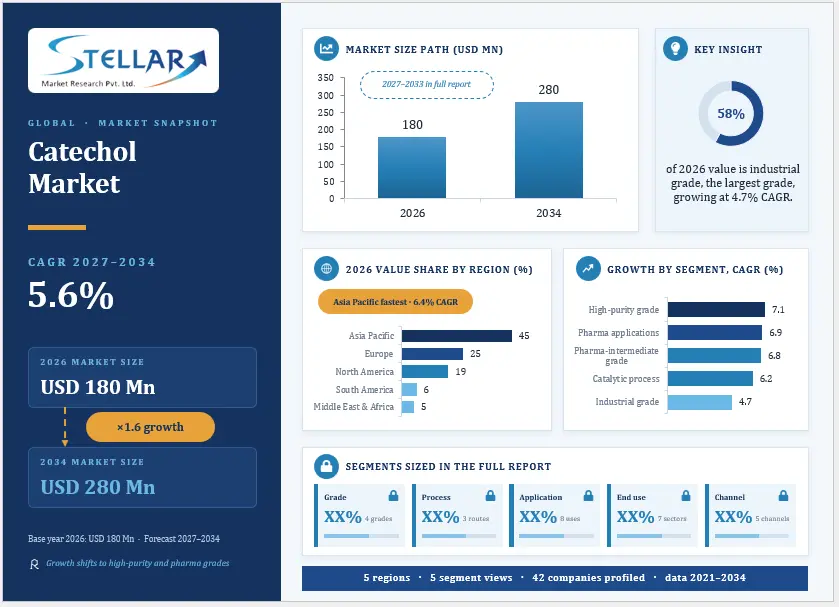
The Global Catechol Market is valued at USD 180 Million in 2026 and is projected to reach USD 280 Million by 2034, growing at a CAGR of 5.6% during 2027–2034
The Global Catechol Market is valued at USD 180 Million in 2026 and is projected to reach USD 280 Million by 2034, growing at a CAGR of 5.6% during 2027–2034, according to Stellar Market Research (SMR). Catechol, also known as pyrocatechol or 1,2-dihydroxybenzene (CAS 120-80-9), is the ortho isomer of the benzenediols and an aromatic chemical intermediate used to make agrochemical actives, pharmaceutical intermediates, flavor and fragrance chemicals, polymerization inhibitors and specialty chemicals. This market overview and market synopsis summarizes the market size, revenue generated, growth prospects and market outlook for catechol, based on SMR’s market research findings.
This Catechol Market analysis answers both sides of the search: what the Catechol Market size and Catechol Market forecast mean for producers, distributors and investors, and what buyers and process engineers want to know, from how catechol is made by phenol hydroxylation to product grades, purity specifications and regulation. The market insights also cover Catechol demand, Catechol supply and Catechol consumption patterns, along with consumer behaviour, Catechol Market share by segment, Catechol Market opportunities, Catechol Market challenges and industry trends.
Agrochemical and pharmaceutical intermediates anchor the Catechol Market and industrial grade is the largest product grade, but Catechol Market growth is shifting toward high-purity and pharmaceutical intermediate grades, catalytic hydroxylation processes and Asia Pacific as customers demand tighter impurity profiles and secure supply. The industry landscape is shaped by growth drivers, market dynamics, market challenges and market opportunities that influence Catechol demand and Catechol supply.
Stellar Market Research provides comprehensive analysis of global Catechol Market size, share, grade, production process, application, end-use industry, distribution channel and regional segmentation, the Catechol Market’s competitive landscape, strategic scenarios and growth opportunities. The report helps catechol manufacturers, raw material suppliers, distributors, pharmaceutical and agrochemical buyers, importers and investors decide which segments, channels and countries to prioritize through 2034. Market segmentation and segment analysis, including target market analysis, product segmentation and geographic segmentation, support market strategies and market entry decisions for key players.
|
2026 | BASE YEAR |
2034 | FORECAST |
GROWTH RATE |
LARGEST REGION |
|
USD 180 Mn |
USD 280 Mn |
5.6% |
Asia Pacific |
Global Catechol Market Overview: Catechol Market Size, Share, Trends and Outlook to 2034
The market is measured at product level across industrial, high-purity, pharmaceutical intermediate and laboratory and analytical grades of catechol sold worldwide for chemical intermediate manufacturing, polymer and rubber formulations, pharmaceutical and agrochemical synthesis and specialty chemical use, in both value (USD billion) and volume (units in million). Hydroquinone is co-produced with catechol in phenol hydroxylation, but only catechol revenue is counted; catechol-derived downstream products such as finished pesticides, vanillin and formulated drugs are excluded. This market summary also reflects the economic factors, technological advancements and regulatory influences that determine Catechol consumption across emerging markets.
Three shifts shape 2027–2034: demand is broadening from commodity intermediates toward pharmaceutical and high-purity uses; value is moving toward higher-purity grades, catalytic processes and long-term supply agreements; and growth is rotating toward Asia Pacific. Producers are answering feedstock volatility and tightening environmental rules with process optimization, catalyst innovation and backward integration into phenol and hydrogen peroxide. These market shifts and emerging trends highlight industry evolution, growth catalysts and competitive forces across the industry.
To get more Insights: Request Free Sample Report
Key Findings: Eight Insights Shaping the Global Catechol Market
SMR’s analysis of published market data, company announcements, regulatory filings and industry reports points to eight findings that explain where Catechol Market growth and value are created through 2034. This market trends analysis also identifies growth catalysts, the market gap and the competitive landscape shifts affecting key players.
|
Sr.No. |
Findings |
Evidence |
So what |
|
1 |
The market grows about 1.6× by 2034 |
USD 180 Mn (2026) to USD 280 Mn (2034) at 5.6% CAGR |
Capacity, raw material supply and purification must scale steadily rather than in step changes |
|
2 |
Agrochemical and pharmaceutical intermediates anchor demand |
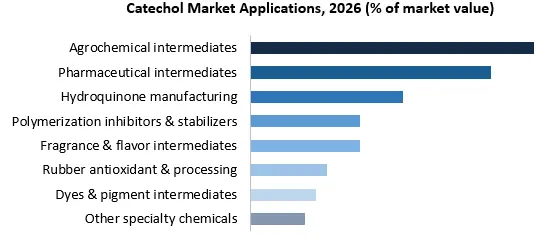
Agrochemical intermediates 26% and pharmaceutical intermediates 22% of 2026 demand |
Crop protection cycles and drug-intermediate approvals set volume and quality standards |
|
3 |
Asia Pacific is the largest region |
45% share in 2026; China, India and Japan host major producers and consumers |
Regional cost position and environmental enforcement set price benchmarks |
|
4 |
High-purity and pharma-intermediate grades outgrow industrial grade |
High-purity 7.1% and pharmaceutical intermediate grade 6.8% CAGR versus 4.7% for industrial grade |
Impurity control and oxidation stability become the margin engine |
|
5 |
Catalytic hydroxylation gains share |
Catalytic processes grow at 6.2% CAGR versus 5.6% for the market |
Selectivity, yield and waste reduction decide cost competitiveness |
|
6 |
Feedstock cost drives margins |
Benzene, phenol and hydrogen peroxide dominate the cost of production |
Backward integration and long-term contracts protect producers |
|
7 |
Supply is concentrated and prone to disruption |
A small group of producers supplies most traded volume; in 2018 plant issues and delayed new capacity tightened supply (GEP) |
Dual sourcing and inventory buffers reduce supply risk |
|
8 |
Regulation and ESG shape investment |
REACH, TSCA, GHS and wastewater rules apply; supplier safety data sheets list acute toxicity, mutagenicity and carcinogenicity hazard classes |
Compliance cost favors scaled, well-capitalized producers |
Global Catechol Market Dynamics: Growth Drivers, Restraints, Opportunities and Trends
Global Catechol Market Growth Drivers: Agrochemical Demand, Pharmaceutical Intermediates, Fine Chemical Synthesis and High-Purity Grades
The Global Catechol Market is supported by catechol’s role as a reactive chemical intermediate in several value chains that expand steadily. In agrochemicals, catechol is an intermediate for carbamate-type crop protection chemistry, including carbofuran phenol, so Catechol demand follows crop protection volumes and the need for food security. In pharmaceuticals, catechol and its derivatives are building blocks for active ingredients and intermediates, including catecholamine-type molecules, which links Catechol consumption to the growth of generic and branded drug manufacturing. Flavor and fragrance chemistry adds a third pillar, because catechol is a route to guaiacol, vanillin and heliotropin. Asia Pacific, which accounts for about 45% of 2026 value, benefits from integrated phenol supply, large agrochemical and pharmaceutical manufacturing bases and lower conversion cost. These market drivers and market growth factors show how end-use-led Catechol demand is expanding and how Catechol supply is scaling, with technological advancements and regulatory changes supporting industry evolution.
Quality and specification requirements add a second layer of demand. Pharmaceutical and agrochemical buyers increasingly specify high-purity catechol with tight impurity profiles, low moisture and good oxidation stability, because catechol darkens on exposure to air and trace contaminants carry into downstream synthesis. High-purity grade is projected to grow at 7.1% CAGR and pharmaceutical intermediate grade at 6.8%, ahead of industrial grade at 4.7%. Producers are also investing in catalytic hydroxylation, crystallization and purification technologies that raise selectivity and yield while cutting waste. Polymerization inhibitors, rubber antioxidant intermediates and dye intermediates provide steady additional volume, and pharmaceutical intermediate manufacturing is the fastest-growing application at 6.9% CAGR. Consumer preferences evolution, innovation in the industry and strong demand and supply dynamics are accelerating Catechol consumption across pharmaceutical, agrochemical and specialty chemical users.
Global Catechol Market Restraints: Feedstock Volatility, Environmental Compliance, Oxidation Sensitivity and Substitution Risk
Feedstock cost and supply concentration are the main restraints. Catechol is made mainly by hydroxylating phenol with hydrogen peroxide, a route that also yields hydroquinone, so Catechol supply depends on phenol and benzene prices, which move with crude oil, and on the product balance between the two diphenols. Few producers operate at scale, and outages, turnarounds or delayed capacity can tighten the market quickly, as happened in 2018 when problems at one European plant and delays at a new Indian plant coincided with maintenance at phenol units in Asia, according to GEP. Energy, electricity and natural gas costs and currency movements also affect plant economics and trade. These market constraints and market challenges, including bottlenecks in Catechol supply, create market volatility and slow market responsiveness.
Regulation, safety and substitution also limit growth. Catechol is a hazardous chemical: supplier safety data sheets list acute toxicity, skin and eye hazards, mutagenicity and carcinogenicity hazard classes, so producers and users must comply with GHS hazard communication, REACH registration in Europe, TSCA in the United States, OSHA workplace rules and dangerous-goods transport regulations. Wastewater from phenol hydroxylation and purification needs treatment, adding capital and operating cost, and stricter emission standards can curb capacity utilization in some regions. Catechol oxidizes and darkens in air, so storage, packaging and shelf-life management raise logistics costs. In some uses, alternative aromatic intermediates, antioxidants and stabilizer compounds, including hydroquinone-based products, can replace catechol where performance allows, which makes price competitiveness and application-specific substitution barriers important. Regulatory influences, external market influences and geopolitical influences remain key market constraints and industry disruptors.
What Are the Biggest Catechol Market Opportunities Through 2034?
High-purity grades, pharmaceutical intermediates and process innovation represent the most significant opportunities because they lift value per ton. High-purity catechol is projected to grow at 7.1% CAGR and pharmaceutical applications at 6.9%, as drug makers and fine chemical producers qualify suppliers on impurity profile and consistency. Catalytic hydroxylation, at 6.2% CAGR, offers better selectivity and lower waste, and producers that cut waste and energy per ton can win cost and ESG-driven contracts. Long-term supply agreements and distributor partnerships with technical support let producers lock in volume with pharmaceutical and agrochemical manufacturers, while online B2B chemical procurement platforms, the smallest channel today, are building reach among smaller buyers. These market opportunities and growth prospects, along with untapped market areas, strengthen long-term Catechol demand.
Regional expansion, backward integration and new applications offer further routes to growth. Asia Pacific is projected to be the fastest-growing region at 6.4% CAGR as China, India, Japan and South Korea expand agrochemical, pharmaceutical and fine chemical production, while Middle East & Africa (about 5.9%) and South America (about 5.2%) build import-dependent demand. Producers that integrate into phenol and hydrogen peroxide, or sign long-term raw material contracts, can protect margins from feedstock swings. Emerging catechol-based materials, including adhesives, coatings and polymer formulations that use catechol chemistry, and joint ventures, technology partnerships and contract manufacturing add further options. Emerging markets and unexplored market niches offer segment-specific opportunities and regionally-driven opportunities, helping producers strengthen market adaptability and refine market strategies.
Catechol Market Trends: High-Purity Demand, Catalytic Process Optimization, Sustainable Manufacturing and Supply Chain Regionalization
Four Catechol Market trends stand out through 2034. First, quality: buyers want consistent purity, low impurity profiles and oxidation stability, and the high-purity grade is growing at 7.1% CAGR. Second, process efficiency: catalytic hydroxylation, reaction optimization, process automation and better crystallization raise yield and cut waste. Third, sustainability: low-waste, energy-efficient production, wastewater treatment and ESG reporting are becoming requirements for supplying large pharmaceutical and agrochemical customers. Fourth, supply chain regionalization: buyers want secondary sources, regional inventories and long-term agreements to reduce exposure to single-plant outages and trade disruptions. Together these industry trends and technology trends reflect innovation impact, market shifts and strategic market changes across the market dynamics.
Global Catechol Market Segmentation: By Grade, Production Process, Application, End-Use Industry, Distribution Channel and Region
Catechol Market by End-Use Industry and Distribution Channel: Agrochemical, Pharmaceutical, Polymer and Specialty Chemical Demand
Grade, Production Process and Application Analysis of the Catechol Market
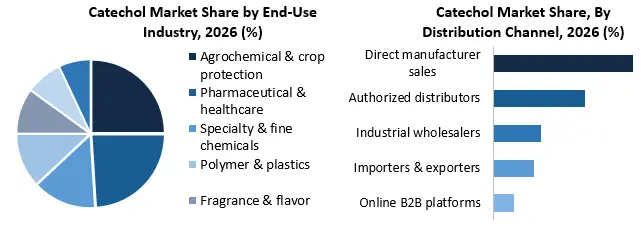
Industrial grade is the largest grade at about xx % of 2026 value, followed by high-purity grade at xx%, pharmaceutical intermediate grade at xx% and laboratory and analytical grade at xx%. By production process, phenol hydroxylation using hydrogen peroxide holds about xx %, catalytic hydroxylation processes xx% and alternative chemical synthesis routes xx%. By application, agrochemical intermediates lead at about xx%, followed by pharmaceutical intermediates at XX%, hydroquinone manufacturing at xx %, polymerization inhibitors and stabilizers and fragrance and flavor intermediates at xx % each, rubber antioxidant and processing chemicals at xx%, dyes and pigment intermediates at xx% and other specialty chemical applications at xx %. By end-use industry, agrochemical and crop protection holds about xx %, pharmaceutical and healthcare xx%, specialty and fine chemicals xx%, polymer and plastics xx%, fragrance and flavor xx%, rubber and elastomer xx% and textile and dye xx%. Direct manufacturer sales are the largest distribution channel at about xx%, followed by authorized chemical distributors at xx%, industrial chemical wholesalers at XX%, importers and exporters at xx% and online B2B procurement platforms at xx%. This segment analysis provides market share by segment, segment growth analysis, market subsegments and segment attractiveness, supporting industry segmentation, customer profiling and customized market strategies. Catechol market segment analysis also covers Catechol consumer demographics, behavioural segmentation, micro-segmentation and niche markets such as laboratory-grade and pharmaceutical-grade supply, with segment-specific trends and tailored marketing strategies.
Catechol Applications and Other Uses: Where Catechol Demand Sits
Global Catechol Market Regional Analysis: Asia Pacific, Europe, North America, South America and Middle East & Africa
Asia Pacific is the largest regional market, accounting for about 45% of global value in 2026, and is projected to grow at about 6.4% CAGR, the fastest of any region. China is the principal anchor through its phenol-to-diphenol production base and its agrochemical and fine chemical industries, while Japan, South Korea, Taiwan and India contribute through specialty chemical and pharmaceutical manufacturing; participants include UBE, Mitsui Chemicals, Sumitomo Chemical and Tokyo Chemical Industry in Japan, Camlin Fine Sciences, Loba Chemie, Sisco Research Laboratories and Central Drug House in India, and the Sanjili companies in China. Europe holds about 25% of 2026 value and is expected to grow at about 4.6% CAGR, supported by specialty chemical production, fragrance and pharmaceutical demand and the compliance-driven REACH framework, with participants such as Syensqo, Merck KGaA, Biosynth and Versalis. This regional market analysis highlights regional market trends, market performance by region, regional economic factors, local consumer behaviour and regional Catechol consumption.
North America holds about 19% of 2026 value and is projected to grow at about 4.8% CAGR, supported by pharmaceutical and agrochemical intermediate demand, research chemical supply and TSCA-regulated manufacturing and imports, with participants including Thermo Fisher Scientific (Alfa Aesar), Spectrum Chemical, Parchem and Eastman Chemical. South America, about 6% of 2026 value, is projected to grow at about 5.2% CAGR, led by Brazil, Argentina and Chile, where agrochemical demand is strong but specialty intermediates depend largely on imports. Middle East & Africa is the smallest region, about 5% of 2026 value, with growth of about 5.9% CAGR as Saudi Arabia, the United Arab Emirates, Turkey, Egypt and South Africa build chemical and agrochemical import demand. Regional market share, the regional competitive landscape and region-specific industry outlook vary by territory, with area-specific opportunities and local market entry strategies shaping regional Catechol demand and Catechol supply. Catechol geographic analysis, regional market segmentation and regional market development also show how local market influences, regional consumer patterns, local economic factors and geopolitical influences shape area-specific market dynamics.
Catechol Companies and Competitive Landscape: Who Are the Top Catechol Manufacturers and Suppliers?
The Catechol competitive landscape includes several distinct groups rather than a single set of rivals: established specialty chemical producers with phenol hydroxylation capacity, regional manufacturers in China and India, global catalog and fine chemical suppliers that sell laboratory and high-purity grades, and distributors and traders that move bulk volume. This competitor analysis, competitor benchmarking and competitor profiling frame company revenue, company net sales, competitive positioning and rival market share, and show how industry competition and market rivalry intensity differ between bulk and high-purity grades.
Competition is increasingly shaped by the ability to combine purity, process cost, secure feedstock and regulatory compliance. Leaders differentiate through catalytic process efficiency, impurity control, backward integration, long-term supply agreements and distributor networks, while regional producers compete on cost and local supply. This competitive strategy review and competitive advantage assessment also covers market player strategies, competitive landscape trends, competitive intelligence, competitive benchmark analysis and strategic analysis. Competitor evaluation, competitor differentiation and industry competition overview complete the picture of competitive market evolution.
Global Catechol Market Recent Developments, Supply Events and Industry News | 2018–2026
|
Date |
Development |
Why it matters |
|
2026 |
Syensqo completes the sale of its Oil & Gas unit in January 2026 and says the planned divestment of its Aroma business is progressing, with an update expected around end-Q2 2026 |
Signals continued portfolio reshaping among European specialty chemical suppliers |
|
2025–2026 |
Camlin Fine Sciences reports FY2025–26 results hit by US tariffs on aroma products and weak global demand; consolidated EBITDA falls to about INR 1.07 billion from about INR 2.16 billion |
Shows how trade and tariff shifts feed through to Indian diphenol, guaiacol and vanillin producers |
|
2026 |
Camlin Fine Sciences says its diphenol (hydroquinone and catechol) plant stayed shut in Apr–Jun 2026 as operating conditions were uneconomical; management expects performance chemicals to improve in the second half |
Idled diphenol capacity at a leading producer tightens supply options and highlights margin pressure from feedstock costs |
|
2026 |
Published catechol market estimates for 2026 range from about USD 160 Mn to USD 410 Mn across research houses |
Scope and definition differences make like-for-like benchmarking essential |
Global Catechol Market Scope: Inquire before buying
|
Global Catechol Market |
|||
|
Report Coverage |
Details |
||
|
Base Year: |
2026 |
Forecast Period: |
2027–2034 |
|
Historical Reference: |
2021–2026 |
Market Size in 2026: |
USD 180 Million |
|
CAGR (2027–2034): |
5.6% |
Market Size in 2034: |
USD 280 Million |
|
Market Size and Share: |
2026–2034 |
Market Value / Volume: |
USD Billion / Units in Million |
|
Segments Covered: |
By Grade |
Industrial Grade Catechol High-Purity Grade Catechol Pharmaceutical Intermediate Grade Catechol Laboratory and Analytical Grade Catechol |
|
|
By Production Process |
Phenol Hydroxylation Using Hydrogen Peroxide Catalytic Hydroxylation Processes Alternative Chemical Synthesis Processes |
||
|
By Application |
Hydroquinone Manufacturing Pharmaceutical Intermediate Manufacturing Agrochemical Intermediate Manufacturing Polymerization Inhibitors and Stabilizers Rubber Antioxidant and Processing Chemicals Dyes and Pigment Intermediates Fragrance and Flavor Intermediates Other Specialty Chemical Applications |
||
|
By End-Use Industry |
Pharmaceutical and Healthcare Industries Agrochemical and Crop Protection Industries Polymer and Plastics Industries Rubber and Elastomer Industries Textile and Dye Manufacturing Industries Fragrance and Flavor Industries Specialty and Fine Chemical Industries |
||
|
By Distribution Channel |
Direct Manufacturer Sales Authorized Chemical Distributors Industrial Chemical Wholesalers Importers and Exporters Online B2B Chemical Procurement Platforms |
||
Global Catechol Market, By Region
North America (United States, Canada, Mexico)
Europe (Germany, United Kingdom, France, Italy, Spain, Netherlands, Belgium, Switzerland, Poland, Rest of Europe)
Asia Pacific (China, India, Japan, South Korea, Taiwan, Australia, Indonesia, Thailand, Malaysia, Rest of Asia Pacific)
Middle East & Africa (Egypt, South Africa, Nigeria, Algeria, Morocco, Angola, Kenya, Ghana, Saudi Arabia, United Arab Emirates, Turkey, Rest of Middle East & Africa)
South America (Brazil, Argentina, Chile, Colombia, Rest of South America)
Global Catechol Market, Key Players
North America
- Thermo Fisher Scientific Inc. (Alfa Aesar)
- Spectrum Chemical Manufacturing Corp.
- Parchem Fine & Specialty Chemicals
- Eastman Chemical Company
- Avantor, Inc. (VWR)
- Alfa Chemistry
- Santa Cruz Biotechnology, Inc.
Others
Europe
- Syensqo (formerly Solvay SA)
- Merck KGaA (Sigma-Aldrich)
- Biosynth Ltd.
- Versalis S.p.A.
- Carl Roth GmbH + Co. KG
- Apollo Scientific Ltd.
- Fluorochem Ltd.
Others
Asia Pacific
- UBE Corporation
- Camlin Fine Sciences Ltd.
- Jiangsu Sanjili Chemical Co., Ltd.
- Lianyungang Sanjili Chemical Industry Co., Ltd.
- Mitsui Chemicals, Inc.
- Sumitomo Chemical Co., Ltd.
- Tokyo Chemical Industry Co., Ltd. (TCI)
- KANTO CHEMICAL CO., INC.
- Junsei Chemical Co., Ltd.
- Brother Enterprises Holding Co., Ltd.
- Haihang Industry Co., Ltd.
- Zhejiang Langhua Pharmaceutical Co., Ltd.
- Hubei Xiangyun (Group) Chemical Co., Ltd.
- Hubei Yuancheng Saichuang Technology Co., Ltd.
- Loba Chemie Pvt. Ltd.
- Sisco Research Laboratories Pvt. Ltd.
- Central Drug House (P) Ltd.
- Aadhunik Industries
- Hubei XinRunde Chemical Co., Ltd.
- YanCheng FengYang Chemical Co., Ltd.
- Shanghai Smart Chemicals Co., Ltd.
- Hangzhou J&H Chemical Co., Ltd.
- Nantong Liqing Chemical Co., Ltd.
- Fujifilm Wako Pure Chemical Corporation
- Nacalai Tesque, Inc.
- Otto Chemie Pvt. Ltd.
- Oxford Lab Fine Chem LLP
- J&K Scientific Ltd.
Others
Frequently Asked Questions
Asia Pacific holds the largest Catechol Market share at about 45% in 2026 and is also the fastest-growing region at about 6.4% CAGR through 2034, led by China, India and Japan. Europe follows at about 25% and North America at about 19%.
High-purity grade (7.1% CAGR) and pharmaceutical intermediate applications (6.9%) grow fastest, while industrial grade, the largest grade at about 58% of 2026 value, grows at 4.7%. By process, catalytic hydroxylation (6.2%) is gaining share over conventional phenol hydroxylation. Direct manufacturer sales are the largest distribution channel at about 41%.
Leading and notable participants include Syensqo (formerly Solvay), UBE Corporation, Camlin Fine Sciences and the Sanjili companies in China, alongside Mitsui Chemicals, Sumitomo Chemical, Versalis, Eastman Chemical, Merck KGaA, Thermo Fisher Scientific (Alfa Aesar) and Tokyo Chemical Industry, with suppliers such as Parchem and Spectrum Chemical serving distribution and research demand. Competition is shaped by process cost, purity, feedstock security and regulatory compliance.
Catechol (pyrocatechol, 1,2-dihydroxybenzene) is mainly made by hydroxylating phenol with hydrogen peroxide, a route that also yields hydroquinone, with catalytic hydroxylation improving selectivity. It is used as an intermediate for agrochemicals (such as carbofuran phenol), pharmaceutical ingredients and intermediates, and flavor and fragrance chemicals (guaiacol, vanillin, heliotropin), and as a polymerization inhibitor, rubber and dye intermediate and antioxidant.
1. Executive Market Landscape and Industry Overview
1.1. Global Catechol Market Size (Value USD Billion and Volume Units in Million), 2026–2034
1.2. Historical Development and Commercial Evolution of Catechol
1.3. Chemical Definition, Molecular Structure and Industrial Classification
1.4. Physical and Chemical Properties of Catechol
1.5. Role of Catechol as an Industrial Chemical Intermediate
1.6. Overview of Global Catechol Manufacturing and Consumption
1.7. Global Market Growth Outlook and CAGR Analysis, 2027–2034
2. Market Dynamics
2.1. Emerging Market Trends and Industry Developments
2.2. Market Dynamics Analysis
2.2.1. Growth Drivers
2.2.2. Market Restraints
2.2.3. Emerging Opportunities
2.2.4. Industry Challenges
2.3. Porter's Five Forces Analysis
2.4. PESTLE Analysis
3. Macroeconomic Factors and Industrial Economic Impact
3.1. Global Industrial Production and Specialty Chemical Manufacturing Trends
3.2. Impact of GDP Growth and Industrialization on Catechol Consumption
3.3. Crude Oil, Benzene and Phenol Price Fluctuations
3.4. Energy, Electricity and Natural Gas Costs in Chemical Manufacturing
3.5. Foreign Exchange Movements and International Chemical Trade
3.6. Inflation, Interest Rates and Chemical Manufacturing Investment
3.7. Government Expenditure and Industrial Infrastructure Development
3.8. Impact of Global Economic Slowdowns on Chemical Demand
3.9. Geopolitical Developments and International Chemical Supply Chain Disruptions
4. Industry Trends and Emerging Technology Requirements
4.1. Increasing Demand for High-Purity Catechol in Specialty Chemical Manufacturing
4.2. Growing Consumption in Pharmaceutical and Agrochemical Intermediates
4.3. Expansion of Catechol-Based Antioxidant and Polymer Applications
4.4. Increasing Focus on Production Efficiency and Process Optimization
4.5. Adoption of Sustainable Chemical Manufacturing Technologies
4.6. Development of Low-Waste and Energy-Efficient Production Processes
4.7. Increasing Demand for Consistent Chemical Quality and Purity
5. Chemical Properties, Raw Materials and Industrial Ecosystem
5.1. Molecular Structure, Chemical Formula and CAS Classification
5.2. Physical Properties, Appearance, Solubility and Melting Characteristics
5.3. Chemical Reactivity and Oxidation Characteristics
5.4. Benzene and Phenol-Based Raw Material Requirements
5.5. Hydrogen Peroxide and Other Process Chemical Requirements
5.6. Catalysts, Solvents and Auxiliary Chemical Inputs
5.7. Raw Material Quality, Specifications and Industrial Procurement
6. Catechol Manufacturing Technologies and Production Processes
6.1. Phenol Hydroxylation Using Hydrogen Peroxide
6.2. Catalytic Hydroxylation and Reaction Optimization
6.3. Alternative Chemical Synthesis and Manufacturing Routes
6.4. Reaction Temperature, Pressure and Catalyst Requirements
6.5. Product Separation, Purification and Crystallization Technologies
6.6. Industrial Process Automation and Production Efficiency
6.7. Manufacturing Yield, Waste Reduction and Process Economics
7. Product Grades, Purity and Quality Specifications
7.1. Industrial Grade Catechol and Commercial Specifications
7.2. High-Purity Catechol for Specialty Chemical Applications
7.3. Pharmaceutical Intermediate Grade Catechol
7.4. Laboratory and Analytical Grade Catechol
7.5. Technical Specifications and Chemical Purity Requirements
7.6. Impurity Profiles, Moisture Content and Oxidation Stability
7.7. Product Packaging, Storage and Shelf-Life Requirements
8. Catechol Manufacturing Infrastructure and Production Capacity Landscape
8.1. Global Catechol Manufacturing Facilities and Industrial Locations
8.2. Installed Production Capacity by Country and Region (MT)
8.3. Actual Production Output and Capacity Utilization Rates
8.4. New Manufacturing Facilities and Capacity Expansion Projects
8.5. Production Technology and Plant-Level Operational Efficiency
8.6. Contract Manufacturing and Third-Party Production Facilities
8.7. Production Bottlenecks and Capacity Constraints
9. Global Catechol Supply and Demand Analysis
9.1. Global Catechol Production Volume (Units in Million), 2021–2034
9.2. Global Catechol Consumption Volume (Units in Million), 2021–2034
9.3. Global Installed Capacity Versus Actual Production
9.4. Regional Supply and Demand Distribution
9.5. Demand–Supply Gap and Market Balancing Analysis
9.6. Production Surplus and Deficit Across Key Countries
9.7. Inventory Levels, Stock Availability and Procurement Trends
9.8. Future Supply–Demand Outlook, 2027–2034
10. Raw Material Sourcing and Procurement Landscape
10.1. Benzene and Phenol Sourcing and Availability
10.2. Hydrogen Peroxide Procurement and Supply Conditions
10.3. Catalyst Availability and Supplier Landscape
10.4. Raw Material Price Trends and Procurement Economics
10.5. Domestic and International Raw Material Sourcing
10.6. Supplier Concentration and Procurement Risk Assessment
10.7. Long-Term Raw Material Contracts and Strategic Sourcing
11. Catechol Applications in Chemical Intermediate Manufacturing
11.1. Hydroquinone Manufacturing and Chemical Conversion Applications
11.2. Guaiacol and Related Aromatic Chemical Intermediate Production
11.3. Pharmaceutical Active Ingredient and Intermediate Synthesis
11.4. Agrochemical Intermediate and Pesticide Manufacturing
11.5. Specialty Chemical and Fine Chemical Manufacturing
11.6. Dyes, Pigments and Colorant Intermediate Production
11.7. Other Catechol-Derived Chemical Manufacturing Applications
12. Applications in Polymer, Rubber and Industrial Formulations
12.1. Polymerization Inhibitor and Stabilizer Applications
12.2. Rubber Processing and Antioxidant Intermediate Applications
12.3. Industrial Resin and Specialty Polymer Formulations
12.4. Chemical Stabilization and Oxidation Control Applications
12.5. Adhesive and Specialty Coating Formulations
12.6. Industrial Chemical Additive Manufacturing
12.7. Emerging Catechol-Based Material Applications
13. Pharmaceutical, Agrochemical and Specialty Chemical Applications
13.1. Pharmaceutical Intermediate Synthesis and Chemical Processing
13.2. Pesticide and Crop Protection Chemical Manufacturing
13.3. Fungicide and Insecticide Intermediate Applications
13.4. Fragrance and Flavor Chemical Intermediate Production
13.5. Antioxidant and Specialty Organic Chemical Manufacturing
13.6. Fine Chemical Synthesis and Custom Chemical Formulations
13.7. Research and Development Applications in Organic Chemistry
14. Catechol End-Use Industry Landscape
14.1. Pharmaceutical and Healthcare Chemical Industries
14.2. Agrochemical and Crop Protection Industries
14.3. Polymer and Plastics Manufacturing Industries
14.4. Rubber and Elastomer Manufacturing Industries
14.5. Dyes, Pigments and Textile Chemical Industries
14.6. Fragrance and Flavor Manufacturing Industries
14.7. Specialty and Fine Chemical Manufacturing Industries
15. Catechol Pricing, Cost Structure and Business Economics
15.1. Global Catechol Price Trends by Grade and Purity
15.2. Regional Price Variations and Market Differentials
15.3. Raw Material Cost Contribution to Manufacturing Economics
15.4. Energy, Utilities and Chemical Processing Costs
15.5. Manufacturing, Packaging and Logistics Expenditure
15.6. Producer Margins and Industrial Pricing Strategies
15.7. Cost Competitiveness and Long-Term Price Outlook
16. Global Import–Export Trade and International Trade Flows
16.1. Global Catechol Import Volume and Export Volume (Units in Million)
16.2. Export Revenue and Import Expenditure Analysis (USD Billion)
16.3. Major Catechol Exporting Countries and Supplier Markets
16.4. Major Catechol Importing Countries and Consumption Markets
16.5. Regional Trade Flows and International Supply Dependencies
16.6. Trade Balance and Cross-Border Chemical Distribution
16.7. Import Tariffs, Customs Duties and Trade Restrictions
16.8. International Trade Agreements and Chemical Market Access
16.9. Import–Export Outlook and Future Trade Opportunities
17. Distribution Network, Sales and Procurement Landscape
17.1. Direct Sales Through Catechol Manufacturers
17.2. Authorized Chemical Distributors and Trading Companies
17.3. Industrial Chemical Wholesalers and Specialty Suppliers
17.4. Importers, Exporters and Regional Trading Networks
17.5. Online Chemical Procurement and B2B Distribution Platforms
17.6. Direct Procurement by Pharmaceutical and Agrochemical Manufacturers
17.7. Distributor Partnerships, Warehousing and Technical Support
18. Supply Chain, Logistics and Operational Ecosystem
18.1. Upstream Raw Material Sourcing and Supplier Networks
18.2. Catechol Manufacturing and Processing Operations
18.3. Bulk Chemical Storage and Industrial Warehousing
18.4. Packaging, Handling and Transportation Requirements
18.5. Domestic Chemical Distribution and International Shipping
18.6. Inventory Management and Supply Chain Resilience
18.7. Supply Chain Risks and Operational Continuity Planning
19. Storage, Packaging and Chemical Handling Requirements
19.1. Commercial Packaging Formats and Container Specifications
19.2. Catechol Storage Conditions and Temperature Management
19.3. Oxidation Prevention and Product Stability Management
19.4. Industrial Handling and Occupational Safety Requirements
19.5. Transportation Safety and Chemical Compatibility
19.6. Shelf-Life Management and Quality Preservation
19.7. Chemical Waste Handling and Disposal Requirements
20. Technology Innovation, R&D and Product Development
20.1. Advancements in Catalytic Phenol Hydroxylation Technologies
20.2. Development of High-Selectivity and High-Yield Production Processes
20.3. Catalyst Innovation and Reaction Efficiency Improvements
20.4. Advanced Separation and Purification Technologies
20.5. Process Automation and Digital Manufacturing Integration
20.6. Sustainable Production and Waste Minimization Technologies
20.7. R&D Investments, Patents and Technology Collaborations
21. Sustainability, Environmental Impact and ESG Analysis
21.1. Environmental Impact of Catechol Manufacturing Processes
21.2. Energy Consumption and Industrial Carbon Emissions
21.3. Wastewater Treatment and Chemical Effluent Management
21.4. Hazardous Waste Reduction and Responsible Disposal
21.5. Sustainable Raw Material Sourcing and Resource Efficiency
21.6. Occupational Health, Safety and Environmental Management
21.7. ESG Investments and Sustainable Chemical Manufacturing Practices
22. Regulatory, Quality and Chemical Safety Framework
22.1. Global Chemical Manufacturing and Registration Requirements
22.2. REACH Regulations and Chemical Registration in Europe
22.3. US EPA Requirements and TSCA Chemical Compliance
22.4. GHS Chemical Classification and Hazard Communication
22.5. OSHA Requirements and Industrial Workplace Safety
22.6. Chemical Transportation and Hazardous Material Regulations
22.7. Environmental Emission, Wastewater and Disposal Standards
22.8. ISO Quality Management and Chemical Manufacturing Standards
22.9. Regional Chemical Import, Export and Registration Requirements
23. Market Adoption, Industrial Consumption and Customer Economics
23.1. Catechol Adoption Across Major Industrial Applications
23.2. Industrial Consumption Volume by End-Use Industry (Units in Million)
23.3. Bulk Procurement and Long-Term Supply Agreements
23.4. Customer Purchasing Behaviour and Supplier Selection
23.5. Product Quality, Purity and Technical Specification Preferences
23.6. Supplier Retention and Repeat Procurement Trends
23.7. Customer Switching Costs and Alternative Chemical Considerations
24. Investment Landscape, Capacity Expansion and Growth Opportunities
24.1. Global Investments in Specialty Chemical Manufacturing
24.2. New Catechol Production Facilities and Capacity Expansion
24.3. Investment in Advanced Manufacturing Technologies
24.4. Strategic Investments in Raw Material and Supply Chain Integration
24.5. Foreign Direct Investment in Emerging Chemical Manufacturing Markets
24.6. Joint Ventures, Technology Partnerships and Contract Manufacturing
24.7. Investment Opportunities Across Emerging Regional Markets
25. Alternative Chemicals, Substitution and Competitive Material Analysis
25.1. Availability of Alternative Aromatic Chemical Intermediates
25.2. Chemical Substitution in Hydroquinone Manufacturing
25.3. Alternative Antioxidants and Stabilizer Compounds
25.4. Comparative Performance and Functional Properties
25.5. Price Competitiveness and Industrial Substitution Economics
25.6. Technical Limitations and Application-Specific Substitution Barriers
25.7. Impact of Alternative Chemicals on Long-Term Catechol Demand
26. Regional and Country-Level Market Landscape
26.1. North American Chemical Manufacturing and Catechol Consumption Landscape
26.2. European Specialty Chemical Production and Industrial Demand
26.3. Asia Pacific Catechol Manufacturing and Consumption Landscape
26.4. Middle East & Africa Chemical Import Dependency and Emerging Demand
26.5. South American Specialty Chemical Industry and Market Opportunities
26.6. Country-Level Production, Consumption and Trade Analysis
26.7. Regional Manufacturing Investments and Industrial Development Trends
27. Market Size and Forecast by Segmentation (Value USD Billion and Volume Units in Million), 2026–2034
27.1. Market Size and Forecast, By Grade
27.1.1. Industrial Grade Catechol
27.1.2. High-Purity Grade Catechol
27.1.3. Pharmaceutical Intermediate Grade Catechol
27.1.4. Laboratory and Analytical Grade Catechol
27.2. Market Size and Forecast, By Production Process
27.2.1. Phenol Hydroxylation Using Hydrogen Peroxide
27.2.2. Catalytic Hydroxylation Processes
27.2.3. Alternative Chemical Synthesis Processes
27.3. Market Size and Forecast, By Application
27.3.1. Hydroquinone Manufacturing
27.3.2. Pharmaceutical Intermediate Manufacturing
27.3.3. Agrochemical Intermediate Manufacturing
27.3.4. Polymerization Inhibitors and Stabilizers
27.3.5. Rubber Antioxidant and Processing Chemicals
27.3.6. Dyes and Pigment Intermediates
27.3.7. Fragrance and Flavor Intermediates
27.3.8. Other Specialty Chemical Applications
27.4. Market Size and Forecast, By End-Use Industry
27.4.1. Pharmaceutical and Healthcare Industries
27.4.2. Agrochemical and Crop Protection Industries
27.4.3. Polymer and Plastics Industries
27.4.4. Rubber and Elastomer Industries
27.4.5. Textile and Dye Manufacturing Industries
27.4.6. Fragrance and Flavor Industries
27.4.7. Specialty and Fine Chemical Industries
27.5. Market Size and Forecast, By Distribution Channel
27.5.1. Direct Manufacturer Sales
27.5.2. Authorized Chemical Distributors
27.5.3. Industrial Chemical Wholesalers
27.5.4. Importers and Exporters
27.5.5. Online B2B Chemical Procurement Platforms
27.6. Market Size and Forecast, By Region
27.6.1. North America
- United States
- Canada
- Mexico
27.6.2. Europe
- Germany
- United Kingdom
- France
- Italy
- Spain
- Netherlands
- Belgium
- Switzerland
- Poland
- Rest of Europe
27.6.3. Asia Pacific
- China
- India
- Japan
- South Korea
- Taiwan
- Australia
- Indonesia
- Thailand
- Malaysia
- Rest of Asia Pacific
27.6.4. Middle East & Africa
- Egypt
- South Africa
- Nigeria
- Algeria
- Morocco
- Angola
- Kenya
- Ghana
- Saudi Arabia
- United Arab Emirates
- Turkey
- Rest of Middle East & Africa
27.6.5. South America
- Brazil
- Argentina
- Chile
- Colombia
- Rest of South America
28. Competitive Landscape and Market Positioning
28.1. SMR Competition Matrix
28.2. Competitive Positioning of Leading Catechol Manufacturers
28.3. Global Market Share and Revenue Benchmarking
28.4. Key Player Benchmarking
28.4.1. Company Name
28.4.2. Headquarters and Geographical Presence
28.4.3. Catechol Product Portfolio
28.4.4. Manufacturing Facilities and Production Capacity
28.4.5. Production Technologies and Process Capabilities
28.4.6. Product Grades and Purity Specifications
28.4.7. Application and End-Use Industry Portfolio
28.4.8. Total Company Revenue (2025–2026)
28.4.9. Catechol-Related Revenue, Where Available
28.4.10. Distribution and International Trade Network
28.4.11. Strategic Partnerships and Collaborations
28.5. Market Structure and Competitive Concentration
28.5.1. Established Market Leaders
28.5.2. Regional Catechol Manufacturers
28.5.3. Specialty Chemical Suppliers
28.5.4. Emerging Chemical Market Participants
28.6. Company Revenue Growth and Financial Performance
28.7. Profitability and Operating Margin Analysis
28.8. R&D Expenditure and Manufacturing Investments
28.9. Revenue Versus Net Earnings – Financial Benchmarking
28.10. Mergers, Acquisitions and Strategic Collaborations
28.11. Recent Product Launches and Capacity Expansion Developments
29. Catechol Manufacturing Companies and Production Facilities Landscape
29.1. Global Catechol Production Facility Mapping
29.2. Industrial Catechol Manufacturing Companies
29.3. Production Capacity Benchmarking by Manufacturer (MT)
29.4. Manufacturing Technology and Production Process Comparison
29.5. Production Quality, Purity and Yield Benchmarking
29.6. Domestic Manufacturing Versus Imported Product Availability
29.7. Contract Manufacturing and Third-Party Production Providers
30. Raw Material Suppliers and Chemical Input Providers
30.1. Benzene and Phenol Raw Material Suppliers
30.2. Hydrogen Peroxide Manufacturers and Suppliers
30.3. Industrial Catalyst Manufacturers and Suppliers
30.4. Specialty Chemical and Solvent Suppliers
30.5. Raw Material Quality and Price Benchmarking
30.6. Supplier Geographic Presence and Procurement Networks
30.7. Strategic Raw Material Sourcing Partnerships
31. Catechol Distribution, Importers and Exporters Landscape
31.1. Global Catechol Exporters and International Suppliers
31.2. Regional Importers and Chemical Trading Companies
31.3. Authorized Industrial Chemical Distributors
31.4. Bulk Chemical Wholesalers and Procurement Networks
31.5. Import–Export Volume and Trade Performance Benchmarking
31.6. Distribution Coverage and Regional Market Penetration
31.7. Logistics Partnerships and International Supply Arrangements
32. Manufacturers' Business Strategies and Expansion Plans
32.1. Expansion of Catechol Production Capacity
32.2. Development of High-Purity Product Portfolios
32.3. Investment in Advanced Chemical Manufacturing Technologies
32.4. Backward Integration and Raw Material Security Strategies
32.5. Expansion into Pharmaceutical and Agrochemical Applications
32.6. Geographic Expansion Across Emerging Chemical Markets
32.7. Strategic Partnerships and Long-Term Supply Agreements
32.8. Mergers, Acquisitions and Business Diversification
33. Industry SWOT, Investment and Strategic Developments
33.1. Strengths of Established Catechol Manufacturing Businesses
33.2. Production Costs and Raw Material Dependency Challenges
33.3. Emerging Opportunities in Specialty Chemical Applications
33.4. Competitive Threats from Alternative Chemical Compounds
33.5. Investments in Production Capacity and Process Innovation
33.6. Sustainability Investments and Environmental Compliance
33.7. Major Industry Developments and Strategic Collaborations
34. Competitive Outlook and Long-Term Market Positioning
34.1. Competitive Dynamics Across Global Catechol Suppliers
34.2. Market Concentration and Manufacturer Positioning
34.3. Competitive Differentiation Through Product Purity and Quality
34.4. Production Capacity and Cost Competitiveness Comparison
34.5. International Distribution and Supply Network Expansion
34.6. Emerging Applications and Future Demand Opportunities
34.7. Long-Term Competitive Positioning of Leading Manufacturers
35. Company Profiles: Key Catechol Manufacturers and Industry Participants
Detailed Company Profiles Considering the Following Parameters:
- Company Overview
- Establishment Year
- Headquarters
- Company Type
- Employee Strength
- Business Portfolio
- Catechol Product Portfolio
- Manufacturing and Production Capabilities
- Installed Production Capacity (MT), Where Available
- Production Technology
- Raw Material Sourcing Strategy
- Geographic Presence
- Distribution and Supply Chain Network
- Financial Overview
- SWOT Analysis
- Strategic Analysis
- Recent Developments and Expansion Plans
Regional Classification of Key Players
North America
- Thermo Fisher Scientific Inc. (Alfa Aesar)
- Spectrum Chemical Manufacturing Corp.
- Parchem Fine & Specialty Chemicals
- Eastman Chemical Company
- Avantor, Inc. (VWR)
- Alfa Chemistry
- Santa Cruz Biotechnology, Inc.
Europe
- Syensqo (formerly Solvay SA)
- Merck KGaA (Sigma-Aldrich)
- Biosynth Ltd.
- Versalis S.p.A.
- Carl Roth GmbH + Co. KG
- Apollo Scientific Ltd.
- Fluorochem Ltd.
Asia Pacific
- UBE Corporation
- Camlin Fine Sciences Ltd.
- Jiangsu Sanjili Chemical Co., Ltd.
- Lianyungang Sanjili Chemical Industry Co., Ltd.
- Mitsui Chemicals, Inc.
- Sumitomo Chemical Co., Ltd.
- Tokyo Chemical Industry Co., Ltd. (TCI)
- KANTO CHEMICAL CO., INC.
- Junsei Chemical Co., Ltd.
- Brother Enterprises Holding Co., Ltd.
- Haihang Industry Co., Ltd.
- Zhejiang Langhua Pharmaceutical Co., Ltd.
- Hubei Xiangyun (Group) Chemical Co., Ltd.
- Hubei Yuancheng Saichuang Technology Co., Ltd.
- Loba Chemie Pvt. Ltd.
- Sisco Research Laboratories Pvt. Ltd.
- Central Drug House (P) Ltd.
- Aadhunik Industries
- Hubei XinRunde Chemical Co., Ltd.
- YanCheng FengYang Chemical Co., Ltd.
- Shanghai Smart Chemicals Co., Ltd.
- Hangzhou J&H Chemical Co., Ltd.
- Nantong Liqing Chemical Co., Ltd.
- Fujifilm Wako Pure Chemical Corporation
- Nacalai Tesque, Inc.
- Otto Chemie Pvt. Ltd.
- Oxford Lab Fine Chem LLP
- J&K Scientific Ltd.
36. Key Findings
37. Strategic Recommendations and Industry Outlook
38. Research Methodology