ENG
 Japanese
 French
 German
 Korean

Global Potassium Benzoate Market & Forecast 2026 - 2034
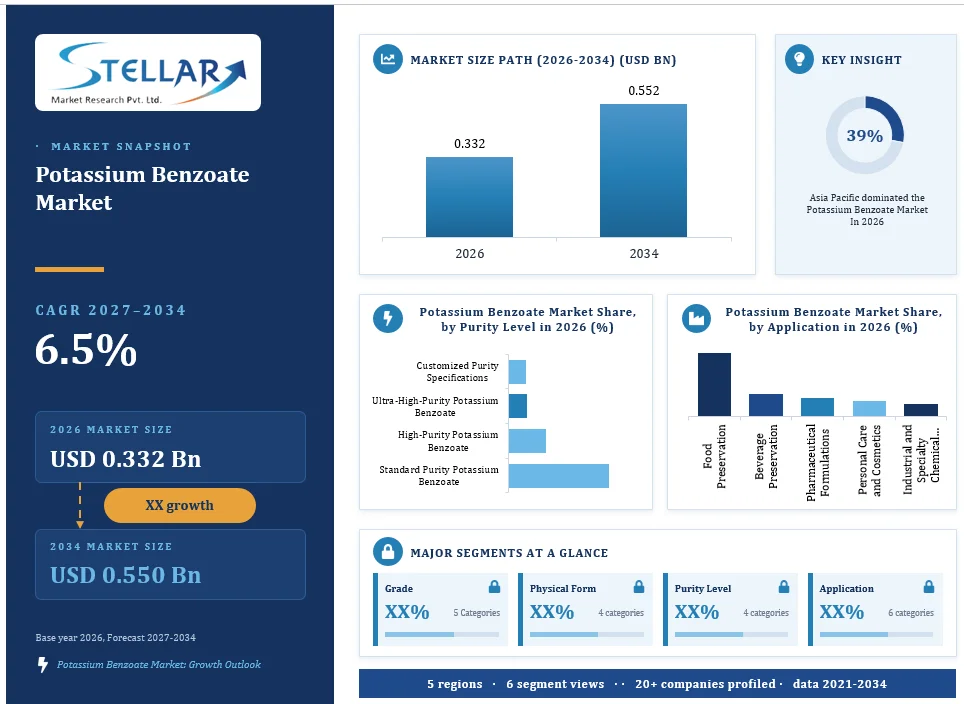
The Global Potassium Benzoate Market was valued at USD 332 million in 2026 and is projected to reach USD 550 million by 2034, growing at a CAGR of 6.5% during 2027–2034
The Global Potassium Benzoate Market was valued at USD 332 million in 2026 and is projected to reach USD 550 million by 2034, growing at a CAGR of 6.5% during 2027–2034, according to Stellar Market Research (SMR). Potassium Benzoate (E212, CAS 582-25-2) is the potassium salt of benzoic acid, a water-soluble white powder that inhibits yeasts, molds and some bacteria in acidic products, and it is widely used as a low-sodium alternative to sodium benzoate in beverages, sauces, pharmaceutical syrups and personal care formulations. This Potassium Benzoate Market overview and Potassium Benzoate Market synopsis summarizes the Potassium Benzoate Market size, Potassium Benzoate revenue generated, Potassium Benzoate growth prospects and Potassium Benzoate Market outlook, based on SMR's Potassium Benzoate Market research findings.
This Potassium Benzoate Market analysis answers both sides of the search: what the Potassium Benzoate Market size and Potassium Benzoate Market forecast mean for producers, distributors and investors, and what food technologists, beverage formulators and procurement teams want to know, from how Potassium Benzoate food preservative systems work to E212 regulation, pH effectiveness, food grade versus pharmaceutical grade specifications and Potassium Benzoate price trends. The Potassium Benzoate Market insights also cover Potassium Benzoate demand, Potassium Benzoate supply and Potassium Benzoate consumption patterns, along with Potassium Benzoate consumer demographics, Potassium Benzoate consumer behaviour and Potassium Benzoate industry trends.
Food and beverage manufacturers anchor the Potassium Benzoate Market and food grade material is the largest grade, but Potassium Benzoate Market growth is shifting toward high-purity and pharmaceutical grades, online and distributor channels and the Middle East & Africa as processed food and ready-to-drink beverage output expands and as sodium reduction pushes formulators toward potassium-based preservatives. The Potassium Benzoate industry landscape is shaped by Potassium Benzoate growth drivers, Potassium Benzoate Market dynamics, Potassium Benzoate Market challenges and Potassium Benzoate Market opportunities that influence Potassium Benzoate demand and Potassium Benzoate supply.
Stellar Market Research provides comprehensive analysis of global Potassium Benzoate Market size, share, grade, physical form, purity level, application, end-use industry, distribution channel, packaging type, customer type and regional segmentation, the Potassium Benzoate competitive landscape, strategic scenarios and growth opportunities. The report helps Potassium Benzoate manufacturers and Potassium Benzoate suppliers, benzoic acid and potassium hydroxide suppliers, food ingredient distributors, beverage and pharmaceutical formulators, contract manufacturers and investors decide which segments, channels and countries to prioritize through 2034. Potassium Benzoate Market segmentation and Potassium Benzoate segment analysis, including target market analysis, Potassium Benzoate product segmentation and Potassium Benzoate geographic segmentation, support Potassium Benzoate Market strategies and Potassium Benzoate Market entry decisions for Potassium Benzoate key players.
|
2026 | BASE YEAR |
2034 | FORECAST |
GROWTH RATE |
LARGEST REGION |
|
USD 332 Mn |
USD 550 Mn |
6.5% |
Asia Pacific |
Global Potassium Benzoate Market Overview: Potassium Benzoate Market Size, Share, Trends and Outlook to 2034
The market is measured at product level across Potassium Benzoate sold as food grade, pharmaceutical grade, industrial grade, high-purity and other specialized grades, in powder, granular and fine powder forms, supplied worldwide to food processing, beverage, pharmaceutical, personal care and specialty chemical customers. Volume is estimated at about 146 kilotons (kt) in 2026, implying an average realization of roughly USD 2,270 per ton. Revenue from sodium benzoate, benzoic acid and other benzoate salts sold on their own is excluded; Potassium Benzoate is counted only where it is sold as the potassium salt. This Potassium Benzoate Market summary also reflects the Potassium Benzoate economic factors, Potassium Benzoate macroeconomic factors, Potassium Benzoate technological advancements and Potassium Benzoate regulatory influences that determine Potassium Benzoate consumption across emerging markets.
Three shifts shape 2027–2034: demand is broadening from carbonated soft drinks and sauces into pharmaceutical syrups, personal care and specialty formulations; value is moving toward high-purity, application-specific grades and distributor-led and online procurement; and growth is rotating toward Asia Pacific and the Middle East & Africa. Producers are answering raw-material volatility and trade friction with integrated benzoic acid supply, regional production and tighter quality control. These Potassium Benzoate Market shifts and Potassium Benzoate emerging trends highlight Potassium Benzoate industry evolution, growth catalysts and Potassium Benzoate competitive forces across the industry.
To get more Insights: Request Free Sample Report
Key Findings: Eight Insights Shaping the Global Potassium Benzoate Market
SMR's analysis of published market data, company announcements, regulatory filings and industry reports points to eight findings that explain where Potassium Benzoate Market growth and value are created through 2034. This Potassium Benzoate Market trends analysis also identifies growth catalysts, the Potassium Benzoate Market gap and the Potassium Benzoate competitive landscape shifts affecting key players.
|
Sr.No. |
Findings |
Evidence |
So what |
|
1 |
The market grows about 1.7× by 2034 |
USD 332 Mn (2026) to USD 550 Mn (2034) at 6.5% CAGR; volume about 146 kt to 221 kt |
Benzoic acid supply, neutralization and packaging capacity must scale about 1.5× by 2034 |
|
2 |
Food and beverage is the anchor buyer |
Food and beverage preservation 67% of 2026 value; large food and beverage manufacturers 41% of customers |
Preservation performance in acidic products and sodium reduction set specification trends |
|
3 |
Asia Pacific is the largest region |
39% share in 2026; China hosts the largest cluster of benzoate producers |
Chinese export pricing and capacity decisions shape global Potassium Benzoate supply and price |
|
4 |
Middle East & Africa is the fastest-growing region |
7.9% CAGR; Egypt, South Africa, Nigeria, Algeria, Morocco, Angola, Kenya and Ghana depend on imports |
Distributor networks and local blending decide share gains |
|
5 |
High-purity and pharmaceutical grades outgrow |
High-purity 8.3% and pharmaceutical grade 7.6% CAGR versus 6.5% for the market |
Tighter assay, impurity and traceability standards become the margin engine |
|
6 |
Supply is concentrated and feedstock-linked |
Benzoic acid feedstock; LANXESS acquired Emerald Kalama in Aug 2021; EU provisional duties on Chinese sodium benzoate from 29 Jul 2026 |
Trade measures on related benzoates can redirect volumes and prices |
|
7 |
Low-sodium positioning is the core differentiator |
Sodium benzoate is the larger benzoate; Potassium Benzoate is positioned for low-sodium drinks and foods |
Reformulation away from sodium supports demand for potassium salts |
|
8 |
Regulation is stable but under watch |
EFSA re-evaluated E210–E213 in 2016 (group ADI 5 mg/kg bw); JECFA reviewed benzoates in 2021 |
Maximum permitted levels and benzene-formation controls shape formulation |
Global Potassium Benzoate Market Dynamics: Growth Drivers, Restraints, Opportunities and Trends
Global Potassium Benzoate Market Growth Drivers: Packaged Food Growth, Beverage Preservation, Sodium Reduction and Shelf-Life Extension
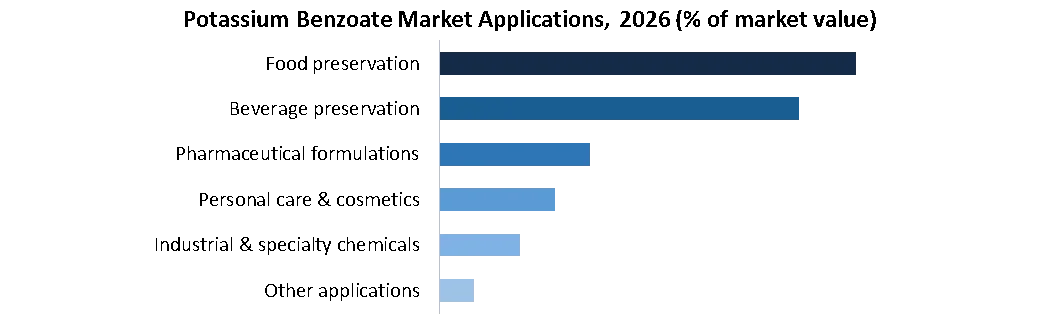
The Global Potassium Benzoate Market is supported by the steady expansion of packaged food and beverage output and by the need to control spoilage in acidic products. Potassium Benzoate is most effective below about pH 4.5, where it converts to undissociated benzoic acid and inhibits yeasts, molds and some bacteria, which suits carbonated soft drinks, fruit juices, flavoured waters, sauces, pickles, dressings, jams and syrups. Because it is highly water-soluble and contributes potassium rather than sodium, it is a practical choice for formulators who need preservation without raising sodium content. Food and beverage preservation account for about 67% of 2026 value, and large-scale food and beverage manufacturers are the largest customer group at about 41%, which gives producers a stable, repeat-purchase base. These Potassium Benzoate Market drivers and Potassium Benzoate Market growth factors show how Potassium Benzoate demand is expanding with urbanization and packaged food consumption, how Potassium Benzoate supply from integrated benzoic acid producers is scaling, and how Potassium Benzoate consumer behaviour trends, economic factors and regulatory influences support Potassium Benzoate industry evolution.
Pharmaceutical, personal care and specialty uses add a second layer of demand. Oral liquid medicines, syrups and aqueous formulations need preservative systems that remain stable and compatible with active ingredients, and personal care manufacturers use benzoates in shampoos, lotions and liquid cleansers, including paraben-free preservative systems. Pharmaceutical grade is projected to grow at 7.6% CAGR and high-purity grades at 8.3%, as buyers demand tighter assay, heavy-metal and microbial specifications and fuller batch traceability. Rising processed-food consumption in Asia Pacific and the Middle East & Africa, expansion of ready-to-drink beverage lines, and the shift of formulators toward lower-sodium recipes reinforce volumes, while distributor-led and online procurement make small-lot purchasing easier for small and medium-scale manufacturers. Potassium Benzoate technological advancements in crystallization, particle size control and analytics, together with Potassium Benzoate innovation in the industry, are accelerating Potassium Benzoate consumption across food, beverage, pharmaceutical and personal care users.
Global Potassium Benzoate Market Restraints: Raw Material Volatility, Alternative Preservatives, Regulatory Scrutiny and Trade Friction
Raw-material cost volatility and competition from alternative preservatives are the main restraints. Potassium Benzoate is made by neutralizing benzoic acid, itself produced by toluene oxidation, with potassium hydroxide, so toluene, benzoic acid, energy and potassium hydroxide prices pass directly into production cost. Sodium benzoate is the larger and cheaper benzoate, and potassium sorbate, natamycin, organic acid blends and clean-label natural antimicrobials compete for the same preservation tasks. Benzoates are also less effective above pH 4.5, which limits use in neutral products. Price spikes in related benzoates, such as the reported 20.5% month-on-month rise in US sodium benzoate prices in April 2026, show how quickly tight Asian export availability and feedstock costs can reach buyers. These Potassium Benzoate Market constraints and Potassium Benzoate Market challenges, including bottlenecks in Potassium Benzoate supply, create Potassium Benzoate industry fluctuations and slow market responsiveness.
Regulation, safety perception and trade policy also limit growth. EFSA re-evaluated benzoic acid and benzoates (E210–E213) in 2016 and set a group acceptable daily intake of 5 mg/kg body weight, while JECFA's 2021 review reached a higher group ADI of 0–20 mg/kg; differences between jurisdictions, category-specific maximum permitted levels and labeling rules raise compliance cost. Consumer demand for clean-label products, concern about benzene formation when benzoates are combined with ascorbic acid in beverages, and scrutiny of preservative exposure among children encourage reformulation. In the United States, the direct-food status of Potassium Benzoate is less explicitly codified than that of sodium benzoate, so buyers rely on food-grade (FCC) specifications and supplier compliance documentation. On trade, the European Commission's provisional anti-dumping duties on Chinese sodium benzoate from 29 July 2026 show that benzoate supply chains are exposed to duties, freight and currency swings. Potassium Benzoate regulatory influences, Potassium Benzoate environmental factors, external market influences and Potassium Benzoate industry disruptors remain key market constraints.
What Are the Biggest Potassium Benzoate Market Opportunities Through 2034?
High-purity and application-specific grades, low-sodium reformulation and digital procurement represent the most significant opportunities because they lift price realization beyond commodity food-grade sales. High-purity Potassium Benzoate is projected to grow at 8.3% CAGR and ultra-high-purity grades at 8.6%, as pharmaceutical, nutraceutical and premium beverage customers specify low-impurity, moisture-controlled material. Online and e-commerce channels are growing at 11.2% CAGR from a small base, serving small and medium-scale manufacturers and laboratories that buy in lots of 25 kg or less. Custom particle size, private-label packaging and contract manufacturing offer a further route to differentiation, and food-safety certification (ISO 22000, GMP) turns quality into a selling point. These Potassium Benzoate Market opportunities and Potassium Benzoate growth prospects, along with untapped market areas, strengthen long-term Potassium Benzoate demand.
Emerging-market expansion, partnerships and new application classes offer further routes to growth. The Middle East & Africa is projected to be the fastest-growing region at 7.9% CAGR as South Africa, Egypt, Nigeria, Algeria, Morocco, Angola, Kenya and Ghana build food processing and beverage capacity while still depending on imported food additives, and Asia Pacific, at 7.4% CAGR, adds volume through China, India, Indonesia, Thailand and Vietnam. Producers can pair local distributors with technical support and regional blending to win import-dependent buyers, and long-term supply agreements with food and beverage groups can stabilize utilization and balance Potassium Benzoate demand and supply. Paraben-free personal care systems, oral liquid pharmaceuticals and specialty formulations are further under-served Potassium Benzoate niche markets. Potassium Benzoate emerging markets, Potassium Benzoate Market entry options and unexplored market niches offer segment-specific opportunities and regionally-driven opportunities, helping producers strengthen market adaptability and refine Potassium Benzoate Market strategies.
Potassium Benzoate Market Trends: High-Purity Grades, Low-Sodium Formulations, Automated Manufacturing and Online Procurement
Four Potassium Benzoate Market trends stand out through 2034. First, high-purity and application-specific grades: pharmaceutical and ultra-high-purity grades are growing faster than standard purity, as buyers tighten assay, impurity and microbiological limits. Second, low-sodium formulation: beverage and food brands reformulate toward potassium-based preservative systems, and potassium salts are positioned for low-sodium soft drinks. Third, automated manufacturing and analytics: producers invest in controlled neutralization, crystallization, drying and HPLC, FTIR and ICP quality testing to improve batch consistency and traceability. Fourth, channel and packaging shifts: distributor and online procurement grow while bulk packaging (above 500 kg) and customized industrial packaging gain with large manufacturers. Together these Potassium Benzoate industry trends and technology trends reflect innovation impact, Potassium Benzoate Market shifts and strategic market changes across the Potassium Benzoate Market dynamics.
Global Potassium Benzoate Market Segmentation:
By Grade, Physical Form, Purity Level, Application, End-Use Industry, Distribution Channel, Packaging Type and Customer Type
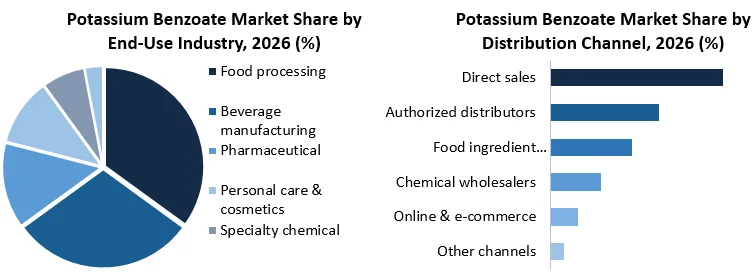
Potassium Benzoate Market by End-Use Industry and Distribution Channel: Food Processing, Beverage, Pharmaceutical and Distributor Networks
Grade, Physical Form, Purity Level, Packaging and Customer Analysis of the Potassium Benzoate Market
Potassium Benzoate food grade is the largest grade at about 68% of 2026 value, followed by Potassium Benzoate pharmaceutical grade at 14%, industrial grade at 10%, high-purity at 6% and other specialized grades at 2%. By physical form, powder leads at about 52%, granular holds 28%, fine powder 15% and other forms 5%; fine powder is the fastest at 7.9% CAGR. By purity level, standard purity holds about 58%, high-purity 27%, ultra-high-purity 9% and customized purity specifications 6%. By packaging type, small-quantity packs up to 25 kg hold about 46% of 2026 value, bulk packaging above 500 kg 33%, medium-quantity packaging 14% and customized industrial packaging 7%. By customer type, large-scale food and beverage manufacturers account for about 41%, small and medium-scale manufacturers 16%, pharmaceutical manufacturers 13%, chemical distributors and wholesalers 12%, personal care and cosmetics manufacturers 10% and specialty chemical manufacturers 8%. Direct sales are the largest route to market at about 38%, while online sales and e-commerce platforms are the fastest at 11.2% CAGR. This segment analysis provides Potassium Benzoate market share by segment, segment growth analysis, market subsegments and segment attractiveness, supporting industry segmentation, customer profiling and customized market strategies.
Potassium Benzoate Applications: Food Preservation, Beverage Preservation, Pharmaceutical, Personal Care and Industrial Uses
Global Potassium Benzoate Market Regional Analysis: North America, Europe, Asia Pacific, Middle East & Africa and South America
Asia Pacific is the largest regional market, accounting for about 39% of global value in 2026. China is the principal production and export hub, with a cluster of benzoate producers in Shandong, Tianjin and Hubei and a large food processing and beverage industry, while India, Japan, South Korea, Australia, Indonesia, Thailand, Malaysia and Vietnam add consumption through packaged food, beverages and pharmaceuticals. The region is projected to grow at about 7.4% CAGR. North America holds about 27% of 2026 value, supported by a mature packaged food and beverage industry, domestic production by suppliers such as LANXESS (Kalama, Washington), Eastman and FBC Industries, and sodium-reduction reformulation; growth is projected at about 5.8% CAGR across the United States, Canada and Mexico. Europe holds about 21%, shaped by EU food additive rules for E212, pharmaceutical demand and producers including LANXESS and Dr. Paul Lohmann, and is expected to grow at about 5.2% CAGR. This Potassium Benzoate regional market analysis highlights Potassium Benzoate regional market trends, market performance by region, regional economic factors, local consumer behaviour and regional Potassium Benzoate consumption.
The Middle East & Africa is projected to be the fastest-growing region, with a 7.9% CAGR through 2034 from about 8% of 2026 value. The region is import-dependent for food additives, and dedicated country-level analysis covers South Africa, Egypt, Nigeria, Algeria, Morocco, Angola, Kenya and Ghana, alongside Saudi Arabia and the United Arab Emirates, as food processing, beverage bottling and pharmaceutical manufacturing capacity expand. South America, about 5% of 2026 value, is projected to grow at about 6.6% CAGR, led by Brazil, Argentina, Chile and Colombia, where soft drinks, sauces and processed food support imports of food-grade preservatives. Regional market share, the regional competitive landscape and region-specific industry outlook vary by territory, with area-specific opportunities, regional market segmentation and local market entry strategies shaping regional Potassium Benzoate demand and Potassium Benzoate supply, including regional production capacity, import-export trends and geopolitical influences.
Potassium Benzoate Companies and Competitive Landscape: Who Are the Top Potassium Benzoate Manufacturers and Suppliers?
The Potassium Benzoate competitive landscape includes several distinct groups rather than a single set of comparable companies. Integrated benzoate producers such as LANXESS, which owns Emerald Kalama Chemical and its Kalama potassium benzoate range, and Eastman Chemical combine benzoic acid feedstock with downstream preservatives, while specialized Chinese producers such as Tengzhou Tenglong Chemical, A.M Food Chemical, Tengzhou Aolong Chemical, Shandong Tong Tai Wei Run Chemical and Wuhan Youji Industries compete on scale and export pricing. North American suppliers such as FBC Industries, Macco Organiques and Velsicol, and Indian producer Ganesh Benzoplast, serve regional food, pharmaceutical and industrial buyers, and food-ingredient distributors and chemical wholesalers complete the supply chain. These groups compete on different dimensions and should not be ranked as though they were identical producers. This Potassium Benzoate competitor analysis draws on Potassium Benzoate competitive intelligence, Potassium Benzoate competitor profiling, Potassium Benzoate competitive positioning and Potassium Benzoate competitor benchmarking of key players, including Potassium Benzoate company revenue and Potassium Benzoate company net sales.
Competition is increasingly shaped by purity and quality credentials, feedstock integration, regional supply reliability and regulatory support. Supply has historically been concentrated: one published study put the top three producers above 65% of the market in 2019, and benzoate capacity remains concentrated among a small group of large producers. LANXESS strengthened its position by acquiring Emerald Kalama Chemical in August 2021, adding sites in Kalama, Washington and Rotterdam, while Chinese producers keep adding capacity and exporting to Asia, the Middle East, Africa and Latin America. Trade defense measures, raw-material costs and food-safety certification are likely to drive consolidation, long-term supply agreements and regional manufacturing partnerships. Competitive strategy review, competitive advantage assessment, market rivalry intensity and strategic analysis of market player strategies suggest that rival market share will shift as competitive landscape trends evolve.
Global Potassium Benzoate Market Recent Developments, Regulatory Milestones and Industry News | 2026
|
Date |
Development |
Why it matters |
|
Apr 2026 |
US sodium benzoate prices rise 20.5% month on month on tighter Asian exports and higher feedstock costs |
Signals price pass-through risk for benzoate buyers |
|
Jul 2026 |
EU applies provisional anti-dumping duties on Chinese sodium benzoate from 29 July 2026 |
Can redirect benzoate trade flows and affect regional pricing |
Global Potassium Benzoate Market Scope: Inquire before buying
|
Global Potassium Benzoate Market |
|||
|
Report Coverage |
Details |
||
|
Base Year: |
2026 |
Forecast Period: |
2027-2034 |
|
Historical Data: |
2021 to 2026 |
Market Size in 2026: |
USD 332 million |
|
Forecast Period 2027 to 2034 CAGR: |
6.5% |
Market Size in 2034: |
USD 550 million |
|
Segments Covered: |
By Grade |
Food-Grade Potassium Benzoate; Pharmaceutical-Grade Potassium Benzoate; Industrial-Grade Potassium Benzoate; High-Purity Potassium Benzoate; Other Specialized Grades |
|
|
By Physical Form |
Powder; Granular; Fine Powder; Other Physical Forms |
||
|
By Purity Level |
Standard Purity Potassium Benzoate; High-Purity Potassium Benzoate; Ultra-High-Purity Potassium Benzoate; Customized Purity Specifications |
||
|
By Application |
Food Preservation; Beverage Preservation; Pharmaceutical Formulations; Personal Care and Cosmetics; Industrial and Specialty Chemical Applications; Other Applications |
||
|
By End-Use Industry |
Food Processing Industry; Beverage Manufacturing Industry; Pharmaceutical Industry; Personal Care and Cosmetics Industry; Specialty Chemical Industry; Other End-Use Industries |
||
|
By Distribution Channel |
Direct Sales; Authorized Chemical Distributors; Food Ingredient Distributors; Industrial Chemical Wholesalers; Online Sales and E-Commerce Platforms; Other Distribution Channels |
||
|
By Packaging Type |
Small-Quantity Packaging (Up to 25 kg); Medium-Quantity Packaging (Above 25 kg to 500 kg); Bulk Packaging (Above 500 kg); Customized Industrial Packaging |
||
|
By Customer Type |
Large-Scale Food and Beverage Manufacturers; Pharmaceutical Manufacturers; Personal Care and Cosmetics Manufacturers; Specialty Chemical Manufacturers; Small and Medium-Scale Manufacturers; Chemical Distributors and Wholesalers |
||
Global Potassium Benzoate Market, By Region
North America (United States, Canada, Mexico, Rest of North America)
Europe (Germany, United Kingdom, France, Italy, Spain, Netherlands, Switzerland, Belgium, Poland, Sweden, Rest of Europe)
Asia Pacific (China, India, Japan, South Korea, Australia, Indonesia, Thailand, Malaysia, Vietnam, Rest of Asia Pacific)
Middle East & Africa (South Africa, Egypt, Nigeria, Algeria, Morocco, Angola, Kenya, Ghana, Saudi Arabia, United Arab Emirates, Rest of Middle East and Africa)
South America (Brazil, Argentina, Chile, Colombia, Rest of South America)
Global Potassium Benzoate Market, Key Players
North America
- Emerald Kalama Chemical
- Macco Organiques Inc.
- FBC Industries, Inc.
- American Elements
- American International Foods, Inc.
- Jarchem Industries, Inc.
- Eastman Chemical Company
- Velsicol Chemical LLC
- Hawkins, Inc.
- Spectrum Chemical Mfg. Corp.
- Avantor, Inc.
- Chemceed
- American International Chemical, Inc.
- Vertellus Holdings LLC
Others
Europe
- LANXESS AG
- Dr. Paul Lohmann GmbH & Co. KGaA
- Merck KGaA
- Tate & Lyle PLC
- Jungbunzlauer Suisse AG
- Ing. Petr Švec – PENTA s.r.o.
- Brenntag SE
- Azelis Group NV
- IMCD Group
- Univar Solutions
Others
Asia Pacific
- Tengzhou Tenglong Chemical Co., Ltd.
- A.M Food Chemical Co., Limited
- Tengzhou Aolong Chemical Co., Ltd.
- Shandong Tong Tai Wei Run Chemical Co., Ltd.
- Shandong Tengbao Biotechnology Co., Ltd.
- Shandong Ruisheng Biotechnology Co., Ltd.
- Tianjin Dongda Chemical Group Co., Ltd.
- Wuhan Youji Industries Co., Ltd.
- Foodchem International Corporation
- Haihang Industry Co., Ltd.
- Liyang Yutian Chemical Co., Ltd.
- Hebei Xinhe Biochemical Co., Ltd.
- Muby Chemicals
- Tokyo Chemical Industry Co., Ltd.
- Shalibhadra Group
Others
Middle East & Africa
- ACTV Biyoteknoloji Lab San. Tic. A.?.
Others
South America
- AQIA Química Industrial Ltda.
- Nanovetores Tecnologia S.A.
Others
Frequently Asked Questions
Asia Pacific holds the largest Potassium Benzoate market share at about 39% in 2026, led by China, which is both the main production hub and a large consumer, followed by India and Japan. North America (about 27%) and Europe (about 21%) follow, while the Middle East & Africa is the fastest-growing region at a 7.9% CAGR.
Food-grade is the largest grade at about 68% of 2026 value and food and beverage preservation is the largest application group at about 67%, but online sales (11.2% CAGR), high-purity grades (8.3%), fine powder (7.9%) and pharmaceutical grade (7.6%) are growing faster than the 6.5% market average.
Leading names include LANXESS (Kalama potassium benzoate through Emerald Kalama Chemical), Eastman Chemical Company, FBC Industries, Tengzhou Tenglong Chemical, A.M Food Chemical, Tengzhou Aolong Chemical, Wuhan Youji Industries and Tianjin Dongda Chemical Group, together with regional producers, food-ingredient distributors and chemical wholesalers. Competitive positioning depends on purity, feedstock integration, regional reach and regulatory compliance.
Potassium Benzoate (E212) is made by neutralizing benzoic acid, usually produced by toluene oxidation, with potassium hydroxide, followed by crystallization, filtration, drying and milling. Like sodium benzoate (E211) it works best in acidic products below about pH 4.5, but it contributes potassium instead of sodium, which suits low-sodium formulations; sodium benzoate is the larger and cheaper benzoate.
1. Executive Market Landscape and Industry Overview
1.1. Global Potassium Benzoate Market Size (Value USD Million and Volume Tonnes (MT)), 2026–2034
1.2. Evolution of Potassium Benzoate as a Chemical Food Preservative
1.3. Definition, Scope and Classification of Potassium Benzoate
1.4. Chemical Composition, Molecular Structure and Functional Properties of Potassium Benzoate
1.5. Role of Potassium Benzoate in Food Preservation and Microbial Growth Inhibition
1.6. Global Demand for Potassium Benzoate Across Food, Beverage and Industrial Applications
1.7. CAGR Analysis of Global Potassium Benzoate Market During 2027–2034
2. Potassium Benzoate Market Dynamics
2.1. Potassium Benzoate Market Trends
2.2. Potassium Benzoate Market Dynamics
2.2.1. Drivers
2.2.2. Restraints
2.2.3. Opportunities
2.2.4. Challenges
2.3. PORTER's Five Forces Analysis
2.4. PESTLE Analysis
3. Potassium Benzoate Market Macroeconomic Factors
3.1. Global Food and Beverage Industry Production and Consumption Trends
3.2. Growth in Packaged Food, Processed Food and Ready-to-Drink Beverage Industries
3.3. Agricultural Raw Material Availability and Benzoic Acid Production Trends
3.4. Global Chemical Manufacturing Investments and Production Expenditure
3.5. Energy Prices, Manufacturing Costs and Industrial Operating Economics
3.6. International Trade Policies, Import Duties and Chemical Supply Chain Developments
3.7. Foreign Exchange Movements and Global Food Additive Pricing Trends
4. Potassium Benzoate Industry Trends & Emerging Technology Requirements
4.1. Increasing Adoption of Chemical Preservatives in Processed Food Manufacturing
4.2. Growing Demand for Potassium Benzoate in Acidic Food and Beverage Products
4.3. Increasing Consumption of Packaged Beverages and Carbonated Soft Drinks
4.4. Growing Demand for Shelf-Life Extension and Microbial Control Solutions
4.5. Increasing Focus on Food Safety, Quality and Preservative Compliance
4.6. Development of High-Purity and Application-Specific Potassium Benzoate Products
4.7. Growing Adoption of Automated Chemical Manufacturing and Quality Testing Technologies
5. Potassium Benzoate Technology Architecture & Ecosystem Landscape
5.1. Benzoic Acid Raw Material Sourcing and Chemical Feedstock Requirements
5.2. Potassium Hydroxide and Potassium-Based Neutralizing Agent Utilization
5.3. Chemical Neutralization and Potassium Benzoate Formation Mechanisms
5.4. Reaction Temperature, pH and Process Parameter Optimization
5.5. Crystallization, Precipitation and Product Recovery Technologies
5.6. Filtration, Drying, Milling and Particle Size Optimization Processes
5.7. Chemical Purification, Impurity Removal and Final Product Quality Assessment
6. Potassium Benzoate Product Forms, Physical Characteristics & Configuration Landscape
6.1. Powder-Based Potassium Benzoate Products and Configurations
6.2. Granular Potassium Benzoate Products and Particle Size Configurations
6.3. Fine Powder and Micronized Potassium Benzoate Products
6.4. Standard Particle Size and Industrial-Grade Product Configurations
6.5. High-Purity Potassium Benzoate Product Configurations
6.6. Moisture-Controlled and Low-Impurity Product Configurations
6.7. Customized Potassium Benzoate Formulations and Packaging Configurations
7. Potassium Benzoate Chemical Composition & Functional Properties
7.1. Potassium Benzoate Chemical Structure and Molecular Composition
7.2. Molecular Weight, Solubility and Physicochemical Characteristics
7.3. Antimicrobial Activity and Microbial Growth Inhibition Mechanisms
7.4. Influence of pH on Potassium Benzoate Preservative Effectiveness
7.5. Solubility Characteristics in Water and Aqueous Food Formulations
7.6. Thermal Stability, Storage Stability and Chemical Compatibility
7.7. Interaction of Potassium Benzoate with Other Food Ingredients and Additives
8. Potassium Benzoate Manufacturing Processes & Production Technologies
8.1. Benzoic Acid Neutralization and Potassium Benzoate Manufacturing Process
8.2. Raw Material Preparation and Chemical Reaction Processing
8.3. Reaction Control, Temperature Management and pH Optimization
8.4. Crystallization and Potassium Benzoate Product Recovery
8.5. Filtration, Washing and Moisture Reduction Processes
8.6. Drying, Milling and Particle Size Standardization
8.7. Manufacturing Automation, Process Efficiency and Production Scalability
9. Potassium Benzoate Raw Materials & Chemical Feedstock Ecosystem
9.1. Benzoic Acid and Its Role in Potassium Benzoate Manufacturing
9.2. Potassium Hydroxide and Potassium-Based Chemical Feedstocks
9.3. Industrial-Grade and High-Purity Benzoic Acid Supply
9.4. Chemical Reagents and Processing Agent Requirements
9.5. Water Quality and Industrial Processing Requirements
9.6. Raw Material Quality, Purity and Supplier Qualification
9.7. Raw Material Availability, Procurement Costs and Supply Risk Assessment
10. Potassium Benzoate Quality Control, Testing & Laboratory Analysis
10.1. Potassium Benzoate Purity and Assay Testing
10.2. Moisture Content and Loss on Drying Analysis
10.3. pH Measurement and Chemical Composition Verification
10.4. Heavy Metal and Trace Impurity Testing
10.5. Particle Size Distribution and Physical Appearance Testing
10.6. Microbiological Contamination and Product Safety Assessment
10.7. Batch Consistency, Product Stability and Quality Assurance
11. Potassium Benzoate Industrial Processing, Storage & Handling Ecosystem
11.1. Industrial Potassium Benzoate Processing and Packaging Facilities
11.2. Automated Weighing, Blending and Material Handling Systems
11.3. Industrial Drying and Moisture Control Equipment
11.4. Powder Processing, Sieving and Particle Size Classification Equipment
11.5. Bulk Packaging and Material Transfer Systems
11.6. Warehouse Storage and Humidity-Controlled Handling Requirements
11.7. Equipment Maintenance, Production Efficiency and Operational Optimization
12. Potassium Benzoate Packaging, Consumables & Industrial Materials
12.1. Multi-Layer Paper Bags and Industrial Packaging Materials
12.2. High-Density Polyethylene (HDPE) Bags and Inner Liners
12.3. Flexible Intermediate Bulk Containers (FIBC) and Jumbo Bags
12.4. Food-Grade Packaging Materials and Contamination Prevention
12.5. Moisture-Resistant Packaging and Product Protection Solutions
12.6. Bulk Transportation Containers and Industrial Storage Materials
12.7. Packaging Quality, Labeling and Product Traceability Requirements
13. Potassium Benzoate Production, Processing & Industrial Workflow
13.1. Raw Material Procurement and Incoming Quality Inspection
13.2. Benzoic Acid and Potassium Hydroxide Preparation
13.3. Chemical Neutralization and Reaction Processing
13.4. Crystallization and Product Separation
13.5. Filtration, Washing and Drying Operations
13.6. Final Product Testing, Packaging and Batch Release
13.7. Manufacturing Workflow Automation and Production Throughput Optimization
14. Potassium Benzoate Chemical Analytics, Laboratory Testing & Technical Evaluation
14.1. Chemical Assay and Purity Measurement Techniques
14.2. High-Performance Liquid Chromatography (HPLC) Analysis
14.3. Fourier Transform Infrared Spectroscopy (FTIR) Testing
14.4. Inductively Coupled Plasma (ICP) and Trace Metal Analysis
14.5. Moisture, Solubility and pH Testing Methods
14.6. Product Stability and Shelf-Life Evaluation
14.7. Laboratory Information Management and Quality Data Integration
15. Potassium Benzoate Applications in Food Processing & Preservation
15.1. Potassium Benzoate in Processed Food Preservation
15.2. Application in Sauces, Ketchup and Condiment Preservation
15.3. Application in Pickles, Dressings and Acidified Food Products
15.4. Application in Jams, Jellies and Fruit-Based Preparations
15.5. Application in Bakery Fillings and Processed Food Ingredients
15.6. Application in Ready-to-Eat and Convenience Food Products
15.7. Shelf-Life Extension and Microbial Stability in Food Manufacturing
16. Potassium Benzoate Applications in Beverages & Liquid Formulations
16.1. Potassium Benzoate in Carbonated Soft Drinks
16.2. Application in Fruit Juices and Fruit-Based Beverages
16.3. Application in Ready-to-Drink (RTD) Beverages
16.4. Application in Flavoured Water and Non-Carbonated Drinks
16.5. Application in Syrups, Concentrates and Beverage Bases
16.6. Application in Energy Drinks and Functional Beverages
16.7. Beverage Preservation, Formulation Compatibility and Shelf-Life Optimization
17. Potassium Benzoate Applications in Pharmaceutical & Healthcare Industries
17.1. Potassium Benzoate in Pharmaceutical Formulation Development
17.2. Application in Oral Liquid Pharmaceutical Preparations
17.3. Application in Pharmaceutical Syrups and Aqueous Formulations
17.4. Application in Preservative Systems for Selected Pharmaceutical Products
17.5. Chemical Compatibility and Formulation Stability Assessment
17.6. Pharmaceutical Grade Purity and Quality Requirements
17.7. Regulatory Compliance and Pharmaceutical Manufacturing Applications
18. Potassium Benzoate Applications in Personal Care & Cosmetics
18.1. Potassium Benzoate in Personal Care Formulations
18.2. Application in Skin Care and Cosmetic Preparations
18.3. Application in Hair Care and Shampoo Formulations
18.4. Application in Liquid Soaps and Cleansing Products
18.5. Application in Creams, Lotions and Emulsion-Based Products
18.6. Formulation Compatibility and Microbial Preservation
18.7. Cosmetic Ingredient Safety and Regulatory Compliance
19. Potassium Benzoate Applications in Industrial & Specialty Chemical Industries
19.1. Potassium Benzoate in Specialty Chemical Formulations
19.2. Application in Industrial Aqueous Formulations
19.3. Application in Selected Chemical Processing Formulations
19.4. Application in Specialty Laboratory and Research Preparations
19.5. Potassium Benzoate in Custom Chemical Formulations
19.6. Industrial Chemical Compatibility and Performance Assessment
19.7. Emerging Specialty Applications and New Product Development Opportunities
20. Potassium Benzoate Contract Manufacturing, Custom Formulation & Chemical Supply Services
20.1. Custom Potassium Benzoate Manufacturing Services
20.2. Contract Chemical Processing and Production Services
20.3. High-Purity Potassium Benzoate Manufacturing Services
20.4. Customized Particle Size and Product Specification Services
20.5. Food-Grade Chemical Manufacturing and Processing Services
20.6. Bulk Chemical Packaging and Private Label Manufacturing Services
20.7. Contract Manufacturing Capacity and Technical Capability Benchmarking
21. Potassium Benzoate Manufacturing, Production Capacity & Quality Control Ecosystem
21.1. Potassium Benzoate Manufacturing Plant Infrastructure
21.2. Benzoic Acid and Potassium Hydroxide Processing Infrastructure
21.3. Chemical Reaction and Neutralization Equipment
21.4. Crystallization, Filtration and Drying Technologies
21.5. Manufacturing Automation and Production Capacity Expansion
21.6. Product Validation, Purity Testing and Quality Assurance
21.7. Manufacturing Standards, Batch Consistency and Production Efficiency
22. Potassium Benzoate Pricing, Business Models & Cost Economics
22.1. Potassium Benzoate Pricing Across Different Product Grades
22.2. Food-Grade and Industrial-Grade Potassium Benzoate Pricing
22.3. High-Purity Potassium Benzoate Product Pricing
22.4. Benzoic Acid and Potassium Hydroxide Raw Material Cost Economics
22.5. Manufacturing, Processing and Packaging Cost Structure
22.6. Bulk Procurement, Contract Pricing and Distributor Margins
22.7. Total Cost of Production and Profitability Analysis
23. Potassium Benzoate Distribution, Sales & Procurement Landscape
23.1. Direct Sales Through Potassium Benzoate Manufacturers
23.2. Authorized Chemical Distributors and Specialty Chemical Suppliers
23.3. Food Ingredient Distributors and Additive Supply Networks
23.4. Industrial Chemical Wholesalers and Bulk Supply Channels
23.5. E-Commerce Platforms and Online Chemical Procurement
23.6. Food and Beverage Manufacturer Procurement and Institutional Purchasing
23.7. Distributor Networks, Technical Support and After-Sales Services
24. Potassium Benzoate Manufacturing Supply Chain & Operational Ecosystem
24.1. Benzoic Acid Raw Material Sourcing and Procurement
24.2. Potassium Hydroxide and Chemical Feedstock Supply Chains
24.3. Chemical Processing and Manufacturing Infrastructure
24.4. Packaging Material Procurement and Supplier Networks
24.5. Domestic and International Chemical Transportation and Logistics
24.6. International Trade, Inventory Management and Supply Chain Resilience
24.7. Manufacturing Capacity, Supplier Qualification and Operational Risk Management
25. Potassium Benzoate Technology Innovation, R&D & Product Development
25.1. Advancements in Potassium Benzoate Manufacturing Processes
25.2. Development of High-Purity and Application-Specific Products
25.3. Improvements in Chemical Reaction Efficiency and Product Recovery
25.4. Innovation in Crystallization and Particle Size Control
25.5. Development of Advanced Quality Testing and Analytical Methods
25.6. Research into Preservative Effectiveness and Formulation Compatibility
25.7. Research Investments, Intellectual Property and Technology Collaborations
26. Potassium Benzoate Market Adoption, Utilization & Customer Economics
26.1. Adoption of Potassium Benzoate Across Food and Beverage Manufacturers
26.2. Potassium Benzoate Consumption Volumes and Industrial Utilization Rates
26.3. Preservative Usage Intensity Across Different Food and Beverage Applications
26.4. Customer Acquisition, Industrial Customer Retention and Repeat Procurement
26.5. Bulk Procurement Cycles and Chemical Inventory Requirements
26.6. Product Quality, Preservative Performance and Customer Satisfaction
26.7. Procurement Preferences and Long-Term Chemical Supply Agreements
27. Potassium Benzoate Market Regulatory, Quality & Technical Standards
27.1. Global Food Additive Regulations and Potassium Benzoate Approval Requirements
27.2. US FDA Requirements and Applicable Food Additive Regulations
27.3. European Union Food Additive Regulations and E212 Requirements
27.4. Codex Alimentarius and International Food Additive Standards
27.5. Food Safety Management Systems and ISO 22000 Requirements
27.6. Good Manufacturing Practices (GMP) and Chemical Quality Standards
27.7. Product Labeling, Maximum Permitted Levels and Food Safety Compliance
28. Potassium Benzoate Regional & Country-Level Market Landscape
28.1. North American Food Preservative Manufacturing and Potassium Benzoate Demand
28.2. European Food Additive Regulations, Chemical Production and Consumption Trends
28.3. Asia-Pacific Potassium Benzoate Manufacturing, Food Processing and Consumption Growth
28.4. Middle East & Africa Potassium Benzoate Import Dependency, Food Processing Infrastructure and Consumption Opportunities
28.5. South American Potassium Benzoate Demand and Emerging Food Manufacturing Opportunities
28.6. Country-Level Market Assessment: United States, Canada, Germany, United Kingdom, China, Japan, India, Brazil, South Africa, Egypt, Nigeria, Algeria, Morocco, Angola, Kenya and Ghana
28.7. Regional Production Capacity, Import-Export Trends, Food Industry Expansion and Chemical Consumption Patterns
Special focus – Middle East & Africa: South Africa, Egypt, Nigeria, Algeria, Morocco, Angola, Kenya and Ghana will receive dedicated country-level analysis, including market size, volume consumption, imports, demand drivers, pricing and growth opportunities.
29. Potassium Benzoate Market: Market Size and Forecast by Segmentation (Value USD Million and Volume Tonnes (MT)) (2026–2034)
29.1. Potassium Benzoate Market Size and Forecast, By Grade
29.1.1. Food-Grade Potassium Benzoate
29.1.2. Pharmaceutical-Grade Potassium Benzoate
29.1.3. Industrial-Grade Potassium Benzoate
29.1.4. High-Purity Potassium Benzoate
29.1.5. Other Specialized Grades
29.2. Potassium Benzoate Market Size and Forecast, By Physical Form
29.2.1. Powder
29.2.2. Granular
29.2.3. Fine Powder
29.2.4. Other Physical Forms
29.3. Potassium Benzoate Market Size and Forecast, By Purity Level
29.3.1. Standard Purity Potassium Benzoate
29.3.2. High-Purity Potassium Benzoate
29.3.3. Ultra-High-Purity Potassium Benzoate
29.3.4. Customized Purity Specifications
29.4. Potassium Benzoate Market Size and Forecast, By Application
29.4.1. Food Preservation
29.4.2. Beverage Preservation
29.4.3. Pharmaceutical Formulations
29.4.4. Personal Care and Cosmetics
29.4.5. Industrial and Specialty Chemical Applications
29.4.6. Other Applications
29.5. Potassium Benzoate Market Size and Forecast, By End-Use Industry
29.5.1. Food Processing Industry
29.5.2. Beverage Manufacturing Industry
29.5.3. Pharmaceutical Industry
29.5.4. Personal Care and Cosmetics Industry
29.5.5. Specialty Chemical Industry
29.5.6. Other End-Use Industries
29.6. Potassium Benzoate Market Size and Forecast, By Distribution Channel
29.6.1. Direct Sales
29.6.2. Authorized Chemical Distributors
29.6.3. Food Ingredient Distributors
29.6.4. Industrial Chemical Wholesalers
29.6.5. Online Sales and E-Commerce Platforms
29.6.6. Other Distribution Channels
29.7. Potassium Benzoate Market Size and Forecast, By Packaging Type
29.7.1. Small-Quantity Packaging (Up to 25 kg)
29.7.2. Medium-Quantity Packaging (Above 25 kg to 500 kg)
29.7.3. Bulk Packaging (Above 500 kg)
29.7.4. Customized Industrial Packaging
29.8. Potassium Benzoate Market Size and Forecast, By Customer Type
29.8.1. Large-Scale Food and Beverage Manufacturers
29.8.2. Pharmaceutical Manufacturers
29.8.3. Personal Care and Cosmetics Manufacturers
29.8.4. Specialty Chemical Manufacturers
29.8.5. Small and Medium-Scale Manufacturers
29.8.6. Chemical Distributors and Wholesalers
29.9. Potassium Benzoate Market Size and Forecast, By Region
29.9.1. North America
- 29.9.1.1. United States
- 29.9.1.2. Canada
- 29.9.1.3. Mexico
- 29.9.1.4. Rest of North America
29.9.2. Europe
- 29.9.2.1. Germany
- 29.9.2.2. United Kingdom
- 29.9.2.3. France
- 29.9.2.4. Italy
- 29.9.2.5. Spain
- 29.9.2.6. Netherlands
- 29.9.2.7. Switzerland
- 29.9.2.8. Belgium
- 29.9.2.9. Poland
- 29.9.2.10. Sweden
- 29.9.2.11. Rest of Europe
29.9.3. Asia Pacific
- 29.9.3.1. China
- 29.9.3.2. India
- 29.9.3.3. Japan
- 29.9.3.4. South Korea
- 29.9.3.5. Australia
- 29.9.3.6. Indonesia
- 29.9.3.7. Thailand
- 29.9.3.8. Malaysia
- 29.9.3.9. Vietnam
- 29.9.3.10. Rest of Asia Pacific
29.9.4. Middle East and Africa
- 29.9.4.1. South Africa
- 29.9.4.2. Egypt
- 29.9.4.3. Nigeria
- 29.9.4.4. Algeria
- 29.9.4.5. Morocco
- 29.9.4.6. Angola
- 29.9.4.7. Kenya
- 29.9.4.8. Ghana
- 29.9.4.9. Saudi Arabia
- 29.9.4.10. United Arab Emirates
- 29.9.4.11. Rest of Middle East and Africa
29.9.5. South America
- 29.9.5.1. Brazil
- 29.9.5.2. Argentina
- 29.9.5.3. Chile
- 29.9.5.4. Colombia
- 29.9.5.5. Rest of South America
30. Potassium Benzoate Market Competitive Landscape
30.1. SMR Competition Matrix
30.2. Competitive Positioning of Leading Key Players [Revenue and Market Share (%)]
30.3. Key Players Benchmarking
30.3.1. Company Name
30.3.2. Headquarters
30.3.3. Potassium Benzoate Product Portfolio
30.3.4. Product Grades and Purity Specifications
30.3.5. Manufacturing and Production Capabilities
30.3.6. Production Capacity and Utilization
30.3.7. Food and Industrial Application Portfolio
30.3.8. Total Company Revenue (2025)
30.3.9. Potassium Benzoate-Related Revenue (2025)
30.3.10. Geographic Presence
30.3.11. Distribution and Commercial Network
30.3.12. Strategic Partnerships and Manufacturing Collaborations
30.4. Market Structure
30.4.1. Market Leaders
30.4.2. Market Followers
30.4.3. Emerging Players
30.4.4. Specialized Potassium Benzoate Manufacturers and Suppliers
30.5. Growth Rate / Y-o-Y (%) of Companies
30.6. Profit Margin (%) of Companies
30.7. Production Capacity and Capacity Utilization (%)
30.8. Revenue Vs. Net Earnings – Financial Health Benchmarking (2025)
30.9. Revenue Performance and Financial Analysis (2025)
30.10. Mergers and Acquisitions Details
30.11. Recent Key Developments
31. Potassium Benzoate Manufacturers & Chemical Production Providers Landscape
31.1. Potassium Benzoate Manufacturing Companies
31.2. Food-Grade Potassium Benzoate Manufacturers
31.3. Pharmaceutical-Grade Potassium Benzoate Manufacturers
31.4. Industrial-Grade Potassium Benzoate Manufacturers
31.5. High-Purity Potassium Benzoate Manufacturers
31.6. Contract Manufacturing and Private Label Chemical Producers
31.7. Manufacturing Capacity, Product Quality and Production Cost Benchmarking
32. Potassium Benzoate Raw Material & Chemical Feedstock Suppliers
32.1. Benzoic Acid Manufacturers and Suppliers
32.2. Potassium Hydroxide Manufacturers and Suppliers
32.3. Industrial Chemical Feedstock Suppliers
32.4. High-Purity Chemical Raw Material Providers
32.5. Specialty Chemical Reagent Suppliers
32.6. Chemical Procurement and Bulk Supply Companies
32.7. Raw Material Quality, Pricing and Supply Reliability Benchmarking
33. Potassium Benzoate Food Additive & Ingredient Distribution Providers
33.1. Food-Grade Potassium Benzoate Distributors
33.2. Food Preservative and Additive Distribution Companies
33.3. Beverage Ingredient Suppliers
33.4. Food Processing Chemical Distributors
33.5. Bulk Food Additive Importers and Wholesalers
33.6. Regional Chemical Distribution Networks
33.7. Distribution Coverage, Supply Capacity and Customer Service Benchmarking
34. Potassium Benzoate Pharmaceutical & Specialty Chemical Suppliers
34.1. Pharmaceutical-Grade Potassium Benzoate Suppliers
34.2. Pharmaceutical Excipients and Ingredient Distributors
34.3. High-Purity Specialty Chemical Suppliers
34.4. Laboratory and Research Chemical Providers
34.5. Custom Chemical Formulation Companies
34.6. Pharmaceutical Chemical Importers and Distributors
34.7. Product Purity, Regulatory Compliance and Technical Capability Benchmarking
35. Potassium Benzoate Testing, Certification & Quality Assurance Providers
35.1. Chemical Purity Testing Laboratories
35.2. Food Additive Testing and Certification Providers
35.3. Heavy Metal and Contaminant Testing Laboratories
35.4. Chemical Composition and Analytical Testing Providers
35.5. Product Stability and Shelf-Life Testing Services
35.6. Food Safety and Quality Certification Organizations
35.7. Testing Accuracy, Certification Standards and Laboratory Capability Benchmarking
36. Potassium Benzoate Contract Manufacturing, Chemical Processing & Supply Providers
36.1. Contract Potassium Benzoate Manufacturing Companies
36.2. Chemical Neutralization and Processing Service Providers
36.3. Crystallization and Drying Service Providers
36.4. Custom Chemical Blending and Formulation Companies
36.5. Bulk Chemical Packaging and Private Label Providers
36.6. Chemical Storage and Logistics Service Providers
36.7. Production Capacity, Service Quality and Technical Capability Benchmarking
37. Potassium Benzoate Manufacturers' Strategies & Expansion Plans
37.1. Expansion of Potassium Benzoate Manufacturing Capacity
37.2. Development of High-Purity and Application-Specific Products
37.3. Expansion into Food and Beverage Preservative Markets
37.4. Development of Advanced Chemical Processing Technologies
37.5. Expansion of Distribution Networks Across Emerging Markets
37.6. Partnerships with Food, Beverage and Pharmaceutical Manufacturers
37.7. Geographic Expansion Across North America, Europe, Asia Pacific and Middle East & Africa
37.8. Mergers, Acquisitions and Strategic Chemical Industry Collaborations
38. Potassium Benzoate Industry SWOT, Investments & Strategic Developments
38.1. Competitive Strengths of Established Potassium Benzoate Manufacturers
38.2. Raw Material Price Volatility and Manufacturing Cost Challenges
38.3. Emerging Opportunities in Processed Food and Beverage Preservation
38.4. Competitive Threats from Alternative Food Preservatives
38.5. Strategic Investments in Chemical Manufacturing Infrastructure
38.6. Investments in Food Safety, Quality Control and Advanced Processing Technologies
38.7. Major Product Launches, Partnerships and Industry Developments
39. Potassium Benzoate Competitive Outlook & Market Positioning
39.1. Competitive Dynamics Across Food, Beverage, Pharmaceutical and Industrial Applications
39.2. Market Concentration Across Global Potassium Benzoate Manufacturers
39.3. Product Differentiation Through Purity, Quality and Pricing
39.4. Competitive Positioning of Established Manufacturers and Emerging Suppliers
39.5. Expansion of Potassium Benzoate Applications in Emerging Markets
39.6. Future Manufacturing Innovation and Chemical Supply Chain Development
39.7. Long-Term Competitive Positioning of Leading Potassium Benzoate Companies
40. Company Profile: 40+ Key Players
Detailed Profile Considering the Parameters
- Overview
- Business Portfolio
- Potassium Benzoate Product Portfolio
- Product Grades and Purity Specifications
- Manufacturing and Production Capabilities
- Production Capacity and Utilization
- Raw Material Procurement and Supply Chain
- Financial Overview
- Geographic Presence
- SWOT Analysis
- Strategic Analysis
- Recent Developments
Global Potassium Benzoate Market, Key Players
North America
- Emerald Kalama Chemical
- Macco Organiques Inc.
- FBC Industries, Inc.
- American Elements
- American International Foods, Inc.
- Jarchem Industries, Inc.
- Eastman Chemical Company
- Velsicol Chemical LLC
- Hawkins, Inc.
- Spectrum Chemical Mfg. Corp.
- Avantor, Inc.
- Chemceed
- American International Chemical, Inc.
- Vertellus Holdings LLC
Others
Europe
- LANXESS AG
- Dr. Paul Lohmann GmbH & Co. KGaA
- Merck KGaA
- Tate & Lyle PLC
- Jungbunzlauer Suisse AG
- Ing. Petr Švec – PENTA s.r.o.
- Brenntag SE
- Azelis Group NV
- IMCD Group
- Univar Solutions
Others
Asia Pacific
- Tengzhou Tenglong Chemical Co., Ltd.
- A.M Food Chemical Co., Limited
- Tengzhou Aolong Chemical Co., Ltd.
- Shandong Tong Tai Wei Run Chemical Co., Ltd.
- Shandong Tengbao Biotechnology Co., Ltd.
- Shandong Ruisheng Biotechnology Co., Ltd.
- Tianjin Dongda Chemical Group Co., Ltd.
- Wuhan Youji Industries Co., Ltd.
- Foodchem International Corporation
- Haihang Industry Co., Ltd.
- Liyang Yutian Chemical Co., Ltd.
- Hebei Xinhe Biochemical Co., Ltd.
- Muby Chemicals
- Tokyo Chemical Industry Co., Ltd.
- Shalibhadra Group
Others
Middle East & Africa
- ACTV Biyoteknoloji Lab San. Tic. A.?.
Others
South America
- AQIA Química Industrial Ltda.
- Nanovetores Tecnologia S.A.
Others
41. Key Findings
42. Strategic Moves & Industry Outlook
43. Research Methodology