ENG
ENG Japanese
  French
  German
  Korean
Precision-Guided Munitions Market Analysis: Guided Missiles, Smart Weapons, Loitering Munitions & Strike Systems Forecast, 2026–2032
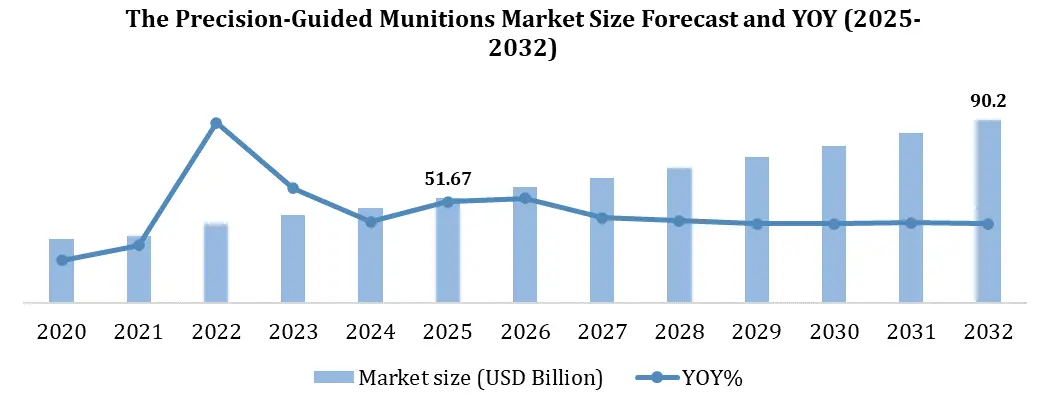
The Precision-Guided Munitions Market was projected to grow from USD 51.67 Bn in 2025 to USD 90.2 Bn by 2032 at 8.25% CAGR, supported by modern wars, stockpile replenishment, long-range strike needs, and guided weapon production expansion. The market’s growth is strongest in guided missiles, guided bombs, loitering munitions, guided artillery, naval strike missiles, and multi-mode seeker-equipped smart weapons.
Precision-Guided Munitions Market Overview
The Precision-Guided Munitions Market is evolving from an exclusive weapon category to a vital procurement consideration. In today's modern battlefield, accuracy, reach, survivability, and a secure supply are essential criteria rather than sheer firepower alone. There is increasing demand for guided missiles, smart bombs, guided rockets, precision artillery rounds, loitering weapons, and weapons systems with advanced seeker technologie. Air force procurement activity for stand-off missile systems and glide bombs has increased significantly for stand-off missile systems and glide bombs, army purchases for anti-tank missiles, guided rockets, and precision artillery rounds, as well as naval procurement of anti-ship and ship-launched precision weapons systems for enhanced maritime security.
The market is shifting from platform-centric procurement toward munition-centric combat readiness planning. Rather than looking at which platforms a country needs to procure first like aircraft, ships, and launcher platforms, defence experts and officials are increasingly looking into the availability of precision weapons, their manufacturing capacities, and strike capabilities. In this context, the Precision-Guided Munitions Market is characterized by a mix of premium, long-range missiles, economical smart bombs and rockets, and cost-effective loitering weapons. Even though inventories and purchases can be difficult to quantify due to classified status, clear trends emerge from open-source defence contracts, military assistance agreements, modernization plans, and production plans.
To get more Insights: Request Free Sample Report
Global Precision-Guided Munitions Demand Analysis 2025
- 2025 demand is led by long-range precision strike. Militaries are increasing demand for stand-off missiles, air-launched cruise missiles, naval strike missiles, and deep-strike weapons because they need to hit targets from safer distances in contested air and maritime environments.
- Guided rockets and precision land fires are becoming a major demand layer.
Armies are prioritizing GMLRS-type rockets, Precision Strike Missile systems, guided artillery, and anti-tank guided missiles to improve battlefield accuracy, range, and response speed. - Naval and coastal precision weapons are gaining importance.
Countries are investing in anti-ship missiles, coastal defence missile systems, and sea-launched strike weapons as maritime deterrence becomes more important in Europe, the Indo-Pacific, and the Middle East. - Demand is shifting from emergency buying to structured procurement.
In 2025, buyers are not only replacing used munitions; they are building long-term precision-strike capacity through multi-year contracts, local production, guided bomb kits, loitering munitions, and advanced seeker upgrades.
Global Precision-Guided Munitions Market Dynamics
The Global Precision-Guided Munitions Market in 2025 is being shaped by a clear change in how militaries plan combat capability. Defence buyers are no longer looking at platforms and weapons in isolation; they are assessing whether aircraft, ships, artillery systems, and ground units have sufficient precision-ready firepower to operate in high-risk environments. This is making guided munitions a direct measure of combat readiness, not just an add-on procurement item.
Demand is also becoming more balanced across weapon classes. High-value missiles remain important, but buyers are increasingly combining them with guided bomb kits, precision rockets, smart artillery, and loitering systems to match weapon cost with target value. This shift is creating a broader market base, with growth coming from both advanced strike capabilities and scalable battlefield-use weapons.
Global Precision-Guided Munitions Growth Drivers
1. Modern warfare is accelerating demand for precision effects across all domains.
Today’s conflicts are reinforcing the need for weapons that can strike high-value targets with greater accuracy, fewer rounds, faster response times, and reduced risk to launch platforms. This is driving demand for guided missiles, air-launched precision weapons, guided artillery, anti-armour systems, and loitering munitions across land, air, naval, and special-operations environments.
2. Long-range strike capability is becoming a top procurement priority.
As contested airspace and advanced air-defence networks make close-range attacks increasingly risky, countries are investing heavily in stand-off weapons, naval strike missiles, deep-strike missiles, and air-launched cruise missiles. This trend is strengthening demand for JASSM-type missiles, LRASM-type weapons, Tomahawk-class systems, Naval Strike Missile-type platforms, and similar precision-strike programs.
3. Guided artillery, rockets, and tactical missiles are becoming battlefield essentials.
The precision weapons market is no longer dominated only by aircraft-delivered smart munitions. Ground-launched precision systems, including guided rockets, precision artillery shells, anti-tank guided missiles, and tactical ballistic missiles, are becoming increasingly important as armies seek accurate, long-range firepower that can be deployed quickly.
4. Loitering munitions are expanding the lower-cost precision-strike layer.
Loitering munitions are reshaping the economics of precision strike by combining surveillance, target acquisition, and attack capability in a single platform. They are especially valuable for tactical units that need accurate strike options without relying entirely on aircraft, large missile batteries, or expensive stand-off weapons.
Global Precision-Guided Munitions Market Opportunities
1. Domestic missile production is becoming a strategic growth opportunity.
Governments are increasingly prioritizing local manufacturing and assembly of guided weapons, missile components, warheads, and guidance systems. This is creating opportunities for joint ventures, licensed production, technology partnerships, and long-term industrial-base contracts.
2. Multi-mode seekers can create premium differentiation.
Weapons equipped with combinations of radar, infrared, electro-optical, laser, and GPS/INS guidance can deliver stronger performance against moving targets, maritime threats, and defended environments. This allows suppliers to upgrade existing weapon families and command higher contract value.
3. Lower-cost precision kits can unlock volume demand.
Guidance kits that convert unguided bombs or rockets into more accurate weapons offer an affordable path to precision capability. This is especially attractive for emerging defence markets where buyers need scale, effectiveness, and cost efficiency rather than only high-end missile systems.
4. Modular weapon design can shorten upgrade cycles.
Defence buyers are showing growing interest in weapons that can integrate new seekers, datalinks, software, propulsion enhancements, or warhead options without replacing the entire platform. This creates recurring aftermarket opportunities and extends the revenue life cycle for suppliers.
Global Precision-Guided Munitions Market Challenges
The primary execution challenge is no longer demand generation; it is delivery reliability. Suppliers must scale production while maintaining strict standards for quality, safety, testing, compliance, and export-control discipline. Precision weapons cannot be manufactured like simple ammunition because each unit depends on the seamless integration of guidance, propulsion, warhead, navigation, and control systems.
Another major challenge is demand forecasting. Military requirements can rise sharply after conflict escalation, but procurement approvals, budget releases, export licensing, and production ramp-up often take much longer. This creates a gap between urgent operational demand and actual market revenue recognition.
Global Precision-Guided Munitions Market Trends
Precision strike is moving toward a mixed-cost portfolio.
Defence buyers are no longer building arsenals solely around expensive long-range missiles. Instead, they are combining premium stand-off weapons, mid-cost guided rockets, guided artillery, smart bombs, and low-cost loitering munitions to align weapon cost with target value.
Seeker technology is becoming a critical buying factor.
Future competition in the precision weapons market will increasingly depend on multi-mode seekers, anti-jamming performance, target recognition, moving-target engagement, and effectiveness in poor visibility. Guidance technology is now becoming as important as range, payload, and warhead size.
Naval precision strike is gaining strategic importance.
Navies are expanding demand for anti-ship missiles, land-attack cruise missiles, and ship-launched strike weapons as maritime chokepoints, carrier groups, island defence, and Indo-Pacific deterrence become more central to defence planning.
Loitering munitions are becoming a formal procurement category.
Once viewed as niche or experimental systems, loitering munitions are now being assessed as standard inventory items for army units, special forces, border security forces, and mobile strike teams. This shift is giving the segment stronger long-term market visibility.
Global Precision-Guided Munitions Market Segmentation (2025)
Precision-Guided Munitions Market by Product Type
By product type, tactical missiles lead the Global Precision-Guided Munitions Market with a 42% share, driven by demand for stand-off, anti-tank, naval strike, and surface-to-surface weapons. Guided bombs hold xx% as air forces use JDAM-type kits, glide bombs, and laser-guided weapons for cost-effective precision strike. Guided rockets and artillery account for xx%, supported by rising demand for accurate land-based fires. Loitering munitions hold xx% and continue to gain traction as lower-cost tactical precision-strike systems.

Precision-Guided Munitions Market by Launch platform
Air-launched systems hold the largest share at 36%. Rising demand for precision aerial strikes, followed by ground-launched systems at % Growing need for mobile battlefield firepower. Naval-launched systems account for 18%. Expanding maritime security and defence operations, while man-portable or vehicle-launched systems make up the remaining 15%. Increasing demand for flexible tactical deployment.

Precision-Guided Munitions Market by end user
Air Force is the top contributor in the Global Precision-Guided Munitions Market with a 34% share, driven by stand-off strike demand, guided bomb usage, and aircraft modernization. Army demand remains strong due to tactical missiles, guided rockets, and precision artillery, while Navy adoption grows through anti-ship missiles, sea-launched strike systems, and maritime deterrence. Special Operations and Homeland Security Forces add demand through portable guided weapons, loitering munitions, and vehicle-launched precision systems.
Global Precision-Guided Munitions Competitive Analysis 2025
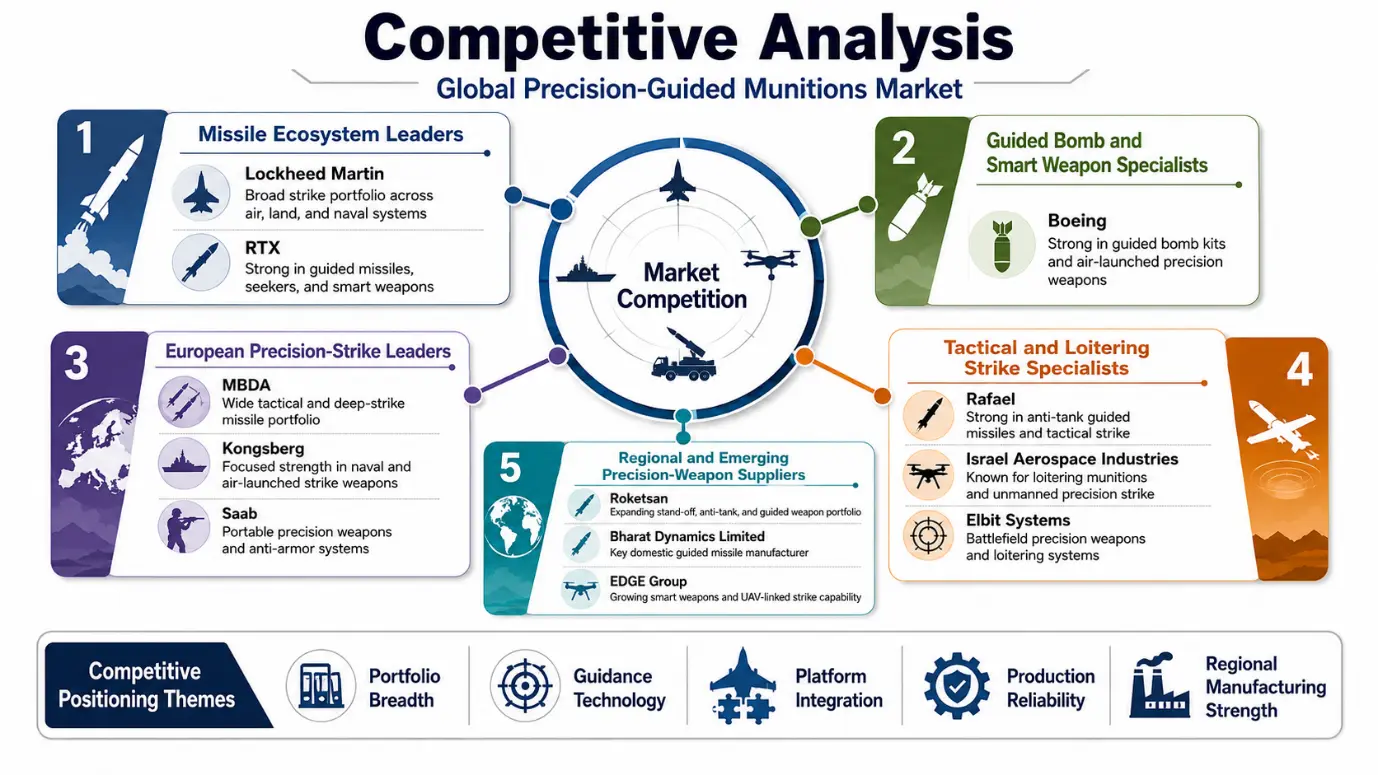
The market for Global Precision-Guided Munitions features companies having advanced missile capabilities, sophisticated guidance technology, and extensive defence industry knowledge. Lockheed Martin and RTX have an edge over their competitors in terms of advanced missiles, guided rockets, seekers, and multi-domain precision strike weapons. Similarly, Boeing dominates the market for guided bombs and JDAM-type weapon kits.
Companies like MBDA, Kongsberg, and Saab make up Europe's precision weapons segment via tactical missiles, naval strike systems, and portable precision weapons. Meanwhile, companies such as Rafael, Israel Aerospace Industries, and Elbit Systems dominate the Middle East precision weapons market with their anti-tank guided missiles, loitering munitions, and battlefield strike weapons.
Roketsan, Bharat Dynamics Limited, and EDGE Group are increasing their significance as regional producers of precision weapons. The companies have been supporting their respective domestic missile manufacturing initiatives, intelligent munitions, UAV-enabled strike weapons, and defence industry manufacturing programs.
Global Precision-Guided Munitions Regional Analysis 2025:
North America dominates the Global Precision-Guided Munitions Market with over 38% market share in 2025, driven primarily by the United States, which maintains the world’s largest precision-strike procurement ecosystem and missile production capacity. The U.S. FY2025 defence budget allocated nearly USD 29.8 billion toward missiles and munitions procurement, supporting programs such as JASSM, LRASM, HIMARS, Tomahawk, Patriot, and GMLRS systems. Canada also contributes through NATO interoperability and air-defence modernization initiatives. The region leads in guided missiles, smart bombs, tactical rockets, and seeker technologies.
Europe accounts for xx% of the global market, supported by rising NATO defence expenditure and accelerated military modernization across Germany, France, the U.K., Poland, Italy, and Norway. NATO members increased defence spending by more than 20% in 2025 compared with 2024 levels. Europe’s growth is strongest in anti-tank guided missiles, naval strike missiles, guided artillery, and air-launched precision weapons through companies such as MBDA, Saab, Rheinmetall, and Kongsberg.
Asia Pacific holds xx% market share and represents the fastest-growing regional market due to Indo-Pacific tensions, maritime security concerns, and domestic missile manufacturing expansion. China, India, Japan, South Korea, and Australia are heavily investing in long-range precision-strike systems, hypersonic weapons, and guided rocket programs. Australia’s Guided Weapons and Explosive Ordnance Enterprise and India’s indigenous missile programs are significantly strengthening regional production capabilities.
Middle East & Africa contributes xx% of market demand, led by Israel, Saudi Arabia, UAE, and Qatar through guided bombs, loitering munitions, and missile-defence procurements. South America remains below 4% share due to budget limitations, with Brazil leading selective modernization programs in guided bombs and coastal-defence missile systems.
|
Global Precision-Guided Munitions Market |
|||
|
Report Coverage |
Details |
||
|
Base Year: |
2025 |
Forecast Period: |
2026-2032 |
|
Historical Data: |
2020 to 2024 |
Market Size in 2025: |
USD 51.67 Bn. |
|
Forecast Period 2025 to 2032 CAGR: |
8.25% |
Market Size in 2032: |
USD 90.2 Bn. |
|
Segments
|
By Product Type |
|
|
|
By Launch Platform
|
|
||
|
By Guidance Technology |
|
||
|
By End User |
|
||
Key Players Profiles Covered in the Precision-Guided Munitions Market
- Lockheed Martin
- RTX Corporation (Raytheon)
- Boeing Defense, Space & Security
- Northrop Grumman Corporation
- BAE Systems plc
- General Dynamics Ordnance and Tactical Systems
- L3Harris Technologies
- MBDA
- Thales Group
- Leonardo S.p.A.
- Rheinmetall AG
- Diehl Defence
- Saab AB
- Kongsberg Defence & Aerospace
- Rafael Advanced Defense Systems
- Israel Aerospace Industries (IAI)
- Elbit Systems Ltd.
- EDGE Group
- Denel Dynamics
- Bharat Dynamics Limited (BDL)
- DRDO
- Roketsan
- ASELSAN
- Hanwha Aerospace
- LIG Nex1
- Mitsubishi Heavy Industries
- Tata Advanced Systems
- AeroVironment Inc.
- Anduril Industries
- Kratos Defense & Security Solutions
- BlueHalo
- Shield AI
- General Atomics Aeronautical Systems
- Adani Defence & Aerospace
- QinetiQ Group plc
- KNDS Nexter
- SIATT
- Avibras Indústria Aeroespacial
- Embraer Defense & Security
- EMGEPRON
Frequently Asked Questions
Loitering munitions are gaining importance because they combine surveillance, target tracking, and strike capability in one weapon. A U.S. Army professional article notes that loitering munitions have become a new factor for large-scale combat operations and could be integrated into fire-support capability, showing that they are moving beyond niche use.
Seeker technology matters because modern targets move, hide, jam signals, and operate in poor visibility. Infrared, electro-optical, radar, laser, and multi-mode seekers help weapons identify targets more reliably, especially in maritime strike, anti-armour, loitering munition, and contested-environment missions.
All three are important, but the strategic emphasis differs by region. Air forces need stand-off weapons and guided bombs, armies need guided rockets and tactical missiles, and navies need anti-ship and coastal-defence missile systems. The Indo-Pacific and Europe are especially important for naval and long-range strike demand because deterrence planning depends heavily on range, accuracy, and survivability.
NATO demand is shifting toward higher readiness, larger inventories, and stronger munitions production capacity. NATO stated that all Allies met or exceeded the earlier 2% of GDP defence-spending target in 2025, while European Allies and Canada increased defence spending by 20% compared with 2024, creating stronger procurement room for missiles, guided weapons, and ammunition.
1. Precision-Guided Munitions Market Executive Summary
1.1 Market Snapshot
1.2 Key Findings
1.3 Strategic Demand Outlook
1.4 Market Size and Forecast Summary
2. Precision-Guided Munitions Market Definition and Scope
2.1 Market Definition
2.2 Included Products and Technologies
2.3 Excluded Categories
2.4 Scope Boundary: Precision-Guided Munitions vs. Broader Missile and Ammunition Markets
3. Precision-Guided Munitions Market Size Estimation
3.1 Bottom-Up Market Sizing Approach
3.2 Demand-Layer Model
3.3 Procurement Volume and Average Unit Value Logic
3.4 Top-Down Validation Using Defence Procurement Indicators
3.5 Key Assumptions and Limitations
4. Historical Precision-Guided Munitions Market Analysis, 2020–2024
4.1 Historical Market Size
4.2 Year-on-Year Growth Analysis
4.3 Conflict and Procurement-Based Historical Movement
4.4 Historical Demand Interpretation
5. Precision-Guided Munitions Market Forecast, 2025–2032
5.1 Forecast Market Size
5.2 Year-on-Year Forecast Growth
5.3 Product-Level Forecast Drivers
5.4 Regional Forecast Drivers
5.5 CAGR Calculation and Validation
6. Global Precision-Guided Munitions Demand Analysis
6.1 Demand Outlook for 2025
6.2 Long-Range Precision Strike Demand
6.3 Guided Rockets and Precision Land Fires Demand
6.4 Naval and Coastal Precision Strike Demand
6.5 Guided Bombs and Smart Weapon Kits Demand
6.6 Loitering Munition Demand
7. Current-War Demand Impact
7.1 Russia–Ukraine War Impact
7.2 NATO Readiness and Precision-Weapon Procurement
7.3 Middle East Conflict Environment
7.4 Indo-Pacific Deterrence and Long-Range Strike Planning
7.5 Military Aid, FMS, and Procurement Acceleration
8. Precision-Guided Munitions Market Dynamics
8.1 Growth Drivers
8.2 Restraints
8.3 Opportunities
8.4 Challenges
9. Precision-Guided Munitions Market Trends
9.1 Rise of Mixed-Cost Precision Weapon Portfolios
9.2 Growth of Multi-Mode Seekers
9.3 Expansion of Loitering Munitions
9.4 Long-Range Stand-Off Weapon Adoption
9.5 Lower-Cost Precision Kits and Scalable Strike Systems
10. Precision-Guided Munitions Market Segmentation
10.1 By Product Type
10.1.1 Tactical Missiles
10.1.2 Guided Bombs
10.1.3 Guided Rockets and Artillery
10.1.4 Loitering Munitions
10.2 By Launch Platform
10.2.1 Air-Launched
10.2.2 Ground-Launched
10.2.3 Naval-Launched
10.2.4 Man-Portable / Vehicle-Launched
10.3 By Guidance Technology
10.3.1 GPS / INS
10.3.2 Infrared / Electro-Optical
10.3.3 Laser Guidance
10.3.4 Radar / Multi-Mode Guidance
10.4 By End User
10.4.1 Air Force
10.4.2 Army
10.4.3 Navy
10.4.4 Special Operations and Homeland Security Forces
10.5 Precision-Guided Munitions Market Regional Analysis
10.5.1 North America
10.5.2 Europe
10.5.3 Asia Pacific
10.5.4 Middle East & Africa
10.5.5 South America
10.5.6 Regional Contribution Summary
11. Precision-Guided Munitions Market Competitive Landscape
11.1 Company Positioning Matrix
11.2 Product Portfolio Comparison
11.3 Market Share and Revenue Analysis
11.4 Strategic Partnerships and Collaborations
11.5 Mergers & Acquisitions
11.6 Recent Developments and Product Launches
12. Key Companies Profiled in the Global Precision-Guided Munitions Market
12.1 Company Overview
12.2 Business Portfolio
12.3 Financial Overview
12.4 SWOT Analysis
12.5 Strategic Analysis
12.6 Recent Development
1. Lockheed Martin
2. RTX Corporation (Raytheon)
3. Boeing Defense, Space & Security
4. Northrop Grumman Corporation
5. BAE Systems plc
6. General Dynamics Ordnance and Tactical Systems
7. L3Harris Technologies
8. MBDA
9. Thales Group
10. Leonardo S.p.A.
11. Rheinmetall AG
12. Diehl Defence
13. Saab AB
14. Kongsberg Defence & Aerospace
15. Rafael Advanced Defense Systems
16. Israel Aerospace Industries (IAI)
17. Elbit Systems Ltd.
18. EDGE Group
19. Denel Dynamics
20. Bharat Dynamics Limited (BDL)
21. DRDO
22. Roketsan
23. ASELSAN
24. Hanwha Aerospace
25. LIG Nex1
26. Mitsubishi Heavy Industries
27. Tata Advanced Systems
28. AeroVironment Inc.
29. Anduril Industries
30. Kratos Defense & Security Solutions
31. BlueHalo
32. Shield AI
33. General Atomics Aeronautical Systems
34. Adani Defence & Aerospace
35. QinetiQ Group plc
36. KNDS Nexter
37. SIATT
38. Avibras Indústria Aeroespacial
39. Embraer Defense & Security
40. EMGEPRON
12. Precision-Guided Munitions Market Investment Outlook
13. Precision-Guided Munitions Market Key Findings
14. Precision-Guided Munitions Market Strategic Recommendation
15. Research Methodology