ENG
ENG Japanese
  French
  German
  Korean
SATCOM Equipment Market Size, Share, Growth Opportunities and Forecast Analysis 2032
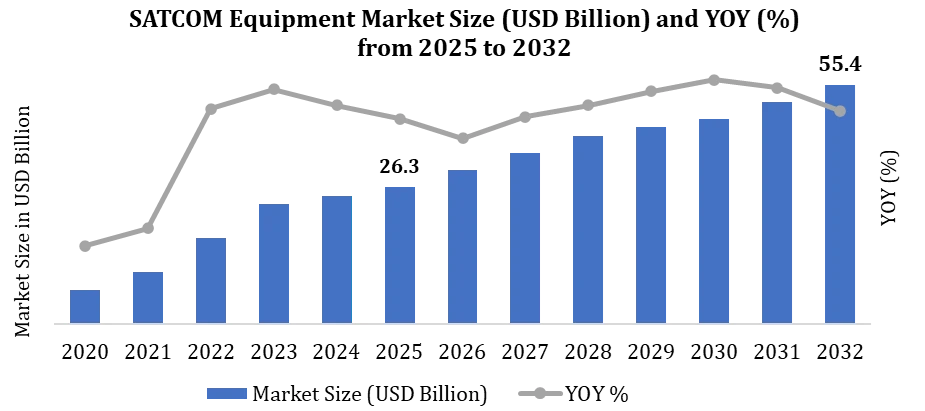
The Global SATCOM Equipment Market is valued at USD 26.3 billion in 2025 and is expected to reach USD 55.4 billion by 2032, growing at 11.2% CAGR, driven by rising demand for secure, compact, certified, and multi-network satellite communication hardware across defence, aviation, maritime, telecom backhaul, enterprise, emergency response, and remote connectivity applications.
The market remains equipment-specific because customers invest directly in terminals, antennas, RF chains, modems, routers, hubs, gateways, and ground systems before they consume satellite capacity or managed connectivity. In 2025, defence and government users account for 39% of demand, followed by commercial telecom and enterprise, maritime and aviation operators, and remote industries and emergency-response users showing that hardware value comes from certified, platform-ready, and mission-specific communication systems rather than bandwidth subscriptions.
To get more Insights: Request Free Sample Report
SATCOM Equipment Market Definition and Scope
The market includes hardware used to transmit, receive, amplify, process, route, secure, and manage communication through satellite networks. It covers SATCOM terminals, VSAT terminals, flat-panel antennas, parabolic antennas, electronically steered antennas, RF systems, BUCs, LNBs, transceivers, modems, routers, network equipment, gateway hardware, ground station equipment, tactical terminals, airborne systems, maritime systems, and defence-grade communication hardware.
The market excludes satellite manufacturing, launch services, satellite bandwidth revenue, connectivity subscription revenue, managed communication services, consumer internet plans, general telecom hardware not used for SATCOM, software-only platforms, and cloud services not directly bundled with ground station equipment. This boundary keeps the SATCOM Equipment Market Size focused on hardware revenue and avoids mixing it with service-based satellite communication revenue.
SATCOM Equipment Market Dynamics
|
SATCOM Equipment Market Drivers |
SATCOM Equipment Market Restraints |
|
Rising demand for secure government and defence communication systems is driving deployment of tactical terminals, RF systems, and mobile SATCOM hardware. FCC modernization reforms and earth-station infrastructure upgrades are accelerating investments in gateways, hub systems, and RF infrastructure. |
Certification delays across aviation, maritime, and defence platforms slow commercialization and deployment timelines. High installation and integration costs for terminals, antennas, cybersecurity layers, and mounting systems limit faster adoption. |
|
SATCOM Equipment Market Opportunities |
SATCOM Equipment Market Challenges |
|
Growing adoption of compact tactical terminals and software-defined modems creates strong opportunities across defence and enterprise SATCOM networks. Europe’s IRIS² initiative and global secure-connectivity programs are increasing long-term demand for gateways, terminals, and ground infrastructure. |
Export controls, spectrum coordination issues, and cybersecurity compliance requirements increase product launch complexity. Suppliers must manage thermal performance, ruggedization, RF interference, interoperability, and power efficiency across multiple platforms. |
SATCOM Equipment Market Segmentation
SATCOM Equipment Market by Equipment Type:
The SATCOM terminals segment leads the market with a 34% share because terminals serve as the main endpoint hardware across fixed, mobile, maritime, airborne, enterprise, and defence networks. Antennas and RF systems hold 30% as they directly control signal strength, transmission quality, and network performance through antennas, BUCs, LNBs, amplifiers, and RF chains. Ground station and gateway equipment accounts for 19% due to the high-value infrastructure needed for hubs, teleports, gateways, and ground network operations. Modems, routers, and network equipment represent 17% because they support link efficiency, data routing, traffic control, and secure SATCOM network access.

SATCOM Equipment Market by Platform
The land fixed and land mobile segment leads the Global SATCOM Equipment Market with a 37% share because fixed sites, vehicles, emergency response units, and remote operations create the widest deployment base. Space and ground infrastructure holds xx% as gateways, hubs, teleports, and mission ground systems involve high-value project equipment and network backbone investments. Airborne SATCOM accounts for xx% because aircraft systems require certified, lightweight, low-drag, and safety-compliant hardware, which increases average selling prices. Maritime represents xx% due to demand for stabilized, rugged, weather-resistant systems designed for ships, offshore assets, and marine connectivity environments.

SATCOM Equipment Market by End User
The defense and government segment leads the Global SATCOM Equipment Market with a 39% share because secure tactical, naval, airborne, and fixed government communication systems require rugged, certified, and mission-critical SATCOM equipment. Commercial telecom and enterprise accounts for xx%, supported by telecom backhaul, VSAT networks, private enterprise connectivity, and remote branch communication needs. Maritime and aviation operators hold xx% as ships and aircraft depend on higher-value, platform-specific SATCOM hardware with strict integration, safety, and retrofit requirements. Energy, mining, emergency response, and remote industries represent xx% because these users rely on satellite equipment where terrestrial networks remain weak, unavailable, or operationally unreliable.

SATCOM Equipment Market Competitive Analysis
The Global SATCOM Equipment Market remains moderately fragmented but technically specialized, with competition spread across terminals, antennas, RF systems, modems, hubs, gateways, airborne systems, maritime systems, and defence-grade communication hardware. Viasat, Hughes/EchoStar, Gilat, ST Engineering iDirect, and Comtech hold strong positions in core SATCOM networking and ground equipment, supported by terminals, VSAT platforms, modems, routers, amplifiers, RF chains, and gateway infrastructure. These companies compete on network reliability, link efficiency, installed base strength, defence compatibility, enterprise connectivity, and the ability to support GEO, LEO, MEO, and multi-orbit communication environments.
Platform-focused players such as Thales, L3Harris, RTX/Collins Aerospace, Honeywell Aerospace, Cobham Satcom, Intellian, Kymeta, ThinKom, Get SAT, CPI Satcom, AvL Technologies, and Kratos strengthen the market through specialized hardware portfolios. Their advantage lies in certified airborne systems, rugged maritime antennas, tactical terminals, mobile flat-panel solutions, transportable ground stations, and defence communication infrastructure. Competition is shifting toward compact, secure, low-profile, multi-network, and mission-ready SATCOM equipment, as customers prioritize mobility, resilience, faster deployment, and platform-specific integration over conventional single-network hardware.
Recent Developments Impacting the Global SATCOM Market.
|
Date |
Company/Organisation |
Recent Development |
Market Impact |
|
Jun-25 |
FCC (U.S.) |
Advanced earth-station licensing reforms and proposed broader blanket licensing for satellite infrastructure deployment. |
Accelerated deployment of gateways, earth stations, RF systems, and network-control equipment with lower regulatory barriers. |
|
2025 |
U.S. Space Force / DoD |
Expanded focus on interoperable SATCOM architectures capable of supporting integrated commercial and military communication systems. |
Increased demand for multi-path terminals, flexible modems, tactical SATCOM equipment, and resilient network infrastructure. |
|
Jul-25 |
Starlink, Jio-SES & Eutelsat OneWeb |
Received final approvals for commercial satellite communication service rollout in India. |
Strengthened demand for user terminals, gateways, satellite backhaul hardware, and rural connectivity infrastructure across Asia Pacific. |
|
Jun-25 |
French Government & Eutelsat |
France increased investment support for Eutelsat to strengthen Europe’s sovereign satellite communication capabilities and IRIS² participation. |
Accelerated investments in secure communication systems, sovereign satellite infrastructure, and defence-grade SATCOM networks. |
|
2025 |
Kratos Defense |
Expanded deployment of software-defined and virtualized SATCOM ground systems through OpenSpace architecture. |
Improved flexibility, interoperability, and scalability of next-generation SATCOM ground infrastructure. |
SATCOM Equipment Market Regional Analysis
North America leads the SATCOM Equipment Market with an estimated 39% regional share in 2025. The region’s development is equipment-led because the United States has a large defence SATCOM base, mature aerospace suppliers, commercial satellite operators, aviation connectivity programs, maritime communication systems, and extensive gateway infrastructure. Demand is strongest for secure terminals, airborne SATCOM hardware, tactical communication systems, gateways, RF systems, modems, and earth-station equipment.
Recent regulatory activity is strengthening the region’s equipment outlook. In 2025, the FCC proposed modernization of space and earth-station licensing, including extending most space-station and earth-station license terms to 20 years and expanding the list of modifications applicants can make without prior approval. This supports long-term investment in gateway equipment, earth-station hardware, hub systems, RF infrastructure, and network-control platforms.
Europe’s SATCOM equipment market is evolving around secure connectivity, sovereign communication infrastructure, defence modernization, and encrypted government communication systems. The region is witnessing rising demand for secure terminals, gateway systems, antennas, ground infrastructure, and network-control hardware. The EU’s IRIS² programme is becoming a major growth driver by accelerating investments in multi-orbit satellite communication systems for defence, maritime surveillance, border security, and critical infrastructure applications.
Asia Pacific is emerging as a major SATCOM growth hub due to rising rural connectivity requirements, telecom backhaul demand, maritime traffic, aviation expansion, and national satellite initiatives. India is playing a key role following satellite internet licensing approvals for Starlink, OneWeb India, and Jio Satellite Communication, increasing demand for user terminals, gateways, ground stations, and satellite backhaul equipment.
Middle East & Africa is strengthening demand for ruggedized SATCOM systems across oil & gas, defence, maritime, and remote industrial applications. South America, particularly Brazil, is witnessing growing satellite communication deployment for rural broadband, mining operations, remote-area connectivity, and emergency communication infrastructure.
|
SATCOM Equipment Market Report Coverage |
Details |
||
|
Base Year: |
2025 |
Forecast Period: |
2025 -2032 |
|
Historical Data: |
2020 to 2024 |
Market Size in 2025: |
USD 26.3 Bn |
|
Forecast Period 2025 to 2032 CAGR: |
11.2% |
Market Size in 2032: |
USD 55.4 Bn. |
|
Segments |
By Equipment Type |
SATCOM terminals Antennas and RF systems Modems, routers, and network equipment Ground station and gateway equipment |
|
|
By End-use
|
Defence and government Commercial telecom and enterprise Maritime and aviation operators Energy, mining, emergency response, and remote industries |
||
|
By Orbit Compatibility |
GEO-only equipment LEO-compatible equipment MEO-compatible equipmen Multi-orbit equipment |
||
|
By Platform |
Land fixed and land mobile Maritime Airborne Space and ground infrastructure |
||
SATCOM Equipment Market Global Key Players:
North America
- Viasat
- Hughes Network Systems / EchoStar
- Comtech Telecommunications
- L3Harris Technologies
- Kratos Defence & Security Solutions
Europe
- Thales
- Cobham Satcom
- ND SatCom
- WORK Microwave
- SpacePath Communications
Asia-Pacific
- ST Engineering iDirect
- Intellian Technologies
- Mitsubishi Electric
- Furuno Electric
- NEC Corporation
Middle East & Africa
- Gilat Satellite Networks
- Orbit Communication Systems
- Get SAT
- ASELSAN
- CTech
Frequently Asked Questions
The SATCOM Equipment Market size is estimated at USD 26.3 billion in 2025 under a hardware-only scope. This excludes satellite bandwidth, managed services, launch services, satellite manufacturing, and consumer internet subscription revenue.
The Global SATCOM Equipment Market is forecast to reach USD 55.4 billion by 2032, growing at a CAGR of 11.2% from 2025 to 2032
The key growth drivers are defence SATCOM modernization, ground station upgrades, aviation and maritime connectivity equipment, enterprise VSAT deployment, telecom backhaul, remote-site communication, and demand for multi-orbit terminals. These drivers increase demand for antennas, terminals, modems, routers, RF equipment, and gateway systems.
SATCOM terminals hold the largest share because every satellite communication network requires endpoint hardware for user access. Antennas and RF systems also hold a major share because link quality depends on signal acquisition, amplification, frequency handling, and platform compatibility.
1. Executive Summary
1.1 Global SATCOM Equipment Market Snapshot
1.2 Market Size, Forecast, and CAGR
1.3 Key Market Findings
1.4 Demand Outlook by Equipment Type
1.5 Demand Outlook by Platform
1.6 Demand Outlook by Region
1.7 Strategic Implications for SATCOM Equipment Suppliers
2. Research Scope and Market Definition
2.1 SATCOM Equipment Market Definition
2.2 Inclusions and Exclusions
2.3 Hardware Scope: Terminals, Antennas, RF Systems, Modems, Routers, Gateways, and Ground Stations
2.4 Difference Between SATCOM Equipment and SATCOM Services
2.5 Difference Between Satellite Communication Equipment and Satellite Bandwidth Revenue
2.6 Base Year, Historical Period, and Forecast Period
2.7 Currency, Units, and Assumption Framework
3. Research Methodology
3.1 Primary Research Framework
3.2 Secondary Research Validation
3.3 Bottom-Up Market Sizing Approach
3.4 Top-Down Triangulation Approach
3.5 Demand Block Identification
3.6 Installed Base Estimation
3.7 New Deployment Estimation
3.8 Equipment ASP Modelling
3.9 Replacement and Upgrade Factor Calculation
3.10 Company Revenue Triangulation
3.11 Regional Share Validation
3.12 Segment Share Validation
3.13 CAGR and Forecast Audit
3.14 Data Reliability and Confidence Scoring
4. Market Engineering and Size Estimation
4.1 Global SATCOM Equipment Market Size, 2025
4.2 Global SATCOM Equipment Market Forecast, 2032
4.3 SATCOM Equipment Market CAGR, 2025–2032
4.4 Market Size by Demand Block
4.5 Defence and Government SATCOM Equipment Market Size
4.6 Commercial VSAT and Enterprise SATCOM Hardware Market Size
4.7 Maritime SATCOM Equipment Market Size
4.8 Airborne SATCOM Equipment Market Size
4.9 Land-Mobile and Remote-Site SATCOM Equipment Market Size
4.10 Ground Station and Gateway Equipment Market Size
4.11 Telecom Backhaul SATCOM Equipment Market Size
4.12 Tactical and Secure SATCOM Equipment Market Size
4.13 Replacement and Modernization Demand Analysis
4.14 Market Size Audit and Sensitivity Check
5. Historical Market Analysis, 2020–2024
5.1 Global SATCOM Equipment Market Historical Size
5.2 Year-on-Year Growth Analysis
5.3 COVID-19 and Supply Chain Impact
5.4 Aviation SATCOM Equipment Recovery
5.5 Maritime SATCOM Hardware Adoption
5.6 Defence SATCOM Procurement Movement
5.7 Enterprise VSAT Hardware Demand
5.8 Ground Station and Gateway Expansion
5.9 Historical Company Revenue Indicators
5.10 Historical Market Movement Summary
6. Forecast Analysis, 2025–2032
6.1 Global SATCOM Equipment Market Forecast
6.2 Year-on-Year Forecast Movement
6.3 Forecast Assumption Framework
6.4 Multi-Orbit SATCOM Equipment Outlook
6.5 Flat-Panel Antenna Adoption Outlook
6.6 Electronically Steered Antenna Outlook
6.7 Software-Defined Modem Outlook
6.8 Ground Infrastructure Modernization Outlook
6.9 Defence and Tactical SATCOM Forecast
6.10 Aviation and Maritime SATCOM Equipment Forecast
6.11 Forecast Risk and Scenario Review
6.12 CAGR Calculation and Verification
7. Market Overview
7.1 Role of SATCOM Equipment in Satellite Communication Networks
7.2 Hardware Revenue vs. Service Revenue
7.3 SATCOM Terminals Market Overview
7.4 SATCOM Antenna Market Overview
7.5 SATCOM RF Systems Market Overview
7.6 SATCOM Modems and Routers Market Overview
7.7 Gateway and Ground Station Equipment Overview
7.8 Application Role Across Defence, Aviation, Maritime, Telecom, Enterprise, and Remote Industries
8. Market Dynamics
8.1 Market Growth Drivers
8.1.1 Defence SATCOM Equipment Modernization
8.1.2 Ground Station and Gateway Infrastructure Upgrades
8.1.3 Maritime and Airborne SATCOM Equipment Demand
8.1.4 Enterprise VSAT and Telecom Backhaul Deployment
8.1.5 Multi-Orbit Terminal Readiness
8.2 Market Restraints
8.2.1 High Equipment and Integration Cost
8.2.2 Certification and Platform Approval Delays
8.2.3 Spectrum Coordination Constraints
8.2.4 Export Control and Security Compliance Burden
8.2.5 Procurement Cycle Volatility
8.3 Market Opportunities
8.3.1 Compact Tactical SATCOM Terminals
8.3.2 Software-Defined SATCOM Modems
8.3.3 Electronically Steered Antenna Systems
8.3.4 Cloud-Connected Ground Infrastructure
8.3.5 Satellite-Cellular Convergence Hardware
8.4 Market Challenges
8.4.1 Thermal Management and Power Consumption
8.4.2 Interoperability Across Satellite Networks
8.4.3 Cybersecurity Requirements
8.4.4 Hardware Miniaturization Pressure
8.4.5 Field Reliability in Harsh Environments
9. Market Trends
9.1 Multi-Orbit SATCOM Equipment
9.2 LEO-Compatible SATCOM Terminals
9.3 Flat-Panel SATCOM Antennas
9.4 Electronically Steered Antennas
9.5 Software-Defined Modems
9.6 AI-Enabled Network Management Equipment
9.7 Cloud-Connected Ground Stations
9.8 Tactical Portable SATCOM Systems
9.9 Satellite-Cellular Convergence Hardware
9.10 Interoperable Terminals Across GEO, MEO, and LEO Networks
10. Market Segmentation
10.1 Global SATCOM Equipment Market by Equipment Type
10.1.1 SATCOM Terminals
10.1.2 Antennas and RF Systems
10.1.3 Modems, Routers, and Network Equipment
10.1.4 Ground Station and Gateway Equipment
10.2 Global SATCOM Equipment Market by Platform
10.2.1 Land Fixed and Land Mobile
10.2.2 Maritime
10.2.3 Airborne
10.2.4 Space and Ground Infrastructure
10.3 Global SATCOM Equipment Market by End User
10.3.1 Defence and Government
10.3.2 Commercial Telecom and Enterprise
10.3.3 Maritime and Aviation Operators
10.3.4 Energy, Mining, Emergency Response, and Remote Industries
10.4 Global SATCOM Equipment Market by Orbit Compatibility
10.4.1 GEO-Only Equipment
10.4.2 LEO-Compatible Equipment
10.4.3 MEO-Compatible Equipment
10.4.4 Multi-Orbit Equipment
10.5 Segment Share Comparison
10.6 Segment Growth Attractiveness Matrix
10.7 Segment-Level Investment Opportunity
11. Regional Analysis
11.1 Global Regional Snapshot
11.2 North America SATCOM Equipment Market
11.2.1 United States
11.2.2 Canada
11.2.3 Mexico
11.2.4 Defence SATCOM Equipment Demand
11.2.5 Aviation and Ground Infrastructure Demand
11.3 Europe SATCOM Equipment Market
11.3.1 Germany
11.3.2 France
11.3.3 United Kingdom
11.3.4 Italy
11.3.5 Spain
11.3.6 Secure Connectivity and Sovereign SATCOM Programs
11.4 Asia Pacific SATCOM Equipment Market
11.4.1 China
11.4.2 India
11.4.3 Japan
11.4.4 South Korea
11.4.5 Australia
11.4.6 Southeast Asia
11.4.7 Telecom Backhaul and Remote Connectivity Demand
11.5 Middle East and Africa SATCOM Equipment Market
11.5.1 GCC Countries
11.5.2 Israel
11.5.3 Turkey
11.5.4 South Africa
11.5.5 Rest of Middle East and Africa
11.5.6 Defence, Oil and Gas, Maritime, and Remote-Site Demand
11.6 South America SATCOM Equipment Market
11.6.1 Brazil
11.6.2 Argentina
11.6.3 Chile
11.6.4 Colombia
11.6.5 Rest of South America
11.6.6 Mining, Remote Connectivity, and Telecom Backhaul Demand
11.7 Regional Share Analysis
11.8 Regional Growth Opportunity Ranking
11.9 Regional Risk Assessment
12. Competitive Landscape
12.1 Competitive Overview
12.2 Market Concentration Analysis
12.3 Global Top SATCOM Equipment Companies
12.4 Regional SATCOM Equipment Companies
12.5 Company Positioning by Equipment Type
12.6 Company Positioning by Platform
12.7 Company Positioning by End User
12.8 Competitive Benchmarking Matrix
12.9 Product Portfolio Comparison
12.10 Recent Company Developments
12.11 Strategic Partnerships and Contracts
12.12 Mergers, Acquisitions, and Investments
12.13 Competitive Gaps and White Space
13. Company Profiles
13.1 Viasat
13.2 Hughes Network Systems / EchoStar
13.3 ST Engineering iDirect
13.4 Comtech Telecommunications
13.5 Thales
13.6 L3Harris Technologies
13.7 RTX / Collins Aerospace
13.8 Honeywell Aerospace
13.9 Cobham Satcom
13.10 Intellian Technologies
13.11 Gilat Satellite Networks
13.12 Kymeta
13.13 ThinKom Solutions
13.14 CPI Satcom & Antenna Technologies
13.15 Kratos Defence & Security Solutions
Each company profile should include: Company Overview, SATCOM Equipment Portfolio, Target Platforms, End-User Focus, Geographic Presence, Recent Developments, Strategic Positioning, and Analyst View.
14. Recent Developments and Market Movements
14.1 Defence SATCOM Equipment Contracts
14.2 Ground Station and Gateway Modernization
14.3 Multi-Orbit Terminal Launches
14.4 Flat-Panel Antenna Product Developments
14.5 Maritime SATCOM Equipment Upgrades
14.6 Airborne SATCOM Hardware Developments
14.7 Satellite Broadband Equipment Deployments
14.8 Regulatory Developments Affecting SATCOM Equipment
14.9 Government Connectivity Programs
14.10 Strategic Partnerships and Product Integrations
15. Technology Analysis
15.1 SATCOM Terminal Architecture
15.2 Antenna Technology Evolution
15.3 RF Chain and Amplifier Technology
15.4 Modem and Router Technology
15.5 Gateway and Ground Station Architecture
15.6 Software-Defined SATCOM Hardware
15.7 Cybersecure SATCOM Equipment
15.8 Low-Power and Compact SATCOM Systems
15.9 Ruggedized Defence SATCOM Equipment
15.10 Future Technology Roadmap
16. Value Chain Analysis
16.1 Component Suppliers
16.2 RF and Antenna Manufacturers
16.3 Terminal Manufacturers
16.4 Modem and Network Equipment Suppliers
16.5 Gateway and Ground Infrastructure Providers
16.6 System Integrators
16.7 Satellite Operators
16.8 Defence and Commercial End Users
16.9 Aftermarket, Replacement, and Upgrade Channels
17. Pricing and ASP Analysis
17.1 SATCOM Terminal ASP
17.2 Maritime SATCOM Equipment ASP
17.3 Airborne SATCOM Equipment ASP
17.4 Tactical SATCOM Terminal ASP
17.5 Ground Station Equipment ASP
17.6 Modem and Router ASP
17.7 Antenna and RF System ASP
17.8 ASP Movement by Technology Type
17.9 ASP Pressure and Margin Impact
18. Supply-Side Analysis
18.1 Manufacturing Footprint
18.2 Component Availability
18.3 Semiconductor and RF Component Dependency
18.4 Antenna Manufacturing Capacity
18.5 Defence-Grade Equipment Production Constraints
18.6 Certification and Testing Capacity
18.7 Supplier Risk Analysis
18.8 Supply Chain Resilience
19. Demand-Side Analysis
19.1 Defence and Government Demand
19.2 Commercial Telecom Demand
19.3 Enterprise VSAT Demand
19.4 Maritime Operator Demand
19.5 Aviation Operator Demand
19.6 Energy and Mining Demand
19.7 Emergency Response Demand
19.8 Remote Community Connectivity Demand
19.9 Replacement and Upgrade Demand
20. Investment Opportunity Analysis
20.1 High-Growth Equipment Categories
20.2 High-Margin SATCOM Hardware Segments
20.3 Regional Investment Attractiveness
20.4 Defence and Secure Communication Opportunity
20.5 Ground Infrastructure Investment Opportunity
20.6 Aviation and Maritime Retrofit Opportunity
20.7 Multi-Orbit Terminal Opportunity
20.8 Emerging Market Connectivity Opportunity
20.9 Strategic Recommendations for Investors and Suppliers
21. Risk Analysis
21.1 Technology Risk
21.2 Certification Risk
21.3 Regulatory Risk
21.4 Export Control Risk
21.5 Procurement Risk
21.6 Supply Chain Risk
21.7 Pricing Risk
21.8 Competition Risk
21.9 Forecast Risk
22. Analyst Recommendations
22.1 Recommendations for SATCOM Equipment Manufacturers
22.2 Recommendations for Antenna and RF Suppliers
22.3 Recommendations for Ground Infrastructure Providers
22.4 Recommendations for Defence SATCOM Suppliers
22.5 Recommendations for Investors
22.6 Recommendations for New Entrants
22.7 Strategic Priorities Through 2032
23. Conclusion
23.1 Final Market Outlook
23.2 Key Growth Areas
23.3 Long-Term Equipment Demand View
23.4 Final Analyst Perspective