ENG
ENG Japanese
  French
  German
  Korean
Global Environmental DNA Market: Biodiversity Surveillance, eDNA Testing, Molecular Ecosystem Monitoring, and Regulatory Assessment Outlook 2026–2032
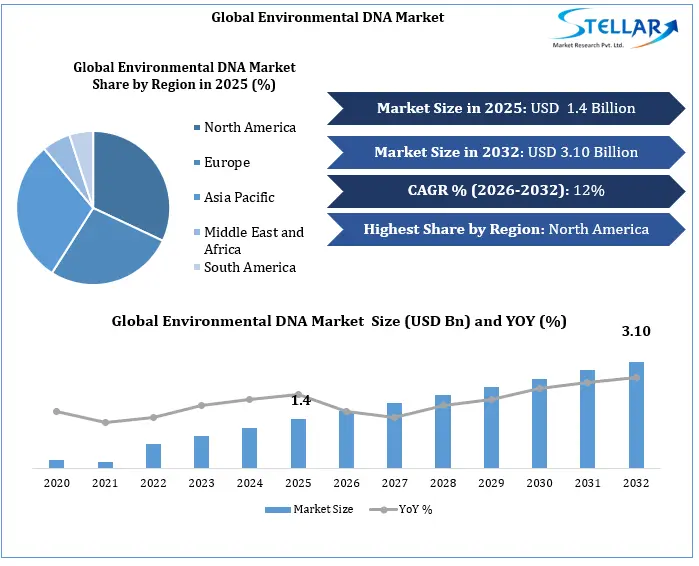
The Environmental DNA Market was valued at USD 1.4 billion in 2025 and is forecast to reach USD 3.10 billion by 2032, growing at a 12.0% CAGR. Rising demand for biodiversity monitoring, invasive species detection, sequencing-enabled ecosystem assessment, and regulatory monitoring is increasing eDNA spending worldwide.
Environmental DNA Market Definition and Scope
Environmental DNA is genetic information obtained from environmental sources including water, soil, sediments, air, biofilms, and wastewater to identify species, communities, pathogens, and ecological changes without directly collecting the organisms themselves. Environmental DNA, eDNA analysis, biodiversity assessment, molecular ecology, qPCR, metabarcoding, metagenomics, next-generation sequencing, bioinformatics, aquatic ecosystems, invasive species, endangered species, and conservation monitoring now connect through practical fieldwork, laboratory testing, and data-driven workflows.
The Environmental DNA Market includes spending on environmental DNA sample collection, extraction kits, reagents, PCR and qPCR testing, ddPCR testing, sequencing services, laboratory processing, bioinformatics tools, reference databases, field sampling services, environmental consultancy, regulatory monitoring, and biodiversity reporting. It also covers paid work linked to species detection, ecosystem health assessment, water quality monitoring, conservation planning, permitting support, and environmental advisory services. This scope reflects how eDNA has moved from research-focused use into routine commercial, regulatory, and ecological monitoring programs.
To get more Insights: Request Free Sample Report
Global Environmental DNA Market Growth Drivers
Transition to Molecular Surveillance Increases Demand for Testing:
eDNA can detect rare, mobile, nocturnal, seasonal, or elusive species through molecular analysis. This creates stronger demand for monitoring, testing, sequencing, and ecological reporting.
Increasing Invasive Species Monitoring Drives Demand for qPCR:
qPCR enables agencies to monitor invasive fish, mussels, crayfish, aquatic plants, and pathogens before they become abundant. This supports early detection and creates repeat testing demand.
Adoption of eDNA by Government Conservation Agencies Is Driving Growth:
Governments are implementing eDNA methods to monitor endangered species, aquatic ecosystems, restoration projects, and baseline biodiversity. This turns scientific methods into funded monitoring programs.
Environmental Monitoring and Protection Is Driving Demand for DNA Analysis:
Environmental health teams are using DNA-based approaches to identify biological, microbial, and pathogen risks in water and wastewater. This generates demand for extraction, qPCR, ddPCR, sequencing, and data interpretation services.
Increased Environmental Impact Assessment Drives eDNA Business:
Infrastructure projects, mining projects, energy projects, and development activities create requirements for baseline biodiversity and species-risk assessment. This supports consulting-led eDNA projects linked to permits, mitigation, and monitoring.
Cost Reductions and Increased Efficiency of DNA Analysis Increase Demand:
Sequencing costs are decreasing, while bioinformatics tools are improving. This makes multi-species testing more efficient and supports larger, more frequent monitoring programs.
Global Environmental DNA Market Opportunities
Regulatory-Approved Protocols Can Open the Compliance Market:
Validated methods, quality assurance, and clear reporting standards can help eDNA enter compliance, water monitoring, and protected species workflows. This can increase recurring testing demand.
Utilities Can Use eDNA for Early Biological Risk Monitoring:
Utility companies can use DNA monitoring for drinking water sources, catchments, wastewater, and microbial monitoring. This creates a practical commercial use case beyond conservation.
Offshore and Marine Projects Can Adopt eDNA for Baseline Biodiversity:
Offshore wind farms, ports, fisheries, marine parks, and coastal infrastructure projects can use eDNA to collect scalable biodiversity evidence. This can reduce field effort and improve baseline coverage.
Global Environmental DNA Market Trends
Use of qPCR Is Increasing for Targeted Species Monitoring:
qPCR works well when buyers need sensitive, cost-effective detection of a specific species or pathogen. It fits invasive species monitoring, endangered species tracking, and compliance-adjacent programs.
Metabarcoding Is Growing for Multi-Species Biodiversity Assessment:
Metabarcoding helps clients build biodiversity baselines and track ecosystem changes from one sample set. It is gaining importance in long-term biodiversity monitoring.
Reference Databases Are Becoming Strategic Infrastructure:
Accurate species identification depends on strong DNA barcode and reference libraries. Governments and research groups are building better regional databases to improve monitoring confidence.
eDNA Is Moving into Infrastructure and Natural Capital Assessment:
Businesses are using eDNA to support biodiversity baselines, nature-risk assessment, and habitat restoration reporting. This connects molecular ecology with sustainability, permitting, and corporate reporting.
Global Environmental DNA Market Challenges
Academic Protocols Must Adapt to Regulatory Standards:
Academic methods often need stronger validation, repeatability, and documentation before agencies accept them. Commercial labs must turn scientific protocols into auditable services.
Proper Contamination Control Measures Are Essential:
eDNA workflows involve low DNA concentrations, so contamination control is critical. Field blanks, extraction blanks, laboratory separation, and chain of custody remain essential.
DNA Presence Does Not Always Confirm Live Species Presence:
A positive result confirms DNA presence, but it does not always prove that a live or breeding population exists. Clients need careful ecological interpretation before making decisions.
Reference Species Databases Need Improvement:
Many habitats and species groups still lack complete DNA reference coverage. This affects confidence in metabarcoding and metagenomics results.
Global Environmental DNA Market Segmentation Analysis
Global Environmental DNA Market by Sample Type
Water Samples lead the Global Environmental DNA Market with a 46% (2025) share due to the wide use of eDNA testing across freshwater, marine, river, lake, wetland, wastewater, aquaculture, and offshore monitoring programs. Soil Samples, Sediment Samples, Air Samples, and Wastewater Samples are also gaining adoption as eDNA expands into restoration tracking, soil biodiversity assessment, benthic habitat studies, airborne biodiversity monitoring, and wastewater-based biological surveillance.

Global Environmental DNA Market by Technology
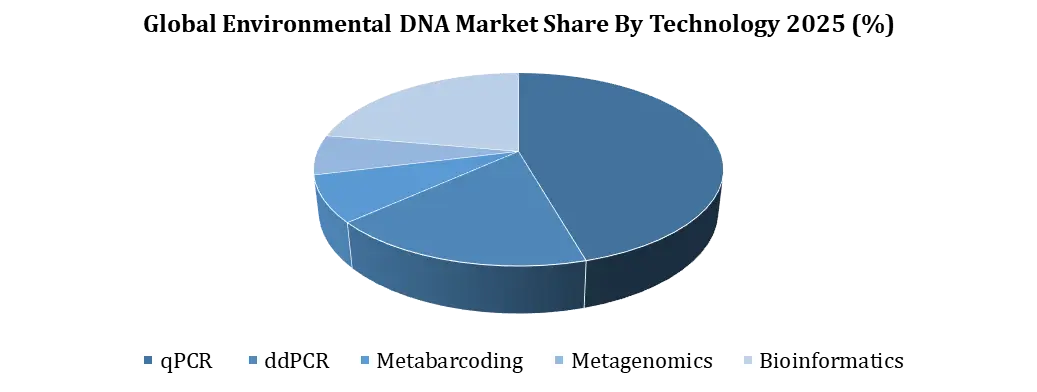
qPCR leads the market with a 32% (2025) share because it offers sensitive, targeted, and cost-effective detection of invasive species, endangered species, pathogens, and priority organisms. ddPCR, Metabarcoding, Metagenomics, and Bioinformatics are expanding as users look for higher sensitivity, multi-species biodiversity assessment, microbial community profiling, and faster ecological data interpretation.
Global Environmental DNA Market by Application
Biodiversity Monitoring leads the market with a 30% (2025) share because government agencies, conservation groups, environmental consultants, and research institutes use eDNA to detect species, build ecosystem baselines, and track ecological change. Invasive Species Detection, Endangered Species Monitoring, Environmental Impact Assessment, and Wastewater-Based Monitoring are also growing as eDNA becomes more useful for early warning systems, conservation planning, permitting support, and biological risk surveillance.
Global Environmental DNA Market by End User
Government Environmental Agencies lead the market with a 28% (2025) share because public programs fund biodiversity surveillance, invasive species control, protected species monitoring, fisheries assessment, water-quality programs, and ecosystem restoration. Environmental Testing Laboratories, Academic and Research Institutes, Environmental Consulting Firms, and Water Utilities support the remaining demand through molecular testing, sequencing, field sampling, regulatory reporting, research programs, and routine monitoring services.
Global Environmental DNA Market Competitive Analysis
The Global Environmental DNA Market includes specialist eDNA service providers, global testing companies, sequencing technology suppliers, and university-linked service laboratories. Leading specialist players such as NatureMetrics, eDNAtec, SPYGEN, and EnviroDNA offer focused services in biodiversity monitoring, species identification, environmental genomics, natural capital assessment, and ecosystem reporting.
Large testing companies such as Eurofins Scientific, SGS, Bureau Veritas, and ALS Limited strengthen the market through broad laboratory networks, environmental testing capabilities, qPCR workflows, sequencing access, and established regulatory client relationships. These companies help drive wider adoption because they can serve government agencies, infrastructure developers, utilities, mining companies, and environmental consultants at scale.
Technology suppliers such as Thermo Fisher Scientific, Illumina, QIAGEN, Bio-Rad Laboratories, Oxford Nanopore Technologies, and PacBio support the market with extraction kits, qPCR, ddPCR, sequencing platforms, reagents, and bioinformatics-linked workflows. Cornell University Environmental DNA and Genomics Core and other government or university-linked eDNA laboratories also play an important role by supporting assay development, method validation, research projects, and agency adoption.
Global Environmental DNA Market Key Developments
February 2026, USGS and partners launched an eDNA project for early detection of aquatic threats in the Colorado River downstream from Glen Canyon Dam and Lake Powell. The project strengthened invasive fish and aquatic threat surveillance. The development shows how public agencies are using eDNA for earlier detection and ecosystem management.
September 2025, NatureMetrics launched its AI-powered Portfolio Assessment tool for enterprise biodiversity and nature-risk assessment. The tool added portfolio-level analysis to its biodiversity intelligence platform. The development shows how eDNA data is moving into corporate nature reporting and multi-site environmental decision-making.
July 2025, Australian Marine Parks announced new eDNA data to improve understanding of marine biodiversity. The development strengthened marine ecosystem visibility through DNA-based monitoring. The announcement supports demand for eDNA in marine protected areas, offshore monitoring, and public biodiversity programs.
Global Environmental DNA Market Regional Analysis:
North America leads the Global Environmental DNA Market with a 37% share (2025). The region benefits from strong federal and state agency adoption, advanced molecular laboratory infrastructure, invasive species programs, fisheries monitoring, conservation funding, wastewater surveillance capacity, and high environmental consulting demand. The United States and Canada actively use eDNA for ecosystem monitoring, species-at-risk programs, aquatic invasive species detection, protected habitat assessment, and government-supported research. Strong collaboration between public agencies, universities, testing laboratories, and environmental consultants also helps move eDNA from research use into routine monitoring programs.
Europe shows strong demand for eDNA due to its biodiversity strategies, water monitoring programs, protected species regulations, natural capital reporting, and mature environmental consulting sector. Public research networks, national monitoring pilots, and protected species applications support wider adoption across the region. Regulators and environmental agencies are also showing growing interest in DNA-based evidence for ecological decision-making. As a result, eDNA is becoming more relevant in conservation planning, river basin management, infrastructure permitting, and habitat restoration programs.
Asia Pacific is the fastest-growing region as Australia, Japan, Singapore, China, India, and New Zealand expand eDNA use across biodiversity monitoring, marine conservation, biosecurity, aquaculture surveillance, water monitoring, and academic research. Australia leads applied adoption through marine parks, ecological restoration, mining rehabilitation, and natural capital assessment. Japan, Singapore, and New Zealand use eDNA in marine and freshwater monitoring, while India and Southeast Asia continue to build reference libraries and biodiversity datasets. Growing investment in conservation science and water-quality monitoring supports strong future demand.
Middle East & Africa shows emerging demand for eDNA through marine biodiversity protection, coastal development, desalination-linked water monitoring, biodiversity offsets, protected-area management, and environmental impact assessment. Governments, conservation bodies, and project developers are beginning to explore eDNA as a faster and less invasive tool for biodiversity screening. However, adoption remains at an early stage because the region still needs stronger local reference DNA databases, trained molecular ecology capacity, sequencing access, and routine regulatory acceptance. As coastal infrastructure and marine conservation programs expand, eDNA use is expected to gain more attention.
South America offers strong long-term potential because of its Amazon Basin, Andes region, freshwater systems, wetlands, coastal zones, mining areas, hydropower projects, and conservation monitoring needs. The region’s high biodiversity creates a strong case for scalable, non-invasive monitoring tools such as eDNA. Academic institutions and conservation groups are likely to play an important role in early adoption, especially for biodiversity discovery, ecosystem monitoring, and protected-area management. Market growth will depend on stronger public funding, better sequencing access, academic-to-commercial transfer, and continued development of regional reference DNA databases.
Global Environmental DNA Market Regulatory Framework
Regulatory acceptance of eDNA is improving across the global market, but adoption still varies by country and application. Biodiversity monitoring rules, water-quality programs, invasive species regulations, environmental impact assessment requirements, and agency acceptance of molecular evidence all shape demand for eDNA services. Regulators build confidence in eDNA when laboratories and field teams use clear sampling protocols, strong contamination controls, validated assays, reliable reference databases, proper chain of custody, quality assurance systems, standardized reporting, and careful interpretation of DNA detections.
North America and Europe are expected to adopt eDNA faster because they already have strong environmental monitoring rules, public conservation programs, protected species requirements, invasive species surveillance systems, water monitoring frameworks, and laboratory quality standards. Asia Pacific is also moving quickly, especially in Australia, Japan, New Zealand, Singapore, India, and China, where eDNA supports marine monitoring, biosecurity, aquaculture, and biodiversity programs. Emerging markets will adopt eDNA where conservation funding, development permitting, ecosystem restoration, and data-quality standards create clear demand for validated molecular monitoring.
|
Global Environmental DNA Market |
|||
|
Report Coverage |
Details |
||
|
Base Year: |
2025 |
Forecast Period: |
2026-2032 |
|
Historical Data: |
2020 to 2025 |
Market Size in 2025: |
USD 1.4 Bn. |
|
Forecast Period 2026 to 2032 CAGR: |
12% |
Market Size in 2032: |
USD 3.10 Bn. |
|
Segments
|
By Sample Type |
|
|
|
By Technology
|
|
||
|
By Application |
|
||
|
By End User |
|
||
Key Players Covered in the Global Environmental DNA Market
- NatureMetrics
- eDNAtec
- SPYGEN
- EnviroDNA
- Wilderlab
- Jonah Ventures
- ID-GENE ecodiagnostics
- Sinsoma
- RIFCON
- Applied Genomics
- Stantec
- Eurofins Genomics
- SGS
- Bureau Veritas
- ALS Limited
- Smith-Root
- Biomeme
- Illumina
- Oxford Nanopore Technologies
- PacBio
Frequently Asked Questions
The Global Environmental DNA Market is expected to reach USD 3.10 billion by 2032, growing at a CAGR of 12.0% from 2025 to 2032. Growth is driven by wider regulatory acceptance, falling sequencing costs, stronger bioinformatics tools, and increasing government and commercial monitoring programs.
Biodiversity Monitoring leads the market because government agencies, conservation groups, researchers, and environmental consultants use eDNA to detect species, track ecosystem change, support conservation planning, and build environmental baseline data.
Key players include NatureMetrics, eDNAtec, SPYGEN, EnviroDNA, Wilderlab, Jonah Ventures, ID-GENE ecodiagnostics, Sinsoma, RIFCON, Applied Genomics, Stantec, Eurofins Genomics, SGS, Bureau Veritas, ALS Limited, Smith-Root, Biomeme, Illumina, Oxford Nanopore Technologies, and PacBio.
1. Global Environmental DNA Market Introduction
2. Global Environmental DNA Market Executive Summary
2.1. Global Environmental DNA Market Size and Forecast (USD Billion)
2.2 Market Definition
2.3 Market Segmentation
2.4 Research Timelines
2.5 Assumptions
2.6 Limitations
3. Global Environmental DNA Market: Research Methodology
3.1 Data Mining
3.2 Secondary Research
3.3 Primary Research
3.4 Subject Matter Expert Advice
3.5 Quality Check
3.6 Final Review
3.7 Data Triangulation
3.8 Top-Down Approach
3.9 Bottom-Up Approach
3.10 Research Flow
3.11 Data Sources
4. Global Environmental DNA Market: Market Attractiveness Mapping
4.1 Global Environmental DNA Market Overview
4.2 Competitive Analysis: Funnel Diagram (Tier 1, Tier 2, Tier 3)
4.3 Global Environmental DNA Market Absolute Market Opportunities
4.4 Global Environmental DNA Market Attractiveness Analysis, By Region
4.5 Global Environmental DNA Market Attractiveness Analysis, By Sample Type
4.6 Global Environmental DNA Market Attractiveness Analysis, By Technology
4.7 Global Environmental DNA Market Attractiveness Analysis, By Application
4.8 Global Environmental DNA Market Attractiveness Analysis, By End User
4.9 Future Market Opportunities
5. Global Environmental DNA Market: Market Outlook
5.1 Global Environmental DNA Market Evolution
5.2 Market Trends
5.3 Market Dynamics
5.3.1 Market Drivers
5.3.2 Market Restraints
5.3.3 Market Trends
5.3.4 Market Opportunity
5.4 Porter’s Five Forces Analysis
5.4.1 Threat of New Entrants
5.4.2 Bargaining Power of Suppliers
5.4.3 Bargaining Power of Buyers
5.4.4 Threat of Substitute Products
5.4.5 Competitive Rivalry of Existing Competitors
5.5 PESTEL Analysis
5.6 Value Chain Analysis
5.7 System Configuration and Installation Analysis
5.8 Geopolitical Impact Assessment
5.9 Regulatory Framework and Policy Impact Assessment
5.10 Technology Landscape
6. Global Environmental DNA Market: By Sample Type, 2026-2032 (USD Billion)
6.1 Water Samples
6.2 Soil Samples
6.3 Sediment Samples
6.4 Air Samples
6.5 Wastewater Samples
7. Global Environmental DNA Market: By Technology, 2026-2032 (USD Billion)
7.1 qPCR
7.2 ddPCR
7.3 Metabarcoding
7.4 Metagenomics
7.5 Bioinformatics
8. Global Environmental DNA Market: By Application, 2026-2032 (USD Billion)
8.1 Biodiversity Monitoring
8.2 Invasive Species Detection
8.3 Endangered Species Monitoring
8.4 Environmental Impact Assessment
8.5 Wastewater-Based Monitoring
9. Global Environmental DNA Market: By End User, 2026-2032 (USD Billion)
9.1 Government Environmental Agencies
9.2 Environmental Testing Laboratories
9.3Academic and Research Institutes
9.4Environmental Consulting Firms
9.5 Water Utilities
10. Global Environmental DNA Market: Geography, 2026-2032 (USD Billion)
10.1 North America Global Environmental DNA Market
10.2 Europe Global Environmental DNA Market
10.3 Asia Pacific Global Environmental DNA Market
10.4 South America Global Environmental DNA Market
10.5 Middle East and Africa Global Environmental DNA Market
11. Global Environmental DNA Competitive Matrix
12. Global Environmental DNA Market: Company Benchmarking
13. Merger & Acquisition
14. Global Environmental DNA Market: Company Profiles
14.1 NatureMetrics
14.2 eDNAtec
14.3 SPYGEN
14.4 EnviroDNA
14.5 Wilderlab
14.6 Jonah Ventures
14.7 ID-GENE ecodiagnostics
14.8 Sinsoma
14.9 RIFCON
14.10 Applied Genomics
14.11 Stantec
14.12 Eurofins Genomics
14.13 SGS
14.14 Bureau Veritas
14.15 ALS Limited
14.16 Smith-Root
14.17 Biomeme
14.18 Illumina
14.19 Oxford Nanopore Technologies
14.20 PacBio
15. Risk Assessment and Scenario Analysis
16. Strategic Opportunity
17. Investments & Funding Analysis
18. Strategic Roadmap
19. Analyst Recommendations