ENG
ENG Japanese
  French
  German
  Korean
Global Ice Cream Market Competitive Analysis, Market Share, Demand Trends, Growth Drivers and Forecast (2026–2032)
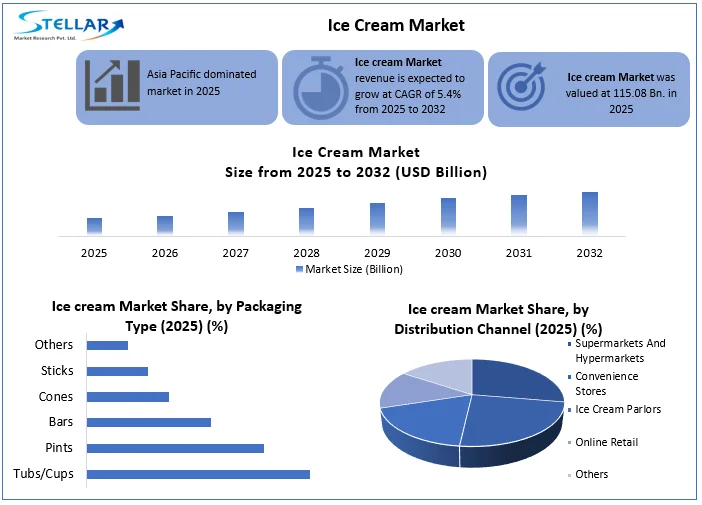
Ice Cream Market was valued at USD 115.08 Billion in 2025, and the total revenue is expected to grow at a CAGR of 5.4 % from 2025 to 2032, reaching USD 166.5 Billion by 2032.
The Global Ice Cream Market is a dynamic and growing segment of the frozen desserts industry, characterized by broad product variety, flavor innovation, and rising consumer preference for both indulgent and healthier options. Ice cream is a frozen dairy dessert traditionally made from milk, cream, sugar, and flavorings, enjoyed worldwide as a snack, treat, or dessert.
Ice cream manufacturers are continuously innovating by introducing new flavors, textures, and formats, including vegan ice cream, dairy-free alternatives, premium artisanal products, and functional frozen desserts, to capture emerging demand segments. Growth in plant-based ice creams reflects rising health consciousness, while small-batch artisanal ice cream emphasizes natural ingredients, exotic flavors, and premium indulgence. Increasing disposable incomes, expansion of modern retail, and the rapid rise of online ice cream delivery and e-commerce frozen dessert sales are boosting consumption across Asia-Pacific, North America, and Europe. Consumer preferences are shifting beyond traditional flavors toward low-sugar, lactose-free, high-protein, and clean-label ice cream products, supporting sustained market growth.
Key Market Insights (2025):
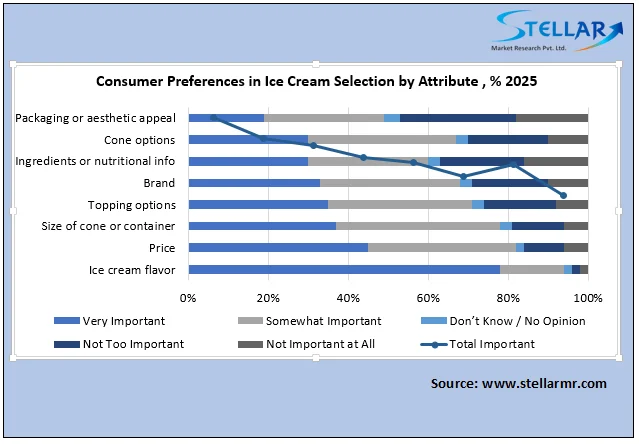
- Indulgence First: Flavor is the top driver for 94% of consumers; "low-sugar" claims appear in only 3% of new launches.
- Texture Pivot: 80% of Asian consumers now prioritize "multiple textures" (chunky/crispy) over traditional smooth profiles.
- Corporate Shakeup: Unilever’s 2025 spin-off of Ben & Jerry’s and Magnum marks a historic shift in global market leadership.
- Impulse Growth: Single-serve bars and cones held a 33.5% revenue share, fueled by on-the-go snacking habits.
- Digital Delivery: Quick Commerce and online sales are projected to capture 27% of urban transactions by year-end 2026.
To get more Insights: Request Free Sample Report
Consumer Preferences:
- Healthier Formulations: Rising demand for low-sugar, low-fat, and reduced-calorie ice creams supporting healthier lifestyles.
- Clean-Label & Natural Ingredients: Preference for simple, transparent ingredient lists with no artificial colors, flavors, or preservatives.
- Plant-Based & Dairy-Free Options: Growing interest in vegan and lactose-free ice creams made from almond, oat, soy, and coconut bases.
- Premium Flavors: Increased consumer spending on rich textures, high-quality ingredients, and exotic or fusion flavor profiles.
- Artisanal & Small-Batch Products: Strong appeal for handcrafted, locally produced ice creams offering uniqueness, authenticity, and gourmet positioning
Top Market Trend:
Health & Flavor Innovation Accelerating Ice Cream Market Growth
In the global ice cream market, consumer preferences are rapidly shifting toward healthier and more flavorful frozen desserts, driving innovation in both vegan ice cream, dairy-free alternatives, and premium artisanal flavors. Manufacturers are introducing functional and clean-label products such as low-sugar, lactose-free, and plant-based ice creams to meet evolving demand, particularly as non-dairy options grow in popularity year-on-year. While 94% of consumers prioritize flavor, the vegan and dairy-free ice cream segment is growing at a 9.6% CAGR, reflecting rising demand for plant-based and clean-label frozen desserts. The global ice cream market growth was supported by premiumization rather than strict dieting as only 3% of new launches focus on low-sugar claims. In the Japan Ice Cream Market, a strong demand for matcha-flavored ice cream, rooted in cultural traditions and reinforced by strict food quality regulations, highlights how local preferences and trust-driven standards shape premium ice cream innovation globally.
Ice Cream Market Dynamics:
Digital Retail Transformation and Quick-Commerce Expansion to drive the Market Growth
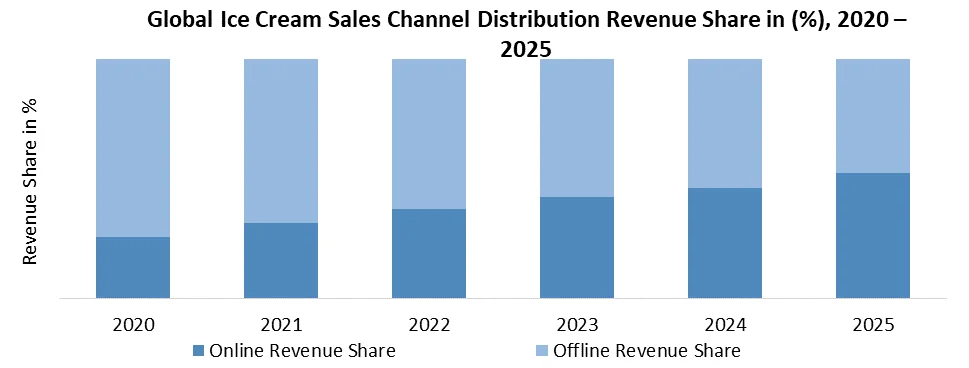
The primary driver for market growth in 2025 is the rapid integration of "Quick-Commerce" (Q-Commerce) and AI-driven logistics. Global online ice cream sales are projected to grow at a CAGR of 12.99% through 2029, as platforms like UberEats and Zomato solve the "last-mile" cold chain challenge. In urban centers, digital transactions are expected to account for 27% of total sales by the end of 2026. This shift is turning ice cream from a planned grocery purchase into an "on-demand" impulse snack, significantly increasing purchase frequency among Gen Z and Millennial consumers
Intensifying Regulatory Scrutiny and Input Cost Volatility to hinder Market Growth
The industry faces a significant headwind from fluctuating raw material prices (sugar, dairy, and cocoa) combined with stricter government health mandates. In 2025, many regions implemented rigorous front-of-pack labeling requirements for high-sugar and high-fat products. With dairy costs remaining volatile due to environmental regulations, manufacturers are being forced to choose between absorbing reduced profit margins or passing price hikes to consumers a risky move given that 80% of consumers remain highly sensitive to price and package size.
Premiumization and Plant-Based Ice Cream Adoption to create Opportunity in the Ice Cream Market
A major opportunity lies in premium and plant-based ice cream segments, which are growing faster than traditional offerings. The ice cream market is increasingly embracing healthier and specialty formats, with Asia-Pacific Ice Cream Market projected to lead market expansion at a 7.3 % CAGR and plant-based variants among the fastest-growing categories globally. This trend is fueled by shifting consumer preferences toward vegan ice cream, dairy-free options, and artisanal frozen desserts, especially among younger demographics and health-conscious buyers seeking indulgent yet wholesome products.
Ice Cream Market: Segment Analysis
By Type: In 2025, take-home ice cream held the largest share of the Ice Cream Market, driven by bulk purchasing, family consumption, and rising at-home indulgence trends supported by supermarkets and online retail. Impulse ice cream continues to show strong demand, supported by convenience stores, single-serve formats, and on-the-go consumption, particularly during peak summer seasons. Meanwhile, artisanal ice cream is witnessing faster growth, fueled by premiumization, demand for natural ingredients, unique flavors, and locally crafted, small-batch offerings that appeal to urban, health-conscious, and experience-driven consumers.
.webp)
Regional Analysis:
The global ice cream market in 2025 is defined by a distinct "North-to-South" and "West-to-East" shift in growth velocity and premiumized snacking and regional flavor localization.
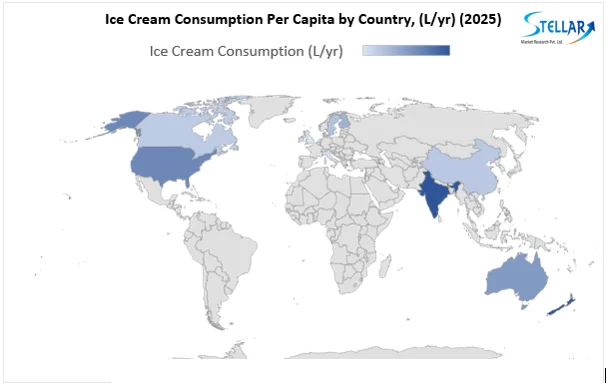
- Asia-Pacific (The Global Leader): China maintained the largest regional slice of over 40% of the Ice Cream Market share in 2025, while India was the world's fastest-growing market, seeing its per capita consumption skyrocket to 1.6L (a four-fold increase in 10 years). the "Sensory Gap" 80% of Asian consumers demand "multiple textures" (chunky/crispy) in single-serve formats.
- North America (The Value Hub): While volume growth was stabilizing, the U.S. market remained the most profitable per unit. According to the IDFA, the industry supported 26,700 direct jobs and generated USD 1.9 billion in wages. A significant 94.9% of U.S. consumers now prioritize "premium and super-premium" labels, allowing small-batch artisanal pints to command a 15–20% price premium over standard products.
- Europe (The Innovation Hub): The Europe Ice Cream Market led in "Clean Label" and sustainability. Production was anchored by Germany (XX million liters) and France (568 million liters). Currently, 25% of European consumers actively choose lactose-free or vegan options, making it the epicenter for non-dairy innovation.
- Middle East & Africa (The Infrastructure Frontier): The MENA sector alone consumed 3 million tons annually. Growth was fueled by a 5.10% CAGR in Africa, where solar-powered cold-chain solutions are expanding distribution into previously inaccessible off-grid regions. High-end "heritage" flavors (using ingredients like za’atar and camel milk) are trending in urban UAE and Saudi Arabia
- South America (The Impulse Snackers): Brazil dominated this region with a XX% share of revenue in 2025. The market is primarily "Impulse-driven," with bars and cones accounting for over 30% of sales. The region is seeing a digital surge, with 11% of total sales now flowing through "Quick-Commerce" delivery platforms in hubs like Sao Paulo and Mexico City.
Competitive Landscape: Strategic Consolidation and "Pure-Play" De-mergers
The global ice cream competitive ecosystem in 2025 was undergoing a fundamental structural reset, characterized by a transition toward portfolio rationalization and operational agility. The most significant strategic move is the December 2025 completion of Unilever’s ice cream spin-off, which carved out its USD 9.21 billion division featuring five of the top ten global brands like Magnum and Ben & Jerry’s into a standalone entity, The Magnum Ice Cream Company (TMICC).
This "pure-play" strategy aims to unlock value by decoupling high-capital-intensity frozen logistics from core FMCG operations. Nestle and General Mills are defending their market share through "Functional Premiumization," with Nestlé launching 40% reduced-sugar Haagen-Dazs ranges and General Mills debuting "Nature’s Scoop" to target the 25% of consumers demanding clean-label transparency. In the high-velocity Asia-Pacific sector, regional giants like Yili Group and Amul (GCMMF) are leveraging superior local cold-chain networks to capture a combined 25.1% share in India and China, outmaneuvering incumbents through localized "Impulse" innovations such as probiotic-rich and heritage-flavor sticks.
Ice Cream Market Scope
|
Ice Cream Market |
|||
|
This Report Covers |
Details |
||
|
Base Year: |
2025 |
Forecast Period: |
2026-2032 |
|
Historical Data: |
2020 to 2025 |
Market Size in 2025: |
USD 115.08 Bn |
|
Forecast Period 2026 to 2032 CAGR: |
5.4 % |
Market Size in 2032: |
USD 166.5 Bn |
|
Ice Cream Market Segments Covered: |
By Type |
Impulse Ice Cream Take-Home Ice Cream Artisanal Ice Cream |
|
|
By Category |
Dairy Non-Dairy |
||
|
By Flavor |
Chocolate Vanilla Fruit Others |
||
|
By Packaging Type |
Pints Tubs/Cups Cones Bars Sticks Others |
||
|
By Distribution Channel |
Supermarkets And Hypermarkets Convenience Stores Ice Cream Parlors Online Retail Others |
||
Ice Cream Market, by region
North America (United States, Canada and Mexico)
Europe (UK, France, Germany, Italy, Spain, Sweden, Russia and Rest of Europe)
Asia Pacific (China, South Korea, Japan, India, Australia, Indonesia, Malaysia, Vietnam, and Rest of APAC)
South America (Brazil, Argentina, Rest of South America)
Middle East and Africa (South Africa, GCC, Egypt, Nigeria, Rest of MEA)
Ice Cream industry key Players
- The Magnum Ice Cream Company
- Nestle
- Froneri
- General Mills (Haagen-Dazs)
- Wells Enterprises
- Mars, Incorporated
- Amul (GCMMF)
- Lotte Confectionery
- Blue Bell Creameries
- Yili Group
- Mengniu Dairy
- Danone
- Baskin-Robbins
- Breyers
- Dairy Queen
- Cold Stone Creamery
- Meiji Holdings
- Vadilal Industries
- Havmor Ice Cream
- Ferrero
- DMK Group
- Talenti Gelato
- Dippin’ Dots
- Turkey Hill Dairy
- Tillamook Creamery
- So Delicious Dairy Free
- NadaMoo
- Cornetto
- Amy’s Ice Creams
- Three Twins Ice Cream
- RITEK Ice Cream
Regional Breakdown:
North America Ice Cream Market: Industry Analysis and Forecast (2024-2030)
Frequently Asked Questions
In 2025, the Asia Pacific region dominated the Ice Cream market, driven by rapid urbanization, massive consumer base and high-growth markets like India.
The Ice Cream market was valued at USD 115.08 Billion in 2025 and is expected to grow at 5.4 % CAGR, reaching USD 166.5 Billion by 2032.
The report covers Type, Category, Flavor, Packaging Type, Distribution Channel, and Region.
Key challenges include rising raw material costs (cocoa, dairy), stringent health regulations, complex cold-chain logistics, and maintaining texture in dairy-free alternatives.
1. Ice Cream Market: Research Methodology
2. Ice Cream Market: Executive Summary
2.1. Study Assumption and Market Definition
2.2. Scope of the Study
2.3. Market Summary
2.3.1. Market Size (2025) & Forecast (2026 -2032)
2.3.2. Market Size (Value USD Billion, Volume in Tons) and Market Share (%) - By Segments, Regions and Country
3. Global Ice Cream Market: Competitive Landscape
3.1. SMR Competition Matrix
3.2. Competitive Positioning
3.3. Key Players Benchmarking
3.3.1. Company Name
3.3.2. Headquarter
3.3.3. Category Portfolio
3.3.4. Market Share (%)
3.3.5. Revenue, (2025)
3.3.6. Profit Margin (%)
3.3.7. Growth Rate (%)
3.3.8. Y-O-Y (%)
3.3.9. Patents
3.3.10. Sales Channels
3.3.11. Customer Engagement Metrics
3.3.12. New Category Innovation Rate
3.3.13. Quality Consistency Index
3.3.14. Certifications
3.3.15. Geographical Presence
3.4. Market Structure
3.4.1. Market Leaders
3.4.2. Market Followers
3.4.3. Emerging Players
3.5. Mergers and Acquisitions Details
4. Ice Cream Market: Dynamics
4.1. Ice Cream Market Trends
4.2. Ice Cream Market Dynamics
4.2.1. Drivers
4.2.2. Restraints
4.2.3. Opportunities
4.2.4. Challenges
4.3. PORTER’s Five Forces Analysis
4.4. PESTLE Analysis
4.5. Regulatory Landscape by Region
4.6. Key Opinion Leader Analysis for the Global Industry
4.7. Analysis of Government Schemes and Initiatives for Industry
5. Ice Cream Market: Global Market Size and Forecast by Segmentation (by Value in USD Billion, Volume in Tons) (2025-2032)
5.1. Ice Cream Market Size and Forecast, By Type (2025-2032)
5.1.1. Impulse Ice Cream
5.1.2. Take-Home Ice Cream
5.1.3. Artisanal Ice Cream
5.2. Ice Cream Market Size and Forecast, By Category (2025-2032)
5.2.1. Dairy
5.2.2. Non-Dairy
5.3. Ice Cream Market Size and Forecast, By Flavor (2025-2032)
5.3.1. Chocolate
5.3.2. Vanilla
5.3.3. Fruit
5.3.4. Others
5.4. Ice Cream Market Size and Forecast, By Packaging Type (2025-2032)
5.4.1. Pints
5.4.2. Tubs/Cups
5.4.3. Cones
5.4.4. Bars
5.4.5. Sticks
5.4.6. Others
5.5. Ice Cream Market Size and Forecast, By Distribution Channel (2025-2032)
5.5.1. Supermarkets And Hypermarkets
5.5.2. Convenience Stores
5.5.3. Ice Cream Parlors
5.5.4. Online Retail
5.5.5. Others
5.6. Ice Cream Market Size and Forecast, By Region (2025-2032)
5.6.1. North America
5.6.2. Europe
5.6.3. Asia Pacific
5.6.4. Middle East and Africa
5.6.5. South America
6. North America Ice Cream Market Size and Forecast by Segmentation (by Value in USD Billion, Volume in Tons) (2025-2032)
6.1. North America Ice Cream Market Size and Forecast, By Type (2025-2032)
6.2. North America Ice Cream Market Size and Forecast, By Category (2025-2032)
6.3. North America Ice Cream Market Size and Forecast, By Flavor (2025-2032)
6.4. North America Ice Cream Market Size and Forecast, By Packaging Type (2025-2032)
6.5. North America Ice Cream Market Size and Forecast, By Distribution Channel (2025-2032)
6.6. North America Ice Cream Market Size and Forecast, by Country (2025-2032)
6.6.1. United States
6.6.2. Canada
6.6.3. Mexico
7. Europe Ice Cream Market Size and Forecast by Segmentation (by Value in USD Billion, Volume in Tons) (2025-2032)
7.1. Europe Ice Cream Market Size and Forecast, By Type (2025-2032)
7.2. Europe Ice Cream Market Size and Forecast, By Category (2025-2032)
7.3. Europe Ice Cream Market Size and Forecast, By Flavor (2025-2032)
7.4. Europe Ice Cream Market Size and Forecast, By Packaging Type (2025-2032)
7.5. Europe Ice Cream Market Size and Forecast, By Distribution Channel (2025-2032)
7.6. Europe Ice Cream Market Size and Forecast, by Country (2025-2032)
7.6.1. United Kingdom
7.6.1.1. United Kingdom Ice Cream Market Size and Forecast, By Type (2025-2032)
7.6.1.2. United Kingdom Ice Cream Market Size and Forecast, By Category (2025-2032)
7.6.1.3. United Kingdom Ice Cream Market Size and Forecast, By Flavor (2025-2032)
7.6.1.4. United Kingdom Ice Cream Market Size and Forecast, By Packaging Type (2025-2032)
7.6.1.5. United Kingdom Ice Cream Market Size and Forecast, By Distribution Channel (2025-2032)
7.6.2. France
7.6.3. Germany
7.6.4. Italy
7.6.5. Spain
7.6.6. Sweden
7.6.7. Russia
7.6.8. Rest of Europe
8. Asia Pacific Ice Cream Market Size and Forecast by Segmentation (by Value in USD Billion, Volume in Tons) (2025-2032)
8.1. Asia Pacific Ice Cream Market Size and Forecast, By Type (2025-2032)
8.2. Asia Pacific Ice Cream Market Size and Forecast, By Category (2025-2032)
8.3. Asia Pacific Ice Cream Market Size and Forecast, By Flavor (2025-2032)
8.4. Asia Pacific Ice Cream Market Size and Forecast, By Packaging Type (2025-2032)
8.5. Asia Pacific Ice Cream Market Size and Forecast, By Distribution Channel (2025-2032)
8.6. Asia Pacific Ice Cream Market Size and Forecast, by Country (2025-2032)
8.6.1. China
8.6.2. S Korea
8.6.3. Japan
8.6.4. India
8.6.5. Australia
8.6.6. Indonesia
8.6.7. Malaysia
8.6.8. Philippines
8.6.9. Thailand
8.6.10. Vietnam
8.6.11. Rest of Asia Pacific
9. Middle East and Africa Ice Cream Market Size and Forecast (by Value in USD Billion, Volume in Tons) (2025-2032)
9.1. Middle East and Africa Ice Cream Market Size and Forecast, By Type (2025-2032)
9.2. Middle East and Africa Ice Cream Market Size and Forecast, By Category (2025-2032)
9.3. Middle East and Africa Ice Cream Market Size and Forecast, By Flavor (2025-2032)
9.4. Middle East and Africa Ice Cream Market Size and Forecast, By Packaging Type (2025-2032)
9.5. Middle East and Africa Ice Cream Market Size and Forecast, By Distribution Channel (2025-2032)
9.6. Middle East and Africa Ice Cream Market Size and Forecast, by Country (2025-2032)
9.6.1. South Africa
9.6.2. GCC
9.6.3. Egypt
9.6.4. Nigeria
9.6.5. Rest of ME&A
10. South America Ice Cream Market Size and Forecast by Segmentation (by Value in USD Billion, Volume in Tons) (2025-2032)
10.1. South America Ice Cream Market Size and Forecast, By Type (2025-2032)
10.2. South America Ice Cream Market Size and Forecast, By Category (2025-2032)
10.3. South America Ice Cream Market Size and Forecast, By Flavor (2025-2032)
10.4. South America Ice Cream Market Size and Forecast, By Packaging Type (2025-2032)
10.5. South America Ice Cream Market Size and Forecast, By Distribution Channel (2025-2032)
10.6. South America Ice Cream Market Size and Forecast, by Country (2025-2032)
10.6.1. Brazil
10.6.2. Argentina
10.6.3. Colombia
10.6.4. Chile
10.6.5. Rest Of South America
11. Company Profile: Key Players
11.1. The Magnum Ice Cream Company
11.1.1. Company Overview
11.1.2. Business Portfolio
11.1.3. Financial Overview
11.1.4. SWOT Analysis
11.1.5. Strategic Analysis
11.1.6. Recent Developments
11.1.7. BYD Auto
11.2. Nestle
11.3. Froneri
11.4. General Mills (Häagen-Dazs)
11.5. Wells Enterprises
11.6. Mars, Incorporated
11.7. Amul (GCMMF)
11.8. Lotte Confectionery
11.9. Blue Bell Creameries
11.10. Yili Group
11.11. Mengniu Dairy
11.12. Danone
11.13. Baskin-Robbins
11.14. Breyers
11.15. Dairy Queen
11.16. Cold Stone Creamery
11.17. Meiji Holdings
11.18. Vadilal Industries
11.19. Havmor Ice Cream
11.20. Ferrero
11.21. DMK Group
11.22. Talenti Gelato
11.23. Dippin’ Dots
11.24. Turkey Hill Dairy
11.25. Tillamook Creamery
11.26. So Delicious Dairy Free
11.27. NadaMoo
11.28. Cornetto
11.29. Amy’s Ice Creams
11.30. Three Twins Ice Cream
11.31. RITEK Ice Cream
11.32. Others
12. Key Findings
13. Analyst Recommendations