ENG
 Japanese
 French
 German
 Korean

Horse Racing Market: Global Industry Analysis, Market Size, Share, Trends and Forecast (2027–2034)
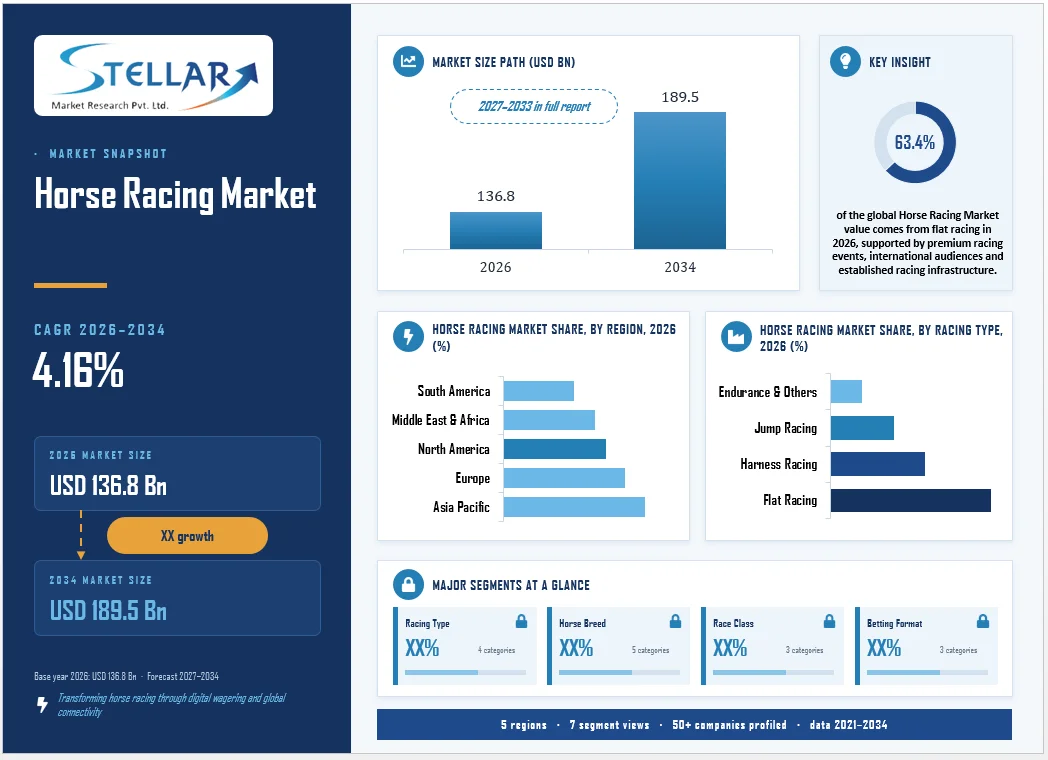
The Global Horse Racing Market is valued at USD 136.8 Bn in 2026 and is expected to reach USD 189.5 Bn by 2034, growing at a CAGR of 4.16% during 2027–2034.
The Global Horse Racing Market is valued at USD 136.8 Bn in 2026 and is expected to reach USD 189.5 Bn by 2034, growing at a CAGR of 4.16% during 2027–2034. The Horse Racing Market covers organized flat, harness, jump, and endurance racing, along with the commercial ecosystem supporting these activities. It includes pari-mutuel and fixed-odds wagering, racecourse admissions and hospitality, media and data rights, sponsorship, and the bloodstock trade that supplies racehorses. The industry is also known as the horse race betting market, thoroughbred racing industry, and racing and wagering market. Unlike many other sports, horse racing depends heavily on wagering revenue while managing a live animal supply chain and competing with football and basketball for consumer betting expenditure.
This Horse Racing Market analysis provides insights for racing authorities, racecourse operators, tote and fixed-odds wagering companies, broadcasters, racing data providers, breeders, bloodstock agents, sponsors and investors. It examines market entry opportunities and market strategies by assessing handle per race across flat, harness and jump racing, evolving bettor behaviour, betting taxes and levies, and their impact on prize money. The analysis also evaluates the betting channels, racing formats and geographic markets offering investment opportunities through 2034.
Flat racing accounts for the largest share of market value, while wagering contributes approximately three-quarters of total industry revenue. Horse Racing Market growth is increasingly shaped by online and mobile betting, commingled international wagering pools, media and streaming rights, premium racecourse hospitality, and expanding opportunities across Asia Pacific and Gulf jurisdictions. The expansion of tote monopolies in Japan and Hong Kong further strengthens the role of regulated wagering platforms in the global racing and betting ecosystem. However, softening racing turnover in the US and Australia introduces new challenges for industry revenue generation and long-term market growth.
Horse Racing Market Size and Growth: Industry Outlook to 2034
The Horse Racing Market is measured by total industry revenue generated from net wagering revenue retained by tote operators and bookmakers, media and broadcasting rights, sponsorship, ticketing and hospitality, and other racecourse income. Gross wagering handle is tracked separately as an indicator of betting demand rather than recognised as market revenue. Bloodstock auction turnover, breeding fees and equestrian sports outside organised racing are excluded to avoid double counting and maintain a consistent market sizing framework.
Industry and regulator data highlight contrasting regional demand trends. The Japan Racing Association recorded approximately JPY 3.51 trillion in wagering in 2025, representing 5.2% growth and its fourteenth consecutive annual increase. Similarly, the Hong Kong Jockey Club reported HK$143.31 billion in racing turnover for the 2025/26 season, up 3.2%. In contrast, Equibase data showed that US pari-mutuel wagering handle declined by 4.52% in the first half of 2026, despite average purses per race day increasing by 3.47%. These contrasting performances indicate that Horse Racing Market revenue growth increasingly depends on Asia's established wagering markets, premium racing events, and diversification into media, hospitality, and other commercial revenue streams rather than expansion in the number of races.
To get more Insights: Request Free Sample Report
Key Findings: Insights Shaping the Global Horse Racing Market
Racing authority reports, company filings, and betting regulator statistics point to the following key market research findings, highlighting Horse Racing Market demand, bettor behaviour, wagering trends, revenue generation, and market value creation through 2034.
- Market Growth. Market size rises from USD 136.8 Bn (2026) to USD 189.5 Bn (2034) at a 4.16% CAGR, adding about USD 52.7 Bn of annual revenue. Racing programmes, wagering technology and media distribution must scale through 2034.
- Flat racing leads, endurance leads growth. Flat racing held about 63.4% of 2026 value and grows at 4.2%, while endurance and other formats grow at 6.8% from a small base. Thoroughbred classics and Gulf showcase cards set the commercial ceiling.
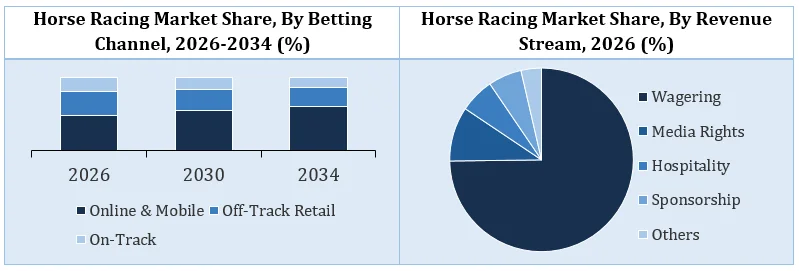
- Wagering dominates revenue; media rights grow fastest. Wagering held about 74.8% of 2026 revenue, while media and broadcasting rights grow at 6.9% on streaming, in-app video and multi-year television deals.
- Online betting overtakes retail. Online and mobile channels held about 48.5% of 2026 handle and climb past 60% by 2034, while off-track retail loses share as betting-shop estates shrink.
- Asia Pacific is the largest region. It held about 41.6% of 2026 value, anchored by JRA wagering of JPY 3.51 trillion in 2025 and Hong Kong turnover of HK$143.31 billion in 2025/26. Total monopolies return a steady share of handle to prize money.
- The Middle East and Africa is the fastest-growing region. It grows at about a 6.2% CAGR as Saudi Arabia and the UAE invest in prize money, international racing cards and racecourse tourism; the 2026 Dubai World Cup meeting alone carried USD 30.5 million.
- Commingled pools gain share. Simulcast and commingled betting rises from about 23% of 2026 handle to about XX% by 2034. The Hong Kong Jockey Club's World Pool overseas turnover grew 20% in 2025 to HK$9.3 billion.
- Horse supply and tax changes reshape competition. US race days fell 2.34% through August 2026, and the NTRA linked part of the 2026 handle decline to new limits on deducting gambling losses. Field size, purse funding and integrity costs favour well-capitalised operators.
- The competitive landscape is fragmented by role. State-sanctioned racing authorities, commercial racecourse groups, wagering companies and media owners compete for content, bettors and rights rather than as identical operators.
Horse Racing Industry Structure and Value Chain
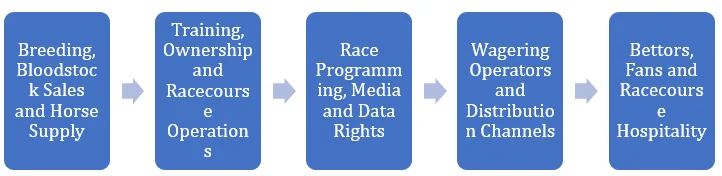
The Horse Racing Industry value chain runs from breeding and bloodstock sales through training, ownership and racecourse operations to race programming, media rights, wagering distribution and the bettor and fan experience. Foal crops, prize money, betting taxes, digital distribution and audience reach influence Horse Racing Market Demand.
Horse Racing Market Trends
1. Asia's Tote Revival: The Japan Racing Association recorded JPY 3.51 trillion of wagering in 2025, up 5.2% and the fourteenth consecutive annual increase, while regional NAR tracks grew about 2% to JPY 1.14 trillion in fiscal 2025. Younger and online-first bettors support Horse Racing Market Volume in Japan.
2. Commingling and Simulcast Expansion: Hong Kong racing turnover reached HK$143.31 billion in 2025/26, up 3.2%, with simulcast turnover up 23.5% to HK$16.2 billion after the government approved a wider overseas race menu to divert money from illegal bookmakers.
3. US Racing Contraction: US pari-mutuel handle fell 4.52% in the first half of 2026, and race days through August fell 2.34% to 2,425. Average purses per race day still rose 3.47% to USD 356,270, funded largely by racinos and historical racing machines.
4. Marquee Events Concentrate Value: Kentucky Derby Week set an all-sources handle record of USD 487 million in 2026, with peak television viewership of 24.4 million. Festivals and championship days capture a rising share of wagering, media and hospitality spend.
5. Sports Betting Competition and Channel Shift: Tabcorp's FY26 racing turnover slipped 1.1% while sports turnover rose 8.3%. In Britain, online racing turnover eased to GBP 7.85 billion in the year to March 2026 as the wider remote betting market grew 5%, although on-course betting reached its highest level since 2011.
Horse Racing Market Drivers: Digital Wagering, Commingled Betting Pools, Prize-Money Investment, and Premium Racing Events
Digital transformation in wagering is strengthening the commercial potential of the horse racing market. Online and mobile channels accounted for approximately 48.5% of total wagering handled in 2026, reflecting the growing preference for app-based betting and convenient digital platforms. Advanced deposit wagering (ADW) platforms and operator applications also provide access to richer customer data, supporting targeted promotions, bettor retention and personalised wagering experiences. The growing importance of digital channels is evident in TwinSpires' record USD 89 million handle on the 2026 Kentucky Derby Day programme, its highest ever, highlighting the revenue potential of major racing events through digital betting platforms.
International commingling is another significant growth driver, as it expands wagering liquidity by combining bets from multiple jurisdictions into shared pools. The Hong Kong Jockey Club conducted 329 races under its World Pool banner across 10 jurisdictions in 2025, increasing overseas World Pool turnover by 20% to HK$9.3 billion. Larger international pools support more stable dividend structures and improve the appeal of high-liquidity betting opportunities, particularly among high-stake bettors. This cross-border wagering model strengthens international betting participation and creates additional revenue opportunities for host jurisdictions, tote operators and racing authorities.
Prize-money investment and premium international racing events are expanding the geographic reach and commercial visibility of the industry. The Saudi Cup offered USD 20 million in February 2026, while the Jockey Club of Saudi Arabia increased the Neom Turf Cup prize money by 50% to USD 3 million. Similarly, the 30th Dubai World Cup meeting distributed USD 30.5 million across nine races. These high-value events attract international runners from Japan, the United States and Europe while generating additional commercial opportunities through broadcasting rights, sponsorship agreements, hospitality and international travel packages. Such investments strengthen the positioning of Gulf racing destinations as premium global sporting and entertainment hubs.
Horse Racing Market Restraints and Challenges: Declining Horse Supply, Betting Taxes, Sports Betting Competition and Animal Welfare Regulations
Declining horse populations and smaller foal crops represent a structural challenge for the Horse Racing Market. A limited supply of racehorses reduces field sizes, potentially weakening betting interest, wagering volumes and racecourse revenues. The British Horseracing Authority expects runner numbers to decline by a further 6–7% by 2027, while US race counts decreased by 2.79% through August 2026. At the same time, competition from sports betting platforms is intensifying, particularly among younger consumers who increasingly favour football, basketball and in-play wagering markets that offer year-round betting opportunities and more frequent events.
Betting taxes and regulatory restrictions create additional pressure on wagering operators and racing industry revenues. In the United States, the National Thoroughbred Racing Association (NTRA) linked a USD 45 million decline in first-half 2026 handle to new restrictions on gambling-loss deductions. Australia's Parliament passed wagering advertising restrictions in August 2026, while Britain's Horserace Betting Levy, charged at 10% of gross gambling yield on British racing, connects industry funding directly to bookmaker margins. In addition, animal welfare incidents, medication compliance requirements and racing integrity measures increase operating costs for racing authorities and racecourse operators. Illegal offshore betting further weakens regulated wagering markets by diverting betting activity away from licensed operators and established pari-mutuel pools.
Horse Racing Market Regional Growth Opportunities and Emerging Commercial Opportunities
Geographic expansion and new operating models create opportunities for the global Horse Racing Market through 2034. Asia Pacific is expected to generate the largest incremental market value, growing at approximately 4.7% through 2034 as Japan, Hong Kong, Australia and South Korea strengthen digital wagering infrastructure and established racing ecosystems. The Middle East and Africa are projected to grow at approximately 6.2%, supported by Gulf-region prize-money investments, international racing festivals and racecourse tourism. South America is expected to expand at approximately 4.1%, with Brazil, Argentina and Chile supporting regional racing and wagering activity.
Beyond traditional racing and betting formats, fractional horse ownership, team-based racing formats, prediction-style betting products and gaming-funded prize pools are creating additional commercial opportunities. These models can broaden consumer participation, attract younger audiences and diversify industry revenue beyond conventional wagering. Their long-term potential will depend on regulatory acceptance, consumer adoption and their ability to complement established racing and betting operations.
Horse Racing Market Dynamics Analysis: Economic Factors, Demand and Supply, Competitive Forces and Regulatory Influences
- Economic and macroeconomic factors: Discretionary spending, betting taxes and interest rates shape wagering demand. US handle fell 4.52% in the first half of 2026 while purses rose, so economic indicators point to revenue resilience at premium events and pressure on everyday race cards.
- Horse Racing Market Demand and Supply Gap Analysis: Demand comes from daily tote betting, festival weeks and international simulcasts, while supply depends on foal crops, trainer and jockey numbers and racecourse capacity. Shrinking fields in the US and Britain contrast with full fields and rising turnover in Japan and Hong Kong.
- Consumer behavior trends and preference evolution: Bettors want faster settlement, live streaming, multi-race exotics, and data-rich apps. Younger and female audiences are entering through online betting in Japan, fractional ownership in North America, and festival hospitality in Europe.
- Competitive forces and competitive landscape shifts: Sports betting is the main substitute for the betting wallet, while acquisitions such as Churchill Downs Incorporated's purchase of the Preakness Stakes rights for USD 85 million show consolidation. Content ownership, pool liquidity, and media reach increasingly decide Horse Racing Market Share.
- Technological advancements and innovation impact: Totalisator upgrades, real-time data feeds, computer-assisted wagering, streaming and integrity technology compress settlement times and widen distribution. About 86% of race days were live-streamed in 2026.
Digital Wagering Penetration, Streaming Reach and Changing Bettor Preferences
- Record Digital Handle: TwinSpires handled a record USD 89 million on the 2026 Kentucky Derby Day programme, up 1%. Advance deposit wagering platforms convert television audiences into bettors within minutes of a race call.
- Primetime Racing Audiences: The 152nd Kentucky Oaks aired in primetime for the first time in 2026, drawing 2.4 million viewers, and Oaks Day all-sources wagering set a record of USD 89 million. Broadcast slots now drive betting volumes directly.
- Cross-Border Liquidity: World Pool operated 329 races across 10 jurisdictions in 2025, with overseas turnover up 20% to HK$9.3 billion. Commingled pools let bettors in one market back races in another through a single tote.
- Racing Tourism: Hong Kong's two racecourses welcomed a record 401,259 visits from Mainland and overseas tourists in the 2025/26 season. Experience-led racedays support on-course betting, hospitality, and sponsor activation.
- Media Distribution Expansion: FOX Sports carries more than 1,000 hours of live racing programming annually and extended its portfolio to Del Mar in July 2026. Wider broadcast reach creates opportunities for Horse Racing Market Penetration among new audiences.
Horse Racing Market Innovations: Commingled Pools, Streaming, Prediction-Style Betting and Integrity Technology
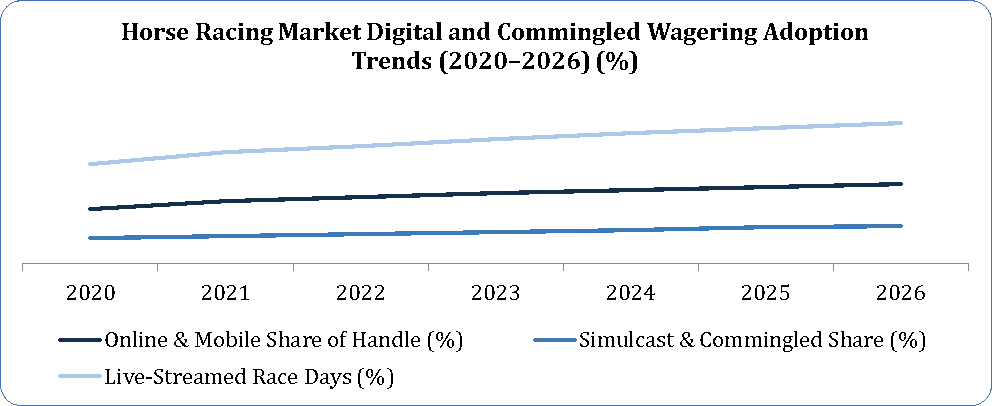
The Horse Racing Market is being reshaped by five trends: mobile-first wagering, international commingling, premium event monetisation, new ownership and competition formats, and integrity technology. Online and mobile betting reached about 48.5% of handle in 2026, up from 33.5% in 2020. Simulcast and commingled pools account for about 23% of handle, up from 15%. Live streaming now covers about 86% of race days, compared with 61% in 2020, and team-based and championship formats such as the Horse Racing League and the Thoroughbred Championship Series give broadcasters storylines they can sell across a season.
Digital tools carry much of the innovation load. Computer-assisted wagering teams, real-time sectional timing, tracking chips and algorithmic pricing reshape pool dynamics, while Podium and Predigy's binary-bet racing product targets traders used to sports exchanges. Fractional ownership platforms such as MyRacehorse bring fans into ownership for a few hundred dollars, and growing interest in racehorse aftercare and retraining programmes supports Horse Racing Market volume growth through a stronger social licence, longer racing careers and broader community engagement.
Horse Racing Formats Landscape: From Flat Classics to Harness, Jump and Endurance Racing
Racing format sets the economics of a meeting. Flat racing, run without obstacles mostly by Thoroughbreds, is the sport's commercial core and holds about xx% of 2026 value, growing at xx%. Harness racing, in which Standardbreds trot or pace while pulling a sulky, holds about xx% and supplies daily tote volume in France, Scandinavia and North America. Jump racing over hurdles and fences (xx%) peaks around British, Irish and French festivals, while endurance, Arabian and Quarter Horse racing (xx%) grow fastest at xx% on Gulf investment and new event formats.
Flat Racing: Thoroughbred Classics, Prize-Money Scale and Global Wagering Pull
Flat racing held about xx% of the Horse Racing Market in 2026, roughly USD xxBn, and grows at a xx% CAGR. It spans the Triple Crown and European Classics, Japan's G1 calendar, Hong Kong's international races and the richest cards in Riyadh, Dubai and Sydney, sold through tote pools, bookmakers, exchanges and advance deposit wagering platforms.
Differentiation increasingly rests on event quality as much as race volume: richer purses, stronger international fields, primetime broadcast slots and premium hospitality. Prize money spreads from claiming races worth a few thousand dollars to the USD 20 million Saudi Cup, and because flagship races are scarce assets, ownership of race rights, media distribution and sponsorship sits at the centre of the competitive game.
Harness and Jump Racing: Daily Tote Volume, Festival Peaks and Regional Strongholds
Harness racing held about xx% of value in 2026 and grows at xx% CAGR, with jump racing at xx%. France anchors harness betting through the PMU network, where trotting accounts for a large share of races and stakes, while Sweden's ATG and North American standardbred circuits supply year-round content. Jump racing draws its biggest crowds and betting peaks at the Cheltenham Festival and the Grand National, and racecourses use these weeks to lift sponsorship, hospitality and media prices above the level that ordinary fixtures support.
Endurance, Arabian and Quarter Horse Racing: Niche Formats, Gulf Investment and Event Experimentation
Endurance, Arabian and Quarter Horse racing sit mainly in the 5.3% "endurance and others" group. Gulf racing bodies fund Arabian races on their international cards, Quarter Horse sprints keep a loyal base in the US Southwest and Mexico, and endurance events give federations a format that showcases national breeding programmes and attracts state-backed sponsorship.
Betting Formats, Revenue Streams and Supply Base: Tote Pools, Fixed Odds, Media Rights and Bloodstock
Pari-mutuel and tote betting leads betting formats at about xx% of 2026 wagering revenue, but fixed-odds betting (xx%, xx% CAGR) gains share through bookmaker apps, and betting exchanges hold (XX%), with growth led by in-play trading. By revenue stream, wagering holds about 74.8%, media and broadcasting rights (XX%), sponsorship (XX%), and ticketing and hospitality (XX%). Horse supply comes from breeding hubs in Kentucky, Ireland, Newmarket, France, Hokkaido, Australia and New Zealand, with yearling sales setting the cost base for owners.
Emerging Horse Racing Innovation: Commingled Pools, Prediction Products, Fractional Ownership and Integrity Technology
Innovation is concentrated in commingled and simulcast pool technology; live streaming and in-app video; prediction-style and exchange betting products; fractional ownership and team-based formats; and equine welfare and integrity technology. Large groups such as Churchill Downs Incorporated, which owns the Kentucky Derby, TwinSpires and now full control of United Tote, use vertical integration to move quickly, while smaller racecourses rely on media partnerships and commingling agreements.
In the United States, the Horseracing Integrity and Safety Authority sets national medication and track safety rules for Thoroughbred racing. In Britain, the Horserace Betting Levy is charged at 10% of gross gambling yield from betting on British racing, and in Hong Kong the government approved a phased expansion of overseas simulcast races in June 2025 as part of its policy against illegal gambling.
Global Horse Racing Market Segmentation:
By Racing Type, Horse Breed, Race Class, Betting Format, Betting Channel, Bet Type, Revenue Stream and Region
Horse Racing Market Share by Racing Type, Betting Channel and Revenue Stream Analysis
By racing type, flat racing led with about 63.4% of 2026 value, followed by harness racing at xx%, jump racing at xx%, and endurance and other formats at xx%. Flat racing earns the highest handle per race in Asia, North America, and the Gulf, whereas endurance and other formats lead growth at xx% CAGR from a small base. Harness and jump racing remain regional strongholds rather than global volume drivers.
By betting channel, online and mobile wagering held about 48.5% of handle, off-track retail xx%, and on-track betting xx%. Off-track retail follows betting shops and OTB estates that shrink each year on-track betting holds up around festivals and championship days, and online and mobile grow the fastest at 7.1% on app-based betting and streaming.
By revenue stream, wagering led with about 74.8%, media and broadcasting rights held 9.6%, ticketing and hospitality xx%, sponsorship xx%, and other revenue xx%. The move toward rights and experiences is the defining revenue trend: media rights grow at xx% and premium hospitality at xx%, against xx% for wagering.
Segment Analysis: Target Market, Bettor Demographics, Niche Markets and Segment Attractiveness
- Racing type and format segmentation: Flat (X3.4%), harness (XX.2%), jump (13.1%), and endurance and other formats (5.3%) define product segmentation, and online flat-racing wagering is the most attractive segment, combining scale with 7%-plus channel growth.
- Bettor demographics and customer profiling: Core bettors are men aged 35 and above, but Japan, Hong Kong and North American festivals report rising participation by younger and female audiences. The core target market is the regular recreational bettor who wagers weekly and follows two or three racing circuits.
- Behavioral segmentation: Pool size, dividend value, streaming access, form data, and promotions drive betting decisions, and small fields rather than race quality are the main reason bettors move to other sports.
Horse Racing Market Regional Outlook: North America, Europe, Asia Pacific, Middle East & Africa and South America
Asia Pacific dominated the global Horse Racing Market in 2026, accounting for approximately 41.6% of total market value. Japan and Hong Kong anchor regional demand through their established tote betting monopolies and exceptionally high wagering turnover. The Japan Racing Association (JRA) recorded JPY 3.51 trillion in wagering in 2025, while the Hong Kong Jockey Club generated HK$143.31 billion in racing turnover during the 2025/26 season. Australia further strengthens the regional racing ecosystem through daily programmes across three racing codes, although Tabcorp's racing turnover declined by 1.1% in FY2026. The Asia Pacific Horse Racing Market is projected to grow at approximately 4.7% CAGR through 2034, supported by online and mobile wagering, international commingling and new bettor participation, which are expected to offset softer Australian betting volumes.
North America accounted for approximately XX% of global Horse Racing Market value in 2026, with the United States representing the largest regional market. US wagering handle reached approximately USD 11.03 billion in 2025, while gaming-funded prize money and diversified racecourse revenues help operators maintain commercial activity despite softer betting volumes. The region is expected to grow at approximately 3.0% CAGR through 2034, supported by premium racing events, digital wagering platforms, media rights and alternative funding models for prize money.
The Middle East and Africa Horse Racing Market is expected to record the fastest regional growth, expanding at approximately 6.2% CAGR through 2034. The region's contribution is projected to increase from XX% of global market value in 2026 to approximately 7.3% by 2034. Saudi Arabia and the UAE lead regional development through high-value international events such as the Saudi Cup and Dubai World Cup, while Qatar and Bahrain strengthen the region's international racing calendar. South Africa contributes established tote wagering activity and bloodstock operations. Growing prize-money investments, international horse participation, racecourse tourism and premium hospitality are strengthening the region's position as an emerging global racing destination.
Europe represented approximately XX% of global Horse Racing Market value in 2026 and is projected to grow at approximately 3.4% CAGR through 2034. Britain, Ireland and France remain the principal racing markets, supported by established racecourse networks, breeding operations, regulated betting systems and international racing events. PMU and on-course betting generated approximately EUR 8.9 billion in stakes, highlighting the importance of established wagering channels in the European racing ecosystem. Meanwhile, South America is expected to grow at approximately 4.1% CAGR, with Brazil, Argentina and Chile supporting regional expansion through established racing programmes, pari-mutuel wagering and bloodstock activities.
Horse Racing Market Forecast 2027–2034: Market Growth Phases, CAGR and Scenario Drivers
The SMR Horse Racing Market forecast indicates that global market revenue will increase from USD 136.8 billion in 2026 to USD 142.5 billion in 2027 and reach USD 189.5 billion by 2034. The market is projected to register a CAGR of 4.16% during 2027–2034, adding approximately USD 52.7 billion in annual revenue over the forecast period. Annual revenue additions are expected to increase from USD 5.7 billion in 2027 to USD 7.6 billion in 2034 as the expanding market base compounds.
Market growth is expected to progress through three broad phases. During 2027–2028, digital wagering adoption, international commingled betting pools and increased prize-money investment across Gulf racing destinations are expected to support expansion. From 2029 to 2031, broadcasting and media rights, premium racecourse hospitality and new racing competition formats are likely to strengthen revenue diversification. During 2032–2034, prediction-style betting products, fractional horse ownership and the expansion of Asia Pacific wagering markets could create additional growth opportunities beyond the base-case forecast. However, declining foal crops, adverse betting tax changes, wagering advertising restrictions and animal welfare-related regulatory developments remain important downside risks for the global Horse Racing Market outlook.
Horse Racing Market Competitive Landscape: Leading Racing Operators, Industry Structure and Key Players
The Horse Racing Market competitive landscape comprises multiple operator groups with distinct revenue models, geographic presence and levels of vertical integration. State-sanctioned racing authorities, including the Japan Racing Association, Hong Kong Jockey Club, Korea Racing Authority and PMU, operate integrated racing and pari-mutuel wagering businesses, supported by established betting networks and strong domestic market positions. Commercial racecourse and wagering groups such as Churchill Downs Incorporated, 1/ST Racing & Gaming, New York Racing Association, Keeneland and Woodbine Entertainment compete through race content ownership, venue operations and betting platform integration. Diversified wagering companies, including Flutter Entertainment, Entain and Tabcorp, strengthen their market presence by distributing horse racing betting alongside broader sports wagering portfolios. Gulf racing authorities and South American jockey clubs further contribute to the global competitive landscape through national racing programmes, premium international events and regional wagering networks.
Competition in the Horse Racing Market increasingly centres on premium racing content ownership, wagering pool liquidity, broadcasting rights and digital distribution capabilities. In 2026, Churchill Downs Incorporated agreed to acquire the Preakness Stakes and Black-Eyed Susan Stakes rights for USD 85 million and completed its acquisition of New York Racing Association's 49% stake in United Tote, restoring full ownership of the totalisator business. These developments demonstrate how acquisitions, strategic partnerships and control over wagering infrastructure can strengthen competitive positioning and expand revenue opportunities. Going forward, international commingling agreements, media rights transactions, championship partnerships and digital platform investments are expected to influence market consolidation, customer engagement and revenue diversification across the global horse racing industry.
Global Horse Racing Market Recent Developments, Event Launches and Industry News | 2026
- 5 Feb 2026: 1/ST Racing & Gaming and Arranca TV launched a Spanish-language horse racing channel with live coverage from Gulfstream Park and Santa Anita Park, widening reach among Hispanic audiences.
- 14 Feb 2026: The Jockey Club of Saudi Arabia staged the USD 20 million Saudi Cup and raised the Neom Turf Cup purse by 50% to USD 3 million, reinforcing Gulf prize-money leadership.
- 28 Mar 2026: Dubai Racing Club hosted the 30th Dubai World Cup meeting, with 101 horses from 17 countries competing for USD 30.5 million across nine races.
- 2 May 2026: Churchill Downs Incorporated recorded all-time Kentucky Derby Week all-sources handle of USD 487 million, up 3%, with TwinSpires setting a Derby Day record of USD 89 million.
- 15 Jul 2026: The Hong Kong Jockey Club closed the 2025/26 season with HK$143.31 billion turnover, up 3.2%, and record overseas betting turnover of HK$34.4 billion.
- 3 Aug 2026: Churchill Downs Incorporated and the New York Racing Association announced the Thoroughbred Championship Series, linking marquee races at Saratoga and Churchill Downs.
- 29 Sep 2026: Podium and Predigy formed an exclusive multi-year global partnership to launch a binary-bet, tradeable horse racing product for operators.
- 8 Oct 2026: MyRacehorse expanded into Canada in partnership with Woodbine Entertainment, bringing fractional racehorse ownership to Canadian fans.
Global Horse Racing Market Scope: Inquire before buying
|
Global Horse Racing Market |
|||
|
Report Coverage |
Details |
||
|
Base Year: |
2026 |
Forecast Period: |
2027-2034 |
|
Historical Data: |
2021 to 2026 |
Market Size in 2026: |
USD 136.8 Billion |
|
Forecast Period 2027 to 2034 CAGR: |
4.16% |
Market Size in 2034: |
USD 189.5 Billion |
|
Horse Racing Market Segments Covered: |
By Racing Type |
Flat Racing Harness Racing Jump Racing (Hurdles and Steeplechase) Endurance and Other Racing Formats |
|
|
By Horse Breed |
Thoroughbred Standardbred Arabian Quarter Horse Other Breeds |
||
|
By Race Class |
Group / Graded Stakes Races Listed and Handicap Races Allowance, Claiming and Maiden Races |
||
|
By Betting Format |
Pari-Mutuel / Tote Betting Fixed-Odds Betting Betting Exchanges |
||
|
By Betting Channel |
On-Track Betting Off-Track Retail OTB Outlets and Betting Shops Simulcast and Digital-In-Venue Online and Mobile Advance Deposit Wagering and Operator Apps Exchange and Peer-to-Peer Platforms |
||
|
By Bet Type |
Win Place, Show and Each-Way Exotic Bets (Exacta, Quinella, Trifecta, Superfecta) Multi-Race Bets (Pick 4/5/6, Quaddie, Jackpot) |
||
|
By Revenue Stream |
Wagering Revenue Media and Broadcasting Rights Sponsorship Ticketing and Hospitality Other Revenue |
||
Global Horse Racing Market, By Region
North America (United States, Canada, Mexico)
Europe (Germany, United Kingdom, France, Italy, Spain, Netherlands, Switzerland, Sweden, Denmark, Belgium, Austria, Poland, Rest of Europe)
Asia Pacific (China, Japan, India, South Korea, Australia, New Zealand, Singapore, Taiwan, Thailand, Malaysia, Indonesia, Vietnam, Rest of Asia Pacific)
Middle East and Africa (United Arab Emirates, Saudi Arabia, Israel, Turkey, South Africa, Nigeria, Algeria, Morocco, Angola, Kenya, Ghana, Egypt, Rest of Middle East and Africa)
South America (Brazil, Argentina, Chile, Colombia, Rest of South America)
Key players/Competitors profiles covered in the Horse Racing Market report from a strategic perspective
North America
- Churchill Downs Incorporated (United States)
- 1/ST Racing & Gaming – The Stronach Group (United States)
- The New York Racing Association, Inc. (United States)
- Keeneland Association (United States)
- Del Mar Thoroughbred Club (United States)
- Breeders' Cup Limited (United States)
- Oaklawn Racing Casino Resort (United States)
- PENN Entertainment Racing Operations (United States)
- Caesars Entertainment Racing Operations (United States)
- FanDuel Racing / TVG (United States)
- Xpressbet (United States)
- Woodbine Entertainment (Canada)
- Hipódromo de las Américas (Mexico)
Europe
- Flutter Entertainment plc (Ireland)
- Entain plc (United Kingdom)
- The Jockey Club (United Kingdom)
- Arena Racing Company (United Kingdom)
- Ascot Racecourse (United Kingdom)
- Racecourse Media Group (United Kingdom)
- The Tote Group (United Kingdom)
- Horse Racing Ireland (Ireland)
- PMU (France)
- France Galop (France)
- LeTrot – SETF (France)
- ATG – AB Trav och Galopp (Sweden)
- Deutscher Galopp (Germany)
Asia Pacific
- Japan Racing Association (Japan)
- National Association of Racing (Japan)
- The Hong Kong Jockey Club (Hong Kong SAR)
- Korea Racing Authority (South Korea)
- Tabcorp Holdings Limited (Australia)
- Sportsbet (Australia)
- Racing Victoria (Australia)
- Racing NSW (Australia)
- TAB New Zealand (New Zealand)
- Royal Western India Turf Club (India)
- Bangalore Turf Club (India)
Middle East & Africa
- Dubai Racing Club (United Arab Emirates)
- Emirates Racing Authority (United Arab Emirates)
- The Jockey Club of Saudi Arabia (Saudi Arabia)
- Qatar Racing and Equestrian Club (Qatar)
- Rashid Equestrian and Horseracing Club (Bahrain)
- Gold Circle (South Africa)
- 4Racing (South Africa)
- SOREC – Société Royale d'Encouragement du Cheval (Morocco)
South America
- Jockey Club Brasileiro (Brazil)
- Jockey Club de São Paulo (Brazil)
- Hipódromo de Palermo (Argentina)
- Jockey Club Argentino – Hipódromo de San Isidro (Argentina)
- Club Hípico de Santiago (Chile)
- Valparaíso Sporting Club (Chile)
- Jockey Club del Perú – Hipódromo de Monterrico (Peru)
- Hipódromo Nacional de Maroñas (Uruguay)
Others
Frequently Asked Questions
Ans. Growth comes from online and mobile wagering, international commingled pools, prize-money investment in the Gulf, premium festival events, media and streaming rights and rising turnover in Japan and Hong Kong, partly offset by shrinking field sizes, betting tax changes and competition from sports betting.
Ans. Asia Pacific held the largest share in 2026, about 41.6% of value, led by Japan and Hong Kong. The Middle East and Africa is the fastest-growing region at about 6.2% CAGR on investment in Saudi Arabia and the UAE.
Ans. Flat racing is the largest racing type at about 63.4% of 2026 value, but endurance and other formats grow fastest at 6.8%. Wagering leads revenue at 74.8%, while media and broadcasting rights grow fastest at 6.9%. Online and mobile betting (7.1%), exchange betting and multi-race exotic bets are other fast-growing segments.
Ans. Leading names include the Japan Racing Association, the Hong Kong Jockey Club, Churchill Downs Incorporated, 1/ST Racing & Gaming, the New York Racing Association, Flutter Entertainment, Entain, Tabcorp, PMU, The Jockey Club, Dubai Racing Club and The Jockey Club of Saudi Arabia.
Ans. In pari-mutuel or tote betting, all stakes go into a shared pool and the dividend depends on how much was bet on each outcome after the operator's takeout. In fixed-odds betting, the bookmaker sets the price when the bet is struck, so the payout is known in advance. Pari-mutuel pools dominate Japan, Hong Kong, France and the US, while fixed odds lead in Britain, Ireland and Australia.
1. Executive Market Landscape and Industry Overview
1.1. Global Horse Racing Market Size (Value USD Billion), 2026–2034
1.2. Evolution of Horse Racing from Traditional Turf Sport to Global Wagering and Media Industry
1.3. Definition, Scope and Classification of Horse Racing
1.4. Role of Horse Racing in Regulated Betting, Sports Media, Tourism and Rural Economies
1.5. Global Horse Racing Industry Structure and Value Chain
1.6. Bettor Preferences, Audience Trends and Changing Wagering Patterns
1.7. CAGR Analysis of Global Horse Racing Market During 2027–2034
2. Horse Racing Market Dynamics
2.1. Horse Racing Market Trends
2.2. Horse Racing Market Dynamics
2.2.1. Drivers
2.2.2. Restraints
2.2.3. Opportunities
2.2.4. Challenges
2.3. PORTER's Five Forces Analysis
2.4. PESTLE Analysis
3. Horse Racing Market Macroeconomic Factors
3.1. Global Consumer Spending on Gambling, Sports and Leisure
3.2. Disposable Income Growth and Discretionary Wagering Capacity
3.3. Betting Taxes, Levies and Government Revenue Dependence
3.4. Inflation, Interest Rates and Racing Operating Costs
3.5. Feed, Veterinary, Transport and Horse Maintenance Cost Trends
3.6. Currency Movements and Cross-Border Commingling Economics
3.7. Tourism, Hospitality and Major Event Investments
4. Horse Racing Industry Trends & Emerging Bettor Requirements
4.1. Shift from Retail and On-Track Betting to Online and Mobile Wagering
4.2. Expansion of International Simulcasting and Commingled Pools
4.3. Prize-Money Escalation and Global Showcase Race Meetings
4.4. Live Streaming, Data-Rich Apps and Second-Screen Engagement
4.5. Fractional Ownership, Team Formats and New Fan Entry Models
4.6. Prediction-Style, Exchange and In-Play Racing Products
4.7. Equine Welfare, Aftercare and Social Licence to Operate
5. Horse Racing Operating Model & Race Programming Ecosystem
5.1. Racing Authorities, Racecourse Operators and Governance Models
5.2. Race Calendars, Fixture Allocation and Field Size Management
5.3. Prize Money Structures, Purse Funding and Owner Incentives
5.4. Racecourse Infrastructure, Surfaces and Track Safety
5.5. Starting, Timing, Photo-Finish and Race Integrity Systems
5.6. Licensing of Trainers, Jockeys and Racing Personnel
5.7. Operating Costs, Racecourse Utilisation and Profitability
6. Horse Racing Formats & Race Configuration Landscape
6.1. Flat Racing on Turf, Dirt and Synthetic Surfaces
6.2. Harness Racing (Trotting and Pacing)
6.3. Jump Racing: Hurdles and Steeplechase
6.4. Endurance Racing
6.5. Arabian and Quarter Horse Racing
6.6. Group/Graded Stakes, Handicaps, Allowance, Claiming and Maiden Races
6.7. Festival, Carnival and Championship Race Meeting Formats
7. Flat Racing & Thoroughbred Racing Landscape
7.1. Thoroughbred Flat Racing Structure and Race Classification
7.2. Classic Races and Triple Crown Series
7.3. International Group 1 Races and Global Showcase Meetings
7.4. Turf, Dirt and Synthetic Track Racing Economics
7.5. Flat Racing Handle, Purses and Media Value
7.6. Bettor Demand for Flat Racing Content
7.7. Flat Racing Event Innovation and Competitive Benchmarking
8. Harness Racing & Standardbred Landscape
8.1. Harness Racing Structure: Trotting and Pacing
8.2. French Trotting and the PMU Ecosystem
8.3. Scandinavian Harness Racing and ATG Model
8.4. North American Standardbred Racing and Racinos
8.5. Harness Racing Field Sizes, Frequency and Tote Volume
8.6. Harness Racing Media and Simulcast Distribution
8.7. Harness Racing Innovation and Audience Development
9. Jump Racing & National Hunt Landscape
9.1. Hurdle and Steeplechase Race Structure
9.2. Major Jump Festivals: Cheltenham, Aintree and Punchestown
9.3. French and Irish Jump Racing Programmes
9.4. Jump Racing Safety, Welfare and Course Design
9.5. Jump Racing Handle, Sponsorship and Hospitality Peaks
9.6. Owner and Breeder Economics in Jump Racing
9.7. Jump Racing Demand Outlook and Event Innovation
10. Endurance, Arabian & Quarter Horse Racing Landscape
10.1. Endurance Racing Structure and Governing Bodies
10.2. Purebred Arabian Racing and Gulf Race Programmes
10.3. Quarter Horse Sprint Racing in North America
10.4. Breeding Programmes and National Heritage Positioning
10.5. Prize Money and Sponsorship in Niche Racing Formats
10.6. Welfare Standards and Regulatory Oversight
10.7. Growth Opportunities in Niche Racing Formats
11. Horse Racing Wagering Formats & Betting Product Ecosystem
11.1. Pari-Mutuel and Tote Betting Systems
11.2. Fixed-Odds Bookmaking
11.3. Betting Exchanges and Peer-to-Peer Wagering
11.4. Win, Place, Show and Each-Way Bets
11.5. Exotic and Multi-Race Bets
11.6. Takeout Rates, Rebates and Pricing Models
11.7. Jackpots, Carryovers and Pool Liquidity Management
12. Horse Racing Wagering Technology & Totalisator Platforms
12.1. Totalisator Systems and Pool Hosting
12.2. International Commingling Hubs and World Pool Models
12.3. Advance Deposit Wagering Platforms
12.4. Computer-Assisted Wagering and Algorithmic Bettors
12.5. Real-Time Data, Sectional Timing and Tracking Technologies
12.6. Mobile Apps, Wallets and Payment Integration
12.7. Cybersecurity, Settlement Speed and Platform Reliability
13. Horse Racing Media, Broadcasting & Data Rights
13.1. Free-to-Air and Pay-TV Racing Broadcasting
13.2. Streaming, In-App Video and Digital Racing Channels
13.3. Racing Picture Rights and Betting Shop Distribution
13.4. Racing Data, Form and Odds Feeds
13.5. International Media Rights Licensing
13.6. Language-Specific and Regional Racing Channels
13.7. Media Rights Valuation and Contract Benchmarking
14. Horse Racing Sponsorship, Ticketing & Hospitality
14.1. Title and Race Sponsorship Models
14.2. Betting Operator Sponsorship and Partnerships
14.3. Racecourse Admissions and Ticketing Strategies
14.4. Premium Hospitality and Corporate Entertainment
14.5. Racing Festivals and Tourism Packages
14.6. Food, Beverage and Non-Racing Event Revenue
14.7. Fan Experience and Attendance Trends
15. Breeding, Bloodstock & Horse Supply Ecosystem
15.1. Global Foal Crops and Breeding Trends
15.2. Stallion Stations and Breeding Fee Economics
15.3. Yearling, Breeze-Up and Horses-in-Training Sales
15.4. Racehorse Ownership Costs and Syndication
15.5. Fractional and Micro-Ownership Platforms
15.6. Racehorse Exports, Imports and Quarantine Rules
15.7. Racehorse Retirement, Aftercare and Retraining
16. Horse Racing Bettor Demographics & Wagering Behavior
16.1. Bettor Demand by Age Group and Gender
16.2. Income-Based Wagering Patterns
16.3. Recreational, Regular and High-Value Bettor Segments
16.4. Brand Loyalty, Promotions and Rebate Influence
16.5. Betting Frequency and Stake Size Trends
16.6. Cross-Sport Betting Behavior and Racing Share of Wallet
16.7. Responsible Gambling and Affordability Checks
17. Horse Racing Integrity, Welfare & Safety Ecosystem
17.1. Medication Control and Anti-Doping Programmes
17.2. Track Safety, Surfaces and Injury Prevention
17.3. Veterinary Protocols and Pre-Race Screening
17.4. Whip Rules and Riding Regulations
17.5. Betting Integrity, Monitoring and Illegal Betting Controls
17.6. Welfare Reporting and Public Transparency
17.7. Integrity Technology and Data Analytics
18. Horse Racing Pricing, Business Models & Revenue Economics
18.1. Takeout, Margins and Wagering Revenue Retention
18.2. Racecourse Revenue Mix by Format and Region
18.3. Purse Funding Models: Tote, Levy, Racino and Government Support
18.4. Media Rights and Sponsorship Revenue Economics
18.5. Ticketing and Hospitality Pricing
18.6. Cost Structures of Racecourse Operations
18.7. Revenue per Race, Handle per Race and Profitability Analysis
19. Horse Racing Distribution, Betting Channels & Retail Landscape
19.1. On-Track Betting Operations
19.2. Off-Track Betting Outlets and Betting Shops
19.3. Simulcast and Digital-In-Venue Betting
19.4. Online and Mobile Wagering Platforms
19.5. Exchange and Peer-to-Peer Betting Platforms
19.6. Omnichannel Wallets and Customer Account Integration
19.7. Channel Shift and Retail Network Rationalisation
20. Horse Racing Regulatory, Licensing & Taxation Standards
20.1. Racing Authority Mandates and Licensing Frameworks
20.2. Betting Licences, Monopolies and Competitive Regimes
20.3. Betting Taxes, Levies and Racing Rights Fees
20.4. Advertising, Inducement and Responsible Gambling Rules
20.5. Integrity and Safety Regulation (incl. HISA)
20.6. Cross-Border Betting and Commingling Regulations
20.7. Regulatory Outlook by Region
21. Horse Racing Regional & Country-Level Market Landscape
21.1. North American Racing, Racino and ADW Market Trends
21.2. European Racing, Bookmaking and Tote Market Trends
21.3. Asia Pacific Tote Monopolies, Commingling and Digital Betting
21.4. Middle East & Africa Prize-Money Investment and Racing Tourism
21.5. South American Jockey Clubs and Bloodstock Trade
21.6. Country-Level Analysis of the United States, Canada, United Kingdom, Ireland, France, Japan, Hong Kong SAR, Australia, South Korea, Saudi Arabia, UAE and Brazil
21.7. Regional Wagering, Purse, Attendance and Investment Trends
22. Horse Racing Market: Market Size and Forecast by Segmentation (Value USD Billion), 2026–2034
22.1. Horse Racing Market Size and Forecast, By Racing Type
22.1.1. Flat Racing
22.1.2. Harness Racing
22.1.3. Jump Racing (Hurdles and Steeplechase)
22.1.4. Endurance and Other Racing Formats
22.2. Horse Racing Market Size and Forecast, By Horse Breed
22.2.1. Thoroughbred
22.2.2. Standardbred
22.2.3. Arabian
22.2.4. Quarter Horse
22.2.5. Other Breeds
22.3. Horse Racing Market Size and Forecast, By Race Class
22.3.1. Group / Graded Stakes Races
22.3.2. Listed and Handicap Races
22.3.3. Allowance, Claiming and Maiden Races
22.4. Horse Racing Market Size and Forecast, By Betting Format
22.4.1. Pari-Mutuel / Tote Betting
22.4.2. Fixed-Odds Betting
22.4.3. Betting Exchanges
22.5. Horse Racing Market Size and Forecast, By Betting Channel
22.5.1. On-Track Betting
22.5.2. Off-Track Retail
22.5.2.1. OTB Outlets and Betting Shops
22.5.2.2. Simulcast and Digital-In-Venue
22.5.3. Online and Mobile
22.5.3.1. Advance Deposit Wagering and Operator Apps
22.5.3.2. Exchange and Peer-to-Peer Platforms
22.6. Horse Racing Market Size and Forecast, By Bet Type
22.6.1. Win
22.6.2. Place, Show and Each-Way
22.6.3. Exotic Bets
22.6.4. Multi-Race Bets
22.7. Horse Racing Market Size and Forecast, By Revenue Stream
22.7.1. Wagering Revenue
22.7.2. Media and Broadcasting Rights
22.7.3. Sponsorship
22.7.4. Ticketing and Hospitality
22.7.5. Other Revenue
22.8. Horse Racing Market Size and Forecast, By Region
22.8.1. North America
22.8.1.1. United States
22.8.1.2. Canada
22.8.1.3. Mexico
22.8.2. Europe
22.8.2.1. United Kingdom
22.8.2.2. Ireland
22.8.2.3. France
22.8.2.4. Germany
22.8.2.5. Italy
22.8.2.6. Sweden
22.8.2.7. Norway
22.8.2.8. Turkey
22.8.2.9. Rest of Europe
22.8.3. Asia Pacific
22.8.3.1. Japan
22.8.3.2. China (incl. Hong Kong SAR and Macau SAR)
22.8.3.3. Australia
22.8.3.4. New Zealand
22.8.3.5. South Korea
22.8.3.6. India
22.8.3.7. Malaysia
22.8.3.8. Philippines
22.8.3.9. Rest of Asia Pacific
22.8.4. Middle East and Africa
22.8.4.1. Saudi Arabia
22.8.4.2. United Arab Emirates
22.8.4.3. Qatar
22.8.4.4. Bahrain
22.8.4.5. South Africa
22.8.4.6. Morocco
22.8.4.7. Rest of Middle East and Africa
22.8.5. South America
22.8.5.1. Brazil
22.8.5.2. Argentina
22.8.5.3. Chile
22.8.5.4. Peru
22.8.5.5. Uruguay
22.8.5.6. Rest of South America
23. Horse Racing Market Competitive Landscape
23.1. SMR Competition Matrix
23.2. Competitive Positioning of Leading Key Players [Horse Racing Revenue and Market Share (%)]
23.3. Key Players Benchmarking
23.3.1. Company / Organisation Name
23.3.2. Headquarters
23.3.3. Racing and Wagering Portfolio
23.3.4. Racecourses and Flagship Events
23.3.5. Wagering Platforms and Channels
23.3.6. Media, Data and Broadcasting Partnerships
23.3.7. Total Revenue (2026)
23.3.8. Racing-Related Revenue and Handle (2026)
23.3.9. Geographic Presence
23.3.10. Strategic Partnerships and Commingling Agreements
23.4. Market Structure
23.4.1. Market Leaders
23.4.2. Market Followers
23.4.3. Emerging Players
23.4.4. State-Sanctioned Racing Authorities
23.5. Growth Rate / Y-o-Y (%) of Companies
23.6. Profit Margin (%) of Companies
23.7. Revenue Vs. Net Earnings – Financial Health Benchmarking (2026)
23.8. Mergers and Acquisitions Details
23.9. Recent Key Developments
24. Racing Authorities & Tote Monopoly Operators Landscape
24.1. Integrated Racing and Wagering Authorities
24.2. Pool Size, Takeout and Return to Racing Benchmarking
24.3. International Commingling Strategies
24.4. Digital Transformation of Tote Operators
24.5. Competitive Positioning of Racing Authorities
25. Racecourse Operators & Racing Entertainment Groups
25.1. Listed and Private Racecourse Operating Groups
25.2. Flagship Events and Racecourse Portfolios
25.3. Racino and Historical Racing Machine Integration
25.4. Hospitality and Real Estate Development
25.5. Racecourse Operator Benchmarking
26. Wagering Operators, Bookmakers & Exchange Platforms
26.1. Online Bookmakers and Racing Product Strategy
26.2. Advance Deposit Wagering Operators
26.3. Betting Exchanges and Trading Platforms
26.4. Retail Betting Shop Networks
26.5. Wagering Operator Benchmarking
27. Racing Media, Data & Technology Providers
27.1. Racing Broadcasters and Streaming Platforms
27.2. Racing Data and Form Providers
27.3. Totalisator and Wagering Technology Suppliers
27.4. Integrity and Tracking Technology Providers
27.5. Provider Benchmarking
28. Horse Racing Operators' Strategies & Expansion Plans
28.1. Prize-Money Investment and Flagship Race Development
28.2. Expansion of Simulcasting and Commingling
28.3. Digital Wagering and Streaming Investments
28.4. Media Rights and Championship Series Partnerships
28.5. Racecourse Redevelopment and Hospitality Expansion
28.6. New Audience, Ownership and Format Initiatives
28.7. Mergers, Acquisitions and Rights Purchases
29. Horse Racing Industry SWOT, Investments & Strategic Developments
29.1. Competitive Strengths of Established Racing Jurisdictions
29.2. Field Size, Cost and Regulatory Weaknesses
29.3. Emerging Opportunities in Digital, Media and New Formats
29.4. Competitive Threats from Sports Betting and Illegal Markets
29.5. Strategic Investments in Racecourses and Technology
29.6. Major Event Launches, Partnerships and Industry Developments
30. Company Profile: Key Horse Racing Market Players
Detailed Profile Considering the Parameters:
- Overview
- Business Portfolio
- Racing and Wagering Portfolio
- Racecourses and Flagship Events
- Wagering Platforms and Media Rights
- Financial Overview
- Geographic Presence
- SWOT Analysis
- Strategic Analysis
- Recent Developments
North America
- Churchill Downs Incorporated (United States)
- 1/ST Racing & Gaming – The Stronach Group (United States)
- The New York Racing Association, Inc. (United States)
- Keeneland Association (United States)
- Del Mar Thoroughbred Club (United States)
- Breeders' Cup Limited (United States)
- Oaklawn Racing Casino Resort (United States)
- PENN Entertainment Racing Operations (United States)
- Caesars Entertainment Racing Operations (United States)
- FanDuel Racing / TVG (United States)
- Xpressbet (United States)
- Woodbine Entertainment (Canada)
- Hipódromo de las Américas (Mexico)
Europe
- Flutter Entertainment plc (Ireland)
- Entain plc (United Kingdom)
- The Jockey Club (United Kingdom)
- Arena Racing Company (United Kingdom)
- Ascot Racecourse (United Kingdom)
- Racecourse Media Group (United Kingdom)
- The Tote Group (United Kingdom)
- Horse Racing Ireland (Ireland)
- PMU (France)
- France Galop (France)
- LeTrot – SETF (France)
- ATG – AB Trav och Galopp (Sweden)
- Deutscher Galopp (Germany)
Asia Pacific
- Japan Racing Association (Japan)
- National Association of Racing (Japan)
- The Hong Kong Jockey Club (Hong Kong SAR)
- Korea Racing Authority (South Korea)
- Tabcorp Holdings Limited (Australia)
- Sportsbet (Australia)
- Racing Victoria (Australia)
- Racing NSW (Australia)
- TAB New Zealand (New Zealand)
- Royal Western India Turf Club (India)
- Bangalore Turf Club (India)
Middle East & Africa
- Dubai Racing Club (United Arab Emirates)
- Emirates Racing Authority (United Arab Emirates)
- The Jockey Club of Saudi Arabia (Saudi Arabia)
- Qatar Racing and Equestrian Club (Qatar)
- Rashid Equestrian and Horseracing Club (Bahrain)
- Gold Circle (South Africa)
- 4Racing (South Africa)
- SOREC – Société Royale d'Encouragement du Cheval (Morocco)
South America
- Jockey Club Brasileiro (Brazil)
- Jockey Club de São Paulo (Brazil)
- Hipódromo de Palermo (Argentina)
- Jockey Club Argentino – Hipódromo de San Isidro (Argentina)
- Club Hípico de Santiago (Chile)
- Valparaíso Sporting Club (Chile)
- Jockey Club del Perú – Hipódromo de Monterrico (Peru)
- Hipódromo Nacional de Maroñas (Uruguay)
31. Key Findings
31.1. Global Horse Racing Market Size, Growth and Revenue Opportunities
31.2. Leading Racing Types, Betting Channels and Revenue Streams
31.3. Regional Market Leadership and Country-Level Growth Opportunities
31.4. Bettor Preferences, Digital Adoption and Pricing Trends
31.5. Competitive Positioning of Leading Racing Operators
31.6. Strategic Implications for Racing Authorities, Wagering Operators and Investors
32. Strategic Moves & Industry Outlook
32.1. Strategic Opportunities in Digital and Commingled Wagering
32.2. Media Rights and Streaming Monetisation
32.3. Prize-Money and Event Investment Strategies
32.4. Emerging Market Entry and Racing Development Opportunities
32.5. Strategic Partnerships, Acquisitions and Rights Consolidation
32.6. Long-Term Horse Racing Market Outlook Through 2034.