ENG
 Japanese
 French
 German
 Korean

Full Face Military Gas Mask Market Size, Share & Forecast 2026 – 2034
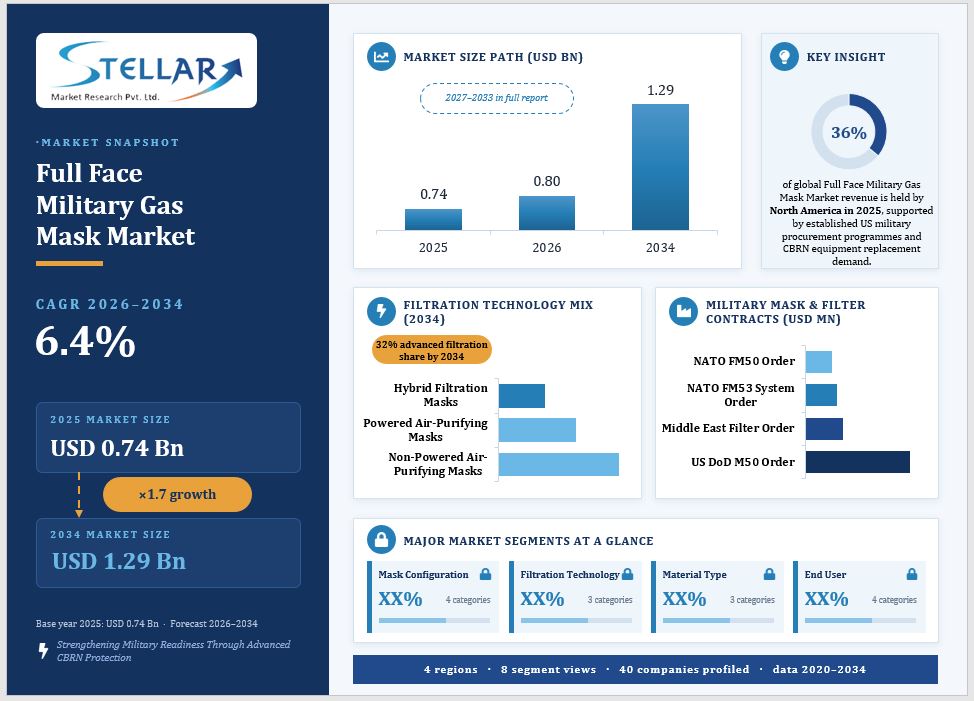
Global Full Face Military Gas Mask Market was valued at USD 0.74 Bn in 2025 and is projected to reach USD 1.29 Bn by 2034, growing at a CAGR of 6.4% during 2026–2034,
The Global Full Face Military Gas Mask Market was valued at USD 0.74 Bn in 2025 and is projected to reach USD 1.29 Bn by 2034, growing at a CAGR of 6.4% during 2026–2034, according to Stellar Market Research (SMR). Full face military gas masks are air-purifying respirators that seal the whole face and protect the eyes, nose and mouth of armed-forces personnel against chemical warfare agents, biological agents, radiological particles and toxic industrial materials, and they are bought as complete mask systems with filters, carriers and accessories.
The report is built around the questions that procurement officers, defence primes, investors and search users actually ask: how large the military gas mask market is, which CBRN protection mask designs are winning contracts, how NATO and US defence budgets translate into mask orders, and which suppliers hold the long-term framework contracts. Numeric evidence is drawn only from government budget documents, tender notices and company disclosures.
Dual-filter, non-powered, multi-threat masks account for most of today’s demand, while powered and hybrid filtration masks, panoramic-lens designs and silicone facepieces are gaining share. Europe is the fastest-growing region as NATO members move towards the 5% of GDP security-spending commitment, and North America remains the largest region because of the US Department of War’s long-running M50 framework.
Stellar Market Research provides comprehensive analysis of the global full face military gas mask market size, share, mask-configuration, filtration, material, lens, protection, application, end-user and distribution-channel segmentation, regional demand, competitive landscape, strategic scenarios and growth opportunities. The report helps defence ministries, CBRN equipment makers, respirator suppliers, contractors and investors decide which segments, programmes and countries to prioritise through 2034.
To Get more Insights: Request Free Sample Report
Global Full Face Military Gas Mask Market Overview: Size, Share, Trends and Outlook to 2034
SMR measures the market at manufacturer-revenue level for full face respirators procured by armed forces and defence-linked agencies worldwide: mask facepieces sold with their standard filters, carriers and accessories. Half masks, escape hoods, industrial and fire-service respirators are outside the core scope, except where the same full face design is bought for emergency and disaster response by defence units.
Three shifts shape 2026–2034: demand is broadening from US-led replacement cycles to NATO-wide modernisation, procurement is moving from stand-alone masks to integrated CBRN ensembles that pair a mask with a powered respirator, suit, boots and gloves, and users are asking for lower breathing resistance, panoramic vision and longer wear time.
|
KEY MARKET INSIGHT | DEMAND IS BROADENING BEYOND THE US Market ~1.7x larger by 2034. US Department of War CBDP request: USD 1,711.4 Mn (FY2027, +8%). European NATO allies and Canada: USD 574 Bn defence spend in 2025 (+20% real). Avon Protection revenue: USD 168.8 Mn in FY2025, +23% in H1 FY2026. |
Key Findings: Eight Insights Shaping the Global Full Face Military Gas Mask Market
1. Market Growth: The market is projected to grow 1.7 times, from USD 0.74 Bn in 2025 to USD 1.29 Bn by 2034, at a CAGR of 6.4%. Production capacity and filter supply chains need to expand together to support demand.
2. NATO Defence Spending: European NATO allies and Canada spent USD 574 Bn in 2025, representing 20% real-term growth, with all 32 NATO members meeting the 2% GDP defence spending threshold. Rising defence investment strengthens demand for military protective masks across Europe.
3. Stable US Demand: The FY2027 US Chemical and Biological Defense Program (CBDP) budget request stands at USD 1,711.4 Mn, increasing 8%. However, CB Protection and Hazard Mitigation procurement declines by USD 85.5 Mn to USD 117.9 Mn, indicating that North American market growth is increasingly supported by equipment sustainment and upgrades.
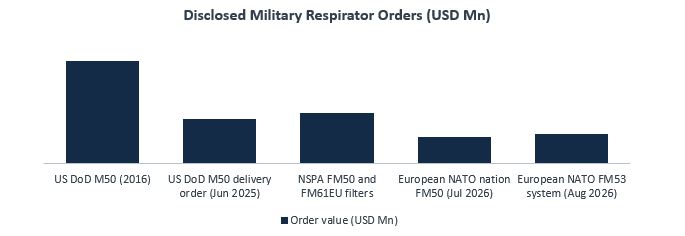
4. Supplier Concentration: Avon Protection remains the sole supplier of M50 masks to the US Department of Defense, supported by a USD 18.3 Mn delivery order in June 2025. Long-term framework agreements significantly influence supplier market share and competitive positioning.
5. NATO Procurement Frameworks: NATO Support and Procurement Agency (NSPA) orders include USD 20.6 Mn for FM50 masks and filters, USD 10.8 Mn in July 2026, and USD 12 Mn for FM53 systems in August 2026. Standardized allied procurement supports established suppliers and interoperable protection systems.
6. Advanced Respiratory Protection: Avon Protection introduced the CS-PAPR in June 2026, while the Turkish Ministry of Defence procured integrated protective ensembles incorporating masks and powered respirators. Demand for powered and hybrid respiratory protection systems increases revenue opportunities per military personnel.
7. Asia Pacific Expansion: India's FY2025–26 defence budget reached INR 6,81,210 Cr, alongside an Indian Navy tender for 4,020 NBC masks. Australian FM54 deliveries also supported Avon Protection's growth. Regional defence modernization creates opportunities, while domestic manufacturing and local-content requirements influence supplier entry strategies.
8. Strong Order Book Visibility: Avon's order book reached USD 262.8 Mn in September 2025, while the Avon Protection division's order book increased by USD 45 Mn to USD 117 Mn. Existing contracts support near-term revenue visibility, although delivery schedules and procurement timing influence revenue recognition.
How Big Is the Global Full Face Military Gas Mask Market, and How Fast Is It Growing?
The estimate triangulates four inputs: US Department of War CBRN budget lines, NATO expenditure growth and NSPA framework orders, company-reported revenue and order values (Avon Protection reported USD 168.8 Mn revenue across respirators, boots, gloves and rebreathers in FY2025), and national tender notices. SMR’s figures are estimates: no government publishes a single global value for this category.
Global Full Face Military Gas Mask Market Dynamics: Growth Drivers, Restraints and Opportunities
Growth Drivers: NATO Budgets, CBRN Modernisation, Ukraine-Related Orders and Integrated Systems
Growth Drivers: NATO Budgets, CBRN Modernisation, Ukraine-Related Orders and Integrated Systems
1. Increasing NATO Defence Budgets: Rising NATO defence expenditure supports the replacement of ageing military gas masks and procurement of advanced respiratory protection equipment. European NATO allies and Canada spent USD 574 Bn on defence in 2025, representing 20% real-term growth. NATO's commitment to spending 5% of GDP on defence and security-related requirements by 2035 further strengthens long-term demand for military gas masks.
2. Growing CBRN Modernisation Programmes: Increasing chemical, biological, radiological and nuclear (CBRN) security concerns encourage military organisations to modernise protective equipment and strengthen operational readiness. The US Chemical and Biological Defense Program (CBDP) FY2027 budget request stands at USD 1,711.4 Mn, representing an 8% increase. National modernisation initiatives, including France's March 2026 order for new-generation KNDS CBRN gas masks, further support market expansion.
3. Increasing Ukraine-Related Military Procurement Orders: Ongoing military assistance and defence support programmes generate additional demand for military gas masks and protective equipment. In June 2025, the UK Ministry of Defence placed a GBP 10.2 Mn order for FM50 protective masks intended for Ukraine. Avon Protection also reported USD 13 Mn in Ukraine-related orders, highlighting the contribution of allied military support programmes to market demand.
4. Rising Adoption of Integrated Respiratory Protection Systems: Military forces increasingly adopt powered and hybrid respiratory protection systems to improve soldier comfort, operational efficiency and protection against hazardous environments. Avon Protection introduced its CS-PAPR system in June 2026, while the Turkish Ministry of Defence procured integrated protective ensembles combining gas masks and powered respirators. Growing demand for complete respiratory protection solutions increases equipment value per soldier and creates additional revenue opportunities for manufacturers.
Market Restraints: Budget Timing, Supplier Concentration, Export Controls and Lumpy Orders
1. Budget Timing: Military gas mask procurement depends on government defence budget approvals, funding allocations and contract schedules, creating uncertainty in purchasing decisions. The US FY2027 budget request for CB Protection and Hazard Mitigation procurement stands at USD 117.9 Mn, declining by USD 85.5 Mn. Delayed budget approvals and changing defence priorities restrict new equipment purchases and affect manufacturers' revenue visibility.
2. Supplier Concentration: The military gas mask market depends on a limited number of qualified manufacturers, creating supply chain vulnerabilities and barriers for new entrants. Avon Protection remains the sole supplier of M50 military gas masks to the US Department of Defense. This concentration increases dependence on established suppliers and creates potential risks related to production disruptions, capacity limitations and procurement flexibility.
3. Export Controls: Strict international defence trade regulations restrict the cross-border sale and distribution of advanced military respiratory protection equipment. Certain military gas masks, including the M53A1, are subject to International Traffic in Arms Regulations (ITAR), requiring export licences and regulatory approvals. Complex compliance procedures, lengthy qualification cycles and restrictions on technology transfers limit international market expansion.
4. Lumpy Orders: Military gas mask procurement involves large, irregular defence contracts rather than consistent purchasing volumes, creating fluctuations in production schedules and revenue recognition. Avon Protection's group orders declined 31.6% in H1 FY2026, despite revenue increasing 6.8%. Dependence on major contract awards and delivery schedules creates short-term demand uncertainty, while multi-year procurement frameworks and order backlogs help manufacturers maintain operational stability.
What Are the Biggest Full Face Military Gas Mask Market Opportunities Through 2034?
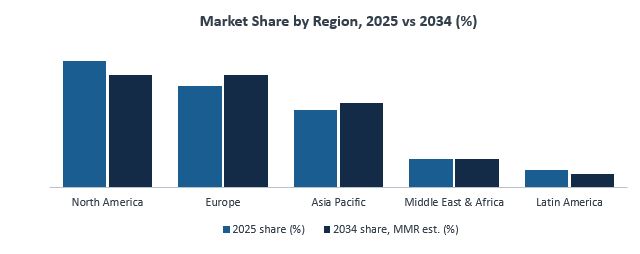
The Full Face Military Gas Mask Market presents strong growth opportunities through advanced CBRN protection technologies and increasing defence modernisation investments. Powered and Hybrid Filtration Masks are projected to grow at CAGRs of 10.6% and 11.3%, respectively, while Panoramic Lens Masks are expected to increase their market share from 35% in 2025 to 50% by 2034. Regionally, Europe leads growth at a 7.6% CAGR, supported by NATO procurement programmes, followed by Asia Pacific at 7.4%, driven by military modernisation and domestic manufacturing initiatives. Increasing demand for lightweight respiratory systems among special operations forces and recurring replacement filter requirements further strengthen market opportunities.
Global Full Face Military Gas Mask Market Segmentation: By Mask Configuration, Filtration, Material, Lens, Protection, Application, End User and Channel
SMR segments the market into eight dimensions. Shares are 2025 value shares and 2034 shares are SMR estimates; CAGRs are calculated from the segment values. Within each dimension, segments sum to 100% of the market.
|
Segmentation dimension |
Segments covered |
|
By Mask Configuration |
Single Filter Port Masks; Dual Filter Port Masks; Central Filter Port Masks; Side-Mounted Filter Port Masks |
|
By Filtration Technology |
Non-Powered Air-Purifying Masks; Powered Air-Purifying Masks; Hybrid Filtration Masks |
|
By Material Type |
Silicone-Based Masks; Rubber-Based Masks; Thermoplastic Elastomer (TPE) Masks; Butyl Rubber-Based Masks |
|
By Lens Configuration |
Single Visor Lens Masks; Dual Eyepiece Lens Masks; Panoramic Lens Masks |
|
By Protection Capability |
Chemical Agent Protection Masks; Biological Agent Protection Masks; Radiological Particle Protection Masks; Multi-Threat CBRN Protection Masks |
|
By Application |
Combat Operations; CBRN Defense Operations; Military Training Exercises; Vehicle and Naval Operations; Aviation and Aircrew Operations; Emergency and Disaster Response |
|
By End User |
Army Forces; Naval Forces; Air Force Units; Special Operations Forces; Military Support and Defense Units |
|
By Distribution Channel |
Direct Government Procurement; Defense Equipment Contractors; Authorized Distributors and Dealers |
|
Others |
* Others in the Full Face Military Gas Mask Market: niche and emerging sub-segments (custom-fit, canine and specialist-role masks, and new facepiece concepts) are covered in the full report text and are not sized separately here |
Full Face Military Gas Mask Market by Mask Configuration: Single, Dual, Central and Side-Mounted Filter Port Masks
Based on Mask Configuration, the Full Face Military Gas Mask Market is segmented into Single, Dual, Central and Side-Mounted Filter Port Masks. Dual Filter Port Masks dominated the market with a 38% share in 2025, valued at USD 281 Mn, supported by their adoption in NATO-standard respiratory protection systems, improved breathing efficiency and operational flexibility. The segment is projected to reach USD 556 Mn by 2034, capturing 43% of the market at a CAGR of 7.9%. Side-Mounted Filter Port Masks held the second-largest share of 27% in 2025, driven by ergonomic advantages and compatibility with military equipment. Meanwhile, Central Filter Port Masks accounted for 20% and Single Filter Port Masks represented 15% of the market in 2025. Increasing CBRN modernisation programmes and replacement of legacy equipment support the growing preference for advanced dual-filter configurations.
Full Face Military Gas Mask Market by Filtration Technology: Non-Powered, Powered and Hybrid Masks
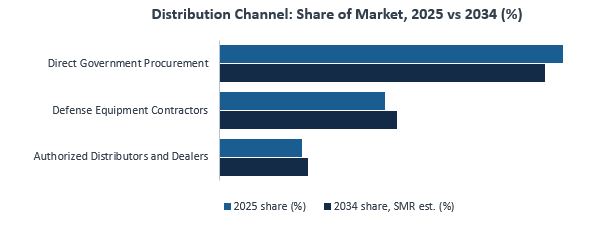
Based on Filtration Technology, the Full Face Military Gas Mask Market is segmented into Non-Powered Air-Purifying Masks, Powered Air-Purifying Masks and Hybrid Filtration Masks. Non-Powered Air-Purifying Masks dominated the market with a 78% share in 2025, valued at USD 577 Mn, supported by their widespread military adoption, operational reliability and cost-effectiveness. The segment is projected to reach USD 879 Mn by 2034, accounting for 68% of the market. Powered Air-Purifying Masks held a 12% share in 2025 and are expected to grow at a CAGR of 10.6%, driven by increasing demand for improved breathing comfort and reduced respiratory burden. Meanwhile, Hybrid Filtration Masks accounted for 10% of the market in 2025 and represent the fastest-growing segment, with a CAGR of 11.3%, supported by advancements in integrated protection systems, including Avon Protection's CS-PAPR and FM53 platforms.
Full Face Military Gas Mask Market by Distribution Channel: Government Procurement, Defence Contractors and Authorised Distributors
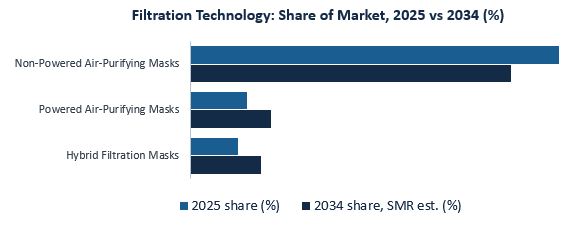
Based on Distribution Channel, the Full Face Military Gas Mask Market is segmented into Direct Government Procurement, Defense Equipment Contractors, and Authorized Distributors and Dealers. Direct Government Procurement dominated the market with a 58% share in 2025, valued at USD 429 Mn, supported by long-term defence contracts, including the US M50 programme and NATO procurement frameworks. The segment is projected to reach USD 711 Mn by 2034, accounting for 55% of the market. Defense Equipment Contractors held a 28% share in 2025 and are expected to grow at a CAGR of 7.2%, driven by increasing demand for integrated CBRN protection systems. Meanwhile, Authorized Distributors and Dealers accounted for 14% of the market in 2025, with the segment projected to reach USD 194 Mn by 2034, supported by procurement from smaller military units and specialised defence agencies.
Global Full Face Military Gas Mask Market Regional Analysis: North America, Europe, Asia Pacific, Middle East & Africa and Latin America
|
Region |
2025 share |
2025 (USD Mn) |
2034 share |
CAGR |
Government / company signal |
|
North America |
36% |
266 |
32% |
5.0% |
US DoW CBDP request USD 1,711.4 Mn (FY2027); M50 framework; USD 18.3 Mn delivery order (June 2025) |
|
Europe |
29% |
215 |
32% |
7.6% |
USD 574 Bn Europe and Canada defence spend (2025); NSPA orders; French DGA new mask order (March 2026) |
|
Asia Pacific |
22% |
163 |
24% |
7.4% |
India MoD Rs 6,81,210 Cr (FY2025–26); Indian Navy tender for 4,020 NBC masks; Australian FM54 deliveries |
|
Middle East & Africa |
8% |
59 |
8% |
6.4% |
Avon MILCF50 filter order of USD 12.7 Mn from a Middle East customer (February 2026) |
|
Latin America |
5% |
37 |
4% |
3.8% |
Limited public CBRN mask procurement data; demand tied to special units |
|
SMR READ-THROUGH North America stays the largest region through 2034 but cedes about 4 points of share. Europe adds the most value: its share rises from 29% to 32% as NATO members convert budget growth into respirator frameworks. |
Government Demand Signals: US CBRN Budget, NATO Spending and Asia Pacific Procurement
US Chemical and Biological Defense Program: FY2027 Budget Request
The US Chemical and Biological Defense Program (CBDP) funds research, testing and purchase of masks, suits, detectors and decontamination systems for the joint force. The FY2027 request is USD 1,711.4 million, USD 129 million (8%) above FY2026 enacted levels. Research and development takes USD 1,370.3 million, while procurement splits into USD 223.2 million for CB situational awareness and USD 117.9 million for CB protection and hazard mitigation, the line that covers individual protection.
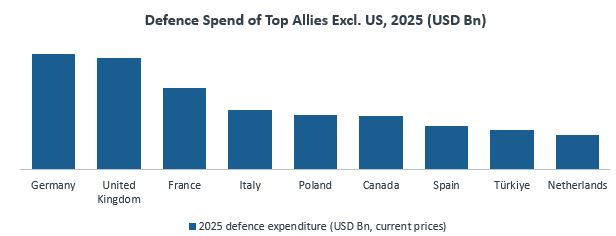
Government Indicators for the Full Face Military Gas Mask Market
|
Indicator |
Value |
Source |
|
US CBDP FY2027 request |
USD 1,711.4 Mn (+8% vs FY2026 enacted) |
US Department of War |
|
US CB protection & hazard mitigation (procurement) |
USD 117.9 Mn (−USD 85.5 Mn) |
US Department of War |
|
US JSGPM FY2010 funding |
142,723 ground/ship masks and 9,000 CVC masks |
DoD FY2010 budget justification |
|
US Army JSGPM production plan |
Production contract planned for FY2026–2030 (sources-sought W912CH24R0143) |
US Army |
|
NATO Europe and Canada defence spend 2025 |
USD 574 Bn, +20% real |
NATO annual report (March 2026) |
|
India MoD allocation FY2025–26 |
Rs 6,81,210.27 Cr (+9.53%) |
PIB, Ministry of Defence |
|
Indian Army ACADA contract (CBRN detection) |
Rs 80.43 Cr for 223 systems (February 2025) |
PIB, Ministry of Defence |
|
Indian Navy NBC mask tender |
4,020 NBC respiratory masks (bid closed 16 June 2026) |
Government e-Marketplace (GeM) |
Full Face Military Gas Mask Market Competitive Landscape: Who Are the Top Manufacturers?
The Full Face Military Gas Mask Market is characterised by a concentrated competitive landscape, with established manufacturers maintaining strong market positions through certified respiratory protection systems, advanced product portfolios and long-term defence procurement contracts. Avon Protection (Avon Technologies plc) holds a prominent position with its M50, FM50, FM53 and FM54 mask platforms, supported by FY2025 revenue of USD 168.8 Mn, an order book of USD 117 Mn and 23% revenue growth in H1 FY2026. KNDS CBRN is strengthening its presence through next-generation protective masks, supported by orders from France's Directorate General of Armaments (DGA) in March 2026. Meanwhile, Dräger, MSA Safety, 3M and MIRA Safety contribute to the competitive environment through specialised respiratory protection products and filtration technologies. Market competition is primarily influenced by military certification requirements, product reliability, technological advancements and established procurement relationships. Government procurement organisations, including the US Department of Defense, NATO Support and Procurement Agency (NSPA) and national defence ministries, play a critical role in shaping supplier selection, contract
opportunities and long-term market positioning.
Disclosed Full Face Military Mask Orders
|
SMR READ-THROUGH Pricing is set by framework contracts, not list prices: the two US awards imply a stable USD 245–255 per system over two years. Margin expansion at Avon Protection (19.9% in FY2025) shows suppliers with qualified masks and filters hold pricing power (SMR judgement). |
Recent Developments in the Full Face Military Gas Mask Market, 2025–2026
|
Date |
Development |
|
Jun 2025 |
USD 18.3 Mn US DoD delivery order for M50 masks and carriers under the existing framework (Avon) |
|
Jun 2025 |
UK MoD orders about GBP 10.2 Mn of FM50 respirators for Ukraine (Avon) |
|
Nov 2025 |
Avon FY2025: revenue USD 313.9 Mn; Avon Protection order book up USD 45 Mn to USD 117 Mn |
|
Feb 2026 |
Avon receives USD 12.7 Mn MILCF50 CBRN filter order from a Middle East customer |
|
Mar 2026 |
French DGA orders first models of KNDS CBRN’s new gas mask (BEDEX 2026) |
|
Mar 2026 |
NATO annual report: European allies and Canada raise defence spending 20% in real terms |
|
Apr 2026 |
US FY2027 budget request: CBDP USD 1,711.4 Mn |
|
May 2026 |
Avon H1 FY2026: Avon Protection revenue USD 92.9 Mn (+23%), supported by NATO mask deliveries |
|
Jun 2026 |
Avon introduces the short-duration CS-PAPR; Indian Navy NBC mask tender closes |
|
Jul 2026 |
USD 10.8 Mn European NATO order for FM50 under the NSPA framework |
|
Aug 2026 |
About USD 12 Mn European NATO order for FM53, CS-PAPR and ST53 |
Global Full Face Military Gas Mask Market Report Scope
|
Report Coverage |
Details |
|
Base Year |
2025 |
|
Forecast Period |
2026–2034 |
|
Historical Data |
2020–2025 |
|
Market Size in 2025 |
USD 0.74 Billion |
|
Market Size in 2034 |
USD 1.29 Billion |
|
Forecast Period CAGR |
6.4% |
|
Segments Covered |
By Mask Configuration Single Filter Port Masks; Dual Filter Port Masks; Central Filter Port Masks; Side-Mounted Filter Port Masks |
|
By Filtration Technology Non-Powered Air-Purifying Masks; Powered Air-Purifying Masks; Hybrid Filtration Masks |
|
|
By Material Type Silicone-Based Masks; Rubber-Based Masks; Thermoplastic Elastomer (TPE) Masks; Butyl Rubber-Based Masks |
|
|
By Lens Configuration Single Visor Lens Masks; Dual Eyepiece Lens Masks; Panoramic Lens Masks |
|
|
By Protection Capability Chemical Agent Protection Masks; Biological Agent Protection Masks; Radiological Particle Protection Masks; Multi-Threat CBRN Protection Masks |
|
|
By Application Combat Operations; CBRN Defense Operations; Military Training Exercises; Vehicle and Naval Operations; Aviation and Aircrew Operations; Emergency and Disaster Response |
|
|
By End User Army Forces; Naval Forces; Air Force Units; Special Operations Forces; Military Support and Defense Units |
|
|
By Distribution Channel Direct Government Procurement; Defense Equipment Contractors; Authorized Distributors and Dealers |
|
|
Regions Covered |
North America; Europe; Asia Pacific; Middle East & Africa; Latin America |
Frequently Asked Questions
SMR estimates revenue from government budget lines, NATO and national procurement notices and company disclosures; figures are estimates.
The market is forecast to grow at a 6.4% CAGR between 2026 and 2034.
North America holds the largest share (36% in 2025); Europe is the fastest-growing region.
Lumpy order timing, US procurement-line pressure, sole-source concentration and export-control limits.
Powered air-purifying masks and panoramic-lens masks are the fastest-growing segments in their dimensions.
Full Face Military Gas Mask Market TOC:
A1. Global Full Face Military Gas Mask Market Industry Landscape
A1.1 Evolution of military respiratory protection from conventional masks to advanced systems
A1.2 Role of full face masks in battlefield chemical and biological defense
A1.3 Military adoption across ground forces, naval units, and aviation personnel
A1.4 Integration of respiratory protection within modern soldier equipment configurations
A1.5 Increasing deployment driven by evolving chemical warfare threats
A1.6 Global market size and growth trajectory through 2032
A2. Market Dynamics & Framework Analysis
A2.1 Market Trends
A2.2 Market Dynamics
- Market Drivers
- Market Restraints
- Market Opportunities
- Market Challenges
A2.3 PORTER's Five Forces Analysis
A2.4 PESTLE Analysis
A2.5 Regulatory and geopolitical influences on military procurement
A2.6 Technological developments shaping next-generation respiratory protection requirements
A3. Military Gas Mask Cost Structure, Economics & Pricing Dynamics
A3.1 Raw material costs across elastomers, polymers, and specialty components
A3.2 Manufacturing expenses associated with precision molding and assembly
A3.3 Filter cartridge production costs across protection categories
A3.4 Cost differences between standard and advanced military configurations
A3.5 Pricing variations across procurement volumes and contract specifications
A3.6 Lifecycle expenses covering maintenance, replacement, and storage requirements
A4. Military Gas Mask Supply Chain & Component Ecosystem
A4.1 Procurement of facepieces, visors, valves, and sealing components
A4.2 Sourcing of specialized materials for chemical-resistant mask construction
A4.3 Supply availability of activated carbon and filtration media
A4.4 Supplier networks supporting military-grade respiratory protection manufacturing
A4.5 Component dependencies affecting filter cartridge production and availability
A4.6 Supply-chain vulnerabilities affecting international defense equipment procurement
A5. Military Respiratory Protection Demand & Threat Environment Analysis
A5.1 Demand arising from chemical warfare preparedness and battlefield protection
A5.2 Biological threat exposure influencing respiratory protection requirements
A5.3 Nuclear fallout preparedness and radioactive particle filtration requirements
A5.4 Protection requirements against toxic industrial chemical exposure incidents
A5.5 Increasing military preparedness for unconventional warfare environments
A5.6 Demand variations across conventional and specialized military operations
A6. Full Face Military Gas Mask Architecture & Component Configuration
A6.1 Facepiece architecture covering full-face sealing and facial coverage
A6.2 Visor configuration providing unobstructed battlefield visibility and protection
A6.3 Inhalation and exhalation valve arrangements supporting controlled breathing
A6.4 Nose cup integration for reduced internal fogging conditions
A6.5 Head harness configurations ensuring stable positioning during movement
A6.6 Integrated drinking systems supporting hydration during extended deployments
A7. Facepiece Materials, Manufacturing & Structural Engineering
A7.1 Silicone rubber selection for flexible facial sealing applications
A7.2 Butyl rubber utilization for chemical warfare protection requirements
A7.3 Thermoplastic elastomer applications in military mask construction
A7.4 Polycarbonate visor materials supporting impact and optical resistance
A7.5 Molded facepiece manufacturing and dimensional precision requirements
A7.6 Material durability against temperature extremes and chemical exposure
A8. Respiratory Filtration Technology & Filter Canister Engineering
A8.1 Activated carbon filtration for toxic chemical vapor adsorption
A8.2 Particulate filtration technologies for biological and radioactive contaminants
A8.3 Combined chemical and particulate filter cartridge configurations
A8.4 Filter canister attachment mechanisms and compatibility requirements
A8.5 Airflow resistance and breathing pressure performance characteristics
A8.6 Filter service life and replacement interval optimization strategies
A9. Chemical, Biological, Radiological & Nuclear Protection Capabilities
A9.1 Protection against nerve agents and organophosphorus chemical compounds
A9.2 Filtration performance against blister agents and vesicant chemicals
A9.3 Respiratory protection against blood agents and choking compounds
A9.4 Biological aerosol filtration covering pathogens and infectious particles
A9.5 Radiological particulate protection during nuclear contamination incidents
A9.6 Chemical warfare protection against emerging toxic industrial substances
A10. Facial Sealing, Fit Testing & Ergonomic Performance
A10.1 Facial seal integrity across different facial dimensions and structures
A10.2 Mask sizing configurations for diverse military personnel populations
A10.3 Fit testing protocols measuring inward leakage performance
A10.4 Pressure distribution across facial contact and sealing surfaces
A10.5 Ergonomic compatibility with helmets and combat equipment
A10.6 Extended wearing comfort during prolonged military deployment operations
A11. Optical Visibility, Communication & Integrated Functional Systems
A11.1 Panoramic visor designs improving peripheral battlefield visibility
A11.2 Anti-fog coatings supporting visibility during intensive physical activities
A11.3 Optical distortion control across different visor configurations
A11.4 Voice diaphragm integration supporting clear tactical communication
A11.5 Microphone compatibility with military communication headset systems
A11.6 Optical compatibility with night vision and aiming equipment
A12. Military Gas Mask Applications & Operational Deployment
A12.1 Infantry deployment across conventional and urban combat environments
A12.2 Special operations applications involving high-risk chemical exposure environments
A12.3 Armored vehicle crew protection during battlefield chemical incidents
A12.4 Naval personnel protection across shipboard operational environments
A12.5 Military aviation applications requiring specialized respiratory protection configurations
A12.6 Training exercises and emergency response deployment requirements
A13. Military Gas Mask Testing, Performance Standards & Certification
A13.1 Respiratory protection testing against specified chemical warfare agents
A13.2 Particulate penetration testing under standardized laboratory conditions
A13.3 Facepiece leakage assessment and quantitative fit evaluation procedures
A13.4 Visor impact resistance and optical clarity verification testing
A13.5 Material compatibility testing under accelerated environmental conditions
A13.6 Military certification requirements across international defense procurement frameworks
A14. Military Procurement, Defense Contracts & Purchasing Strategies
A14.1 Government procurement programs for military respiratory protection equipment
A14.2 Defense ministry purchasing requirements across national armed forces
A14.3 Competitive bidding processes for military protective equipment contracts
A14.4 Bulk procurement strategies supporting large-scale military modernization programs
A14.5 Domestic manufacturing preferences and defense localization requirements
A14.6 International defense partnerships influencing military equipment procurement decisions
A15. Installed Military Gas Mask Base & Deployment Analysis
A15.1 Existing military gas mask inventories across national armed forces
A15.2 Deployment distribution across infantry, naval, and aviation personnel
A15.3 Installed mask configurations across active military units
A15.4 Legacy equipment replacement and modernization requirements
A15.5 Operational readiness of existing respiratory protection inventories
A15.6 Stockpile replenishment trends across strategic defense establishments
A16. Military Gas Mask Maintenance, Lifecycle & Operational Readiness
A16.1 Inspection procedures covering facepieces, valves, and sealing components
A16.2 Filter replacement schedules based on exposure and storage conditions
A16.3 Cleaning and disinfection procedures for reusable military masks
A16.4 Storage requirements preserving filter integrity and material durability
A16.5 Component replacement strategies extending overall equipment service life
A16.6 Readiness assessment across military maintenance and logistics facilities
A17. Military Gas Mask Manufacturing Capacity & Production Infrastructure
A17.1 Manufacturing capacity across military respiratory protection equipment producers
A17.2 Production processes covering molding, assembly, and component integration
A17.3 Automated manufacturing technologies improving dimensional consistency and precision
A17.4 Quality control procedures across military mask production facilities
A17.5 Production scalability supporting large-scale defense procurement requirements
A17.6 Manufacturing localization across strategically important defense markets
A18. Military Gas Mask Trade Flow, Logistics & Distribution Network
A18.1 International trade flows of military respiratory protection equipment
A18.2 Cross-border distribution of specialized filtration components and cartridges
A18.3 Defense export restrictions affecting international equipment availability
A18.4 Military logistics networks supporting operational equipment distribution
A18.5 Strategic stockpiling requirements across national defense establishments
A18.6 Geopolitical disruptions affecting military equipment supply continuity
A19. Military Gas Mask Technology Innovation & Future Developments
A19.1 Advanced filtration materials improving chemical agent adsorption efficiency
A19.2 Lightweight facepiece designs reducing overall soldier equipment burden
A19.3 Smart sensors enabling real-time respiratory protection monitoring
A19.4 Integrated communication technologies supporting connected battlefield operations
A19.5 Advanced visor technologies improving visibility under combat conditions
A19.6 Modular mask architectures enabling application-specific component customization
A20. Military Gas Mask Safety, Reliability & Risk Assessment
A20.1 Respiratory protection failure risks during chemical exposure incidents
A20.2 Facial seal degradation affecting overall protective performance
A20.3 Filter saturation risks under prolonged contaminant exposure conditions
A20.4 Valve malfunction risks affecting breathing resistance and safety
A20.5 Material degradation under extreme climatic and storage conditions
A20.6 Equipment reliability assessment across demanding military operational environments
A21. Sustainability, Material Advancements & Environmental Considerations
A21.1 Environmentally responsible manufacturing of military respiratory protection equipment
A21.2 Material recycling opportunities across retired mask components
A21.3 Disposal requirements for contaminated filters and cartridges
A21.4 Development of durable materials extending equipment replacement cycles
A21.5 Reduced manufacturing waste through advanced molding technologies
A21.6 Environmental compliance across military equipment production facilities
A22. Full Face Military Gas Mask Market Segmentation
By Mask Type
- Standard Full Face Military Gas Masks
- Low-Profile Full Face Military Gas Masks
- Integrated Communication Full Face Gas Masks
- Powered Air-Compatible Full Face Gas Masks
By Protection Type
- Chemical Protection Masks
- Biological Protection Masks
- Radiological Protection Masks
- Nuclear Protection Masks
- Multi-Threat CBRN Protection Masks
By Filter Type
- Activated Carbon Filters
- Particulate Filters
- Combined Chemical and Particulate Filters
- Specialized CBRN Filter Cartridges
By Material
- Silicone Rubber
- Butyl Rubber
- Thermoplastic Elastomers
- Other Specialized Materials
By Application
- Infantry and Ground Forces
- Special Operations Forces
- Naval Forces
- Military Aviation
- Armored Vehicle Crews
- Military Training and Emergency Response
By Procurement Channel
- Government Defense Procurement
- Military Direct Procurement
- Defense Contractors and Integrators
- Specialized Military Equipment Distributors
A23. Global Full Face Military Gas Mask Market Size and Forecast, By Region & Country
A23.1 North America military gas mask procurement and modernization trends
A23.2 Europe defense preparedness and respiratory protection adoption patterns
A23.3 Asia Pacific military modernization and CBRN defense investments
A23.4 Middle East & Africa military protection equipment procurement trends
A23.5 South America defense infrastructure and military equipment purchasing
A23.6 Regional market opportunities across emerging defense procurement economies
A24. Full Face Military Gas Mask Market Competitive Landscape
A24.1 Full Face Military Gas Mask Market Competitive Matrix
A24.2 Key Player Benchmarking
A24.3 Company Portfolio and Product Configuration Comparison
A24.4 Military Certification and Protection Performance Benchmarking
A24.5 Manufacturing Capacity and Geographic Presence Assessment
A24.6 Market Leaders, Market Followers, and Emerging Players
A24.7 Mergers, Acquisitions, and Strategic Partnership Analysis
A24.8 Recent Product Launches and Technological Developments
A25. Company Profiles: Key Players
A25.1 Company Overview and Historical Business Development
A25.2 Military Respiratory Protection Product Portfolio Analysis
A25.3 Manufacturing Facilities and Production Capacity Assessment
A25.4 Financial Performance and Geographic Market Presence
A25.5 SWOT Analysis and Competitive Positioning
A25.6 Strategic Initiatives and Recent Company Developments
A26. Strategic Analysis & Future Market Outlook
A26.1 Emerging military respiratory protection requirements across global defense forces
A26.2 Competitive positioning of advanced military gas mask manufacturers
A26.3 Future procurement opportunities across expanding CBRN defense programs
A26.4 Technological differentiation influencing next-generation military mask adoption
A26.5 Long-term market growth opportunities across emerging defense economies
A26.6 Strategic recommendations for manufacturers and defense industry stakeholders
A27. Research Methodology
A27.1 Research Objectives and Scope Definition
A27.2 Primary Research and Industry Stakeholder Interviews
A27.3 Secondary Research and Defense Industry Information Sources
A27.4 Market Estimation and Forecasting Methodology
A27.5 Data Triangulation and Validation Procedures
A27.6 Assumptions, Limitations, and Research Considerations
A28. Full Face Military Gas Mask Market Key Players – Region-Wise
48 companies | Regional competitive landscape
A28.1 North America
- 3M Company
- Honeywell International Inc.
- MSA Safety Incorporated
- AirBoss Defense Group Inc.
- ILC Dover LP
- Gentex Corporation
- Bullard
- RPB Safety
- MIRA Safety
- Parcil Safety
- All Safe Industries, Inc.
- TSI Incorporated
- EDI-USA
- Alpha Pro Tech Ltd.
- Kimberly-Clark Worldwide, Inc.
- Ansell Limited
- Blauer Manufacturing Co., Inc.
- HDT Global
- Lakeland Industries, Inc.
A28.2 Europe
- Avon Protection
- Drägerwerk AG & Co. KGaA
- Sundström Safety AB
- Moldex-Metric AG & Co. KG
- Camfil AB
- RSG Safety B.V.
- Spasciani S.p.A.
- Mestel Safety Srl
- GVS S.p.A.
- Respirex International Limited
- Seyntex N.V.
- Blücher GmbH
- Kärcher Futuretech GmbH
- Maskpol S.A.
- KNDS Group
- Rheinmetall AG
- Thales Group
A28.3 Asia Pacific
- Shigematsu Works Co., Ltd.
- Koken Ltd.
- Kowa Company, Ltd.
- Anbu Safety
- Fenan Safety (Shanghai) Co., Ltd.
- China Hengtai Group Co., Ltd.
- Sri Sai Industries
- Lifesaving Equipment Factory
A28.4 Middle East
- Shalon Chemical Industries Ltd.
- Duram Mask
- Supergum Industries
- Mechanical and Chemical Industry Corporation (MKE)