ENG
ENG Japanese
  French
  German
  Korean
Aquatic Robots Market: AI-Enabled Aquatic Robots, Autonomous Marine Vehicles, Advanced Underwater Robotics Outlook 2026–2034
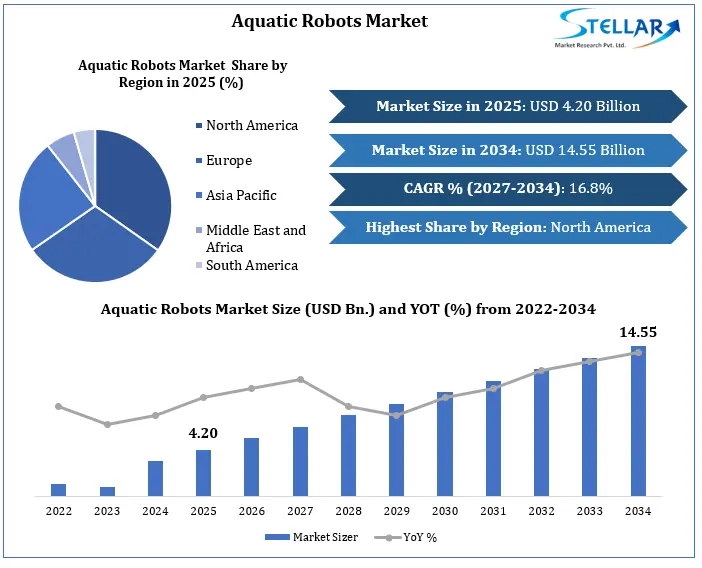
The Global Aquatic Robots Market was projected to grow from USD 4.20 billion in 2025 to USD 14.55 billion by 2034 at 16.8% CAGR, driven by the increasing need for underwater inspection, monitoring of offshore infrastructure, and oceanic exploration in sectors including energy, military, and research.
Aquatic Robots Market Overview
Underwater robots are mechanical devices designed to operate in subaquatic conditions without direct human intervention. They are typically used for ocean exploration, underwater infrastructure maintenance, environmental monitoring and underwater photography.
The Market for Aquatic Robots is growing due to the increasing need for underwater investigation and exploration, offshore inspection, environmental monitoring, marine research, and defence. Aquatic robots consist of Remote Operated Vehicles (ROVs) and Autonomous Underwater Vehicles (AUVs). They are capable of conducting operations under water depths and difficult underwater conditions using sophisticated sensors, cameras, sonar technology, and autonomous navigation techniques.
For example, OceanOneK is a deep-sea humanoid robot capable of operating at depths of up to 1,000 meters. Equipped with advanced vision and haptic feedback systems, it supports underwater exploration, scientific research, and archaeological recovery missions, showcasing the increasing capabilities of next-generation aquatic robotics.
To get more Insights: Request Free Sample Report
Global Aquatic Robots Market Definition
The Aquatic Robot Market consists of robotic systems, navigational devices, sensing devices, imaging equipment, communication systems, software, and other services, which are utilised to accomplish different tasks in aquatic environments. Robotic systems are employed for the purpose of undertaking various operations, including sea floor mapping, marine exploration, and resource assessment in areas where performing such operations using conventional approaches is not feasible or practical.
The market comprises robotic hardware as well as the supporting technologies that help the robots perform accurate underwater manoeuvres, provide monitoring capabilities, conduct data processing, and allow remote mission control. Robots for aquatic environments are becoming more widespread as they help enhance efficiency, minimise risks, and ensure high performance in the difficult conditions of underwater operations.
Global Aquatic Robots Market Driver
Increasing Adoption of Composite Materials in Aircraft Manufacturing
The increasing use of advanced composite materials in commercial aircraft, military aircraft, and space vehicles is driving demand for aerospace robots across manufacturing facilities. Composite components require highly precise processes such as automated fiber placement (AFP), automated tape laying (ATL), trimming, drilling, and inspection to ensure structural integrity and consistent product quality. Aerospace robots help manufacturers achieve the accuracy and repeatability required for handling complex composite structures while reducing material waste and production variability.
Modern aircraft programs are incorporating larger proportions of lightweight composite materials to improve fuel efficiency, reduce emissions, and enhance overall aircraft performance. As composite manufacturing processes become more sophisticated, aerospace manufacturers are investing in robotic automation to manage intricate production tasks that are difficult to perform consistently through manual operations. Robotic systems also support faster production cycles and help maintain strict aerospace quality requirements.
Companies such as Airbus, Boeing, Electroimpact, and Ingersoll Machine Tools are deploying automated fibre placement and robotic composite manufacturing technologies for aerospace applications. Growing production of next-generation aircraft and increasing reliance on lightweight composite structures are expected to further support the adoption of aerospace robots throughout the aerospace manufacturing sector.
Growing Demand for Automated Aerospace Inspection and Quality Assurance
The growing focus on product quality and safety is encouraging the use of aerospace robots for inspection and quality control purposes. Inspection plays a dynamic role in the production process since it helps find any possible defects and ensure that the product meets the required specifications before putting it into use. The use of inspection robots with vision technology and other advanced inspection techniques improves inspection accuracy while minimising human error.
Due to growing complexities in aircraft design and increased production quantities, manufacturers are now looking for automation that is capable of carrying out inspection tasks accurately in large structures and vital parts. The use of robotic inspection systems allows for real-time monitoring of quality, better traceability, and adherence to the high standards required by aerospace manufacturers in their production processes.
Some of the companies that offer robotically controlled inspection equipment for the aerospace industry include Hexagon AB, FANUC Corporation, KUKA AG, and Nikon Metrology. The increasing necessity of improving quality control, saving costs incurred on reworking and complying with aviation safety standards is likely to continue pushing for investments in robotic inspections.
Global Aquatic Robots Market Opportunities
Expansion of Offshore Renewable Energy Projects
The quick rise of offshore wind farms, tidal power facilities, and undersea power transmission is leading to new business prospects for robotic devices designed for aquatic use. Such equipment is being utilized for purposes ranging from underwater construction assistance to cable path surveying, structure inspection, and maintenance activities relating to offshore renewable energy resources. With the continued expansion of clean energy generation capacity in offshore areas by nations around the world, robotic aquatic equipment will be in greater demand than ever before.
Growing Demand for Marine Environmental Monitoring and Conservation
Rising concerns regarding ocean health, biodiversity protection, pollution tracking, and climate change impacts are increasing the need for advanced marine monitoring solutions. Aquatic robots provide an efficient platform for collecting long-duration environmental data in coastal, deep-sea, and protected marine areas. Governments, research institutions, and environmental organisations are investing in underwater monitoring programs to assess ecosystem conditions and support conservation initiatives. This is creating new commercial opportunities for aquatic robots designed for scientific research and environmental assessment applications.
Global Aquatic Robots Market Trends
Increasing Adoption of Autonomous Underwater Vehicles (AUVs)
AUVs are being widely used currently for the purpose of seabed mapping, oceanography, offshore asset inspection, and military operations. As compared to remotely-operated vehicles, AUVs have the potential to carry out these operations with minimal human assistance while providing higher efficiency and accuracy. Moreover, rising investment in deep-water exploration activities and maritime security operations has been facilitating the use of AUVs in many countries. Improved battery life and autonomy in navigation techniques have made long-distance coverage possible for AUVs.
Integration of Advanced Sensors and AI-Based Analytics
The underwater robots are now being designed with advanced high-resolution sonar sensors, LIDARs, underwater cameras, and data analytics systems driven by artificial intelligence. These capabilities provide the ability to detect objects in real-time and navigate within an aquatic environment while conducting surveillance activities and performing maintenance operations in a predictive manner on the subsea infrastructure. The use of artificial intelligence for analysing data is enabling faster analysis of large amounts of data generated from underwater environments.
Global Aquatic Robots Market Segmentation (2025)
Global Aquatic Robots Market by Type
The Remote Operated Vehicles (ROVs) have the highest market share of 42.8% since it is largely used for offshore inspection, subsea maintenance, and military purposes. The Autonomous Underwater Vehicle (AUV) category is experiencing fast growth because there is high demand for unmanned surveying, mapping, and environmental monitoring operations. Unmanned Surface Vehicles (USVs) are experiencing steady growth, as it has found in maritime surveillance and hydrographic surveys. Hybrid Vehicles are growing rapidly since they combine autonomous and remote control technologies.

Global Aquatic Robots Market by Component
Hardware possesses the largest market share of 62.7% as of its expensive nature and wide use of parts like sensors, cameras, propulsion systems, navigation systems, and communication systems in aquatic robots. The software market is expanding rapidly due to the growing use of artificial intelligence, autonomous navigation, real-time analysis of data, and mission planning. The services sector maintains consistent growth because of rising demand for maintenance, integration, training, and technical support, among others.
Global Aquatic Robots Market by Application
Oil & Gas Exploration & Inspection has the highest market share of 28.9%, which is attributed to the significant use of aquatic robots for inspection of subsea assets, pipeline inspection, and offshore facility maintenance. The fastest growing sector is that of Defence & Security, where there is a high demand owing to increased spending on maritime surveillance, mine countermeasures, and naval reconnaissance. Scientific Research and Environmental Monitoring also experience steady growth, owing to increasing research in the field of oceanography, assessment of marine ecosystems, and climate monitoring.

Global Aquatic Robots Market by Depth Capacity
Deep Water dominates the market, accounting for 44.1% share owing to the rising demand for aquatic robots in offshore energy developments, submarine infrastructure inspections, and deep-sea explorations. Ultra-Deep Water is emerging as the fastest-growing segment owing to increased funding for deep ocean explorations and studies, offshore explorations, and underwater military applications. Shallow Water is showing steady growth owing to its application in coastal monitoring, aquaculture, environmental impact assessments, port surveillance, and offshore infrastructure inspections.
Global Aquatic Robots Market by End User
The Oil & Gas industry accounts for the highest market share of 31.8% owing to the widespread usage of aquatic robots for offshore exploration, subsea inspections, pipeline monitoring, and asset maintenance purposes. The Defence & Military industry is growing at the fastest rate due to increased funding for maritime surveillance, underwater reconnaissance, mine clearance operations, and naval security applications. Research Organizations continue to experience steady growth owing to the rising need for marine research and oceanographic surveys conducted by these organisations. Commercial Businesses are experiencing rapid adoption in relation to underwater surveys and inspection services.
Global Aquatic Robots Competitive Landscape 2025
The Aquatic Robots Market features the existence of companies that manufacture products related to ROVs, AUVs, hybrid submersibles, and subsea inspection tools. The companies are concentrating on developing the capability of underwater navigation, autonomous missions, sensors, data transmission, and operation at depth levels to meet the increased demand coming from various applications, including defence, oceanography, offshore oil & gas, environmental protection, and inspection of undersea structures. The development in artificial intelligence, sonar technology, machine vision, and automation is also boosting their competitive position in the market.
In addition to this, the leading contenders are further diversifying their product range through technological advancement, collaborative ventures with defence agencies and organisations, and the invention of advanced underwater robotic vehicles that can operate efficiently in marine conditions. Some of the key players that are currently competing in the Aquatic Robots Market are Oceaneering International, Inc., Saab AB, Kongsberg Gruppen, Teledyne Technologies Incorporated, International Submarine Engineering Ltd., ECA Group, Bluefin Robotics, Soil Machine Dynamics Ltd., Deep Ocean Engineering, Inc., and Ocean Infinity.
Global Aquatic Robots Market Recent Developments:
On August 2025, Oceaneering International announced that its Brazilian subsidiary secured multiple Subsea Robotics contracts from Petrobras valued at approximately USD 180 million. The four-year contracts, scheduled to begin between the third quarter of 2025 and the first quarter of 2026, include ROV services, survey support, and subsea inspection, maintenance, repair, and decommissioning activities for offshore projects in Brazil.
On March 2025, during the ROV and Mapping Shakedown expedition, NOAA Ocean Exploration used its two-bodied remotely operated vehicle (ROV) system, which includes ROVs Deep Discoverer and Seirios. Underwater robots, such as remotely operated vehicles (ROVs) and autonomous underwater vehicles (AUVs), are essential tools for ocean exploration, able to explore areas of the ocean that are too dangerous or too difficult for humans to access.
Global Aquatic Robots Regional Analysis
The North American region has occupied the dominant share of the global Aquatic Robots Market because of high demand for defence, offshore oil and gas exploration, ocean research, and submarine pipeline inspection operations. The European region acts as a significant market due to offshore wind farms, marine research, and the development of modern technologies in nations like Norway, the UK, France, and Germany.
The Asia Pacific is anticipated to grow at the fastest rate owing to rising investments in offshore exploration, naval defence equipment development, marine infrastructural development, and aquaculture monitoring in countries such as China, Japan, South Korea, and India. The South American market is exhibiting steady growth, with offshore oil and gas exploration, underwater pipeline inspections, and ocean monitoring being the key factors driving the market. The Middle East and Africa region is seeing gradual adoption, driven by the growth in offshore energy developments, the need for port security, and underwater pipeline inspections and other subsea operations.
|
Aquatic Robots Market |
|||
|
Report Coverage |
Details |
||
|
Base Year: |
2025 |
Forecast Period: |
2026-2034 |
|
Historical Data: |
2020 to 2025 |
Market Size in 2025: |
USD 4.20 Bn. |
|
Forecast Period 2026 to 2034 CAGR: |
16.8% |
Market Size in 2034: |
USD 14.55 Bn. |
|
Segments
|
By Type |
Remotely Operated Vehicles (ROVs) Autonomous Underwater Vehicles (AUVs) Unmanned Surface Vehicles (USVs) Hybrid Vehicles |
|
|
By Component
|
Hardware Software Services |
||
|
By Application |
Oil & Gas Exploration & Inspection Defense & Security Scientific Research Environmental Monitoring Commercial Exploration Search & Rescue Others |
||
|
By Depth Capacity |
Shallow Water Deep Water Ultra-Deep Water |
||
|
|
By End User |
Oil & Gas Defense & Military Research Institutions Commercial Enterprises Environmental & Marine Agencies Others |
|
Key Players Profiles Covered in the Report
- Oceaneering International, Inc.
- Saab AB
- Kongsberg Gruppen
- Teledyne Technologies Incorporated
- TechnipFMC plc
- ECA Group
- General Dynamics Mission Systems, Inc.
- International Submarine Engineering Limited
- Ocean Infinity
- Bluefin Robotics Corporation
- Soil Machine Dynamics Ltd.
- Deep Ocean Engineering, Inc.
- ATLAS MARIDAN ApS
- Eddyfi Technologies
- Fugro N.V.
- VideoRay LLC
- Forum Energy Technologies, Inc.
- Atlas Elektronik GmbH
- HII
- Nauticus Robotics, Inc.
Frequently Asked Questions
Aquatic robots inspect pipelines, subsea cables, offshore platforms, and underwater structures, helping operators identify defects, reduce maintenance costs, and improve operational safety.
AUVs can operate independently for extended periods, cover large underwater areas, and perform complex missions with minimal human involvement, making them suitable for surveying and monitoring tasks.
They help monitor water quality, track marine ecosystems, study biodiversity, assess pollution levels, and support conservation projects through continuous underwater data collection.
Manufacturers must address challenges such as extreme underwater pressure, corrosion resistance, limited communication capabilities, energy efficiency, and reliable navigation in low-visibility environments.
1. Aquatic Robots Market: Introduction
2. Aquatic Robots Market: Executive Summary
2.1. Global Aquatic Robots Market Size and Forecast (USD Billion)
2.2 Market Definition
2.3 Market Segmentation
2.4 Research Timelines
2.5 Assumptions
2.6 Limitation
3. Aquatic Robots Market: Research Methodology
3.1 Data Mining
3.2 Secondary Research
3.3 Primary Research
3.4 Subject Matter Expert Advice
3.5 Quality Check
3.6 Final Review
3.7 Data Triangulation
3.8 Top-Down Approach
3.9 Bottom-Up Approach
3.10 Research Flow
3.11 Data Sources
4. Aquatic Robots Market: Market Attractiveness Mapping
4. 1 Global Aquatic Robots Market Overview
4.2 Competitive Analysis: Funnel Diagram (Tier 1, Tier 2, Tier 3)
4.3 Global Aquatic Robots Market Absolute Market Opportunity
4.4 Global Aquatic Robots Market Attractiveness Analysis, By Region
4.5 Global Aquatic Robots Market Attractiveness Analysis, By Type
4.6 Global Aquatic Robots Market Attractiveness Analysis, By Component
4.7 Global Aquatic Robots Market Attractiveness Analysis, By Application
4.8 Global Aquatic Robots Market Attractiveness Analysis, By Depth Capacity
4.9 Global Aquatic Robots Market Attractiveness Analysis, By End User
4.10 Future Market Opportunities
5. Aquatic Robots Market: Market Outlook
5.1 Global Aquatic Robots Market Evolution
5.2 Aquatic Robots Adoption Analysis
5.3 Market Trends
5.4 Market Dynamics
5.4.1 Market Drivers
5.4.2 Market Restraints
5.4.3 Market Trends
5.4.4 Market Opportunity
5.5 Porter’s Five Forces Analysis
5.5.1 Threat Of New Entrants
5.5.2 Bargaining Power Of Suppliers
5.5.3 Bargaining Power Of Buyers
5.5.4 Threat Of Substitute Products
5.5.5 Competitive Rivalry Of Existing Competitors
5.6 PESTEL Analysis
5.7 Value Chain Analysis
5.8 Aquatic Robots Infrastructure Development Analysis
5.9 Pricing Analysis
5.10 Geopolitical Impact Assessment
5.11 Regulatory Framework and Policy Impact Assessment
5.12 Technology Landscape
6. Aquatic Robots Market: By Type, 2026-2032 (USD Billion)
6.1 Remotely Operated Vehicles (ROVs)
6.2 Autonomous Underwater Vehicles (AUVs)
6.3 Unmanned Surface Vehicles (USVs)
6.4 Hybrid Vehicles
7. Aquatic Robots Market: By Component, 2026-2032 (USD Billion)
7.1 Hardware
7.2 Software
7.3 Services
8. Aquatic Robots Market: By Application, 2026-2032 (USD Billion)
8.1 Oil & Gas Exploration & Inspection
8.2 Defence & Security
8.3 Scientific Research
8.4 Environmental Monitoring
8.5 Commercial Exploration
8.6 Search & Rescue
8.7 Others
9. Aquatic Robots Market: By Depth Capacity, 2026-2032 (USD Billion)
9.1 Shallow Water
9.2 Deep Water
9.3 Ultra-Deep Water
10. Aquatic Robots Market: By End User, 2026-2032 (USD Billion)
10.1 Oil & Gas
10.2 Defense & Military
10.3 Research Institutions
10.4 Commercial Enterprises
10.5 Environmental & Marine Agencies
10.6 Others
11. Aquatic Robots Market: Geography, 2026-2032 (USD Billion)
11.1 North America Aquatic Robots Market
11.2 Europe Aquatic Robots Market
11.3 Asia Pacific Aquatic Robots Market
11.4 South America Aquatic Robots Market
11.5 Middle East And Africa Aquatic Robots Market
12. Aquatic Robots Competitive Matrix
13. Aquatic Robots Market: Company Benchmarking
14. Merger & Acquisition
15. Aquatic Robots Market: Company Profiles
1. Oceaneering International, Inc.
2. Saab AB
3. Kongsberg Gruppen
4. Teledyne Technologies Incorporated
5. TechnipFMC plc
6. ECA Group
7. General Dynamics Mission Systems, Inc.
8. International Submarine Engineering Limited
9. Ocean Infinity
10. Bluefin Robotics Corporation
11. Soil Machine Dynamics Ltd.
12. Deep Ocean Engineering, Inc.
13. ATLAS MARIDAN ApS
14. Eddyfi Technologies
15. Fugro N.V.
16. VideoRay LLC
17. Forum Energy Technologies, Inc.
18. Atlas Elektronik GmbH
19. HII
20. Nauticus Robotics, Inc.
16. Risk Assessment and Scenario Analysis
17. Strategic Opportunity
18. Investments & Funding Analysis
19. Strategic Roadmap
20. Analyst Recommendations