ENG
 Japanese
 French
 German
 Korean

Europe Auxins Market: Industry Analysis, Market Size, Share, Trends and Forecast (2026–2034)
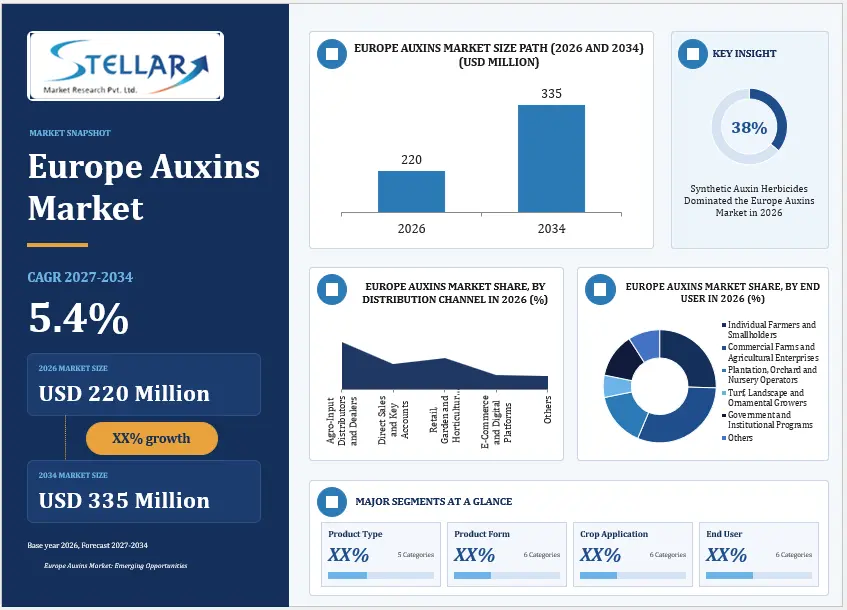
The Europe Auxins Market was valued at USD 220 Mn in 2026 and is expected to reach USD 335 Mn by 2034, growing at a CAGR of 5.4% during 2027–2034.
The Europe Auxins Market was valued at USD 220 Mn in 2026 and is expected to reach USD 335 Mn by 2034, growing at a CAGR of 5.4% during 2027–2034. In terms of volume, the Europe Auxins Market was valued at XX Metric Tons in 2026 and is expected to reach XX Metric Tons by 2034, growing at a CAGR of XX% during 2027–2034.
Market definition and scope: The Europe Auxins Market covers auxin-class agricultural inputs: synthetic auxin herbicides (2,4-D, dicamba, MCPA, MCPB, mecoprop-P, fluroxypyr, picloram, aminopyralid, halauxifen and florpyrauxifen), auxin-type plant growth regulators and rooting hormones (NAA, IBA, IAA and related compounds), and natural and bio-derived auxin formulations, supplied as liquid concentrates, water-soluble and dispersible powders and granules, rooting powders, gels and pastes, and tablets or capsules. To avoid double counting with the wider herbicide and plant growth regulator markets, synthetic auxin herbicides are counted at the auxin active-ingredient level only, and non-auxin partner actives in co-formulated products, such as glyphosate or glufosinate, are excluded. Gibberellin, cytokinin and ethylene-based regulators, and biostimulants without a declared auxin or auxin-like active, are outside the scope.
Stellar Market Research (SMR) study scope and coverage: The study period is 2021–2034, with 2026 as the base year, 2021–2026 as historical data and 2027–2034 as the forecast period. Market size is reported in USD million (value) and metric tons (volume), with all other currencies converted to USD. The Auxins Market analysis segments the market by product type, product form, crop application, end user and distribution channel, and covers seven European countries and a Rest of Europe group (Germany, France, Spain, Italy, the United Kingdom, the Netherlands and Poland). The competitive landscape profiles 30 key players, from global crop-protection majors and generic herbicide producers to plant growth regulator specialists and biostimulant companies.
The report is for crop-protection manufacturers, plant growth regulator and rooting hormone suppliers, biological and biostimulant companies, distributors, cooperatives, government agencies, technology providers and investors. It answers practical questions on market entry and strategy: how synthetic auxin herbicides, auxin-type plant growth regulators, rooting hormones and natural auxin formulations compare on price and performance, where grower demand is heading, how registrations, stewardship rules and generic competition shape pricing, and which crops, channels, segments and countries offer the best opportunities.
Synthetic Auxin Herbicides accounted for the largest share of Europe Auxins Market value in 2026 at about 38%, while cereals and grains represented about 44% of crop-application demand during the same year. Europe Auxins Market growth is moving toward natural and bio-derived auxin formulations, rooting powders, gels and pastes, fruits and vegetables, e-commerce and digital channels, and Poland, as herbicide-resistance management, horticulture expansion, regulatory change and demand for lower-residue inputs change what growers apply and where they buy it.
Stellar Market Research delivers a comprehensive Europe Auxins Market Research Report covering value and volume (metric tons) by product type, product form, crop application, end user, distribution channel and country, together with a competitive landscape, strategic scenarios and growth opportunities.
To get more Insights: Request Free Sample Report
Europe Auxins Market Size and Growth: Industry Outlook to 2034
The Europe Auxins Market is sized at the auxin active-ingredient and finished-product level, so that the wider herbicide, plant growth regulator and biostimulant markets are not double counted. According to Eurostat, pesticide sales in the European Union reached about 316,000 tonnes in 2024, up 8% on 2023, with herbicides, haulm destructors and moss killers accounting for 35% of sales; the data were published in May 2026. The European Commission extended the approval periods of the auxin-type herbicides MCPA and MCPB under Implementing Regulation (EU) 2026/1421 of 30 June 2026, and renewed mecoprop-P as a candidate for substitution under Regulation (EU) 2026/2025 of 10 September 2026. The Commission also presented its food and feed safety omnibus on 16 December 2025 to simplify approval and authorization procedures. This regulatory backdrop keeps established auxin herbicides on the market while steering long-term value toward plant growth regulators and bio-derived auxin formulations.
Key Findings: Insights Shaping the Europe Auxins Market
Government statistics, company disclosures and SMR's market model point to the following key findings, highlighting Europe Auxins Market demand, consumption, supply, revenue generation and market value creation through 2034.
- Synthetic Auxin Herbicides lead on value; Natural and Bio-Derived Auxin Formulations lead on growth. Synthetic Auxin Herbicides held about 38% of 2026 value and grow at 3.2%, below the market's 5.4% CAGR, while Natural and Bio-Derived Auxin Formulations grow at 10.5% and Auxin-Type Plant Growth Regulators at 5.4%.
- Liquid and Emulsifiable Concentrates lead product forms; Rooting Powders, Gels and Pastes grow fastest. Liquid and Emulsifiable Concentrates held about 50% of 2026 value and grow at 4.6%, while Rooting Powders, Gels and Pastes grow at 7.0%.
- Cereals and Grains lead crops; Fruits and Vegetables grow fastest. Cereals and Grains held about 44% of 2026 value and grow at 4.1%, while Fruits and Vegetables grow at 7.9% and reach 29% of value by 2034.
- Regulation anchors demand. Regulation (EU) 2026/1421 extended MCPA and MCPB approvals and Regulation (EU) 2026/2025 renewed mecoprop-P as a candidate for substitution.
- E-Commerce and Digital Platforms gain share. They grow at 10.9% a year, against XX% for Agro-Input Distributors and Dealers, which held about 52% of the 2026 value.
Europe Auxins Market Trends
Approval Extensions Keeping Auxin Herbicides on the Market: Implementing Regulation (EU) 2026/1421 of 30 June 2026 extended the approval periods of MCPA and MCPB while renewal assessments continue. These phenoxy herbicides remain important in cereals and grassland, and extensions support Auxins Market demand and revenue in the near term.
Candidate-for-Substitution Status Signaling Long-Term Pressure: Regulation (EU) 2026/2025 of 10 September 2026 renewed mecoprop-P, an auxin herbicide used mainly in cereals, as a candidate for substitution. A draft regulation on non-renewal of triclopyr was also on the agenda of the 29–30 June 2026 Standing Committee, according to PAN Europe's published letter, so the active-substance list may narrow over time.
Shift Toward Bio-Derived and Specialty Products: Natural and bio-derived auxin formulations are the fastest-growing product type, at 10.5% a year in this report. Sumitomo Chemical Agro Europe and Valent BioSciences launched a new biostimulant portfolio for Europe, the Middle East and Africa in December 2025.
Horticulture, Nursery and Digital Channel Expansion: Fruits and vegetables grow at 7.9% a year as protected cultivation, orchards and nurseries use auxin-type regulators and rooting hormones, and e-commerce and digital platforms grow at 10.9% a year.
Europe Auxins Market Drivers: Weed-Resistance Management, Horticulture Demand, Regulatory Support and Bio-Derived Products
Cereal growers still need selective broadleaf weed control. Cereals and grains made up about 44% of 2026 value, and auxin herbicides such as MCPA, 2,4-D and mecoprop-P remain affordable tools with a distinct mode of action for resistance management. Extension and renewal decisions in 2026 give manufacturers planning visibility for these products.
Specialty production adds a second pull. Fruits and vegetables grow at 7.9% a year, supported by orchard, greenhouse and nursery output across Spain, Italy, the Netherlands and Poland. Auxin-type regulators and rooting hormones help growers improve fruit set and propagation, and buyers increasingly favor lower-residue natural formulations.
Expansion of Organic Farming and Demand for Natural Auxin Formulations
The increasing adoption of organic farming is creating significant growth opportunities for the Europe Auxins Market, particularly for eligible natural and bio-derived formulations. According to Eurostat’s 2026, organic agricultural land in the European Union exceeded 16.8 million hectares in 2024, representing 10.6% of total utilised agricultural land. Furthermore, Bulgaria, Ireland, Romania and Croatia recorded organic farming area growth exceeding 10% between 2023 and 2024. The European Union aims to bring at least 25% of agricultural land under organic farming by 2030. This transition creates opportunities for approved natural auxin formulations that support root development, nutrient uptake and plant growth while meeting organic production requirements.
Europe Auxins Market Restraints and Challenges: Regulatory Risk, Generic Competition, Stewardship and Supply Costs
Regulatory attrition is the most persistent restraint. Auxin actives are reviewed under Regulation (EC) No 1107/2009, and candidate-for-substitution status, endocrine-disruption data requests and possible non-renewals, such as the draft triclopyr proposal, create uncertainty for portfolios and limit volume growth. Eurostat data show EU pesticide sales are still about 12% below 2011 levels.
Cost and compliance friction add to the pressure. Generic competition compresses margins on off-patent actives, and registering new products or uses is slow and costly. Member State authorization of finished products adds country-level differences.
Opportunities: Europe Auxins Market value growth is therefore expected to come from specialty and bio-derived products. Poland is the fastest-growing market in this report at a 6.9% CAGR during 2027–2034 on cereal and horticulture expansion, while Germany and France grow most slowly at 4.6% on mature, regulation-constrained cereal use.
Europe Auxins Market Dynamics Analysis: Economic Factors, Demand and Supply, Competitive Rivalry and Regulation
Demand and Supply Gap Analysis: Demand is concentrated in cereal and grassland weed control and in orchard, vegetable and nursery regulation. In SMR's analysis, supply of basic actives is ample, while stewardship-ready formulations and registered natural auxin products are scarcer.
Farmer Behavior Trends and Preference Evolution: Growers reduce herbicide passes through integrated weed management and increasingly add mechanical and cultural controls. Horticultural growers prefer products with clear residue profiles and organic-compatible options.
Technological Advancements and Innovation Impact: Low-volatility formulations, drift-reduction nozzles and digital timing tools support compliance, and natural-origin auxin products are being standardized for consistent results.
Regulatory Influences and Regulatory Changes: The December 2025 omnibus proposal seeks simpler approval procedures, while 2026 extensions and renewals show the Commission balancing continuity with substitution. Companies need dossiers that anticipate endocrine and child-exposure assessments.
Digital Application, Grower Advisory and Changing Crop Protection Preferences
Integrated Weed Management Adoption: Cereal growers combine auxin herbicides with other modes of action and cultural practices to meet EU rules and manage resistance.
Growing Acceptance of Bio-Derived Plant Hormones: Natural and bio-derived auxin formulations grow at 10.5% a year, supported by the EMEA biostimulant launches of December 2025.
Horticulture and Protected-Cultivation Pull: Fruits and vegetables grow at 7.9% a year and rooting hormones and propagation products at XX%.
Direct-to-Grower and E-Commerce Distribution: E-commerce and digital platforms grow at XX% and retail, garden and horticulture stores at 6.5%, ahead of dealers at 3.2%.
Europe Auxins Market Innovations: Low-Volatility Formulations, Bio-Derived Auxins, Rooting Technologies and Precision Application
Companies are refining low-volatility and reduced-rate formulations, encapsulation and adjuvant systems that keep auxin herbicides within tighter exposure limits. Plant growth regulator makers are improving IBA and NAA delivery for rooting products, and biological companies are developing seaweed, microbial and plant-extract formulations with declared auxin activity.
Standardized auxin content, longer shelf life and combined biostimulant-auxin products support European growers who need documented performance. Digital tools that time applications to crop stage and weather help lower off-target risk.
Emerging Europe Auxins Innovation: Reduced-Exposure Formulations, Bio-Derived Hormones and Digital Stewardship
Innovation is concentrated in reduced-exposure herbicide formulations and bio-derived auxin products; the charts in the Segmentation and Leading Europe Auxins Manufacturers sections show the market's segment mix and player structure.
Active substances are approved at EU level under Regulation (EC) No 1107/2009, and Member States authorize finished products. Organic production follows EU organic rules, and fertilizing and biostimulant products are governed by the EU Fertilising Products Regulation (EU) 2019/1009 where they qualify, so classification of auxin-containing products affects the route to Europe Auxins Market growth.
Europe Auxins Market Segment Analysis
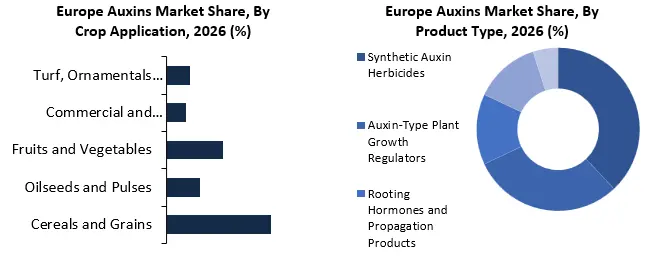
By Product Type: Synthetic Auxin Herbicides led with 38% of the 2026 market value, supported by low unit cost, broadleaf weed-control efficacy and compatibility with auxin-tolerant crop systems, and are projected to grow at 3.2% to XX% of 2034 value. Natural and Bio-Derived Auxin Formulations are the fastest-growing type at 10.5% a year, rising from 13% to XX% of value as buyers prefer natural-origin and lower-residue inputs. Auxin-Type Plant Growth Regulators and Rooting Hormones and Propagation Products benefit from orchard, nursery and protected-cultivation expansion, while Other Auxin Formulations hold about 5%.
By Crop Application: Cereals and Grains dominated with 44% of the 2026 market value (USD 96.8 Mn) and grow at 4.1%, supported by large treated area and the need for selective broadleaf control. Fruits and Vegetables are the fastest-growing application at 7.9% a year, rising from XX% to XX% of value on orchard, vegetable and nursery demand for plant growth regulators and rooting products. The remaining applications are Oilseeds and Pulses and the commercial, plantation and turf segments, which together provide steady, lower-growth demand.
By Product Form: Liquid and Emulsifiable Concentrates dominated with 50% of the 2026 market value and grow at 4.6%, because liquid herbicide and regulator concentrate suit spray application and tank mixing. Rooting Powders, Gels and Pastes are the fastest-growing form at 7.0% a year, while Water-Soluble and Dispersible Powders and Granules hold 26% and grow at 5.4%.
Europe Auxins Market Country-Level Outlook: Germany, France, Spain, Italy, United Kingdom, Netherlands and Poland
Germany and France each held about 16% of 2026 value, growing at a 4.6% CAGR during 2027–2034 as cereal use matures, while Spain held XX% and Italy XX%, growing at 5.4% each on fruit, vegetable and olive production. Extensive wheat, barley, maize and rapeseed cultivation supports consistent demand for synthetic auxin herbicides, particularly for selective broadleaf weed management. Increasing herbicide resistance, stringent European Union pesticide regulations and sustainable farming practices encourage manufacturers to develop efficient, low-volatility and regulatory-compliant formulations. Germany's advanced agricultural infrastructure, precision farming technologies and established agrochemical distribution networks further support market development. Additionally, increasing demand for biological agricultural inputs and speciality plant growth regulators creates opportunities for product innovation and portfolio diversification.
Poland is expected to be the fastest-growing market at 6.9% CAGR, rising from XX% of 2026 value to about 9% by 2034 on cereal, oilseed and horticulture expansion. Agricultural modernization, farm mechanization and European Union agricultural support programs encourage investment in advanced farming technologies and efficient agricultural inputs. Growing awareness of herbicide resistance management and crop productivity strengthens synthetic auxin herbicide consumption.
|
Country |
2026 share |
2026 (USD Mn) |
2034 (USD Mn) |
CAGR |
|
Germany |
16.0% |
XX |
XX |
4.6% |
|
France |
16.0% |
XX |
XX |
4.6% |
|
Spain |
XX% |
XX |
XX |
5.4% |
|
Italy |
XX% |
XX |
XX |
5.4% |
|
United Kingdom |
XX% |
XX |
XX |
XX% |
|
Netherlands |
XX% |
XX |
XX |
XX% |
|
Poland |
XX% |
XX |
XX |
6.9% |
|
Rest of Europe |
XX% |
XX |
XX |
XX% |
Leading Europe Auxins Manufacturers: Competitive Landscape and Auxin Product Portfolios
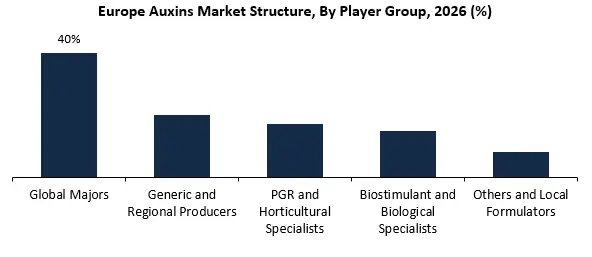
The Europe Auxins Market competitive landscape includes several distinct groups: global crop-protection majors, generic and regional herbicide producers, plant growth regulator and horticultural specialists, and biostimulant and biological specialists.
Competition is shaped by regulatory dossier capability, active-substance portfolio breadth, formulation technology and distribution reach. In December 2025, Sumitomo Chemical Agro Europe and Valent BioSciences launched a new biostimulant portfolio for EMEA, and in April 2026 Sumitomo Chemical formed Sumitomo Biorational Company. Dossier investment, bolt-on biological acquisitions and distributor partnerships are likely to continue.
Europe Auxins Market Recent Developments, Product Launches and Industry News | Top Company Developments in 2026
|
Date |
Company |
Development |
|
Apr 2026 |
Sumitomo Chemical |
Valent BioSciences, MGK and Valent North America began operating as Sumitomo Biorational Company LLC (kept from the original). |
|
Jun 2026 |
Nufarm |
Reported first-half FY2026 results with Europe as the standout region, EBITDA up 17% in local currency. |
|
Sep 2026 |
ADAMA |
First EU registration for Ferrabait molluscicide (Latvia, 9 Sep), with launches in France, Sweden and Lithuania from 2027. |
|
Sep 2026 |
BASF |
Mandated four banks to prepare the planned IPO of Agricultural Solutions, with IPO readiness targeted for mid-2027 and no final decision yet. |
|
Oct 2026 |
Corteva |
Completed the separation of Vylor, its seed business, on 1 Oct 2026 and is now a pure-play crop protection company. |
Auxins Competitive Landscape Analysis: Competitor Benchmarking, Rivalry Intensity and Market Strategies
- Competitor analysis and Auxins Market share: The report profiles key players, benchmarking company revenue, auxin-related revenue, growth rate, profit margin and R&D investment, and groups them by role rather than ranking them as identical producers.
- Competitive positioning and differentiation: Global majors differentiate on dossier strength and branded formulations; generic producers on cost and active-ingredient supply; plant growth regulator specialists on crop-specific know-how; and biological companies on natural-origin positioning.
- Rivalry intensity and competitive forces: Rivalry is shaped by approval and renewal risk, candidate-for-substitution status, generic competition in off-patent actives, integrated weed management and price sensitivity.
- Market player strategies and competitive maneuvers: Leading companies invest in regulatory dossiers, expand bio-derived and specialty portfolios, acquire biological businesses and grow digital and retail channels.
Europe Auxins Market Scope: Inquire before buying
|
Europe Auxins Market |
|||
|
Report Coverage |
Details |
||
|
Base Year: |
2026 |
Forecast Period: |
2027–2034 |
|
Historical Data:
|
2021 to 2026
|
(Value) Market Size in 2026: |
USD 220 Million |
|
(Volume) Market Size in 2026: |
XX Metric Tons |
||
|
Forecast Period 2027 to 2034 CAGR (Value) |
5.4% |
Market Size in 2034: |
USD 335 Million |
|
Forecast Period 2027 to 2034 CAGR (Volume) |
XX% |
Market Size in 2034: |
XX Metric Tons |
|
Europe Auxins Market Segments Covered: |
By Product Type |
Synthetic Auxin Herbicides Auxin-Type Plant Growth Regulators Rooting Hormones and Propagation Products Natural and Bio-Derived Auxin Formulations Other Auxin Formulations |
|
|
By Product Form |
Liquid and Emulsifiable Concentrates Water-Soluble and Dispersible Powders and Granules Rooting Powders Gels and Pastes Tablets and Capsules Others |
||
|
By Crop Application |
Cereals and Grains Oilseeds and Pulses Fruits and Vegetables Commercial and Plantation Crops Turf and Ornamentals Others |
||
|
By End User |
Individual Farmers and Smallholders Commercial Farms and Agricultural Enterprises Plantation, Orchard and Nursery Operators Turf, Landscape and Ornamental Growers Government and Institutional Programs Others |
||
|
By Distribution Channel |
Agro-Input Distributors and Dealers Direct Sales and Key Accounts Retail, Garden and Horticulture Stores E-Commerce and Digital Platforms Others |
||
|
By Country |
Germany France Spain Italy United Kingdom Netherlands Poland Rest of Europe |
||
Key players/Competitors profiled in the Europe Auxins Market report from a regional and global perspective:
Europe
- BASF SE (Germany)
- Bayer AG (Germany)
- Syngenta Group (Switzerland)
- Sumitomo Chemical Agro Europe S.A.S. (France)
- Belchim Crop Protection NV (Belgium)
- Rovensa Group (Portugal)
- Timac Agro International (France)
- COMPO EXPERT GmbH (Germany)
- Sipcam Oxon S.p.A. (Italy)
- Industrias Químicas del Vallés S.A. (Spain)
- Globachem NV (Belgium)
- Rhizopon B.V. (Netherlands)
- Tradecorp International S.A. (Spain)
- Stähler Agrochemie GmbH & Co. KG (Germany)
- Ciech Sarzyna S.A. (Poland)
- Atlántica Agrícola S.A. (Spain)
- Agriphar S.A. (Belgium)
- Koppert B.V. (Netherlands)
- Barclay Chemicals Manufacturing Ltd. (Ireland)
- Interagro (UK) Ltd. (United Kingdom)
Global Participants with European Operations
- Corteva, Inc. (United States)
- UPL Limited (India)
- Nufarm Limited (Australia)
- ADAMA Ltd. (Israel)
- FMC Corporation (United States)
- Albaugh, LLC (United States)
- Sharda Cropchem Limited (India)
- Rotam Agrochem International Co., Ltd. (Hong Kong)
- Gowan Company, LLC (United States)
- Nanjing Red Sun Co., Ltd. (China)
Others
Frequently Asked Questions
Ans. Growth comes from continued cereal weed-control needs, 2026 approval extensions for MCPA and MCPB, horticulture and nursery expansion, and the shift toward natural and bio-derived auxin formulations.
Ans. Germany and France led in 2026 with about 16% of value each, supported by large cereal areas; Poland is the fastest-growing market.
Ans. Leading names include BASF SE, Bayer AG, Syngenta Group, Sumitomo Chemical Agro Europe S.A.S., Belchim Crop Protection NV, Rovensa Group, Timac Agro International, COMPO EXPERT GmbH, Corteva, Inc., UPL Limited, Nufarm Limited and ADAMA Ltd., along with regional formulators, plant growth regulator specialists and biological companies.
Ans. Synthetic auxin herbicides such as 2,4-D, dicamba and MCPA mimic the plant hormone auxin at high doses to control broadleaf weeds. Auxin-type plant growth regulators and rooting hormones, such as NAA and IBA, use low doses to improve rooting, fruit set and thinning. Natural and bio-derived auxin formulations draw on plant, seaweed or microbial sources of indole-3-acetic acid and related compounds and are positioned as lower-residue inputs.
1. Executive Market Landscape and Industry Overview
1.1. Europe Auxins Market Size (Value USD Million and Volume Metric Tons), 2026–2034
1.2. Evolution of Auxins in Crop Protection and Plant Growth Regulation
1.3. Market Definition, Scope, Boundaries and Product Classification
1.4. Role of Auxins in Weed Management, Propagation and Crop Quality
1.5. Europe Auxins Market Industry Structure and Value Chain
1.6. Herbicide Resistance Management, Horticulture and Plant Growth Regulator Adoption
1.7. CAGR Analysis of Europe Auxins Market During 2027–2034
2. Auxins Market Dynamics
2.1. Auxins Market Trends
2.2. Auxins Market Dynamics
2.2.1. Drivers
2.2.2. Restraints
2.2.3. Opportunities
2.2.4. Challenges
2.3. Porter's Five Forces Analysis
2.4. PESTLE Analysis
3. Auxins Market Macroeconomic Factors
3.1. Agricultural Production and Cultivated Land Area
3.2. Crop Protection and Agricultural Input Expenditure
3.3. Expansion of Horticulture, Nurseries and Protected Cultivation
3.4. Government Registration Decisions and Agricultural Support Programs
3.5. Food Security and Agricultural Productivity Requirements
3.6. Generic Active-Ingredient Prices and Agricultural Commodity Economics
3.7. International Pesticide Trade Policies and Residue Regulations
4. Auxins Industry Trends and Emerging Requirements
4.1. Growing Role of Auxin Herbicides in Integrated Weed Management
4.2. Growing Demand for Low-Volatility and Drift-Reduced Formulations
4.3. Impact of Approval Extensions and Substitution Policy on Auxin Use
4.4. Increasing Demand for Rooting Hormones and Propagation Products
4.5. Development of Natural and Bio-Derived Auxin Formulations
4.6. Adoption of Precision Application and Digital Advisory
4.7. Growing Commercialization of Biostimulant-Auxin Combinations
5. Auxins Technology and Agronomic Ecosystem
5.1. Chemistry and Classes of Auxins (Phenoxy, Benzoic, Pyridine, Quinoline and Indole Auxins)
5.2. Mode of Action and Auxin Signaling in Plants
5.3. Selectivity, Crop Tolerance and Weed Spectrum
5.4. Interaction of Auxins with Soil, Weather and Spray Drift
5.5. Rooting, Fruit Set and Plant Growth Regulation Mechanisms
5.6. Formulation Stability, Salt Forms and Compatibility
5.7. Agronomic Performance and Crop Response Assessment
6. Auxins Raw Materials and Feedstock Landscape
6.1. Chlorophenol, Phenoxyacetic Acid and Pyridine Intermediates
6.2. Indole, Naphthalene and Other Aromatic Feedstocks
6.3. Plant, Seaweed and Microbial Sources of Natural Auxins
6.4. Solvents, Salts, Adjuvants and Safeners
6.5. Intermediate Supply and Regional Production Clusters
6.6. Raw Material Quality and Regulatory Impurity Limits
6.7. Procurement Economics and Supply Security
Part II: Product Landscape, Manufacturing and Technology Analysis
7. Synthetic Auxin Herbicide Market Landscape
7.1. Composition and Product Characteristics
7.2. 2,4-D and 2,4-D Choline Products
7.3. Dicamba and Low-Volatility Dicamba Products
7.4. MCPA, MCPB and Mecoprop-P Products
7.5. Fluroxypyr, Picloram, Aminopyralid and Arylpicolinate Auxins
7.6. Production Costs, Pricing and Commercial Viability
7.7. Demand and Growth Opportunities
8. Auxin-Type Plant Growth Regulator Market Landscape
8.1. Composition and Product Characteristics
8.2. NAA and Naphthaleneacetamide Products
8.3. Fruit Thinning, Fruit Set and Pre-Harvest Drop Control
8.4. Sprout Suppression and Flowering Control Uses
8.5. Application Rates and Agronomic Performance
8.6. Production Costs and Pricing
8.7. Demand and Growth Opportunities
9. Rooting Hormones and Propagation Products Market Landscape
9.1. Composition and Product Characteristics
9.2. IBA-Based Rooting Products
9.3. IAA and NAA-Based Rooting Products
9.4. Cuttings, Grafting and Tissue Culture Applications
9.5. Powder, Gel and Liquid Rooting Formats
9.6. Production Economics and Pricing
9.7. Demand and Adoption Trends
10. Natural and Bio-Derived Auxin Formulations Market Landscape
10.1. Composition and Classification
10.2. Seaweed-Derived Auxin Formulations
10.3. Microbial and Fermentation-Derived Indole-3-Acetic Acid
10.4. Plant-Extract-Based Auxin Products
10.5. Standardization of Auxin Content
10.6. Production Economics and Pricing
10.7. Demand and Adoption Trends
11. Other Auxin Formulations and Emerging Products
11.1. Auxin Combinations with Safeners and Partner Herbicides
11.2. Biostimulant-Auxin Combination Products
11.3. Tissue Culture Media Auxins
11.4. Encapsulated and Controlled-Release Formulations
11.5. Product Stability, Storage and Shelf-Life Requirements
11.6. Specialty Product Pricing
11.7. Emerging Product Development and Opportunities
12. Auxins Product Forms and Delivery Technologies
12.1. Liquid and Emulsifiable Concentrates
12.2. Water-Soluble and Dispersible Powders and Granules
12.3. Rooting Powders, Gels and Pastes
12.4. Tablets, Capsules and Other Forms
12.5. Particle Size, Solubility and Application Compatibility
12.6. Product Handling, Storage and Transportation Requirements
12.7. Product Form Performance and Commercial Benchmarking
13. Auxins Manufacturing and Production Workflow
13.1. Intermediate Synthesis and Active Ingredient Production
13.2. Salt Formation, Purification and Technical Grade Control
13.3. Fermentation and Extraction of Natural Auxins
13.4. Formulation, Blending and Adjuvant Addition
13.5. Filling, Granulation and Tablet Production
13.6. Quality Inspection and Active Content Testing
13.7. Packaging, Storage and Production Optimization
14. Auxins Manufacturing Automation and Processing Technologies
14.1. Automated Synthesis and Reactor Control
14.2. Purification and Crystallization Technologies
14.3. Automated Formulation and Dosing Systems
14.4. Granulation and Tablet Equipment
14.5. Digital Production Monitoring and Process Optimization
14.6. Automated Packaging and Product Traceability Systems
14.7. Energy-Efficient Manufacturing and Waste Reduction Technologies
Part III: Crop Applications, Customer Requirements and Commercial Landscape
15. Auxin Applications in Cereals and Grains
15.1. Wheat and Barley Broadleaf Weed Control
15.2. Maize and Sorghum Weed Management
15.3. Rice and Millets Applications
15.4. Pasture and Grassland Applications
15.5. Application Rates and Crop Safety
15.6. Farm-Level Economics
15.7. Cereals and Grains Demand and Adoption Trends
16. Auxin Applications in Oilseeds and Pulses
16.1. Soybean Cultivation and Weed Management Systems
16.2. Cotton and Rapeseed Applications
16.3. Sunflower and Other Oilseed Applications
16.4. Pulses and Legume Applications
16.5. Drift Management and Sensitive Crop Buffers
16.6. Application Economics and Crop Productivity
16.7. Oilseeds and Pulses Demand Opportunities
17. Auxin Applications in Fruits and Vegetables
17.1. Orchard Fruit Set, Thinning and Drop Control
17.2. Open-Field Vegetable Applications
17.3. Protected Cultivation and Greenhouse Applications
17.4. Nursery Propagation and Grafting
17.5. Crop Quality, Uniformity and Yield Improvement
17.6. Procurement and Application Economics
17.7. Fruits and Vegetables Demand and Adoption
18. Auxin Applications in Commercial and Plantation Crops
18.1. Sugar Beet Weed Control
18.2. Vineyard, Olive and Orchard Plantations
18.3. Hops, Forestry and Other Tree Crops
18.4. Medicinal, Aromatic and Specialty Crops
18.5. Turf, Ornamentals and Landscape Applications
18.6. Commercial Crop Application Economics
18.7. Commercial and Specialty Crop Demand Opportunities
19. Auxins Buyers and Procurement Requirements
19.1. Individual Farmers and Smallholder Producers
19.2. Commercial Farms and Agricultural Enterprises
19.3. Plantation, Orchard and Nursery Operators
19.4. Turf, Landscape and Ornamental Growers
19.5. Government and Institutional Programs
19.6. Purchasing Criteria, Product Quality and Price Sensitivity
19.7. Seasonal Purchasing Patterns and Brand Loyalty
20. Auxins Customization and Product Development
20.1. Crop-Specific Formulation Development
20.2. Region and Climate-Based Product Customization
20.3. Active Ingredient Ratio and Salt Form Optimization
20.4. Safener, Adjuvant and Partner Active Selection
20.5. Concentration and Dose Optimization for Rooting Products
20.6. Compatibility with Tank-Mix and Fertigation Systems
20.7. Custom Formulation Costs and Commercialization Requirements
21. Auxins Testing, Validation and Quality Assurance
21.1. Raw Material Quality and Chemical Composition Testing
21.2. Active Ingredient Content and Impurity Analysis
21.3. Volatility and Drift Assessment
21.4. Physical Stability and Particle Size Testing
21.5. Residue, Toxicology and Environmental Safety Testing
21.6. Field Trials and Agronomic Performance Validation
21.7. Product Certification, Shelf-Life and Quality Compliance
22. Auxins Pricing, Business Models and Cost Economics
22.1. Pricing Analysis by Product Type
22.2. Pricing Analysis by Product Form
22.3. Intermediate and Technical Grade Costs
22.4. Labor, Energy, Processing and Manufacturing Overhead Costs
22.5. Packaging, Transportation and Distribution Costs
22.6. Branded versus Generic Pricing Models
22.7. Average Selling Price, Gross Margin and Profitability Analysis
22.8. Historical and Forecast Price Trends (2021–2034)
22.9. Auxin Products versus Alternative Modes of Action Cost Comparison
23. Auxins Sales, Distribution and Market Delivery Landscape
23.1. Direct Sales by Manufacturers
23.2. Agricultural Distributors and Agro-Input Dealers
23.3. Cooperatives and Government Distribution Networks
23.4. Retail, Garden and Horticulture Stores
23.5. E-Commerce and Digital Agricultural Input Platforms
23.6. Export Distribution and International Sales Networks
23.7. Distributor Margins, Trade Incentives and Channel Performance
24. Auxins Manufacturing Supply Chain and Operational Ecosystem
24.1. Intermediate Producers and Technical Grade Suppliers
24.2. Formulation and Toll Manufacturing Companies
24.3. Natural Auxin Extraction and Fermentation Companies
24.4. Manufacturing and Processing Clusters
24.5. Packaging, Warehousing and Agricultural Logistics Networks
24.6. Seasonal Demand and Supply Chain Disruptions
24.7. Manufacturing Capacity, Localization and Supply Chain Resilience
Part IV: Innovation, International Trade, Sustainability and Regulatory Landscape
25. Auxins Technology Innovation, R&D and Product Development
25.1. Novel Auxin Active Ingredients and Chemistries
25.2. Low-Volatility and Drift-Reduced Formulations
25.3. Safener and Adjuvant Technologies
25.4. Natural and Bio-Derived Auxin Research
25.5. Precision Application and Digital Advisory Integration
25.6. Improved Stability and Agronomic Performance
25.7. Technology Patents, R&D Investments and Research Collaborations
26. Auxins International Trade, Import-Export and Logistics
26.1. Global Intermediate and Technical Grade Trade Landscape
26.2. Finished Herbicide Import and Export Analysis
26.3. Plant Growth Regulator and Rooting Product Trade
26.4. Major Exporting and Importing Countries
26.5. Tariffs, Customs Classification and Trade Restrictions
26.6. International Transportation, Packaging and Logistics Costs
26.7. Export Competitiveness and International Market Expansion Opportunities
27. Auxins Regulatory, Quality and Sustainability Landscape
27.1. European Pesticide and Plant Growth Regulator Regulatory Framework
27.2. EU Regulation (EC) No 1107/2009 and Active Substance Renewals
27.3. Member State Product Authorization and Zonal Assessment
27.4. EU Organic Production Rules and Fertilising Products Regulation (EU) 2019/1009
27.5. Residue Limits, Maximum Residue Levels and Export Compliance
27.6. Spray Drift, Environmental Impact and Stewardship Requirements
27.7. Circular Economy and Waste Reduction
27.8. Sustainable Sourcing, Biodiversity and Resource Conservation
27.9. Product Registration and Certification Requirements
28. Europe Auxins Regional and Country-Level Market Landscape
28.1. Germany and France Cereal and Rapeseed Weed Management
28.2. Spain and Italy Fruit, Vegetable and Olive Demand
28.3. United Kingdom Cereal and Grassland Weed Management and Post-Brexit Regulation
28.4. Netherlands Horticulture, Nursery and Protected-Cultivation Demand
28.5. Poland Cereal, Oilseed and Horticulture Growth
28.6. Rest of Europe Production, Consumption and Trade Analysis
28.7. Regional Manufacturing Investments and Adoption Trends
Part V: Market Size and Forecast by Segmentation
29. Europe Auxins Market: Market Size and Forecast by Segmentation, Value (USD Million), Volume (Metric Tons), 2026–2034
29.1. By Product Type
29.1.1. Synthetic Auxin Herbicides
29.1.2. Auxin-Type Plant Growth Regulators
29.1.3. Rooting Hormones and Propagation Products
29.1.4. Natural and Bio-Derived Auxin Formulations
29.1.5. Other Auxin Formulations
29.2. By Product Form
29.2.1. Liquid and Emulsifiable Concentrates
29.2.2. Water-Soluble and Dispersible Powders and Granules
29.2.3. Rooting Powders
29.2.4. Gels and Pastes
29.2.5. Tablets and Capsules
29.2.6. Others
29.3. By Crop Application
29.3.1. Cereals and Grains
29.3.2. Oilseeds and Pulses
29.3.3. Fruits and Vegetables
29.3.4. Commercial and Plantation Crops
29.3.5. Turf and Ornamentals
29.3.6. Others
29.4. By End User
29.4.1. Individual Farmers and Smallholders
29.4.2. Commercial Farms and Agricultural Enterprises
29.4.3. Plantation, Orchard and Nursery Operators
29.4.4. Turf, Landscape and Ornamental Growers
29.4.5. Government and Institutional Programs
29.4.6. Others
29.5. By Distribution Channel
29.5.1. Agro-Input Distributors and Dealers
29.5.2. Direct Sales and Key Accounts
29.5.3. Retail, Garden and Horticulture Stores
29.5.4. E-Commerce and Digital Platforms
29.5.5. Others
29.6. By Country
29.6.1. Germany
29.6.2. France
29.6.3. Spain
29.6.4. Italy
29.6.5. United Kingdom
29.6.6. Netherlands
29.6.7. Poland
29.6.8. Rest of Europe
Part VI: Competitive Landscape and Strategic Benchmarking
30. Europe Auxins Market Competitive Landscape
30.1. SMR Competition Matrix
30.2. Competitive Positioning of Leading Key Players (Revenue and Market Share %)
30.3. Key Players Benchmarking
30.3.1. Company Name
30.3.2. Headquarters
30.3.3. Auxin Product Portfolio
30.3.4. Product Type and Formulation Coverage
30.3.5. Active Ingredient Portfolio and Formulation Technology
30.3.6. Manufacturing and Processing Technologies
30.3.7. Registrations, Certifications and Stewardship Programs
30.3.8. Raw Material and Intermediate Sourcing Capabilities
30.3.9. Total Company Revenue (2026)
30.3.10. Auxin-Related Revenue (2026)
30.3.11. Geographic Presence
30.3.12. Manufacturing Capacity and Production Capabilities
30.3.13. Distribution Network and Customer Portfolio
30.3.14. Product Pricing and Market Positioning
30.3.15. Strategic Partnerships and Technology Collaborations
30.4. Market Structure
30.4.1. Market Leaders
30.4.2. Market Followers
30.4.3. Emerging Players
30.4.4. Specialized Auxin Manufacturers
30.5. Growth Rate / Y-o-Y (%) of Companies
30.6. Profit Margin (%) of Companies
30.7. R&D and Technology Development Investments (%) of Companies
30.8. Revenue versus Net Earnings – Financial Health Benchmarking (2026)
30.9. Revenue Performance and Financial Analysis (2026)
30.10. Mergers and Acquisitions Details
30.11. Recent Key Developments
31. Europe Auxins Market Manufacturers
31.1. Synthetic Auxin Herbicide Manufacturers
31.2. Auxin-Type Plant Growth Regulator Manufacturers
31.3. Rooting Hormone Manufacturers
31.4. Natural and Bio-Derived Auxin Manufacturers
31.5. Specialty Auxin Formulators
31.6. Product Portfolio and Production Capacity Benchmarking
31.7. Manufacturing Competitive Positioning
32. Auxin Technology and Formulation Providers
32.1. Active Ingredient Synthesis Technology Providers
32.2. Formulation and Adjuvant Technology Providers
32.3. Safener and Drift-Reduction Technology Providers
32.4. Fermentation and Extraction Technology Providers
32.5. Crop-Specific Formulation Developers
32.6. Technology Performance and Commercial Benchmarking
32.7. Emerging Auxin Technology Innovations
33. Auxin Raw Material and Agricultural Input Suppliers
33.1. Intermediate and Technical Grade Suppliers
33.2. Solvent, Salt and Adjuvant Suppliers
33.3. Seaweed and Plant Extract Suppliers
33.4. Fermentation Input Suppliers
33.5. Packaging Material Suppliers
33.6. Additive and Safener Suppliers
33.7. Supplier Quality, Production Capacity and Cost Benchmarking
34. Auxin Manufacturing Equipment and Automation Providers
34.1. Reactor and Synthesis Equipment Manufacturers
34.2. Purification and Drying Equipment Providers
34.3. Formulation and Granulation Equipment Providers
34.4. Filling, Tablet and Packaging Equipment Manufacturers
34.5. Automated Material Handling System Providers
34.6. Digital Production Monitoring and Quality Control Solutions
34.7. Manufacturing Equipment Performance and Technology Benchmarking
35. Auxin Dealers, Distributors and Sales Companies
35.1. Agricultural Input Dealers and Distributors
35.2. Horticulture and Nursery Supply Companies
35.3. Government and Cooperative Distribution Agencies
35.4. Rural Retail Networks
35.5. Online Agricultural Input Sales Platforms
35.6. International Importers and Exporters
35.7. Distribution Network Performance and Competitive Benchmarking
36. Auxin Agronomic and Technical Service Providers
36.1. Weed Management and Crop Advisory Consultants
36.2. Spray Application and Drift Management Service Providers
36.3. Propagation and Nursery Technical Service Providers
36.4. Residue Testing and Regulatory Laboratories
36.5. Agricultural Research Institutions and Field Trial Organizations
36.6. Grower Training and Product Demonstration Programs
36.7. Technical Service Performance and Customer Support Benchmarking
37. Auxin Manufacturers' Strategies and Expansion Plans
37.1. Expansion of Auxin Product Portfolios
37.2. Development of Low-Volatility and Stewardship-Ready Formulations
37.3. Backward Integration into Intermediate Supply
37.4. Expansion into Bio-Derived and Specialty Segments
37.5. Strategic Partnerships with Distributors and Cooperatives
37.6. Investment in Advanced Manufacturing and Formulation Technologies
37.7. Production Capacity Expansion and Supply Chain Development
37.8. Mergers, Acquisitions and Strategic Collaborations
38. Auxins Industry SWOT, Investments and Strategic Developments
38.1. Competitive Strengths of Established Auxin Manufacturers
38.2. Regulatory Risk, Production Costs and Stewardship Challenges
38.3. Opportunities in Horticulture and Bio-Derived Crop Inputs
38.4. Competitive Threats from Alternative Modes of Action
38.5. Strategic Investments in Formulation and Manufacturing
38.6. Government Registration Decisions and Agricultural Programs
38.7. Major Product Launches, Partnerships and Industry Developments
39. Auxins Competitive Outlook and Market Positioning
39.1. Competitive Dynamics Across Auxin Product Categories
39.2. Market Concentration Among Crop-Protection Manufacturers
39.3. Product Differentiation Through Efficacy, Stewardship and Pricing
39.4. Competitive Positioning of Established and Emerging Manufacturers
39.5. Regional Manufacturing Expansion and Localization
39.6. Future Developments in Low-Volatility and Bio-Derived Auxins
39.7. Long-Term Competitive Positioning of Leading Companies
40. Company Profile: Key Auxins Market Players
Detailed Profile Considering the Parameters:
1. Company Overview
2. Business Portfolio
3. Auxin Product Portfolio
4. Manufacturing and Technology Capabilities
5. Production Capacity and Raw Material Sourcing
6. Financial Overview
7. Geographic Presence and Distribution Network
8. SWOT Analysis
9. Strategic Analysis
10. Recent Developments
Europe
40.1. BASF SE (Germany)
40.2. Bayer AG (Germany)
40.3. Syngenta Group (Switzerland)
40.4. Sumitomo Chemical Agro Europe S.A.S. (France)
40.5. Belchim Crop Protection NV (Belgium)
40.6. Rovensa Group (Portugal)
40.7. Timac Agro International (France)
40.8. COMPO EXPERT GmbH (Germany)
40.9. Sipcam Oxon S.p.A. (Italy)
40.10. Industrias Químicas del Vallés S.A. (Spain)
40.11. Globachem NV (Belgium)
40.12. Rhizopon B.V. (Netherlands)
40.13. Tradecorp International S.A. (Spain)
40.14. Stähler Agrochemie GmbH & Co. KG (Germany)
40.15. Ciech Sarzyna S.A. (Poland)
40.16. Atlántica Agrícola S.A. (Spain)
40.17. Agriphar S.A. (Belgium)
40.18. Koppert B.V. (Netherlands)
40.19. Barclay Chemicals Manufacturing Ltd. (Ireland)
40.20. Interagro (UK) Ltd. (United Kingdom)
Global Participants with European Operations
40.21. Corteva, Inc. (United States)
40.22. UPL Limited (India)
40.23. Nufarm Limited (Australia)
40.24. ADAMA Ltd. (Israel)
40.25. FMC Corporation (United States)
40.26. Albaugh, LLC (United States)
40.27. Sharda Cropchem Limited (India)
40.28. Rotam Agrochem International Co., Ltd. (Hong Kong)
40.29. Gowan Company, LLC (United States)
40.30. Nanjing Red Sun Co., Ltd. (China)
Others
Part VII: Key Findings, Strategic Recommendations and Research Methodology
41. Key Findings
41.1. Europe Auxins Market Size, Growth and Revenue Opportunities
41.2. Leading Product Types, Product Forms and Crop Applications
41.3. Regional or Country-Level Leadership and Growth Opportunities
41.4. Auxin Production, Sales and Consumption Trends
41.5. Competitive Positioning of Leading Manufacturers
41.6. Manufacturing, Pricing, Supply Chain and Distribution Insights
41.7. Strategic Implications for Manufacturers, Distributors and Investors
42. Strategic Moves and Industry Outlook
42.1. Strategic Opportunities in Weed Management and Horticulture
42.2. Expansion of Low-Volatility and Bio-Derived Auxin Products
42.3. Localization of Formulation and Manufacturing
42.4. Agricultural Distribution and Rural Retail Network Expansion
42.5. Emerging Market Entry and Geographic Expansion Opportunities
42.6. Strategic Partnerships, Acquisitions and Product Development
42.7. Long-Term Europe Auxins Market Outlook Through 2034
43. Research Methodology
43.1. Research Objectives, Market Definition and Scope
43.2. Primary Research Methodology
43.2.1. Interviews with Auxin Manufacturers and Formulators
43.2.2. Interviews with Plant Growth Regulator and Biological Companies
43.2.3. Interviews with Agricultural Input Distributors and Dealers
43.2.4. Interviews with Growers, Nursery Operators and Agronomists
43.2.5. Procurement, Consumption and Application Assessment
43.3. Secondary Research Methodology
43.3.1. Company Annual Reports and Financial Statements
43.3.2. Government Agricultural and Pesticide Registration Statistics
43.3.3. FAO, Eurostat, European Commission, EFSA and Agricultural Industry Associations
43.3.4. International Pesticide Trade and Customs Databases
43.3.5. Scientific Publications and Agronomic Research Studies
43.4. Market Size Estimation Methodology
43.4.1. Bottom-Up Market Estimation
43.4.2. Top-Down Market Estimation
43.4.3. Active Ingredient Production and Conversion Ratio Analysis
43.4.4. Volume and Sales Analysis
43.4.5. Average Selling Price Analysis
43.4.6. Revenue-Based Market Size Validation
43.5. Market Forecasting Methodology
43.6. Data Triangulation and Validation
43.7. Assumptions, Limitations and Research Quality Control