ENG
ENG Japanese
  French
  German
  Korean
Smart Contract Market: Blockchain Platform Expansion, Decentralized Applications, Enterprise Adoption, and Regulatory Landscape Outlook 2026–2032
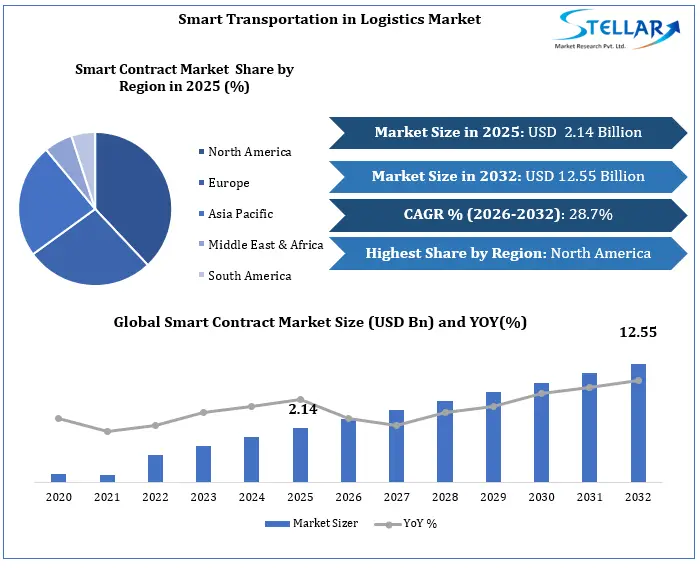
The Smart Contract Market was projected to grow from USD 2.14 billion in 2025 to USD 12.55 billion by 2032 at a 28.7% CAGR, driven by increasing adoption of blockchain-based automation, decentralized finance, enterprise tokenization, and digital contract management across industries worldwide.
Smart Contract Market Overview
The Smart Contract Market encompasses self-executing digital agreements coded directly onto blockchain networks, enabling automated, trustless, and tamper-resistant execution of contractual obligations without the need for intermediaries. The market covers a broad range of blockchain-based contract automation technologies spanning decentralized finance (DeFi), enterprise tokenization, digital identity, supply chain automation, legal contract digitization, and decentralized governance systems.
Market growth is supported by rapid blockchain infrastructure expansion, increasing enterprise adoption of distributed ledger technologies, rising demand for transparent and immutable digital agreements, and growing regulatory acceptance of smart contracts across financial, legal, healthcare, and government sectors. Technology providers, financial institutions, legal technology firms, and government bodies are increasingly deploying smart contracts to reduce transaction costs, minimize counterparty risk, and automate complex multi-party agreements across global markets.
To get more Insights: Request Free Sample Report
Global Smart Contract Market Definition
The Smart Contract Market comprises programmable, self-executing digital contracts stored on distributed blockchain networks that automatically enforce, execute, and verify the terms of an agreement when predefined conditions are met. These contracts eliminate the need for central authorities or intermediaries, enabling secure, transparent, and efficient digital transactions across multiple industries.
Smart contracts are deployed across public, private, and hybrid blockchain infrastructures to support applications including decentralized finance protocols, supply chain automation, healthcare data sharing, tokenized asset management, digital identity verification, legal agreement automation, and government service delivery. The market serves enterprises, financial institutions, legal technology providers, government agencies, and decentralized application developers seeking reliable, auditable, and cost-effective contract automation solutions.
Global Smart Contract Market Drivers
Rapid Expansion of Decentralized Finance and Blockchain Ecosystems
The accelerating growth of decentralized finance platforms and broader blockchain ecosystems is the primary driver of smart contract adoption globally. DeFi protocols depend entirely on smart contracts for automated lending, borrowing, staking, trading, and liquidity management functions, driving enormous transaction volumes and development activity. The total value locked across DeFi protocols has grown substantially, demonstrating sustained demand for reliable smart contract infrastructure.
Leading blockchain platforms including Ethereum, Cardano, BNB Chain, Solana, and Polkadot are continuously improving throughput, scalability, and security features that make smart contract deployment more accessible and cost-effective for developers and enterprises. Companies such as ConsenSys, Chainlink Labs, and Alchemy Insights are expanding developer tooling, oracle infrastructure, and deployment platforms that lower barriers to smart contract creation and auditing.
Growing Enterprise Adoption of Blockchain-Based Contract Automation
Large enterprises across banking, insurance, supply chain, healthcare, and government sectors are increasingly integrating smart contracts into their digital infrastructure to reduce operational costs, eliminate manual reconciliation, and accelerate settlement timelines. IBM, Microsoft, Oracle, and Accenture are actively building enterprise blockchain solutions that incorporate smart contract automation into supply chain management, trade finance, digital identity, and compliance systems.
Tata Consultancy Services, Infosys, and SAP are deploying smart contract platforms for enterprise clients in financial services, logistics, and government sectors, enabling automated invoice processing, regulatory reporting, multi-party trade agreements, and asset tokenization at scale. This institutional adoption is driving the shift from experimental blockchain pilots to production-grade smart contract deployments.
Global Smart Contract Market Opportunities
Tokenization of Real-World Assets and Digital Securities
The growing movement toward tokenizing real-world assets including real estate, equities, bonds, commodities, and intellectual property on blockchain networks represents a major growth opportunity for smart contract platforms. Smart contracts enable programmable ownership transfer, automated dividend distribution, fractional asset ownership, and compliance enforcement for tokenized securities, significantly expanding the addressable market.
Integration with Artificial Intelligence and IoT Infrastructure
The convergence of smart contracts with artificial intelligence and Internet of Things ecosystems is creating new automation opportunities across healthcare monitoring, supply chain traceability, energy trading, and autonomous machine-to-machine commerce. AI-enabled oracle systems that feed real-world data into smart contracts are enabling more sophisticated conditional logic and dynamic contract execution, expanding utility beyond simple financial transactions into complex enterprise workflows.
Global Smart Contract Market Trends
Rising Adoption of Layer 2 Scaling Solutions
Smart contract platforms are increasingly leveraging Layer 2 scaling technologies including rollups, state channels, and sidechains to address Ethereum mainnet congestion and high gas fee challenges. Solutions provided by Offchain Labs (Arbitrum), Optimism Foundation, Matter Labs (zkSync), and StarkWare Industries are enabling faster and cheaper smart contract execution while inheriting the security guarantees of Layer 1 networks, accelerating enterprise and consumer adoption.
Growing Emphasis on Smart Contract Security and Formal Auditing
As smart contract vulnerabilities continue to result in significant financial losses, the market is seeing strong growth in professional auditing, formal verification, and automated security analysis services. Firms such as CertiK, SlowMist, and Hacken are expanding audit capabilities and on-chain monitoring tools, while OpenZeppelin is widely adopted for its library of audited, standardized contract components that reduce deployment risks.
Global Smart Contract Market by Blockchain Platform, 2025–2032
Blockchain platform selection is a critical differentiator in the smart contract market, influencing transaction throughput, cost, security, interoperability, and developer ecosystem maturity. The choice of underlying blockchain determines the scalability, composability, and regulatory compliance profile of smart contract applications.
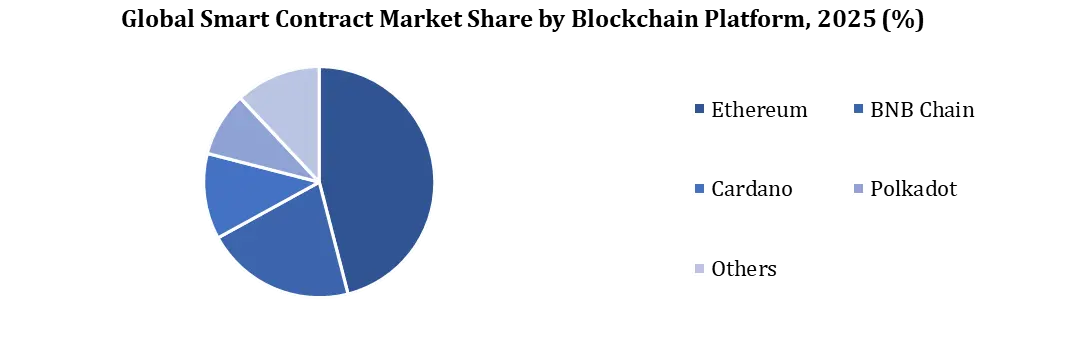
Ethereum remains the dominant blockchain platform for smart contract deployment, holding approximately 58% of market share in 2025. Its first-mover advantage, massive developer community, extensive tooling, and dominant DeFi and NFT ecosystem position it as the default choice for high-value smart contract applications. The successful transition to Proof-of-Stake and ongoing Layer 2 scaling expansion through Arbitrum, Optimism, and zkSync are improving transaction economics and throughput, supporting continued enterprise and institutional adoption. Cardano is gaining traction as a preferred blockchain for smart contract deployments in regulated environments, particularly in healthcare, government, and financial inclusion projects across Africa and Southeast Asia.
BNB Chain, operated by Binance, represents the second-largest smart contract ecosystem by transaction volume, benefiting from its lower gas fees, high throughput, and large retail user base. Its EVM compatibility enables rapid porting of Ethereum-based applications, making it a popular choice for DeFi protocols, NFT marketplaces, and GameFi applications seeking lower transaction costs. Polkadot provides a unique multi-chain architecture through its parachain ecosystem, enabling specialized blockchains to communicate and share security while deploying interoperable smart contracts.
The Others segment includes Solana, Avalanche, Algorand, Tezos, NEAR Protocol, and emerging Layer 1 and Layer 2 networks. Solana is experiencing rapid growth driven by its high throughput and low latency advantages for real-time trading and consumer applications. Avalanche, supported by the Avalanche Foundation, is gaining enterprise adoption through subnet architecture that enables dedicated blockchain environments for institutional use cases.
Global Smart Contract Market by Contract Type, 2025–2032
The Global Smart Contract Market by contract type is driven by increasing adoption of blockchain-based automation across decentralized finance, enterprise operations, and digital asset ecosystems. Application Logic Contracts (ALCs) dominated the market in 2025 and accounted for the largest share due to their extensive use in DeFi platforms, NFT marketplaces, blockchain gaming, and enterprise decentralized applications. DAO Contracts are witnessing the fastest growth as decentralized governance models gain traction across Web3 platforms and community-managed ecosystems. Smart Legal Contracts are increasingly being adopted for automated legal execution in banking, insurance, and trade finance. Meanwhile, Token Smart Contracts continue to expand rapidly with growing adoption of cryptocurrencies, stablecoins, NFTs, and tokenized real-world assets across global blockchain networks.

Global Smart Contract Market by Enterprise Size, 2025–2032
Enterprise size segmentation reflects distinct adoption patterns, deployment priorities, and investment capacities that shape how organizations approach smart contract integration. Large enterprises and SMEs face different barriers, use cases, and competitive incentives driving their smart contract adoption strategies. Large Enterprises currently account for the majority of smart contract market revenue, representing approximately 68% of market share in 2025. Financial institutions, multinational corporations, government agencies, and technology conglomerates are investing heavily in enterprise-grade smart contract platforms for trade finance automation, supply chain transparency, regulatory reporting, cross-border payment settlement, and digital identity management. IBM, Accenture, Oracle, and SAP are the primary technology partners enabling large enterprise smart contract deployments.
SMEs represent the fastest-growing enterprise size segment, benefiting from increasingly accessible smart contract deployment platforms, low-code development tools, and blockchain-as-a-service offerings from providers such as Alchemy Insights, Infura, and QuickNode. SMEs across retail, healthcare, media, and logistics are deploying smart contracts for automated payment processing, supply chain traceability, digital rights management, and customer loyalty programs without requiring deep in-house blockchain expertise.
Global Smart Contract Market Regional Analysis
North America dominated the Smart Contract Market with the 38% share in 2025 due to the presence of leading blockchain technology companies, well-developed venture capital ecosystems, advanced financial market infrastructure, and a progressive regulatory environment for digital assets and blockchain innovation. The United States and Canada represent the largest markets driven by strong DeFi adoption, institutional blockchain investment, and active enterprise smart contract deployments across financial services, healthcare, and technology sectors. Key regulatory developments including SEC guidance on digital assets and growing state-level blockchain legislation are shaping the enterprise adoption landscape.
Europe held a significant market share supported by progressive digital asset regulation under the Markets in Crypto-Assets (MiCA) framework, active central bank digital currency research, and strong institutional interest in blockchain-based settlement infrastructure. Germany, Switzerland, France, and the United Kingdom are leading enterprise smart contract adoption in financial services, supply chain management, and digital identity applications.
Asia Pacific is the fastest-growing regional market driven by rapid blockchain ecosystem development in China, South Korea, Japan, Singapore, and India. Government-backed blockchain initiatives, expanding DeFi communities, and large-scale enterprise blockchain deployments are driving strong regional growth. Singapore has emerged as a leading smart contract regulatory hub, while China's state-backed blockchain infrastructure and digital yuan development are creating significant market opportunities.
The Middle East & Africa region is witnessing accelerating smart contract adoption supported by ambitious digital transformation agendas in the UAE, Saudi Arabia, and Bahrain. The UAE's regulatory sandbox for digital assets and Saudi Arabia's NEOM smart city project are creating significant opportunities for smart contract deployment in government, real estate, and financial services.
South America is experiencing gradual smart contract market growth led by Brazil, Argentina, and Colombia, where DeFi adoption is driven by inflation hedging demand, remittance automation, and financial inclusion applications for underbanked populations.
Global Smart Contract Market Recent Developments
ConsenSys (January 2026): ConsenSys expanded its MetaMask Institutional platform with advanced smart contract compliance and monitoring tools for enterprise DeFi participants, enabling automated regulatory reporting and on-chain AML screening for institutional wallet operators.
Chainlink Labs (March 2026): Chainlink Labs launched its Cross-Chain Interoperability Protocol (CCIP) expansion supporting five additional blockchain networks, enabling smart contracts on different chains to securely share data and execute cross-chain transactions without trusted intermediaries.
IBM Corporation (February 2026): IBM announced the expansion of its IBM Blockchain Platform with AI-enhanced smart contract auditing tools that automatically detect vulnerabilities and generate remediation recommendations, targeting enterprise clients in financial services and supply chain management.
Matter Labs / zkSync (April 2026): Matter Labs completed its zkSync Era mainnet expansion with native account abstraction, enabling programmable smart contract wallets and gasless transaction models that significantly improve user experience for consumer-facing smart contract applications.
CertiK (May 2026): CertiK launched its AI-powered real-time smart contract monitoring service for institutional DeFi participants, providing on-chain transaction surveillance, anomaly detection, and automated incident response for enterprise blockchain deployments.
Global Smart Contract Market Competitive Landscape 2025
The Smart Contract Market is characterized by a diverse competitive landscape spanning established enterprise technology giants, specialized blockchain infrastructure providers, security and auditing firms, and emerging Layer 2 scaling solution developers. The market is driven by strong competitive dynamics across blockchain platform development, enterprise solution integration, developer tooling, security services, and cross-chain infrastructure.
Enterprise technology leaders including IBM Corporation, Microsoft Corporation, Oracle Corporation, Amazon Web Services, SAP SE, and Accenture are competing for large enterprise smart contract implementation contracts by integrating blockchain capabilities into existing enterprise software ecosystems. These players leverage existing enterprise relationships, compliance expertise, and system integration capabilities to position smart contracts as natural extensions of digital transformation initiatives.
Specialized blockchain infrastructure providers including ConsenSys, Chainlink Labs, Alchemy Insights, Ripple Labs, and R3 LLC are competing on technical capability, developer ecosystem strength, and protocol interoperability. These organizations provide the foundational infrastructure, oracle networks, developer platforms, and enterprise blockchain frameworks that power the broader smart contract ecosystem.
Layer 2 scaling solution providers, including Matter Labs, StarkWare Industries, Offchain Labs, and Optimism Foundation are competing to capture developer share by offering faster, cheaper, and more privacy-preserving smart contract execution environments that address Ethereum mainnet limitations. Their growth is directly linked to Ethereum ecosystem expansion and enterprise scalability requirements.
Security and auditing specialists including CertiK, SlowMist, Hacken, and Fireblocks are addressing the growing market demand for smart contract security services, providing audit, formal verification, real-time monitoring, and institutional-grade key management solutions that are increasingly required by enterprise and institutional smart contract deployers.
|
Global Smart Contract Market |
|||
|
Report Coverage |
Details |
||
|
Base Year: |
2025 |
Forecast Period: |
2026-2032 |
|
Historical Data: |
2020 to 2025 |
Market Size in 2025: |
USD 2.14 Bn. |
|
Forecast Period 2026 to 2032 CAGR: |
28.7% |
Market Size in 2032: |
USD 12.55 Bn. |
|
Segments
|
By Blockchain Platform |
Ethereum Cardano BNB Chain Polkadot Others |
|
|
By Contract Type
|
Smart Legal Contracts Decentralized Autonomous Organization (DAO) Contracts Application Logic Contracts (ALC) Distributed Autonomous Organization Contracts Token Smart Contracts |
||
|
By Enterprise Size |
Large Enterprises Small & Medium Enterprises (SMEs) |
||
|
By Deployment Mode |
Public Blockchain Private Blockchain Hybrid Blockchain |
||
|
By End-User Industry |
BFSI Healthcare Retail & E-commerce Government IT & Telecommunications Media & Entertainment Logistics & Transportation Energy & Utilities Real Estate Manufacturing Others |
||
Smart Contract Market Regulatory Framework
The Smart Contract Market is significantly influenced by evolving digital asset regulation, blockchain governance policies, and financial market infrastructure rules across major jurisdictions. The European Union's Markets in Crypto-Assets (MiCA) Regulation provides the world's most comprehensive framework for digital asset and smart contract governance, establishing licensing requirements, consumer protection standards, and operational requirements for smart contract-based financial services across EU member states.
In the United States, the Securities and Exchange Commission, Commodity Futures Trading Commission, and Financial Crimes Enforcement Network are collectively shaping the regulatory environment for smart contract-based financial applications through enforcement actions, guidance documents, and proposed rulemaking. The introduction of the Responsible Financial Innovation Act and Digital Asset Anti-Money Laundering Act reflects growing congressional engagement with smart contract regulation.
Regulatory bodies including the Financial Action Task Force, Bank for International Settlements, and International Organization of Securities Commissions are developing global standards and guidance for DeFi, smart contract auditing, and digital asset custody that are influencing national regulatory approaches worldwide. Growing regulatory engagement is creating both compliance costs and market credibility benefits that are accelerating institutional smart contract adoption across regulated industries.
Key Players in the Smart Contract Market
|
Sr. No. |
Company |
Key Products / Platforms |
|
1 |
IBM Corporation |
Hyperledger Fabric, IBM Blockchain Platform |
|
2 |
Microsoft Corporation |
Azure Blockchain, Ethereum on Azure |
|
3 |
Oracle Corporation |
Oracle Blockchain Platform |
|
4 |
Amazon Web Services (AWS) |
Amazon Managed Blockchain |
|
5 |
Blockchain integration services |
|
|
6 |
Tata Consultancy Services (TCS) |
TCS BaNCS Blockchain |
|
7 |
Accenture plc |
Enterprise DLT solutions |
|
8 |
MetaMask, Truffle, Infura |
|
|
9 |
Chainlink Labs |
Chainlink CCIP, VRF, Data Feeds |
|
10 |
Alchemy Insights Inc. |
Alchemy Supernode, Notify |
|
11 |
Ripple Labs Inc. |
XRP Ledger, RLUSD |
|
12 |
R3 LLC |
Corda Platform |
|
13 |
Intel Corporation |
SGX Trusted Execution |
|
14 |
SAP SE |
SAP Blockchain Application Studio |
|
15 |
Huawei Technologies Co., Ltd. |
Huawei Cloud BCS |
|
16 |
Avalanche Foundation |
Avalanche C-Chain, Subnets |
|
17 |
Polygon Technology |
Polygon PoS, zkEVM |
|
18 |
Solana Labs |
Solana Mainnet |
|
19 |
Coinbase Global Inc. |
Base L2, Coinbase Cloud |
|
20 |
OpenZeppelin |
OpenZeppelin Contracts, Defender |
|
21 |
LeewayHertz |
Enterprise smart contract development |
|
22 |
Blockstream Corporation |
Liquid Network, Blockstream AMP |
|
23 |
Quant Network |
Overledger DLT Gateway |
|
24 |
Monax Industries |
Agreements Network |
|
25 |
Applied Blockchain Ltd. |
Custom smart contract solutions |
|
26 |
Matter Labs (zkSync) |
zkSync Era, ZK Stack |
|
27 |
StarkWare Industries |
StarkNet, StarkEx |
|
28 |
Offchain Labs (Arbitrum) |
Arbitrum One, Orbit |
|
29 |
Optimism Foundation |
OP Mainnet, OP Stack |
|
30 |
CertiK |
CertiK Audit, Skynet |
|
31 |
SlowMist |
Smart contract auditing |
|
32 |
Hacken |
Smart contract audits, bug bounty |
|
33 |
Fireblocks |
MPC Wallet, DeFi access |
Frequently Asked Questions
Ethereum pioneered smart contract functionality and has benefited from a decade of ecosystem development, including the largest developer community, most extensive DeFi and NFT infrastructure, widespread institutional recognition, and the most mature tooling and auditing ecosystem of any smart contract platform.
Enterprises in regulated industries are primarily adopting smart contracts through private and hybrid blockchain deployments that meet data privacy and compliance requirements, often using established enterprise blockchain frameworks including Hyperledger Fabric, R3 Corda, and Quorum that provide permissioned access control and regulatory audit capabilities.
Primary smart contract security risks include reentrancy attacks, integer overflow and underflow vulnerabilities, front-running exploits, oracle manipulation, and logic errors in contract code. Professional auditing by firms such as CertiK, SlowMist, and OpenZeppelin's audit team, combined with formal verification and ongoing monitoring, are the primary risk mitigation approaches.
AI is being integrated into smart contract development through automated vulnerability detection, AI-assisted contract code generation, intelligent oracle systems that feed dynamic real-world data into contracts, and AI-powered compliance monitoring that automatically flags suspicious contract interactions for regulatory review.
1. Smart Contract Market: Introduction
2. Smart Contract Market: Executive Summary
2.1 Global Smart Contract Market Size and Forecast (USD Billion)
2.2 Market Definition
2.3 Market Segmentation
2.4 Research Timelines
2.5 Assumptions
2.6 Limitations
3. Smart Contract Market: Research Methodology
3.1 Data Mining
3.2 Secondary Research
3.3 Primary Research
3.4 Subject Matter Expert Advice
3.5 Quality Check
3.6 Final Review
3.7 Data Triangulation
3.8 Top-Down Approach
3.9 Bottom-Up Approach
3.10 Research Flow
3.11 Data Sources
4. Smart Contract Market: Market Attractiveness Mapping
4.1 Global Smart Contract Market Overview
4.2 Competitive Analysis: Funnel Diagram (Tier 1, Tier 2, Tier 3)
4.3 Global Smart Contract Market Absolute Market Opportunity
4.4 Global Smart Contract Market Attractiveness Analysis, By Region
4.5 Global Smart Contract Market Attractiveness Analysis, By Blockchain Platform
4.6 Global Smart Contract Market Attractiveness Analysis, By Contract Type
4.7 Global Smart Contract Market Attractiveness Analysis, By Enterprise Size
4.8 Global Smart Contract Market Attractiveness Analysis, By Deployment Mode
4.9 Global Smart Contract Market Attractiveness Analysis, By End-User Industry
4.10 Future Market Opportunities
5. Smart Contract Market: Market Outlook
5.1 Global Smart Contract Market Evolution
5.2 Smart Contract Adoption Analysis
5.3 Market Trends
5.4 Market Dynamics
5.4.1 Market Drivers
5.4.2 Market Restraints
5.4.3 Market Trends
5.4.4 Market Opportunities
5.5 Porter’s Five Forces Analysis
5.5.1 Threat of New Entrants
5.5.2 Bargaining Power of Suppliers
5.5.3 Bargaining Power of Buyers
5.5.4 Threat of Substitute Products
5.5.5 Competitive Rivalry of Existing Competitors
5.6 PESTEL Analysis
5.7 Value Chain Analysis
5.8 Blockchain Ecosystem Readiness Analysis
5.9 Pricing Analysis
5.10 Geopolitical Impact Assessment
5.11 Regulatory Framework and Policy Impact Assessment
5.12 Cybersecurity & Smart Contract Security Analysis
5.13 Technology Landscape
6. Smart Contract Market: By Blockchain Platform, 2026–2032 (USD Billion)
6.1 Ethereum
6.2 Cardano
6.3 BNB Chain
6.4 Polkadot
6.5 Others
7. Smart Contract Market: By Contract Type, 2026–2032 (USD Billion)
7.1 Smart Legal Contracts
7.2 Decentralized Autonomous Organization (DAO) Contracts
7.3 Application Logic Contracts (ALC)
7.4 Distributed Autonomous Organization Contracts
7.5 Token Smart Contracts
8. Smart Contract Market: By Enterprise Size, 2026–2032 (USD Billion)
8.1 Large Enterprises
8.2 Small & Medium Enterprises (SMEs)
9. Smart Contract Market: By Deployment Mode, 2026–2032 (USD Billion)
9.1 Public Blockchain
9.2 Private Blockchain
9.3 Hybrid Blockchain
10. Smart Contract Market: By End-User Industry, 2026–2032 (USD Billion)
10.1 BFSI
10.2 Healthcare
10.3 Retail & E-Commerce
10.4 Government
10.5 IT & Telecommunications
10.6 Media & Entertainment
10.7 Logistics & Transportation
10.8 Energy & Utilities
10.9 Real Estate
10.10 Manufacturing
10.11 Others
11. Smart Contract Market: Geography, 2026–2032 (USD Billion)
11.1 North America Smart Contract Market
11.1.1 United States
11.1.2 Canada
11.1.3 Mexico
11.2 Europe Smart Contract Market
11.2.1 Germany
11.2.2 United Kingdom
11.2.3 France
11.2.4 Switzerland
11.2.5 Netherlands
11.2.6 Italy
11.2.7 Spain
11.2.8 Sweden
11.2.9 Rest of Europe
11.3 Asia Pacific Smart Contract Market
11.3.1 China
11.3.2 South Korea
11.3.3 Japan
11.3.4 Singapore
11.3.5 India
11.3.6 Australia
11.3.7 Indonesia
11.3.8 Vietnam
11.3.9 Rest of Asia Pacific
11.4 Middle East & Africa Smart Contract Market
11.4.1 UAE
11.4.2 Saudi Arabia
11.4.3 Bahrain
11.4.4 South Africa
11.4.5 Israel
11.4.6 Rest of Middle East & Africa
11.5 South America Smart Contract Market
11.5.1 Brazil
11.5.2 Argentina
11.5.3 Colombia
11.5.4 Rest of South America
12. Smart Contract Competitive Matrix
13. Smart Contract Market: Company Benchmarking
14. Merger & Acquisition
15. Smart Contract Market: Company Profiles
15.1 IBM Corporation
15.2 Microsoft Corporation
15.3 Oracle Corporation
15.4 Amazon Web Services (AWS)
15.5 Infosys Limited
15.6 Tata Consultancy Services (TCS)
15.7 Accenture plc
15.8 ConsenSys
15.9 Chainlink Labs
15.10 Alchemy Insights Inc.
15.11 Ripple Labs Inc.
15.12 R3 LLC
15.13 Intel Corporation
15.14 SAP SE
15.15 Huawei Technologies Co., Ltd.
15.16 Avalanche Foundation
15.17 Polygon Technology
15.18 Solana Labs
15.19 Coinbase Global Inc.
15.20 OpenZeppelin
15.21 LeewayHertz
15.22 Blockstream Corporation
15.23 Quant Network
15.24 Monax Industries
15.25 Applied Blockchain Ltd.
15.26 Matter Labs (zkSync)
15.27 StarkWare Industries
15.28 Offchain Labs (Arbitrum)
15.29 Optimism Foundation
15.30 CertiK
15.31 SlowMist
15.32 Hacken
15.33 Fireblocks16. Risk Assessment and Scenario Analysis
17. Strategic Opportunity
18. Investments & Funding Analysis
19. Strategic Roadmap
19.1 Short-Term Roadmap 2026–2027
19.2 Mid-Term Roadmap 2028–2029
19.3 Long-Term Roadmap 2030–2032
20. Analyst Recommendations
20.1 Recommendations for Blockchain Platform Developers
20.2 Recommendations for Enterprise Adopters
20.3 Optimisation Recommendations for Investors
20.4 Recommendations for New Entrants
20.5 Recommendations for Consulting and Strategy Teams