ENG
ENG Japanese
  French
  German
  Korean
AI in Consumer Goods Market: Generative AI Adoption, Operational Efficiency Impact, Forecast Period (2026–2032)
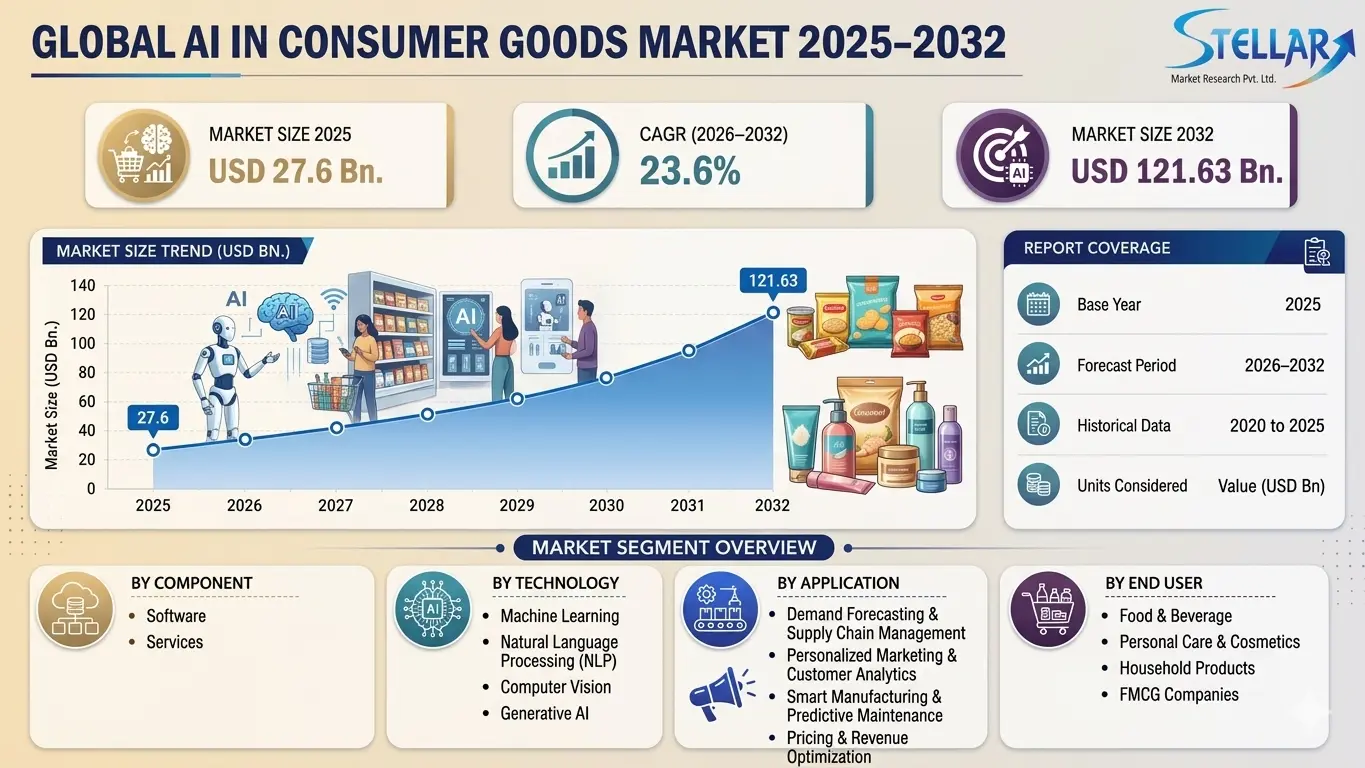
The AI in Consumer Goods Market was projected to grow from USD 27.6 Bn in 2025 to USD 121.63 Bn by 2032 at 23.6% CAGR, supported by the increasing use of AI solutions for consumer behaviour analysis, accurate demand planning, targeted marketing strategies, and efficient supply chain management across the consumer goods sector.
Market Definition
The AI in Consumer Goods Market covers the adoption of artificial intelligence technologies by consumer goods companies to improve business operations, customer engagement, pricing strategies, demand planning, and supply chain efficiency. The market includes AI-based software, platforms, and related services widely used across FMCG, food and beverage, personal care, and household product industries to support faster and more accurate business decisions.
Businesses are increasingly integrating AI into daily operations to automate processes, study customer purchasing patterns, manage inventory levels, and strengthen marketing effectiveness. The growing focus on digital transformation, along with the wider use of machine learning and predictive analytics, is supporting the expansion of AI applications across global consumer goods companies.
To get more Insights: Request Free Sample Report
Demand Analysis 2025
- Consumer goods companies are increasingly adopting AI-based consumer analytics and personalized marketing solutions to strengthen customer engagement and improve brand visibility. Major companies such as Unilever and Coca-Cola are expanding the use of recommendation engines, customer data platforms, and AI-driven advertising technologies to support targeted marketing activities and improve consumer interaction.
- AI-supported demand forecasting and supply chain management are becoming major investment areas across the industry. Companies including Nestlé and PepsiCo are increasing their focus on predictive analytics, warehouse automation, and intelligent logistics systems to strengthen inventory planning, improve operational efficiency, and reduce supply chain disruptions.
- The adoption of smart manufacturing technologies and AI-enabled automation is increasing across production facilities. Consumer goods manufacturers are integrating machine vision systems, predictive maintenance tools, robotic process automation, and AI-based quality inspection solutions to improve production efficiency, minimize operational downtime, and strengthen manufacturing control processes.
- The market is witnessing a transition from selective AI adoption to broader enterprise-level implementation. Companies across the consumer goods sector are increasing investments in generative AI, cloud analytics platforms, intelligent commerce solutions, and automated decision-making systems to improve pricing optimization, accelerate product development, and strengthen digital commerce operations.
Global AI in Consumer Goods Market Dynamics
Market Drivers
Increasing Preference for Personalized Consumer Interaction
The demand for AI in the Consumer Goods (FMCG) market is increasing rapidly because companies must understand shifting customer preferences in real time and respond faster. For example, brands like those on Amazon and Flipkart use AI-driven recommendation engines that analyze browsing and purchase history to suggest snacks, beverages, or personal care items, significantly boosting conversion rates.
Retailers also apply AI analytics to track buying patterns and offer targeted discounts, such as promoting biscuits to frequent buyers during weekends, while brands optimize digital ads by identifying which customer segments are most likely to respond, thereby reducing wasted ad spend.
AI further drives demand through operational efficiency and personalization. Companies like Procter & Gamble (P&G) use AI for demand forecasting, resulting in better inventory management and fewer stockouts. Unilever applies AI to predict trends, optimize supply chains, and reduce waste.
Features like dynamic pricing, virtual product suggestions, and AI chatbots for customer support help deliver personalized shopping experiences, improving customer loyalty and giving companies a strong competitive edge in a fast-evolving market.
Stronger Adoption of AI-Based Supply Chain Solutions
Companies are using AI technologies in demand forecasting, warehouse management, and logistics operations to improve supply chain visibility, reduce operational delays, and support better inventory planning.
Rising Deployment of Intelligent Manufacturing Systems
Manufacturers are integrating AI-supported automation, predictive equipment monitoring, and machine vision applications to improve factory operations, lower maintenance-related downtime, and maintain consistent production quality.
Growing Investments in Enterprise Digital Modernization
Consumer goods enterprises continue to increase spending on cloud computing, AI-enabled analytics, and connected business systems to automate workflows, improve operational decision-making, and strengthen long-term digital transformation strategies.
Market Restraints
High Costs Associated with AI Deployment
The adoption of AI technologies often requires substantial investment in software platforms, cloud infrastructure, system integration, and employee training. These costs create adoption barriers for small and medium-sized consumer goods companies, while extended deployment periods and infrastructure upgrades further increase operational expenses.
Growing Concerns Around Data Privacy and Cybersecurity
Consumer goods companies handle large volumes of customer data, making data security and privacy compliance a major challenge during AI adoption. Strict regulatory requirements and increasing cybersecurity threats continue to limit the wider use of AI-powered consumer analytics and personalization solutions.
Market Opportunities
Growing Use of Generative AI Across Consumer-Focused Operations
Consumer goods companies are steadily expanding the use of generative AI technologies for content development, personalized product suggestions, customer communication, and digital commerce management. The increasing focus on AI-supported customer engagement is also helping businesses create additional revenue opportunities across online sales channels.
Rising AI Adoption Across Emerging Economies
Rapid digital transformation and higher cloud adoption across regions such as Asia-Pacific, Latin America, and the Middle East are creating favorable opportunities for AI integration within consumer goods operations. Expanding internet accessibility and ongoing retail sector modernization are further supporting the growth of AI-based business solutions in these markets.
Market Trends
Growing Use of Generative AI for Consumer Engagement
Consumer goods companies are increasingly incorporating generative AI into marketing campaigns, virtual assistants, and customer communication platforms to deliver more personalized digital experiences. Businesses are also using AI-generated content to improve campaign efficiency and respond to customer needs more quickly across digital channels.
Rising Adoption of AI Across Smart Supply Chain Operations
Companies are implementing AI-powered forecasting systems, warehouse automation technologies, and logistics management tools to improve supply chain visibility and operational performance. Real-time monitoring solutions are also helping businesses strengthen inventory management and improve distribution efficiency.
Increasing Focus on AI-Based Product Development
Businesses are using AI analytics and consumer behavior modeling to speed up product innovation, improve product formulation strategies, and identify changing market preferences. AI-supported research and testing tools are further helping companies shorten product development and commercialization timelines.
Expansion of Cloud-Enabled AI Platforms
Enterprises are adopting cloud-based AI infrastructure and Software-as-a-Service solutions to support scalable analytics, workflow automation, and real-time business monitoring. Cloud deployment is also helping organizations reduce implementation challenges and improve access to advanced AI technologies across operations.
Global AI in Consumer Goods Market Segmentation (2025)
Market by Component

Software dominates the market with a 68.4% share, driven by strong adoption of automation tools, analytics platforms, and core operational systems that support efficient and scalable business operations across industries. Services are growing rapidly, supported by rising demand for implementation, system integration, consulting, and ongoing maintenance as companies continue to expand AI deployment across their operations.
Market, by Technology
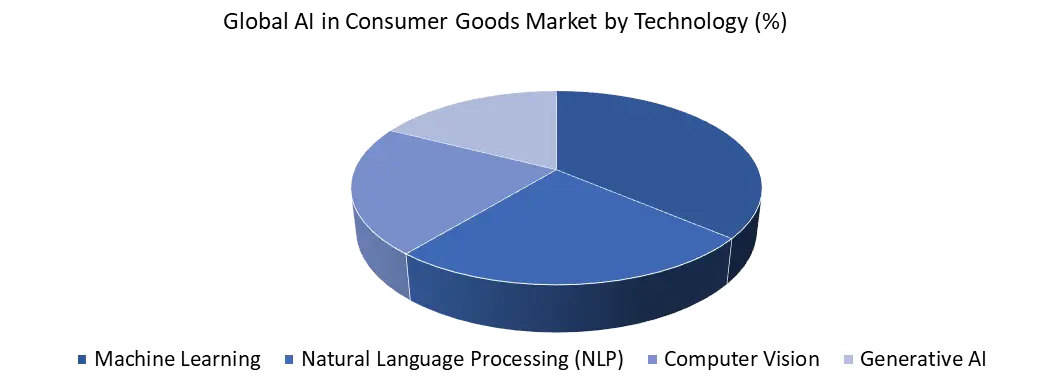
Machine Learning holds the largest share at 36.2%, mainly because it is widely used for predictive analytics, automation, and supporting better decision-making across different industries. Natural Language Processing follows, driven by chatbots, text analysis, and other language-based tools that improve how users interact with systems.
Computer Vision accounts for a significant portion of the market, supported by its application in image recognition, surveillance, and quality inspection tasks. Generative AI represents the remaining share, with growing use in content generation and synthetic data creation.
Market by Application
Demand Forecasting & Supply Chain Management holds the largest share at 33.7%, mainly due to companies using it to improve inventory planning, forecast demand more accurately, and make logistics operations more efficient across industries.
Personalized Marketing & Customer Analytics follows, supported by the growing use of AI to understand customer behaviour and run more targeted marketing campaigns.
Smart Manufacturing & Predictive Maintenance accounts for a significant share, as businesses rely on it to monitor equipment in real time, reduce downtime, and improve overall production efficiency. Pricing & Revenue Optimization contributes, driven by its role in helping companies adjust pricing dynamically and improve overall revenue performance.
Market by End User
FMCG companies account for the largest share at 34.1%, mainly due to their widespread use of AI for demand planning, inventory optimization, and improving distribution efficiency at scale. The Food & Beverage segment follows, supported by strong application of AI in demand forecasting, quality control, and supply chain coordination across manufacturing and retail networks. Personal Care & Cosmetics holds a significant share, as brands increasingly rely on advanced analytics for product development, consumer targeting, and tracking market trends. Household Products continue to grow, driven by gradual adoption of data-led approaches in production planning, pricing strategies, and distribution management.
Global AI in Consumer Goods Competitive Analysis 2025
The AI in Consumer Goods Market covers cloud providers, enterprise software companies, and AI-focused specialists with strong capabilities in automation, predictive analytics, and consumer intelligence. Microsoft, Google, and Amazon Web Services maintain a leading position through scalable cloud AI platforms that enable demand forecasting, personalization, and supply chain optimization across consumer goods operations. IBM and SAP continue to have a strong presence with enterprise AI systems that combine planning, operations, and customer data to improve efficiency and decision-making.
Salesforce, Adobe, and NVIDIA further strengthen the ecosystem through AI-powered customer engagement tools, marketing automation, and high-performance computing that enables real-time personalization and retail analytics. Oracle and Accenture play an important role in embedding AI into pricing, logistics, and manufacturing workflows for global consumer goods companies.
Companies such as Infosys, TCS, and Wipro support wider adoption through AI implementation services and industry-specific solutions, helping FMCG and retail firms deploy machine learning models, improve data usage, and integrate generative AI into business operations.
Global AI in Consumer Goods Market: Recent Developments
|
Date |
Key Development |
|
April, 2026 |
Google’s AI expansion is strengthening the consumer goods market through large-scale adoption and infrastructure growth, with 8.5 million developers, 19 billion tokens processed per minute, 375+ cloud customers handling 1 trillion+ tokens annually, and strong consumer reach via 900 million Gemini users, 2.5 billion AI Overview users, and 1 billion AI Mode users. Supported by $190 billion capex, Google is scaling AI infrastructure and tools like Gemini 3.5 Flash and Gemini Spark to improve automation, personalization, and customer engagement. |
|
March, 2026 |
This Microsoft update shows how AI adoption is transforming enterprise operations, which is strongly impacting the AI in Consumer Goods Market. PepsiCo reports 90%–95% Copilot usage, improving productivity and collaboration, while Air India handles 40,000 daily queries with 13M+ resolved conversations at a 97% success rate. Tata Realty cutting costs by 20–30%. Overall, the development highlights how AI is improving efficiency, reducing costs, and strengthening decision-making across industries, including consumer goods through better forecasting, customer engagement, and supply chain performance. |
Global AI in Consumer Goods Regional Analysis 2025:
|
Global AI in Consumer Goods Market |
|||
|
Report Coverage |
Details |
||
|
Base Year: |
2025 |
Forecast Period: |
2026-2032 |
|
Historical Data: |
2020 to 2025 |
Market Size in 2025: |
USD 27.6 Bn. |
|
Forecast Period 2025 to 2032 CAGR: |
23.6% |
Market Size in 2032: |
USD 121.63 Bn. |
|
Segments
|
By Component |
|
|
|
By Technology
|
|
||
|
By Application |
|
||
|
By End User |
|
||
Key Players Profiles Covered In The Report
Frequently Asked Questions
Generative AI is being used to create marketing content, support product design, improve customer communication, and speed up digital campaign execution across multiple channels.
AI helps match inventory levels with real-time demand patterns and supports smarter distribution planning, which reduces stock issues and improves delivery timelines.
Key inputs include sales data from retail points, customer behaviour data, supply chain records, social media signals, and internal enterprise systems like ERP platforms.
Adoption is often slowed by disconnected data systems, integration issues with older infrastructure, high setup costs, and concerns around data privacy and governance.
1. AI in Consumer Goods Market: Introduction
2. AI in Consumer Goods Market: Executive Summary
2.1. Global AI in Consumer Goods Market Size And Forecast (USD Billion)
2.2 Market Definition
2.3 Market Segmentation
2.4 Research Timelines
2.5 Assumptions
2.6 Limitation
3. AI in Consumer Goods Market: Research Methodology
3.1 Data Mining
3.2 Secondary Research
3.3 Primary Research
3.4 Subject Matter Expert Advice
3.5 Quality Check
3.6 Final Review
3.7 Data Triangulation
3.8 Top-Down Approach
3.9 Bottom-Up Approach
3.10 Research Flow
3.11 Data Sources
4. AI in Consumer Goods Market: Market Attractiveness Mapping
4. 1 Global AI in Consumer Goods Market Overview
4.2 Competitive Analysis: Funnel Diagram (Tier 1, Tier 2, Tier 3)
4.3 Global AI in Consumer Goods Market Absolute Market Opportunity
4.4 Global AI in Consumer Goods Market Attractiveness Analysis, By Region
4.5 Global AI in Consumer Goods Market Attractiveness Analysis, By Component
4.6 Global AI in Consumer Goods Market Attractiveness Analysis, By Technology
4.7 Global AI in Consumer Goods Market Attractiveness Analysis, By Application
4.8 Global AI in Consumer Goods Market Attractiveness Analysis, By End User
4.10 Future Market Opportunities
5. AI in Consumer Goods Market: Market Outlook
5.1 Global AI in Consumer Goods Market Evolution
5.2 AI in Consumer Goods Adoption Analysis
5.3 Market Trends
5.4 Market Dynamics
5.4.1 Market Drivers
5.4.2 Market Restraints
5.4.3 Market Trends
5.4.4 Market Opportunity
5.5 Porter’s Five Forces Analysis
5.5.1 Threat Of New Entrants
5.5.2 Bargaining Power Of Suppliers
5.5.3 Bargaining Power Of Buyers
5.5.4 Threat Of Substitute Products
5.5.5 Competitive Rivalry Of Existing Competitors
5.6 PESTEL Analysis
5.7 Value Chain Analysis
5.8 System Configuration and Installation Analysis
5.9 Pricing Analysis
5.10 Industrial Robotics & Cobots Statistics
5.11 Analysis Opportunity Outlook & Adoption Analysis
5.12 Geopolitical Impact Assessment
5.13 Regulatory Framework and Policy Impact Assessment
5.14 Technology Landscape
6. AI in Consumer Goods Market: By Component
7. AI in Consumer Goods Market: By Technology
8. AI in Consumer Goods Market: By Application
9. AI in Consumer Goods Market: By End User
12. AI in Consumer Goods Market: Geography
12.1 North America AI in Consumer Goods Market
12.2 Europe AI in Consumer Goods Market
12.3 Asia Pacific AI in Consumer Goods Market
12.4 South America AI in Consumer Goods Market
12.5 Middle East And Africa AI in Consumer Goods Market
13. SMR Competitive Matrix
14. AI in Consumer Goods Market: Company Benchmarking
15. AI in Consumer Goods Market: Company Profiles
16. Merger & Acquisition
17. Risk Assessment and Scenario Analysis
18. Strategic Opportunity
19. Investments & Funding Analysis
20. Strategic Roadmap
21. Analyst Recommendations