ENG
 Japanese
 French
 German
 Korean

Middle East and Africa Military Load Carriage System Market Size, Share, Growth & Forecast 2026–2034
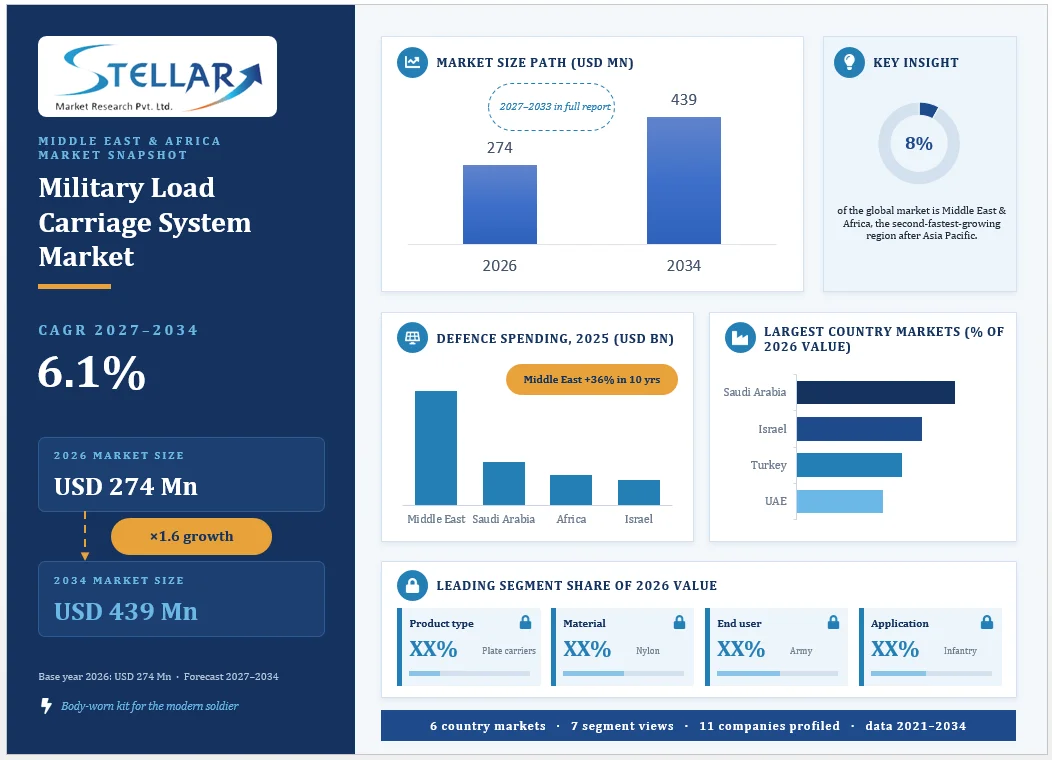
The Middle East and Africa Military Load Carriage System Market stands at USD 274 Million in 2026 and is projected to reach USD 439 Million by 2034, registering a CAGR of 6.1% during 2027–2034.
The Middle East and Africa Military Load Carriage System Market stands at USD 274 Million in 2026 and is projected to reach USD 439 Million by 2034, registering a CAGR of 6.1% during 2027–2034, according to Stellar Market Research (SMR). Middle East & Africa holds about 8% of the global military load carriage system market and is the second-fastest-growing region after Asia Pacific (SMR estimates). A military load carriage system is the body-worn framework that lets a soldier carry weapons, ammunition, body armor, water, communications and medical kit while keeping mobility, balance and endurance. The market covers tactical vests, load-bearing equipment (LBE), plate carriers, chest rigs, military backpacks, belts and pouches, and modular load carriage accessories, built from nylon, polyester, ultra-high-molecular-weight polyethylene (UHMWPE), aramid fibers and other advanced materials, and bought by Gulf, Levant, North African and Sub-Saharan armies, navies, air forces and special operations forces through direct government procurement, defence contractors and system integrators, and military equipment distributors.
Market volume. In volume terms, SMR estimates MEA shipments at about 1.3 million units in 2026, rising to about 1.9 million units by 2034, a volume CAGR of 4.9%. The blended average selling price is about USD 210 per unit in 2026 and rises roughly 1.1% a year as plate-ready, ventilated and lightweight-fiber carriers replace basic load-bearing equipment, so value (a 6.1% CAGR) grows faster than units.
Demand is anchored by large, steady Gulf budgets and fast-rising African ones. SIPRI estimates Middle East military expenditure at USD 218 billion in 2025, 0.1% above 2024 but 36% above a decade earlier, with Saudi Arabia the largest spender at USD 83.2 billion and Israel second at USD 48.3 billion. Military expenditure in Africa rose 8.5% to USD 58.2 billion, and Nigeria's grew 55% to USD 2.1 billion as insurgencies and extremist violence worsened insecurity. Vests, plates and packs are core equipment for both the conventional armies of the Gulf and the counter-insurgency forces of Africa.
Localization is changing how the region buys. Saudi Arabia allocated about USD 78 billion to defence in 2025, 21% of government expenditure, and targets localizing more than 50% of military procurement by 2030, although the U.S. Department of Commerce reported in May 2026 that domestic defense content had reached 19.35%. Saudi firm Sondos has outlined plans for a ballistic armor facility to localize helmets and body armor plates, and Galvion announced orders for 35,000 Batlskin helmet systems from Middle Eastern forces in February 2025. Together with desert heat, sand and dust, these shifts favor ventilated, modular carriers that can be assembled and supported locally.
This report answers both sides of the search: what the Middle East and Africa military load carriage system market is worth for manufacturers, defence contractors, distributors and investors, and what buyers ask most, from MEA military load carriage system market size and share to plate carrier market growth, desert combat load carriage systems, lightweight tactical vest materials and special operations load carriage requirements. Buyers and investors look for the Middle East and Africa Military Load Carriage System Market, the MEA military load bearing equipment market, the Middle East tactical gear market, the Africa military equipment market and the MEA soldier equipment market, and for related topics such as Middle eastern military load bearing systems, African infantry tactical equipment, desert combat load carriage systems, military rucksacks and tactical vests and military soldier modernization equipment. The same audience asks about Middle East and Africa military load carriage market size, MEA military load carriage system market forecast, military load bearing equipment suppliers in Middle East, tactical load carriage systems for desert operations and military equipment procurement trends in Africa, and uses short search terms such as MEA military gear, desert tactical gear, military backpacks, infantry gear and combat equipment.
Stellar Market Research provides a segment-level analysis of the Middle East and Africa military load carriage system market size, share and forecast by product type, load carriage configuration, material type, load capacity, application, end user and procurement channel, together with country-level analysis of Saudi Arabia, Israel, Turkey, the United Arab Emirates and South Africa, value-chain mapping, competitive landscape and strategic scenarios through 2034.
To get more Insights: Request Free Sample Report
Key Findings: Eight Insights Shaping the Middle East and Africa Military Load Carriage System Market
SMR's analysis of SIPRI, DLA Piper, Covington, Army Recognition, Galvion and company releases points to eight findings that explain where Middle East and Africa military load carriage system value is created through 2034.
|
# |
Finding |
Evidence |
So what |
|
1 |
MEA grows about 1.6x by 2034 |
USD 274 Mn (2026) to USD 439 Mn (2034) at 6.1% CAGR (SMR) |
Faster than the global market |
|
2 |
Gulf budgets are large and steady |
SIPRI: Middle East USD 218 Bn in 2025; Saudi Arabia USD 83.2 Bn, Israel USD 48.3 Bn |
Reliable orders from a few big buyers |
|
3 |
African budgets are rising fastest |
SIPRI: Africa USD 58.2 Bn, up 8.5%; Nigeria up 55% to USD 2.1 Bn |
Counter-insurgency demand for vests, plates and packs |
|
4 |
Localization reshapes supply |
Saudi Arabia targets over 50% localized procurement by 2030; domestic content 19.35% in May 2026 (U.S. Commerce) |
Local assembly and partnerships win awards |
|
5 |
Ballistic plates are being localized |
Sondos plans a Saudi ballistic armor facility for helmets and body armor plates |
Carrier makers gain local plate sources |
|
6 |
Soldier-system buying is bundled |
Galvion: 35,000 Batlskin helmet systems ordered by Middle Eastern forces (Feb 2025) |
Head-to-toe packages favor integrators |
|
7 |
Desert use shapes design |
SMR assessment: heat, sand and dust raise demand for ventilated carriers and hydration integration |
Breathable, modular carriers gain share |
|
8 |
Israeli specialists anchor niches |
SMR key-player map: Agilite, Source Tactical Gear and Elbit Systems |
Specialist OEMs hold premium niches |
Middle East and Africa Military Load Carriage System Market Dynamics: Growth Drivers, Restraints and Opportunities
Market dynamics. Middle East and Africa market dynamics are shaped by industry fluctuations in defence budgets, wider economic factors and consumer behavior trends among armed forces and soldier-users. Demand and supply are tied to multi-year contract awards, while competitive forces from specialist OEMs, armor makers and fiber suppliers set pricing. The main market drivers are soldier modernization and weight reduction; the main market challenges are qualification time and material cost. Technological advancements in UHMWPE and aramid fibers, regulatory influences from military qualification standards and emerging trends such as female-contoured and size-inclusive designs open further market opportunities, and innovation in the industry keeps lifting modular platforms. Macroeconomic factors and market growth factors, including defence spending and infantry modernization budgets, are balanced by market constraints such as brand-name specifications and set-aside rules.
Industry disruptors such as lighter plates, smart textiles and soldier-system integration cause market shifts, and environmental factors such as heat, dust and moisture raise durability requirements, while socioeconomic influences, from recruitment patterns to the share of women in service, change sizing needs. A market trends analysis built on economic indicators, industry evolution and competitive landscape shifts shows the demand and supply dynamics and the market forces at work. Consumer preferences evolution, regulatory changes, innovation impact and technology trends test market responsiveness and market adaptability, and external market influences such as conflicts and sanctions force strategic market changes and market segmentation shifts. Customer engagement dynamics, industry resilience and market fluctuation analysis identify growth catalysts, manage market volatility and point to the market gap between lightweight, plate-ready kit and equipment that is actually fielded.
MEA Military Load Carriage System Market Growth Drivers: Gulf Budgets, African Insecurity and Soldier Modernization
- Large Gulf defence budgets. SIPRI estimates Middle East military expenditure at USD 218 billion in 2025, with Saudi Arabia at USD 83.2 billion, supporting steady re-equipment of infantry and special forces.
- African security spending. Military expenditure in Africa rose 8.5% to USD 58.2 billion in 2025, and Nigeria's grew 55% to USD 2.1 billion, lifting demand for protective and load carriage equipment.
- Localization programs. Saudi Arabia targets localizing more than 50% of military procurement by 2030, and Sondos has outlined a ballistic armor facility for helmets and plates, which opens room for local carrier and plate production.
- Soldier-system packages. Galvion announced orders for 35,000 Batlskin helmet systems from Middle Eastern forces in February 2025, showing that head-protection and load carriage are increasingly bought together.
- Lighter plates and fibers. The Army's LSAPI plates are about 30% lighter than ESAPI Gen III and Avient says Dyneema UD supports soft armor vests up to 20% lighter; these designs are available to Gulf and African buyers through export channels.
MEA Military Load Carriage System Market Restraints: Local-Content Rules, Budget Volatility and Climate
- Local-content gaps. Saudi domestic defense content stood at 19.35% in May 2026 against a 50% target, so suppliers face pressure to localize before they can win larger awards.
- Case-by-case procurement. Many defence procurements in Saudi Arabia are negotiated case by case, which lengthens sales cycles for new entrants.
- Budget volatility. Middle East spending was almost flat in 2025 (up 0.1%), and Iran's spending fell in real terms because of economic difficulties, so demand is uneven across countries.
- Heat and durability requirements. Desert heat, sand and dust raise qualification and replacement costs for fabrics, webbing and hardware.
What Are the Biggest MEA Military Load Carriage System Market Opportunities Through 2034?
- Local assembly and plate production: Saudi localization targets and the Sondos plans create openings for joint ventures with carrier and plate makers.
- Desert-optimized carriers: ventilated panels, light fabrics and hydration integration for hot, dusty operations.
- Special operations and border forces: Israeli specialists and international OEMs sell brand-specified carriers to elite and border units.
- African counter-insurgency demand: rising budgets in Nigeria and other states favor durable, affordable vests and packs.
- Bundled soldier systems: helmets, plates, carriers and radios sold as one package to Gulf armies.
- Distributor channels: smaller African and Gulf forces buy standard carriers off catalog through distributors.
Middle East and Africa Military Load Carriage System Market Segmentation: By Product Type, Configuration, Material, Load Capacity, Application, End User and Procurement Channel
Market segment analysis. SMR's market segment analysis applies industry segmentation across product, configuration, material, load capacity, application, end user and procurement channel, supported by target market analysis and consumer demographics such as the age, body type and gender mix of the force. Product segmentation and geographic segmentation are broken into market subsegments and niche markets, and customer profiling of armies, navies, air forces and special operations units supports market share by segment, segment growth analysis and a view of the competitive segment landscape. Emerging market segments and segment attractiveness are scored alongside behavioral segmentation and segment-based marketing, so that customized market strategies can follow demographic profiling and market niche exploration. Micro-segmentation, segmentation strategies and market segment dynamics are tied to customer behavior segmentation within specialized market segments, exposing unexplored market niches, segment-specific trends and untapped market areas. Segment-specific opportunities feed tailored marketing strategies, and the market fragment analysis of unique market sectors provides a granular market breakdown and comprehensive market sector analysis for the Middle East and Africa market.
Military Load Carriage System Market by Product Type: Tactical Vests, LBE, Plate Carriers, Chest Rigs, Backpacks, Belts and Pouches and Modular Accessories
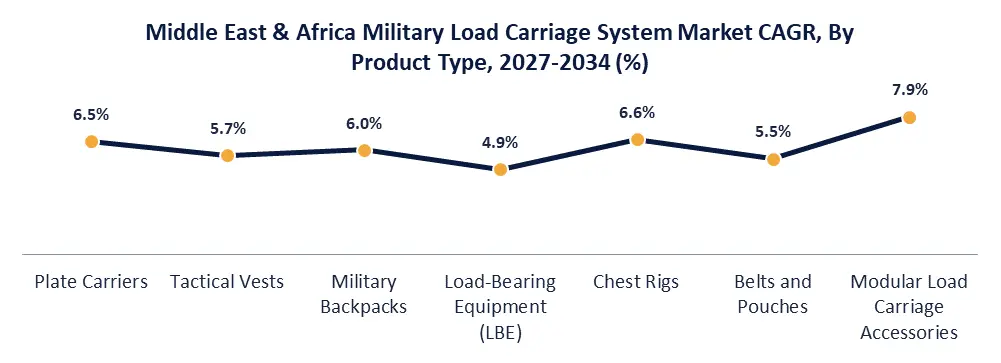
Plate carriers lead with about 25% of 2026 value and a 6.5% CAGR as Gulf and African forces adopt plate-ready carriers for elite and frontline units. Tactical vests hold 20% (5.7% CAGR), military backpacks 19% (6.0%), supported by long-range patrol and border-security needs and load-bearing equipment (LBE) 12% (4.9%). Chest rigs hold 10% (6.6% CAGR), belts and pouches 8% (5.5%) and modular load carriage accessories 6% (7.9%). Modular load carriage accessories are the fastest-growing product type, at a 7.9% CAGR from a small base.
Military Load Carriage System Market by Load Carriage Configuration: Integrated, Modular and Standalone Systems
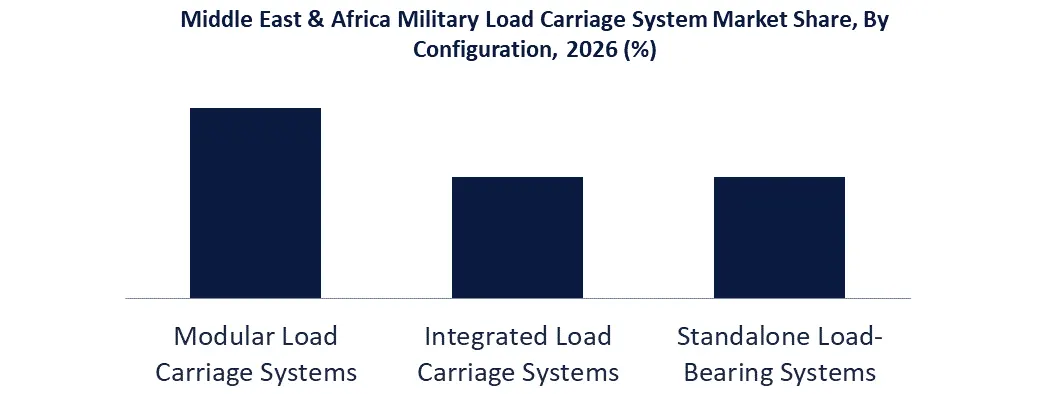
Modular load carriage systems lead with about 44% of 2026 value and a 6.9% CAGR, because a scalable base carrier lets one issue item serve several missions. Integrated load carriage systems hold 28% (6.1% CAGR) and standalone load-bearing systems 28% (4.7%), still common in forces that buy basic vests and belts in volume. Modular load carriage systems are also the fastest-growing configuration.
Military Load Carriage System Market by Material Type: Nylon, Polyester, UHMWPE, Aramid Fibers and Other Advanced Materials
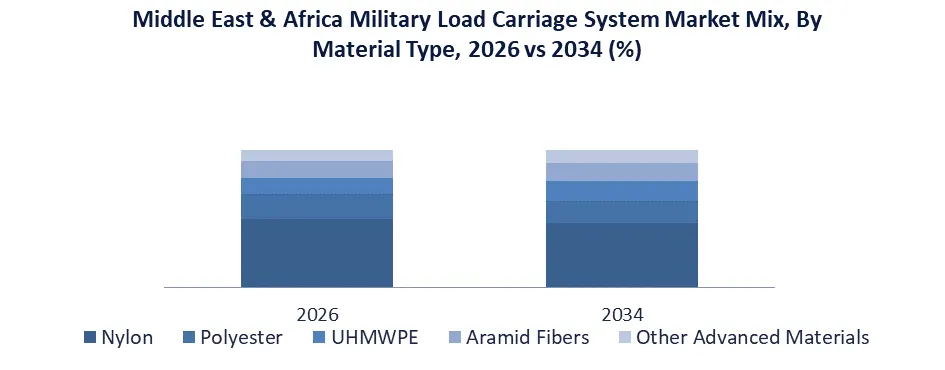
Nylon leads with about 50% of 2026 value and a 5.2% CAGR because Cordura-type fabrics remain the standard shell for carriers and packs. Polyester holds 18% (5.0% CAGR), UHMWPE 12% (8.2%), the fiber family behind Dyneema, as lighter armor matters in desert heat and aramid fibers 12% (7.0%), supported by DuPont's Kevlar EXO launch for hard armor in December 2025. Other advanced materials hold 8% (8.6% CAGR). Other advanced materials are the fastest-growing material type, at a 8.6% CAGR from a small base.
Military Load Carriage System Market by Load Capacity: Lightweight, Medium-Load and Heavy-Load Systems
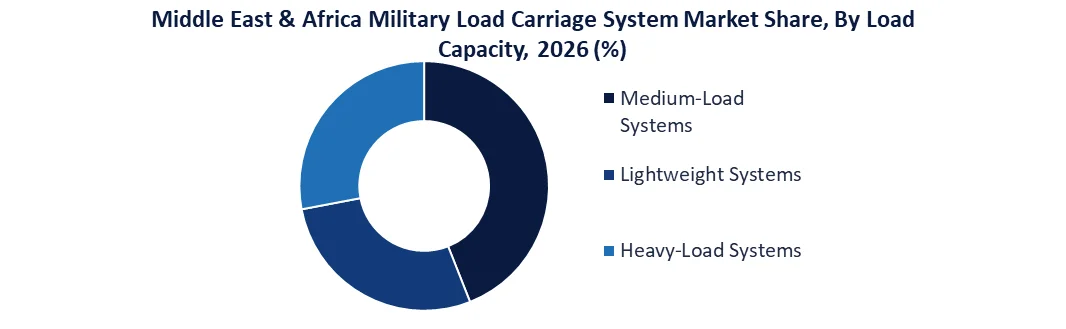
Medium-load systems lead with about 44% of 2026 value and a 5.9% CAGR, covering standard fighting and approach loads. Lightweight systems hold 28% (7.1% CAGR) and heavy-load systems 28% (5.5%). Lightweight systems are the fastest-growing load capacity, at a 7.1% CAGR, as heat and dust make every pound more costly in desert operations.
Military Load Carriage System Market by Application: Infantry, Special Operations, Reconnaissance, Tactical Support and Training
Infantry and ground combat leads with about 45% of 2026 value and a 5.6% CAGR, anchored by Gulf and African army fleets. Special operations holds 21% (7.2% CAGR), reconnaissance and surveillance 14% (6.4%) and tactical support operations 11% (5.7%). Training and military exercises holds 9% (5.5% CAGR). Special operations is the fastest-growing application, at a 7.2% CAGR, as elite units buy brand-specified carriers.
Military Load Carriage System Market by End User: Army, Navy, Air Force, Special Operations Forces and Other Military Forces
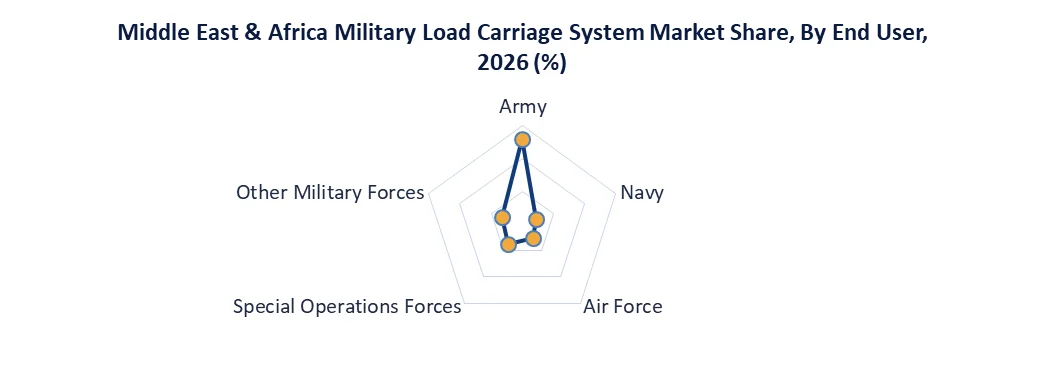
Army leads with about 52% of 2026 value and a 5.9% CAGR, reflecting the scale of infantry fleets across the region. Special operations forces hold 15% (7.4% CAGR), other military forces 13% (6.3%), including national guard, presidential guard and border units and Air Force 11% (5.6%). Navy holds 9% (5.7% CAGR). Special operations forces are the fastest-growing end user, at a 7.4% CAGR.
Military Load Carriage System Market by Procurement Channel: Direct Government, Defence Contractors and Distributors
Defence contractors and system integrators lead with about 42% of 2026 value and a 6.3% CAGR, as Gulf buyers prefer bundled packages with local partners. Direct government procurement holds 36% (5.3% CAGR), through ministries of defence and national procurement bodies and military equipment distributors 22% (7.1%). Military equipment distributors are the fastest-growing procurement channel, at a 7.1% CAGR as smaller forces buy standard carriers off catalog.
Middle East and Africa Military Load Carriage System Market Regional Analysis: Saudi Arabia, Israel, Turkey, United Arab Emirates, South Africa and Rest of MEA
Saudi Arabia is the largest national market at about 24% of 2026 value (6.5% CAGR), supported by the largest defence budget in the region and by localization targets. Israel holds 19% (5.3%), anchored by domestic specialists, Turkey 16% and the fastest-growing country at 6.7% as local industry scales, the United Arab Emirates 13% (6.1%) and South Africa 8% (4.7%). Rest of Middle East & Africa, including Qatar, Egypt, Nigeria, Algeria and other states, holds 20% and grows at 6.3%. Country shares are SMR estimates.
Geographic analysis. The geographic analysis of the Middle East and Africa market reviews regional market trends and area-specific market dynamics, including local market influences such as national procurement rules. Market performance by region and regional market segmentation show geographical trends shaped by regional economic factors and local consumer behavior, while regional market challenges and area-specific opportunities define the regional competitive landscape. Market growth by location, the region-specific industry outlook and local market entry strategies are set against regional market share, economic impact by region and regional market development, with market trends in specific regions tracked at country level. Territorial dynamics, locational market nuances, area-centric market shifts and geographic market intricacies explain regional consumer patterns and local economic factors, and regional market performance is compared across the territorial competitive landscape. Demographic trends by region, localized market challenges and regionally-driven opportunities shape locational market share, geo-strategic influences and regional market entry strategies, supported by area-centric growth factors, a regional industry outlook, market trends in designated areas and the wider geopolitical influences on defence demand.
Defence Spending Benchmarks: What SIPRI Says About Middle East and African Demand
Public sources frame the demand cycle. SIPRI estimates Middle East military expenditure at USD 218 billion in 2025, 0.1% above 2024 and 36% above a decade earlier, and Africa's at USD 58.2 billion, up 8.5%. Saudi Arabia spent USD 83.2 billion, up 1.4%, and Israel USD 48.3 billion, while Nigeria's spending rose 55% to USD 2.1 billion.
Middle East and Africa Military Load Carriage System Ecosystem: From Fibers to Fielded Soldier Kit
|
Layer |
What happens |
Examples |
|
1. Fibers and fabrics |
Nylon, polyester, UHMWPE and aramid are imported, woven or laminated |
Avient (Dyneema), DuPont (Kevlar), Honeywell (Spectra) |
|
2. Armor and plate makers |
Soft armor and hard plates are imported or increasingly produced under localization programs |
NP Aerospace, Sondos, Elbit Systems |
|
3. Carrier and pack makers |
Vests, plate carriers, chest rigs, packs, belts and pouches are cut, sewn and assembled |
Agilite, Source Tactical Gear, Hard Shell, MS Equipment |
|
4. Integrators and distributors |
Governments buy through contractors, local partners and distributors |
Elbit Systems, Galvion, regional distributors |
|
5. Armed forces |
Armies, navies, air forces, national guards and special operations units are issued and sustain the systems |
Saudi, Emirati, Israeli, Turkish and South African forces |
|
6. Government and standards |
Requirements, localization targets and qualification |
Ministries of defence, Saudi GAMI and Emirati Tawazun, local standards bodies |
Middle East and Africa Military Load Carriage System Companies and Competitive Landscape: Who Supplies the MEA Market?
The MEA market combines regional specialists, defence primes and international OEMs. Agilite, Source Tactical Gear, Elbit Systems, Hard Shell and MS Equipment appear in SMR's key-player map, Sondos is planning ballistic armor production in Saudi Arabia, and international suppliers such as NP Aerospace and Galvion sell protective equipment into the region, while Avient (Dyneema), DuPont (Kevlar) and Honeywell (Spectra) supply the fibers. Competition varies by country: local content, offsets, brand specification and the ability to support equipment in hot, dusty conditions decide awards.
Company and government disclosures show how suppliers respond to demand. In February 2025 Galvion announced orders for 35,000 Batlskin helmet systems from Middle Eastern forces, and Sondos has outlined plans for a Saudi ballistic armor facility to localize helmets and plates. DuPont introduced Kevlar EXO for hard armor in December 2025, and the Army's LSAPI orders in September 2025 show how quickly lighter plate designs are moving from specification to production.
Competitor analysis. SMR's competitor analysis combines company revenue and company net sales with competitive intelligence to deliver an industry rivals examination and market rivalry assessment. Competitor benchmarking, a competitive strategy review and industry player dynamics feed a rivalry impact analysis, competitor evaluation and competitive landscape trends, with competitive positioning and market rivalry intensity measured for each supplier. Competitor profiling and competitive advantage assessment give an industry competition overview, covering market player strategies, competitive benchmark analysis and rival market share. Competitive market evolution and competitor differentiation are examined through market rival scrutiny and industry adversary exploration, while competitive ecosystem analysis maps rivalry landscape intricacies and a competitive matrix investigation. Business opponent profiling, sectorial rivalry dynamics, competitive maneuver examination and competing force scrutiny support rivalry intensity mapping, opponent landscape divergence and industry opposition tactics, rounded off by a strategic analysis of each leading company.
Competitive Strategies in the Middle East and Africa Military Load Carriage System Market
- Localization and joint ventures: local assembly, offsets and partnerships with Saudi, Emirati and Turkish industry.
- Desert-optimized design: ventilated, light and dust-resistant carriers and hydration integration.
- Bundled soldier systems: helmets, plates, carriers and radios sold as one package.
- Modular platforms: base carriers with swappable front flaps, panels and pouches.
- Specialist brands for elite units: brand-specified carriers for special operations and border forces.
Middle East and Africa Military Load Carriage System Market Recent Developments
|
Date |
Development |
|
27 Apr 2026 |
SIPRI estimates Middle East military expenditure at USD 218 billion and Africa's at USD 58.2 billion for 2025 |
|
29 Apr 2026 |
Saudi Arabia allocated about USD 78 billion to defence in 2025 and targets localizing over 50% of procurement by 2030 |
|
May 2026 |
U.S. Department of Commerce reports Saudi domestic defense content at 19.35% |
Middle East and Africa Military Load Carriage System Market Scope: Inquire before buying
|
Middle East and Africa Military Load Carriage System Market Segmentation |
|
|
Report Coverage |
Details |
|
Base Year |
2026 |
|
Historical Data |
2021 to 2026 |
|
Forecast Period |
2027-2034 |
|
Market Size in 2026 |
USD 274 Million |
|
Market Size in 2034 |
USD 439 Million |
|
CAGR (2027-2034) |
6.1% |
|
By Product Type |
Tactical Vests Load-Bearing Equipment (LBE) Plate Carriers Chest Rigs Military Backpacks Belts and Pouches Modular Load Carriage Accessories |
|
By Load Carriage Configuration |
Integrated Load Carriage Systems Modular Load Carriage Systems Standalone Load-Bearing Systems |
|
By Material Type |
Nylon Polyester Ultra-High-Molecular-Weight Polyethylene (UHMWPE) Aramid Fibers Other Advanced Materials |
|
By Load Capacity |
Lightweight Systems Medium-Load Systems Heavy-Load Systems |
|
By Application |
Infantry and Ground Combat Special Operations Reconnaissance and Surveillance Tactical Support Operations Training and Military Exercises |
|
By End User |
Army Navy Air Force Special Operations Forces Other Military Forces |
|
By Procurement Channel |
Direct Government Procurement Defence Contractors and System Integrators Military Equipment Distributors |
Middle East and Africa Military Load Carriage System Market, By Country:
- Saudi Arabia
- Israel
- Turkey
- United Arab Emirates
- South Africa
- Rest of Middle East & Africa
Military Load Carriage System Market Key Players:
Middle East & Africa
- Agilite
- Source Tactical Gear
- Elbit Systems
- Hard Shell
- MS Equipment
- Sondos
International Suppliers and Fiber Makers Active in MEA
- NP Aerospace
- Galvion
- Avient (Dyneema)
- DuPont (Kevlar)
- Honeywell (Spectra)
Frequently Asked Questions
Ans: It is the body-worn equipment that carries a soldier's weapons, ammunition, armor, water and mission kit, including tactical vests, plate carriers, chest rigs, load-bearing equipment, backpacks, belts, pouches and modular accessories.
Ans: SIPRI estimates Middle East military expenditure at USD 218 billion in 2025 and Africa's at USD 58.2 billion, up 8.5%. Saudi Arabia targets localizing more than 50% of military procurement by 2030.
Ans: Plate carriers lead with about 25% of 2026 value (SMR). Modular load carriage accessories are the fastest-growing product type at a 7.9% CAGR.
Ans: In SMR estimates other advanced materials grow at 8.6%, UHMWPE at 8.2% and aramid fibers at 7.0%, ahead of nylon at 5.2%. DuPont introduced Kevlar EXO for hard armor in December 2025.
Ans: Saudi Arabia leads with about 24% of 2026 value, while Turkey grows fastest at 6.7% (SMR estimates).
Ans: Through ministries of defence and national procurement bodies, defence contractors and local partners, and distributors, with growing local-content and offset requirements. Many Saudi defence procurements are negotiated case by case.
Ans: Heat, sand and dust raise demand for ventilated carriers, light fabrics, corrosion-resistant hardware and hydration integration, so desert combat load carriage systems differ from temperate-climate designs (SMR assessment).
Ans: SMR estimates about 1.3 million units in 2026, rising to about 1.9 million units by 2034, a 4.9% volume CAGR.
Ans: Middle East & Africa holds about 8% of the global military load carriage system market in 2026 (USD 274 Million of USD 3.42 Billion), according to SMR estimates.
1. Military Load Carriage System Market – Executive Summary & Industry Overview
1.1. Middle East & Africa Military Load Carriage System Market Size and Growth Outlook
1.2. Historical Evolution of Military Load-Bearing Equipment and Systems
1.3. Military Load Carriage Systems Definition, Classification and Operational Scope
1.4. Role of Load Carriage Systems in Soldier Equipment Modernization
1.5. Middle East & Africa Military Load Carriage System Production and Deployment Overview
1.6. Market Growth Assessment and Long-Term Defence Demand Outlook
2. Military Load Carriage System Market Dynamics
2.1. Emerging Trends in Soldier Load Management and Equipment Modernization
2.2. Market Dynamics Analysis
- Drivers
- Restraints
- Opportunities
- Challenges
2.3. Porter's Five Forces Analysis of Military Equipment Suppliers
2.4. PESTLE Analysis of Middle East & Africa Military Load Carriage Procurement
2.5. Defence Modernization Priorities and Tactical Equipment Replacement Cycles
2.6. Military Operational Requirements Influencing Equipment Adoption Decisions
3. Military Load Carriage System Market – Macroeconomic Factors
3.1. Middle East & Africa Defence Expenditure and Military Modernization Budget Allocations
3.2. Infantry Modernization Programs and Soldier Equipment Investment Trends
3.3. International Military Procurement Spending and Defence Contract Allocations
3.4. Military Textile Manufacturing Costs and Advanced Material Pricing
3.5. Geopolitical Conflicts and Cross-Border Defence Equipment Requirements
3.6. Currency Fluctuations and International Military Equipment Trade Dynamics
4. Military Load Carriage System Industry Trends & Technology Developments
4.1. Increasing Demand for Lightweight Soldier Equipment and Mobility
4.2. Integration of Modular Load-Bearing Platforms Across Infantry Units
4.3. Development of Ergonomic Systems for Extended Operational Deployments
4.4. Adoption of Advanced Fabrics for Tactical Equipment Durability
4.5. Integration of Body Armor and Load Distribution Technologies
4.6. Development of Smart Load Carriage and Soldier Integration Systems
5. Military Load Carriage System Technical Specifications & Engineering Landscape
5.1. Structural Design and Configuration of Military Load Carriage Equipment
5.2. Load Distribution Mechanisms and Soldier Weight Management Characteristics
5.3. Ergonomic Design, Adjustability and Human Body Compatibility Requirements
5.4. Equipment Durability Under Extreme Operational and Environmental Conditions
5.5. Attachment Interfaces, Modular Compatibility and Equipment Interoperability Standards
5.6. Performance Testing, Field Validation and Military Qualification Requirements
6. Military Load Carriage System Manufacturing & Material Ecosystem
6.1. Nylon Fabric Selection and High-Tenacity Textile Manufacturing Processes
6.2. Polyester Fabric Applications in Tactical Equipment Construction
6.3. UHMWPE Material Integration and Lightweight Protection Applications
6.4. Aramid Fiber Utilization in Reinforced Military Equipment Components
6.5. Advanced Composite Materials and Specialized Fabric Development
6.6. Material Sourcing, Fabrication Efficiency and Manufacturing Cost Optimization
7. Military Load Carriage System Product Architecture & Configuration Landscape
7.1. Tactical Vest Construction and Integrated Equipment Carrying Arrangements
7.2. Plate Carrier Design and Body Armor Compatibility Requirements
7.3. Load-Bearing Equipment Architecture and Belt-Based Carrying Configurations
7.4. Chest Rig Construction and Mission-Specific Equipment Placement
7.5. Military Backpack Frames and Extended Load-Carrying Capabilities
7.6. Modular Pouches, Belts and Accessory Attachment Systems
8. Military Load Carriage System Load Management & Capacity Landscape
8.1. Lightweight Load Carriage Systems for High-Mobility Operations
8.2. Medium-Load Equipment Configurations for Standard Infantry Missions
8.3. Heavy-Load Systems for Extended Tactical Deployment Requirements
8.4. Weight Distribution Across Torso, Waist and Shoulder Interfaces
8.5. Equipment Carrying Capacity and Mission-Specific Load Allocation
8.6. Soldier Fatigue Management and Load-Bearing Performance Optimization
9. Military Load Carriage System Application & Operational Deployment Landscape
9.1. Infantry Equipment Requirements Across Ground Combat Operations
9.2. Special Operations Load Configurations and Mission-Specific Equipment Requirements
9.3. Reconnaissance Missions and Lightweight Equipment Carrying Arrangements
9.4. Surveillance Operations and Specialized Tactical Equipment Integration
9.5. Tactical Support Missions and Equipment Transportation Requirements
9.6. Military Training Exercises and Field Equipment Utilization Patterns
10. Military Load Carriage System Integration & Soldier Equipment Compatibility
10.1. Integration with Ballistic Protection and Personal Armor Equipment
10.2. Compatibility with Tactical Communication and Radio Carrying Systems
10.3. Weapon Accessory Storage and Ammunition Carrying Configurations
10.4. Hydration Systems Integration and Field Water Transportation Requirements
10.5. Compatibility with Night Vision and Electronic Soldier Equipment
10.6. Interoperability Across Existing Military Personal Equipment Platforms
11. Military Load Carriage System Design Innovation & Ergonomic Development
11.1. Shoulder Strap Engineering and Pressure Distribution Optimization
11.2. Waist Belt Design and Lower Body Load Transfer
11.3. Ventilation Structures and Thermal Comfort Improvement Technologies
11.4. Adjustable Suspension Systems and Individual Soldier Fit Customization
11.5. Quick-Release Mechanisms and Emergency Equipment Detachment Capabilities
11.6. Anthropometric Design Adaptations for Diverse Military Personnel Requirements
12. Military Load Carriage System Quality, Durability & Performance Assessment
12.1. Fabric Tear Resistance and Abrasion Performance Evaluation
12.2. Stitching Strength and Structural Component Reliability Testing
12.3. Environmental Resistance Against Moisture, Heat and Dust
12.4. Load-Bearing Capacity and Long-Duration Stress Testing
12.5. Hardware Corrosion Resistance and Attachment Component Durability
12.6. Military Field Trials and Product Performance Qualification Procedures
13. Military Load Carriage System Safety, Standards & Regulatory Compliance
13.1. Military Equipment Qualification and Defence Procurement Standard Requirements
13.2. Ballistic Protection Compatibility and Personal Equipment Safety Considerations
13.3. Textile Material Compliance and Restricted Substance Testing Requirements
13.4. Operational Safety Standards for Soldier-Carried Equipment Systems
13.5. Equipment Reliability Certification and Military Acceptance Procedures
13.6. Regional Defence Standards and International Compliance Frameworks
14. Military Load Carriage System Research, Development & Product Innovation
14.1. Advanced Lightweight Materials and Next-Generation Equipment Development
14.2. Modular Load Carriage Platform Research and Design Advancements
14.3. Ergonomic Research and Soldier Mobility Improvement Initiatives
14.4. Smart Textiles and Integrated Soldier Equipment Development
14.5. Defence Research Investments and Military Technology Collaborations
14.6. Product Commercialization and Advanced Equipment Portfolio Expansion Strategies
15. Military Load Carriage System Supply Chain & Manufacturing Operations
15.1. Raw Material Procurement and Specialized Textile Supplier Networks
15.2. Fabric Cutting, Stitching and Tactical Equipment Assembly Operations
15.3. Component Sourcing and Modular Equipment Manufacturing Coordination
15.4. Production Capacity and Military Contract Fulfilment Capabilities
15.5. Inventory Management and Defence Equipment Distribution Networks
15.6. Supply Chain Resilience and Strategic Material Sourcing Requirements
16. Military Load Carriage System Pricing, Procurement & Cost Economics
16.1. Product Pricing Across Military Load Carriage Equipment Categories
16.2. Material Costs and Tactical Equipment Manufacturing Economics
16.3. Modular System Pricing and Configuration-Based Cost Variations
16.4. Government Contract Pricing and Defence Procurement Mechanisms
16.5. Lifecycle Costs and Military Equipment Replacement Expenditure
16.6. Cost Competitiveness Across International Military Equipment Manufacturers
17. Military Load Carriage System Distribution & Procurement Landscape
17.1. Direct Government Procurement and Military Contracting Arrangements
17.2. Defence Contractors and System Integrator Procurement Networks
17.3. Military Equipment Distributors and Specialized Supply Channels
17.4. Government Tendering Processes and Defence Supplier Qualification
17.5. Framework Agreements and Long-Term Military Supply Contracts
17.6. International Defence Sales and Cross-Border Equipment Distribution
18. Military Load Carriage System End-User & Defence Requirements Analysis
18.1. Army Infantry Equipment Requirements and Standardization Priorities
18.2. Naval Personnel Equipment and Maritime Operational Carrying Requirements
18.3. Air Force Ground Personnel and Specialized Equipment Requirements
18.4. Special Operations Forces and Mission-Specific Load Configurations
18.5. Other Military Forces and Specialized Tactical Equipment Requirements
18.6. Inter-Service Procurement Requirements and Equipment Standardization Initiatives
19. Military Load Carriage System Adoption & Operational Utilization
19.1. Military Adoption Across Infantry and Specialized Operational Units
19.2. Soldier Equipment Standardization and Platform Replacement Requirements
19.3. Deployment Frequency and Operational Equipment Utilization Patterns
19.4. Procurement Preferences Across Military Organizations and Defence Agencies
19.5. Equipment Interoperability and Existing Platform Replacement Considerations
19.6. Soldier Feedback and Field-Based Product Improvement Requirements
20. Military Load Carriage System Regional & Country-Level Market Landscape
20.1. Saudi Arabia Defence Localization and Military Procurement Landscape
20.2. Israel Domestic Defence Specialists and Soldier Equipment Demand
20.3. Turkey Defence Industry Growth and Tactical Equipment Manufacturing
20.4. United Arab Emirates Defence Procurement and Military Modernization
20.5. South Africa and African Military Equipment Procurement Landscape
20.6. Regional Production Capabilities and International Defence Trade Flows
21. Military Load Carriage System Market Size & Forecast by Segmentation (Value USD Million), 2027–2034
21.1. Military Load Carriage System Market Size and Forecast, By Product Type
- Tactical Vests
- Load-Bearing Equipment (LBE)
- Plate Carriers
- Chest Rigs
- Military Backpacks
- Belts and Pouches
- Modular Load Carriage Accessories
21.2. Military Load Carriage System Market Size and Forecast, By Load Carriage Configuration
- Integrated Load Carriage Systems
- Modular Load Carriage Systems
- Standalone Load-Bearing Systems
21.3. Military Load Carriage System Market Size and Forecast, By Material Type
- Nylon
- Polyester
- Ultra-High-Molecular-Weight Polyethylene (UHMWPE)
- Aramid Fibers
- Other Advanced Materials
21.4. Military Load Carriage System Market Size and Forecast, By Load Capacity
- Lightweight Systems
- Medium-Load Systems
- Heavy-Load Systems
21.5. Military Load Carriage System Market Size and Forecast, By Application
- Infantry and Ground Combat
- Special Operations
- Reconnaissance and Surveillance
- Tactical Support Operations
- Training and Military Exercises
21.6. Military Load Carriage System Market Size and Forecast, By End User
- Army
- Navy
- Air Force
- Special Operations Forces
- Other Military Forces
21.7. Military Load Carriage System Market Size and Forecast, By Procurement Channel
- Direct Government Procurement
- Defence Contractors and System Integrators
- Military Equipment Distributors
21.8. Military Load Carriage System Market Size and Forecast, By Country
- Saudi Arabia
- Israel
- Turkey
- United Arab Emirates
- South Africa
- Rest of Middle East & Africa
22. Military Load Carriage System Market Competitive Landscape
22.1. SMR Competition Matrix and Competitive Positioning Assessment
22.2. Competitive Positioning of Leading Military Equipment Manufacturers
22.3. Key Players Benchmarking
- Company Name and Corporate Headquarters
- Military Load Carriage Product Portfolio and Offerings
- Manufacturing Capabilities and Production Capacity
- Material Technologies and Product Engineering Capabilities
- Defence Contracts and Military Customer Relationships
- Geographic Presence and Distribution Network
22.4. Market Structure and Competitive Participant Categorization
- Specialized Tactical Equipment Manufacturers
- Defence and Military Equipment Manufacturers
- Ballistic Protection and Armor System Providers
- Military Textile and Equipment Suppliers
22.5. Company Revenue Growth and Financial Performance Benchmarking
22.6. Manufacturing Capacity and Production Scale Comparison
22.7. Military Contract Portfolio and Defence Customer Benchmarking
22.8. Product Portfolio Breadth and Equipment Configuration Comparison
22.9. Corporate Financial Performance and Business Portfolio Analysis
22.10. Mergers, Acquisitions and Strategic Collaborations
22.11. Recent Product Launches and Military Equipment Developments
23. Military Load Carriage System Manufacturers & Tactical Equipment Specialists
23.1. Tactical Vest and Plate Carrier Manufacturing Company Landscape
23.2. Load-Bearing Equipment and Modular Chest Rig Manufacturers
23.3. Military Backpack and Specialized Load-Carrying Equipment Providers
23.4. Tactical Belt, Pouch and Accessory Manufacturing Companies
23.5. Product Customization and Mission-Specific Equipment Manufacturing Capabilities
23.6. Manufacturing Capacity, Product Availability and Supply Reliability Assessment
24. Military Load Carriage System Materials & Component Supplier Landscape
24.1. High-Tenacity Nylon and Polyester Fabric Supplier Ecosystem
24.2. UHMWPE and Aramid Fiber Material Supplier Landscape
24.3. Tactical Equipment Hardware and Attachment Component Manufacturers
24.4. Specialized Webbing, Buckle and Fastening Component Providers
24.5. Advanced Textile Processing and Material Engineering Capabilities
24.6. Material Quality, Procurement Reliability and Supplier Diversification Assessment
25. Military Load Carriage System Market Manufacturers' Strategies & Expansion Plans
25.1. Expansion of Military Equipment Manufacturing and Production Capabilities
25.2. Development of Lightweight and High-Durability Load Carriage Products
25.3. Modular Equipment Portfolio Expansion and Configuration Customization Initiatives
25.4. Strategic Partnerships with Defence Contractors and Military Organizations
25.5. Expansion into International Defence Procurement and Military Markets
25.6. Investments in Advanced Materials and Product Engineering Technologies
26. Military Load Carriage System Industry SWOT, Investments & Strategic Developments
26.1. Competitive Strengths of Established Tactical Equipment Manufacturers
26.2. Manufacturing Constraints and Military Procurement Market Limitations
26.3. Emerging Opportunities in Infantry Modernization and Soldier Equipment
26.4. Competitive Threats from Alternative Equipment and Material Technologies
26.5. Investments in Modular Platforms and Lightweight Material Development
26.6. Product Launches, Defence Partnerships and Strategic Industry Developments
27. Military Load Carriage System Competitive Outlook & Market Positioning
27.1. Competitive Dynamics Across Military Load Carriage Product Categories
27.2. Market Concentration Across Specialized Tactical Equipment Manufacturers
27.3. Competitive Differentiation Through Material Quality and Ergonomic Design
27.4. Established Defence Suppliers Versus Specialized Tactical Equipment Manufacturers
27.5. Competitive Positioning Across Military End-User and Application Categories
27.6. Future Market Opportunities and Military Procurement Expansion Potential
28. Company Profiles: Key Military Load Carriage System Market Participants
Middle East & Africa
- Agilite
- Source Tactical Gear
- Elbit Systems
- Hard Shell
- MS Equipment
- Sondos
International Suppliers and Fiber Makers Active in MEA
- NP Aerospace
- Galvion
- Avient (Dyneema)
- DuPont (Kevlar)
- Honeywell (Spectra)
29. Key Findings
30. Strategic Moves & Industry Outlook
31. Research Methodology