ENG
 Japanese
 French
 German
 Korean

Middle East and Africa Supersonic Jet Market : Size, Share and Forecast 2027 - 2034
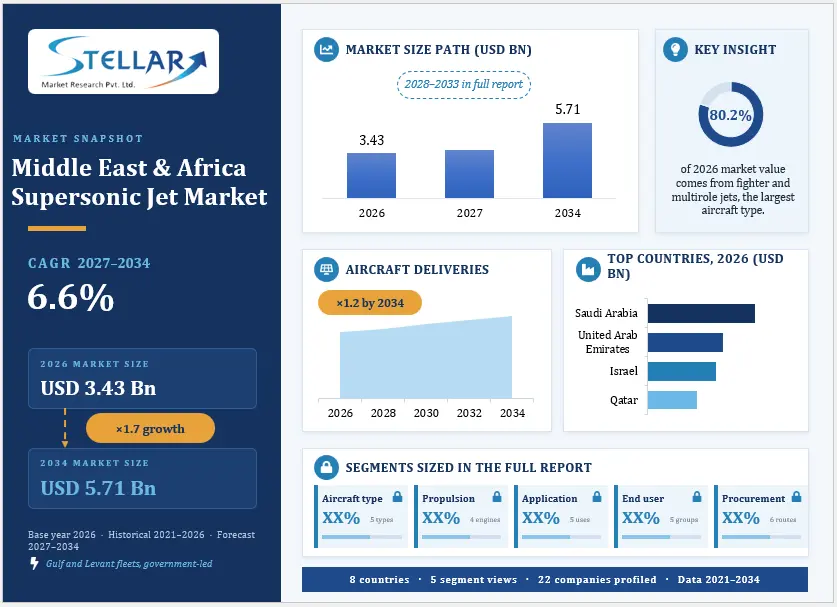
The Middle East and Africa Supersonic Jet Market is valued at USD 3.43 billion in 2026 and is projected to reach USD 5.71 billion by 2034, growing at a CAGR of 6.6% during 2027–2034.
The Middle East and Africa Supersonic Jet Market is valued at USD 3.43 billion in 2026 and is projected to reach USD 5.71 billion by 2034, growing at a CAGR of 6.6% during 2027–2034, according to SMR. The region accounts for about 10.6% of the global supersonic jet market and is import-led, with Gulf Cooperation Council states, Israel, Turkey and Egypt buying advanced fighters from the United States, Europe and increasingly regional suppliers.
This Middle East and Africa Supersonic Jet Market analysis serves two audiences: aircraft manufacturers, engine makers, suppliers and investors who want to know what the Middle East supersonic aircraft market is worth, and air forces, defense ministries and procurement agencies that track the Middle East military supersonic jet market, the African military supersonic aircraft market, the Middle East fighter jet market and the MEA military aviation market. The market overview covers industry trends, market dynamics, market size, key players, the competitive landscape, market segmentation, growth prospects and market opportunities, and gives stakeholders a clear market outlook.
Fighter and multirole jets, together with government-to-government and direct commercial imports, anchor the market, and Saudi Arabia is the largest country. Growth is shifting toward Saudi Arabia, Turkey and the rest of the region, advanced trainers and localized industry as air forces modernize fleets, add squadrons and negotiate offsets. These industry trends and market dynamics shape the challenges, growth drivers, market entry strategies and emerging opportunities across the Middle East defense aviation market.
SMR provides comprehensive analysis of the Middle East Supersonic Aircraft Market size, share, aircraft type, propulsion technology, application, end user, procurement route and country segmentation, the Africa supersonic aircraft market, strategic scenarios and growth opportunities. The report helps global supersonic jet manufacturers, engine and avionics suppliers, regional aerospace companies, defense ministries and investors decide which programs, segments and countries to prioritise through 2034. It also covers the GCC military aircraft market, Qatar military aircraft market, South Africa military aircraft market and the African aerospace and defense market, together with advanced combat aircraft procurement in MEA.
|
2026 | BASE YEAR |
2034 | FORECAST |
GROWTH RATE |
LARGEST COUNTRY |
|
USD 3.43 Bn |
USD 5.71 Bn |
6.6% |
Saudi Arabia |
Middle East and Africa Supersonic Jet Market Overview: Size, Share, Trends and Outlook to 2034
The market is measured at original-equipment-manufacturer revenue level for supersonic jets ordered by or delivered to customers in the Middle East and Africa, across fighter and multirole, trainer and light combat, strike, attack and interceptor, business and passenger supersonic jets, including development, prototype and capability-upgrade contracts. Subsonic military aircraft, helicopters, unmanned aircraft without supersonic capability, weapons and standalone spare-parts sales are excluded. The region covers Saudi Arabia, the United Arab Emirates, Qatar, Israel, Turkey, Egypt, South Africa and the rest of the Middle East and Africa, including Kuwait, Bahrain, Oman, Morocco and Algeria.
Three shifts shape 2026–2034: demand is moving from legacy F-16 and Mirage fleets to fifth-generation and advanced fourth-generation fighters; value is moving toward Saudi Arabia, Turkey and Israel as they add squadrons and localize work; and procurement is diversifying from a single supplier toward a mix of US, European, Turkish, Korean and Chinese options. Suppliers are answering with offsets, local maintenance and co-production. This market synopsis reflects the key growth drivers, market opportunities, challenges, economic factors, technological advancements and regulatory influences.
On a volume basis, SMR estimates aircraft deliveries to customers in the Middle East and Africa of about 60 aircraft in 2026, rising to about 75 aircraft by 2034 at a CAGR of roughly 2.8% during 2027–2034. Value grows faster than volume (6.6% versus 2.8%) because the mix is shifting toward fifth- and sixth-generation fighters, adaptive-cycle engines, capability upgrades and civil supersonic development contracts, lifting average revenue per aircraft from about USD 57 million in 2026 to about USD 76 million in 2034.
To get more Insights: Request Free Sample Report
Key Findings: Eight Insights Shaping the Middle East and Africa Supersonic Jet Market
SMR’s analysis of published market data, company announcements, regulatory frameworks and industry developments points to eight findings that explain where MEA Supersonic Jet Market growth and value are created through 2034. These market insights summarise the MEA Supersonic Jet Market forecast, market segmentation and competitive landscape in one view.
|
Sr. No. |
Findings |
Evidence |
So what |
|
1 |
The market grows about 1.7× by 2034 |
USD 3.43 Bn (2026) to USD 5.71 Bn (2034) at 6.6% CAGR |
Maintenance, training and basing capacity must scale with large squadron additions |
|
2 |
Fighter and multirole jets dominate, trainers grow faster |
Fighter & multirole ~80.2% of 2026 value; trainer & light combat 7.5% CAGR |
Advanced trainers support pilot pipelines for new fighter fleets |
|
3 |
Saudi Arabia is the largest country and the fastest-growing major country |
~24% share in 2026 with 8.5% CAGR; US approval for a possible sale of 48 F-35 jets in September 2026 |
Large single orders and localization targets set pricing and offsets |
|
4 |
Israel and Turkey expand fleets |
Israel approved extra F-35I and F-15IA squadrons in May 2026; Turkey grows 7.5% CAGR with Typhoon, F-16 and KAAN |
Mixed US, European and domestic programs widen the supplier base |
|
5 |
Multirole and strike lead applications |
Multirole & strike ~58%; air superiority & defense ~30% of 2026 value |
Weapons integration and sensor fusion anchor competitiveness |
|
6 |
Imports dominate procurement |
G2G & FMS imports ~43%; direct commercial sales and offset-linked imports ~36% |
Export approval, financing and offsets decide contract timing |
|
7 |
Qatar and the UAE grow steadily |
Qatar 4.5% CAGR and the UAE 6.0% CAGR on F-15QA, Rafale and Typhoon fleets |
Sustainment and upgrades are a larger share of value than new orders |
|
8 |
Localization is a growing lever |
Turkey, Saudi Arabia, the UAE and Israel pursue local production and sustainment |
Industrial participation separates winning bids from losing ones |
Middle East and Africa Supersonic Jet Market Dynamics: Growth Drivers, Restraints, Opportunities and Trends
Middle East and Africa Supersonic Jet Market Growth Drivers: Fleet Modernization, Gulf and Israeli Squadron Expansion, Turkish Fighter Programs, Regional Security Needs and Localization
The MEA Supersonic Jet Market is supported by regional security tension, aging fighter fleets and large defense budgets. Saudi Arabia received US State Department approval in September 2026 for a possible sale of 48 F-35 jets valued at USD 24.3 billion, in addition to its fleets of F-15SA and Typhoon fighters, and UK industry expects a follow-on Typhoon order. Israel approved a fourth F-35 squadron and a second F-15IA squadron in May 2026, building toward about 100 F-35I and 50 F-15IA aircraft, while Turkey signed for 20 new Typhoons in October 2025. These factors give suppliers a recurring revenue base, although buying decisions still depend on export approval, financing and delivery schedules. Demand and supply conditions, economic factors and competitive forces act as market drivers and growth catalysts for MEA supersonic aircraft demand.
Technology and industrial strategy add new layers of demand. Israel’s F-15IA contract, announced with a ceiling of USD 8.58 billion for 25 aircraft with an option for 25 more, delivers advanced strike capability from 2031; Turkey is developing the KAAN fighter, receiving second-hand Typhoons from Qatar and Oman and buying F-16 Block 70 aircraft; and Saudi Arabia and the UAE are building local maintenance and offset programs through SAMI and EDGE Group. Gripen operations in South Africa, Rafale fleets in Egypt, Qatar and the UAE and F-15QA aircraft in Qatar show how diversified the buyer base is. Technological advancements, supportive regulatory influences and emerging trends reinforce this momentum.
Middle East and Africa Supersonic Jet Market Restraints: Budget Volatility, Export Approval Delays, Political Risk, Sustainment Capacity and Currency Pressure
Budget, political and approval risks are the main restraints. Oil price swings affect Gulf budgets, regional conflict can disrupt delivery and basing plans, and US export approvals involve congressional review and conditions such as preserving Israel’s qualitative military edge, which can delay or reshape contracts. Many buyers depend on a single supplier for spares and upgrades, and skilled maintenance personnel are limited in several countries. Macroeconomic factors and market shifts also shape supply and add constraints that suppliers must manage.
Regulation, financing and competition also limit growth. Export control rules, sanction exposure and technology-transfer limits complicate contracts, buyers weigh cost per flight hour against drones, missiles and air defense that compete for the same budgets, and some air forces prefer second-hand or lower-cost aircraft such as the JF-17, KF-21 and KAAN. Environmental, socioeconomic and market forces also influence how quickly new entrants can scale.
What Are the Biggest Supersonic Jet Market Opportunities in Middle East & Africa Through 2034?
Gulf and Israeli squadron expansion, Turkish and Saudi localization and advanced trainers represent the most significant MEA Supersonic Jet Market opportunities because they extend revenue beyond aircraft sales into training, sustainment, upgrades and local industry. Trainer and light combat jets are projected to grow at 7.5% CAGR, modernization contracts at 5.5% and direct commercial sales at 6.0%, while Saudi Arabia grows at 8.5% and Turkey at 7.5%. Suppliers with credible offset packages, local partners and strong sustainment offers may be better positioned to win new contracts. MEA Supersonic Jet Market industry evolution, competitive landscape shifts, the evolution of consumer preferences, regulatory changes, MEA Supersonic Jet Market innovation impact, technology trends are assessed for each segment.
Localization, new buyers and African fleet renewal offer further routes to growth. Rest of Middle East & Africa, covering Kuwait, Bahrain, Oman, Morocco, Algeria and Sub-Saharan Africa, is projected to grow at 7.2% CAGR as smaller air forces replace legacy aircraft, and Egypt and the UAE add fleet capacity. Co-production, local assembly and maintenance centers can widen market access, shorten delivery cycles and strengthen sovereignty, creating attractive segment-specific opportunities and untapped market areas.
MEA Supersonic Jet Market Trends: Fifth-Generation Fighters, Advanced Trainers, Local Industrial Participation, Diversified Suppliers and Upgrades
Four MEA Supersonic Jet Market trends stand out through 2034. First, fifth-generation entry: Israel operates the F-35I and Saudi Arabia may become the second regional operator. Second, advanced fourth-generation fleets: F-15EX derivatives, Typhoons, Rafales and F-16 Block 70 aircraft expand. Third, localization: Turkey, Saudi Arabia, the UAE and Israel pursue local production and sustainment. Fourth, new supplier options: Turkish, Korean, Pakistani and Chinese aircraft compete for lower-cost requirements. Industry resilience, market volatility and gaps in supply and capability determine how suppliers respond to these trends and which growth catalysts they pursue.
Middle East and Africa Supersonic Jet Market Segmentation: By Aircraft Type, Propulsion Technology, Application, End User and Procurement Route
Supersonic Jet Market by Application and Procurement Route: Multirole and Strike, Air Superiority, Training, Business and Passenger Travel
Supersonic Fighter Jet Market, Military Supersonic Jet Market, Commercial Supersonic Jet Market, Aircraft Type and Propulsion Technology
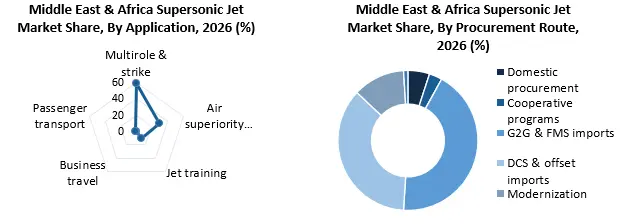
Fighter and multirole jets dominate the MEA Supersonic Jet Market, accounting for approximately 80.2% of 2026 value, followed by strike, attack and interceptor jets (10%) and trainer and light combat jets (9%), with the latter growing at a 7.5% CAGR. By propulsion technology, afterburning turbofan engines lead with a 97% share, while adaptive and variable-cycle engines account for 1%. By application, multirole and ground strike contribute 58%, followed by air superiority and air defense (30%) and advanced jet training (11.2%). Government-to-government and FMS imports dominate procurement channels at 43%, followed by direct commercial sales and offset-linked imports (36%) and fleet modernization contracts (12%). Air forces represent the largest end-user category, accounting for approximately 94% of market value.
The MEA Supersonic Jet Market segmentation analysis evaluates aircraft types, propulsion technologies, applications, procurement channels and end users, highlighting market shares, growth trends, competitive positioning and emerging opportunities. It also examines regional demand, customer profiles, niche markets and segment-specific growth prospects across the Middle East fighter jet market and the African military supersonic aircraft market.
Middle East and Africa Supersonic Jet Market Regional Analysis: Saudi Arabia, United Arab Emirates, Qatar, Israel, Turkey, Egypt, South Africa and Rest of Middle East & Africa
Saudi Arabia is the largest country market, accounting for about 24% of regional value in 2026 and expected to grow at about 8.5% CAGR, supported by F-15SA and Typhoon fleets, the proposed F-35 purchase and Vision 2030 localization. Israel holds about 15% of 2026 value and is expected to grow at 5.0% CAGR on F-35I and F-15IA squadrons, while the United Arab Emirates, about 17%, grows at 6.0% CAGR on its Rafale and F-16 fleets. Qatar, about 11%, grows at 4.5% CAGR on F-15QA, Rafale and Typhoon fleets. Regional economic factors and local defense priorities shape how each country buys supersonic aircraft.
Turkey holds about 11% of 2026 value and grows at about 7.5% CAGR as it imports Typhoon and F-16 aircraft while developing the KAAN. Egypt, about 8%, grows at about 5.0% CAGR through Rafale and F-16 fleets. South Africa holds about 1.5% and grows at about 3.0% CAGR through its Gripen fleet, reflecting limited funding. Rest of Middle East & Africa, about 12.5% of 2026 value, grows at about 7.2% CAGR as Kuwait, Bahrain, Oman, Morocco and Algeria renew fleets.
The geographical analysis of the MEA Supersonic Jet Market examines regional growth, country-level market share and the competitive landscape across the Middle East and Africa, and outlines local market entry strategies for suppliers.
It also reviews regional market performance and segmentation, geo-strategic and geopolitical influences, and localized challenges and opportunities, to give a clear view of the regional industry outlook through 2034.
Supersonic Jet Companies and Competitive Landscape: Who Are the Top Middle East and Africa Supersonic Jet Suppliers and Players?
The MEA Supersonic Jet Market competitive landscape comprises US and European aircraft manufacturers, regional defense companies and international technology suppliers. Major US players, including Lockheed Martin, Boeing and Pratt & Whitney, supply F-35, F-15 and F-16 aircraft and propulsion systems. European manufacturers such as Dassault Aviation, BAE Systems, Airbus, Leonardo and Saab offer Rafale, Eurofighter Typhoon, Gripen and advanced trainers. Regional players, including Israel Aerospace Industries, Elbit Systems, Turkish Aerospace, EDGE Group and Saudi Arabian Military Industries (SAMI), contribute through domestic programs, aircraft upgrades and local manufacturing. Korean, Pakistani and Chinese suppliers also target cost-sensitive defense requirements. These companies operate across different value-chain segments and should not be directly compared as identical aircraft manufacturers.
Competition is driven by political alignment, export approvals, financing arrangements, technology transfer, offset requirements and long-term sustainment support. US suppliers benefit from established fleets and interoperability, while European manufacturers compete through aircraft capabilities, delivery options and defense sovereignty. Regional companies differentiate through local content, modernization programs and domestic production partnerships. The competitive analysis evaluates company revenues, product portfolios, market presence, strategic partnerships, competitive advantages and market positioning to assess industry rivalry and emerging growth opportunities.
Middle East and Africa Supersonic Jet Market Recent Developments, Contract Awards and Industry Positioning
|
Period |
Development |
Why it matters |
|
Mar 2026 |
The UK and Turkey signed a training and support agreement for Turkish Typhoons |
Adds sustainment revenue and deepens regional supplier ties |
|
May 2026 |
Israel approved a fourth F-35 squadron and a second F-15IA squadron |
Builds toward about 100 F-35I and 50 F-15IA aircraft |
|
Sep 2026 |
The US approved a possible sale of 48 F-35A jets and 49 F135 engines to Saudi Arabia valued at USD 24.3 billion |
Makes Saudi Arabia the second regional F-35 operator candidate and drives localization talks |
|
2026 |
Saudi Arabia continues Typhoon and F-15EX talks while Qatar transfers second-hand Typhoons to Turkey |
Shows continued multi-supplier fleet building across the Gulf |
Middle East and Africa Supersonic Jet Market Scope: Inquire before buying
|
Middle East and Africa Supersonic Jet Market |
|||
|
Report Coverage |
Details |
||
|
Base Year: |
2026 |
Forecast Period: |
2027-2034 |
|
Historical Data: |
2021 to 2026 |
Market Size in 2026: |
USD 3.43 Billion |
|
Forecast Period 2027 to 2034 CAGR: |
6.6% |
Market Size in 2034: |
USD 5.71 Billion |
|
Segments Covered: |
By Aircraft Type |
Fighter and Multirole Jets Advanced Trainer and Light Combat Jets Strike, Attack and Interceptor Jets Supersonic Business Jets Supersonic Passenger Jets |
|
|
By Propulsion Technology |
Afterburning Turbofan Engines Adaptive and Variable-Cycle Engines Non-Afterburning Civil Supersonic Turbofans Turbojet and Other Propulsion |
||
|
By Application |
Multirole and Ground Strike Air Superiority and Air Defense Advanced Jet Training and Lead-In Fighter Training Business and Executive Travel Commercial Passenger Transport |
||
|
By End User |
Air Forces; Naval and Marine Aviation Airlines and Commercial Operators Private and Corporate Operators Government Research and Test Agencies |
||
|
By Procurement Route |
Domestic National Procurement Multinational Cooperative and Co-Production Programs Government-to-Government and FMS Imports; Direct Commercial Sales and Offset-Linked Imports Fleet Modernization and Capability-Upgrade Contracts Commercial Civil Orders and Development Contracts |
||
Middle East and Africa Supersonic Jet Market, By Region
Middle East and Africa (Saudi Arabia, United Arab Emirates, Qatar, Israel, Turkey, Egypt, South Africa and Rest of Middle East & Africa, which covers Kuwait, Oman, Bahrain, Jordan, Lebanon, Iraq, Morocco, Algeria, Nigeria and other Middle East and African countries)
Middle East and Africa Supersonic Jet Market, Key Players
A. Global Suppliers Active in MEA
- Lockheed Martin Corporation – United States
- The Boeing Company – United States
- RTX Corporation (Pratt & Whitney) – United States
- GE Aerospace – United States
- Dassault Aviation – France
- BAE Systems plc – United Kingdom
- Airbus Defence and Space – Germany
- Leonardo S.p.A. – Italy
- Saab AB – Sweden
- Rolls-Royce Holdings plc – United Kingdom
- Safran Aircraft Engines – France
- Korea Aerospace Industries – South Korea
- Pakistan Aeronautical Complex – Pakistan
- Aviation Industry Corporation of China (AVIC) – China
B. Regional Champions
- Israel Aerospace Industries – Israel
- Elbit Systems – Israel
- Turkish Aerospace (TUSA?) – Türkiye
- TUSA? Engine Industries (TEI) – Türkiye
- EDGE Group – United Arab Emirates
- Saudi Arabian Military Industries (SAMI) – Saudi Arabia
- Denel SOC Ltd – South Africa
- Arab Organization for Industrialization – Egypt
Others
Frequently Asked Questions
Saudi Arabia holds the largest share at about 24% of 2026 regional value, followed by the United Arab Emirates at about 17% and Israel at about 15%. Saudi Arabia is also the fastest-growing major country at 8.5% CAGR, followed by Turkey at 7.5%.
Fighter and multirole jets are the largest aircraft type at about 80.2% of 2026 value, while trainer and light combat jets grow at 7.5% CAGR. Government-to-government and FMS imports hold about 43% of value and direct commercial sales and offset-linked imports about 36%.
Leading names include Lockheed Martin, Boeing, Dassault Aviation, BAE Systems, Airbus, Saab, Leonardo, Pratt & Whitney, Israel Aerospace Industries, Elbit Systems, Turkish Aerospace, EDGE Group and SAMI. They compete in different segments, from imported fighters to regional upgrade and localization work.
Saudi Arabia (possible 48 F-35 jets approved by the US in September 2026), Israel (extra F-35I and F-15IA squadrons approved in May 2026), Turkey (20 Typhoons, F-16 Block 70 aircraft and KAAN development), Qatar, the UAE and Egypt are the main buyers, with smaller orders from Kuwait, Bahrain, Oman and Morocco.
1. Executive Market Landscape and Industry Overview
1.1. Middle East and Africa Supersonic Jet Market Size (Value USD Billion & Volume Aircraft Units), 2026–2034
1.2. Evolution of Supersonic Flight from Cold War Fighters and Concorde to Next-Generation Supersonic Aircraft
1.3. Definition, Scope and Classification of Supersonic Jets
1.4. Performance Envelope and Technical Characteristics of Supersonic Aircraft
1.5. Role of Supersonic Jets in Air Superiority, Strike, Training and Civil Aviation Missions
1.6. Integration of Low-Boom, Adaptive-Cycle and Digital Engineering Technologies
1.7. Key Findings and Strategic Takeaways
2. Supersonic Jet Market Dynamics
2.1. Supersonic Jet Market Trends
2.2. Supersonic Jet Market Dynamics
2.2.1. Drivers
2.2.2. Restraints
2.2.3. Opportunities
2.2.4. Challenges
2.3. Porter’s Five Forces Analysis
2.4. PESTLE Analysis
2.5. Market Gap and Growth Catalysts
3. Supersonic Jet Market Macroeconomic Factors
3.1. Gulf Cooperation Council, Israeli, Turkish and African Defense Spending Trends
3.2. Air Force Fleet Age and Fighter Recapitalization Cycles
3.3. Geopolitical Tensions and Regional Security Environment
3.4. Aerospace Supply Chain, Titanium and Composite Material Cost Trends
3.5. Premium Air Travel Demand and Corporate Aviation Spending
3.6. Interest Rates, Currency Movements and Public Financing Conditions
3.7. Offset, Industrial Participation and Local Content Policies
4. Supersonic Jet Industry Trends & Emerging Customer Requirements
4.1. Rising Demand for Fifth- and Sixth-Generation Fighter Capability
4.2. Collaborative Combat Aircraft and Manned-Unmanned Teaming
4.3. Adaptive-Cycle and Variable-Cycle Engine Development
4.4. Low-Boom Design and Overland Supersonic Flight Rules
4.5. Sustainable Aviation Fuel Compatibility in Supersonic Propulsion
4.6. Digital Engineering, Digital Twins and Model-Based Design
4.7. Fleet Modernization and Service-Life Extension Programs
5. Supersonic Jet Industry Value Chain & Business Ecosystem Landscape
5.1. Advanced Materials and Raw Material Supply
5.2. Component and Subsystem Manufacturing
5.3. Engine and Propulsion System Manufacturers
5.4. Airframe Assembly and Systems Integration
5.5. Avionics, Sensors and Mission Systems
5.6. Weapons Integration and Munitions Compatibility
5.7. Sustainment, Maintenance, Repair and Overhaul (MRO) and Upgrades
5.8. Government Customers, Airlines and Corporate Operators
6. Supersonic Jet Product Portfolio & Classification Landscape
6.1. Fighter and Multirole Jets
6.2. Advanced Trainer and Light Combat Jets
6.3. Strike, Attack and Interceptor Jets
6.4. Supersonic Business Jets
6.5. Supersonic Passenger Jets
6.6. Experimental and Technology Demonstrator Aircraft
7. Supersonic Jet Performance Envelope & Technical Characteristics
7.1. Speed, Altitude and Range Performance
7.2. Thrust-to-Weight Ratio and Maneuverability
7.3. Stealth and Signature Management
7.4. Sonic Boom Signature and Noise Characteristics
7.5. Thermal Management at Supersonic Speeds
7.6. Fuel Efficiency and Operating Economics
8. Supersonic Jet Advanced Materials & Raw Material Sourcing Landscape
8.1. Titanium and Aluminum-Lithium Alloys
8.2. Carbon-Fiber and Ceramic-Matrix Composites
8.3. Nickel Superalloys for Hot-Section Components
8.4. Additive Manufacturing Feedstock and Powders
8.5. Rare-Earth Magnets and Electronic Components
8.6. Supply Concentration and Material Risk Management
9. Supersonic Jet Manufacturing & Industrial Production Landscape
9.1. Airframe Fabrication and Machining
9.2. Final Assembly Lines and Production Rates
9.3. Engine Core and Module Production
9.4. Composite Layup and Autoclave Processing
9.5. Additive Manufacturing and Digital Factory Adoption
9.6. Production Capacity, Backlog and Delivery Schedules
10. Supersonic Jet Propulsion Technologies & Engine Development
10.1. Afterburning Turbofan Engines
10.2. Adaptive and Variable-Cycle Engines
10.3. Non-Afterburning Civil Supersonic Turbofans
10.4. Supersonic Intakes and Exhaust Nozzles
10.5. Sustainable Aviation Fuel and Emissions Compliance
10.6. Engine Testing, Certification and Sustainment
11. Fighter & Multirole Jet Programs and Applications
11.1. Fifth-Generation Stealth Fighter Programs
11.2. Fourth-Generation Plus Multirole Fighters
11.3. Sixth-Generation and Next-Generation Air Dominance Programs
11.4. Naval and Carrier-Based Fighter Programs
11.5. Export Fighter Competitions and Orders
12. Advanced Trainer & Light Combat Jet Applications
12.1. Advanced Jet Trainers and Lead-In Fighter Trainers
12.2. Light Combat and Light Attack Aircraft
12.3. Aggressor and Adversary Air Training Fleets
12.4. Training Syllabus and Simulator Integration
13. Strike, Attack & Interceptor Jet Applications
13.1. Long-Range Strike and Interdiction Aircraft
13.2. Air Defense and Interceptor Aircraft
13.3. Maritime Strike and Anti-Surface Missions
13.4. Electronic Warfare and Support Variants
14. Supersonic Business Jet Applications & Development Landscape
14.1. Executive and Corporate Supersonic Travel
14.2. Prototype, Certification and Entry-Into-Service Timelines
14.3. Overland Operating Rules and Route Economics
14.4. Pre-Order and Customer Demand Signals
15. Supersonic Passenger Jet Applications & Airline Adoption
15.1. Airline Order Books and Pre-Delivery Payments
15.2. Premium Cabin Economics and Route Networks
15.3. Airport Compatibility and Noise Compliance
15.4. Sustainable Aviation Fuel Strategy for Supersonic Airliners
16. Low-Boom Supersonic Aircraft & Experimental X-Plane Programs
16.1. Quiet Supersonic Technology Demonstrators
16.2. Sonic Boom Measurement and Community Response Testing
16.3. Research Agency Programs and Test Infrastructure
16.4. Transition from Demonstrators to Commercial Aircraft
17. Supersonic Jet Avionics, Sensors & Mission Systems
17.1. Active Electronically Scanned Array (AESA) Radar
17.2. Electronic Warfare and Self-Protection Suites
17.3. Infrared Search and Track and Targeting Systems
17.4. Open Mission Systems and Sensor Fusion
17.5. Flight Deck and Fly-by-Wire Systems
18. Supersonic Jet Weapons Integration & Munitions Compatibility
18.1. Air-to-Air Missile Integration
18.2. Air-to-Ground and Precision Strike Munitions
18.3. Stand-Off and Long-Range Weapons
18.4. Internal and External Weapons Carriage
19. Supersonic Jet Sustainment, MRO & Capability Upgrades
19.1. Performance-Based Logistics and Sustainment Contracts
19.2. Depot-Level Maintenance and Overhaul
19.3. Mid-Life Upgrades and Block Modernization
19.4. Engine Overhaul and Spare Parts Supply
19.5. Predictive Maintenance and Digital Fleet Management
20. Supersonic Jet Procurement, Contracting & Sales Models
20.1. Domestic and Direct Government Contracting
20.2. Government-to-Government and Foreign Military Sales
20.3. Direct Commercial Sales and Offset-Linked Imports
20.4. Multinational Cooperative and Co-Production Programs
20.5. Commercial Airline and Corporate Aircraft Orders
21. Supersonic Jet Pricing, Production Economics & Lifecycle Cost Structure
21.1. Average Unit Flyaway Cost by Aircraft Class
21.2. Development and Non-Recurring Engineering Costs
21.3. Operating and Support Cost per Flight Hour
21.4. Learning Curves and Production Rate Economics
21.5. Lifecycle Cost and Total Ownership Cost
22. Supersonic Jet Supply Chain, Offsets & Export Control
22.1. Middle East and Africa Import Dependence, Export Licensing and Localization
22.2. Tier-1 and Tier-2 Supplier Networks
22.3. Industrial Participation and Technology Transfer
22.4. Logistics, Spare Parts and Delivery Scheduling
23. Supersonic Jet Sustainability & Environmental Impact
23.1. Fuel Burn, Emissions and Contrail Considerations
23.2. Sustainable Aviation Fuel Adoption
23.3. Noise and Sonic Boom Mitigation
23.4. End-of-Life Aircraft Recycling and Materials Recovery
24. Supersonic Jet Regulatory Compliance & Certification
24.1. Military Airworthiness and Operator Certification Requirements
24.2. US Foreign Military Sales Notification and Congressional Review
24.3. European and Regional Export Licensing for Combat Aircraft
24.4. Local Content, Offset and Industrial Participation Rules
25. Supersonic Jet Regional & Country-Level Market Landscape
25.1. Gulf Cooperation Council Fighter Modernization and Procurement
25.2. Israel: Advanced Fighter Fleet Expansion and Local Industry
25.3. Turkey: Fighter Imports, KAAN Development and Local Production
25.4. North Africa: Egypt and Regional Fleet Renewal
25.5. Sub-Saharan Africa: Light Combat, Trainer and Fleet Sustainment Demand
26. Middle East and Africa Supersonic Jet Market: Market Size and Forecast by Segmentation (Value USD Billion & Volume Aircraft Units) (2026–2034)
26.1. Supersonic Jet Market Size and Forecast, By Aircraft Type
26.1.1. Fighter and Multirole Jets
26.1.2. Advanced Trainer and Light Combat Jets
26.1.3. Strike, Attack and Interceptor Jets
26.1.4. Supersonic Business Jets
26.1.5. Supersonic Passenger Jets
26.2. Supersonic Jet Market Size and Forecast, By Propulsion Technology
26.2.1. Afterburning Turbofan Engines
26.2.2. Adaptive and Variable-Cycle Engines
26.2.3. Non-Afterburning Civil Supersonic Turbofans
26.2.4. Turbojet and Other Propulsion
26.3. Supersonic Jet Market Size and Forecast, By Application
26.3.1. Multirole and Ground Strike
26.3.2. Air Superiority and Air Defense
26.3.3. Advanced Jet Training and Lead-In Fighter Training
26.3.4. Business and Executive Travel
26.3.5. Commercial Passenger Transport
26.4. Supersonic Jet Market Size and Forecast, By End User
26.4.1. Air Forces
26.4.2. Naval and Marine Aviation
26.4.3. Airlines and Commercial Operators
26.4.4. Private and Corporate Operators
26.4.5. Government Research and Test Agencies
26.5. Supersonic Jet Market Size and Forecast, By Procurement Route
26.5.1. Domestic National Procurement
26.5.2. Multinational Cooperative and Co-Production Programs
26.5.3. Government-to-Government and FMS Imports
26.5.4. Direct Commercial Sales and Offset-Linked Imports
26.5.5. Fleet Modernization and Capability-Upgrade Contracts
26.5.6. Commercial Civil Orders and Development Contracts
26.6. Supersonic Jet Market Size and Forecast, By Country
26.6.1. Saudi Arabia
26.6.2. United Arab Emirates
26.6.3. Qatar
26.6.4. Israel
26.6.5. Turkey
26.6.6. Egypt
26.6.7. South Africa
26.6.8. Rest of Middle East & Africa (Kuwait, Oman, Bahrain, Jordan, Lebanon, Iraq, Morocco, Algeria, Nigeria and Others)
27. Supersonic Jet Market Competitive Landscape
27.1. SMR Competition Matrix
27.2. Competitive Positioning of Leading Supersonic Jet Companies [Revenue and Market Share]
27.3. Key Players Benchmarking
27.3.1. Company Name
27.3.2. Headquarters
27.3.3. Supersonic Aircraft and Engine Portfolio
27.3.4. Recent Contract Awards
27.3.5. Revenue Generated
27.3.6. Strategic Initiatives
28. Combat Aircraft Original Equipment Manufacturers
28.1. Fifth-Generation Fighter Manufacturers
28.2. Fourth-Generation Plus Multirole Fighter Manufacturers
28.3. Advanced Trainer and Light Combat Aircraft Manufacturers
28.4. Sixth-Generation Program Prime Contractors
29. Engine, Propulsion & Powerplant Manufacturers
29.1. Afterburning Turbofan Engine Manufacturers
29.2. Adaptive and Variable-Cycle Engine Developers
29.3. Civil Supersonic Engine Developers
29.4. Engine Components, Nozzles and Intake Suppliers
30. Civil Supersonic Aircraft Developers & Start-Ups
30.1. Supersonic Airliner Developers
30.2. Supersonic Business Jet Developers
30.3. Low-Boom Demonstrator Developers
30.4. Funding, Partnerships and Certification Pathways
31. Avionics, Sensors & Tier-1 Subsystem Suppliers
31.1. Radar and Sensor Suppliers
31.2. Electronic Warfare and Mission System Suppliers
31.3. Flight Control and Actuation Suppliers
31.4. Structures, Composites and Landing Gear Suppliers
32. Sustainment, MRO & Upgrade Service Providers
32.1. OEM Sustainment and Support Providers
32.2. Independent MRO and Depot Service Providers
32.3. Upgrade and Modernization Integrators
32.4. Training, Simulation and Support Equipment Providers
33. Supersonic Jet Companies' Strategies & Expansion Plans
33.1. Expansion of Production Lines and Delivery Capacity
33.2. Investments in Advanced Engines and Sixth-Generation Technology
33.3. Partnerships, Co-Production and Offset Agreements
33.4. Mergers, Acquisitions and Joint Ventures
33.5. Digital Engineering and Sustainment Strategies
34. Supersonic Jet Industry SWOT, Investments & Strategic Developments
34.1. Competitive Strengths of Established Combat Aircraft Manufacturers
34.2. Program Delay, Cost Growth and Supply Chain Risks
34.3. Opportunities in Fleet Renewal, Export Orders and Civil Supersonic Flight
34.4. Recent Investments, Contracts and Strategic Developments
35. Supersonic Jet Competitive Outlook & Market Positioning
35.1. Competitive Dynamics Across Military and Civil Supersonic Segments
35.2. Market Concentration Across Prime Contractors and Engine Makers
35.3. Entry Barriers and Technology Sovereignty
35.4. Future Competitive Landscape Through 2034
36. Company Profile: Key Players
Detailed Profile Considering the Parameters
- Overview
- Business Portfolio
- Supersonic Aircraft and Engine Product Portfolio
- Platform Specifications and Performance Envelope
- Military and Civil Product Availability
- Manufacturing Facilities and Production Capacity
- Supply Chain and Sourcing Network
- Propulsion, Avionics and Technology Capabilities
- Order Backlog, Delivery and Support Network
- Total Company Revenue
- Supersonic Aircraft-Related Revenue, Where Available
- Geographic Presence
- Certifications and Qualification Standards
- SWOT Analysis
- Strategic Analysis
- Recent Developments
37. Key Players – Middle East and Africa Supersonic Jet Market
Global Suppliers Active in MEA
United States
- Lockheed Martin Corporation
- The Boeing Company
- RTX Corporation (Pratt & Whitney)
- GE Aerospace
Europe
- Dassault Aviation
- BAE Systems plc
- Airbus Defence and Space
- Leonardo S.p.A.
- Saab AB
- Rolls-Royce Holdings plc
- Safran Aircraft Engines
Asia
- Korea Aerospace Industries
- Pakistan Aeronautical Complex
- Aviation Industry Corporation of China (AVIC)
Regional Champions
Israel
- Israel Aerospace Industries
- Elbit Systems
Turkey
- Turkish Aerospace (TUSA?)
- TUSA? Engine Industries (TEI)
Gulf
- EDGE Group
- Saudi Arabian Military Industries (SAMI)
Africa
- Denel SOC Ltd
- Arab Organization for Industrialization
38. Key Findings
39. Strategic Moves & Industry Outlook
40. Research Methodology