ENG
 Japanese
 French
 German
 Korean

Global Military Load Carriage System Market Size, Share, Growth & Forecast 2026–2034
Global Military Load Carriage System Market was valued at USD 3.42 Billion in 2026 and is projected to reach USD 5.21 Billion by 2034,
The Global Military Load Carriage System Market was valued at USD 3.42 Billion in 2026 and is projected to reach USD 5.21 Billion by 2034, growing at a CAGR of 5.4% during 2027-2034, according to Stellar Market Research (SMR). A military load carriage system is the body-worn framework that lets a soldier carry weapons, ammunition, body armor, water, communications and medical kit while keeping mobility, balance and endurance. The market covers tactical vests, load-bearing equipment (LBE), plate carriers, chest rigs, military backpacks, belts and pouches, and modular load carriage accessories, built from nylon, polyester, ultra-high-molecular-weight polyethylene (UHMWPE), aramid fibers and other advanced materials, and bought by armies, navies, air forces and special operations forces through direct government procurement, defence contractors and system integrators, and military equipment distributors.
Demand is anchored by the weight problem. The U.S. Army's Natick Soldier Research, Development and Engineering Center reports a fighting load of about 40 pounds and an approach load of about 88 pounds in its biomechanics studies, against doctrine limits of 48 and 72 pounds in FM 21-18. That gap keeps lightweight, modular and better-distributed carriage systems at the top of modernization lists. The Army's Soldier Protection System pairs the Modular Scalable Vest (MSV) with a load distribution approach, and the Defense Logistics Agency (DLA) states that it has provided 235,200 MSVs on the original Army contract since 2021.
Materials and plates are changing carrier design. In September 2026 the U.S. Army awarded USD 65.5 million in Lightweight Small Arms Protective Insert (LSAPI) contracts to Hardwire LLC and Leading Technology Composites, Inc., describing the plates as about 30% lighter than ESAPI Generation III and compatible with MSV Gen II. Avient's Dyneema launched a next-generation UD material in October 2023 that it says enables soft armor vests up to 20% lighter, and DuPont introduced Kevlar EXO for hard armor applications in December 2026. Each step lowers carrier weight and rewards modular designs that spread load across the torso and hips.
This report answers both sides of the search: what the military load carriage system market is worth for manufacturers, defence contractors, distributors and investors, and what buyers ask most, from military load carriage system market size and share to plate carrier market growth, modular MOLLE load bearing equipment, lightweight tactical vest materials and special operations load carriage requirements.
Stellar Market Research provides a segment-level analysis of the global military load carriage system market size, share and forecast by product type, load carriage configuration, material type, load capacity, application, end user and procurement channel, together with regional analysis, value-chain mapping, competitive landscape and strategic scenarios through 2034.
To get more Insights: Request Free Sample Report
Key Findings: Eight Insights Shaping the Global Military Load Carriage System Market
SMR's analysis of U.S. Army, PEO Soldier, Defense Logistics Agency, DOT&E and Natick publications and company releases from Avient (Dyneema) and DuPont points to eight findings that explain where military load carriage system value is created through 2034.
|
# |
Finding |
Evidence |
So what |
|
1 |
The market grows about 1.5x by 2034 |
USD 3.42 Bn (2026) to USD 5.21 Bn (2034) at 5.4% CAGR (SMR) |
Steady, modernization-led growth |
|
2 |
Combat load is the core problem |
Natick: fighting load about 40 lb, approach load about 88 lb; FM 21-18 limits 48 lb and 72 lb |
Lighter, better-distributed carriage wins programs |
|
3 |
Modular vests become standard issue |
DLA: 235,200 MSVs provided on the Army contract since 2021 |
Scalable carriers set the volume base |
|
4 |
Lighter plates reshape carrier design |
Army PEO Soldier: USD 65.5 million LSAPI contracts (Sep 2026); plates about 30% lighter than ESAPI Gen III |
Carriers must integrate lighter plates |
|
5 |
Weight distribution gets its own gear |
DOT&E: Army moved to a stand-alone Battle Belt as weight distribution system |
Belts and pouches gain relevance |
|
6 |
Fibers are the lever for lighter armor |
Avient/Dyneema: UD material enables vests up to 20% lighter; DuPont: Kevlar EXO for hard armor (Dec 2026) |
UHMWPE and aramid outgrow nylon |
|
7 |
Special operations buy by brand |
SAM.gov USASOC notices list Crye Precision, TYR Tactical, S&S Precision, Eagle Industries, London Bridge, First Spear and Mystery Ranch |
Specialist OEMs hold premium niches |
|
8 |
Protection is moving toward fit |
Avient/Dyneema and NP Aerospace: female-contoured plate gives over 10% more average ballistic coverage |
Fit-specific carriers open new demand |
Global Military Load Carriage System Market Dynamics: Growth Drivers, Restraints and Opportunities
Military Load Carriage System Market Growth Drivers: Soldier Modernization, Weight Reduction and Modular Design
- Soldier modernization programs. The U.S. Army's Soldier Protection System combines the Modular Scalable Vest with extremity protection and a weight distribution approach, and DLA has provided 235,200 MSVs on the original Army contract since 2021.
- Combat load reduction. Natick measurements of about 40 pounds for a fighting load and about 88 pounds for an approach load, versus FM 21-18 limits of 48 and 72 pounds, keep lighter carriers and plates in demand.
- Lighter plates and fibers. The Army's LSAPI plates are about 30% lighter than ESAPI Gen III, and Avient says its next-generation Dyneema UD supports soft armor vests up to 20% lighter.
- Modularity. MSV is built around a four-tier configuration that lets the wearer tailor protection to the mission, a pattern now copied by allied forces and commercial OEMs.
- Special operations demand. USASOC and MARSOC solicitations on SAM.gov name Crye Precision, TYR Tactical, Eagle Industries, Mystery Ranch and other brands for load carriage, sustaining a premium niche.
Military Load Carriage System Market Restraints: Budget Cycles, Qualification Time and Weight Trade-Offs
- Long procurement cycles. Army contracts for MSV Gen II were structured as a five-year base with two-year options, so volume follows multi-year award timing.
- Ballistic requirements. DOT&E reports show subsystems must meet ballistic requirements before fielding, which lengthens development and limits design freedom.
- Brand-name and set-aside rules. Government notices include brand-name justifications and small-business set-asides that narrow supplier access for new entrants.
- Material cost. UHMWPE and aramid solutions cost more than nylon, which slows conversion in cost-sensitive fleets.
What Are the Biggest Military Load Carriage System Market Opportunities Through 2034?
- Lightweight plate carriers and soft armor: LSAPI-class plates and next-generation UD fibers favor carriers that cut combat load.
- Modular accessories: pouches, panels and attachment systems sell repeatedly on top of a base carrier.
- Weight distribution gear: the Army's move to a stand-alone Battle Belt shows demand for belts that move load from shoulders to hips.
- Female-contoured and size-inclusive systems: Dyneema and NP Aerospace report over 10% greater average ballistic coverage with a female-contoured plate.
- Asia Pacific and allied modernization: infantry modernization programs outside the U.S. widen the addressable base.
- Distributor and integrator channels: defence contractors and system integrators bundle carriers with plates, comms and medical kit.
Global Military Load Carriage System Market Segmentation:
By Product Type, Configuration, Material, Load Capacity, Application, End User and Procurement Channel
Military Load Carriage System Market by Product Type: Tactical Vests, LBE, Plate Carriers, Chest Rigs, Backpacks, Belts and Pouches and Modular Accessories
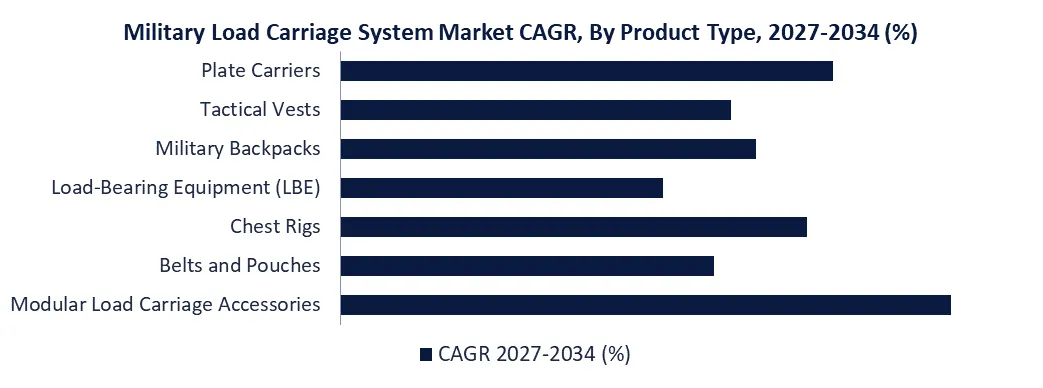
Plate carriers hold about 27% of 2026 value and grow at a 5.8% CAGR as armies adopt lightweight, plate-ready carriers such as the Army's MSV Gen II and the Marine Corps Plate Carrier Gen III. Tactical vests hold 21% (4.6% CAGR) and military backpacks 17% (4.9%). Load-bearing equipment holds 12% with a 3.8% CAGR as legacy fleets age out. Chest rigs hold 9% (5.5%), belts and pouches 8% (4.4%), and modular load carriage accessories 6%, the fastest-growing product type at a 7.2% CAGR from a small base.
Military Load Carriage System Market by Load Carriage Configuration: Integrated, Modular and Standalone Systems
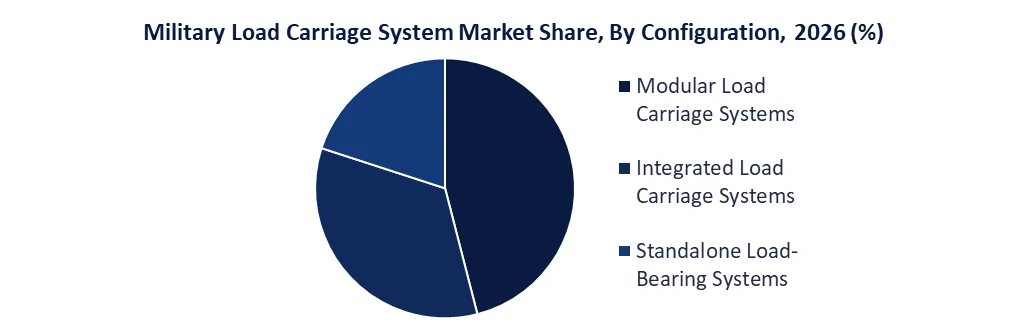
Modular load carriage systems lead with about 46% of 2026 value and a 6.0% CAGR, because a scalable base carrier lets one issue item serve several missions. Integrated load carriage systems hold 34% (5.1% CAGR), typified by vest-plus-protection programs such as the Soldier Protection System. Standalone load-bearing systems hold 20% and grow at 3.9% as modular platforms replace single-purpose kit.
Military Load Carriage System Market by Material Type: Nylon, Polyester, UHMWPE, Aramid Fibers and Other Advanced Materials
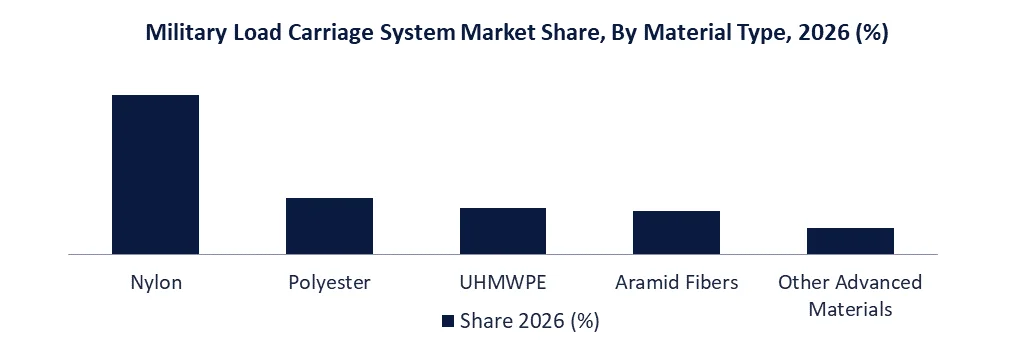
Nylon holds about 48% of 2026 value (4.2% CAGR) because Cordura-type fabrics remain the standard shell for carriers and packs. Polyester holds 17% (4.0%). UHMWPE, the fiber family behind Dyneema and Spectra, holds 14% and grows at 7.4% as armor makers pursue weight cuts, and Avient states that Dyneema UD supports vests up to 20% lighter. Aramid fibers hold 13% (6.1% CAGR), supported by DuPont's Kevlar EXO launch for hard armor in December 2026. Other advanced materials hold 8% and grow fastest at 7.8%.
Military Load Carriage System Market by Load Capacity: Lightweight, Medium-Load and Heavy-Load Systems
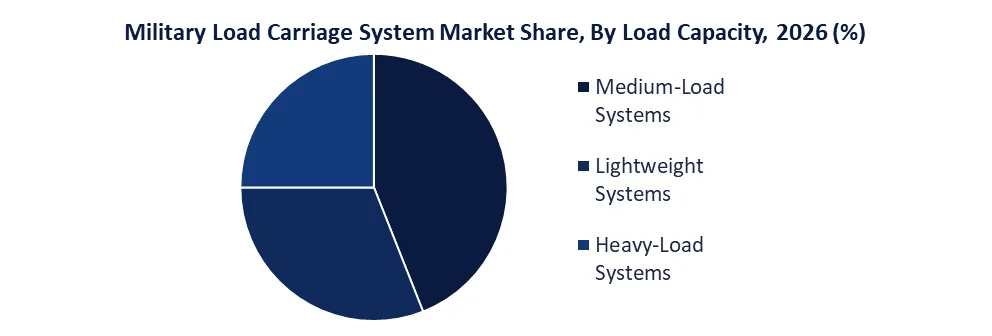
Medium-load systems hold about 44% of 2026 value (5.0% CAGR), covering standard fighting and approach loads. Lightweight systems hold 31% and grow fastest at 6.3%, in line with the Army and Natick focus on reducing combat load. Heavy-load systems hold 25% (4.6% CAGR) for sustainment, weapons-team and long-duration patrol carriage.
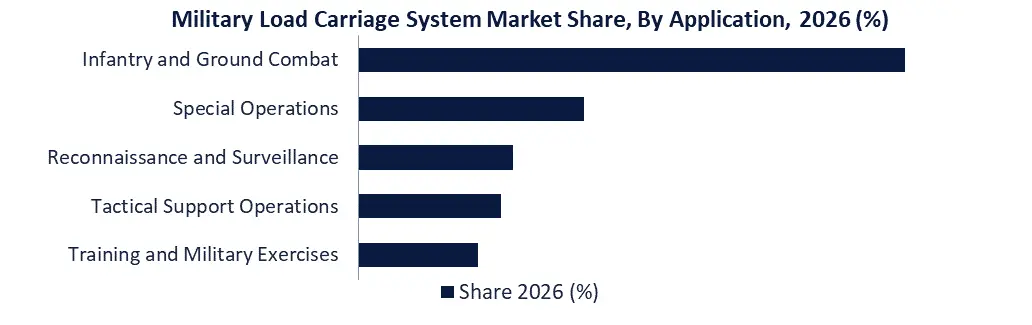
Military Load Carriage System Market by Application: Infantry, Special Operations, Reconnaissance, Tactical Support and Training
Infantry and ground combat leads at about 46% of 2026 value (4.9% CAGR). Special operations holds 19% and is the fastest-growing application at 6.7%, helped by brand-specific purchasing for units such as USASOC and MARSOC. Reconnaissance and surveillance holds 13% (5.9%), tactical support operations 12% (5.2%) and training and military exercises 10% (5.0%).
Military Load Carriage System Market by End User: Army, Navy, Air Force, Special Operations Forces and Other Military Forces
The Army leads at about 54% of 2026 value (5.2% CAGR), reflecting the scale of infantry fleets and programs such as MSV Gen II. Special operations forces hold 14% and grow fastest at 6.8%. Navy and Air Force each hold 11% (5.0% and 4.9% CAGR), and other military forces, including marine and territorial units, hold 10% (5.6%).
Source: SMR estimates, 2026.
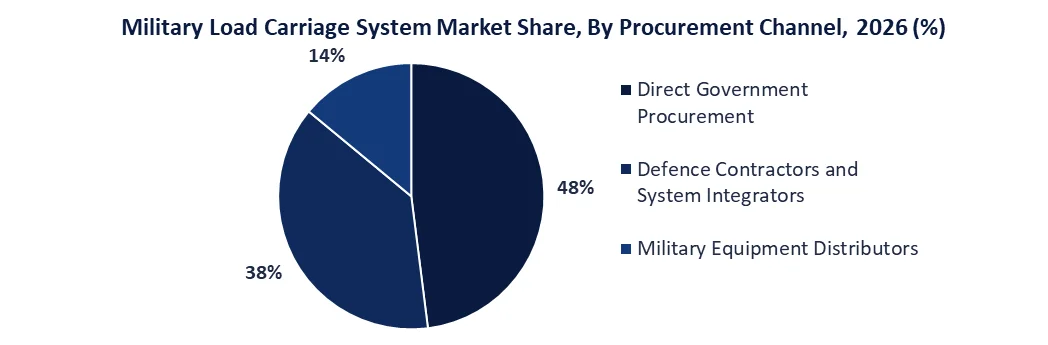
Military Load Carriage System Market by Procurement Channel: Direct Government, Defence Contractors and Distributors
Direct government procurement holds about 48% of 2026 value (4.8% CAGR), through contracts such as Army Contracting Command awards and DLA ordering on Army contracts. Defence contractors and system integrators hold 38% (5.7%), bundling carriers with plates and mission kit. Military equipment distributors hold 14% and grow fastest at 6.4% as smaller forces buy standard carriers off catalog.
Global Military Load Carriage System Market Regional Analysis: North America, Europe, Asia Pacific, Middle East & Africa, Central & South America
North America is the largest region at about 38% of 2026 value (4.9% CAGR), anchored by the U.S. Army's Soldier Protection System, DLA sustainment of the MSV and Marine Corps plate carrier programs. Asia Pacific holds 28% and is the fastest-growing region at 6.7% as armed forces in China, India, Japan, South Korea and Australia modernize infantry equipment. Europe holds 21% (4.8%), with NP Aerospace in the UK and Dyneema production in the Netherlands supporting regional carriers and armor. Middle East & Africa (8%, 6.1%) and Central & South America (5%, 5.2%) grow with defence budgets and border-security programs.
Soldier Load Benchmarks: What U.S. Army Sources Say About Combat Load
Government sources frame the carriage problem. U.S. Army doctrine in FM 21-18 sets a 48-pound fighting load and a 72-pound approach march load, and DTIC-hosted Army research restates the limits as 22 kg and 33 kg, or 30% and 45% of body weight. Natick researchers describe measured loads of about 40 pounds for a fighting load and about 88 pounds for an approach load.
Military Load Carriage System Ecosystem: From Fibers to Fielded Soldier Kit
|
Layer |
What happens |
Examples |
|
1. Fibers and fabrics |
Nylon, polyester, UHMWPE and aramid are produced and woven or laminated |
Avient (Dyneema), DuPont (Kevlar), Honeywell (Spectra) |
|
2. Armor and plate makers |
Soft armor and hard plates are produced to Army and Marine Corps specifications |
Hardwire LLC, Leading Technology Composites, Point Blank Enterprises, NP Aerospace |
|
3. Carrier and pack makers |
Vests, plate carriers, chest rigs, packs, belts and pouches are cut, sewn and assembled |
Crye Precision, Eagle Industries, Mystery Ranch, TYR Tactical, KDH Defense Systems |
|
4. Contracting and distribution |
Governments buy direct, through DLA, or via contractors and distributors |
Army Contracting Command, DLA Troop Support, SourceAmerica |
|
5. Armed forces |
Army, Navy, Air Force and special operations units are issued and sustain the systems |
PEO Soldier, USASOC, MARSOC |
|
6. Government and standards |
Requirements, testing and evaluation |
DOT&E, PM Soldier Protective Equipment, Natick SRDEC |
Military Load Carriage System Companies and Competitive Landscape: Who Supplies the Global Market?
The market combines specialist tactical-gear brands, body-armor producers, plate makers and fiber suppliers. Crye Precision, Eagle Industries, Mystery Ranch, TYR Tactical, S&S Precision, First Spear, London Bridge Trading, Point Blank Enterprises, KDH Defense Systems (Armor Express), Hardwire LLC and Leading Technology Composites appear in U.S. government awards, notices or company releases, while Avient (Dyneema), DuPont (Kevlar) and Honeywell (Spectra) supply the fibers. Competition varies by product: weight, fit, modularity, compatibility with Army and Marine Corps plates, and brand specification decide awards.
Company and government disclosures show how suppliers respond to demand. The Army awarded Hardwire LLC and Leading Technology Composites USD 65.5 million in LSAPI contracts in September 2026. Avient launched next-generation Dyneema UD in October 2023, and DuPont introduced Kevlar EXO for hard armor in December 2026. In 2019 Army Contracting Command awarded SourceAmerica a USD 25.0 million contract to re-purpose legacy vests into the Modular Scalable Vest configuration.
Competitive Strategies in the Military Load Carriage System Market
- Weight leadership: fibers and plates that cut combat load, such as Dyneema UD and LSAPI-class plates.
- Modular platforms: base carriers with swappable front flaps, panels and pouches.
- Integration with government programs: compatibility with MSV Gen II, Plate Carrier Gen III and the Soldier Protection System.
- Domestic manufacturing: the Army highlighted LSAPI as a win for domestic manufacturing.
- Fit-specific design: female-contoured plates and size-inclusive carriers.
Global Military Load Carriage System Market Recent Developments
|
Date |
Development |
Source |
|
24 Sep 2026 |
Army awards USD 65.5 million LSAPI contracts to Hardwire LLC and Leading Technology Composites; plates about 30% lighter than ESAPI Gen III |
PEO Soldier, U.S. Army |
Military Load Carriage System Market Scope: Inquire before buying
|
Global Military Load Carriage System Market Segmentation |
|
|
Report Coverage |
Details |
|
Base Year |
2026 |
|
Historical Data |
2021 to 2026 |
|
Forecast Period |
2027-2034 |
|
Market Size in 2026 |
USD 3.42 Billion |
|
Market Size in 2034 |
USD 5.21 Billion |
|
CAGR (2027-2034) |
5.4% |
|
By Product Type |
Tactical Vests Load-Bearing Equipment (LBE) Plate Carriers Chest Rigs Military Backpacks Belts and Pouches Modular Load Carriage Accessories |
|
By Load Carriage Configuration |
Integrated Load Carriage Systems Modular Load Carriage Systems Standalone Load-Bearing Systems |
|
By Material Type |
Nylon Polyester High-Performance Polyethylene (UHMWPE) Aramid Fibers Other Advanced Materials |
|
By Load Capacity |
Lightweight Systems Medium-Load Systems Heavy-Load Systems |
|
By Application |
Infantry and Ground Combat Special Operations Reconnaissance and Surveillance Tactical Support Operations Training and Military Exercises |
|
By End User |
Army Navy Air Force Special Operations Forces Other Military Forces |
|
By Procurement Channel |
Direct Government Procurement Defence Contractors and System Integrators Military Equipment Distributors |
Global Military Load Carriage System Market, By Region:
- North America (United States, Canada, Mexico, Rest of North America)
- Europe (Germany, France, United Kingdom, Italy, Spain, Russia, Rest of Europe)
- Asia Pacific (China, Japan, South Korea, India, Taiwan, Southeast Asia, Australia, Rest of Asia Pacific)
- Middle East & Africa (Saudi Arabia, United Arab Emirates, South Africa, Rest of Middle East & Africa)
- Central & South America (Brazil, Argentina, Rest of Central & South America)
Military Load Carriage System Market Key Players:
North America
- Crye Precision
- FirstSpear
- Eagle Industries
- Mystery Ranch
- Safariland Group
- Tactical Tailor
- TYR Tactical
- Point Blank Enterprises
- Honeywell International
- L3Harris Technologies
- Atlantic Diving Supply (ADS Inc.)
- Ferro Concepts
- Logistik Unicorp
- Eberlestock
- CamelBak
Europe
- Rheinmetall
- BAE Systems
- Mehler Protection
- NFM Group
- Warrior Assault Systems
- Karrimor SF
- Snugpak
- Protection Group Denmark
- Helikon-Tex
- Berghaus Tactical
Asia-Pacific
- Australian Defence Apparel
- Platatac
- Armasen Tactical
- MEC Gear
- Special Ops India
- KMS
- Steady Flying Enterprise (SFE)
- Sarkar Tactical
Middle East & Africa
- Agilite
- Source Tactical Gear
- Elbit Systems
- Hard Shell
- MS Equipment
South America
- IMBEL
- Taurus Armas
- Combat Armor Defence (CBC Group)
- Inbra Aerospace & Defense
- Indumil
- FAMAE
Frequently Asked Questions
Ans: It is the body-worn equipment that carries a soldier's weapons, ammunition, armor, water and mission kit, including tactical vests, plate carriers, chest rigs, load-bearing equipment, backpacks, belts, pouches and modular accessories. The Army's Soldier Protection System pairs the Modular Scalable Vest with weight distribution equipment.
Ans: U.S. Army doctrine in FM 21-18 sets a 48-pound fighting load and a 72-pound approach march load. Natick researchers describe about 40 pounds for a fighting load and about 88 pounds for an approach load in their studies.
Ans: Plate carriers lead with about 27% of 2026 value (SMR). Modular load carriage accessories are the fastest-growing product type at a 7.2% CAGR.
Ans: In SMR estimates other advanced materials grow at 7.8%, UHMWPE at 7.4% and aramid fibers at 6.1%, ahead of nylon at 4.2%. Avient says Dyneema UD supports soft armor vests up to 20% lighter, and DuPont introduced Kevlar EXO for hard armor in December 2026.
Ans: North America leads with about 38% of 2026 value, while Asia Pacific is the fastest-growing region at a 6.7% CAGR (SMR).
Ans: Through direct government contracts, DLA ordering on Army contracts, defence contractors and system integrators, and distributors. DLA states it has provided 235,200 MSVs on the original Army contract since 2021.
Ans: A plate carrier holds ballistic plates and soft armor and often accepts modular pouches, while a chest rig is a lighter front-mounted pouch system without armor. Army PEO Soldier says LSAPI plates are about 30% lighter than ESAPI Gen III and work with MSV Gen II.
1. Military Load Carriage System Market – Executive Summary & Industry Overview
1.1. Global Military Load Carriage System Market Size and Growth Outlook
1.2. Historical Evolution of Military Load-Bearing Equipment and Systems
1.3. Military Load Carriage Systems Definition, Classification and Operational Scope
1.4. Role of Load Carriage Systems in Soldier Equipment Modernization
1.5. Global Military Load Carriage System Production and Deployment Overview
1.6. Market Growth Assessment and Long-Term Defence Demand Outlook
2. Military Load Carriage System Market Dynamics
2.1. Emerging Trends in Soldier Load Management and Equipment Modernization
2.2. Market Dynamics Analysis
- Drivers
- Restraints
- Opportunities
- Challenges
2.3. Porter's Five Forces Analysis of Military Equipment Suppliers
2.4. PESTLE Analysis of Global Military Load Carriage Procurement
2.5. Defence Modernization Priorities and Tactical Equipment Replacement Cycles
2.6. Military Operational Requirements Influencing Equipment Adoption Decisions
3. Military Load Carriage System Market – Macroeconomic Factors
3.1. Global Defence Expenditure and Military Modernization Budget Allocations
3.2. Infantry Modernization Programs and Soldier Equipment Investment Trends
3.3. International Military Procurement Spending and Defence Contract Allocations
3.4. Military Textile Manufacturing Costs and Advanced Material Pricing
3.5. Geopolitical Conflicts and Cross-Border Defence Equipment Requirements
3.6. Currency Fluctuations and International Military Equipment Trade Dynamics
4. Military Load Carriage System Industry Trends & Technology Developments
4.1. Increasing Demand for Lightweight Soldier Equipment and Mobility
4.2. Integration of Modular Load-Bearing Platforms Across Infantry Units
4.3. Development of Ergonomic Systems for Extended Operational Deployments
4.4. Adoption of Advanced Fabrics for Tactical Equipment Durability
4.5. Integration of Body Armor and Load Distribution Technologies
4.6. Development of Smart Load Carriage and Soldier Integration Systems
5. Military Load Carriage System Technical Specifications & Engineering Landscape
5.1. Structural Design and Configuration of Military Load Carriage Equipment
5.2. Load Distribution Mechanisms and Soldier Weight Management Characteristics
5.3. Ergonomic Design, Adjustability and Human Body Compatibility Requirements
5.4. Equipment Durability Under Extreme Operational and Environmental Conditions
5.5. Attachment Interfaces, Modular Compatibility and Equipment Interoperability Standards
5.6. Performance Testing, Field Validation and Military Qualification Requirements
6. Military Load Carriage System Manufacturing & Material Ecosystem
6.1. Nylon Fabric Selection and High-Tenacity Textile Manufacturing Processes
6.2. Polyester Fabric Applications in Tactical Equipment Construction
6.3. UHMWPE Material Integration and Lightweight Protection Applications
6.4. Aramid Fiber Utilization in Reinforced Military Equipment Components
6.5. Advanced Composite Materials and Specialized Fabric Development
6.6. Material Sourcing, Fabrication Efficiency and Manufacturing Cost Optimization
7. Military Load Carriage System Product Architecture & Configuration Landscape
7.1. Tactical Vest Construction and Integrated Equipment Carrying Arrangements
7.2. Plate Carrier Design and Body Armor Compatibility Requirements
7.3. Load-Bearing Equipment Architecture and Belt-Based Carrying Configurations
7.4. Chest Rig Construction and Mission-Specific Equipment Placement
7.5. Military Backpack Frames and Extended Load-Carrying Capabilities
7.6. Modular Pouches, Belts and Accessory Attachment Systems
8. Military Load Carriage System Load Management & Capacity Landscape
8.1. Lightweight Load Carriage Systems for High-Mobility Operations
8.2. Medium-Load Equipment Configurations for Standard Infantry Missions
8.3. Heavy-Load Systems for Extended Tactical Deployment Requirements
8.4. Weight Distribution Across Torso, Waist and Shoulder Interfaces
8.5. Equipment Carrying Capacity and Mission-Specific Load Allocation
8.6. Soldier Fatigue Management and Load-Bearing Performance Optimization
9. Military Load Carriage System Application & Operational Deployment Landscape
9.1. Infantry Equipment Requirements Across Ground Combat Operations
9.2. Special Operations Load Configurations and Mission-Specific Equipment Requirements
9.3. Reconnaissance Missions and Lightweight Equipment Carrying Arrangements
9.4. Surveillance Operations and Specialized Tactical Equipment Integration
9.5. Tactical Support Missions and Equipment Transportation Requirements
9.6. Military Training Exercises and Field Equipment Utilization Patterns
10. Military Load Carriage System Integration & Soldier Equipment Compatibility
10.1. Integration with Ballistic Protection and Personal Armor Equipment
10.2. Compatibility with Tactical Communication and Radio Carrying Systems
10.3. Weapon Accessory Storage and Ammunition Carrying Configurations
10.4. Hydration Systems Integration and Field Water Transportation Requirements
10.5. Compatibility with Night Vision and Electronic Soldier Equipment
10.6. Interoperability Across Existing Military Personal Equipment Platforms
11. Military Load Carriage System Design Innovation & Ergonomic Development
11.1. Shoulder Strap Engineering and Pressure Distribution Optimization
11.2. Waist Belt Design and Lower Body Load Transfer
11.3. Ventilation Structures and Thermal Comfort Improvement Technologies
11.4. Adjustable Suspension Systems and Individual Soldier Fit Customization
11.5. Quick-Release Mechanisms and Emergency Equipment Detachment Capabilities
11.6. Anthropometric Design Adaptations for Diverse Military Personnel Requirements
12. Military Load Carriage System Quality, Durability & Performance Assessment
12.1. Fabric Tear Resistance and Abrasion Performance Evaluation
12.2. Stitching Strength and Structural Component Reliability Testing
12.3. Environmental Resistance Against Moisture, Heat and Dust
12.4. Load-Bearing Capacity and Long-Duration Stress Testing
12.5. Hardware Corrosion Resistance and Attachment Component Durability
12.6. Military Field Trials and Product Performance Qualification Procedures
13. Military Load Carriage System Safety, Standards & Regulatory Compliance
13.1. Military Equipment Qualification and Defence Procurement Standard Requirements
13.2. Ballistic Protection Compatibility and Personal Equipment Safety Considerations
13.3. Textile Material Compliance and Restricted Substance Testing Requirements
13.4. Operational Safety Standards for Soldier-Carried Equipment Systems
13.5. Equipment Reliability Certification and Military Acceptance Procedures
13.6. Regional Defence Standards and International Compliance Frameworks
14. Military Load Carriage System Research, Development & Product Innovation
14.1. Advanced Lightweight Materials and Next-Generation Equipment Development
14.2. Modular Load Carriage Platform Research and Design Advancements
14.3. Ergonomic Research and Soldier Mobility Improvement Initiatives
14.4. Smart Textiles and Integrated Soldier Equipment Development
14.5. Defence Research Investments and Military Technology Collaborations
14.6. Product Commercialization and Advanced Equipment Portfolio Expansion Strategies
15. Military Load Carriage System Supply Chain & Manufacturing Operations
15.1. Raw Material Procurement and Specialized Textile Supplier Networks
15.2. Fabric Cutting, Stitching and Tactical Equipment Assembly Operations
15.3. Component Sourcing and Modular Equipment Manufacturing Coordination
15.4. Production Capacity and Military Contract Fulfilment Capabilities
15.5. Inventory Management and Defence Equipment Distribution Networks
15.6. Supply Chain Resilience and Strategic Material Sourcing Requirements
16. Military Load Carriage System Pricing, Procurement & Cost Economics
16.1. Product Pricing Across Military Load Carriage Equipment Categories
16.2. Material Costs and Tactical Equipment Manufacturing Economics
16.3. Modular System Pricing and Configuration-Based Cost Variations
16.4. Government Contract Pricing and Defence Procurement Mechanisms
16.5. Lifecycle Costs and Military Equipment Replacement Expenditure
16.6. Cost Competitiveness Across International Military Equipment Manufacturers
17. Military Load Carriage System Distribution & Procurement Landscape
17.1. Direct Government Procurement and Military Contracting Arrangements
17.2. Defence Contractors and System Integrator Procurement Networks
17.3. Military Equipment Distributors and Specialized Supply Channels
17.4. Government Tendering Processes and Defence Supplier Qualification
17.5. Framework Agreements and Long-Term Military Supply Contracts
17.6. International Defence Sales and Cross-Border Equipment Distribution
18. Military Load Carriage System End-User & Defence Requirements Analysis
18.1. Army Infantry Equipment Requirements and Standardization Priorities
18.2. Naval Personnel Equipment and Maritime Operational Carrying Requirements
18.3. Air Force Ground Personnel and Specialized Equipment Requirements
18.4. Special Operations Forces and Mission-Specific Load Configurations
18.5. Other Military Forces and Specialized Tactical Equipment Requirements
18.6. Inter-Service Procurement Requirements and Equipment Standardization Initiatives
19. Military Load Carriage System Adoption & Operational Utilization
19.1. Military Adoption Across Infantry and Specialized Operational Units
19.2. Soldier Equipment Standardization and Platform Replacement Requirements
19.3. Deployment Frequency and Operational Equipment Utilization Patterns
19.4. Procurement Preferences Across Military Organizations and Defence Agencies
19.5. Equipment Interoperability and Existing Platform Replacement Considerations
19.6. Soldier Feedback and Field-Based Product Improvement Requirements
20. Military Load Carriage System Regional & Country-Level Market Landscape
20.1. North American Military Equipment Modernization and Procurement Landscape
20.2. European Infantry Equipment Standardization and Defence Manufacturing Ecosystem
20.3. Asia-Pacific Military Modernization and Tactical Equipment Demand
20.4. Middle East & Africa Defence Procurement and Military Modernization
20.5. South American Military Equipment Manufacturing and Procurement Landscape
20.6. Regional Production Capabilities and International Defence Trade Flows
21. Military Load Carriage System Market Size & Forecast by Segmentation (Value USD Million), 2026–2034
21.1. Military Load Carriage System Market Size and Forecast, By Product Type
- Tactical Vests
- Load-Bearing Equipment (LBE)
- Plate Carriers
- Chest Rigs
- Military Backpacks
- Belts and Pouches
- Modular Load Carriage Accessories
21.2. Military Load Carriage System Market Size and Forecast, By Load Carriage Configuration
- Integrated Load Carriage Systems
- Modular Load Carriage Systems
- Standalone Load-Bearing Systems
21.3. Military Load Carriage System Market Size and Forecast, By Material Type
- Nylon
- Polyester
- High-Performance Polyethylene (UHMWPE)
- Aramid Fibers
- Other Advanced Materials
21.4. Military Load Carriage System Market Size and Forecast, By Load Capacity
- Lightweight Systems
- Medium-Load Systems
- Heavy-Load Systems
21.5. Military Load Carriage System Market Size and Forecast, By Application
- Infantry and Ground Combat
- Special Operations
- Reconnaissance and Surveillance
- Tactical Support Operations
- Training and Military Exercises
21.6. Military Load Carriage System Market Size and Forecast, By End User
- Army
- Navy
- Air Force
- Special Operations Forces
- Other Military Forces
21.7. Military Load Carriage System Market Size and Forecast, By Procurement Channel
- Direct Government Procurement
- Defence Contractors and System Integrators
- Military Equipment Distributors
21.8. Military Load Carriage System Market Size and Forecast, By Region
North America
- United States
- Canada
- Mexico
Europe
- United Kingdom
- Germany
- France
- Italy
- Spain
- Poland
- Rest of Europe
Asia-Pacific
- China
- India
- Japan
- South Korea
- Australia
- Rest of Asia-Pacific
Middle East & Africa
- Israel
- Saudi Arabia
- United Arab Emirates
- Turkey
- South Africa
- Rest of Middle East & Africa
South America
- Brazil
- Colombia
- Chile
- Argentina
- Rest of South America
22. Military Load Carriage System Market Competitive Landscape
22.1. MMR Competition Matrix and Competitive Positioning Assessment
22.2. Competitive Positioning of Leading Military Equipment Manufacturers
22.3. Key Players Benchmarking
- Company Name and Corporate Headquarters
- Military Load Carriage Product Portfolio and Offerings
- Manufacturing Capabilities and Production Capacity
- Material Technologies and Product Engineering Capabilities
- Defence Contracts and Military Customer Relationships
- Geographic Presence and Distribution Network
22.4. Market Structure and Competitive Participant Categorization
- Specialized Tactical Equipment Manufacturers
- Defence and Military Equipment Manufacturers
- Ballistic Protection and Armor System Providers
- Military Textile and Equipment Suppliers
22.5. Company Revenue Growth and Financial Performance Benchmarking
22.6. Manufacturing Capacity and Production Scale Comparison
22.7. Military Contract Portfolio and Defence Customer Benchmarking
22.8. Product Portfolio Breadth and Equipment Configuration Comparison
22.9. Corporate Financial Performance and Business Portfolio Analysis
22.10. Mergers, Acquisitions and Strategic Collaborations
22.11. Recent Product Launches and Military Equipment Developments
23. Military Load Carriage System Manufacturers & Tactical Equipment Specialists
23.1. Tactical Vest and Plate Carrier Manufacturing Company Landscape
23.2. Load-Bearing Equipment and Modular Chest Rig Manufacturers
23.3. Military Backpack and Specialized Load-Carrying Equipment Providers
23.4. Tactical Belt, Pouch and Accessory Manufacturing Companies
23.5. Product Customization and Mission-Specific Equipment Manufacturing Capabilities
23.6. Manufacturing Capacity, Product Availability and Supply Reliability Assessment
24. Military Load Carriage System Materials & Component Supplier Landscape
24.1. High-Tenacity Nylon and Polyester Fabric Supplier Ecosystem
24.2. UHMWPE and Aramid Fiber Material Supplier Landscape
24.3. Tactical Equipment Hardware and Attachment Component Manufacturers
24.4. Specialized Webbing, Buckle and Fastening Component Providers
24.5. Advanced Textile Processing and Material Engineering Capabilities
24.6. Material Quality, Procurement Reliability and Supplier Diversification Assessment
25. Military Load Carriage System Market Manufacturers' Strategies & Expansion Plans
25.1. Expansion of Military Equipment Manufacturing and Production Capabilities
25.2. Development of Lightweight and High-Durability Load Carriage Products
25.3. Modular Equipment Portfolio Expansion and Configuration Customization Initiatives
25.4. Strategic Partnerships with Defence Contractors and Military Organizations
25.5. Expansion into International Defence Procurement and Military Markets
25.6. Investments in Advanced Materials and Product Engineering Technologies
26. Military Load Carriage System Industry SWOT, Investments & Strategic Developments
26.1. Competitive Strengths of Established Tactical Equipment Manufacturers
26.2. Manufacturing Constraints and Military Procurement Market Limitations
26.3. Emerging Opportunities in Infantry Modernization and Soldier Equipment
26.4. Competitive Threats from Alternative Equipment and Material Technologies
26.5. Investments in Modular Platforms and Lightweight Material Development
26.6. Product Launches, Defence Partnerships and Strategic Industry Developments
27. Military Load Carriage System Competitive Outlook & Market Positioning
27.1. Competitive Dynamics Across Military Load Carriage Product Categories
27.2. Market Concentration Across Specialized Tactical Equipment Manufacturers
27.3. Competitive Differentiation Through Material Quality and Ergonomic Design
27.4. Established Defence Suppliers Versus Specialized Tactical Equipment Manufacturers
27.5. Competitive Positioning Across Military End-User and Application Categories
27.6. Future Market Opportunities and Military Procurement Expansion Potential
28. Company Profiles: Key Military Load Carriage System Market Participants
Detailed Company Profile Parameters
- Company Overview and Business Operations
- Military Load Carriage Product Portfolio
- Manufacturing Facilities and Production Capabilities
- Material Technologies and Product Engineering Capabilities
- Defence Contracts and Military Customer Relationships
- Financial Overview and Revenue Performance
- Geographic Presence and Distribution Network
- SWOT Analysis
- Strategic Analysis and Growth Initiatives
- Recent Developments, Partnerships and Expansion Activities
North America
- Crye Precision
- FirstSpear
- Eagle Industries
- Mystery Ranch
- Safariland Group
- Tactical Tailor
- TYR Tactical
- Point Blank Enterprises
- Honeywell International
- L3Harris Technologies
- Atlantic Diving Supply (ADS Inc.)
- Ferro Concepts
- Logistik Unicorp
- Eberlestock
- CamelBak
Europe
- Rheinmetall
- BAE Systems
- Mehler Protection
- NFM Group
- Warrior Assault Systems
- Karrimor SF
- Snugpak
- Protection Group Denmark
- Helikon-Tex
- Berghaus Tactical
Asia-Pacific
- Australian Defence Apparel
- Platatac
- Armasen Tactical
- MEC Gear
- Special Ops India
- KMS
- Steady Flying Enterprise (SFE)
- Sarkar Tactical
Middle East & Africa
- Agilite
- Source Tactical Gear
- Elbit Systems
- Hard Shell
- MS Equipment
South America
- IMBEL
- Taurus Armas
- Combat Armor Defence (CBC Group)
- Inbra Aerospace & Defense
- Indumil
- FAMAE
29. Key Findings
30. Strategic Moves & Industry Outlook
31. Research Methodology