ENG
 Japanese
 French
 German
 Korean

Global Agentic AI Market Size and Forecast
The Global Agentic AI Market size was valued at USD 7.80 billion in 2025, and the total market revenue is expected to grow at a CAGR of 41.62% from 2025 to 2034, reaching USD 178.77 billion by 2034.
Overview:
The Global Agentic AI Market size was valued at USD 7.80 billion in 2025, and the total market revenue is expected to grow at a CAGR of 41.62% from 2025 to 2034, reaching USD 178.77 billion by 2034.
The Global Agentic AI Market encompasses software platforms, development frameworks, orchestration tools, applications, and professional services that enable autonomous AI agents to plan, reason, use tools, make decisions, and execute multi-step tasks with limited human intervention. Unlike conventional rule-based automation and prompt-driven generative AI chatbots, agentic AI systems pursue defined goals, retrieve enterprise knowledge, call external applications through APIs, collaborate with other agents, and adapt their actions based on feedback. The market is shaped by advances in large language models (LLMs), reasoning models, retrieval-augmented generation (RAG), cloud and GPU infrastructure, enterprise software integration, and growing demand for intelligent automation across business functions.
This growth reflects the shift of enterprises from generative AI pilots and copilots towards autonomous AI agents that execute end-to-end workflows in customer service, software engineering, IT operations, finance, sales, procurement, and compliance. Agentic AI solutions include agentic AI platforms, AI agent development frameworks, multi-agent orchestration platforms, agent management, monitoring and governance software, and packaged AI agent applications. Services include consulting, system integration, custom AI agent development, training, and managed agentic AI services. Agent architecture (single-agent, multi-agent, hierarchical, collaborative, and hybrid), level of autonomy (human-assisted to fully autonomous), deployment mode (cloud, on-premises, hybrid, and edge), and integration with enterprise systems such as ERP, CRM, ITSM, and data platforms influence solution selection and total cost of ownership.
The SMR report on the Global Agentic AI Market provides a comprehensive assessment of the rapidly evolving ecosystem of autonomous AI agents, covering agentic AI platforms, development frameworks, multi-agent orchestration solutions, packaged AI applications, agent management and governance software, and associated professional services. The study evaluates market size, historical performance and future growth prospects through 2034, supported by detailed analysis across offering, agent architecture, autonomy level, deployment mode, application, end-use industry, organization size and region. It examines enterprise adoption across customer service, software engineering, IT operations, finance, sales, procurement, healthcare, manufacturing and other business functions. The report further assesses the competitive positioning of foundation model developers, hyperscale cloud providers, enterprise software companies, specialized agentic AI vendors and system integrators through product portfolios, technology capabilities, ecosystem partnerships, financial performance, strategic investments and recent developments. This analysis helps technology providers, enterprise buyers, investors and policymakers evaluate market opportunities, benchmark competitors, understand adoption barriers, and formulate strategies for product development, enterprise integration and geographic expansion.
|
Parameter |
Value |
|
Market Size (2025) |
USD 7.80 Billion |
|
Market Size (2034) |
USD 178.77 Billion |
|
CAGR (2026–2034) |
41.62% |
|
Historical Period |
2020 to 2025 |
|
Forecast Period |
2026 to 2034 |
Global Agentic AI Market Key Highlights
|
Global Agentic AI Market Dynamics:
Rising Enterprise Demand for Autonomous Workflow Automation to Drive Global Agentic AI Market
Enterprises across banking, healthcare, retail, manufacturing, telecommunications, and technology are under pressure to improve productivity, reduce operating costs, and address skilled-labor shortages. Autonomous AI agents can read documents, query databases, trigger transactions, resolve support tickets, generate and test code, and coordinate approvals across applications, allowing organizations to automate processes that previously required human judgment at each step.
Customer service, IT service management, finance operations, procurement, human resources, and software development are among the first functions to scale agentic AI beyond pilot projects. Vendors are embedding agents directly into CRM, ERP, ITSM, HR, and contact center platforms, which shortens deployment time and encourages adoption among existing enterprise software customers.
As organizations measure outcomes such as ticket deflection, cycle-time reduction, and cost per transaction, outcome-based and usage-based pricing models are also emerging, aligning vendor revenue with the productivity delivered by AI agents.
Advances in Foundation Models, Reasoning, and Tool-Use Capabilities to Create Market Opportunities
Improvements in large language models, small language models (SLMs), multimodal models, and reasoning models are expanding the complexity of tasks that AI agents can perform reliably. Longer context windows, structured tool calling, retrieval-augmented generation, persistent memory, and planning capabilities enable agents to operate across enterprise knowledge bases and software environments.
Open-weight models and domain-specific fine-tuned models are lowering inference costs and allowing enterprises to deploy agents in regulated or data-sensitive environments. Model routing and hybrid architectures, in which smaller models handle routine tasks and frontier models handle complex reasoning, are improving cost efficiency and creating opportunities for model providers, platform vendors, and infrastructure companies.
Growth of Multi-Agent Systems, Open Frameworks, and Interoperability Standards
Enterprises are increasingly deploying networks of specialized agents that collaborate under orchestrator agents to complete end-to-end processes such as order-to-cash, procure-to-pay, claims processing, and incident resolution. Multi-agent orchestration platforms provide routing, shared memory, task delegation, monitoring, and failover capabilities required for production-scale deployments.
Open-source agentic AI frameworks, low-code and no-code agent builders, and emerging communication standards such as the Model Context Protocol (MCP) and Agent-to-Agent (A2A) protocols are improving interoperability between tools, data sources, and agents from different vendors. These developments reduce integration effort, support multi-cloud strategies, and reduce vendor lock-in concerns for enterprise buyers.
Increasing Investments in AI Infrastructure, Cloud Platforms, and Enterprise AI Budgets
Hyperscale cloud providers, semiconductor manufacturers, and data center operators are investing heavily in GPU accelerators, high-performance computing, vector databases, and inference infrastructure required to host AI agents at scale. Managed agent runtimes, secure sandboxing, and model-serving platforms are simplifying deployment for enterprises that lack in-house AI engineering capacity.
Corporate digital transformation budgets, venture capital funding for AI-native startups, and national AI strategies in the United States, China, the European Union, India, the Gulf countries, and other regions are further supporting ecosystem development, talent creation, and infrastructure expansion.
Security, Governance, and Regulatory Considerations Influencing Agentic AI Adoption
Because AI agents can access enterprise systems and execute actions, risks such as prompt injection, agent hijacking, excessive permissions, data leakage, hallucinated outputs, and unintended autonomous decisions require strong controls. Enterprises are prioritizing agent identity and authentication, least-privilege tool access, output validation, human-in-the-loop approvals, observability, and audit trails before expanding autonomy.
Regulatory developments such as the European Union AI Act, data protection laws, sector-specific rules in banking and healthcare, and emerging national AI governance frameworks are shaping deployment practices. Vendors offering governance, compliance, and explainability capabilities are better positioned to win regulated-industry customers, while governance and data-sovereignty requirements may moderate the pace of fully autonomous deployments.
Global Agentic AI Market Segment Analysis
The Global Agentic AI Market is segmented into offering, agent architecture, autonomy level, deployment mode, application, end-use industry, organization size, and region. Each segment reflects different technology requirements, deployment models, buyer priorities, and commercial adoption patterns.
By Offering
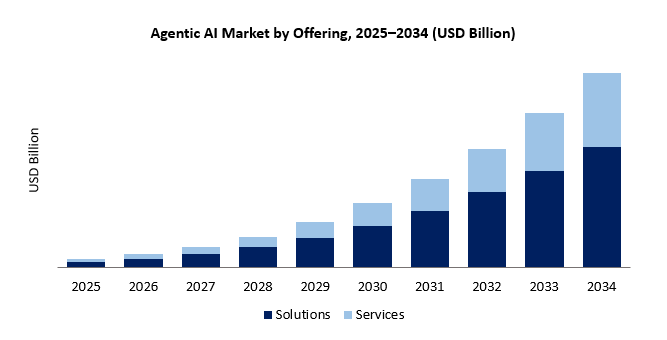
Based on offering, the global market is segmented into solutions and services. Solutions include agentic AI platforms, AI agent development frameworks, AI agent applications and software, multi-agent orchestration platforms, and agent management, monitoring and governance software. Services include consulting and advisory, system integration and implementation, custom AI agent development, training and support, and managed agentic AI services.
The solutions segment is expected to hold the larger share of the market in 2025 owing to rapid commercialization of agent platforms, embedded agents within enterprise applications, and growing demand for orchestration, observability, and governance tools. Platform vendors are bundling model access, tool connectors, memory, evaluation, and security features to simplify enterprise adoption.
The services segment is expected to grow at a faster pace as enterprises require readiness assessments, workflow redesign, integration with legacy systems, model customization, change management, and lifecycle management of production AI agents. System integrators and consulting firms are building dedicated agentic AI practices to meet this demand.
By Autonomy Level
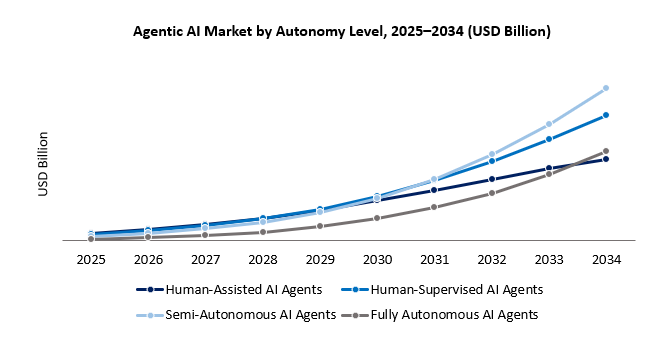
Based on autonomy level, the market is segmented into human-assisted AI agents, human-supervised AI agents, semi-autonomous AI agents, and fully autonomous AI agents.
Human-assisted and human-supervised agents currently dominate enterprise deployments because organizations prefer approval checkpoints for financial, legal, healthcare, and customer-facing actions. As reliability, evaluation methods, and governance frameworks mature, semi-autonomous and fully autonomous agents are expected to gain share, particularly in IT operations, software testing, data processing, and routine back-office workflows.
By Application
Based on application, the market is segmented into customer service and customer experience automation, software development and engineering automation, business process and workflow automation, sales and marketing automation, data analytics and business intelligence, finance and accounting automation, human resources and workplace operations, IT operations and cybersecurity, supply chain and procurement management, research, knowledge management and information retrieval, and other applications.
Customer service and customer experience automation is expected to account for the largest application share, supported by autonomous support agents, voice-based agents, and omnichannel engagement. Software development and engineering automation, including autonomous coding, testing, code review, and DevOps agents, is among the most dynamic segments, while business process automation, finance, and IT operations agents are scaling quickly as enterprises integrate agents with core systems.
Frequently Asked Questions
- Executive Market Landscape and Industry Overview
- Global Agentic AI Market Size (Value USD Billion), 2025–2034
- Evolution of Artificial Intelligence from Rule-Based Systems and Generative AI to Autonomous AI Agents
- Definition, Scope and Core Characteristics of Agentic Artificial Intelligence
- Role of Autonomous AI Agents in Decision-Making, Task Execution and Business Process Automation
- Integration of Large Language Models (LLMs), Machine Learning, Retrieval-Augmented Generation (RAG) and External Tools in Agentic AI Systems
- CAGR Analysis of Global Agentic AI Market During 2025–2034
- Agentic AI Adoption Landscape Across Enterprise and Consumer Environments
- Agentic AI Market Dynamics
- Agentic AI Market Trends
- Agentic AI Market Dynamics
- Drivers
- Restraints
- Opportunities
- Challenges
- PORTER's Five Forces Analysis
- PESTLE Analysis
- Agentic AI Market Macroeconomic Factors
- Global GDP Growth and Enterprise Technology Spending Influencing Agentic AI Adoption
- Corporate Investments in Artificial Intelligence, Cloud Computing and Digital Transformation
- Labor Costs, Workforce Shortages and Demand for Intelligent Automation
- Interest Rates, Venture Capital Funding and Private Investment in AI Startups
- Semiconductor Supply, GPU Availability and Data Center Infrastructure Investments
- Government AI Strategies, National AI Investments and Digital Economy Development
- International Trade Restrictions, Technology Export Controls and AI Infrastructure Supply Chains
- Agentic AI Industry Trends & Emerging Technology Requirements
- Transition from Generative AI Chatbots to Autonomous Goal-Oriented AI Agents
- Increasing Adoption of Multi-Agent Systems and Collaborative AI Agent Networks
- Growth of Enterprise AI Copilots and Autonomous Workflow Execution
- Integration of Agentic AI with Enterprise Resource Planning (ERP), Customer Relationship Management (CRM) and Business Applications
- Development of Open-Source Agentic AI Frameworks and Low-Code/No-Code Agent Development Platforms
- Increasing Adoption of AI Agents for Software Engineering, IT Operations and Autonomous Coding
- Growing Importance of AI Agent Security, Governance, Explainability and Human Oversight
- Agentic AI Technology Architecture & Ecosystem Landscape
- Large Language Models (LLMs), Small Language Models (SLMs) and Foundation Models as Agent Reasoning Engines
- AI Agent Planning, Reasoning, Memory and Context Management Architectures
- Tool Calling, API Integration and External System Connectivity
- Retrieval-Augmented Generation (RAG), Vector Databases and Enterprise Knowledge Integration
- Multi-Agent Orchestration, Communication Protocols and Collaborative Execution Frameworks
- Agent Runtime Environments, Sandboxing, Execution Monitoring and Deployment Infrastructure
- Model Context Protocol (MCP), Agent-to-Agent (A2A) Communication and Interoperability Standards
- AI Agent Types, Functional Capabilities & Autonomy Levels
- Reactive AI Agents and Rule-Based Task Execution Systems
- Goal-Based AI Agents and Autonomous Planning Systems
- Utility-Based AI Agents and Decision Optimization Systems
- Learning-Based AI Agents and Adaptive Decision-Making Systems
- Single-Agent Systems and Independent Task Execution Models
- Multi-Agent Systems and Collaborative Autonomous Workflows
- Human-in-the-Loop, Human-on-the-Loop and Fully Autonomous Agent Models
- Agentic AI Development Platforms & Frameworks
- Enterprise Agent Development Platforms and AI Application Builders
- Open-Source Agentic AI Frameworks and Developer Toolkits
- Multi-Agent Orchestration and Workflow Management Platforms
- Low-Code and No-Code AI Agent Development Platforms
- Agent Memory, Knowledge Retrieval and Context Management Tools
- Agent Testing, Evaluation, Observability and Performance Monitoring Platforms
- AI Agent Integration with Enterprise Software and Third-Party Applications
- Foundation Models, Reasoning Engines & AI Model Providers
- Proprietary Large Language Models for Autonomous AI Agent Development
- Open-Weight and Open-Source Foundation Models for Agentic Applications
- Reasoning Models and Advanced Inference Capabilities
- Multimodal Foundation Models Supporting Text, Image, Audio and Video-Based Agent Interactions
- Domain-Specific and Industry-Tuned Models for Enterprise AI Agents
- Model Fine-Tuning, Quantization and Optimization for Agent Deployment
- Model Selection, Routing and Hybrid Model Architectures
- Agentic AI Infrastructure, Cloud & Computing Ecosystem
- Cloud-Based Agentic AI Infrastructure and Managed AI Services
- GPU Accelerators, AI Chips and High-Performance Computing Infrastructure
- Data Centers, Distributed Computing and AI Model Hosting Infrastructure
- Vector Databases, Knowledge Graphs and Enterprise Data Infrastructure
- Edge AI Infrastructure and On-Device Autonomous Agent Deployment
- AI Inference Optimization, Model Serving and Computational Cost Management
- Agent Runtime Infrastructure, Containerization and Secure Execution Environments
- Agentic AI Software Development & Engineering Applications
- Autonomous Software Coding and Code Generation Agents
- AI-Based Software Testing, Debugging and Quality Assurance Agents
- Autonomous Code Review, Documentation and Software Maintenance
- AI Agents for Application Development and DevOps Automation
- Autonomous IT Operations, Infrastructure Monitoring and Incident Resolution
- AI-Powered Cybersecurity Operations and Threat Detection Agents
- Software Engineering Multi-Agent Systems and Autonomous Development Workflows
- Agentic AI in Enterprise Business Process Automation
- Autonomous Enterprise Workflow Management and Process Orchestration
- AI Agents for Finance, Accounting and Financial Reporting Automation
- Procurement Automation, Supplier Management and Purchase Order Processing
- Human Resources, Recruitment and Employee Support AI Agents
- Legal Research, Contract Review and Compliance Automation Agents
- Document Processing, Data Extraction and Knowledge Management Agents
- Cross-Functional Enterprise AI Agents for End-to-End Business Process Execution
- Agentic AI in Customer Experience, Sales & Marketing
- Autonomous Customer Service and Conversational AI Agents
- AI-Powered Sales Prospecting, Lead Qualification and Pipeline Management
- Personalized Marketing Campaign Management and Customer Segmentation Agents
- Customer Relationship Management (CRM) Automation and Intelligent Sales Assistants
- AI Agents for Customer Retention, Churn Prediction and Engagement Optimization
- Omnichannel Customer Support and Voice-Based AI Agents
- Autonomous E-Commerce Recommendations, Order Management and Customer Assistance
- Agentic AI in Financial Services & Banking
- Autonomous Financial Research and Investment Analysis Agents
- AI Agents for Banking Operations and Customer Account Management
- Fraud Detection, Transaction Monitoring and Financial Crime Prevention
- Credit Assessment, Risk Evaluation and Loan Processing Automation
- Insurance Underwriting, Claims Processing and Policy Management Agents
- Regulatory Compliance, Know Your Customer (KYC) and Anti-Money Laundering (AML) Automation
- Algorithmic Trading Support and Autonomous Financial Decision Systems
- Agentic AI in Healthcare & Life Sciences
- Clinical Workflow Automation and Healthcare Administrative AI Agents
- AI Agents for Medical Research and Drug Discovery
- Clinical Decision Support and Patient Management Agents
- Medical Documentation, Electronic Health Record (EHR) and Data Management Automation
- Pharmaceutical Research, Laboratory Automation and Clinical Trial Management
- Healthcare Supply Chain and Hospital Resource Management Agents
- Medical Imaging Analysis and Multimodal Clinical AI Applications
- Agentic AI in Manufacturing, Industrial Operations & Supply Chain
- Autonomous Manufacturing Workflow Management and Production Planning Agents
- Predictive Maintenance and Industrial Equipment Monitoring Agents
- AI-Based Quality Control, Defect Detection and Production Optimization
- Intelligent Supply Chain Planning and Inventory Management Agents
- Procurement, Logistics and Warehouse Automation Agents
- Industrial Robotics Integration and Autonomous Operational Decision-Making
- Digital Twin Integration and AI-Driven Industrial Process Optimization
- Agentic AI in Retail, E-Commerce & Consumer Services
- Autonomous Shopping Assistants and Personalized Product Discovery Agents
- AI Agents for E-Commerce Operations and Marketplace Management
- Dynamic Pricing, Demand Forecasting and Inventory Optimization
- Retail Customer Service and Omnichannel Engagement Agents
- Automated Merchandising, Product Catalog Management and Recommendation Systems
- Autonomous Order Processing, Returns and Post-Purchase Support
- Agentic AI in Telecommunications, Media & Technology
- Autonomous Network Operations and Network Performance Optimization Agents
- AI Agents for Telecom Customer Support and Service Management
- Intelligent Network Fault Detection and Incident Resolution
- Media Content Creation, Personalization and Distribution Agents
- Advertising Optimization and Audience Intelligence Agents
- AI-Driven IT Service Management and Technology Support Automation
- Agentic AI in Transportation, Logistics & Mobility
- Autonomous Fleet Management and Transportation Planning Agents
- AI Agents for Logistics Coordination and Shipment Tracking
- Route Optimization, Traffic Management and Delivery Scheduling
- Warehouse Robotics and Autonomous Material Handling
- Intelligent Mobility Platforms and Autonomous Vehicle Support Systems
- Predictive Maintenance and Transportation Asset Management
- Agentic AI Security, Governance & Risk Management
- AI Agent Identity, Authentication and Access Control Management
- Data Privacy, Confidentiality and Sensitive Information Protection
- Prompt Injection, Agent Hijacking and Adversarial Attack Prevention
- AI Agent Permission Management, Tool Access and Execution Controls
- AI Governance, Regulatory Compliance and Responsible AI Frameworks
- Model Hallucinations, Autonomous Decision Risks and Output Validation
- Human Oversight, Audit Trails and AI Agent Accountability Mechanisms
- Agentic AI Integration, Deployment & Implementation Services
- Enterprise AI Agent Strategy, Consulting and Readiness Assessment
- Custom AI Agent Development and Application Engineering Services
- Enterprise System Integration and API Connectivity Services
- Agentic AI Deployment, Configuration and Workflow Implementation
- AI Model Customization, Fine-Tuning and Knowledge Base Integration
- AI Agent Testing, Validation, Monitoring and Lifecycle Management
- Employee Training, Change Management and Enterprise Adoption Support
- Agentic AI Pricing, Monetization & Cost Economics
- Subscription-Based Pricing Models for Agentic AI Platforms
- Usage-Based Pricing Based on Tokens, API Calls and Computational Consumption
- Per-Agent, Per-User and Enterprise Licensing Models
- Outcome-Based and Performance-Linked AI Agent Pricing Models
- Infrastructure, Model Inference and AI Computing Cost Structures
- Custom Development, Integration and Managed AI Services Pricing
- Total Cost of Ownership (TCO), Return on Investment (ROI) and Productivity Benefits
- Agentic AI Procurement, Enterprise Adoption & Vendor Selection
- Enterprise Procurement Strategies for Agentic AI Platforms and Solutions
- Build-versus-Buy Decisions for In-House and Third-Party AI Agent Development
- Vendor Selection Criteria and Platform Evaluation Frameworks
- Data Security, Compliance and Integration Requirements in Enterprise Procurement
- Proof-of-Concept (PoC), Pilot Deployment and Enterprise-Wide Implementation
- Service-Level Agreements, Licensing and Commercial Contract Structures
- Vendor Lock-In, Model Portability and Multi-Cloud AI Strategies
- Agentic AI Implementation, Productivity & Business Performance
- Enterprise Adoption Readiness and AI Agent Deployment Maturity
- Reduction in Manual Workloads and Improvement in Employee Productivity
- Autonomous Task Completion Rates and Workflow Efficiency
- AI Agent Accuracy, Reliability and Decision-Making Performance
- Operational Cost Reduction and Enterprise Return on Investment
- Human-Agent Collaboration and Workforce Transformation
- Enterprise AI Agent Performance Benchmarking and Continuous Optimization
- Agentic AI Demand by Industry & Enterprise Function
- IT and Software Development
- Banking, Financial Services and Insurance (BFSI)
- Healthcare and Life Sciences
- Manufacturing and Industrial Operations
- Retail and E-Commerce
- Telecommunications and Media
- Transportation and Logistics
- Energy, Utilities and Natural Resources
- Government, Public Administration and Defense
- Education and Research
- Professional Services, Legal and Consulting
- Other Industry Verticals
- Agentic AI Demand by Customer Type & Enterprise Size
- Large Enterprises and Multinational Corporations
- Medium-Sized Enterprises
- Small Businesses and Startups
- Government Organizations and Public Sector Institutions
- Technology Companies and AI-Native Businesses
- Research Institutions, Universities and Innovation Centers
- Individual Developers and Independent AI Agent Creators
- Agentic AI Regional & Country-Level Market Landscape
- North American Agentic AI Adoption, Investments and Enterprise Deployment
- European Agentic AI Market Development, Regulatory Environment and Enterprise Applications
- Asia-Pacific Agentic AI Growth, Technology Investments and Government AI Initiatives
- Middle East & Africa Agentic AI Adoption, Digital Transformation and AI Infrastructure Development
- South American Agentic AI Adoption, Enterprise Automation and Emerging Technology Investments
- United States, Canada, United Kingdom, Germany, France, China, Japan, South Korea, India, Australia, UAE, Saudi Arabia and Brazil
- Regional AI Regulations, Data Sovereignty, Infrastructure Availability and Enterprise Adoption Barriers
- Agentic AI Market: Market Size and Forecast by Segmentation (Value USD Billion) (2025–2034)
- Agentic AI Market Size and Forecast, By Offering
- Solutions
- Agentic AI Platforms
- AI Agent Development Frameworks
- AI Agent Applications and Software
- Multi-Agent Orchestration Platforms
- Agent Management, Monitoring and Governance Software
- Services
- Consulting and Advisory Services
- System Integration and Implementation Services
- Custom AI Agent Development Services
- Training and Support Services
- Managed Agentic AI Services
- Solutions
- Agentic AI Market Size and Forecast, By Agent Architecture
- Single-Agent Systems
- Multi-Agent Systems
- Hierarchical Agent Systems
- Collaborative and Distributed Agent Systems
- Hybrid Agent Architectures
- Agentic AI Market Size and Forecast, By Autonomy Level
- Human-Assisted AI Agents
- Human-Supervised AI Agents
- Semi-Autonomous AI Agents
- Fully Autonomous AI Agents
- Agentic AI Market Size and Forecast, By Deployment Mode
- Cloud-Based
- On-Premises
- Hybrid Deployment
- Edge-Based Deployment
- Agentic AI Market Size and Forecast, By Application
- Customer Service and Customer Experience Automation
- Software Development and Engineering Automation
- Business Process and Workflow Automation
- Sales and Marketing Automation
- Data Analytics and Business Intelligence
- Finance and Accounting Automation
- Human Resources and Workplace Operations
- IT Operations and Cybersecurity
- Supply Chain and Procurement Management
- Research, Knowledge Management and Information Retrieval
- Other Applications
- Agentic AI Market Size and Forecast, By End-Use Industry
- Information Technology and Software
- Banking, Financial Services and Insurance (BFSI)
- Healthcare and Life Sciences
- Retail and E-Commerce
- Manufacturing and Industrial Operations
- Telecommunications and Media
- Transportation and Logistics
- Energy and Utilities
- Government and Public Sector
- Education and Research
- Professional Services and Consulting
- Others
- Agentic AI Market Size and Forecast, By Organization Size
- Large Enterprises
- Small and Medium-Sized Enterprises (SMEs)
- Startups and AI-Native Companies
- Agentic AI Market Size and Forecast, By Region
- North America
- United States
- Canada
- Mexico
- Europe
- Germany
- United Kingdom
- France
- Italy
- Spain
- Netherlands
- Switzerland
- Sweden
- Finland
- Norway
- Denmark
- Poland
- Rest of Europe
- Asia Pacific
- China
- Japan
- South Korea
- India
- Australia
- Singapore
- Indonesia
- Malaysia
- Thailand
- Vietnam
- Taiwan
- Philippines
- Rest of Asia Pacific
- Middle East and Africa
- Saudi Arabia
- United Arab Emirates
- Israel
- Turkey
- South Africa
- Egypt
- Qatar
- Rest of Middle East and Africa
- South America
- Brazil
- Argentina
- Chile
- Colombia
- Rest of South America
- North America
- Agentic AI Market Size and Forecast, By Offering
- Agentic AI Competitive Landscape
- SMR Competition Matrix
- Competitive Positioning of Leading Key Players [Revenue and Market Share (%)]
- Key Players Benchmarking
- Company Name
- Headquarters
- Agentic AI Product and Platform Portfolio
- Foundation Model and AI Technology Integration
- Agent Development and Orchestration Capabilities
- Enterprise Integration and Ecosystem Partnerships
- Customer Base and Industry Presence
- Total Company Revenue (2025)
- Agentic AI-Related Revenue (2025, where separately identifiable or estimated)
- Research and Development Investments
- Geographic Presence
- Strategic Partnerships and Technology Alliances
- Market Structure
- Market Leaders
- Market Followers
- Emerging Players
- Specialized Agentic AI Providers
- Growth Rate / Y-o-Y (%) of Companies
- Profit Margin (%) of Companies
- R&D Investments (%) of Companies
- Revenue Vs. Net Earnings – Financial Health Benchmarking (2025)
- Revenue Performance and Financial Analysis (2025)
- Mergers and Acquisitions Details
- Recent Key Developments
- Foundation Model Providers & AI Technology Ecosystem
- Proprietary Foundation Model Providers and Frontier AI Companies
- Open-Source and Open-Weight AI Model Developers
- Advanced Reasoning Models and Multimodal AI Technology Providers
- Enterprise LLM Hosting, Fine-Tuning and Model Customization Platforms
- Model Inference, Routing and Optimization Technology Providers
- Foundation Model Performance, Scalability and Enterprise Readiness Benchmarking
- Agentic AI Platforms, Frameworks & Orchestration Providers
- Enterprise Agent Development and Deployment Platform Providers
- Open-Source Agentic AI Framework Developers
- Multi-Agent Collaboration and Orchestration Platform Providers
- Low-Code and No-Code AI Agent Development Providers
- Agent Memory, Knowledge Retrieval and Context Management Providers
- Agent Evaluation, Observability, Monitoring and Governance Providers
- Enterprise Software & Application-Based Agentic AI Providers
- Enterprise Resource Planning and Business Application AI Agent Providers
- Customer Relationship Management and Sales Automation Agent Providers
- IT Service Management and Autonomous IT Operations Providers
- Robotic Process Automation and Intelligent Workflow Automation Providers
- HR, Finance, Procurement and Enterprise Productivity Agent Providers
- Customer Experience, Conversational AI and Contact Center Agent Providers
- Agentic AI Infrastructure, Cloud & Semiconductor Providers
- Hyperscale Cloud and Managed AI Infrastructure Providers
- GPU Accelerators and AI Semiconductor Manufacturers
- AI Data Center and High-Performance Computing Infrastructure Providers
- Vector Database, Data Management and Knowledge Graph Providers
- AI Model Serving, Inference and Deployment Infrastructure Providers
- Edge AI and Distributed Computing Technology Providers
- Agentic AI Consulting, System Integration & Implementation Services Providers
- Global IT Consulting and Digital Transformation Service Providers
- Enterprise AI Strategy, Advisory and Readiness Assessment Providers
- Custom AI Agent Development and Application Engineering Companies
- Enterprise System Integration and Workflow Implementation Providers
- Managed AI Services and AI Agent Lifecycle Management Providers
- Industry-Specific Agentic AI Implementation and Transformation Specialists
- Agentic AI Provider Strategies & Expansion Plans
- Development of Proprietary Agentic AI Platforms and Enterprise Solutions
- Expansion of Multi-Agent Systems and Autonomous Workflow Capabilities
- Strategic Investments in Foundation Models and AI Computing Infrastructure
- Geographic Expansion Across Established and Emerging AI Markets
- Partnerships with Cloud Providers, Enterprise Software Companies and AI Startups
- Acquisitions, Joint Ventures and Strategic Technology Collaborations
- Agentic AI Industry SWOT, Investments & Strategic Developments
- Competitive Strengths of Established AI Technology and Enterprise Platform Providers
- Technology Limitations, Reliability Concerns and Implementation Barriers
- Emerging Opportunities in Autonomous Enterprise Operations and Industry-Specific AI Agents
- Competitive Threats from Open-Source Frameworks and New AI-Native Entrants
- Venture Capital Investments, Strategic Funding and AI Startup Developments
- Investments in Foundation Models, Agentic AI Research and Computing Infrastructure
- AI Governance, Regulatory Developments and Enterprise Security Initiatives
- Agentic AI Competitive Outlook & Market Positioning
- Competitive Dynamics Across Foundation Models, Agent Platforms and Enterprise Applications
- Market Concentration and Competitive Fragmentation Across the Agentic AI Ecosystem
- Growth of Integrated Enterprise Agent Platforms and Multi-Agent Ecosystems
- Technology Differentiation Through Reasoning, Memory, Autonomy and Orchestration Capabilities
- Transition from Subscription-Based Software to Usage-Based and Outcome-Based AI Monetization
- Competitive Positioning of Hyperscalers, Enterprise Software Providers and AI-Native Companies
- Future Market Opportunities and Competitive Positioning of Leading Agentic AI Providers
- Company Profile: 60+ Key Players
- Detailed Profile Considering the Parameters:
- Overview
- Business Portfolio
- Agentic AI Product and Platform Portfolio
- Technology Capabilities
- Financial Overview
- Strategic Analysis
- SWOT Analysis
- Recent Developments
- Detailed Profile Considering the Parameters:
North America
- Microsoft Corporation
- OpenAI, Inc.
- Anthropic PBC
- Amazon Web Services, Inc. (AWS)
- Google LLC (Google Cloud / Google DeepMind)
- NVIDIA Corporation
- International Business Machines Corporation (IBM)
- Salesforce, Inc.
- ServiceNow, Inc.
- Oracle Corporation
- Meta Platforms, Inc.
- Palantir Technologies Inc.
- Databricks, Inc.
- Snowflake Inc.
- LangChain, Inc.
- CrewAI, Inc.
- Cognition AI, Inc. (Devin)
- Glean Technologies, Inc.
- Sierra AI, Inc.
- UiPath Inc.
- Automation Anywhere, Inc.
- Pegasystems Inc.
- C3.ai, Inc.
- Dataiku, Inc.
- DataRobot, Inc.
- Kore.ai, Inc.
- Moveworks, Inc.
- Relevance AI
- WRITER, Inc.
- Harvey AI
- Perplexity AI, Inc.
- Adobe Inc.
- Workday, Inc.
- HubSpot, Inc.
- Zapier, Inc.
- Cloudflare, Inc.
- MongoDB, Inc.
- Neo4j, Inc.
- n8n GmbH (North American operations)
- LlamaIndex, Inc.
Europe
-
- SAP SE (Germany)
- Mistral AI (France)
- Aleph Alpha GmbH (Germany)
- Accenture plc (Ireland)
- Capgemini SE (France)
- Siemens AG (Germany)
- Celonis SE (Germany)
- DeepL SE (Germany)
- Dust (France)
- PolyAI Limited (United Kingdom)
- Synthesia Limited (United Kingdom)
- ABB Ltd. (Switzerland)
- UiPath (European-founded operations)
Asia Pacific
- Alibaba Group Holding Limited (China)
- Baidu, Inc. (China)
- Tencent Holdings Limited (China)
- ByteDance Ltd. (China)
- Huawei Technologies Co., Ltd. (China)
- NAVER Corporation (South Korea)
- Kakao Corporation (South Korea)
- Samsung SDS Co., Ltd. (South Korea)
- Fujitsu Limited (Japan)
- NEC Corporation (Japan)
- SoftBank Group Corp. (Japan)
- Infosys Limited (India)
- Tata Consultancy Services Limited (India)
- Wipro Limited (India)
- HCL Technologies Limited (India)
- Tech Mahindra Limited (India)
- Persistent Systems Limited (India)
Middle East & Africa
-
- G42 (United Arab Emirates)
- Presight AI Holding PLC (United Arab Emirates)
- AIQ (United Arab Emirates)
South America
- Globant S.A. (Argentina)
- Stefanini Group (Brazil)
- Key Findings
- Strategic Moves & Industry Outlook
- Research Methodology