ENG
 Japanese
 French
 German
 Korean

AI-Based Crop Disease Detection Software Market Size, Share, Growth & Forecast 2026–2034
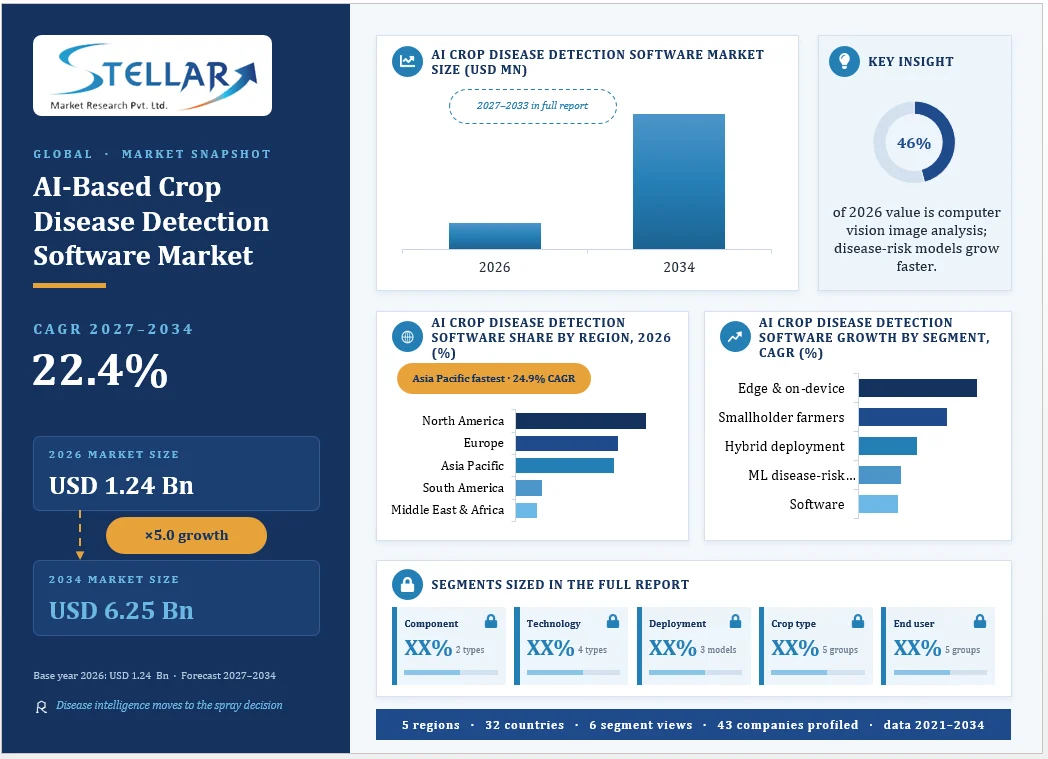
The AI-Based Crop Disease Detection Software Market is valued at USD 1.24 billion in 2026 and is expected to reach USD 6.25 billion by 2034, representing a compound annual growth rate (CAGR) of 22.4% from 2027 to 2034.
AI-Based Crop Disease Detection Software Market Overview
The AI-Based Crop Disease Detection Software Market is valued at USD 1.24 billion in 2026 and is expected to reach USD 6.25 billion by 2034, representing a compound annual growth rate (CAGR) of 22.4% from 2027 to 2034. This market synopsis covers AI crop disease detection platforms and related services. These solutions use artificial intelligence (AI) to diagnose, predict, and map plant diseases from multiple sources: smartphone images, drone and satellite imagery, weather feeds, and in-field sensors.
Crop disease remains one of the costliest and least predictable risks in agriculture. Growers continue to lose yield to infections that are detected late, misdiagnosed, or managed through fixed, calendar-based fungicide programs. AI-powered plant disease detection software addresses this gap by turning field observations into three outputs: an early diagnosis, a severity score, and a recommended action. This often takes seconds, and the software frequently flags an infection before symptoms are visible to the naked eye. For growers and agronomists, early detection protects yield, reduces unnecessary spray passes, and supports more defensible crop protection decisions.
The commercial focus of the market is moving away from stand-alone diagnostic apps. Disease intelligence is increasingly built into farm management software, ag-retailer service programmes and crop protection portfolios. Crop protection majors, agricultural machinery manufacturers and specialist AgTech start-ups now compete to own the spray decision: whether, when and where a grower applies treatment. As a result, accurate disease-risk models have become a core competitive asset across the digital agriculture value chain.
North America holds the largest regional market share in 2026, at about 34.5% of global value. Large-acreage row-crop operations and a dense ag-retail distribution network support this lead. Asia Pacific is the fastest-growing region, with a CAGR of about 24.9%. Growth there comes from smartphone-led crop disease diagnosis spreading among smallholder farmers and from the digitalisation of public agricultural extension programmes.
To get more Insights: Request Free Sample Report
AI-Based Crop Disease Detection Software Market Growth Catalyst: Rising Fungicide Costs and Climate-Driven Disease Volatility
Higher fungicide spend, tighter residue limits and growing resistance are pushing growers away from preventive, calendar-based spraying. AI disease-risk models combine localised weather data, field history and hybrid disease tolerance. With them, agronomists can time fungicide applications to actual infection risk, protecting yield while cutting unnecessary spray passes. Corteva's AI-driven Fungicide Timing tool is used on more than four million acres in the United States in 2026. It shows how quickly crop disease decision tools move from pilot to scale once growers see a measurable return on investment.
Climate variability is a second growth catalyst. Warmer, wetter, and more erratic seasons change when and where fungal, bacterial, and viral outbreaks occur, so historical spray calendars become less reliable. AI crop disease detection software recalculates disease pressure continuously. That gives growers, cooperatives, and crop insurers a sound, data-backed basis for deciding when to intervene.
AI-Based Crop Disease Detection Software Market Restraint: Model Accuracy Gaps and Fragmented Field Data
Plant disease detection models often score well on laboratory datasets but lose accuracy in the field. Variable lighting, leaf orientation, mixed infections, and nutrient stress can all confuse image classifiers. Model training is slowed by a shortage of labelled images for regional crop varieties and less common diseases. Farm data is also fragmented and proprietary, which makes it hard to validate models across platforms. Together, these constraints lengthen sales cycles, particularly among risk-averse commercial growers.
AI-Based Crop Disease Detection Software Market Opportunity: Pre-Symptomatic Detection and Bundled Agronomic Services
Pre-symptomatic crop disease detection is the most valuable white space in the market. Airborne spore traps, plant biosignal sensors, hyperspectral imaging, and molecular early-warning systems now feed AI models. These models flag infections days or even weeks before visible lesions appear. Vendors that combine these signals with image-based diagnosis can move up the value chain, from simple disease identification to outcome-based agronomic advisory contracts.
Bundling is a second opportunity. Crop protection companies and agricultural retailers increasingly package AI crop scouting with input programmes and conservation services. One example is Syngenta's expanded partnership with Taranis for Midwest retailers in 2026. These bundles make adoption easier for growers and give software providers access to established distribution networks.
AI-Based Crop Disease Detection Software Market Challenges: Connectivity, Data Ownership and Proof of Return
Poor rural connectivity limits real-time cloud-based disease detection across much of Africa, South Asia, and parts of South America. This raises demand for offline, on-device AI models, but it also raises development costs. Concerns over data ownership also slow adoption among large growers and cooperatives, especially over who controls field-level imagery and disease records.
Growers expect clear proof of return before they commit to per-hectare software subscriptions. Vendors that cannot show avoided yield loss or fungicide savings at field level often lose customers after the first season. That makes independent agronomic validation a competitive necessity rather than a marketing add-on.
AI-Based Crop Disease Detection Software Market Trends: Foundation Models, Generative Agronomy Assistants and Edge AI
Three technology trends are shaping product roadmaps:
- Multimodal foundation models. These models are trained on millions of crop images and work more reliably across crops and growing regions.
- Generative AI agronomy assistants. These assistants turn disease detections into prioritised recommendations in plain language. For example, Taranis' Ag Assistant converts leaf-level drone imagery into severity scores and suggested interventions.
- Edge AI. Disease diagnosis can now run on smartphones, drones, and sprayers without a continuous network connection, which widens access in low-connectivity farming regions.
AI-Based Crop Disease Detection Software Market Revenue Pool and Margin Structure Assessment
The market earns revenue in four main ways:
- Per-hectare or per-acre subscriptions
- Enterprise and application programming interface (API) licences
- Freemium mobile apps that make money through input sales
- Service fees for crop scouting, image capture and agronomic interpretation
Software licences have the highest gross margins. Services take more labour, but they hold long-term customer relationships in place. They also produce the labelled field data that keeps disease detection models accurate.
AI-Based Crop Disease Detection Software Market Segment Analysis: Segment Attractiveness
AI-Based Crop Disease Detection Software Market by Technology: Computer Vision and Deep Learning Image Analysis Holds the Largest Market Share
By technology, the market splits into four segments:
- Computer vision and deep learning image analysis
- Machine learning predictive disease-risk modelling
- Multispectral and hyperspectral remote-sensing analytics
- Others, including spore, biosignal and Internet of Things (IoT) sensor analytics
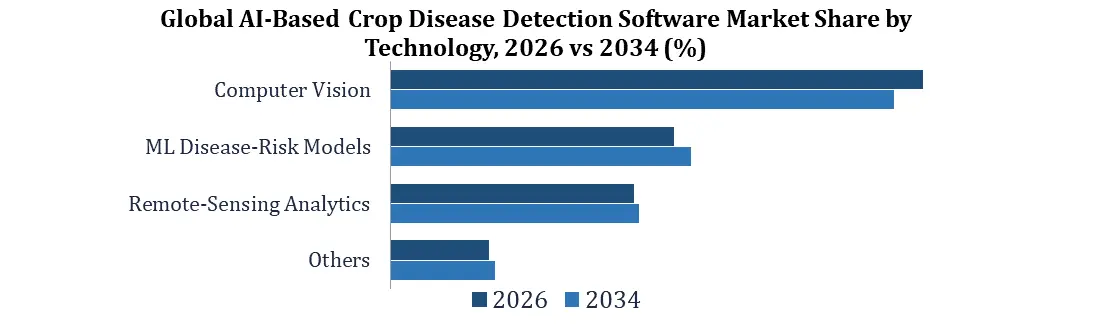
Computer vision and deep learning image analysis holds the largest share in 2026, at about 46.0% of market value. Smartphone and drone image diagnosis is still the easiest starting point for growers and crop advisers.
Machine learning predictive disease-risk modelling grows faster than image analysis, at a CAGR of about 23.3% during 2027–2034. Growers increasingly value deciding when to spray over identifying a disease after it has appeared. Remote-sensing analytics is gaining ground in large-acreage cereals and oilseeds. In these crops, satellite and drone imagery highlights stress zones and directs scouts to the right part of the field.
AI-Based Crop Disease Detection Software Market by Crop Type: Cereals and Grains Lead, While Fruits and Vegetables Gain Market Share
By crop type, the AI-Based Crop Disease Detection Software Market is segmented into cereals and grains, fruits and vegetables, oilseeds and pulses, commercial and plantation crops, and others. Cereals and grains hold the largest market share, at about 34.0% of the 2026 value. Extensive corn, wheat and rice acreage supports this position, along with well-documented foliar diseases that suit AI crop disease detection and disease-risk prediction models.
Fruits and vegetables account for about XX% of 2026 value and generate the highest revenue per hectare of any crop group. Vineyards, orchards and protected horticulture carry high crop value and face constant disease pressure, so growers in these segments have a strong commercial case for early plant disease detection software and precision crop protection tools.
AI-Based Crop Disease Detection Software Market by Deployment: Cloud-Based Platforms Dominate, While Edge and On-Device Deployment Grows Fastest
Cloud-based deployment holds about 61.0% of the AI-Based Crop Disease Detection Software Market in 2026, driven by the strong position of cloud-hosted farm management software and crop imagery analytics platforms. Edge and on-device deployment is the fastest-growing model, at a CAGR of about XX% during 2027–2034, as offline smartphone diagnosis apps and sprayer-mounted AI models spread across low-connectivity farming regions where cloud access is limited or unreliable.
Hybrid deployment accounts for about XX% of 2026 value. This model suits agribusinesses and large farming enterprises that run crop disease detection locally in the field while synchronising records to the cloud for reporting, traceability and agronomic analysis.
AI-Based Crop Disease Detection Software Market by End User: Large Commercial Farms Lead, While Smallholder Adoption Accelerates
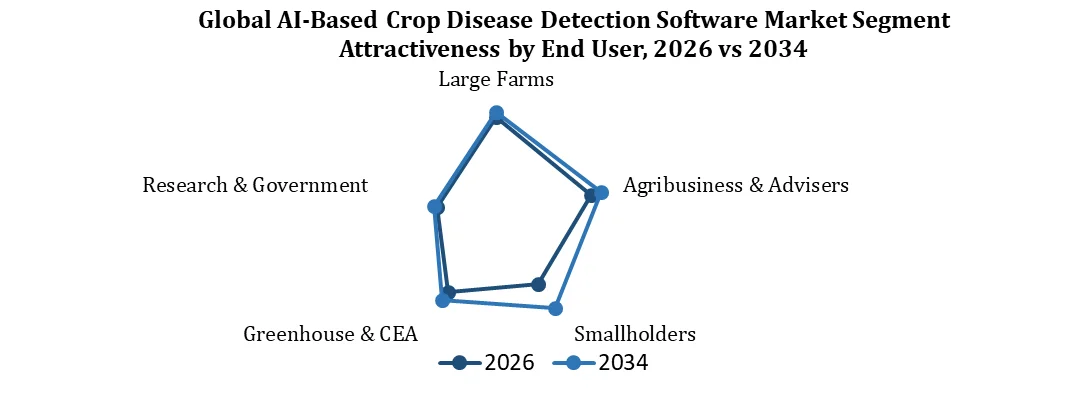
Large commercial farms hold the largest end-user share of the AI-Based Crop Disease Detection Software Market, at about 37.5% of 2026 value, followed by agribusinesses, cooperatives and agronomy service providers at about 27.0%. These buyers have the acreage, budgets and agronomic teams to turn AI crop scouting insights into measurable yield protection and fungicide savings.
Smallholder and mid-size farmers form the fastest-growing end-user group, at a CAGR of about XX% during 2027–2034. Free and low-cost mobile crop disease diagnosis apps now reach these farmers through agricultural extension services, input retailers, and telecom partnerships. Greenhouse and controlled-environment agriculture (CEA) operators, together with research institutes and government agencies, complete the end-user segment.
AI-Based Crop Disease Detection Software Market by Component: Software Commands the Majority of Revenue
Software is the core revenue engine of the AI-Based Crop Disease Detection Software Market, accounting for about 68.5% of 2026 value and expanding at a CAGR of about XX% during 2027–2034. Services hold the remaining XX% and include system integration, AI model customisation, crop scouting and agronomic advisory support. The software share keeps rising over the forecast period because recurring platform subscriptions and application programming interface (API) licences scale far more efficiently than labour-intensive field services.
AI-Based Crop Disease Detection Software Market Regional Insights: Regional Market Share
North America leads the global AI-Based Crop Disease Detection Software Market with about 34.5% of 2026 value, anchored by the United States. Large-acreage corn, soybean, and specialty crop operations, a mature ag-retail distribution channel, and strong AgTech venture funding drive early and sustained adoption of AI crop scouting and disease prediction tools. Europe follows with about XX%of the market, supported by pesticide reduction targets, integrated pest management (IPM) obligations, and high-value viticulture and horticulture.
Asia Pacific accounts for about XX% of 2026 value and is the fastest-growing regional market, at a CAGR of about XX%during 2027–2034, reaching broad parity with North America by 2034. India, China, Indonesia and Australia lead this growth through smartphone-based plant disease diagnosis for smallholder farmers, government-backed digital agriculture missions and airborne spore-monitoring networks. South America holds about XX%of the market and grows at a CAGR of about XX%, driven by AI-led soybean rust and sugarcane disease management in Brazil and Argentina. The Middle East and Africa, at about XX%, expands through mobile crop advisory services and protected agriculture investment.
At country level, the United States, Germany, France, China, India and Brazil generate the bulk of demand for AI-based crop disease detection software. Kenya, South Africa, Israel and the United Arab Emirates (UAE) serve as innovation and pilot hubs, testing new solutions for smallholder crop diagnosis, greenhouse disease monitoring and date palm health.
AI-Based Crop Disease Detection Software Market Competitive Landscape: Crop Protection Majors and AI Specialists Compete for the Spray Decision
The AI-Based Crop Disease Detection Software Market brings together four groups of competitors: diversified crop protection and seed companies, agricultural machinery manufacturers, cloud and technology providers, and a broad base of specialist AI developers. Bayer, BASF, Syngenta and Corteva build disease detection models into their digital farming platforms to strengthen their crop protection and seed portfolios. Deere & Company and Trimble link disease detection directly to precision machine execution in the field. Specialist players such as Taranis, Plantix, Fermata, Agrio and Semios compete on diagnostic accuracy, crop and disease coverage and speed of detection.
Competitor benchmarking shows that strategic partnerships, more than acquisitions, shape the current phase of market development. AI software providers seek wider distribution through ag retailers and crop input companies, while established agribusinesses partner with specialists to add proven disease models to their platforms. The SMR competition matrix in the full report benchmarks 43 key players on technology approach, crop and disease coverage, geographic reach, and partnership depth.
AI-Based Crop Disease Detection Software Market: Key Developments and Strategic Moves, 2026
-
January 2026 – Taranis: Partnered with Apex Ag Solutions to bring leaf-level, AI-powered crop intelligence, including disease detection, to Arkansas growers through the retailer’s field technology service.
- February 2026 – Bayer and Deere & Company: Announced deeper integration between Climate FieldView and John Deere Operations Center, allowing U.S. farmers and advisers to export FieldView scripts directly to equipment as Work Plans for the 2026 season.
- March 2026 – Corteva (Pioneer): Launched an AI-powered Granular Insights Fungicide Timing tool for corn, combining localised weather, field conditions and hybrid disease tolerance to identify optimal fungicide application windows.
- April 2026 – Deere & Company: Revealed plans for See & Scout, a scouting capability built on its See & Spray precision technology, extending machine vision from targeted spraying to field monitoring.
- May 2026 – AGR: Launched an early crop disease detection system that identifies afflictions more than a week earlier than traditional methods, reporting 99% accuracy in trials.
- August 2026 – HELM and Parijat Industries: Announced a strategic collaboration with Plantix covering digital commerce and crop advisory, extending AI-based diagnosis to agricultural retailers through the Plantix Partner platform in India.
- October 2026 – Solinftec: Expanded commercial availability of its autonomous Solix field robot, which monitors crops and applies targeted treatments, and called for a shift towards permanently deployed physical AI in the field.
- November 2026 – InnerPlant: Reported expansion of its CropVoice disease monitoring service across more soybean acres in 2026, with a move into corn planned for 2027.
AI-Based Crop Disease Detection Software Market Scope: Inquire before buying
|
Report Coverage |
Details |
||
|
Base Year: |
2026 |
Forecast Period: |
2027–2034 |
|
Historical Data: |
2021–2026 |
Market Size in 2026: |
USD 1.24Billion |
|
Forecast Period 2027–2034 CAGR: |
22.4% |
Market Size in 2034: |
USD 6.25 Billion |
|
AI-Based Crop Disease Detection Software Market Segments Covered: |
By Component |
Software |
|
|
By Technology |
Computer Vision and Deep Learning Image Analysis |
||
|
By Deployment |
Cloud-Based |
||
|
By Crop Type |
Cereals and Grains |
||
|
By End User |
Large Commercial Farms |
||
AI-Based Crop Disease Detection Software Market, by Region
- North America (United States, Canada and Mexico)
- Europe (Germany, France, United Kingdom, Spain, Italy, Netherlands, Poland and Rest of Europe)
- Asia Pacific (China, India, Japan, Australia, Indonesia, South Korea, Vietnam and Rest of Asia Pacific)
- Middle East and Africa (Israel, South Africa, Saudi Arabia, UAE, Egypt, Kenya, Nigeria and Rest of Middle East and Africa)
- South America (Brazil, Argentina, Colombia, Chile and Rest of South America)
AI-Based Crop Disease Detection Software Market Key Players
1. Deere & Company (United States)
2. Corteva, Inc. – Granular (United States)
3. Trimble Inc. (United States)
4. IBM Corporation (United States)
5. Microsoft Corporation (United States)
6. Taranis (United States)
7. InnerPlant, Inc. (United States)
8. Agtrinsic (United States)
9. ScanIt Technologies (United States)
10. Ceres Imaging (United States)
11. Sentera, Inc. (United States)
12. Intelinair, Inc. (United States)
13. Arable Labs, Inc. (United States)
14. Semios Technologies Inc. (Canada)
15. Farmers Edge Inc. (Canada)
16. Bayer AG – Climate FieldView (Germany)
17. BASF SE – xarvio Digital Farming Solutions (Germany)
18. Syngenta Group – Cropwise (Switzerland)
19. CNH Industrial N.V. (United Kingdom)
20. PEAT GmbH – Plantix (Germany)
21. Pheno-Inspect GmbH (Germany)
22. hexafarms GmbH (Germany)
23. EFOS d.o.o. – Trapview (Slovenia)
24. Agremo (Serbia)
25. Atfield Technologies (Serbia)
26. Pessl Instruments GmbH – METOS (Austria)
27. Agricolus S.r.l. (Italy)
28. Gamaya SA (Switzerland)
29. Vivent Biosignals SA (Switzerland)
30. Hummingbird Technologies – an Agreena company (United Kingdom)
31. Doktar (Türkiye)
32. Fermata (Israel)
33. Saillog Ltd. – Agrio (Israel)
34. SeeTree Systems Ltd. (Israel)
35. AgroScout Ltd. (Israel)
36. Prospera Technologies – a Valmont company (Israel)
37. CropX Technologies Ltd. (Israel)
38. Aerobotics (South Africa)
39. Cropin Technology Solutions Pvt. Ltd. (India)
40. Kissan AI (India)
41. BioScout Pty Ltd. (Australia)
42. Solinftec (Brazil)
43. Agrosmart (Brazil)
Frequently Asked Questions
Ans. The market is projected to reach USD 6.25 billion by 2034, growing at a CAGR of 22.4% during the 2027–2034 forecast period.
Ans. The report covers the market by component, technology, deployment, crop type, end user, and region, with market size and forecast data for 2026–2034 and historical data for 2021–2026.
Ans. North America holds the largest share in 2026, at about 34.5% of global value, while Asia Pacific records the fastest growth during 2027–2034.
Ans. Computer vision and deep learning image analysis leads the technology segment, accounting for about 46.0% of 2026 value, while machine learning predictive disease-risk modelling grows faster.
Ans. Edge and on-device deployment grows the fastest, at a CAGR of about 25.6% during 2027–2034, as offline smartphone and machine-mounted models spread across low-connectivity farming regions.
Ans. Rising fungicide costs and resistance, climate-driven disease volatility, pesticide reduction policies and the bundling of AI scouting with crop protection and ag-retail programmes are the key growth catalysts.
Ans. Key players include Bayer, BASF (xarvio), Syngenta (Cropwise), Corteva (Granular), Deere & Company, Trimble, Taranis, Plantix, Fermata, Agrio, Semios, Solinftec and Cropin, among 43 companies profiled in the report.
1. Executive Market Landscape and Industry Overview
1.1. Global AI-Based Crop Disease Detection Software Market Size (Value USD Billion), 2026–2034
1.2. Market Definition, Scope and Classification of AI-Based Crop Disease Detection Software
1.3. Historical Assessment During 2021–2026 and Forecast Framework for 2027–2034
1.4. Industry Structure, Value Chain and Revenue Models
1.5. Role of AI Disease Detection in Yield Protection, Input Efficiency and Sustainability Compliance
1.6. CAGR Analysis of the Global AI-Based Crop Disease Detection Software Market During 2027–2034
2. AI-Based Crop Disease Detection Software Market Dynamics
2.1. AI-Based Crop Disease Detection Software Market Trends
2.2. AI-Based Crop Disease Detection Software Market Dynamics
2.2.1. Growth Catalysts
2.2.2. Restraints
2.2.3. Opportunities
2.2.4. Challenges
2.3. Porter’s Five Forces Analysis
2.4. Political, Economic, Social, Technological, Legal and Environmental (PESTLE) Analysis
2.5. Market Gap and Unmet Needs
3. AI-Based Crop Disease Detection Software Market Macroeconomic, Agronomic and Policy Factors
3.1. Crop Losses from Plant Diseases and Food Security Pressure
3.2. Fungicide Costs, Resistance Management and Residue Limits
3.3. Climate Variability and Shifting Disease Pressure
3.4. Rural Connectivity and Smartphone Penetration
3.5. Public Funding, Extension Digitalisation and Research Grants
3.6. Agricultural Data Ownership and Privacy Rules
4. AI-Based Crop Disease Detection Technology Landscape
4.1. Convolutional Neural Networks (CNNs) and Vision Transformers for Leaf-Level Diagnosis
4.2. Foundation Models and Multimodal Disease Intelligence
4.3. Weather-Driven Disease-Risk and Spray-Timing Models
4.4. Drone, Satellite and Hyperspectral Imaging Analytics
4.5. Airborne Spore, Plant Biosignal and Internet of Things (IoT) Sensor Analytics
4.6. Edge AI, Offline Inference and On-Device Models
4.7. Generative AI Agronomy Assistants
5. Data, Model Training and Validation Ecosystem
5.1. Crop Image Libraries, Annotation and Labelling
5.2. Ground-Truthing with Agronomists and Diagnostic Laboratories
5.3. Model Accuracy, Bias and Domain Adaptation
5.4. Data Partnerships with Input Suppliers, Retailers and Research Bodies
6. AI-Based Crop Disease Detection Software Market Value Chain and Business Ecosystem
6.1. Imaging Hardware, Drone and Sensor Providers
6.2. Cloud and AI Infrastructure Providers
6.3. Disease Detection Software Developers
6.4. Farm Management Information System (FMIS) Platforms
6.5. Crop Protection Companies, Ag Retailers and Distributors
6.6. Growers, Cooperatives and Agronomy Advisers
7. AI-Based Crop Disease Detection Software Market Pricing, Cost Structure and Business Models
7.1. Per-Hectare and Per-Acre Subscription Pricing
7.2. Freemium and Commerce-Linked Mobile Models
7.3. Enterprise and Application Programming Interface (API) Licensing
7.4. Bundled Offerings with Crop Protection Inputs and Retail Services
7.5. Return on Investment (ROI) Analysis for Growers
8. Regulatory, Standards and Data Governance Framework
8.1. Plant Health and Quarantine Regulations
8.2. Pesticide Reduction and Integrated Pest Management (IPM) Policies
8.3. AI Governance and Algorithm Transparency Requirements
8.4. Drone Operation Rules for Crop Imaging
8.5. Agricultural Data Sharing Codes and Standards
9. AI-Based Crop Disease Detection Software Market Capital Flow and Investment Trends
9.1. Venture Capital and Corporate Venture Funding
9.2. Mergers, Acquisitions and Strategic Partnerships
9.3. Public Research Programmes and Grants
9.4. R&D Investment by Crop Protection and Machinery Majors
10. AI-Based Crop Disease Detection Software Market: Market Size and Forecast by Segmentation (Value USD Billion ), 2026–2034
10.1. AI-Based Crop Disease Detection Software Market Size and Forecast, By Component
10.1.1. Software
10.1.2. Services
10.2. AI-Based Crop Disease Detection Software Market Size and Forecast, By Technology
10.2.1. Computer Vision and Deep Learning Image Analysis
10.2.2. Machine Learning Predictive Disease-Risk Modelling
10.2.3. Multispectral and Hyperspectral Remote-Sensing Analytics
10.2.4. Others (Spore, Biosignal and IoT Sensor Analytics)
10.3. AI-Based Crop Disease Detection Software Market Size and Forecast, By Deployment
10.3.1. Cloud-Based
10.3.2. Hybrid
10.3.3. Edge and On-Device
10.4. AI-Based Crop Disease Detection Software Market Size and Forecast, By Crop Type
10.4.1. Cereals and Grains
10.4.2. Fruits and Vegetables
10.4.3. Oilseeds and Pulses
10.4.4. Commercial and Plantation Crops
10.4.5. Others
10.5. AI-Based Crop Disease Detection Software Market Size and Forecast, By End User
10.5.1. Large Commercial Farms
10.5.2. Agribusinesses, Cooperatives and Agronomy Service Providers
10.5.3. Smallholder and Mid-Size Farmers
10.5.4. Greenhouse and Controlled-Environment Agriculture (CEA) Operators
10.5.5. Research Institutes and Government Agencies
10.6. AI-Based Crop Disease Detection Software Market Size and Forecast, By Region
10.6.1. North America
10.6.1.1. United States
10.6.1.2. Canada
10.6.1.3. Mexico
10.6.2. Europe
10.6.2.1. Germany
10.6.2.2. France
10.6.2.3. United Kingdom
10.6.2.4. Spain
10.6.2.5. Italy
10.6.2.6. Netherlands
10.6.2.7. Poland
10.6.2.8. Rest of Europe
10.6.3. Asia Pacific
10.6.3.1. China
10.6.3.2. India
10.6.3.3. Japan
10.6.3.4. Australia
10.6.3.5. Indonesia
10.6.3.6. South Korea
10.6.3.7. Vietnam
10.6.3.8. Rest of Asia Pacific
10.6.4. Middle East and Africa
10.6.4.1. Israel
10.6.4.2. South Africa
10.6.4.3. Saudi Arabia
10.6.4.4. UAE
10.6.4.5. Egypt
10.6.4.6. Kenya
10.6.4.7. Nigeria
10.6.4.8. Rest of Middle East and Africa
10.6.5. South America
10.6.5.1. Brazil
10.6.5.2. Argentina
10.6.5.3. Colombia
10.6.5.4. Chile
10.6.5.5. Rest of South America
Note: Country-level estimates include historical data for 2021–2026 and forecasts for 2027–2034.
11. AI-Based Crop Disease Detection Software Market Competitive Landscape
11.1. SMR Competition Matrix
11.2. Competitive Positioning of Key Players [AI-Based Crop Disease Detection Software Market Revenue and Market Share (%)]
11.3. Key Players Benchmarking
11.3.1. Company Name
11.3.2. Platform and Product Portfolio
11.3.3. Crops and Diseases Covered
11.3.4. Technology Approach and Deployment Model
11.3.5. Geographic Presence
11.3.6. Key Partnerships and Distribution Channels
11.3.7. Revenue, 2026
11.4. Market Structure
11.4.1. Market Leaders
11.4.2. Market Followers
11.4.3. Emerging Players
11.5. Mergers, Acquisitions and Partnership Details
12. AI-Based Crop Disease Detection Software Market Strategic Developments, SWOT and Investment Outlook
12.1. Product Launches and Platform Upgrades, 2026
12.2. Partnerships, Funding and Commercial Roll-Outs, 2026
12.3. Strengths, Weaknesses, Opportunities and Threats (SWOT) Analysis
12.4. Investment Attractiveness by Segment
13. Company Profiles: 43 Key Players
Detailed Profile Considering the Parameters:
1. Overview
2. Business Portfolio
3. AI Disease Detection Platform Portfolio
4. Crops, Diseases and Technologies Covered
5. Deployment and Integration Capabilities
6. Financial Overview
7. Geographic Presence and Distribution Partnerships
8. SWOT Analysis
9. Strategic Analysis
10. Recent Developments
North America
1. Deere & Company (United States)
2. Corteva, Inc. – Granular (United States)
3. Trimble Inc. (United States)
4. IBM Corporation (United States)
5. Microsoft Corporation (United States)
6. Taranis (United States)
7. InnerPlant, Inc. (United States)
8. Agtrinsic (United States)
9. ScanIt Technologies (United States)
10. Ceres Imaging (United States)
11. Sentera, Inc. (United States)
12. Intelinair, Inc. (United States)
13. Arable Labs, Inc. (United States)
14. Semios Technologies Inc. (Canada)
15. Farmers Edge Inc. (Canada)
Europe
16. Bayer AG – Climate FieldView (Germany)
17. BASF SE – xarvio Digital Farming Solutions (Germany)
18. Syngenta Group – Cropwise (Switzerland)
19. CNH Industrial N.V. (United Kingdom)
20. PEAT GmbH – Plantix (Germany)
21. Pheno-Inspect GmbH (Germany)
22. hexafarms GmbH (Germany)
23. EFOS d.o.o. – Trapview (Slovenia)
24. Agremo (Serbia)
25. Atfield Technologies (Serbia)
26. Pessl Instruments GmbH – METOS (Austria)
27. Agricolus S.r.l. (Italy)
28. Gamaya SA (Switzerland)
29. Vivent Biosignals SA (Switzerland)
30. Hummingbird Technologies – an Agreena company (United Kingdom)
31. Doktar (Türkiye)
Middle East and Africa
32. Fermata (Israel)
33. Saillog Ltd. – Agrio (Israel)
34. SeeTree Systems Ltd. (Israel)
35. AgroScout Ltd. (Israel)
36. Prospera Technologies – a Valmont company (Israel)
37. CropX Technologies Ltd. (Israel)
38. Aerobotics (South Africa)
Asia Pacific
39. Cropin Technology Solutions Pvt. Ltd. (India)
40. Kissan AI (India)
41. BioScout Pty Ltd. (Australia)
South America
42. Solinftec (Brazil)
43. Agrosmart (Brazil)
Others
14. Key Findings
14.1. AI-Based Crop Disease Detection Software Market Size, Growth and Revenue Opportunities
14.2. Leading Technologies, Crop Types and End-User Segments
14.3. Regional Market Leadership and Growth Pockets
14.4. Competitive Intensity and Partnership Patterns
15. Strategic Recommendations and Industry Outlook
15.1. Strategic Opportunities in Pre-Symptomatic Disease Detection
15.2. Go-to-Market Options through Retailers, Cooperatives and Input Bundles
15.3. Edge AI and Offline Deployment Priorities
15.4. Outlook for 2027–2034