ENG
 Japanese
 French
 German
 Korean

Middle East and Africa Neem Based Fertilizer Market Size, Share, Trends and Forecast (2026–2034)
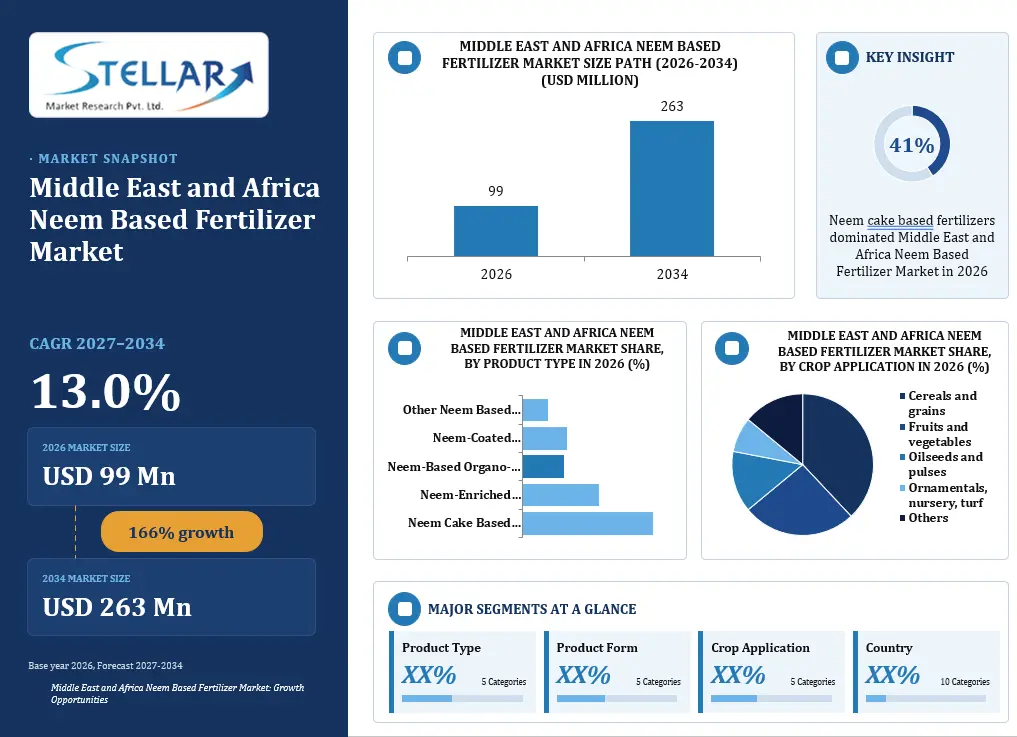
The Middle East and Africa Neem Based Fertilizer Market was USD 99 Million in 2026 and is projected to reach USD 263 Million by 2034, growing at a CAGR of 13.0% during 2027–2034. In terms of volume, the Global Middle East and Africa Neem Based Fertilizer Market Size was valued at XX Metric Tons in 2026 and is expected to reach XX Metric Tons by 2034, growing at a CAGR of XX% during 2026–2034.
The Middle East and Africa Neem Based Fertilizer Market was USD 99 Million in 2026 and is projected to reach USD 263 Million by 2034, growing at a CAGR of 13.0% during 2027–2034. In terms of volume, the Global Middle East and Africa Neem Based Fertilizer Market Size was valued at XX Metric Tons in 2026 and is expected to reach XX Metric Tons by 2034, growing at a CAGR of XX% during 2026–2034.
Market definition and scope: The Middle East and Africa Neem Based Fertilizer Market covers fertilizers and soil amendments sold in the Middle East and Africa whose nutrient value comes from neem seed, kernel, cake or meal. Included are neem cake and neem seed meal fertilizers, neem-enriched organic fertilizers, neem-based organo-mineral fertilizers, neem-coated mineral fertilizers (including neem-coated urea) and other neem-based formulations.
Study scope and coverage: The study period is 2021–2034, with 2026 as the base year, 2021–2026 as historical data and 2027–2034 as the forecast period; the CAGR is calculated for 2027–2034.The analysis segments the market by product type, product form, crop application, end user, distribution channel and country across South Africa, Nigeria, Kenya, Egypt, Saudi Arabia, United Arab Emirates, Ghana, Ethiopia, Turkey and Rest of Middle East and Africa.
The report is for neem seed processors and cooperatives, organic and bio-fertilizer producers, blenders, agro-dealers and distributors, greenhouse and landscaping suppliers, growers, development agencies and investors who need a view of Middle East and Africa demand, supply and competition through 2034. The 2024 Nairobi Declaration commits African leaders to triple certified fertilizer production by 2034 and to reach 70% of smallholders with soil-health advice, while Gulf states support protected agriculture under national strategies. Neem based fertilizers remain a small, fragmented segment, sold mainly through local producers, agro-dealers, specialty distributors and export channels.
To get more Insights: Request Free Sample Report
Key Findings: Insights Shaping the Middle East and Africa Neem Based Fertilizer Market
The Middle East and Africa Neem Based Fertilizer Market demand is driven by low synthetic fertilizer use, soil fertility programs, expanding organic and export horticulture, and the availability of neem seed close to farms in West Africa. Consumption is expected to increase across cereals, vegetables, fruit, date palm and protected cultivation through 2034. Supply remains fragmented, with local neem seed processors, farmer groups and Gulf biofertilizer producers serving different customer groups. Revenue generation is supported by smallholder organic input programs, greenhouse and landscaping demand in the Gulf, and export-oriented specialty crops. Value creation opportunities emerge through certified local production, aggregation of neem seed supply, neem-enriched organic blends and partnerships with agro-dealer networks.
1. Africa’s leaders committed to fertilizer and soil health in 2024. The Nairobi Declaration, endorsed on May 9, 2024, comes with a 10-year action plan and commitments that include tripling production of certified fertilizers by 2034, and it covers both organic and inorganic products.
2. Fertilizer use is below target in most countries. More than 40 African countries fall below the 50 kilograms per hectare target, which leaves room for organic inputs where mineral fertilizer is costly.
3. Neem seed is a local feedstock in West Africa. In Ghana, 581 women in three cooperatives supply neem seeds to agribusinesses, and Kingsworth Farms in Accra uses neem seeds for organic fertilizers and pesticides.
4. Growing Organic Fertilizer Demand in GCC Countries: Expanding greenhouse cultivation, sustainable agriculture, soil fertility improvement, and government food security initiatives create growth opportunities for neem based fertilizers across GCC countries.
Middle East and Africa Neem Basd Fertilizer Market Trends
1. Continental Policy Push on Soil Health: The Nairobi Declaration and its 10-year plan put fertilizer access and soil health on the agenda of African governments, and the African Union Commission reported in February 2026 that regional hubs had launched in West and Southern Africa. Debate at the summit noted a strong focus on mineral fertilizers, which leaves space for organic and blended products.
2. Local Neem Value Chains Are Forming: Seed cooperatives in Ghana, women’s groups in Nigeria and farm companies in Accra show how neem seed turns into oil, pesticide and cake fertilizer close to the farm.
3. Blended Organic Fertilizers with Neem: Farmers Hope in Ghana produced an organic fertilizer from poultry droppings and neem seeds, reaching 4,000 farmers and pricing the product at about half of competing products by its own account.
4. Protected Agriculture in the Gulf: Greenhouse vegetable and date palm programs in Saudi Arabia and the UAE are replacing part of their synthetic inputs with organic and microbial inputs under national sustainability policies.
5. Input Price Shocks Raise Interest in Alternatives: Yara’s chief executive said in May 2026 that urea prices had risen 60% to 70% after the Iran war began at the end of February and that Africa imports roughly 70% of its fertilizer, which strengthens the case for locally produced organic inputs.
Middle East and Africa Neem Based Fertilizer Market Drivers
1. Smallholder Organic Input Use: Low synthetic fertilizer use and high prices make locally produced organic inputs attractive, and field trials in Ghana show that neem cake at 200 to 400 kilograms per hectare, combined with NPK, raised maize potassium uptake and yield.
2. Government Soil Fertility Programs: The Nairobi Declaration, national action plans such as Kenya’s 2026–2035 plan and agro-dealer expansion lift demand for certified inputs.
3. Gulf Food Security and Greenhouse Investment: Saudi Vision 2030 and UAE policies support protected agriculture and organic input use, with demand concentrated in greenhouse clusters.
4. Local Feedstock Availability: Neem trees grow in parts of Africa, which supports local sourcing and shorter supply chains than for regions that import seed cake.
Middle East and Africa Neem Based Fertilizer Market Restraints and Challenges
1. Fragmented Supply and Informal Markets: Neem seed collection is seasonal and informal, quality varies, and few producers hold certification, which limits export and large-buyer sales.
2. Price Sensitivity and Access to Credit: Smallholders weigh neem cake against manure and cheap synthetic fertilizer, and limited credit slows adoption of branded products.
3. Regulatory and Registration Gaps: Fertilizer registration, heavy-metal and pathogen thresholds in the Gulf and uneven rules in Africa raise compliance cost for new suppliers.
Middle East and Africa Neem Based Fertilizer Market Opportunities
1. Certified Local Production Under the Nairobi Plan: Tripling certified fertilizer production by 2034 opens room for neem enriched organic fertilizers made from local seed.
2. Gulf Greenhouse and Date Palm Programs: Large greenhouse clusters and national sustainability mandates support premium organic inputs and landscaping products.
3. Export of Neem Cake and Blends: African neem seed cake can serve regional and European buyers if quality and certification are in place.
Middle East and Africa Neem Based Fertilizer Market Segmentation
By Product Type: Neem cake-based fertilizers dominated the Middle East and Africa market in 2026 with a 41% share of market value, supported by local seed processing and low-cost on-farm use. Neem-enriched organic fertilizers (about 24%) are expected to register the fastest growth as producers blend neem with poultry manure and other organic materials. Neem-coated mineral fertilizers matter more here than in the West because of coated-urea programs, while neem-based organo-mineral fertilizers and other formulations serve specialized needs.
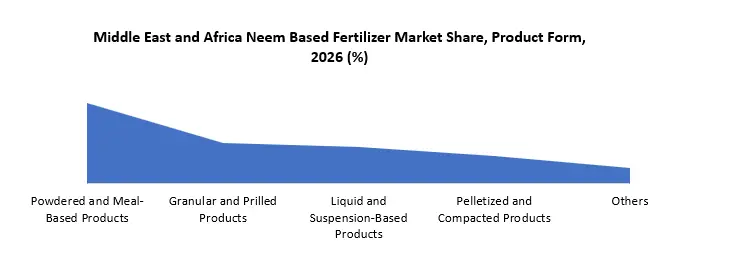
By Product Form: Powdered and meal products led the Middle East and Africa market with a 40% share of value because they suit smallholder use and local processing of neem seed cake. Granular and prilled products (about 20%) and pelletized and compacted products (about 14%) are gaining importance on commercial farms because of easier handling and mechanical application. Liquid and suspension products are growing in Gulf greenhouses and fertigation when formulated for irrigation systems. Manufacturers are increasingly focusing on product forms that improve storage life, nutrient distribution and compatibility with local farm equipment.
Middle East and Africa Neem Based Fertilizer Market Country-Level Analysis
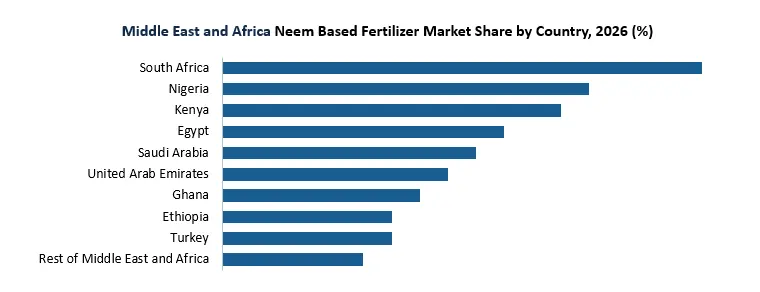
South Africa: South Africa led the Middle East and Africa Neem Based Fertilizer Market in 2026 with a XX share, supported by commercial horticulture, grain farming and an established agro-dealer network. Distributors list neem cake for export through Durban, and commercial growers can use neem-enriched organic blends in fruit and vegetable programs. Demand is expected to center on packaged products and organic blends for horticulture.
Nigeria: Nigeria accounted for about XX% of regional demand, driven by smallholder maize and vegetable farming and an emerging neem oil and cake value chain. The HortiNigeria program (2021–2025) taught women farmers in Kano State to use neem oil and the leftover cake as organic fertilizer, and groups such as the Atamaki Mata Women Farmers Association in Tofa show local production at small scale.
Leading Middle East and Africa Neem Based Fertilizer Manufacturers: Competitive Landscape and Key Players
The Middle East and Africa Neem Based Fertilizer Market is fragmented. It combines local neem processors and farmer groups such as Kingsworth Farms, Farmers Hope and Atamaki Mata Women Farmers Association, Gulf organic and biofertilizer suppliers such as Gulf Agriculture Company, Saudi Bio Fertilizers Co. and Emirates Bio Fertilizer Factory, and global crop nutrition groups including Yara International, ICL Group and Haifa Group that supply adjacent organic and specialty products. Market participants focus on seed aggregation, certification, organic blends and distribution reach to strengthen their positions.
Increasing demand for neem cake-based fertilizers, neem-enriched organic fertilizers and neem-coated urea encourages producers to diversify their product portfolios. Partnerships with seed cooperatives and agro-dealers support raw material availability and reach. Companies compete through price, certification, supply reliability, nutrient-release performance and farmer advisory services. Government soil fertility programs, Gulf greenhouse investment and export-oriented horticulture create opportunities for emerging players, while private-label and cooperative models shape competition across the region.
Middle East and Africa Neem Based Fertilizer Market Recent Developments
|
Company |
Date |
Recent Development |
Strategic Impact |
|
Yara Ghana |
July 2026 |
Launched Yara Winner Plus for rice and cereals and Yara Legume for soybeans, cowpeas and groundnuts at Walewale in Ghana’s North East Region. |
Expands crop-specific nutrition for West African smallholders and shows demand for tailored fertilizer blends. |
|
Yara International |
May 2026 |
Chief executive warned that urea prices had risen 60%–70% since the Iran war began and that Africa imports about 70% of its fertilizer. |
Highlights import-price risk that supports locally produced organic inputs. |
|
African Union Commission |
February 2026 |
Reported that domestication of the Nairobi Declaration was under way, with regional hubs launched in West and Southern Africa. |
Builds the policy base for certified and organic fertilizer production. |
|
Biotrop |
January 2026 |
Took over management of the BioWorks division, which operates in the United States, Africa and the European Union. |
Extends a large biological inputs group into African horticulture markets. |
Middle East and Africa Neem Based Fertilizer Market Scope: Inquire before buying
| Report Coverage | Details |
|---|---|
| Base Year | 2026 |
| Historical Data | 2021 to 2026 |
| Forecast Period | 2027–2034 |
| Market Size in 2026 (Value) | USD 99 Million |
| Market Size in 2026 (Volume) | XX Metric Tons |
| CAGR 2027–2034 (Value) | 13.0% |
| CAGR 2027–2034 (Volume) | XX% |
| Market Size in 2034 | USD 263 Million |
| By Product Type | Neem Cake Based Fertilizers Neem-Enriched Organic Fertilizers Neem-Based Organo-Mineral Fertilizers Neem-Coated Mineral Fertilizers Other Neem Based Formulations |
| By Product Form | Powdered and Meal-Based Products Granular and Prilled Products Liquid and Suspension-Based Products Pelletized and Compacted Products Others |
| By Crop Application | Cereals and Grains Fruits and Vegetables Oilseeds and Pulses Ornamentals, Nurseries and Turf Others |
| By End User | Smallholder and Commercial Farmers Greenhouse, Horticulture and Landscaping Operations Residential Gardeners Government, Research and Institutional Programs Others |
| By Distribution Channel | Agro-Dealers, Cooperatives and Direct Local Sales Specialty Distributors and Landscaping Suppliers Online and Export Channels Government and NGO Programs Others |
| By Country | South Africa Nigeria Kenya Egypt Saudi Arabia United Arab Emirates Ghana Ethiopia Turkey Rest of Middle East and Africa |
Key players covered in the Middle East and Africa Neem Based Fertilizer Market report from a strategic perspective
- Kingsworth Farms
- Farmers Hope
- Atamaki Mata Women Farmers Association
- UMGS
- Gulf Agriculture Company
- Saudi Bio Fertilizers Co. (Biofert)
- Emirates Bio Fertilizer Factory
- Haifa Group
- ICL Group
- Yara International
- OCP Group
- Omnia Holdings
- SABIC Agri-Nutrients
- Dangote Fertilizer
- Notore Chemical Industries
- Indorama Eleme Fertilizer
- Safi Organics
- Amiran Kenya
- Export Trading Group
- Koppert
- Biobest
- Rovensa Next
- Timac Agro (Groupe Roullier)
- Biolchim
- COMPO EXPERT
- EuroChem Group
- K+S
- Abu Qir Fertilizers
- Coromandel International Limited
- UPL Limited
- Fortune Biotech Limited
- Ozone Biotech
- P.J. Margo Pvt. Ltd.
- T. Stanes and Company Limited
- Multiplex Group of Companies
- TrustBasket (Multiplex Urban Green)
- Suståne Natural Fertilizer Inc.
- Others
Frequently Asked Questions
Growth comes from low fertilizer use and soil fertility programs, the 2024 Nairobi Declaration, local neem seed supply in Ghana and Nigeria, and Gulf greenhouse and date palm programs.
The report covers Kingsworth Farms, Farmers Hope, Atamaki Mata Women Farmers Association, UMGS, Gulf Agriculture Company, Saudi Bio Fertilizers Co., Emirates Bio Fertilizer Factory, Haifa Group, ICL Group, Yara International and other regional and international participants.
The 2024 Nairobi Declaration and its 10-year Fertilizer and Soil Health Action Plan commit African governments to triple certified fertilizer production by 2034 and to reach at least 70% of smallholders with soil-health advice.
Part I: Middle East and Africa Neem Based Fertilizer Market Overview, Dynamics and Technology
1. Executive Market Landscape and Industry Overview
1.1. Middle East and Africa Neem Based Fertilizer Market Size (Value USD Million and Volume Metric Tons), 2026–2034
1.2. Evolution of Neem Based Fertilizers and Sustainable Crop Nutrition
1.3. Market Definition, Scope, Boundaries and Product Classification
1.4. Role of Neem Based Fertilizers in Sustainable Agriculture and Soil Fertility
1.5. Middle East and Africa Neem Based Fertilizer Industry Structure and Value Chain
1.6. Organic Farming Expansion, Soil Health Management and Fertilizer Adoption
1.7. CAGR Analysis of Middle East and Africa Neem Based Fertilizer Market During 2027–2034
2. Middle East and Africa Neem Based Fertilizer Market Dynamics
2.1. Neem Based Fertilizer Market Trends
2.2. Neem Based Fertilizer Market Dynamics
2.2.1. Drivers
2.2.2. Restraints
2.2.3. Opportunities
2.2.4. Challenges
2.3. Porter's Five Forces Analysis
2.4. PESTLE Analysis
3. Middle East and Africa Neem Based Fertilizer Market Macroeconomic Factors
3.1. Middle East and Africa Agricultural Investment and Organic Farming Expenditure
3.2. Government Agricultural Subsidies and Soil Health Programs
3.3. Middle East and Africa Agricultural Land Utilization and Organic Cultivation Area
3.4. Conventional Fertilizer Consumption and Price Fluctuations
3.5. Sustainable Agriculture Investment and Environmental Regulations
3.6. Agricultural Productivity, Farm Income and Fertilizer Affordability
3.7. Organic Fertilizer Imports, Exports and International Trade Policies
3.8. Food Security Programs and Agricultural Development Investments
4. Neem Based Fertilizer Industry Trends and Emerging Requirements
4.1. Increasing Adoption of Plant-Based Organic Fertilizers
4.2. Growing Demand for Sustainable Soil Nutrient Management
4.3. Expansion of Certified Organic Farming and Horticulture
4.4. Increasing Adoption of Granular and Pelletized Neem Based Fertilizers
4.5. Development of Nutrient-Enriched Neem Based Formulations
4.6. Growing Preference for Standardized and Certified Agricultural Inputs
4.7. Integration of Neem Based Fertilizers into Regenerative Agriculture Practices
4.8. Growing Adoption of Neem-Coated Mineral Fertilizers
4.9. Expansion of Local Neem Processing and Fertilizer Production Ecosystems
5. Neem Based Fertilizer Composition and Technology Ecosystem
5.1. Neem Based Fertilizer Composition and Nutrient Characteristics
5.2. Nitrogen, Phosphorus, Potassium and Micronutrient Content
5.3. Organic Carbon, Organic Matter and Soil Conditioning Properties
5.4. Nutrient Mineralization and Controlled-Release Mechanisms
5.5. Neem Oil, Neem Extracts, Azadirachtin and Bioactive Compounds
5.6. Soil Microbial Activity and Nutrient Availability
5.7. Nitrification Inhibition and Nitrogen Retention Mechanisms
5.8. Product Stability, Agronomic Performance and Application Efficiency
6. Neem Based Fertilizer Raw Materials and Formulation Components
6.1. Neem Seeds and Neem Kernels
6.2. Neem Cake and Neem Seed Meal
6.3. Neem Oil and Neem Oil Derivatives
6.4. Neem Leaf and Seed Extracts
6.5. Organic Nutrient Enrichment Materials
6.6. Mineral Fertilizer and Micronutrient Ingredients
6.7. Binding Agents, Coating Materials and Formulation Components
6.8. Raw Material Quality, Availability and Procurement Economics
6.9. Local Neem Seed Collection and Agricultural Cooperative Supply Networks
Part II: Product Landscape, Manufacturing and Processing Technologies
7. Neem Cake Based Fertilizer Market Landscape
7.1. Product Composition and Nutrient Specifications
7.2. Cold-Pressed and Mechanically Extracted Neem Cake Characteristics
7.3. Residual Oil Content and Agronomic Performance
7.4. Soil Application Methods and Recommended Dosage
7.5. Organic Certification and Product Quality Requirements
7.6. Product Pricing and Production Economics
7.7. Neem Cake Based Fertilizer Demand and Opportunities
8. Neem-Enriched Organic Fertilizer Market Landscape
8.1. Neem-Enriched Organic Fertilizer Composition and Product Specifications
8.2. Integration of Neem Ingredients with Compost, Poultry Manure and Plant-Based Nutrients
8.3. Nutrient-Enriched Organic Fertilizer Formulations
8.4. Microbial Enrichment and Biofertilizer Compatibility
8.5. Crop-Specific Organic Fertilizer Formulations
8.6. Manufacturing Costs and Average Selling Prices
8.7. Neem-Enriched Organic Fertilizer Demand and Adoption Trends
9. Neem-Based Organo-Mineral Fertilizer Market Landscape
9.1. Organo-Mineral Fertilizer Composition and Formulation Principles
9.2. Integration of Neem-Derived Ingredients with Mineral Nutrients
9.3. Nitrogen Retention and Nutrient Release Characteristics
9.4. Crop-Specific Nutrient Formulation Requirements
9.5. Agronomic Performance and Nutrient Use Efficiency
9.6. Manufacturing Economics and Commercial Viability
9.7. Neem-Based Organo-Mineral Fertilizer Demand and Growth Opportunities
10. Neem-Coated Mineral Fertilizer Market Landscape
10.1. Neem-Coated Mineral Fertilizer Composition and Product Specifications
10.2. Neem-Coated Urea and Other Mineral Fertilizer Products
10.3. Neem Oil and Neem Extract-Based Coating Technologies
10.4. Nitrogen Retention and Nutrient Release Characteristics
10.5. Nutrient Use Efficiency and Agronomic Performance
10.6. Manufacturing Costs, Product Pricing and Commercial Viability
10.7. Neem-Coated Mineral Fertilizer Demand and Growth Opportunities
11. Other Neem Based Fertilizer Formulations
11.1. Neem Extract-Based Nutrient Formulations
11.2. Neem Leaf-Derived Fertilizer Products
11.3. Specialty Neem-Based Crop Nutrition Products
11.4. Neem-Based Multi-Nutrient Fertilizer Formulations
11.5. Advanced Neem-Based Nutrient Delivery Systems
11.6. Product Development and Commercialization Economics
11.7. Emerging Neem Based Fertilizer Demand and Market Opportunities
12. Neem Based Fertilizer Product Forms and Processing Technologies
12.1. Powdered and Meal-Based Neem Based Fertilizers
12.2. Granular and Prilled Neem Based Fertilizers
12.3. Liquid and Suspension-Based Neem Based Fertilizers
12.4. Pelletized and Compacted Neem Based Fertilizers
12.5. Grinding, Milling and Particle Size Classification
12.6. Granulation, Prilling and Pelletization Technologies
12.7. Extraction, Filtration and Liquid Formulation Technologies
12.8. Product Stability, Handling and Application Compatibility
12.9. Product Form-Wise Production Economics and Pricing
12.10. Emerging Product Forms and Commercial Opportunities
13. Neem Based Fertilizer Manufacturing and Production Workflow
13.1. Neem Seed Collection and Raw Material Procurement
13.2. Seed Cleaning, Drying and Kernel Separation
13.3. Neem Oil Extraction and Neem Cake Recovery
13.4. Neem Extract Processing and Bioactive Compound Recovery
13.5. Nutrient Enrichment, Blending and Formulation
13.6. Mineral Fertilizer Coating and Controlled-Release Processing
13.7. Granulation, Pelletization and Product Quality Inspection
13.8. Final Packaging, Warehousing and Production Optimization
14. Neem Based Fertilizer Manufacturing Automation and Processing Technologies
14.1. Automated Neem Seed Cleaning and Sorting Systems
14.2. Mechanical Oil Extraction and Cold-Press Technologies
14.3. Automated Grinding, Milling and Blending Equipment
14.4. Fertilizer Coating and Controlled-Release Manufacturing Technologies
14.5. Granulation, Pelletization and Drying Technologies
14.6. Automated Nutrient Analysis and Quality Control
14.7. Digital Manufacturing, Batch Traceability and Production Monitoring
14.8. Energy-Efficient Manufacturing and Waste Reduction Technologies
Part III: Crop Applications, Customers and Commercial Landscape
15. Neem Based Fertilizer Applications in Cereals and Grains
15.1. Nutrient Requirements of Wheat, Maize, Rice, Sorghum and Other Cereals
15.2. Neem Based Fertilizer Application Rates and Nutrient Management
15.3. Soil Fertility and Nitrogen Retention Considerations
15.4. Integration with Conventional and Organic Fertilization Programs
15.5. Cereal Crop Productivity and Agronomic Performance
15.6. Fertilizer Procurement and Application Economics
15.7. Cereals and Grains Fertilizer Demand and Adoption Trends
16. Neem Based Fertilizer Applications in Fruits and Vegetables
16.1. Nutrient Requirements of Fruit and Vegetable Crops
16.2. Neem Based Fertilizer Applications in Orchards and Date Palm Plantations
16.3. Greenhouse and Protected Cultivation Applications
16.4. Soil Conditioning and Root Zone Nutrient Management
16.5. Organic Horticulture and Export-Oriented Crop Production
16.6. Fertigation and Foliar Nutrient Application
16.7. Fertilizer Application Costs and Crop Yield Economics
16.8. Fruits and Vegetables Fertilizer Demand and Growth Opportunities
17. Neem Based Fertilizer Applications in Oilseeds and Pulses
17.1. Nutrient Requirements of Oilseeds and Pulse Crops
17.2. Neem Based Fertilizer Applications in Groundnut, Sesame and Sunflower
17.3. Fertilizer Applications in Soybean, Cowpea and Other Pulses
17.4. Soil Organic Matter and Nutrient Availability
17.5. Integration with Crop Rotation and Sustainable Farming Practices
17.6. Fertilizer Consumption and Application Economics
17.7. Oilseeds and Pulses Fertilizer Demand and Market Opportunities
18. Neem Based Fertilizer Applications in Ornamentals, Nurseries, Turf and Other Crops
18.1. Ornamental Plant and Floriculture Nutrient Requirements
18.2. Neem Based Fertilizer Applications in Commercial Nurseries
18.3. Turfgrass, Landscaping and Garden Management Applications
18.4. Applications in Medicinal and Aromatic Plants
18.5. Applications in Cotton, Sugarcane and Other Commercial Crops
18.6. Specialty Crop Fertilizer Pricing and Application Economics
18.7. Specialty Crop Fertilizer Demand and Adoption Trends
19. Neem Based Fertilizer Buyers and Procurement Requirements
19.1. Smallholder and Commercial Farmers
19.2. Greenhouse, Horticulture and Landscaping Operations
19.3. Residential Gardeners and Household Consumers
19.4. Government, Research and Institutional Programs
19.5. Customer Procurement Criteria, Certification and Supplier Selection
19.6. Customer Purchasing Behavior, Brand Preferences and Price Sensitivity
19.7. Agricultural Cooperatives and Institutional Procurement Programs
19.8. Farmer Access to Agricultural Credit and Fertilizer Financing
20. Neem Based Fertilizer Customization and Product Configuration
20.1. Crop-Specific Nutrient Formulation Requirements
20.2. Soil Type-Specific Fertilizer Customization
20.3. Nutrient Enrichment and Organic Blend Development
20.4. Integration with Microbial and Biological Agricultural Inputs
20.5. Neem Coating and Controlled Nutrient Release Customization
20.6. Product Form, Particle Size and Application Method Configuration
20.7. Private Label Manufacturing and Customized Packaging
20.8. Customization Costs, Minimum Order Quantities and Manufacturing Lead Times
21. Neem Based Fertilizer Testing, Validation and Quality Assurance
21.1. Fertilizer Testing and Quality Validation Infrastructure
21.2. Nitrogen, Phosphorus, Potassium and Micronutrient Analysis
21.3. Organic Carbon, Moisture and Residual Oil Content Testing
21.4. Azadirachtin and Bioactive Compound Analysis
21.5. Nutrient Release, Coating Uniformity and Product Stability Testing
21.6. Heavy Metal, Pathogen and Contaminant Testing
21.7. Field Trials, Crop Response and Agronomic Performance Validation
21.8. Product Quality Certification, Batch Consistency and Regulatory Compliance
22. Neem Based Fertilizer Pricing, Business Models and Cost Economics
22.1. Neem Based Fertilizer Pricing by Product Type
22.2. Fertilizer Pricing by Product Form and Nutrient Composition
22.3. Neem Seed, Neem Oil, Neem Cake and Extract Procurement Costs
22.4. Organic and Mineral Fertilizer Ingredient Costs
22.5. Labor, Energy, Processing and Manufacturing Overhead Costs
22.6. Packaging, Transportation, Import Duties and Landed Costs
22.7. Direct Sales, Distribution, Contract Manufacturing and Private Label Models
22.8. Average Selling Price, Gross Margin and Profitability Analysis
22.9. Country-Level Neem Based Fertilizer Pricing Analysis
22.10. Smallholder Fertilizer Affordability and Subsidized Pricing Models
23. Neem Based Fertilizer Sales, Distribution and Market Delivery Landscape
23.1. Agro-Dealers, Cooperatives and Direct Local Sales
23.2. Specialty Distributors and Landscaping Suppliers
23.3. Online and Export Channels
23.4. Government and NGO Programs
23.5. Agricultural Input Retailers and Rural Distribution Networks
23.6. Importer Partnerships and International Distribution Networks
23.7. Distributor Margins, Trade Schemes and Customer Support Networks
23.8. Agricultural Extension Services and Farmer Advisory Networks
24. Neem Based Fertilizer Supply Chain and Operational Ecosystem
24.1. Global Neem Seed, Neem Oil, Neem Cake and Extract Supply Chains
24.2. Major Neem-Based Raw Material Producing and Exporting Countries
24.3. Middle East and Africa Neem Based Fertilizer Importers and Processing Companies
24.4. Organic and Mineral Fertilizer Formulation Material Suppliers
24.5. Middle East and Africa Fertilizer Manufacturing, Coating and Blending Clusters
24.6. International Trade, Import-Export and Logistics Networks
24.7. Manufacturing Capacity, Localization and Supply Chain Resilience
24.8. Local Neem Seed Aggregation and Cooperative-Based Supply Models
24.9. Seasonal Raw Material Availability and Procurement Risk Management
Part IV: Innovation, Sustainability, Regulatory and Country-Level Landscape
25. Neem Based Fertilizer Technology Innovation, R&D and Product Development
25.1. Advanced Neem Processing and Nutrient Extraction Technologies
25.2. Controlled Nutrient Release and Enhanced Efficiency Formulations
25.3. Microbial-Enriched Neem Based Fertilizer Development
25.4. Advanced Granulation, Coating and Pelletization Technologies
25.5. Neem-Based Liquid Fertilizer Innovation
25.6. Nanotechnology and Emerging Nutrient Delivery Systems
25.7. Precision Agriculture and Crop-Specific Nutrient Management
25.8. Technology Patents, R&D Investments and Research Collaborations
26. Neem Based Fertilizer Consumption, Utilization and Sustainability Economics
26.1. Middle East and Africa Neem Based Fertilizer Market Production and Consumption Analysis
26.2. Middle East and Africa Neem Based Fertilizer Market Demand and Supply Gap Analysis
26.3. Annual Fertilizer Application Rates and Consumption Intensity
26.4. Nutrient Use Efficiency and Crop Productivity Assessment
26.5. Cost per Hectare and Cost per Unit of Nutrient
26.6. Soil Organic Carbon, Soil Health and Environmental Impact
26.7. Nitrogen Loss Reduction and Sustainable Nutrient Management
26.8. Circular Economy, Neem Industry By-Product Utilization and Waste Reduction
26.9. Return on Investment and Comparative Economics Against Alternative Fertilizers
26.10. Middle East and Africa Neem Based Fertilizer Market Revenue Generation and Value Creation Through 2034
27. Neem Based Fertilizer Regulatory, Quality and Technical Standards
27.1. African Union Nairobi Declaration and 10-Year Fertilizer and Soil Health Action Plan
27.2. National Fertilizer Registration Rules in South Africa, Nigeria, Kenya and Egypt
27.3. Gulf Cooperation Council Organic and Biofertilizer Standards and Registration
27.4. Organic Production Standards and Permitted Input Requirements
27.5. Nutrient Content, Contaminant Limits and Product Safety Requirements
27.6. Organic Input Certification and Supply Chain Traceability
27.7. Regulatory Distinction Between Neem Based Fertilizers and Plant Protection Products
27.8. Fertilizer Import-Export Compliance and Customs Classification
27.9. Saudi Vision 2030 and Gulf Food Security Initiatives
27.10. National Sustainable Agriculture and Soil Health Programs
28. Middle East and Africa Neem Based Fertilizer Country-Level Market Landscape
28.1. South Africa Neem Based Fertilizer Market Development and Demand Outlook
28.2. Nigeria Neem Based Fertilizer Market Development and Demand Outlook
28.3. Kenya Neem Based Fertilizer Market Development and Demand Outlook
28.4. Egypt Neem Based Fertilizer Market Development and Demand Outlook
28.5. Saudi Arabia Neem Based Fertilizer Market Development and Demand Outlook
28.6. United Arab Emirates Neem Based Fertilizer Market Development and Demand Outlook
28.7. Ghana Neem Based Fertilizer Market Development and Demand Outlook
28.8. Ethiopia Neem Based Fertilizer Market Development and Demand Outlook
28.9. Turkey Neem Based Fertilizer Market Development and Demand Outlook
28.10. Rest of Middle East and Africa Neem Based Fertilizer Market
28.11. Country-Level Fertilizer Production, Consumption and Import-Export Analysis
28.12. Country-Level Manufacturing Investments and Fertilizer Adoption Trends
Part V: Market Size and Forecast by Segmentation
29. Middle East and Africa Neem Based Fertilizer Market: Market Size and Forecast by Segmentation, Value (USD Million), Volume (Metric Tons), 2026–2034
29.1. By Product Type
29.1.1. Neem Cake Based Fertilizers
29.1.2. Neem-Enriched Organic Fertilizers
29.1.3. Neem-Based Organo-Mineral Fertilizers
29.1.4. Neem-Coated Mineral Fertilizers
29.1.5. Other Neem Based Formulations
29.2. By Product Form
29.2.1. Powdered and Meal-Based Products
29.2.2. Granular and Prilled Products
29.2.3. Liquid and Suspension-Based Products
29.2.4. Pelletized and Compacted Products
29.2.5. Others
29.3. By Crop Application
29.3.1. Cereals and Grains
29.3.2. Fruits and Vegetables
29.3.3. Oilseeds and Pulses
29.3.4. Ornamentals, Nurseries and Turf
29.3.5. Others
29.4. By End User
29.4.1. Smallholder and Commercial Farmers
29.4.2. Greenhouse, Horticulture and Landscaping Operations
29.4.3. Residential Gardeners
29.4.4. Government, Research and Institutional Programs
29.4.5. Others
29.5. By Distribution Channel
29.5.1. Agro-Dealers, Cooperatives and Direct Local Sales
29.5.2. Specialty Distributors and Landscaping Suppliers
29.5.3. Online and Export Channels
29.5.4. Government and NGO Programs
29.5.5. Others
29.6. By Country
29.6.1. South Africa
29.6.2. Nigeria
29.6.3. Kenya
29.6.4. Egypt
29.6.5. Saudi Arabia
29.6.6. United Arab Emirates
29.6.7. Ghana
29.6.8. Ethiopia
29.6.9. Turkey
29.6.10. Rest of Middle East and Africa
Part VI: Competitive Landscape and Company Profiles
30. Middle East and Africa Neem Based Fertilizer Market Competitive Landscape
30.1. SMR Competition Matrix
30.2. Competitive Positioning of Leading Key Players (Neem Based Fertilizer Revenue and Market Share %)
30.3. Key Players Benchmarking
30.3.1. Company Name
30.3.2. Headquarters
30.3.3. Neem Based Fertilizer Product Portfolio
30.3.4. Product Type and Product Form Coverage
30.3.5. Nutrient Composition and Formulation Capabilities
30.3.6. Product Quality and Organic Certifications
30.3.7. Customer Portfolio and Distribution Partnerships
30.3.8. Total Company Revenue (2026)
30.3.9. Neem Based Fertilizer-Related Revenue (2026)
30.3.10. Geographic Presence
30.3.11. Manufacturing Capacity and Production Capabilities
30.3.12. Raw Material Sourcing Capabilities
30.3.13. Product Pricing and Market Positioning
30.3.14. Strategic Partnerships and Technology Collaborations
30.3.15. Research and Development Capabilities
30.4. Market Structure
30.4.1. Market Leaders
30.4.2. Market Followers
30.4.3. Emerging Players
30.4.4. Specialized Neem Based Fertilizer Manufacturers
30.5. Growth Rate / Y-o-Y (%) of Companies
30.6. Profit Margin (%) of Companies
30.7. R&D and Technology Development Investments (%) of Companies
30.8. Revenue versus Net Earnings – Financial Health Benchmarking (2026)
30.9. Revenue Performance and Financial Analysis (2026)
30.10. Mergers and Acquisitions Details
30.11. Recent Key Developments
31. Middle East and Africa Neem Based Fertilizer Manufacturers
31.1. Neem Cake Based Fertilizer Manufacturers
31.2. Neem-Enriched Organic Fertilizer Manufacturers
31.3. Neem-Based Organo-Mineral Fertilizer Manufacturers
31.4. Neem-Coated Mineral Fertilizer Manufacturers
31.5. Other Neem Based Fertilizer Formulation Manufacturers
31.6. Product, Formulation and Manufacturing Technology Benchmarking
31.7. Regional Manufacturing Competitive Positioning
31.8. Local Neem Processing Enterprises and Agricultural Cooperatives
32. Advanced Neem Based Fertilizer Technology and Formulation Providers
32.1. Neem Seed Processing and Oil Extraction Technology Providers
32.2. Organic Fertilizer Blending and Enrichment Technology Providers
32.3. Fertilizer Coating, Granulation and Pelletization Technology Providers
32.4. Controlled Nutrient Release Technology Providers
32.5. Microbial Enrichment and Biological Formulation Technology Providers
32.6. Nutrient Release and Agronomic Performance Benchmarking
32.7. Emerging Neem Based Fertilizer Technology Innovations
33. Neem Based Fertilizer Raw Material and Ingredient Suppliers
33.1. Neem Seed and Neem Kernel Suppliers
33.2. Neem Cake and Neem Seed Meal Suppliers
33.3. Neem Oil, Neem Extract and Derivative Suppliers
33.4. Organic Nutrient Enrichment Material Suppliers
33.5. Mineral Nutrient and Microbial Ingredient Suppliers
33.6. Fertilizer Coating, Binding Agent and Packaging Material Suppliers
33.7. Supplier Quality, Production Capacity and Cost Benchmarking
34. Neem Based Fertilizer Manufacturing Automation and Processing Equipment Providers
34.1. Neem Seed Cleaning and Oil Extraction Equipment Providers
34.2. Grinding, Milling and Particle Classification Equipment Suppliers
34.3. Automated Fertilizer Blending and Formulation Equipment Providers
34.4. Fertilizer Coating, Granulation, Pelletization and Drying Equipment Suppliers
34.5. Automated Packaging and Quality Inspection Technology Providers
34.6. Digital Manufacturing and Batch Traceability System Providers
34.7. Manufacturing Automation Performance and Technology Benchmarking
35. Neem Based Fertilizer Dealers, Distributors and Sales Companies
35.1. Organic Fertilizer Dealers and Distributors
35.2. Agricultural Input Wholesalers and Cooperatives
35.3. Neem Based Fertilizer Importers and Exporters
35.4. Garden Centers and Specialty Retail Networks
35.5. Online Neem Based Fertilizer Sales Platforms
35.6. Distribution Partnerships and Dealer Network Expansion
35.7. Distribution Network Performance and Competitive Benchmarking
35.8. Rural Agro-Dealer and Farmer Cooperative Networks
36. Neem Based Fertilizer Contract Manufacturing and Support Service Providers
36.1. Contract Fertilizer Processing and Blending Companies
36.2. Private Label Fertilizer Manufacturing Providers
36.3. Fertilizer Testing and Quality Certification Laboratories
36.4. Organic Input Certification and Regulatory Consulting Providers
36.5. Agricultural Advisory and Nutrient Management Service Providers
36.6. Warehousing, Packaging and Fertilizer Logistics Providers
36.7. Contract Manufacturing and Support Service Pricing Benchmarking
37. Neem Based Fertilizer Manufacturers' Strategies and Expansion Plans
37.1. Expansion of Neem Based Fertilizer Product Portfolios
37.2. Development of Advanced Organic and Organo-Mineral Formulations
37.3. Development of Neem-Coated Mineral and Enhanced Efficiency Fertilizers
37.4. Localization of Fertilizer Processing and Manufacturing
37.5. Expansion into Emerging Middle East and Africa Agricultural Markets
37.6. Strategic Partnerships with Agricultural Distributors and Cooperatives
37.7. Investment in Advanced Fertilizer Processing Technologies
37.8. Manufacturing Capacity Expansion and Supply Chain Development
37.9. Mergers, Acquisitions and Strategic Collaborations
38. Neem Based Fertilizer Industry SWOT, Investments and Strategic Developments
38.1. Competitive Strengths of Established Fertilizer Manufacturers
38.2. Raw Material Availability, Import Dependence and Production Cost Challenges
38.3. Opportunities in Organic Farming and Sustainable Crop Nutrition
38.4. Competitive Threats from Alternative Organic and Conventional Fertilizers
38.5. Strategic Investments in Neem Based Fertilizer Manufacturing
38.6. Government Organic Agriculture and Soil Health Funding
38.7. Major Product Launches, Partnerships and Industry Developments
38.8. Agricultural Development Agency and Institutional Funding Opportunities
39. Neem Based Fertilizer Competitive Outlook and Market Positioning
39.1. Competitive Dynamics Across Neem Based Fertilizer Product Categories
39.2. Market Concentration Among Middle East and Africa Neem Based Fertilizer Suppliers
39.3. Product Differentiation Through Nutrient Content, Certification and Pricing
39.4. Competitive Positioning of Established and Emerging Manufacturers
39.5. Middle East and Africa Manufacturing Expansion and Raw Material Sourcing Strategies
39.6. Future Developments in Sustainable and Enhanced Efficiency Fertilizers
39.7. Long-Term Competitive Positioning of Leading Companies
40. Company Profile: Key Middle East and Africa Neem Based Fertilizer Market Players
Detailed Profile Considering the Parameters:
- Company Overview
- Business Portfolio
- Neem Based Fertilizer Product Portfolio
- Manufacturing and Formulation Capabilities
- Production Capacity and Distribution Network
- Financial Overview
- Geographic Presence
- SWOT Analysis
- Strategic Analysis
- Recent Developments
Middle East and Africa Companies and Strategic Industry Participants
40.1. Kingsworth Farms
40.2. Farmers Hope
40.3. Atamaki Mata Women Farmers Association
40.4. UMGS
40.5. Gulf Agriculture Company
40.6. Saudi Bio Fertilizers Co. (Biofert)
40.7. Emirates Bio Fertilizer Factory
40.8. Haifa Group
40.9. ICL Group
40.10. Yara International
40.11. OCP Group
40.12. Omnia Holdings
40.13. SABIC Agri-Nutrients
40.14. Dangote Fertilizer
40.15. Notore Chemical Industries
40.16. Indorama Eleme Fertilizer
40.17. Safi Organics
40.18. Amiran Kenya
40.19. Export Trading Group
40.20. Koppert
40.21. Biobest
40.22. Rovensa Next
40.23. Timac Agro (Groupe Roullier)
40.24. Biolchim
40.25. COMPO EXPERT
40.26. EuroChem Group
40.27. K+S
40.28. Abu Qir Fertilizers
40.29. Coromandel International Limited
40.30. UPL Limited
40.31. Fortune Biotech Limited
40.32. Ozone Biotech
40.33. P.J. Margo Pvt. Ltd.
40.34. T. Stanes and Company Limited
40.35. Multiplex Group of Companies
40.36. TrustBasket (Multiplex Urban Green)
40.37. Suståne Natural Fertilizer Inc.
Others
Part VII: Key Findings, Strategic Outlook and Research Methodology
41. Key Findings
41.1. Middle East and Africa Neem Based Fertilizer Market Size, Growth and Revenue Opportunities
41.2. Leading Product Types, Product Forms and Crop Applications
41.3. Country-Level Market Leadership and Growth Opportunities
41.4. Neem Based Fertilizer Production, Consumption and Technology Adoption Trends
41.5. Competitive Positioning of Leading Manufacturers and Suppliers
41.6. Manufacturing, Raw Material Sourcing, Supply Chain and Distribution Insights
41.7. Middle East and Africa Neem Based Fertilizer Market Demand, Consumption, Supply, Revenue Generation and Value Creation Through 2034
41.8. Strategic Implications for Manufacturers, Importers, Distributors and Investors
42. Strategic Moves and Industry Outlook
42.1. Strategic Opportunities in Organic Farming and Sustainable Crop Nutrition
42.2. Expansion of Advanced Neem Based Fertilizer Formulations
42.3. Development of Neem-Coated and Enhanced Efficiency Fertilizers
42.4. Localization of Neem Based Fertilizer Processing and Manufacturing
42.5. Agricultural Fertilizer Distribution and Dealer Network Expansion
42.6. Emerging Middle East and Africa Market Entry and Geographic Expansion Opportunities
42.7. Strategic Partnerships, Acquisitions and Product Development
42.8. Opportunities in African Smallholder Farming and Gulf Protected Agriculture
42.9. Long-Term Middle East and Africa Neem Based Fertilizer Market Outlook Through 2034
43. Research Methodology
43.1. Research Objectives, Market Definition and Scope
43.2. Primary Research Methodology
43.2.1. Interviews with Neem Based Fertilizer Manufacturers
43.2.2. Interviews with Fertilizer Importers, Distributors and Retailers
43.2.3. Interviews with Agricultural Enterprises, Organic Farmers and Horticultural Growers
43.2.4. Interviews with Raw Material Suppliers, Agronomists and Fertilizer Industry Experts
43.2.5. Interviews with Agricultural Cooperatives, Government Agencies and Institutional Buyers
43.2.6. Fertilizer Procurement, Consumption and Application Assessment
43.3. Secondary Research Methodology
43.3.1. Company Annual Reports and Financial Statements
43.3.2. FAOSTAT, FAO Regional Statistics and African Union Agricultural Data
43.3.3. African Union Commission, IFDC, IFA and Agricultural Industry Associations
43.3.4. UN Comtrade, ITC Trade Map and Regional Customs Databases
43.3.5. Scientific Publications, Agronomic Studies and Organic Fertilizer Technology Reports
43.3.6. National Agricultural Ministries, Fertilizer Regulatory Authorities and GCC Agricultural Statistics
43.4. Market Size Estimation Methodology
43.4.1. Bottom-Up Market Estimation
43.4.2. Top-Down Market Estimation
43.4.3. Fertilizer Production, Consumption and Sales Volume Analysis
43.4.4. Average Selling Price Analysis
43.4.5. Revenue-Based Market Size Validation
43.4.6. Country-Level Demand and Supply Assessment
43.5. Market Forecasting Methodology
43.6. Data Triangulation and Validation
43.7. Assumptions, Limitations and Research Quality Control