ENG
 Japanese
 French
 German
 Korean

Middle East and Africa Auxins Market : Industry Analysis, Market Size, Share, Trends and Forecast (2026–2034)
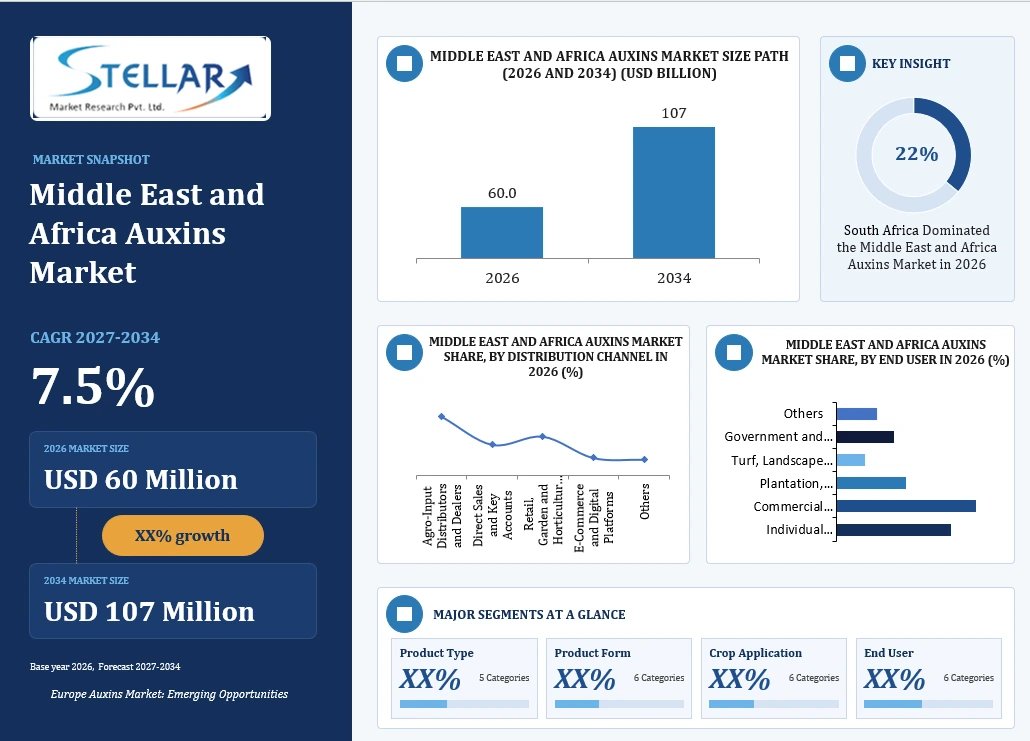
The Middle East and Africa Auxins Market was valued at USD 60.0 Mn in 2026 and is expected to reach USD 107 Mn by 2034, growing at a CAGR of 7.5% during 2027–2034.
The Middle East and Africa Auxins Market was valued at USD 60.0 Mn in 2026 and is expected to reach USD 107 Mn by 2034, growing at a CAGR of 7.5% during 2027–2034. In terms of volume, the Middle East and Africa Auxins Market was valued at XX Metric Tons in 2026 and is expected to reach XX Metric Tons by 2034, growing at a CAGR of XX% during 2027–2034.
Market definition and scope:
The Auxins Market covers auxin-based agricultural inputs used in weed management, plant growth regulation, root development, and crop productivity enhancement. The market includes synthetic auxin herbicides such as 2,4-D, dicamba, MCPA, MCPB, mecoprop-P, fluroxypyr, picloram, aminopyralid, halauxifen, and florpyrauxifen; auxin-based plant growth regulators (PGRs) and rooting hormones, including NAA, IBA, and IAA; and natural and bio-derived auxin formulations. These agricultural auxin products are available as liquid concentrates, water-soluble and dispersible powders, granules, rooting powders, gels, pastes, tablets, and capsules.
The Middle East and Africa Auxins Market assessment considers only auxin active ingredients to avoid double counting with the broader agricultural herbicides and plant growth regulators markets. Non-auxin active ingredients in combination formulations, such as glyphosate and glufosinate, are excluded. Gibberellins, cytokinins, ethylene-based regulators, and agricultural biostimulants without declared auxin or auxin-like active ingredients are also outside the market scope. This classification ensures consistency in Auxins Market sizing, demand, consumption, supply, revenue generation, and competitive landscape analysis.
Stellar Market Research Study scope and coverage:
The study period is 2021–2034, with 2026 as the base year, 2021–2026 as historical data and 2027–2034 as the forecast period. Market size is reported in USD million (value) and metric tons (volume), with all other currencies converted to USD. The Auxins Market analysis segments the market by product type, product form, crop application, end user and distribution channel, and covers nine country groups (South Africa, Egypt, Turkey, Saudi Arabia, the United Arab Emirates, Morocco, Kenya, Nigeria and Rest of Middle East and Africa).
The report is for crop-protection manufacturers, plant growth regulator and rooting hormone suppliers, biological and biostimulant companies, distributors, cooperatives, government agencies, technology providers and investors. It answers practical questions on market entry and strategy: how synthetic auxin herbicides, auxin-type plant growth regulators, rooting hormones and natural auxin formulations compare on price and performance, where grower demand is heading, how registrations, stewardship rules and generic competition shape pricing, and which crops, channels, segments and countries offer the best opportunities.
Synthetic Auxin Herbicides accounted for the largest share of Middle East and Africa Auxins Market value in 2026 at about 40%, while cereals and grains represent about XX% of crop-application demand in 2026. The Middle East and Africa Auxins Market is witnessing a shift toward natural and bio-derived auxin formulations, rooting powders, gels and pastes, alongside increasing applications in fruit and vegetable cultivation. Growing concerns about herbicide resistance, horticultural expansion, evolving regulatory requirements, and rising demand for lower-residue agricultural inputs are influencing growers’ purchasing preferences. E-commerce and digital agricultural platforms are improving product accessibility and distribution efficiency.
Stellar Market Research delivers a comprehensive Middle East and Africa Auxins Market Research Report covering value and volume (metric tons) by product type, product form, crop application, end user, distribution channel and country, together with a competitive landscape, strategic scenarios and growth opportunities.
Middle East and Africa Auxins Market Size and Growth: Industry Outlook, 2026–2034
The Middle East and Africa Auxins Market is sized at the auxin active-ingredient and finished-product level, so that the wider herbicide, plant growth regulator and biostimulant markets are not double counted. According to South Africa's Crop Estimates Committee, the 2025–26 maize harvest was confirmed at a record 17.7 million tonnes , the summer grain and oilseed crop reached a record 21.6 million tonnes in August 2026, and farmers intend to plant 4.5 million hectares of summer grains and oilseeds in 2026–27. The crop-production and export backdrop supports demand for weed-control and plant growth regulator inputs, though the regional base remains small and fragmented.
To get more Insights: Request Free Sample Report
Key Findings: Insights Shaping the Middle East and Africa Auxins Market
The following insights shape Middle East and Africa Auxins Market demand, consumption, supply, revenue generation and market value creation during 2026–2034.
1. Synthetic Auxin Herbicides dominate market value, while Natural and Bio-Derived Auxin Formulations register the fastest growth: Synthetic Auxin Herbicides accounted for 40% of the 2026 market value and are projected to grow at a XX% CAGR during 2027–2034, below the overall market CAGR of 7.5%. Natural and Bio-Derived Auxin Formulations and Auxin-Type Plant Growth Regulators are expected to grow at XX% and 8.0%, respectively.
2. Liquid and Emulsifiable Concentrates dominate product demand, while Rooting Powders, Gels and Pastes witness accelerated growth: Liquid and Emulsifiable Concentrates accounted for 52% of the 2026 market value and are projected to grow at a 6.7% CAGR, while Rooting Powders, Gels and Pastes are expected to register a higher CAGR of XX% during 2027–2034.
3. Cereals and Grains dominate crop applications, while Fruits and Vegetables emerge as the fastest-growing application: Cereals and Grains represent 38% of the 2026 market value and are projected to grow at a XX% CAGR.
4. Expanding agricultural production and export activities strengthen regional auxin demand: South Africa's record maize production of 17.7 million metric tons during the 2025–2026 agricultural season and Egypt's agricultural exports valued at USD XX billion in 2025 support demand for efficient crop protection products, plant growth regulators and specialized auxin formulations.
5. South Africa maintains market leadership, while the United Arab Emirates emerges as the fastest-growing market: South Africa accounted for 22% of the regional market value in 2026 and is projected to grow at a XX% CAGR. The United Arab Emirates is expected to register a 9.9% CAGR during 2027–2034, increasing its market share from XX% in 2026 to 6% by 2034.
6. E-Commerce and Digital Platforms transform agricultural input distribution: E-Commerce and Digital Platforms are projected to grow at a 13.6% CAGR during 2027–2034, significantly outperforming Agro-Input Distributors and Dealers, which are expected to grow at 5.6% and accounted for XX% of the 2026 market value.
7. Natural and Bio-Derived Auxins emerge as a key growth engine: Increasing demand for sustainable agricultural inputs, lower-residue formulations and environmentally responsible crop management solutions is accelerating natural auxin adoption. Natural and Bio-Derived Auxin Formulations are projected to grow at an 11.7% CAGR during 2027–2034, increasing their market share from 11% in 2026 to XX% by 2034.
Middle East and Africa Auxins Market Trends
Record South African Grain Harvests Supporting Weed-Control Demand: South Africa's Crop Estimates Committee confirmed record maize production of 17.7 million metric tons during 2025–2026, while summer crop production reached 21.6 million metric tons in August 2026. Farmers intend to cultivate 4.5 million hectares during 2026–2027. Extensive maize and soybean cultivation supports demand for selective broadleaf herbicides, including synthetic auxin formulations.
Export Horticulture Driving Plant Growth Regulator Adoption: According to Egypt's Ministry of Agriculture and Land Reclamation, agricultural exports reached 9.5 million metric tons, valued at USD 11.5 billion in 2025, while export volumes reached 6.8 million metric tons by August 28, 2026. Expanding citrus, grape, potato and vegetable exports support demand for auxin-based fruit development, rooting and propagation products.
Expansion of Biologicals and Bio-Derived Auxin Formulations: Sumitomo Chemical Agro Europe and Valent BioSciences launched a biostimulant portfolio across Europe, the Middle East and Africa in December 2025. Mycophyto established a Moroccan subsidiary in April 2026, while SAS Group reported acquiring a majority stake in South African seaweed biostimulant manufacturer Afrikelp in October 2026. These developments support regional biological agricultural input adoption.
Digitalization and Agricultural Distribution Network Expansion: Agro-Input Distributors and Dealers accounted for 60% of the Middle East and Africa Auxins Market value in 2026, while E-Commerce and Digital Platforms are projected to register a 13.6% CAGR during 2027–2034. Increasing digital procurement, online agricultural advisory services and improved product accessibility across Gulf and North African countries support regional auxin consumption.
Middle East and Africa Auxins Market Drivers: Weed-Resistance Management, Horticulture Demand, Regulatory Support and Bio-Derived Products
Food security and cereal intensification drive demand for effective weed control. FAO expects cereal output in North and Southern Africa to exceed five-year averages in 2026, with record harvests in some countries, and South Africa's maize area and yields are rising. Synthetic auxin herbicides are low-cost, selective options for maize, wheat and sorghum, and cereals accounted for about 38% of 2026 value.
Horticulture and protected cultivation add a second pull. Fruits and vegetables accounted for about 32% of 2026 value and are the fastest-growing crop application at 9.8% a year, driven by export-oriented citrus, vegetable and fruit production in Egypt, Morocco, Kenya, Turkey and the Gulf. Auxin-type regulators and rooting hormones support nursery propagation, fruit set and uniform harvest.
Regulatory support and bio-derived products add a third pull. Morocco's Green Generation Strategy 2020–2030 backs agricultural modernization and advisory services, which encourages the use of registered auxin formulations, while natural and bio-derived auxin formulations grow at 11.7% a year as new biostimulant portfolios and acquisitions in 2025 and 2026 widen the supply of lower-residue options.
Middle East and Africa Auxins Market Restraints and Challenges: Regulatory Risk, Generic Competition, Stewardship and Supply Costs
Fragmented registration, uneven stewardship and import dependence are the most persistent restraints. Product registration systems differ widely between South Africa, North African and Gulf markets, and many growers rely on imported formulations through dealers, which raises costs and lengthens time to market.
Climate and cost pressure add to the strain. Trade reporting in November 2026 flags a developing El Niño as a risk to the 2026–27 season in southern Africa, and higher fertilizer and fuel costs are competing with crop-protection budgets. Generic competition also compresses margins on commodity actives. South Africa is the largest market in this report at about 22% of 2026 value, while the United Arab Emirates is the fastest-growing at 9.9% a year from a small base.
Middle East and Africa Auxins Market Opportunities: Export Horticulture, Bio-Derived Auxins, Local Formulation and Digital Channels
Export horticulture offers the clearest opportunity. Fruits and vegetables grow at 9.8% a year, and citrus, grape, potato and vegetable exports from Egypt, Morocco and Kenya support demand for auxin-type plant growth regulators and rooting products. Natural and bio-derived auxin formulations, growing at 11.7% a year, give suppliers a route into lower-residue, export-compliant programs.
Local formulation and digital distribution create further openings. Dependence on imported actives supports regional formulation and toll-manufacturing facilities, while e-commerce and digital platforms, growing at 13.6% a year, widen access for smallholder and commercial growers. Water-soluble products suited to drip irrigation and fertigation, growing at 7.5% a year, add to the opportunity in Gulf and North African protected cultivation.
Middle East and Africa Auxins Market Dynamics Analysis: Economic Factors, Demand and Supply, Competitive Rivalry and Regulation
Middle East and Africa Auxins Market Demand and Supply Gap Analysis: According to the OECD's November 2026 Agricultural Policy Monitoring and Evaluation report, South Africa had 96.34 million hectares of agricultural land in 2024, of which 12.5% was arable. Extensive maize, wheat, barley, oilseed and horticultural cultivation support demand for auxin herbicides and plant growth regulators. Dependence on imported active ingredients creates opportunities for regional formulation facilities and agricultural input distribution networks.
Farmer Behavior Trends and Preference Evolution: According to the Islamic Development Bank's 2024 report, 55% of Moroccan farms are smaller than 3 hectares. Small farm sizes influence purchasing preferences toward affordable packaging, multipurpose agricultural inputs and locally available products. Commercial growers increasingly prioritize application efficiency, crop quality and regulatory compliance, creating opportunities for specialized auxin formulations and technical advisory services.
Technological Advancements and Innovation Impact: Agricultural modernization across the Middle East and Africa increasingly focuses on drip irrigation, fertigation, precision agriculture and controlled-environment cultivation. Morocco's Green Generation Strategy 2020–2030 supports agricultural digitalization and technological adoption. These developments create opportunities for compatible water-soluble auxin formulations, precision application technologies and specialized plant growth regulators that improve agricultural productivity and resource utilization.
Regulatory Influences and Regulatory Changes: Morocco's Green Generation Strategy 2020–2030 focuses on agricultural modernization, human capital development and agricultural value-chain efficiency. According to FAO's 2025 country assessment, agriculture accounted for nearly one-third of Moroccan employment, while agricultural land represents two-thirds of national territory. Government-supported agricultural advisory services, sustainable farming initiatives and evolving regulatory requirements encourage responsible agricultural input adoption and strengthen opportunities for registered auxin formulations.
Middle East and Africa Auxins Market Trends: Digital Application, Grower Advisory and Changing Crop Protection Preferences
Drip and Fertigation-Compatible Products: Water-soluble powders and granules grow at 7.5% a year, supported by irrigated vegetable, fruit and greenhouse production.
Growing Acceptance of Bio-Derived Plant Hormones: Natural and bio-derived auxin formulations grow at 11.7% a year, supported by new biostimulant portfolios and acquisitions in 2025 and 2026.
Horticulture and Export Pull: Fruits and vegetables grow at XX% a year and rooting hormones and propagation products at 7.5%.
Direct-to-Grower and E-Commerce Distribution: E-commerce and digital platforms grow at 13.6% and retail and horticulture stores at 9.0%, ahead of dealers at 5.6%.
Middle East and Africa Auxins Market Innovations: Low-Volatility Formulations, Bio-Derived Auxins, Rooting Technologies and Precision Application
Regional formulators are developing water-soluble and liquid auxin products for drip irrigation, and biological companies are scaling seaweed and microbial extracts with declared auxin activity. Plant growth regulator makers are adapting IBA and NAA rooting products for nurseries serving export horticulture.
Standardized auxin content, heat-stable formulations and advisory tools for arid and irrigated conditions improve consistency. Local manufacturing and acquisitions, such as SAS Group's stake in Afrikelp, shorten supply chains.
Emerging Middle East and Africa Auxins Innovation: Water-Soluble Products, Bio-Derived Hormones and Digital Stewardship
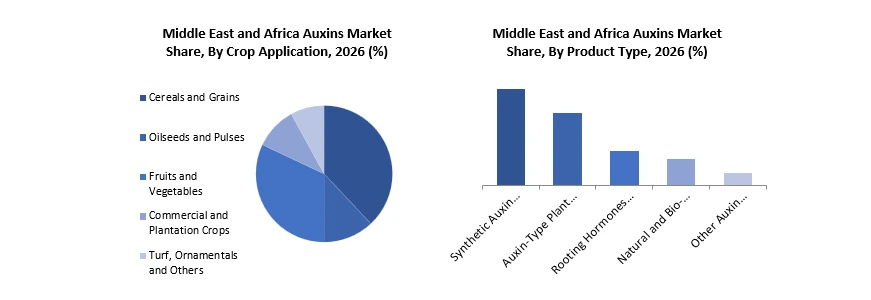
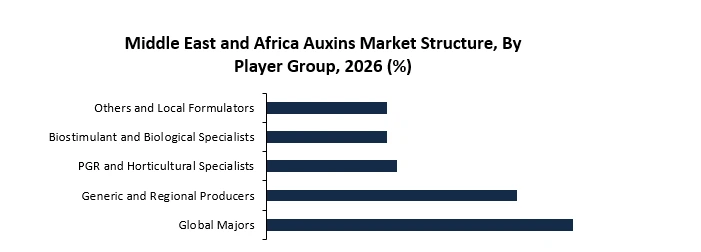
Innovation is concentrated in water-soluble products, bio-derived auxin formulations and local manufacturing; the charts below show the market's segment mix and player structure.
Pesticide and plant growth regulator registration is national: South Africa registers agricultural remedies under national legislation, Egypt and Morocco operate their own approval systems, and Gulf states are working toward harmonized residue limits. Export horticulture must also meet importing-market residue rules, so certification and traceability drive access to premium channels.
Middle East and Africa Auxins Market Segmentation
By Product Type: Synthetic Auxin Herbicides lead with 40% of the 2026 market value, supported by low unit cost, broadleaf weed-control efficacy and compatibility with auxin-tolerant crop systems, and grow at a 5.7% CAGR, declining to 35% of 2034 value. Natural and Bio-Derived Auxin Formulations are the fastest-growing type at XX% a year, rising from 11% to XX% of value as buyers prefer natural-origin and lower-residue inputs. Auxin-Type Plant Growth Regulators and Rooting Hormones and Propagation Products benefit from orchard, nursery and protected-cultivation expansion, while Other Auxin Formulations hold about 5%.
By Crop Application: Cereals and Grains dominate with 38% of the 2026 market value and grow at XX%, supported by large treated area and the need for selective broadleaf control. Fruits and Vegetables are the fastest-growing application at 9.8% a year, rising from XX% to 38% of value on orchard, vegetable and nursery demand for plant growth regulators and rooting products. The remaining applications are Oilseeds and Pulses and the commercial, plantation and turf segments, which together provide steady, lower-growth demand.
By Product Form: Liquid and Emulsifiable Concentrates dominate with 52% of the 2026 market value and grow at 6.7%, because liquid herbicide and regulator concentrate suit spray application and tank mixing. Rooting Powders, Gels and Pastes are the fastest-growing form at XX% a year, while Water-Soluble and Dispersible Powders and Granules hold 24% and grow at XX%.
By End User: Individual Farmers and Smallholders buy mainly through local dealers and favor affordable packaging and multipurpose inputs, as about 55% of Moroccan farms are smaller than 3 hectares. Commercial Farms and Agricultural Enterprises and Plantation, Orchard and Nursery Operators prioritize application efficiency, crop quality and regulatory compliance, while Turf, Landscape and Ornamental Growers, Government and Institutional Programs and Others complete the end-user base. Segment shares and CAGRs: XX%.
Middle East and Africa Auxins Market Country-Level Outlook: South Africa, Egypt, Turkey, Saudi Arabia, United Arab Emirates, Morocco, Kenya and Nigeria
South Africa dominates the Middle East and Africa Auxins Market, accounted for 22% of the regional market value in 2026, and is projected to grow at a 6.2% CAGR during 2027–2034. Extensive maize, soybean, wheat, and sunflower cultivation supports demand for synthetic auxin herbicides, while advanced agricultural practices and herbicide-resistance management strengthen growth in the South Africa Auxins Market.
Egypt and Turkey represent significant markets, supported by commercial horticulture, cereal cultivation and export-oriented fruit and vegetable production, driving demand for auxin-type plant growth regulators and rooting hormones. The United Arab Emirates is expected to emerge as the fastest-growing market, supported by increasing investments in greenhouse cultivation, controlled-environment agriculture, landscaping and advanced irrigation technologies. Kenya and Saudi Arabia offer considerable Auxins Market growth opportunities through agricultural modernization, commercial floriculture, food security initiatives and sustainable farming practices.
Morocco benefits from expanding export-oriented horticulture, agricultural development programs and established trade relationships with European markets. A growing emphasis on crop quality, pesticide residue compliance, efficient propagation, and agricultural productivity supports demand in the Middle East and Africa Auxins Market. Furthermore, growing adoption of precision agriculture, natural and bio-derived auxin formulations, digital agricultural platforms and specialized crop protection products strengthens the long-term Middle East and Africa outlook.
|
Country |
2026 share |
2026 (USD Mn) |
2034 (USD Mn) |
CAGR (2027–2034) |
Notes |
|
South Africa |
22.0% |
XX |
XX |
6.2% |
Maize, soybean and sunflower; record 2025–26 crops; largest market |
|
Egypt |
XX% |
XX |
XX |
XX% |
Export citrus, potato and vegetable production |
|
Turkey |
XX% |
XX |
XX |
XX% |
Cereal, fruit and vegetable production |
|
Saudi Arabia |
XX% |
XX |
XX |
XX% |
Protected cultivation and landscape demand |
|
United Arab Emirates |
XX% |
XX |
XX |
XX% |
Landscape, greenhouse and ornamental demand; fastest-growing market |
|
Morocco |
XX% |
XX |
XX |
XX% |
Export fruit and vegetable production |
|
Kenya |
XX% |
XX |
XX |
XX% |
Export horticulture and cut flowers |
|
Nigeria |
XX% |
XX |
XX |
XX% |
Cereal and smallholder expansion |
|
Rest of Middle East and Africa |
XX% |
XX |
XX |
XX% |
Remaining Gulf, North, East, West and Southern African markets |
Leading Middle East and Africa Auxins Manufacturers: Competitive Landscape and Auxin Product Portfolios
The Middle East and Africa Auxins Market competitive landscape includes several distinct groups: global crop-protection majors, generic and regional herbicide producers, plant growth regulator and horticultural specialists, and biostimulant and biological specialists, with regional formulators and local distributors playing a larger role than in mature markets.
Competition is shaped by registration coverage, local manufacturing, distributor networks and technical support. In 2025 and 2026, Sumitomo Chemical Agro Europe and Valent BioSciences launched a biostimulant portfolio for EMEA, Mycophyto opened a Moroccan subsidiary and SAS Group reported acquiring a majority stake in Afrikelp. Local acquisitions and distributor partnerships are shaping regional competition.
Middle East and Africa Auxins Market Recent Developments
|
Date |
Company |
Key Development |
Impact on Auxins Market |
|
Mar 2026 |
ADAMA Ltd. (Israel) |
Launched Dicamba 4L DGA, a synthetic auxin herbicide targeting broadleaf weeds across major row crops in the United States. |
Strengthens its synthetic auxin herbicide portfolio and potential regional expansion opportunities. |
|
Apr 2026 |
Haifa Group (Israel) |
Joined the European Biostimulants Industry Council (EBIC), strengthening its sustainable plant nutrition portfolio. |
Supports potential commercialization of bio-derived plant growth regulators. |
|
May 2026 |
Villa Crop Protection (Pty) Ltd. (South Africa) |
Launched a 12-week AI-enabled agricultural weather information initiative in partnership with Metos, TerraClim and Landbouweekblad. |
Improves herbicide application efficiency and reduces off-target spray drift risks. |
|
Jun 2026 |
ICL Group Ltd. (Israel) |
Launched Bioz Kellus, a specialty agricultural product combining micronutrients and biostimulants. |
Supports integrated plant growth enhancement and sustainable crop nutrition programmes. |
|
Nov 2026 |
Omnia Holdings Limited (South Africa) |
Reported agricultural segment revenue of USD 320.06 Million, with operating profit increasing by 13% to USD 30.41 Million. |
Strengthens regional agricultural input distribution networks and commercialization opportunities for auxin-based products. |
Auxins Competitive Landscape Analysis: Competitor Benchmarking, Rivalry Intensity and Market Strategies
- Competitor analysis and Auxins Market share: The report profiles key players, benchmarking company revenue, auxin-related revenue, growth rate, profit margin and R&D investment, and groups them by role rather than ranking them as identical producers.
- Competitive positioning and differentiation: Global majors differentiate on registrations and branded systems; regional formulators on local supply and price; plant growth regulator specialists on export-horticulture know-how; and biological companies on natural-origin positioning.
- Rivalry intensity and competitive forces: Rivalry is shaped by fragmented registration, import dependence, generic competition in off-patent actives, climate risk and price sensitivity.
- Market player strategies and competitive maneuvers: Leading companies localize formulation and distribution, add biological products, acquire regional businesses and expand digital channels.
Middle East and Africa Auxins Market Scope: Inquire before buying
| Middle East and Africa Auxins Market | |||
|---|---|---|---|
| Report Coverage | Details | ||
| Base Year: | 2026 | Forecast Period: | 2027–2034 |
| Historical Data: |
2021 to 2026 |
(Value) Market Size in 2026: | USD 60.0 Million |
| (Volume) Market Size in 2026: | XX Metric Tons | ||
| Forecast Period 2027 to 2034 CAGR (Value) | 7.5% | Market Size in 2034: | USD 107 Million |
| Forecast Period 2027 to 2034 CAGR (Volume) | XX% | Market Size in 2034: | XX Metric Tons |
| Middle East and Africa Auxins Market Segments Covered: | By Product Type | Synthetic Auxin Herbicides Auxin-Type Plant Growth Regulators Rooting Hormones and Propagation Products Natural and Bio-Derived Auxin Formulations Other Auxin Formulations |
|
| By Product Form | Liquid and Emulsifiable Concentrates Water-Soluble and Dispersible Powders and Granules Rooting Powders, Gels and Pastes Tablets and Capsules Others |
||
| By Crop Application | Cereals and Grains Oilseeds and Pulses Fruits and Vegetables Commercial and Plantation Crops Turf and Ornamentals Others |
||
| By End User | Individual Farmers and Smallholders Commercial Farms and Agricultural Enterprises Plantation, Orchard and Nursery Operators Turf, Landscape and Ornamental Growers Government and Institutional Programs Others |
||
| By Distribution Channel | Agro-Input Distributors and Dealers Direct Sales and Key Accounts Retail, Garden and Horticulture Stores E-Commerce and Digital Platforms Others |
||
| By Country | South Africa Egypt Turkey Saudi Arabia United Arab Emirates Morocco Kenya Nigeria Rest of Middle East and Africa |
||
Key players/Competitors profiled in the Middle East and Africa Auxins Market report from a regional and global perspective:
Middle East & Africa
- ADAMA Ltd. (Israel)
- ICL Group Ltd. (Israel)
- Haifa Group (Israel)
- Omnia Holdings Limited (South Africa)
- Villa Crop Protection (Pty) Ltd (South Africa)
- Afrikelp Biosolutions (South Africa)
- Kafr El Zayat Pesticides and Chemicals Co. (Egypt)
- Hekta? Ticaret T.A.?. (Turkey)
Global Participants with Regional Operations
- BASF SE (Germany)
- Corteva, Inc. (United States)
- Syngenta Group (Switzerland)
- UPL Limited (India)
- Sumitomo Chemical Co., Ltd. (Japan)
- Bayer AG (Germany)
- FMC Corporation (United States)
- Nufarm Limited (Australia)
- Albaugh, LLC (United States)
- Rotam Global Agrosciences Limited (Hong Kong)
Biological and Plant Growth Regulator Specialists
- Valent BioSciences LLC (United States)
- Mycophyto (France)
Frequently Asked Questions
Growth comes from record cereal harvests in southern Africa, export horticulture in Egypt, Morocco, Kenya and the Gulf, and the shift toward natural and bio-derived auxin formulations, supported by dealer expansion and digital channels.
South Africa held the largest share in 2026, about 22% of value, driven by maize, soybean and sunflower production.
Leading names include ADAMA Ltd., ICL Group Ltd., Haifa Group, Omnia Holdings Limited, Villa Crop Protection (Pty) Ltd, Afrikelp Biosolutions, Kafr El Zayat Pesticides and Chemicals Co., Hekta? Ticaret T.A.?., BASF SE, Corteva, Inc., Syngenta Group, UPL Limited, Sumitomo Chemical Co., Ltd., Bayer AG, FMC Corporation, Nufarm Limited, Albaugh, LLC, Rotam Global Agrosciences Limited, Valent BioSciences LLC and Mycophyto, along with regional formulators, plant growth regulator specialists and biological companies.
Synthetic auxin herbicides such as 2,4-D, dicamba and MCPA mimic the plant hormone auxin at high doses to control broadleaf weeds. Auxin-type plant growth regulators and rooting hormones, such as NAA and IBA, use low doses to improve rooting, fruit set and thinning. Natural and bio-derived auxin formulations draw on plant, seaweed or microbial sources of indole-3-acetic acid and related compounds and are positioned as lower-residue inputs.
Natural and Bio-Derived Auxin Formulations are the fastest-growing product type, expanding at an 11.7% CAGR during 2027–2034, well ahead of Synthetic Auxin Herbicides at 5.7%.
The United Arab Emirates is the fastest-growing country market, with a 9.9% CAGR during 2027–2034, supported by greenhouse cultivation, controlled-environment agriculture, landscaping and advanced irrigation.
Middle East and Africa Auxins Market: Table of Contents (2026–2034)
Part I: Market Overview, Dynamics and Industry Landscape
1. Executive Market Landscape and Industry Overview
1.1. Middle East and Africa Auxins Market Size (Value USD Million and Volume Metric Tons), 2026–2034
1.2. Evolution of Auxins in Crop Protection and Plant Growth Regulation
1.3. Market Definition, Scope, Boundaries and Product Classification
1.4. Role of Auxins in Weed Management, Propagation and Crop Quality
1.5. Middle East and Africa Auxins Market Industry Structure and Value Chain
1.6. Herbicide Resistance Management, Horticulture and Plant Growth Regulator Adoption
1.7. CAGR Analysis of Middle East and Africa Auxins Market During 2027–2034
2. Middle East and Africa Auxins Market Dynamics
2.1. Middle East and Africa Auxins Market Trends
2.2. Middle East and Africa Auxins Market Dynamics
2.2.1. Drivers
2.2.2. Restraints
2.2.3. Opportunities
2.2.4. Challenges
2.3. PORTER's Five Forces Analysis
2.4. PESTLE Analysis
3. Middle East and Africa Auxins Market Macroeconomic Factors
3.1. Agricultural Production and Cultivated Land Area
3.2. Crop Protection and Agricultural Input Expenditure
3.3. Expansion of Horticulture, Nurseries and Protected Cultivation
3.4. Government Registration Decisions and Agricultural Support Programs
3.5. Food Security and Agricultural Productivity Requirements
3.6. Generic Active-Ingredient Prices and Agricultural Commodity Economics
3.7. International Pesticide Trade Policies and Residue Regulations
4. Middle East and Africa Auxins Industry Trends and Emerging Requirements
4.1. Increasing Adoption of Auxin-Tolerant Trait Systems
4.2. Growing Demand for Low-Volatility and Drift-Reduced Formulations
4.3. Expansion of Over-the-Top Auxin Herbicide Use
4.4. Increasing Demand for Rooting Hormones and Propagation Products
4.5. Development of Natural and Bio-Derived Auxin Formulations
4.6. Adoption of Precision Application and Digital Advisory
4.7. Growing Commercialization of Biostimulant-Auxin Combinations
5. Middle East and Africa Auxins Technology and Agronomic Ecosystem
5.1. Chemistry and Classes of Auxins (Phenoxy, Benzoic, Pyridine, Quinoline and Indole Auxins)
5.2. Mode of Action and Auxin Signaling in Plants
5.3. Selectivity, Crop Tolerance and Weed Spectrum
5.4. Interaction of Auxins with Soil, Weather and Spray Drift
5.5. Rooting, Fruit Set and Plant Growth Regulation Mechanisms
5.6. Formulation Stability, Salt Forms and Compatibility
5.7. Agronomic Performance and Crop Response Assessment
6. Middle East and Africa Auxins Raw Materials and Feedstock Landscape
6.1. Chlorophenol, Phenoxyacetic Acid and Pyridine Intermediates
6.2. Indole, Naphthalene and Other Aromatic Feedstocks
6.3. Plant, Seaweed and Microbial Sources of Natural Auxins
6.4. Solvents, Salts, Adjuvants and Safeners
6.5. Intermediate Supply and Regional Production Clusters
6.6. Raw Material Quality and Regulatory Impurity Limits
6.7. Procurement Economics and Supply Security
Part II: Product Landscape, Manufacturing and Technology Analysis
7. Middle East and Africa Synthetic Auxin Herbicide Market Landscape
7.1. Composition and Product Characteristics
7.2. 2,4-D and 2,4-D Choline Products
7.3. Dicamba and Low-Volatility Dicamba Products
7.4. MCPA, MCPB and Mecoprop-P Products
7.5. Fluroxypyr, Picloram, Aminopyralid and Arylpicolinate Auxins
7.6. Production Costs, Pricing and Commercial Viability
7.7. Demand and Growth Opportunities
8. Middle East and Africa Auxin-Type Plant Growth Regulator Market Landscape
8.1. Composition and Product Characteristics
8.2. NAA and Naphthaleneacetamide Products
8.3. Fruit Thinning, Fruit Set and Pre-Harvest Drop Control
8.4. Sprout Suppression and Flowering Control Uses
8.5. Application Rates and Agronomic Performance
8.6. Production Costs and Pricing
8.7. Demand and Growth Opportunities
9. Middle East and Africa Rooting Hormones and Propagation Products Market Landscape
9.1. Composition and Product Characteristics
9.2. IBA Based Rooting Products
9.3. IAA and NAA Based Rooting Products
9.4. Cuttings, Grafting and Tissue Culture Applications
9.5. Powder, Gel and Liquid Rooting Formats
9.6. Production Economics and Pricing
9.7. Demand and Adoption Trends
10. Middle East and Africa Natural and Bio-Derived Auxin Formulations Market Landscape
10.1. Composition and Classification
10.2. Seaweed-Derived Auxin Formulations
10.3. Microbial and Fermentation-Derived Indole-3-Acetic Acid
10.4. Plant-Extract Based Auxin Products
10.5. Standardization of Auxin Content
10.6. Production Economics and Pricing
10.7. Demand and Adoption Trends
11. Middle East and Africa Other Auxin Formulations and Emerging Products
11.1. Auxin Combinations with Safeners and Partner Herbicides
11.2. Biostimulant-Auxin Combination Products
11.3. Tissue Culture Media Auxins
11.4. Encapsulated and Controlled-Release Formulations
11.5. Product Stability, Storage and Shelf-Life Requirements
11.6. Specialty Product Pricing
11.7. Emerging Product Development and Opportunities
12. Middle East and Africa Auxins Product Forms and Delivery Technologies
12.1. Liquid and Emulsifiable Concentrates
12.2. Water-Soluble and Dispersible Powders and Granules
12.3. Rooting Powders, Gels and Pastes
12.4. Tablets, Capsules and Other Forms
12.5. Particle Size, Solubility and Application Compatibility
12.6. Product Handling, Storage and Transportation Requirements
12.7. Product Form Performance and Commercial Benchmarking
13. Middle East and Africa Auxins Manufacturing and Production Workflow
13.1. Intermediate Synthesis and Active Ingredient Production
13.2. Salt Formation, Purification and Technical Grade Control
13.3. Fermentation and Extraction of Natural Auxins
13.4. Formulation, Blending and Adjuvant Addition
13.5. Filling, Granulation and Tablet Production
13.6. Quality Inspection and Active Content Testing
13.7. Packaging, Storage and Production Optimization
14. Middle East and Africa Auxins Manufacturing Automation and Processing Technologies
14.1. Automated Synthesis and Reactor Control
14.2. Purification and Crystallization Technologies
14.3. Automated Formulation and Dosing Systems
14.4. Granulation and Tablet Equipment
14.5. Digital Production Monitoring and Process Optimization
14.6. Automated Packaging and Product Traceability Systems
14.7. Energy-Efficient Manufacturing and Waste Reduction Technologies
Part III: Crop Applications, Customer Requirements and Commercial Landscape
15. Middle East and Africa Auxin Applications in Cereals and Grains
15.1. Wheat and Barley Broadleaf Weed Control
15.2. Maize and Sorghum Weed Management
15.3. Rice and Millets Applications
15.4. Pasture and Grassland Applications
15.5. Application Rates and Crop Safety
15.6. Farm-Level Economics
15.7. Cereals and Grains Demand and Adoption Trends
16. Middle East and Africa Auxin Applications in Oilseeds and Pulses
16.1. Soybean Cultivation and Auxin-Tolerant Systems
16.2. Cotton and Rapeseed Applications
16.3. Sunflower and Other Oilseed Applications
16.4. Pulses and Legume Applications
16.5. Drift Management and Sensitive Crop Buffers
16.6. Application Economics and Crop Productivity
16.7. Oilseeds and Pulses Demand Opportunities
17. Middle East and Africa Auxin Applications in Fruits and Vegetables
17.1. Orchard Fruit Set, Thinning and Drop Control
17.2. Open-Field Vegetable Applications
17.3. Protected Cultivation and Greenhouse Applications
17.4. Nursery Propagation and Grafting
17.5. Crop Quality, Uniformity and Yield Improvement
17.6. Procurement and Application Economics
17.7. Fruits and Vegetables Demand and Adoption
18. Middle East and Africa Auxin Applications in Commercial and Plantation Crops
18.1. Sugarcane Weed Control and Ripening Uses
18.2. Coffee, Tea and Cocoa Plantations
18.3. Oil Palm, Rubber and Tree Crops
18.4. Spices, Medicinal and Aromatic Crops
18.5. Turf, Ornamentals and Landscape Applications
18.6. Commercial Crop Application Economics
18.7. Commercial and Specialty Crop Demand Opportunities
19. Middle East and Africa Auxins Buyers and Procurement Requirements
19.1. Individual Farmers and Smallholder Producers
19.2. Commercial Farms and Agricultural Enterprises
19.3. Plantation, Orchard and Nursery Operators
19.4. Turf, Landscape and Ornamental Growers
19.5. Government and Institutional Programs
19.6. Purchasing Criteria, Product Quality and Price Sensitivity
19.7. Seasonal Purchasing Patterns and Brand Loyalty
20. Middle East and Africa Auxins Customization and Product Development
20.1. Crop-Specific Formulation Development
20.2. Region and Climate-Based Product Customization
20.3. Active Ingredient Ratio and Salt Form Optimization
20.4. Safener, Adjuvant and Partner Active Selection
20.5. Concentration and Dose Optimization for Rooting Products
20.6. Compatibility with Tank-Mix and Fertigation Systems
20.7. Custom Formulation Costs and Commercialization Requirements
21. Middle East and Africa Auxins Testing, Validation and Quality Assurance
21.1. Raw Material Quality and Chemical Composition Testing
21.2. Active Ingredient Content and Impurity Analysis
21.3. Volatility and Drift Assessment
21.4. Physical Stability and Particle Size Testing
21.5. Residue, Toxicology and Environmental Safety Testing
21.6. Field Trials and Agronomic Performance Validation
21.7. Product Certification, Shelf-Life and Quality Compliance
22. Middle East and Africa Auxins Pricing, Business Models and Cost Economics
22.1. Pricing Analysis by Product Type
22.2. Pricing Analysis by Product Form
22.3. Intermediate and Technical Grade Costs
22.4. Labor, Energy, Processing and Manufacturing Overhead Costs
22.5. Packaging, Transportation and Distribution Costs
22.6. Branded versus Generic Pricing Models
22.7. Average Selling Price, Gross Margin and Profitability Analysis
22.8. Historical and Forecast Price Trends (2021–2034)
22.9. Auxin Products versus Alternative Modes of Action Cost Comparison
23. Middle East and Africa Auxins Sales, Distribution and Market Delivery Landscape
23.1. Direct Sales by Manufacturers
23.2. Agricultural Distributors and Agro-Input Dealers
23.3. Cooperatives and Government Distribution Networks
23.4. Retail, Garden and Horticulture Stores
23.5. E-Commerce and Digital Agricultural Input Platforms
23.6. Export Distribution and International Sales Networks
23.7. Distributor Margins, Trade Incentives and Channel Performance
24. Middle East and Africa Auxins Manufacturing Supply Chain and Operational Ecosystem
24.1. Intermediate Producers and Technical Grade Suppliers
24.2. Formulation and Toll Manufacturing Companies
24.3. Natural Auxin Extraction and Fermentation Companies
24.4. Manufacturing and Processing Clusters
24.5. Packaging, Warehousing and Agricultural Logistics Networks
24.6. Seasonal Demand and Supply Chain Disruptions
24.7. Manufacturing Capacity, Localization and Supply Chain Resilience
Part IV: Innovation, International Trade, Sustainability and Regulatory Landscape
25. Middle East and Africa Auxins Technology Innovation, R&D and Product Development
25.1. Novel Auxin Active Ingredients and Chemistries
25.2. Low-Volatility and Drift-Reduced Formulations
25.3. Safener and Adjuvant Technologies
25.4. Natural and Bio-Derived Auxin Research
25.5. Precision Application and Digital Advisory Integration
25.6. Improved Stability and Agronomic Performance
25.7. Technology Patents, R&D Investments and Research Collaborations
26. Middle East and Africa Auxins International Trade, Import-Export and Logistics
26.1. Middle East and Africa Intermediate and Technical Grade Trade Landscape
26.2. Finished Herbicide Import and Export Analysis
26.3. Plant Growth Regulator and Rooting Product Trade
26.4. Major Exporting and Importing Countries
26.5. Tariffs, Customs Classification and Trade Restrictions
26.6. International Transportation, Packaging and Logistics Costs
26.7. Export Competitiveness and International Market Expansion Opportunities
27. Middle East and Africa Auxins Regulatory, Quality and Sustainability Landscape
27.1. Middle East and Africa Pesticide and Plant Growth Regulator Regulatory Framework
27.2. South Africa Agricultural Remedies Registration (Act 36 of 1947)
27.3. Egypt Agricultural Pesticides Committee Registration Framework
27.4. Morocco, Kenya, Nigeria and Gulf Cooperation Council Registration Frameworks
27.5. Residue Limits, Maximum Residue Levels and Export Compliance
27.6. Spray Drift, Environmental Impact and Stewardship Requirements
27.7. Circular Economy and Waste Reduction
27.8. Sustainable Sourcing, Biodiversity and Resource Conservation
27.9. International Product Registration and Certification Requirements
28. Middle East and Africa Auxins Regional and Country-Level Market Landscape
28.1. Southern Africa Cereal, Oilseed and Horticulture Demand
28.2. North Africa Export Horticulture and Regulatory Landscape
28.3. Gulf Cooperation Council Protected Cultivation and Landscape Demand
28.4. East and West Africa Smallholder and Floriculture Demand
28.5. Turkey Cereal, Fruit and Vegetable Demand
28.6. Country-Level Production, Consumption and Trade Analysis
28.7. Regional Manufacturing Investments and Adoption Trends
Part V: Market Size and Forecast by Segmentation
29. Middle East and Africa Auxins Market: Market Size and Forecast by Segmentation, Value (USD Million), Volume (Metric Tons), 2026–2034
29.1. By Product Type
29.1.1. Synthetic Auxin Herbicides
29.1.2. Auxin-Type Plant Growth Regulators
29.1.3. Rooting Hormones and Propagation Products
29.1.4. Natural and Bio-Derived Auxin Formulations
29.1.5. Other Auxin Formulations
29.2. By Product Form
29.2.1. Liquid and Emulsifiable Concentrates
29.2.2. Water-Soluble and Dispersible Powders and Granules
29.2.3. Rooting Powders, Gels and Pastes
29.2.4. Tablets and Capsules
29.2.5. Others
29.3. By Crop Application
29.3.1. Cereals and Grains
29.3.2. Oilseeds and Pulses
29.3.3. Fruits and Vegetables
29.3.4. Commercial and Plantation Crops
29.3.5. Turf and Ornamentals
29.3.6. Others
29.4. By End User
29.4.1. Individual Farmers and Smallholders
29.4.2. Commercial Farms and Agricultural Enterprises
29.4.3. Plantation, Orchard and Nursery Operators
29.4.4. Turf, Landscape and Ornamental Growers
29.4.5. Government and Institutional Programs
29.4.6. Others
29.5. By Distribution Channel
29.5.1. Agro-Input Distributors and Dealers
29.5.2. Direct Sales and Key Accounts
29.5.3. Retail, Garden and Horticulture Stores
29.5.4. E-Commerce and Digital Platforms
29.5.5. Others
29.6. By Country
29.6.1. South Africa
29.6.2. Egypt
29.6.3. Turkey
29.6.4. Saudi Arabia
29.6.5. United Arab Emirates
29.6.6. Morocco
29.6.7. Kenya
29.6.8. Nigeria
29.6.9. Rest of Middle East and Africa
Part VI: Competitive Landscape and Strategic Benchmarking
30. Middle East and Africa Auxins Market Competitive Landscape
30.1. SMR Competition Matrix
30.2. Competitive Positioning of Leading Key Players (Revenue and Market Share %)
30.3. Key Players Benchmarking
30.3.1. Company Name
30.3.2. Headquarters
30.3.3. Auxin Product Portfolio
30.3.4. Product Type and Formulation Coverage
30.3.5. Active Ingredient Portfolio and Formulation Technology
30.3.6. Manufacturing and Processing Technologies
30.3.7. Registrations, Certifications and Stewardship Programs
30.3.8. Raw Material and Intermediate Sourcing Capabilities
30.3.9. Total Company Revenue (2026)
30.3.10. Auxin-Related Revenue (2026)
30.3.11. Geographic Presence
30.3.12. Manufacturing Capacity and Production Capabilities
30.3.13. Distribution Network and Customer Portfolio
30.3.14. Product Pricing and Market Positioning
30.3.15. Strategic Partnerships and Technology Collaborations
30.4. Market Structure
30.4.1. Market Leaders
30.4.2. Market Followers
30.4.3. Emerging Players
30.4.4. Specialized Auxin Manufacturers
30.5. Growth Rate / Y-o-Y (%) of Companies
30.6. Profit Margin (%) of Companies
30.7. R&D and Technology Development Investments (%) of Companies
30.8. Revenue versus Net Earnings – Financial Health Benchmarking (2026)
30.9. Revenue Performance and Financial Analysis (2026)
30.10. Mergers and Acquisitions Details
30.11. Recent Key Developments
31. Middle East and Africa Auxins Market Manufacturers
31.1. Synthetic Auxin Herbicide Manufacturers
31.2. Auxin-Type Plant Growth Regulator Manufacturers
31.3. Rooting Hormone Manufacturers
31.4. Natural and Bio-Derived Auxin Manufacturers
31.5. Specialty Auxin Formulators
31.6. Product Portfolio and Production Capacity Benchmarking
31.7. Manufacturing Competitive Positioning
32. Middle East and Africa Auxin Technology and Formulation Providers
32.1. Active Ingredient Synthesis Technology Providers
32.2. Formulation and Adjuvant Technology Providers
32.3. Safener and Drift-Reduction Technology Providers
32.4. Fermentation and Extraction Technology Providers
32.5. Crop-Specific Formulation Developers
32.6. Technology Performance and Commercial Benchmarking
32.7. Emerging Auxin Technology Innovations
33. Middle East and Africa Auxin Raw Material and Agricultural Input Suppliers
33.1. Intermediate and Technical Grade Suppliers
33.2. Solvent, Salt and Adjuvant Suppliers
33.3. Seaweed and Plant Extract Suppliers
33.4. Fermentation Input Suppliers
33.5. Packaging Material Suppliers
33.6. Additive and Safener Suppliers
33.7. Supplier Quality, Production Capacity and Cost Benchmarking
34. Middle East and Africa Auxin Manufacturing Equipment and Automation Providers
34.1. Reactor and Synthesis Equipment Manufacturers
34.2. Purification and Drying Equipment Providers
34.3. Formulation and Granulation Equipment Providers
34.4. Filling, Tablet and Packaging Equipment Manufacturers
34.5. Automated Material Handling System Providers
34.6. Digital Production Monitoring and Quality Control Solutions
34.7. Manufacturing Equipment Performance and Technology Benchmarking
35. Middle East and Africa Auxin Dealers, Distributors and Sales Companies
35.1. Agricultural Input Dealers and Distributors
35.2. Horticulture and Nursery Supply Companies
35.3. Government and Cooperative Distribution Agencies
35.4. Rural Retail Networks
35.5. Online Agricultural Input Sales Platforms
35.6. International Importers and Exporters
35.7. Distribution Network Performance and Competitive Benchmarking
36. Middle East and Africa Auxin Agronomic and Technical Service Providers
36.1. Weed Management and Crop Advisory Consultants
36.2. Spray Application and Drift Management Service Providers
36.3. Propagation and Nursery Technical Service Providers
36.4. Residue Testing and Regulatory Laboratories
36.5. Agricultural Research Institutions and Field Trial Organizations
36.6. Grower Training and Product Demonstration Programs
36.7. Technical Service Performance and Customer Support Benchmarking
37. Middle East and Africa Auxin Manufacturers' Strategies and Expansion Plans
37.1. Expansion of Auxin Product Portfolios
37.2. Development of Low-Volatility and Stewardship-Ready Formulations
37.3. Backward Integration into Intermediate Supply
37.4. Expansion into Bio-Derived and Specialty Segments
37.5. Strategic Partnerships with Distributors and Cooperatives
37.6. Investment in Advanced Manufacturing and Formulation Technologies
37.7. Production Capacity Expansion and Supply Chain Development
37.8. Mergers, Acquisitions and Strategic Collaborations
38. Middle East and Africa Auxins Industry SWOT, Investments and Strategic Developments
38.1. Competitive Strengths of Established Auxin Manufacturers
38.2. Regulatory Risk, Production Costs and Stewardship Challenges
38.3. Opportunities in Horticulture and Bio-Derived Crop Inputs
38.4. Competitive Threats from Alternative Modes of Action
38.5. Strategic Investments in Formulation and Manufacturing
38.6. Government Registration Decisions and Agricultural Programs
38.7. Major Product Launches, Partnerships and Industry Developments
39. Middle East and Africa Auxins Competitive Outlook and Market Positioning
39.1. Competitive Dynamics Across Auxin Product Categories
39.2. Market Concentration Among Crop-Protection Manufacturers
39.3. Product Differentiation Through Efficacy, Stewardship and Pricing
39.4. Competitive Positioning of Established and Emerging Manufacturers
39.5. Regional Manufacturing Expansion and Localization
39.6. Future Developments in Low-Volatility and Bio-Derived Auxins
39.7. Long-Term Competitive Positioning of Leading Companies
40. Company Profile: Key Middle East and Africa Auxins Market Players
Detailed Profile Considering the Parameters:
1. Company Overview
2. Middle East and Africa Business Portfolio
3. Middle East and Africa Auxin Product Portfolio
4. Middle East and Africa Manufacturing and Technology Capabilities
5. Middle East and Africa Production Capacity and Raw Material Sourcing
6. Middle East and Africa Financial Overview
7. Middle East and Africa Geographic Presence and Distribution Network
8. Middle East and Africa SWOT Analysis
9. Middle East and Africa Strategic Analysis
10. Middle East and Africa Recent Developments
Middle East & Africa
ADAMA Ltd. (Israel)
ICL Group Ltd. (Israel)
Haifa Group (Israel)
Omnia Holdings Limited (South Africa)
Villa Crop Protection (Pty) Ltd (South Africa)
Afrikelp Biosolutions (South Africa)
Kafr El Zayat Pesticides and Chemicals Co. (Egypt)
Hekta? Ticaret T.A.?. (Turkey)
Global Participants with Regional Operations
BASF SE (Germany)
Corteva, Inc. (United States)
Syngenta Group (Switzerland)
UPL Limited (India)
Sumitomo Chemical Co., Ltd. (Japan)
Bayer AG (Germany)
FMC Corporation (United States)
Nufarm Limited (Australia)
Albaugh, LLC (United States)
Rotam Global Agrosciences Limited (Hong Kong)
Biological and Plant Growth Regulator Specialists
Valent BioSciences LLC (United States)
Mycophyto (France)
Others
Key Findings, Strategic Recommendations and Research Methodology
41. Key Findings
41.1. Middle East and Africa Auxins Market Size, Growth and Revenue Opportunities
41.2. Leading Product Types, Product Forms and Crop Applications
41.3. Regional or Country-Level Leadership and Growth Opportunities
41.4. Auxin Production, Sales and Consumption Trends
41.5. Competitive Positioning of Leading Manufacturers
41.6. Manufacturing, Pricing, Supply Chain and Distribution Insights
41.7. Strategic Implications for Manufacturers, Distributors and Investors
42. Strategic Moves and Industry Outlook
42.1. Strategic Opportunities in Weed Management and Horticulture
42.2. Expansion of Low-Volatility and Bio-Derived Auxin Products
42.3. Localization of Formulation and Manufacturing
42.4. Agricultural Distribution and Rural Retail Network Expansion
42.5. Emerging Market Entry and Geographic Expansion Opportunities
42.6. Strategic Partnerships, Acquisitions and Product Development
42.7. Long-Term Middle East and Africa Auxins Market Outlook Through 2034
43. Research Methodology
43.1. Research Objectives, Market Definition and Scope
43.2. Primary Research Methodology
43.2.1. Interviews with Auxin Manufacturers and Formulators
43.2.2. Interviews with Plant Growth Regulator and Biological Companies
43.2.3. Interviews with Agricultural Input Distributors and Dealers
43.2.4. Interviews with Growers, Nursery Operators and Agronomists
43.2.5. Procurement, Consumption and Application Assessment
43.3. Secondary Research Methodology
43.3.1. Company Annual Reports and Financial Statements
43.3.2. Government Agricultural and Pesticide Registration Statistics
43.3.3. FAO, USDA, South Africa Crop Estimates Committee, Egypt Ministry of Agriculture and Land Reclamation and Agricultural Industry Associations
43.3.4. International Pesticide Trade and Customs Databases
43.3.5. Scientific Publications and Agronomic Research Studies
43.4. Market Size Estimation Methodology
43.4.1. Bottom-Up Market Estimation
43.4.2. Top-Down Market Estimation
43.4.3. Active Ingredient Production and Conversion Ratio Analysis
43.4.4. Volume and Sales Analysis
43.4.5. Average Selling Price Analysis
43.4.6. Revenue-Based Market Size Validation
43.5. Market Forecasting Methodology
43.6. Data Triangulation and Validation
43.7. Assumptions, Limitations and Research Quality Control