ENG
ENG Japanese
  French
  German
  Korean
South Korea Industrial Robotics Market: AI-Enabled Industrial Robotics, Advanced Collaborative Robotics, Autonomous Smart Factory Robotics Outlook 2026–2034
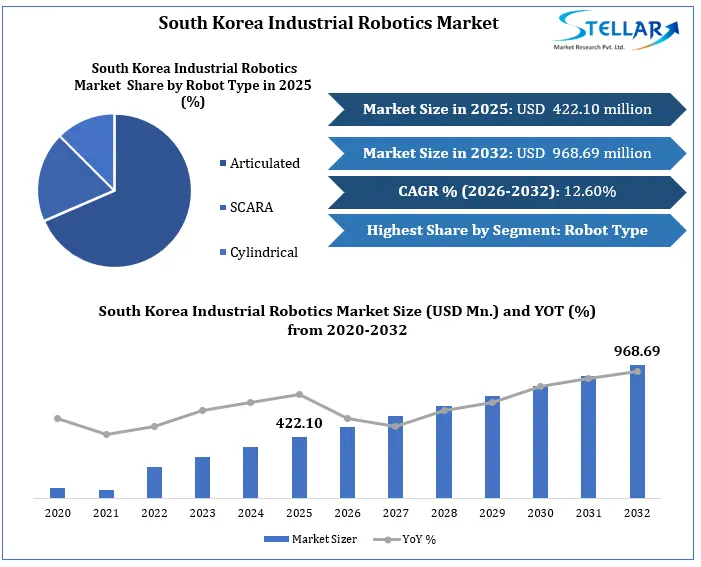
The South Korea Industrial Robotics Market was projected to grow from USD 422.10 million in 2025 to USD 968.69 million by 2034 at 12.60% CAGR, driven by increasing automation investments across manufacturing industries to improve productivity, operational efficiency, and production quality.
South Korea Industrial Robotics Market Overview
Industrial robotics is a branch of robotics focused on building, designing, and deploying automated machines to perform tasks in manufacturing and industrial environments.
Industrial robots are designed and programmed to perform specific, repetitive, and potentially hazardous tasks with high efficiency and precision.
Widely deployed across various industries, these robotic systems work alongside human operators to improve production efficiency, support quality control activities, optimise material handling and logistics operations, and accelerate manufacturing processes.
From industrial robotics to automotive industry to advanced healthcare applications, aerospace and defence, and electronics manufacturing.
The rate of adoption of industrial robots in the electrical & electronics and in automotive industries is growing significantly. For instance, as per the International Federation of Robotics (IFR), the annual installation of industrial robots in electrical & electronics industry is 125.804 units, and in automotive it was 135.461 units. In addition, end-use industries such as metal & machinery and plastics and chemical products are 76.831 units and 22.402 units
It helps to increase productivity and operational speed in many applications, improve the ability to lift heavy and unsafe payloads like nuclear waste, increase the safety standards in industrial settings, and is applied in dangerous settings, such as high-risk construction and infrastructure developments like tunnels, instead of putting human lives at risk, improving decision-making capabilities and removal of unwanted objects on conveyor belts in smart manufacturing environments.
To get more Insights: Request Free Sample Report
South Korea Industrial Robotics Market Definition
The global network engaged in the design, development, manufacturing, integration, and deployment of robotic systems utilized in production and industrial environments is covered by the Industrial Robotics Market. Robot manufacturers, automation solution providers, software developers, suppliers of components, and system integrators are all involved in assisting industries in implementing robotic technology in their day-to-day operations. Important parts, including controllers, drives, sensors, end-effectors, and robotic software platforms that facilitate automated process implementation, are also available on the market.
The market encompasses a wide range of robotic solutions designed to improve production capabilities and support modern industrial operations. Outside robot hardware, it also covers installation, programming, maintenance, training, and aftermarket services that help maintain efficient system performance throughout the equipment lifecycle. Increasing digitalization in manufacturing facilities and the rising integration of robotics with advanced industrial technologies are further expanding the market’s scope across global industrial sectors.
South Korea Industrial Robotics Market Drivers
Expanding Smart Factory and Manufacturing Automation Initiatives
Over the years, it has been observed that manufacturing companies have undergone significant transformation in terms of productivity and efficiency. Many manufacturing businesses are facing challenges to improve their production quality in order to meet the ongoing consumer demands. Therefore, many manufacturing companies are adopting more efficient robots, sophisticated software and artificial intelligence, which help them to improve their production speed with precision that was previously looked impossible for companies. Many warehouses and industrial robotics companies are investing a massive amount of capital for the development of their product portfolios. For instance, in May 2026, Smart Robotics raised approximately USD 10.9 million in Series A funding to expand its AI-driven robotic picking technology across Europe.
The investment will help the Dutch warehouse robotics company strengthen its presence in the growing warehouse automation market, with funding led by Rotterdamse Havendraken and supported by Innovation Industries and Ernij Next.
Companies such as YASKAWA, FANUC, KUKA, and Mitsubishi Electric are expanding their industrial automation and robotics solutions to support the country’s growing smart manufacturing sector.
For instance, October, 2024, Mitsubishi Electric’s investment in Formic Technologies shows that subscription-based robotics open new growth opportunities for industrial robotics manufacturers. By lowering high upfront costs and providing installation, maintenance, and software support, this model help more small and medium-sized manufacturers adopt robots for palletizing, packaging, and other automation tasks.
In addition, government-backed smart factory programs and continued investment in digital manufacturing technologies are further accelerating the use of robotics across South Korea. Manufacturers are increasingly adopting artificial intelligence, machine vision, and autonomous robotic systems in production facilities to improve quality control, lower operating costs, and strengthen long-term manufacturing competitiveness.
Rising Investment in Electric Vehicle and Battery Manufacturing
In South Korea, the demand for industrial robots is increasing across automotive and battery production plants due to the growing investments in electric vehicles and battery manufacturing.
A big center for battery production, such as LG Energy Solution, Samsung SDI and SK On is increasing the production of batteries because there is a demand for more robotic automation in assembling them and making cells. Car manufacturers like Hyundai Motor Company and Kia Corporation employ industrial robots for tasks such as welding, assembly work, painting jobs and handling materials to better their production process plus improve the quality of products. The exact manufacturing activities that involve making battery cells or assembling battery packs with EV components need very precise methods that can be done repeatedly in a consistent manner. This fact supports broader use of industrial robots for checking products over during inspections, tapping parts together on assemblies and ensuring applications meet standard levels of quality control.
Domestic provider companies in South Korea like Hyundai Robotics, Doosan Robotics, and Rainbow Robotics, are improving automation solutions to support the growing necessities of EV and battery manufacturers. Rising investments in smart factories and advanced manufacturing technologies are rising the integration of robotics, artificial intelligence, and machine vision systems, helping manufacturers improve productivity, reduce defects, and support large-scale EV and battery production.
South Korea Industrial Robotics Market Opportunities
Expansion of Robotics in Healthcare and Medical Device Manufacturing
Healthcare and medical technology manufacturing investment is rising in South Korea, leading to a higher demand for industrial robots. Manufacturers of medical devices, diagnostic tools and pharmaceutical goods need more production processes that are high-precision with controlled contamination. Robotic automation aids these manufacturers by enhancing accuracy and consistency as well as meeting regulatory standards. The growth of advanced healthcare manufacturing buildings keeps encouraging the increased use of industrial robotics within South Korea's medicine and life sciences sectors.
Growth Potential in Small and Medium-Sized Manufacturing Enterprises
Many small and medium manufacturers in South Korea keep improving their production processes by using automation. The rise of inexpensive robotic systems, easy-to-use programming technologies and models such as robotics-as-a-service are making it easier for these companies to use industrial automation. As manufacturers seek to enhance competitiveness, product quality and efficiency in operations, they increasingly adopt industrial robots across more industries, not just within large manufacturing plants but beyond them as well.
South Korea Industrial Robotics Market Trends
Expansion of Robotics Adoption in Semiconductor and Battery Manufacturing
The progress in manufacturing semiconductors and rechargeable batteries is leading to high use of industrial robots in the areas where things are made or manufactured. These kinds of robots ensure jobs like handling wafers, doing precise assembly work, checking products for problems, packing items up and moving materials around within very controlled production settings. As people invest more money in places that make semiconductors or fabricate battery units, this increases the need for sophisticated robotic systems, which can perform with great precision and consistency, especially across South Korea.
Increasing Deployment of Collaborative Robots in Smart Factories
Robots that collaborate with humans are more popular in the smart factory environment because manufacturers need automation solutions that can safely operate next to people. These types of robots are commonly used for tasks like assembling parts, inspecting items and moving materials around, especially in small to medium-sized manufacturing companies. The support from governments through programs for intelligent manufacturing and continuous efforts towards digital factories is helping increase the use of collaborative robots across South Korea's industrial landscape.
South Korea Industrial Robotics Market Segmentation (2025)
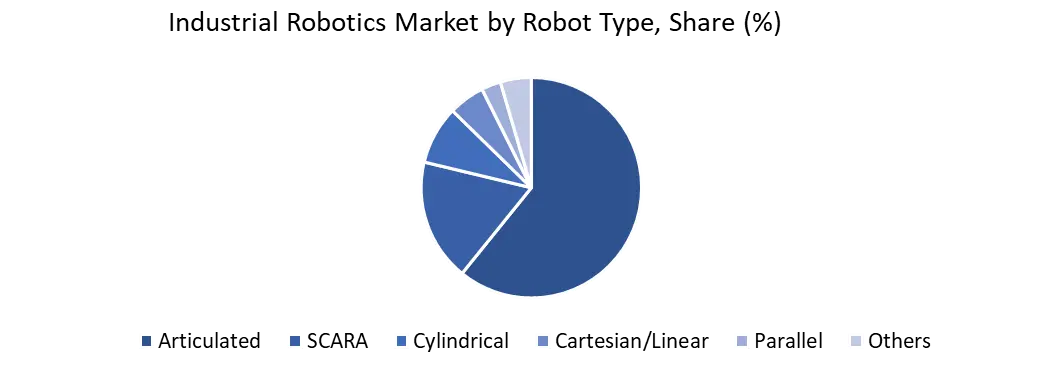
South Korea Industrial Robotics Market by Robot Type
Articulated robots account for the largest share at 61.8%, supported by their flexibility and wide use in welding, assembly, painting, and material handling applications. SCARA robots are the fastest-growing segment, driven by rising demand for high-speed and precision-based tasks in electronics and assembly operations. Cartesian or linear robots are showing steady growth due to their accuracy and reliability, while parallel robots are expanding rapidly with greater use in packaging and pick-and-place applications. Cylindrical robots are recording moderate growth in specialized industrial processes, and the other segment continues to grow steadily across niche automation applications.
South Korea Industrial Robotics Market by Application
Material handling holds the major portion of 28.6%, because it is commonly used for moving, loading, unloading and arranging materials on pallets in manufacturing plants. Welding and soldering are the fastest-growing segments due to their extensive use in car manufacturing and metal shaping industries. Assembly is increasing rapidly as manufacturers automate complicated production procedures to enhance uniformity and efficiency. Pick and place application is growing rapidly due to increasing needs from electronics, packaging and consumer goods production. Cutting and processing are showing a moderate rise in precision manufacturing. At the same time, other segments continue to maintain a steady demand across certain industrial applications.
South Korea Industrial Robotics Market by Payload Capacity
Up to 16 KG robots account for the largest share at 37.4%, supported by their wide use in electronics, assembly, packaging, and light material handling applications where speed and precision are important. Robots in the 16 to 60 KG range are the fastest-growing segment, driven by increasing automation in general manufacturing, food processing, and logistics operations. Robots with 61 to 225 KG payload capacity are showing steady growth, as they are widely used for welding, palletizing, and heavy-duty material handling in automotive and industrial facilities. Above 225 KG robots continue to record moderate growth, supported by demand for large-payload applications such as automotive body assembly, foundry operations, and heavy machinery manufacturing.

South Korea Industrial Robotics Market by Industry
Automotive holds the largest share at 36.5%, supported by the extensive use of industrial robots for welding, painting, assembly, and material handling in vehicle manufacturing plants. Electronics and electrical is the fastest-growing segment, driven by rising production of semiconductors, consumer electronics, batteries, and electronic components that require high-precision automation. Metals and machinery are showing steady growth as manufacturers increasingly use robots for fabrication, machining, and welding processes. Food and beverages are growing rapidly due to wider automation in packaging, processing, and quality control applications. Healthcare and pharmaceutical continue to record moderate growth, supported by demand for precision manufacturing and sterile production environments, while the others segment maintains stable expansion across various industrial sectors.
South Korea Industrial Robotics Competitive Landscape 2025
The South Korea Industrial Robotics Market is highly competitive, supported by the country’s strong manufacturing base and wide use of automation technologies. Major domestic companies such as Hyundai Robotics, Doosan Robotics, and Rainbow Robotics are expanding their robotics portfolios to serve automotive, electronics, semiconductor, and general manufacturing industries. Ongoing investment in robot performance, precision control, and industrial automation capabilities is further intensifying competition across the market.
Manufacturers are increasingly prioritizing collaborative robots, intelligent automation systems, and AI-enabled robotic solutions to meet changing production needs. Companies are developing robots for flexible manufacturing, high-precision assembly, quality inspection, and material handling applications. Rising demand from semiconductor fabrication, battery production, and electronics manufacturing facilities is encouraging suppliers to introduce more advanced robotic technologies designed for high-tech industrial environments.
Competition is also being influenced by the expansion of smart factory initiatives and digital manufacturing programs across South Korea. Robotics companies are adding machine vision, artificial intelligence, autonomous operation, and industrial software platforms to their solutions to improve production efficiency and operational reliability. Strategic partnerships with manufacturers, technology providers, and research institutions are also helping accelerate innovation and strengthen the market position of robotics suppliers across South Korea.
South Korea Industrial Robotics Market Recent Developments
Samsung, Hyundai, SK, LG (November 2025): Samsung, Hyundai Motor Group, SK, and LG announced a coordinated domestic investment wave equivalent to roughly USD 480 billion, targeting advanced semiconductors, AI data centers, and robotics.
KUKA (December 2025): KUKA (owned by Midea Group) serves South Korea's automotive and electronics industries with industrial robots and automation systems. Revenue of €3.9 billion (2025) includes Korean market operations.
LG CNS (May 2026): LG CNS became the first Korean company to launch a full end-to-end robot training platform, "Physical Works," which cuts robot deployment time to 1-2 months using AI-generated simulation data.
South Korea Industrial Robotics Regional Analysis
The Seoul Capital Area, including Seoul, Gyeonggi-do, and Incheon, leads the South Korea Industrial Robotics Market due to its strong base of advanced manufacturing facilities, robotics developers, semiconductor companies, electronics manufacturers, and research institutions. The region also benefits from major investments in smart factories, industrial automation, and high-tech production. Meanwhile, the Gyeongsang Region, including Ulsan, Daegu, Busan, and Changwon, is growing at the fastest pace, supported by its strong automotive, shipbuilding, machinery, and heavy industrial sectors, where robotics adoption is increasing to improve productivity and manufacturing efficiency.
The Chungcheong Region is growing rapidly, supported by expanding investments in semiconductors, batteries, electronics, and advanced manufacturing in cities such as Daejeon and Cheongju. Wider use of automation technologies in high-value manufacturing industries is continuing to strengthen robotics demand across the region. Meanwhile, the Jeolla Region is showing steady growth, driven by automation adoption in food processing, agricultural equipment manufacturing, renewable energy components, and general industrial production facilities.
|
Industrial Robotics Market |
|||
|
Report Coverage |
Details |
||
|
Base Year: |
2025 |
Forecast Period: |
2026-2034 |
|
Historical Data: |
2020 to 2025 |
Market Size in 2025: |
USD 422.10 Mn. |
|
Forecast Period 2026 to 2034 CAGR: |
12.60% |
Market Size in 2034: |
USD 968.69 Mn. |
|
Segments
|
By Robot Type |
Articulated SCARA Cylindrical Cartesian/Linear Parallel Others |
|
|
By Application
|
Pick and Place Welding & Soldering Material Handling Assembling Cutting & Processing Others |
||
|
By Payload Capacity |
Up to 16 KG 16 to 20 KG 61 to 225 KG Above 225 KG |
||
|
By Industry |
Automotive Healthcare & Pharmaceutical Food & Beverages Metals & Machinery Others |
||
Key Players Profiles Covered in the Report
- ABB
- YASKAWA
- FANUC
- KUKA
- Mitsubishi Electric
- Kawasaki Heavy Industries
- DENSO
- NACHI-FUJIKOSHI
- EPSON
- Durr
- Universal Robots
- Omron Adept
- b+m Surface Systems
- Stäubli
- Comau
- Yamaha
- IGM
- ST Robotics
- Franka Emika
- CMA Robotics
- Delta Electronics
- Rethink Robotics
- Techman Robots
- Precise Automation
- Siasun
Frequently Asked Questions
An aging workforce and a declining working-age population are encouraging manufacturers to invest in robotics to maintain production capacity, reduce labor dependency, and improve operational efficiency.
Smart factory initiatives are accelerating the integration of industrial robots with AI, IoT, machine vision, and real-time analytics, enabling manufacturers to improve process control, production flexibility, and equipment performance.
The country's large-scale production of consumer electronics, displays, batteries, and electronic components requires highly precise and automated manufacturing processes, creating strong demand for industrial robots.
Collaborative robots are gaining traction among small and medium-sized manufacturers by providing flexible automation solutions that can safely work alongside employees and support assembly, inspection, and material handling tasks without extensive facility modifications.
1. South Korea Industrial Robotics Market: Introduction
2. South Korea Industrial Robotics Market: Executive Summary
2.1. South Korea Industrial Robotics Market Size And Forecast (USD Million)
2.2 Market Definition
2.3 Market Segmentation
2.4 Research Timelines
2.5 Assumptions
2.6 Limitation
3. South Korea Industrial Robotics Market: Research Methodology
3.1 Data Mining
3.2 Secondary Research
3.3 Primary Research
3.4 Subject Matter Expert Advice
3.5 Quality Check
3.6 Final Review
3.7 Data Triangulation
3.8 Top-Down Approach
3.9 Bottom-Up Approach
3.10 Research Flow
3.11 Data Sources
4. South Korea Industrial Robotics Market: Market Attractiveness Mapping
4. 1 South Korea Industrial Robotics Market Overview
4.2 Competitive Analysis: Funnel Diagram (Tier 1, Tier 2, Tier 3)
4.3 South Korea Industrial Robotics Market Absolute Market Opportunity
4.4 South Korea Industrial Robotics Market Attractiveness Analysis, By Region
4.5 South Korea Industrial Robotics Market Attractiveness Analysis, By Robot Type
4.6 South Korea Industrial Robotics Market Attractiveness Analysis, By Application
4.7 South Korea Industrial Robotics Market Attractiveness Analysis, By Payload Capacity
4.8 South Korea Industrial Robotics Market Attractiveness Analysis, By Industry
4.9 Future Market Opportunities
5. South Korea Industrial Robotics Market: Market Outlook
5.1 South Korea Industrial Robotics Market Evolution
5.2 Industrial Robotics Adoption Analysis
5.3 Market Trends
5.4 Market Dynamics
5.4.1 Market Drivers
5.4.2 Market Restraints
5.4.3 Market Trends
5.4.4 Market Opportunity
5.5 Porter’s Five Forces Analysis
5.5.1 Threat Of New Entrants
5.5.2 Bargaining Power Of Suppliers
5.5.3 Bargaining Power Of Buyers
5.5.4 Threat Of Substitute Products
5.5.5 Competitive Rivalry Of Existing Competitors
5.6 PESTEL Analysis
5.7 Value Chain Analysis
5.8 Industrial Robotics Infrastructure Development Analysis
5.9 Pricing Analysis
5.10 Geopolitical Impact Assessment
5.11 Regulatory Framework and Policy Impact Assessment
5.12 Technology Landscape
6. South Korea Industrial Robotics Market: By Robot Type, 2026-2032 (USD Million)
6.1 Articulated
6.2 SCARA
6.3 Cylindrical
6.4 Cartesian/Linear
6.5 Parallel
6.6 Others
7. South Korea Industrial Robotics Market: By Application, 2026-2032 (USD Million)
7.1 Pick and Place
7.2 Welding & Soldering
7.3 Material Handling
7.4 Assembling
7.5 Cutting & Processing
7.6 Others
8. South Korea Industrial Robotics Market: By Payload Capacity, 2026-2032 (USD Million)
8.1 Up to 16 KG
8.2 16 to 20 KG
8.3 61 to 225 KG
8.4 Above 225 KG
9. South Korea Industrial Robotics Market: By Industry, 2026-2032 (USD Million)
9.1 Automotive
9.2 Healthcare & Pharmaceutical
9.3 Food & Beverages
9.4 Metals & Machinery
9.5 Others
10. Industrial Robotics Competitive Matrix
11. Industrial Robotics Market: Company Benchmarking
12. Merger & Acquisition
13. Industrial Robotics Market: Company Profiles
1. ABB
2. YASKAWA
3. FANUC
4. KUKA
5. Mitsubishi Electric
6. Kawasaki Heavy Industries
7. DENSO
8. NACHI-FUJIKOSHI
9. EPSON
10. Durr
11. Universal Robots
12. Omron Adept
13. b+m Surface Systems
14. Stäubli
15. Comau
16. Yamaha
17. IGM
18. ST Robotics
19. Franka Emika
20. CMA Robotics
21. Delta Electronics
22. Rethink Robotics
23. Techman Robots
24. Precise Automation
25. Siasun
14. Risk Assessment and Scenario Analysis
15. Strategic Opportunity
16. Investments & Funding Analysis
17. Strategic Roadmap
18. Analyst Recommendations