ENG
ENG Japanese
  French
  German
  Korean
mHealth Market Analysis 2026–2032: Size, Share, Competitive Landscape & Growth Trends
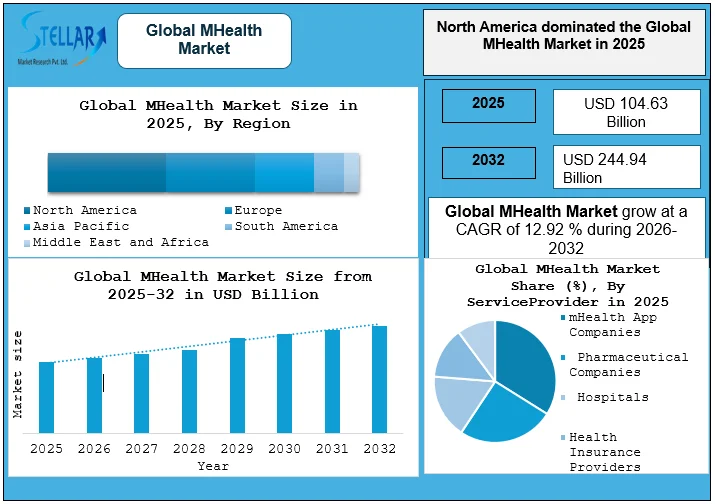
The Mobile Health (mHealth) Market is projected to grow from USD 104.63 billion in 2025 to USD 244.94 billion by 2032, registering a CAGR of 12.92%. This growth is boosted by rising smartphone penetration, expanding internet connectivity, increasing demand for remote healthcare services, and adoption of mobile health apps, wearable health devices, and telemedicine platforms.
mHealth Market Overview
The global mHealth market is emerging as a leading segment in digital health solutions, driven by wearable technology adoption, telemedicine expansion, AI-enabled analytics, and supportive health policies worldwide. mHealth solutions include fitness tracking apps, chronic disease management platforms, teleconsultation services, wellness programs, and RPM apps, offering seamless real-time data exchange between providers and users.
mHealth Market Key Market Highlights (2025)
- Remote monitoring services hold the largest share in the mHealth market, driven by rising adoption of digital healthcare solutions for chronic disease management and continuous patient monitoring.
- Rapid smartphone penetration, with over 7.4 billion smartphones globally, is significantly expanding access to mobile health applications and digital healthcare services.
- Platform adoption remains strong, with 54% of iOS users and 36% of Android users having downloaded health applications, indicating higher engagement within the Apple ecosystem.
- Young adults aged 18–34 represent the most active demographic, driving higher engagement with mHealth and wellness applications.
- Regional adoption continues to expand, with 43% of U.S. consumers and nearly 70% of Indian users relying on health apps.
- Chronic disease management accounts for around 45% of mHealth demand, particularly for diabetes, cardiovascular, and respiratory care solutions.
- Asia-Pacific represents over 55% of global mHealth users, driven by mobile-first healthcare adoption in countries such as India and China.
- Healthcare applications generate nearly 75% of total mHealth revenue, outperforming general wellness applications.
- Institutional buyers, including hospitals and healthcare providers, account for over 50% of global mHealth contract value.
- Data security and privacy compliance influence more than 70% of procurement decisions in digital healthcare solutions.
To get more Insights: Request Free Sample Report
mHealth Market Dynamics
Government & Policy Support to drive the mHealth Market growth
Strong government initiatives and policy frameworks significantly drive mHealth market growth, ensuring interoperability, patient trust, and healthcare digitization.
- India (ABDM & ABHA): 568M digital health IDs and 230,000+ verified facilities, enabling FHIR-based interoperability and seamless teleconsultation.
- China: State-led digital health programs integrated with WeChat deliver AI-enabled consultations and behavior-change programs.
- Europe: Telehealth regulations provide CE-marking, reimbursement clarity, and data protection standards, boosting app adoption.
- Africa & Asia: WHO Be He@lthy initiative and mDiabetes campaigns provide SMS-based health communication for NCDs and COVID-19 awareness.
|
Region / Country |
Government / Program |
Key mHealth Focus Areas |
Implementation Highlights |
|
India |
Ayushman Bharat Digital Mission (ABDM) |
Digital health IDs, telemedicine, mobile health apps |
Unique Health ID (ABHA), eSanjeevani teleconsultations, PM-ABHIM funding for rural digital infrastructure |
|
United States |
National Institutes of Health (NIH) |
mHealth research funding, app-based interventions |
Programs such as Mobile Health Technology in LMICs (R21/R33); focus on validation, clinical outcomes, and scalability |
|
Belgium (Europe) |
mHealthBelgium Platform |
App validation, reimbursement, interoperability |
CE-marked apps evaluated through a validation pyramid covering data security, clinical value, and socioeconomic impact |
|
Africa & Asia |
WHO Be He@lthy Initiative |
SMS-based health communication, NCDs, COVID-19 awareness |
Implemented in Burkina Faso, Egypt, Philippines, Senegal, Sudan, Tunisia; Egypt’s mDiabetes campaign reached ~330,000 users |
|
China |
National Health Programs with WeChat Integration |
Tobacco cessation, digital behavior change |
mTobaccoCessation program delivered via WeChat, integrated into national health systems |
Telemedicine Adoption Across Emerging and Developed Healthcare Systems
Telemedicine adoption accelerated post-COVID-19, particularly in chronic disease management, maternal health, and HIV care, even in resource-constrained regions.
- Sub-Saharan Africa: South Africa, Kenya, Nigeria deployed telehealth to improve access to primary and chronic care.
- North America & Europe: Telemedicine supported by reimbursement programs and enterprise healthcare integration, driving high-margin revenue.
.
mHealth Market Restraints
Data Privacy and Cybersecurity Vulnerabilities Limiting mHealth Adoption
Data Privacy & Cybersecurity
Security vulnerabilities pose significant challenges to market growth.
- In 2025, ~71% of mHealth apps had major flaws, including weak encryption, unpatched libraries, and broken TLS implementation.
- 28% of iOS and 34% of Android apps faced encryption risks, leading to data breaches impacting 500,000+ patients in Europe.
- High-profile incidents, like HeartRate Monitor Pro, resulted in 40% decline in downloads, and nearly 50% of physicians became hesitant to recommend mHealth solutions.
mHealth Market Opportunities
AI & Predictive Analytics – Market Opportunity
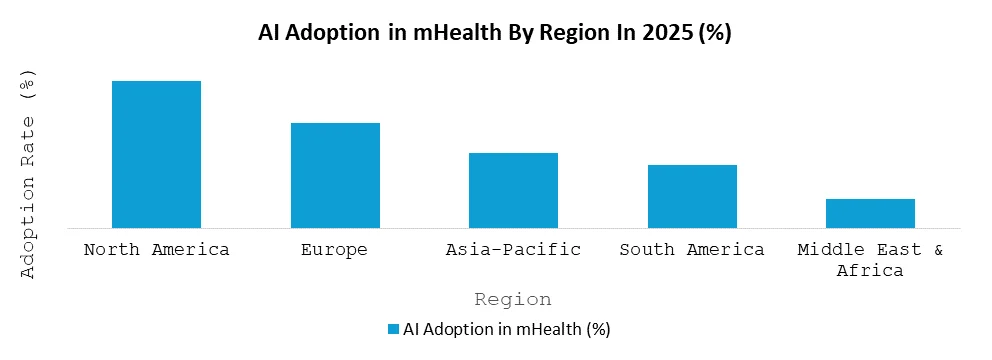
Artificial intelligence and predictive analytics represent a high-impact opportunity for the mHealth market, enabling real-time diagnostics, personalized care pathways, and early disease intervention using mobile and wearable data. AI-driven analytics transform continuous streams of glucose levels, ECG signals, heart rate, and vitals into actionable clinical insights, particularly valuable in resource-constrained settings with limited physician access. Advanced mHealth platforms now support proactive care by predicting health deterioration, reducing hospital dependency, and improving long-term outcomes for chronic and high-risk patients. Integration with digital health infrastructures and EHR systems further strengthens scalability and clinical acceptance. As governments and providers prioritize preventive and value-based care, AI-enabled mHealth solutions are positioned to significantly lower healthcare costs, improve population health outcomes, and expand access to timely interventions across both developed and emerging economies.
mHealth Market Segment Analysis
The mHealth application segment dominates the mHealth Market, holding over xx% share in 2025, due to widespread smartphone and internet adoption. Its rapid growth is driven by apps for remote patient monitoring, medication management, disease tracking, fitness, women’s health, and personal health records. These solutions enhance healthcare accessibility, efficiency, and patient engagement, making apps the most preferred mHealth component.

mHealth Market Regional Analysis
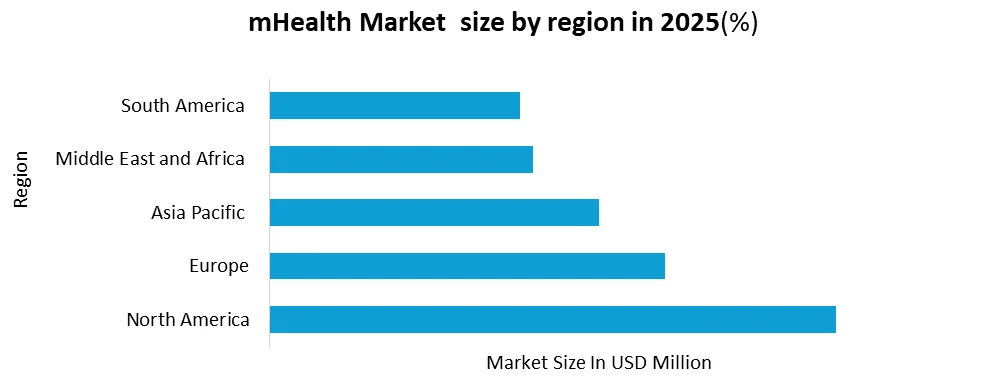
North America dominated the global mHealth market, accounting for XX.X% of Market Share in 2025, Boosted by strong healthcare investments, advanced connectivity, and a focus on chronic disease management. The U.S. leads adoption with 43% of adults using health apps, highlighted by platforms like Amwell, which facilitated over 50 million virtual consultations in 2025, supporting remote monitoring and mental health care. In the United States, high adoption of telehealth and chronic care apps continues, supported by regulatory emphasis on interoperability and data privacy. China benefits from state-driven policies, widespread smartphone use, and AI diagnostics, targeting elderly care and bridging healthcare access disparities
In Asia-Pacific, countries such as India and China exhibit 60–70% adult adoption, driven by digital health initiatives and AI integration. Apps like 1mg in India deliver prescription management to 30 million users, while Ping A Good Doctor in China provides AI-powered consultations to over 180 million patients annually. India’s mHealth landscape is advancing rapidly with 568 million ABHA health IDs facilitating unified records and consent management, while over 100 programs, including eSanjeevani, are integrated into the Ayushman Bharat Digital Mission with FHIR/SNOMED-CT alignment
Sub-Saharan Africa presents high-growth potential, with South Africa’s MomConnect reaching 15 million maternal health users, Kenya’s Ilara Health expanding point-of-care diagnostics in rural clinics, and Nigeria’s Doctoora offering teleconsultations to over 2 million insured patients, improving access in underserved regions.
mHealth Market Competitive Landscape
The mHealth market is highly fragmented, with a mix of global tech players, digital health startups, and regional innovators. The competitive landscape in 2025 is characterized by platform integration, AI adoption, and interoperability focus.
The global mHealth market has been shaped by leading players driving innovation and expansion over the last five years. Babylon Health has scaled AI-driven self-diagnosis and teleconsultation services from the UK to global markets, including Rwanda, while navigating data privacy regulations. 1mg (now Tata Digital) expanded to over 160 million users, focusing on digital pharmacy, lab test bookings, and integrating health records into seamless consumer health journeys. Google strengthened the Android FHIR SDK, enabling interoperable app development and EHR integration, while Apple enhanced HealthKit and wearable integration, leveraging FHIR standards to improve user engagement. Fitness platforms like Fitbit and Strava accumulated billions of activity records, using gamification and cloud analytics to drive long-term user retention and wellness tracking.
MHealth Market Scope
|
MHealth Market |
|||
|
Report Coverage |
Details |
||
|
Base Year: |
2025 |
Forecast Period: |
2026-2032 |
|
Historical Data: |
2020 to 2025 |
Market Size in 2025: |
USD 104.63 billion |
|
Forecast Period 2026 to 2032 CAGR: |
12.92% |
Market Size in 2032: |
USD 244.94 billion |
|
MHealth Market Segment Analysis |
By Category |
|
|
|
By Service Type |
|
||
|
By Service Provider |
|
||
MHealth Market Key Players
- Teladoc Health
- Livongo (Teladoc)
- Fitbit (Google)
- Apple Health
- Medtronic
- Philips HealthSuite
- Omron Healthcare
- Cerner (Oracle)
- BioTelemetry
- AirStrip
- MD Revolution
- Flatiron Health
- Pager Health
- Click Therapeutics
- WHOOP
- Modern Health
- Octave
- Computools
- Techstack
- Langate
- Jelvix
- Vention
- Binah.ai
- Adheretech
- ZeaMed Healthcare
- Biyomod
- Healthkon Digital
- Medfast Egypt
- Others
Frequently Asked Questions
The US, Germany, UK, China, India, and Japan lead adoption due to infrastructure, mobile penetration, and government initiatives.
AI, IoT, wearables, telemedicine, blockchain, and health analytics drive innovation and real-time remote healthcare monitoring.
Medtronic, Philips, Fitbit, Cerner, Siemens, Huawei focus on AI, telehealth, wearables, partnerships, and global market Growth.
Demand is driven by chronic diseases, digital health awareness, telemedicine, while supply grows via smartphones, wearables, and 5G networks.
MHealth Market Introduction
1.1. Study Assumption and Market Definition
1.2. Scope of the Study
1.3. Executive Summary
2. MHealth Market: Competitive Landscape
2.1. SMR Competition Matrix
2.2. Key Players Benchmarking
2.2.1. Company Name
2.2.2. Headquarter
2.2.3. Product Segment
2.2.4. End-User Segment
2.2.5. Revenue Details in 2025
2.2.6. Market Share (%)
2.2.7. Growth Rate (%)
2.2.8. Return on Investment (%)
2.2.9. Technological Capabilities
2.2.10. Geographical Presence
2.3. Market Structure
2.3.1. Market Leaders
2.3.2. Market Followers
2.3.3. Emerging Players
2.4. Mergers and Acquisitions Details
3. MHealth Market: Dynamics
3.1. MHealth Market Trends
3.2. MHealth Market Dynamics
3.2.1. Drivers
3.2.2. Restraints
3.2.3. Opportunities
3.2.4. Challenges
3.3. PORTER’s Five Forces Analysis
3.4. PESTLE Analysis
3.5. Key Opinion Leader Analysis for the Global Industry
4. mHealth Market Regulatory Landscape
4.1. US FDA Guidelines
4.2. EU MDR Compliance
4.3. HIPAA & Data Privacy Laws
4.4. Asia-Pacific Regulatory Trends
4.5. Reimbursement Policies
4.6. Impact on Market Growth
5. mHealth Market Investment & Funding Analysis
5.1. Venture Capital Trends
5.2. Private Equity Investments
5.3. Strategic Corporate Funding
5.4. Startup Ecosystem
5.5. M&A Activity
5.6. Future Investment Outlook
6. mHealth Market Technology Innovations & Trends
6.1. AI & Machine Learning Applications
6.2. IoT & Wearables Integration
6.3. Predictive Analytics in Healthcare
6.4. Cloud-Based Health Platforms
6.5. Blockchain Security
6.6. Future Tech Outlook
7. MHealth Market: Global Market Size and Forecast by Segmentation (by Value in USD Billion) (2025-2032)
7.1. MHealth Market Size and Forecast, By Category (2025-2032)
7.1.1. Mobile Applications
7.1.1.1. Disease & Treatment Management
7.1.1.1.1. Healthcare Providers/Insurance
7.1.1.1.2. Medication Reminders
7.1.1.1.3. Women Health and Pregnancy
7.1.1.1.4. Disease Specific
7.1.1.2. Wellness Management
7.1.1.2.1. Fitness
7.1.1.2.2. Lifestyle and Stress
7.1.1.2.3. Diet and Nutrition
7.1.1.3. Others
7.1.2. Wearables
7.1.3. Body & Temperature Monitors
7.1.4. Sleep Trackers
7.1.5. Fitness Trackers
7.1.6. Glucose Monitors
7.1.7. BP Monitors
7.1.8. Cardiac Monitors
7.1.9. Others
7.2. MHealth Market Size and Forecast, By Service Type (2025-2032)
7.2.1. Monitoring Services
7.2.2. Fitness and Wellness Solutions
7.2.3. Diagnostic Services
7.2.4. Treatment Services
7.2.5. Other Services
7.3. MHealth Market Size and Forecast, Application (2025-2032)
7.3.1. mHealth App Companies
7.3.2. Pharmaceutical Companies
7.3.3. Hospitals
7.3.4. Health Insurance Providers
7.3.5. Others
7.4. MHealth Market Size and Forecast, By Region (2025-2032)
7.4.1. North America
7.4.2. Europe
7.4.3. Asia Pacific
7.4.4. Middle East and Africa
7.4.5. South America
8. North America MHealth Market Size and Forecast by Segmentation (by Value in USD Billion) (2025-2032)
8.1. North America MHealth Market Size and Forecast, By Category (2025-2032)
8.2. North America MHealth Market Size and Forecast, By Service Type (2025-2032)
8.3. North America MHealth Market Size and Forecast, By Application (2025-2032)
8.4. North America MHealth Market Size and Forecast, by Country (2025-2032)
8.4.1. United States
8.4.2. Canada
8.4.3. Mexico
9. Europe MHealth Market Size and Forecast by Segmentation (by Value in USD Billion) (2025-2032)
9.1. Europe MHealth Market Size and Forecast, By Category (2025-2032)
9.2. Europe MHealth Market Size and Forecast, By Service Type (2025-2032)
9.3. Europe MHealth Market Size and Forecast, By Application (2025-2032)
9.4. Europe MHealth Market Size and Forecast, by Country (2025-2032)
9.4.1. United Kingdom
9.4.2. France
9.4.3. Germany
9.4.4. Italy
9.4.5. Spain
9.4.6. Sweden
9.4.7. Russia
9.4.8. Rest of Europe
10. Asia Pacific MHealth Market Size and Forecast by Segmentation (by Value in USD Billion) (2025-2032)
10.1. Asia Pacific MHealth Market Size and Forecast, By Category (2025-2032)
10.2. Asia Pacific MHealth Market Size and Forecast, By Service Type (2025-2032)
10.3. Asia Pacific MHealth Market Size and Forecast, By Application (2025-2032)
10.4. Asia Pacific MHealth Market Size and Forecast, by Country (2025-2032)
10.4.1. China
10.4.2. S Korea
10.4.3. Japan
10.4.4. India
10.4.5. Australia
10.4.6. Indonesia
10.4.7. Malaysia
10.4.8. Philippines
10.4.9. Thailand
10.4.10. Vietnam
10.4.11. Rest of Asia Pacific
11. Middle East and Africa MHealth Market Size and Forecast (by Value in USD Billion) (2025-2032)
11.1. Middle East and Africa MHealth Market Size and Forecast, By Category (2025-2032)
11.2. Middle East and Africa MHealth Market Size and Forecast, By Service Type (2025-2032)
11.3. Middle East and Africa MHealth Market Size and Forecast, By Application (2025-2032)
11.4. Middle East and Africa MHealth Market Size and Forecast, by Country (2025-2032)
11.4.1. South Africa
11.4.2. GCC
11.4.3. Egypt
11.4.4. Nigeria
11.4.5. Rest of ME&A
12. South America MHealth Market Size and Forecast by Segmentation (by Value in USD Billion) (2025-2032)
12.1. South America MHealth Market Size and Forecast, By Category (2025-2032)
12.2. South America MHealth Market Size and Forecast, By Service Type (2025-2032)
12.3. South America MHealth Market Size and Forecast, By Application (2025-2032)
12.4. South America MHealth Market Size and Forecast, by Country (2025-2032)
12.4.1. Brazil
12.4.2. Argentina
12.4.3. Colombia
12.4.4. Chile
12.4.5. Rest Of South America
13. mHealth Market Company Profile: Key Players
13.1. Teladoc Health
13.1.1. Company Overview
13.1.2. Business Portfolio
13.1.3. Financial Overview
13.1.4. SWOT Analysis
13.1.5. Strategic Analysis
13.1.6. Recent Developments
13.2. Livongo (Teladoc)
13.3. Fitbit (Google)
13.4. Apple Health
13.5. Medtronic
13.6. Philips HealthSuite
13.7. Omron Healthcare
13.8. Cerner (Oracle)
13.9. BioTelemetry
13.10. iRhythm Technologies
13.11. AirStrip
13.12. MD Revolution
13.13. Flatiron Health
13.14. Pager Health
13.15. Click Therapeutics
13.16. WHOOP
13.17. Modern Health
13.18. Octave
13.19. Computools
13.20. Techstack
13.21. Langate
13.22. Jelvix
13.23. Vention
13.24. Robin Health
13.25. Binah.ai
13.26. Adheretech
13.27. ZeaMed Healthcare
13.28. Biyomod
13.29. Healthkon Digital
13.30. Medfast Egypt
14. mHealth Market Key Findings
15. mHealth Market Analyst Recommendations
16. mHealth Market: Research Methodology