ENG
ENG Japanese
  French
  German
  Korean
Impulse Dosing Valves Market Report 2025–2032: Global Market Size, Volume Analysis, Competitive Landscape, Segmentation Analysis & High-Yield Investment Opportunities
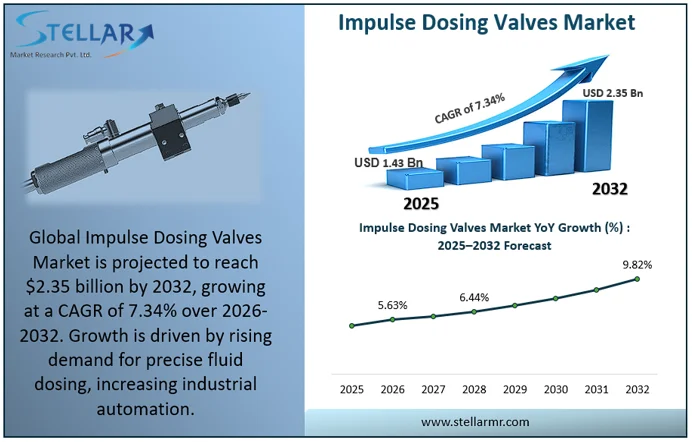
The global Impulse Dosing Valves Market is valued at USD 1.43 billion in 2025 and is projected to reach USD 2.35 billion by 2032, advancing at a CAGR of 7.34% over the 2026–2032 forecast period. This sustained expansion is driven by accelerating industrial automation adoption, tightening precision dosing regulations across chemical and pharmaceutical sectors, and rapid deployment of IoT-integrated valve management systems across high-growth emerging markets.
Impulse Dosing Valves Market Key Highlights:
- Impulse Dosing Valves Market Size 2025: USD 1.43 Billion
- Projected Size 2032: USD 2.35 Billion
- Value CAGR (2026–2032): 7.34%
- Volume CAGR (2026–2032): 6.34%
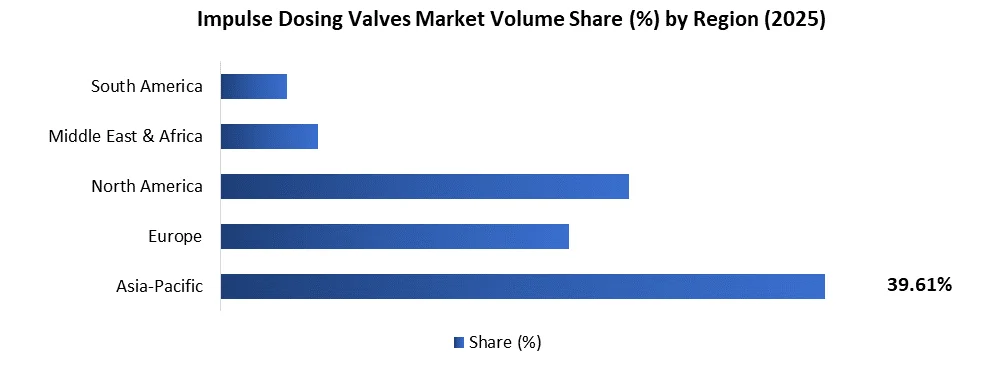
- Dominant and Fastest Growing Region: Asia Pacific (39.61% volume share, 8.48% CAGR)
- Leading Segment: One-way Valve (64.73%) | Chemical Application (46.93%)
- Electric Actuated valves hold 68% actuation-type share, driven by PLC/SCADA and Industry 4.0 compatibility.
Impulse Dosing Valves Market Overview & Definition
Impulse dosing valves are precision fluid-control devices engineered to deliver exact, repeatable fluid volumes in response to electrical or hydraulic actuation signals. Unlike continuous-flow regulators, impulse dosing valves operate in discrete open-close cycles, enabling highly accurate volumetric dispensing critical for chemical treatment, pharmaceutical manufacturing, water and wastewater processing, and specialty industrial processes.
The market encompasses one-way (unidirectional) and reversing valve architectures, actuated via electric solenoids or hydraulic systems. Modern variants increasingly incorporate embedded sensor arrays, IoT communication modules, and digital control interfaces, enabling seamless integration with Industry 4.0 plant management ecosystems. The market occupies a technically specialized niche within industrial fluid control, characterized by high switching costs, rigorous regulatory qualification requirements, and above-average margin profiles for technically differentiated suppliers.
To get more Insights: Request Free Sample Report
Impulse Dosing Valves Market: DROCT Strategic Framework
The DROCT framework delivers a five-dimensional strategic assessment of forces shaping the Impulse Dosing Valves Market through 2032.
Impulse Dosing Valves Market Drivers
Industrial automation investment exceeding USD 200 billion globally through 2030 is systematically displacing analog dosing systems with precision digital valve architectures. Regulatory mandates — including EPA Clean Water Act requirements, EU Water Framework Directive, FDA 21 CFR Part 211 for pharmaceutical manufacturing, and ISO 4413 hydraulic safety standards — enforce traceable, repeatable dosing accuracy. The water and wastewater treatment sector, processing over 380 billion liters per day globally, constitutes a structurally durable demand base.
Impulse Dosing Valves Market Restraints
Premium smart impulse dosing valves carry capital costs 3–5x above conventional metering pumps, creating adoption friction in price-sensitive markets across Southeast Asia, South America, and Sub-Saharan Africa. Integration complexity with legacy PLC/SCADA architectures and limited field service engineering talent in emerging markets further constrain near-term penetration rates.
Impulse Dosing Valves Market Opportunities
Renewable energy applications — hydrogen electrolysis, concentrated solar power, and next-generation battery manufacturing — present a high-value demand vector with zero historical installed base. Digital-as-a-Service (DaaS) and predictive maintenance subscription models create recurring revenue streams that can double installed-valve lifetime value. The USD 2.3 trillion global infrastructure modernization pipeline, particularly water treatment in APAC and MEA, will generate large replacement demand cycles through 2030.
Impulse Dosing Valves Market Challenges
Sustaining sub-1% dosing accuracy tolerance under variable temperature, pressure, and fluid viscosity conditions demands continuous engineering investment. IoT-connected valve networks introduce cybersecurity vulnerabilities with limited established best-practice frameworks. Supply chain fragility for rare-earth actuator materials and specialty polymer compounds — exposed during 2020–2023 — remains a structural procurement risk.
Impulse Dosing Valves Market Trends
Digital twin deployment for valve performance modeling is enabling zero-unplanned-downtime operational targets. PEEK polymer bodies, ceramic valve seats (>1,500 HV hardness), and PTFE-lined flow paths are extending service life beyond 10 million actuation cycles. Sustainability mandates are driving 15–30% fluid waste reduction targets by 2030, with smart dosing systems identified as a primary enabling technology.
Impulse Dosing Valves Market Segmentation Analysis:
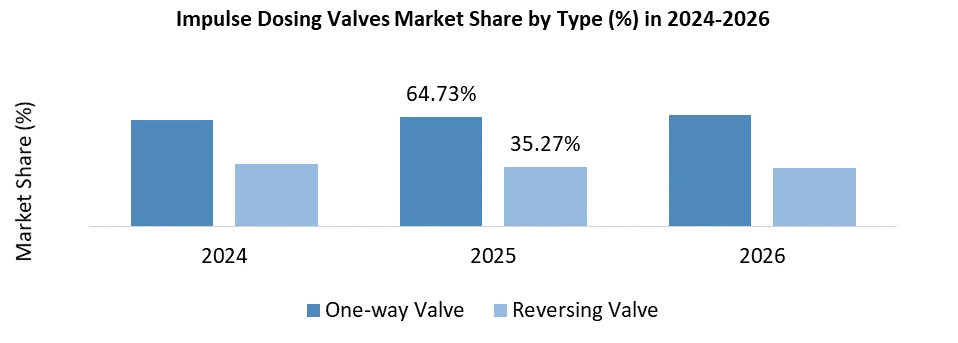
By Valve Type: One-way valves held 64.73% market share with a XX% CAGR in 2025, leading due to their low cost, broad fluid compatibility, and minimal maintenance, making them standard in chemical, water treatment, and industrial dosing applications. Reversing valves captured 35.27% share, growing faster because of bidirectional flow requirements in pharmaceutical CIP systems, semiconductor wet processing, and precision adhesive dispensing, where high-purity performance and precise fluid control were essential. While one-way valves dominated in volume and cost efficiency, reversing valves expanded in high-value, regulated markets.
By Application: Chemical segment led the global Impulse Dosing Valves market with 46.93% share in 2025, driven by EU REACH, EPA, and OSHA regulations requiring precise chemical injection, and large-scale continuous production that boosts unit consumption. The Medicine sector is the fastest-growing, fueled by FDA 21 CFR Part 211, EU GMP Annex 15, and USP Class VI standards mandating validated, traceable dosing in drug manufacturing and diagnostics. Other applications—including water treatment, food & beverage, and industrial processes—also grow, with water/wastewater treatment driving stainless-steel valve demand under EHEDG and 3-A sanitary standards, while industrial automation retrofits add incremental adoption across sectors.

Impulse Dosing Valves Market Regulatory Landscape & Compliance Impact
Regulatory frameworks across key end-use industries are a primary structural driver of impulse dosing valve adoption, establishing minimum standards for dosing accuracy, material compatibility, digital traceability, and safety validation.
- EU REACH & CLP (Europe / Chemical): Mandates corrosion-resistant, chemically inert valve materials and leak-proof architectures for hazardous fluid handling. Drives premium stainless steel and PTFE-lined valve demand.
- FDA 21 CFR Part 211/820 (USA / Pharma & Medical): Requires validated, traceable dosing systems with digital audit trails. Drives adoption of IoT-connected impulse valves with embedded data logging in pharmaceutical manufacturing.
- EU GMP Annex 11 & 15 (Europe / Pharma): Computer-readable process validation requirements accelerate deployment of digital-control-compatible dosing valve architectures in EU pharmaceutical facilities.
- EPA NPDES / Clean Water Act (USA / Water Treatment): Discharge permit compliance mandates verifiable, repeatable chemical dosing accuracy in municipal and industrial wastewater treatment.
- ISO 4413/4414 (Global / Industrial): Hydraulic and pneumatic system safety standards govern actuator design, pressure ratings, and safety valve requirements for hydraulic-actuated dosing applications.
- NSF/ANSI 61 (USA / Potable Water): Certification required for valves in contact with potable water supply systems, enforcing validated materials and construction standards.
Impulse Dosing Valves Market Regional Analysis:
Regional Breakdown of Impulse Dosing Valves Units Sold in 2025:
|
Region |
Market Overview |
Description |
|
Asia?Pacific |
Largest contributor |
Largest volume contributor owing to high manufacturing activity, rapid industrial automation, and expanding installations in China and India. |
|
Europe |
Mature market |
Mature market driven by stringent dosing regulations, strong presence of process industries, and high adoption of precision fluid management systems in Germany, France, and the Nordics. |
|
North America |
Advanced adoption |
High adoption of automated dosing systems in chemicals, oil & supported by advanced industrial infrastructure and regulatory compliance requirements. |
|
Middle East & Africa |
Growing market |
Growing demand from water desalination, wastewater treatment, and energy projects, with increasing investments in industrial automation. |
|
South America |
Emerging adoption |
Emerging adoption in medical, and chemical processing, driven by infrastructure upgrades and regulatory improvements. |
Impulse Dosing Valves Market Competitive Landscape
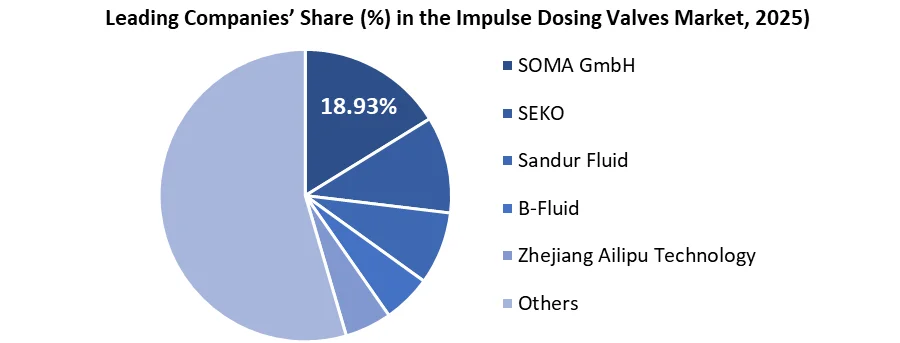
The Impulse Dosing Valves Market is moderately consolidated at the tier-1 level, with five to seven global incumbents collectively accounting for an estimated 45–55% of total market revenue. Competitive differentiation is driven by digital integration capability, material science innovation, regulatory validation depth, and certified solutions for pharmaceutical and semiconductor-grade applications.
Impulse Dosing Valves Market Structure
Tier 1: Global Leaders: Broad portfolios across valve types, actuation technologies, and application certifications. Advanced R&D pipelines in smart valve integration. Global distribution and service infrastructure. Key players: Parker Hannifin, Bürkert Fluid Control Systems, ASCO (Emerson), SMC Corporation, ProMinent GmbH.
Tier 2: Segment Specialists: Deep application expertise in targeted verticals. Strong regulatory validation credentials. Key players: Nordson EFD, Techcon Systems, SOMA GmbH, SEKO, ViscoTec (preeflow), IVEK Corporation.
Tier 3: Regional & Emerging: Cost-competitive solutions for standard-precision applications. Growing IoT capabilities. Key players: Zhejiang Ailipu Technology, Sandur Fluid Controls, Musashi Engineering, Fisnar, PVA, The Lee Company, Takasago Fluidic Systems.
What Impulse Dosing Valves Competitors Are Doing Right Now
- Allocating 12–18% of annual R&D budgets to IoT-enabled smart dosing valve platforms with edge computing and cloud-based analytics.
- Expanding manufacturing capacity in China, India, and Southeast Asia to capture APAC demand and compete with cost-advantaged domestic producers.
- Fast-tracking FDA 21 CFR, EU GMP, and NSF/ANSI 61 certifications to secure pharmaceutical and municipal water treatment procurement frameworks.
- Commercializing energy-efficient actuator technologies and fluid-recovery valve geometries targeting 20–40% reductions in fluid waste per dosing cycle.
- Pursuing targeted M&A to acquire niche precision dispensing specialists and round out smart fluid management portfolios.
Impulse Dosing Valves Market Key Players:
- SOMA GmbH
- SEKO
- Zhejiang Ailipu Technology Co., Ltd.
- Sandur Fluid Controls Private Limited
- KaiGO
- B-Fluid
- Nordson EFD (Nordson Corporation)
- Techcon Systems
- Musashi Engineering, Inc.
- Fisnar
- PVA (Precision Valve & Automation)
- ViscoTec Pumpen- u. Dosiertechnik GmbH (preeflow)
- IVEK Corporation
- The Lee Company
- Takasago Fluidic Systems
- Bürkert Fluid Control Systems
- Parker Hannifin (precision/pulsed solenoid valve lines)
- ASCO (Emerson)
- SMC Corporation
- Others
Frequently Asked Questions
Asia Pacific dominates at 39.61% volume share in 2025, growing at the fastest regional CAGR of 8.48% through 2032. China and India are the primary demand engines, supported by chemical processing expansion, water infrastructure investment, and accelerating industrial automation deployment.
One-way valves represent 64.73% of market share in 2025. Chemical processing leads application demand at 46.93%, while Medicine/Pharma is the fastest-growing application at ~8.1% CAGR, driven by FDA and EU GMP compliance requirements for validated digital dosing systems.
Leading global participants include Parker Hannifin, Bürkert Fluid Control Systems, ASCO (Emerson), SMC Corporation, ProMinent GmbH, Nordson EFD, SOMA GmbH, SEKO, ViscoTec (preeflow), and Zhejiang Ailipu Technology. These companies define the competitive frontier through precision engineering, smart integration capabilities, and global service infrastructure.
IoT integration enables real-time dosing performance monitoring, predictive maintenance, and seamless Industry 4.0 connectivity. Early adopters are reporting 30–45% reductions in valve-related unplanned downtime and measurable improvements in dosing accuracy compliance across pharmaceutical and chemical processing applications.
1. Impulse Dosing Valves Market Introduction
1.1. Study Assumption and Market Definition
1.2. Scope of the Study
1.3. Executive Summary
2. Global Impulse Dosing Valves Market: Competitive Landscape
2.1. MMR Competition Matrix
2.2. Key Players Benchmarking
2.2.1. Company Name
2.2.2. Headquarter
2.2.3. Impulse Dosing Valves Type
2.2.4. Actuation Type
2.2.5. Applications
2.2.6. Revenue Details in 2025
2.2.7. Market Share (%)
2.2.8. Growth Rate (%)
2.2.9. Return on Investment (%)
2.2.10. Technological Capabilities
2.2.11. Geographical Presence
2.3. Market Structure
2.3.1. Market Leaders
2.3.2. Market Followers
2.3.3. Emerging Players
2.4. Mergers and Acquisitions Details
3. Impulse Dosing Valves Market: Dynamics
3.1. Impulse Dosing Valves Market Trends
3.2. Impulse Dosing Valves Market Dynamics
3.2.1. Drivers
3.2.2. Restraints
3.2.3. Opportunities
3.2.4. Challenges
3.3. PORTER’s Five Forces Analysis
3.4. PESTLE Analysis
3.5. Regulatory Landscape by Region
3.6. Key Opinion Leader Analysis for the Global Industry
3.7. Analysis of Government Schemes and Initiatives for Industry
4. Impulse Dosing Valves Market Production & Capacity Analysis 2025
4.1 Global Impulse Dosing Valves Production by Region and Country
4.2 Manufacturing Output by Valve Type (One-way vs Reversing)
4.3 Manufacturing Output by Application Category (Chemical, Medicine, Others)
4.4 Manufacturing Output by Actuation Type (Electric Actuated vs Hydraulic Actuated)
4.5 Installed Production Capacity vs Capacity Utilization Trends
4.6 Capacity Expansion Plans, Localization Strategies, and Greenfield Investments by OEMs
4.7 Regional Supply Chain Dependencies and Risk Assessment
4.8 Production Lead Time, Delivery Timelines, and Order Backlog Trends
4.9 Quality Compliance, Testing Cycles, and Certification Impact on Manufacturing Throughput
5. Impulse Dosing Valves Market Demand Analysis Impulse Dosing Valves Market
5.1. Regional Demand Analysis for Impulse Dosing Valves (2025–2032)
5.2. Regional Demand Breakdown and High-Growth Hotspots (APAC, Europe, North America)
5.3. Demand by Valve Type (One-way vs Reversing) and Use-Case Fit
5.4. Demand by Actuation Type (Electric vs Hydraulic) and Automation Compatibility
5.5. Demand Constraints and Adoption Barriers (cost, skills, integration complexity)
5.6. Demand Outlook and Scenario View (baseline vs accelerated automation scenario)
6. Impulse Dosing Valves Market Trade Analysis (2025)
6.1. Global Import and Export Volumes of Impulse Dosing Valves by Region
6.2. Major Exporting and Importing Countries for Industrial Impulse Dosing Valves
6.3. Trade Regulations, Industrial Standards, and Certification Requirements
6.4. Global Trade Flow Mapping and Value Chain Shifts
6.5. Impact of Supply Chain Disruptions on Impulse Dosing Valves Availability
7. Impulse Dosing Valves Market Pricing Analysis (2025)
7.1. Average Pricing Trends for Impulse Dosing Valves in 2025
7.2. Regional Pricing Analysis of Impulse Dosing Valves (2025)
7.3. Impact of Technological Advancements on Impulse Dosing Valves Pricing
7.4. Pricing Strategies of Key Players in the Impulse Dosing Valves Market
7.5. Factors Affecting Impulse Dosing Valves Prices: Raw Materials, Labor, and Regulations
8. Impulse Dosing Valves Market Supply Chain & Manufacturing Insights
8.1. Raw material sourcing and price sensitivity
8.2. Manufacturing footprint and localization strategies across Asia-Pacific, Europe, and North America
8.3. Quality standards, testing protocols, and certification requirements influencing production
8.4. Lead times, order backlogs, and delivery performance trends
8.5. Distributor, system integrator, and OEM channel dependencies
8.6. Supply chain risk assessment and mitigation strategies, including logistics and sourcing risks
9. Impulse Dosing Valves Market Consumer & Buyer Insights
9.1. Preference for high-precision, reliable impulse dosing valves
9.2. Growing demand for automation-ready and smart dosing solutions
9.3. Strong emphasis on regulatory compliance and safety standards
9.4. Purchasing decisions driven by total cost of ownership
9.5. Rising interest in customized and application-specific solutions
10. Impulse Dosing Valves Market Technology & Innovation Trends
10.1. Integration of smart sensors and IoT-enabled monitoring for real-time dosing control
10.2. Development of high-precision and fast-response valve mechanisms
10.3. Adoption of advanced, corrosion-resistant materials to improve durability
10.4. Growing use of digital control systems and automation compatibility
10.5. Innovation in energy-efficient and low-waste dosing technologies
10.6. Increasing focus on predictive maintenance and diagnostic
10.7. Design advancements supporting compact, modular, and customized valve solutions
11. Impulse Dosing Valves Market: Global Market Size and Forecast by Segmentation (by Value in USD Million and Volume in Units) (2025-2032)
11.1. Impulse Dosing Valves Market Size and Forecast, By Type (2025-2032)
11.1.1. One-way Valve
11.1.2. Reversing Valve
11.2. Impulse Dosing Valves Market Size and Forecast, By Actuation Type (2025-2032)
11.2.1. Electric Actuated
11.2.2. Hydraulic Actuated
11.3. Impulse Dosing Valves Market Size and Forecast, By Application (2025-2032)
11.3.1. Medicine
11.3.2. Chemical
11.3.3. Others
11.4. Impulse Dosing Valves Market Size and Forecast, By Region (2025-2032)
11.4.1. North America
11.4.2. Europe
11.4.3. Asia Pacific
11.4.4. Middle East and Africa
11.4.5. South America
12. North America Impulse Dosing Valves Market Size and Forecast by Segmentation (by Value in USD Million and Volume in Units) (2025-2032)
12.1. North America Impulse Dosing Valves Market Size and Forecast, By Type (2025-2032)
12.2. North America Impulse Dosing Valves Market Size and Forecast, By Actuation Type (2025-2032)
12.3. North America Impulse Dosing Valves Market Size and Forecast, By Application (2025-2032)
12.4. North America Impulse Dosing Valves Market Size and Forecast, by Country (2025-2032)
12.4.1. United States
12.4.2. Canada
12.4.3. Mexico
13. Europe Impulse Dosing Valves Market Size and Forecast by Segmentation (by Value in USD Million and Volume in Units) (2025-2032)
13.1. Europe Impulse Dosing Valves Market Size and Forecast, By Type (2025-2032)
13.2. Europe Impulse Dosing Valves Market Size and Forecast, By Actuation Type (2025-2032)
13.3. Europe Impulse Dosing Valves Market Size and Forecast, By Application (2025-2032)
13.4. Europe Impulse Dosing Valves Market Size and Forecast, by Country (2025-2032)
13.4.1. United Kingdom
13.4.1.1. United Kingdom Impulse Dosing Valves Market Size and Forecast, By Type (2025-2032)
13.4.1.2. United Kingdom Impulse Dosing Valves Market Size and Forecast, By Actuation Type (2025-2032)
13.4.1.3. United Kingdom Impulse Dosing Valves Market Size and Forecast, By Application (2025-2032)
13.4.2. France
13.4.3. Germany
13.4.4. Italy
13.4.5. Spain
13.4.6. Sweden
13.4.7. Russia
13.4.8. Rest of Europe
14. Asia Pacific Impulse Dosing Valves Market Size and Forecast by Segmentation (by Value in USD Million and Volume in Units) (2025-2032)
14.1. Asia Pacific Impulse Dosing Valves Market Size and Forecast, By Type (2025-2032)
14.2. Asia Pacific Impulse Dosing Valves Market Size and Forecast, By Actuation Type (2025-2032)
14.3. Asia Pacific Impulse Dosing Valves Market Size and Forecast, By Application (2025-2032)
14.4. Asia Pacific Impulse Dosing Valves Market Size and Forecast, by Country (2025-2032)
14.4.1. China
14.4.2. S Korea
14.4.3. Japan
14.4.4. India
14.4.5. Australia
14.4.6. Indonesia
14.4.7. Malaysia
14.4.8. Philippines
14.4.9. Thailand
14.4.10. Vietnam
14.4.11. Rest of Asia Pacific
15. Middle East and Africa Impulse Dosing Valves Market Size and Forecast (by Value in USD Million and Volume in Units) (2025-2032)
15.1. Middle East and Africa Impulse Dosing Valves Market Size and Forecast, By Type(2025-2032)
15.2. Middle East and Africa Impulse Dosing Valves Market Size and Forecast, By Actuation Type (2025-2032)
15.3. Middle East and Africa Impulse Dosing Valves Market Size and Forecast, By Application (2025-2032)
15.4. Middle East and Africa Impulse Dosing Valves Market Size and Forecast, by Country (2025-2032)
15.4.1. South Africa
15.4.2. GCC
15.4.3. Egypt
15.4.4. Nigeria
15.4.5. Rest of ME&A
16. South America Impulse Dosing Valves Market Size and Forecast by Segmentation (by Value in USD Million and Volume in Units) (2025-2032)
16.1. South America Impulse Dosing Valves Market Size and Forecast, By Type (2025-2032)
16.2. South America Impulse Dosing Valves Market Size and Forecast, By Actuation Type (2025-2032)
16.3. South America Impulse Dosing Valves Market Size and Forecast, By Application (2025-2032)
16.4. South America Impulse Dosing Valves Market Size and Forecast, by Country (2025-2032)
16.4.1. Brazil
16.4.2. Argentina
16.4.3. Colombia
16.4.4. Chile
16.4.5. Rest Of South America
17. Impulse Dosing Valves Market Company Profile: Key Players
17.1. SOMA GmbH
17.1.1. Company Overview
17.1.2. Business Portfolio
17.1.3. Financial Overview
17.1.4. SWOT Analysis
17.1.5. Strategic Analysis
17.1.6. Recent Developments
17.2. SEKO
17.3. Zhejiang Ailipu Technology Co., Ltd.
17.4. Sandur Fluid Controls Private Limited
17.5. KaiGO
17.6. B-Fluid
17.7. Nordson EFD (Nordson Corporation)
17.8. Techcon Systems
17.9. Musashi Engineering, Inc.
17.10. Fisnar
17.11. PVA (Precision Valve & Automation)
17.12. ViscoTec Pumpen- u. Dosiertechnik GmbH (preeflow)
17.13. IVEK Corporation
17.14. The Lee Company
17.15. Takasago Fluidic Systems
17.16. Bürkert Fluid Control Systems
17.17. Parker Hannifin (precision/pulsed solenoid valve lines)
17.18. ASCO (Emerson)
17.19. SMC Corporation
Others
18. Impulse Dosing Valves Market Key Findings
19. Impulse Dosing Valves Market Analyst Recommendations
20. Impulse Dosing Valves Market: Research Methodology